
What Does a Dog’s Posture Mean: 6 Signals to Read
This post contains affiliate links. As an Amazon Associate, we earn from qualifying purchases.
A dog’s posture means the shape of its whole body at one moment: back position, ear carriage, tail height, eye shape, and mouth tension, read together rather than one at a time. The US DOJ’s LEDET training guide tells officers to check six characteristics before approaching any unfamiliar dog.
Reading those six together is the part that takes practice, because one signal can point two directions at once. A wagging tail is the classic case, and the published sources genuinely disagree about it. Knowing which sources split, and why, changes how you answer the what does a dog’s posture mean question for the next dog you meet.
What follows walks the six characteristics in the order a trained officer checks them, then the four signals owners misread most: ears, tail, a low crouch, and the sideways glance called whale eye.
Key Takeaways
- Read the whole body, not one part. A wagging tail on a stiff dog means something different from a wagging tail on a loose one.
- Ear carriage has five distinct positions in the LEDET framework, and only the flat-against-the-head version signals fear or submission.
- A high, tense tail wag points toward aggression or dominance, while a tail tucked close to the belly points toward fear.
- Yawning and nose-licking are ambivalent, meaning stress, caution, or a setup for aggression if the situation doesn’t change.
- The sources disagree on the wagging tail, so treat any single-signal rule as a starting point and check the rest of the body.
The Six Characteristics Officers Check Before They Approach a Dog
The LEDET quick reference guide, published by the US Department of Justice COPS Office, gives officers a fixed checklist: eyes, ears, mouth, tail, fur, and overall posture. It exists because officers walk up to dogs they have never met, in bad light, with an owner shouting advice from the porch.
The LEDET quick reference guide directs officers to note six characteristics in sequence: eye size and gaze direction, ear carriage, mouth and lip position, tail height and motion, raised fur along the back, and overall body posture. Each characteristic is read against the others, and the officer adjusts approach based on the combined picture.
Six is a useful number for anyone, not just law enforcement. It gives you something to check in order instead of staring at the dog and waiting for a feeling to arrive.
| Characteristic | What to check | What it signals |
|---|---|---|
| Eyes | Size and gaze direction | Enlarged eyes mean threatened or frightened |
| Ears | Which of five positions | Natural reads relaxed; flat back reads fear |
| Mouth | Open, closed, or teeth showing | Relaxed mouth reads friendly; teeth read aggressive |
| Tail | Height, motion, and tension | High and tense reads aggression or dominance |
| Fur | Raised along back or neck | Arousal, not automatically aggression |
| Posture | Weight forward or weight back | Forward reads interest; back reads retreat |
Veterinarian Karen L. Overall, writing in dvm360, starts somewhere slightly different: how the dog is standing. She looks at the line from head to topline, whether the hair is up on the back or neck, whether the neck is stiff or extended, and whether the whole tail is moving or just the tip vibrating.
That last detail is the one owners miss. A tail moving at the tip alone looks like a wag on video and reads as tension in person.
The COPS Office canine body language guide is short enough to read in one sitting, and it’s written for people who have to make a decision in seconds.
Before you start: A stiff, staring dog with a closed mouth is the combination that comes before a bite, and VCA warns a dog can skip the subtle signals and escalate fast. Do not stare back at a dog showing a hard stare with tense features, and give a stiff dog room instead of reaching for it.
What Do a Dog’s Ear Positions Actually Tell You?
The LEDET framework lists five ear positions, and only one of them points at aggression.
- Natural, no visible tension: relaxed and nonthreatening.
- High on the head, often pointed at whatever got the dog’s attention: alert. Not a threat by itself, but an alert dog can respond aggressively, so approach with that in mind.
- Up and forward: the dog is feeling aggressive. This is the one to slow down for.
- Pulled back: an attempt to communicate friendliness or a nonthreatening attitude.
- Flat against the head: fear or submission, and the guide warns that frightened dogs can act aggressively out of fear.
The Two Back-Ear States That Get Blended Together
The LEDET guide separates ears pulled back from ears flat against the head. The RSPCA doesn’t. Its guide describes a worried dog with ears back and an angry dog with ears back, without drawing a line between the two.
That difference matters in a real yard. The LEDET guide reads ears pulled back with a loose body as friendliness, while the RSPCA folds ears back into worried and angry dogs without drawing that line. The LEDET guide treats ears pinned flat with a low head as fear or submission, while the RSPCA collapses ears back across worried and angry dogs.
The full set of dog ear positions is worth learning as a set, because the shift between them happens fast. If the ears go flat and the body drops with them, treat it as a scared dog and stop approaching.
The Tail Tells You About Arousal, Not Friendliness

The American Kennel Club is blunt about this one: a wagging tail shows emotional arousal, and arousal can be excitement or anxiety. That’s the whole signal. The mood behind it lives somewhere else on the body.
The AKC’s advice is to read three things together: the speed of the wag, the direction of the movement, and the overall tail position. A full, loose sweep that moves the whole rear end looks nothing like a tip that vibrates while the rest of the tail stays still.
The DOJ guide goes further and calls the friendly-wag assumption a mistake outright. Aggressive dogs wag. Friendly dogs sometimes don’t wag at all. A tail held high and wagged tensely points toward aggression or dominance, and a tail tucked between the rear legs points toward fear, with the position closer to the belly meaning a more frightened dog.
Read the tail for arousal, then check the rest of the body for direction. A wag on a loose dog and a wag on a stiff dog are two different messages.
Breed matters more than most guides admit. Boston terriers don’t have much tail to wag, and a greyhound’s natural tail position can look frightened to someone who has never met one. The wagging tail isn’t a mood ring. It’s a volume knob.
What Does a Low, Crouched Posture Mean?
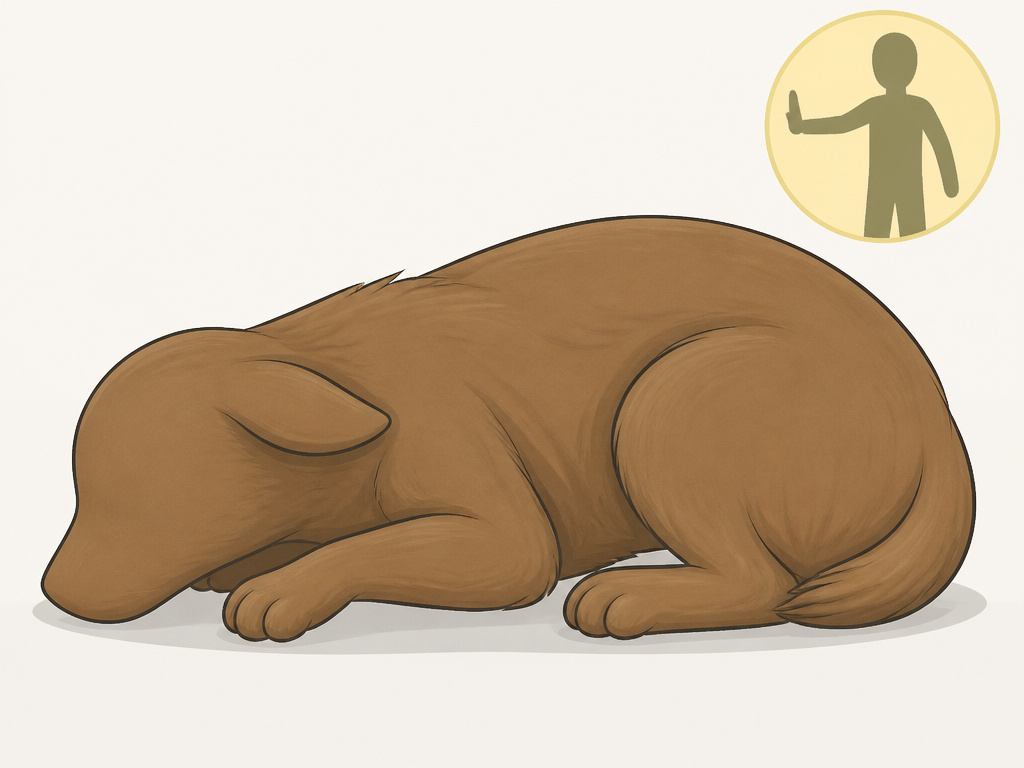
The dog flattens toward the ground, head low, tail tucked, and makes itself small. That shape carries one meaning across every source I looked at, and it isn’t play.
Horoszewicz and colleagues, in a peer-reviewed journal article on dog postures, name stances by the position of the dog’s back. That’s a cleaner system than a list of parts, because the back tells you the direction of the whole animal.
Tall, Low, and Ambivalent: The Three Back Positions
A tall posture communicates domination or self-confidence. A low stance means low self-confidence and fear, with the body contracted, the neck and head withdrawn, the legs slightly crouched, and the tail low or tucked. An ambivalent posture mixes confidence with visible uncertainty, which is what you see in a dog that can’t decide whether to approach or back off.
Dogs Trust puts the same idea in plain owner language. A dog leaning back with a tucked tail and ears back is a “we need space” signal. A dog crouched and growling with ears back and tail under is “we need space now.”
Those are two different messages and they deserve two different responses. The first one you can work with. The second one you back away from.
If you’re seeing several of these at once, the full list of signs of stress is worth having in your head before the next encounter.
Where the Sources Disagree on Posture
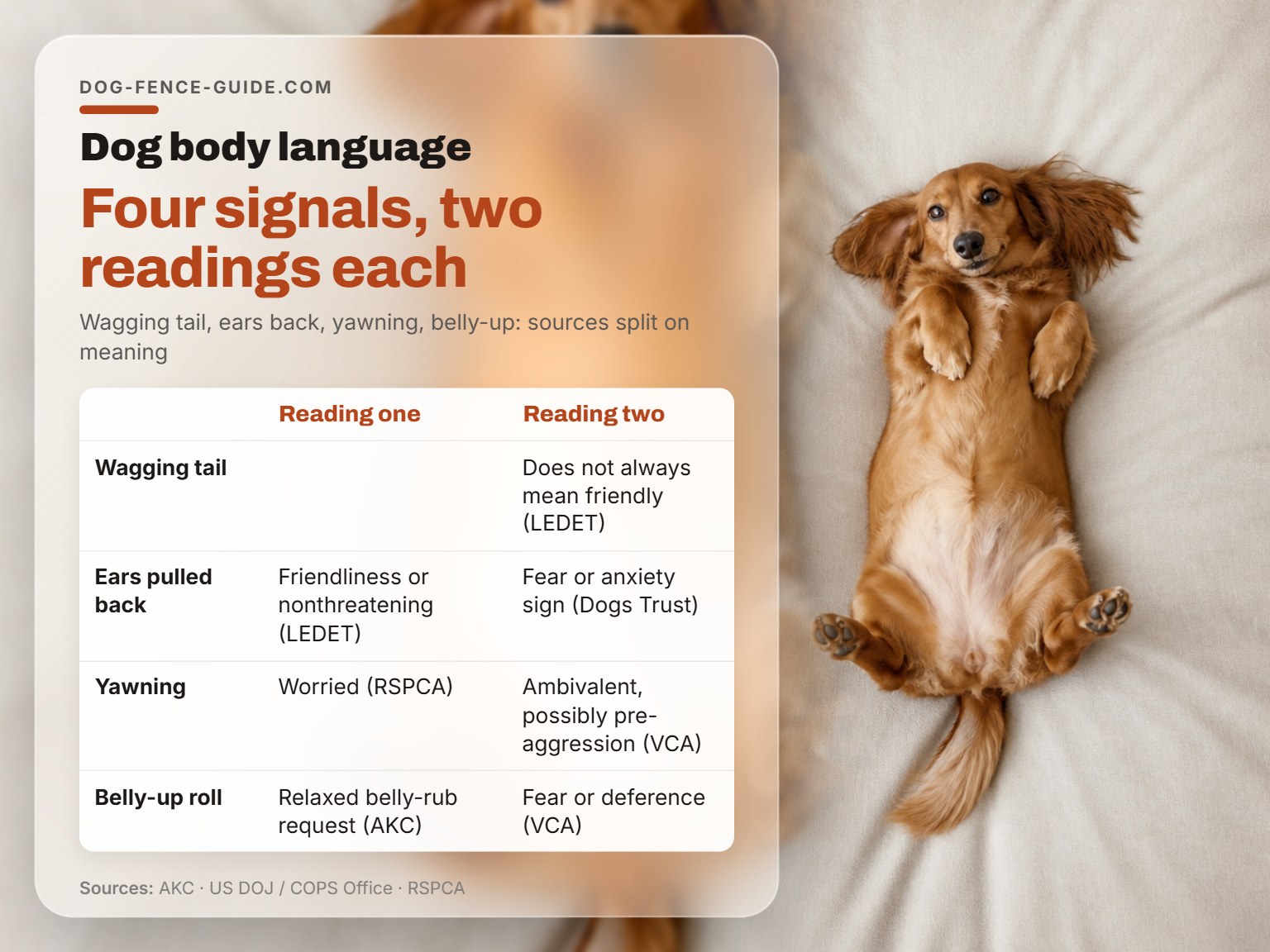
Four common signals carry two published meanings each, and the split isn’t a small one.
| Signal | Reading one | Reading two | What to do |
|---|---|---|---|
| Wagging tail | RSPCA lists it under happy, relaxed dogs | AKC and the DOJ guide treat it as arousal only | Check body stiffness before deciding |
| Ears pulled back | LEDET reads it as friendliness | RSPCA folds it into worried and angry | Look at whether ears are loose or flat |
| Yawning | RSPCA places it under worried dogs | VCA calls it ambivalent, possibly a pre-aggression signal | Watch for lip-licking and looking away |
| Belly-up roll | AKC allows for a relaxed belly-rub request | VCA warns it can be fear or deference | Check the rest of the body first |
None of these splits is a case of one source being sloppy. They’re writing for different readers: a welfare charity writing for pet owners, a veterinary hospital writing for clinicians, and a law enforcement guide writing for officers who have seconds to decide.
The AKC dog body language guide takes the arousal line and holds it throughout, which makes it the most internally consistent of the group.
So what does a dog’s posture mean when two good sources disagree? Take the safer reading. VCA warns a belly-up dog may be showing fear or deference, while AKC allows it may be soliciting a belly rub when relaxed, so give space until the rest of the body says otherwise.
Where this goes sideways: Praising a submissive roll as affection. VCA is explicit that rolling over can be fear or deference, and a dog that gets petted through a fear signal learns that the signal doesn’t work.
The Signals Owners Miss: Yawning, Lip-Licking, and Whale Eye
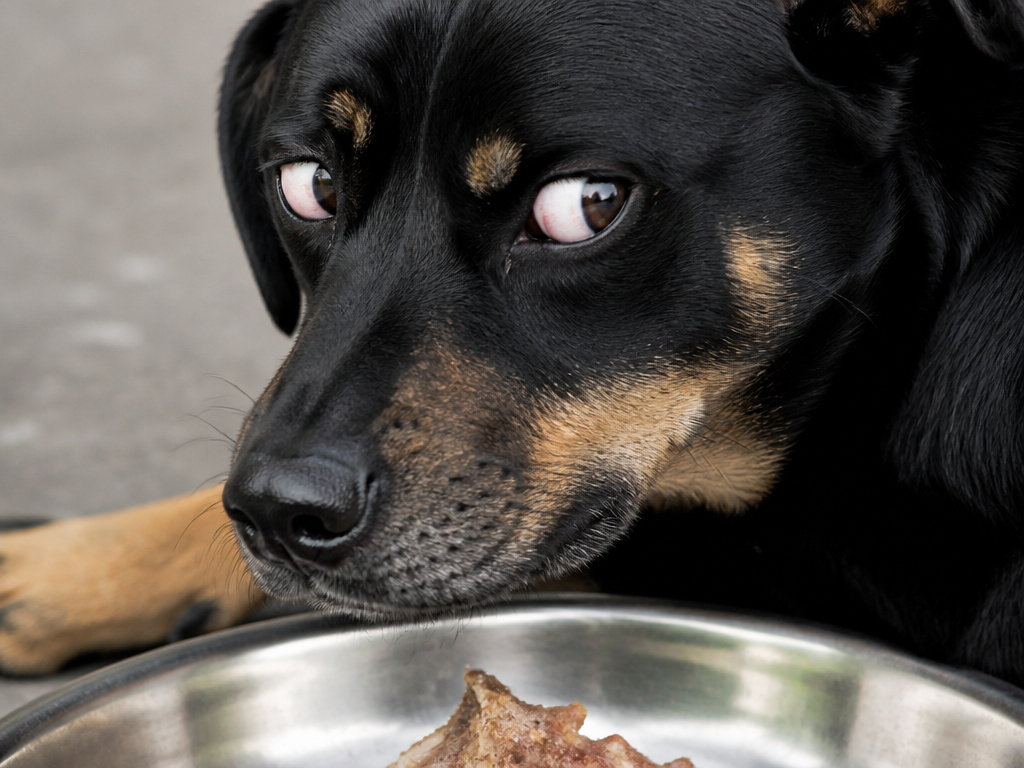
Whale eye is the one to take seriously. It’s the dog looking at you from the corners of its eyes with most of the whites showing, and the DOJ guide says it usually indicates an imminent act of aggression, particularly when the dog is guarding something or someone.
That’s a stronger claim than most pet guides make, and it’s worth sitting with. A dog guarding a food bowl, a stolen sock, or a sleeping child and showing whale eye is not being cute about it.
Whale Eye, and Why Guarding Changes It
The AKC lists whale eye among the common signs of stress, alongside a tucked tail, lip licking, yawning, avoiding eye contact, lowered body posture, trembling, and attempts to move away, while the DOJ guide reads whale eye during guarding as a sign of imminent aggression. Context is what separates a stress signal from a warning. Whale eye while backing away is one thing. Whale eye while standing over a bone is another.
VCA calls yawning and nose-licking “ambivalent behaviors,” meaning the dog is cautious, concerned, stressed, or anxious, with the potential to respond with aggression if the situation escalates. RSPCA files yawning under worried dogs, while VCA calls it ambivalent and Horoszewicz et al. List it among appeasement signals. Both are describing the same animal from different angles.
I film boundary training sessions and watch them back slowly, because the signals I miss live are the ones that happen in the pause before the dog moves. On video, the freeze is obvious: the mouth closes and the tail stops mid-sweep.
The whale eye look is the one I’d learn first if I were starting over. It’s the least dramatic signal on the list and the one that buys you the most time.
What Does a Dog’s Posture Mean at the Boundary Line?
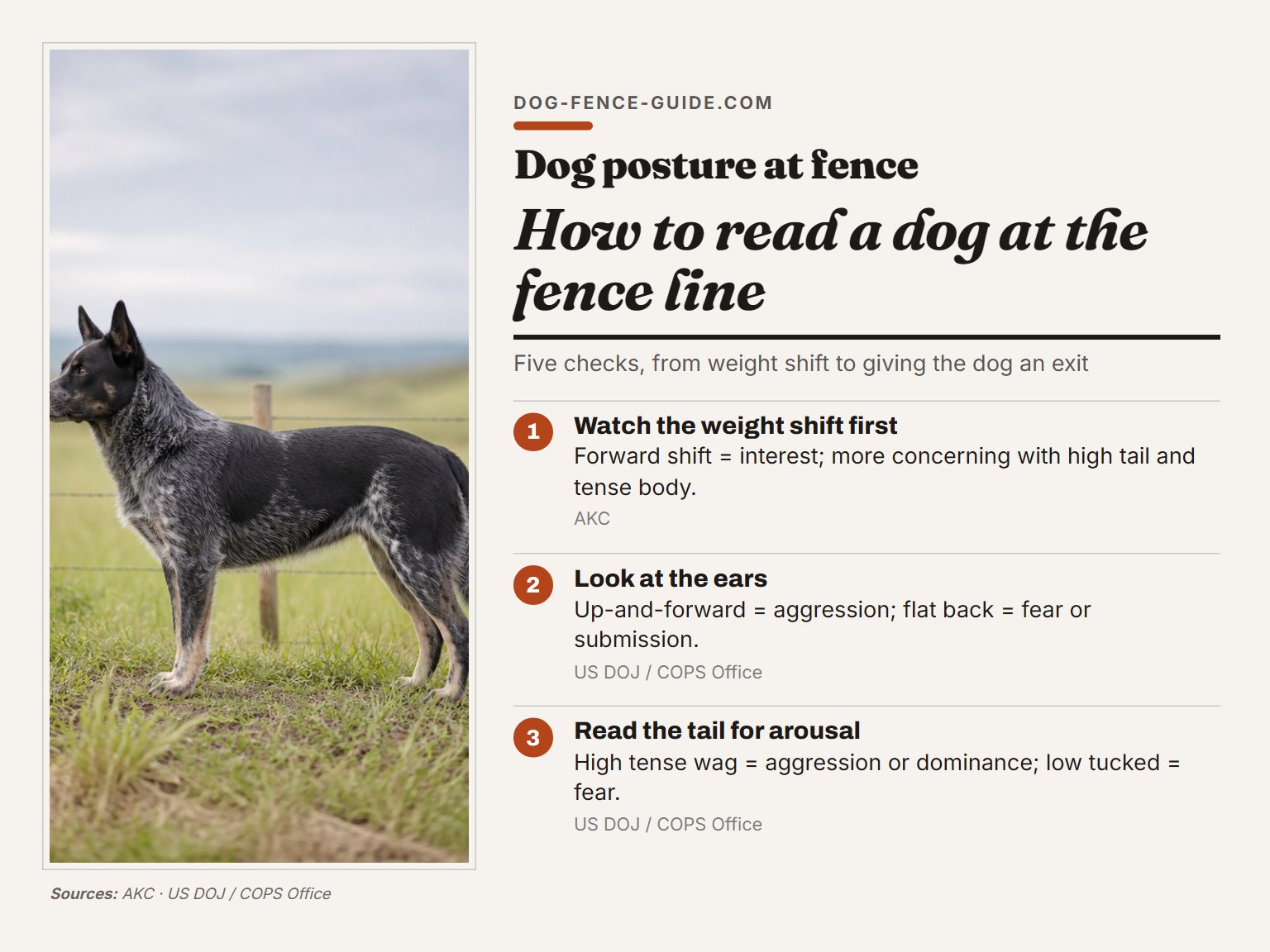
The fence line is where posture reading pays for itself, because that’s where a dog tells you whether it has learned the boundary or just learned to wait. A dog that stops at the boundary and looks back at you may have learned the boundary, though the AKC notes dogs may also look away as a calming signal when uncomfortable. A dog that stops and stares at the far side may have only learned to wait, and the AKC notes a prolonged hard stare is often a warning signal.
Here’s the sequence I run through, in order:
- Watch the weight shift first. The AKC reads a forward weight shift as increased interest that may be harmless curiosity or more assertive intent, becoming more concerning with a high tail and tense body. Skip this and you’ll correct a dog that was about to interrupt itself.
- Check the mouth. A mouth that closes on a dog that was panting a minute ago is a change worth noting, though the DOJ guide notes a closed mouth can also indicate submission. Miss it and the next signal you see will be the loud one.
- Look at the ears. The LEDET guide reads forward-and-up ears as aggression and flat-back ears as fear or submission, while the RSPCA folds ears back across worried and angry dogs.
- Read the tail for arousal, not for mood. The DOJ guide reads a high, tense wag as aggression or dominance and a low, tucked tail as fear, while the AKC treats wagging as emotional arousal that may be positive or negative. Getting this backwards is how people end up praising a dog that is winding up.
- Give the dog an exit before you add a correction. A dog with no way out of the situation has one option left, and it isn’t obedience.
A play bow at the boundary is often an invitation to play rather than a settled signal, as the AKC describes it. It means the dog is offering a social signal instead of making a decision.
The same goes for the submissive roll. VCA treats rolling over as one of the appeasement behaviors a dog offers to end a confrontation, while the AKC allows it may be soliciting a belly rub when relaxed, and the difference matters at a fence line where you’re trying to build a habit.
Filming the Dog Changes What You See
A GoPro on a fence post or a phone on a tripod catches the freeze your eye smooths over in real time. Watch it back at normal speed first, then again slowly, and write down the first signal you missed.
For a dog that keeps getting out, a GPS collar buys you recovery time, and a front-clip harness gives you better steering during the sessions themselves. Neither one teaches the boundary. That part is still you, standing in the yard, watching.
Frequently Asked Questions
Is a wagging tail always a sign of a happy dog?
No. The AKC describes a wagging tail as a sign of emotional arousal, which can be positive excitement or negative frustration and anxiety. The DOJ guide notes that aggressive dogs wag and friendly dogs sometimes don’t wag at all. Read the speed, the tail position, and the rest of the body together.
What does it mean when a dog’s ears are pinned flat back?
The LEDET guide treats ears flat against the head as a sign of fear or submission and warns that frightened dogs can act aggressively out of fear, while the RSPCA folds ears back across worried and angry dogs. That’s different from ears pulled back loosely, which the LEDET guide reads as an attempt to communicate friendliness, while the RSPCA does not draw that line.
Why do sources disagree about yawning in dogs?
RSPCA lists yawning under worried dogs, VCA calls yawning and nose-licking ambivalent behaviors that can indicate stress or a potential step toward aggression, and Horoszewicz et al. Horoszewicz et al. Also list yawning among appeasement signals. The behavior is real; the label depends on the framework.
Can I tell if a dog is aggressive from posture alone?
Not reliably. Horoszewicz et al. Describe aggressive signs as a stiffened, leaning-forward body with widely spaced paws and intense eye contact, most often shown before an attack, though the AKC cautions that no single signal tells the whole story. Those signals are meaningful in combination, and any single one on its own tells you less than the whole picture.
Does breed change how I should read posture?
Yes, in specific places. The AKC notes that neutral tail position varies by breed, with Chow Chows carrying their tails high over their backs and Italian Greyhounds sitting much lower, while the DOJ guide makes separate breed observations. The AKC notes that neutral tail position varies by breed, with Chow Chows carrying their tails high over their backs and Italian Greyhounds sitting much lower.
The Bottom Line
Here’s the trigger worth memorizing. When the mouth closes and the tail stops moving at the same moment, stop what you’re doing, though the DOJ guide notes a closed mouth can also indicate submission. That pairing shows up across the sources as a change worth noting, though the DOJ guide reads a closed mouth as possibly submissive.
One honest limit on all of this. I’m not a behaviorist, and nothing here diagnoses a dog. A dog that shows fear signals on every approach, in every context, needs a vet first and possibly a clinical animal behaviorist, which is the referral path the RSPCA lays out.
And the part that posture charts can’t fix: a dog that has been corrected into stillness can look identical to a trained one from across the yard, though the AKC cautions that no single signal tells the whole story. One way to tell them apart is to watch what the dog does when it thinks nobody is looking, though the AKC advises reading the whole body and context.
Three things to do this week. Film one boundary session, watch it back slowly, and write down the first signal you missed.
