
What Does a Wagging Tail Mean in Dogs? Read the Whole Body
This post contains affiliate links. As an Amazon Associate, we earn from qualifying purchases.
A wagging tail in dogs signals arousal, so what it means depends on three things: tail position, wag speed, and how much of the body joins in. A loose, full-body wag reads friendly. A stiff, high wag reads as a warning. Position and speed together carry the message.
Position and speed are only two of the signals in play. The same wag on a dog with a stiffened body, a closed mouth, and a hard stare lands very differently than it does on a loose, wiggling dog. Direction adds another layer, and it rarely makes it into the standard advice. What does a wagging tail mean in dogs depends on all of these cues together.
What follows covers the position chart, the speed question, the left-right finding, and the one wag where the sources genuinely disagree. By the end you’ll have a cluster of signals to check instead of a single sign to memorize.
Key Takeaways
- Position outranks speed. A high, stiff tail held over the back is the one to watch, no matter how fast it moves.
- Speed alone is contested. VCA notes fearful dogs wag fast and low, and so do excited dogs, with tail height separating them, while Adopt-a-Pet ties fast wags through a big arc to friendliness and slow wags with little movement to an absence of it.
- Direction differs. Dogs shown a left-biased wag had higher cardiac activity and higher anxiety scores than dogs shown a right-biased wag.
- A wag can mean willingness to interact. Karen B. London notes that can include fighting or biting, not just greeting, while VCA cautions a wagging tail does not necessarily mean the dog wants to interact or continue an interaction.
- Read the cluster. Ears, weight, mouth, and tail together tell you more than any single sign, though Karen B. London notes the more the wag encompasses the whole body, the friendlier the dog’s intentions.
Why a Wagging Tail Signals Arousal
The tail is wired to the limbic system, the part of the brain that handles emotion. From there, signals reach the muscles at the base of the tail and produce movement anyone nearby can read.
Tail wagging is a broadcast signal that carries more than one message. The behaviour is controlled by the limbic system, which routes emotional state to muscles at the base of the tail. Position encodes general mood, speed encodes intensity, and direction of swing carries additional information about the animal’s internal state.
Arousal covers the whole range. A dog can be aroused by a friend at the door, a squirrel on the fence line, a stranger leaning over the gate, or another dog squaring up. When you ask what does a wagging tail mean in dogs, the tail moves in all four cases.
Watch a dog greet someone it knows well and the whole rear end swings with the tail. Watch the same dog meet a stranger at the gate and the tail goes up, stiffens, and the swings get short and tight. Same body part. Different broadcast.
VCA Animal Hospitals states it plainly: “a dog with a wagging tail does not necessarily mean they want to interact or continue an interaction.”
Origins matter here too. Wolves wag less often than dogs, and dog puppies start wagging earlier than wolf pups. A 2024 paper in Biology Letters tail wag study proposed two competing explanations for why domestication produced the behaviour, and states both are untested. Nobody has settled it.
Dogs read each other through dog communication that includes far more than the tail. A play bow is a clearer invitation than any wag, because the front end drops while the rear stays up.
6 Tail Positions Worth Memorizing
Distinct tail positions appear in the peer-reviewed mapping published in Animals, each tied to a specific state or intention. Six of them cover almost everything you’ll see in a normal day.
| Tail position | What it suggests |
|---|---|
| Fast wag | Excited |
| Broad wag, wide swings pulling the hips | Happily greeting a special individual |
| Tail half lowered, slow wag | Insecure, unsure what to do next |
| Tail tucked between the hind legs | Fearful, anxious |
| Tail horizontal, stiff, pointing straight out | Initial challenge, might lead to aggression |
| Tail up, slightly curved over the back | Confident, feels in control |
Breed baseline matters before you apply a single row of that. Most dogs carry the tail near the heels when relaxed, but beagles hold theirs more vertically, greyhounds and whippets curl theirs under the belly, and Siberian huskies and Norwegian elkhounds curl over the back, which is why what does a wagging tail mean in dogs varies by breed.
Some breeds have no tail, or one curled so tightly that a wag barely registers. VCA notes this can impair communication between dogs, and between dogs and people.
A relaxed tail sits lower than horizontal and well off the legs, swinging in a lazy arc that moves the whole rear end. That’s the picture to hold in your head before you compare anything else.
The full PMC tail wagging data table is worth reading once, because it shows how specific the categories get.
Does Wag Speed Actually Tell You Anything?
Speed is contested on its own. VCA ties speed to intensity rather than mood, with tail height separating a happy fast wag from a worried one, while Adopt-a-Pet ties fast wags through a big arc to friendliness and slow wags with little movement to an absence of it.
- Fast wag, neutral or high tail. Eager for an interaction.
- Fast wag, low tail. VCA reads it as fearful, Carey as often nervous or submissive, and Adopt-a-Pet ties fast wags through a big arc to friendliness.
- Slow wag, neutral or slightly low tail. VCA reads it as tentative, the Animals table as insecure, Carey as uncertainty or submission, and Adopt-a-Pet notes it can in some cases signify aggressive tendencies.
- Rapid wag in the middle of a pause. VCA reads it as emotional conflict or discomfort, while Adopt-a-Pet ties fast big-arc wags to friendliness and Carey ties wide fast wags to excitement and happiness.
Karen B. London, a certified applied animal behaviorist, reads speed differently. She ties fast wags through a big arc to friendliness, and slow wags with little movement to an absence of it, while VCA notes fearful dogs may also wag rapidly and speed alone is unreliable.
Both readings can hold, because they describe different things. London is describing the whole gesture. VCA is describing the tail in isolation.
Here’s the practical version. VCA holds that a fast wag tells you the dog is aroused and doesn’t tell you what kind of aroused, while Adopt-a-Pet ties fast wags through a big arc to friendliness.
Does a Dog Wag More to the Left or the Right?
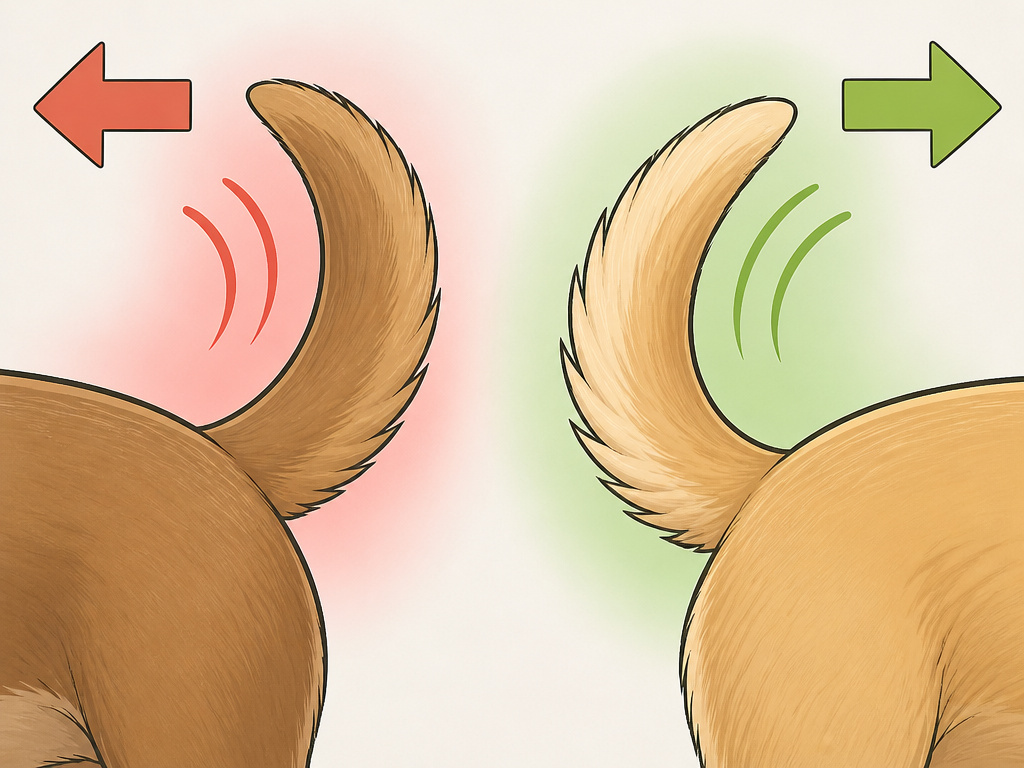
Siniscalchi and colleagues showed dogs video of another dog wagging with a left bias, a right bias, or no bias at all. Dogs watching the left-biased wag showed higher cardiac activity and higher anxiety scores than dogs watching the right-biased version.
The statistics were solid but not uniform. Left-wag versus the other stimuli came in at p < 0.01. Right-wag versus a static image and versus a no-wag stimulus both landed at p < 0.05. Left-wag versus the static stimulus came in at p = 0.062, which is not significant.
That last number is the one most write-ups skip. The effect is real and it’s also uneven.
VCA summarises the finding as right for happy or confident and left for frightened. Blue Cross goes softer, saying a slight right wag “research suggests” could indicate recognition. The left-right tail wag research is real in the primary literature and largely missing from clinical guidance.
Science magazine also covered the directional finding in tail wagging signals between dogs.
The Helicopter Wag: Where the Sources Disagree
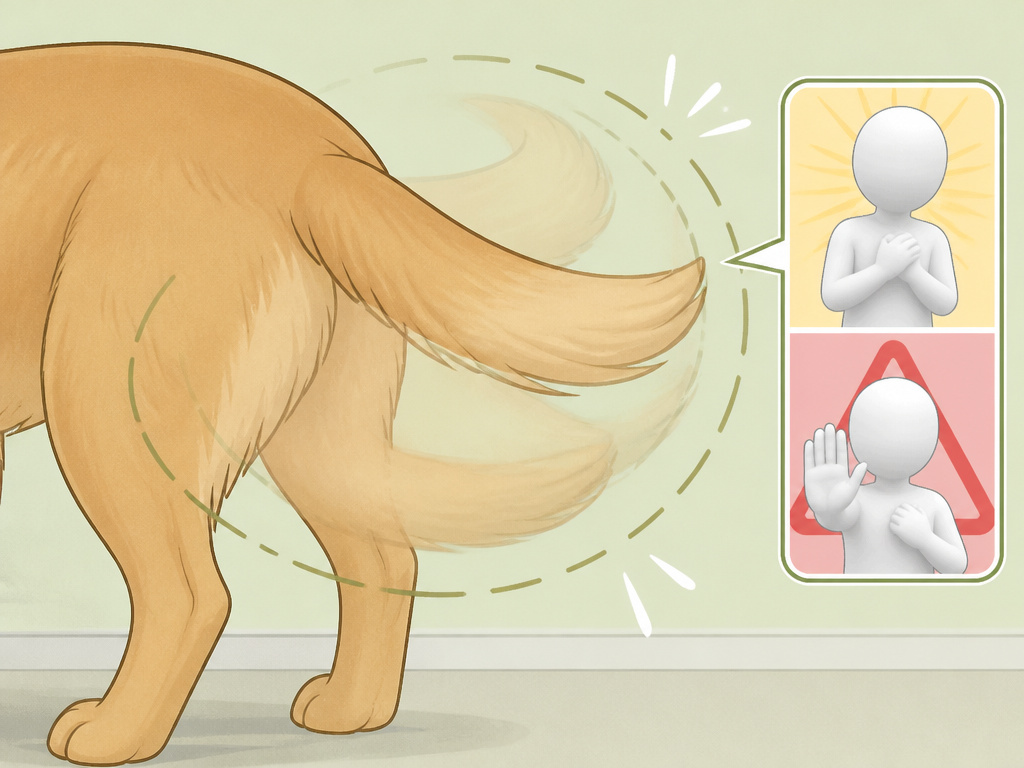
The circle wag gets called joy in one place and anxiety in another, and the peer-reviewed table doesn’t list it at all.
| Source | What it says about the circle or helicopter wag |
|---|---|
| Karen B. London, PhD (Adopt-a-Pet) | Strongly linked to a friendly mood; common when greeting a close friend after a long absence |
| Blue Cross (UK) | Usually reserved for known people and close dog friends; shows excitement and sociability |
| PetMD | Some dogs do it when anxious, aroused, or agitated; no single body part tells the whole story |
| Siniscalchi et al. 2018 (Animals) | The peer-reviewed table does not include a circle-wag category at all |
Three of those four sources are popular or clinical guidance. Only one is peer-reviewed, and it’s silent on the category. So the honest answer is that Adopt-a-Pet and Blue Cross tie a circle wag to friendly excitement and sociability, while PetMD notes some dogs do it when anxious, aroused, or agitated, and the peer-reviewed table doesn’t list the category at all.
Treat the helicopter wag as a good sign from a dog you know, and as one data point among many from a dog you don’t.
How to Read the Whole Dog in Three Checks
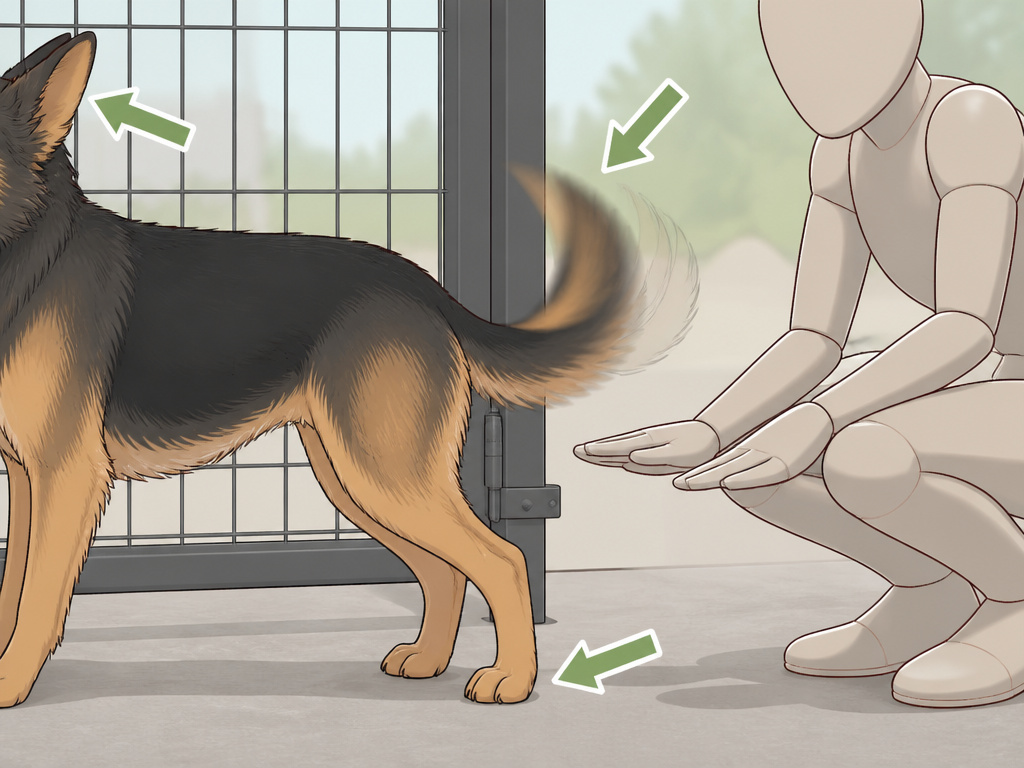
A dog stands at the gate with its tail going and its weight shifted back. The tail says one thing. The weight says another. The weight can be the more honest signal, though Karen B. London notes the more the wag encompasses the whole body, the friendlier the dog’s intentions.
Before you start: Keep your weight on your back foot and your hands low. A dog that stiffens mid-wag can escalate to a snap without much warning, and reaching over its head closes the escape route, though Blue Cross notes a high fast wag often indicates arousal and excitement depending on breed, personality, body, and activity. Ask the owner before you touch any dog you don’t live with.
Turid Rugaas’s work on calming signals is the standard starting point, and Lili Chin’s Doggie Language is the clearest visual version of it. Both are better used as context than as a checklist. The Dog Decoder app is fine for learning the shapes, but it can’t tell you what’s happening in the specific dog in front of you.
Ear Set
Ears forward and relaxed suggest attention. Ears pinned flat and back suggest fear or submission. The dog ear positions that matter most are the ones that change fast.
Weight Shift
Where the dog’s weight sits tells you which way it wants to go. Leaning toward you is engagement. Leaning away, or freezing with the feet planted, is a dog that wants distance. Dog posture reads more honestly than the tail because it’s harder to fake.
Muzzle and Mouth
A closed, tight mouth on a panting day is worth noting. So is a tongue flick, a yawn out of context, or the whites of the eyes showing. Those are the dog stress signs that show up before the tail changes.
I’d skip the single-sign chart entirely and teach the cluster first. Owners who learn position, weight, and mouth together read a dog faster than owners who memorize twelve tail entries and then freeze at the gate.
Put it together in this order:
- Start at the head. Ears and mouth set the baseline before anything else.
- Check the weight. Toward you, away from you, or frozen in place.
- Read the tail last. Position first, then speed, then direction.
- Compare to the breed. A greyhound’s neutral is not a beagle’s neutral.
The full dog body language picture includes the face, the tail, and the weight together. Any one of them alone is a guess.
When to Stop and Give Space
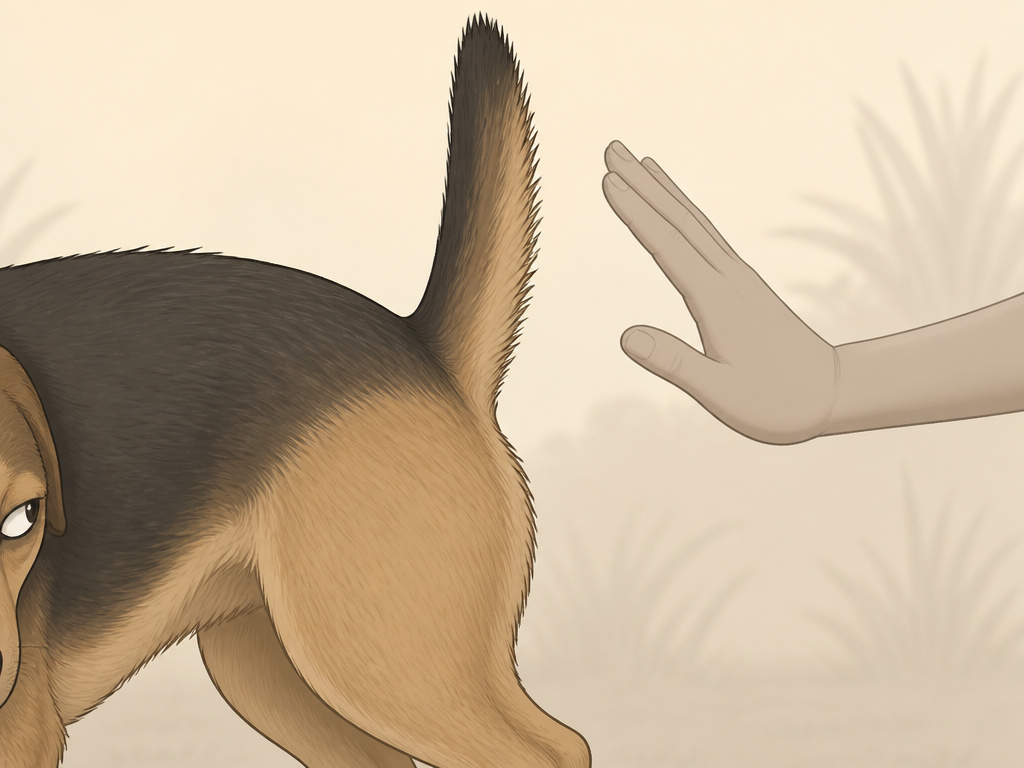
Stop.
A tail that was swinging and then goes still, held stiff, is the dog asking for a break. VCA calls it a pause, and notes it’s common when strangers pet a dog.
Blue Cross is blunter: if a dog shows worried or fearful tail behaviour, stop what you’re doing and give them space.
- Tail goes still and stiff. A pause signal.
- Tail tucked and clamped. Fear, self-protection.
- Whale eye with a closed mouth. Stress.
- A growl, even a quiet one. Distance requested.
Common mistake: Reading a stiff, high wag as excitement. VCA reads a tail held taut and vertical, arching over the back, as an assertive posture that can progress to aggression, while Blue Cross notes a high tail wagging fast often indicates arousal and excitement depending on breed, personality, body, and activity.
Where this goes sideways: Watching only the tail. A dog can wag while giving whale eye, lip licking, and a closed mouth, and the face can tell you more than the tail, though Karen B. London notes the more the wag encompasses the whole body, the friendlier the dog’s intentions.
A scared dog and a dog growling both need distance, not reassurance from a stranger, though PetMD notes a neutral-position moderate-speed wag with loose bouncy body language is a sign you can approach. Give the space first and sort out the meaning later.
Frequently Asked Questions
Does a wagging tail always mean a dog is happy?
No. Karen B. London frames a wag as meaning the dog is willing to interact, which can include fighting, biting, and threatening as well as greeting and playing, while VCA cautions a wagging tail does not necessarily mean the dog wants to interact or continue an interaction. The wag tells you contact is on the table. It doesn’t tell you which kind.
Why do dogs wag their tails when they see me?
Often because you’re a known person and the dog is excited. Blue Cross ties the circular helicopter wag specifically to people the dog knows and close dog friends, though PetMD notes some dogs do it when anxious, aroused, or agitated. Blue Cross says a slight right-side wag ‘research suggests’ could indicate recognition, though this asymmetry is not part of standard clinical guidance. Context and the rest of the body still decide the read.
Is a fast wag always friendly?
No. VCA notes that fearful dogs also wag rapidly, typically with the tail held low, and that dogs in emotional conflict may wag fast as a discomfort signal, while Adopt-a-Pet ties fast wags through a big arc to friendliness.
What does it mean when a dog’s tail goes still?
It’s usually a request to pause or end the interaction. VCA describes a dog holding its tail and body stiff as an attempt to discontinue contact, and notes many dogs do this when petted by strangers. Stop and give space.
Do docked breeds communicate differently?
Yes, and it’s a real disadvantage. Blue Cross notes that docking makes it harder for owners to read the dog and for other dogs to understand it, especially when the tail is docked close to the body. Carey Animal Hospital names Dobermans and Boxers as breeds where you should read the whole posture instead.
The Bottom Line
Video your own dog at the vet or the groomer, and you’ll catch stress signals you missed in real time. That’s the one habit I’d hand any owner before a single tail chart, because the video doesn’t care what you expected to see.
This all assumes a tail you can actually see. For a docked breed like a Doberman or a Boxer, the tail read drops to a fraction of its value and you’re working with ears, weight, and mouth alone.
And the honest limit: no chart replaces knowing the individual dog. A dog that always wags like a metronome at the door is telling you something different than a dog that never does.
