
Unique Dog Names: How to Pick One That Sticks
This post contains affiliate links. As an Amazon Associate, we earn from qualifying purchases.
Unique dog names work best when they’re short, clear, and nothing like a command. The Seeing Eye keeps its guide-dog names to one or two syllables, and the American Kennel Club recommends two-syllable names like Josie or Percy. The Seeing Eye flags both “sit” and “no” collisions, while the AKC gives only the “Kit”/”Sit” example.
The two institutions don’t actually agree on the number. The Seeing Eye allows one or two syllables and occasionally three, while the AKC lands squarely on two. That gap matters more than it sounds, because a name you can’t holler across a yard is a name your dog won’t reliably learn.
What follows is the working method: how syllables and sound shape recall, why command collisions break training, and how the oldest guide-dog school in the world names roughly 500 puppies a year without repeating itself.
Key Takeaways
- The authorities split on syllables. The Seeing Eye keeps names to one or two syllables (occasionally three), while the AKC recommends two-syllable names like Josie or Percy.
- Test the name against your command list. “Kit” sounds like “sit” and “Mo” sounds like “no,” and both confuse a dog mid-training.
- Wait if you can. The AKC suggests meeting the dog’s personality first; The Seeing Eye names puppies at two weeks because it has to.
- Say it out loud in public. If you’d be embarrassed shouting it across a park, the name fails that test.
- Distinctiveness earns its keep in a crowd. A name nobody else at the dog park uses cuts through the noise.
What Makes a Dog Name Work When You’re Calling Across a Yard?
A name has to survive distance. That’s the test most naming lists skip, and it’s the one that decides whether the name is useful or just decorative.
A working dog name carries three jobs: identify the animal, survive distance and wind, and stay distinct from every cue in the training vocabulary. The failures land on the second or third job. Short vowel sounds travel farther than sibilants, and a name sharing a phoneme with a command competes with that command on every repetition.
Think about the last time you called a dog in from the back of a yard. You probably didn’t say the name once. You said it two or three times, with rising volume, while the dog weighed a squirrel against your voice.
A name with a hard consonant at the front, like Buck, Cass, or Duke, cuts through wind and traffic. A name that opens soft, like Sasha or Theo, dissolves into background noise before it reaches the back fence. That’s not a preference thing. It’s how sound carries.
So a working name needs a few things at once:
- One or two syllables, one clear vowel. Easy to repeat without tripping over the sound.
- A consonant that carries. Hard sounds project; soft ones fade at the property line.
- No overlap with sit, stay, come, down, no, or heel. This one matters.
- Short.
The rest of the choosing a dog name decision follows the same logic: the sound has to work before the meaning matters. Which is why “Princess Buttercup” fails and “Duke” works.
How Many Syllables Should Unique Dog Names Have?
The two biggest naming authorities don’t agree, and the disagreement is worth knowing before you pick.
The Seeing Eye’s rule is the looser one: one or two syllables, with an occasional three-syllable exception. The AKC is narrower and lands on two, naming Josie and Percy as models for varying stress and intonation when you speak to the dog.
| Question | The Seeing Eye | American Kennel Club |
|---|---|---|
| How many syllables? | One or two, occasionally three | Two, like Josie or Percy |
| When does naming happen? | At two weeks old | After personality shows |
| Which command clashes? | Mo/No and Kit/Sit | Kit/Sit |
Neither body cites the other, and neither is wrong. The Seeing Eye is naming hundreds of puppies on a schedule and needs names that work for a handler it hasn’t met yet. The AKC is talking to an owner who can afford to wait and watch.
I’d take the two-syllable rule over the one-syllable option every time. A single syllable gets swallowed by wind and distance, and you end up repeating it while the dog stares at a squirrel. Two syllables give you a rhythm to shout.
If you want to see what most people actually land on, the popular dog names list is a useful reality check. Most of them are two syllables. That’s not an accident.
Why a Name That Sounds Like a Command Confuses Your Dog
Say “Kit” and “Sit” out loud, back to back. They’re close enough that a dog in the middle of training has to guess which one you meant.
The Kit and Sit Problem
Both sources flag this one. The AKC uses it as its sole command-collision example. The Seeing Eye uses it too, and the reasoning is the same on both sides: a name that shares a sound with a cue competes with that cue every time the dog hears it.
The fix is simple. Cross the name off the list and pick another.
The Mo and No Problem
The Seeing Eye adds a second example the AKC doesn’t mention: “Mo” can sound like “No.” That one is sneakier, because “no” is the correction word most owners use a hundred times a week without thinking about it. A dog named Mo spends his first year hearing his own name used as a reprimand.
Common mistake: Picking a name before you’ve written down your command list. You find out about the collision on day three, when the dog sits every time you call him.
The broader point holds for any name you’re considering. Write out every cue you plan to use, then read the shortlist against it. If a name shares a vowel or a leading consonant with a command, it goes.
How The Seeing Eye Names 500 Puppies Every Year
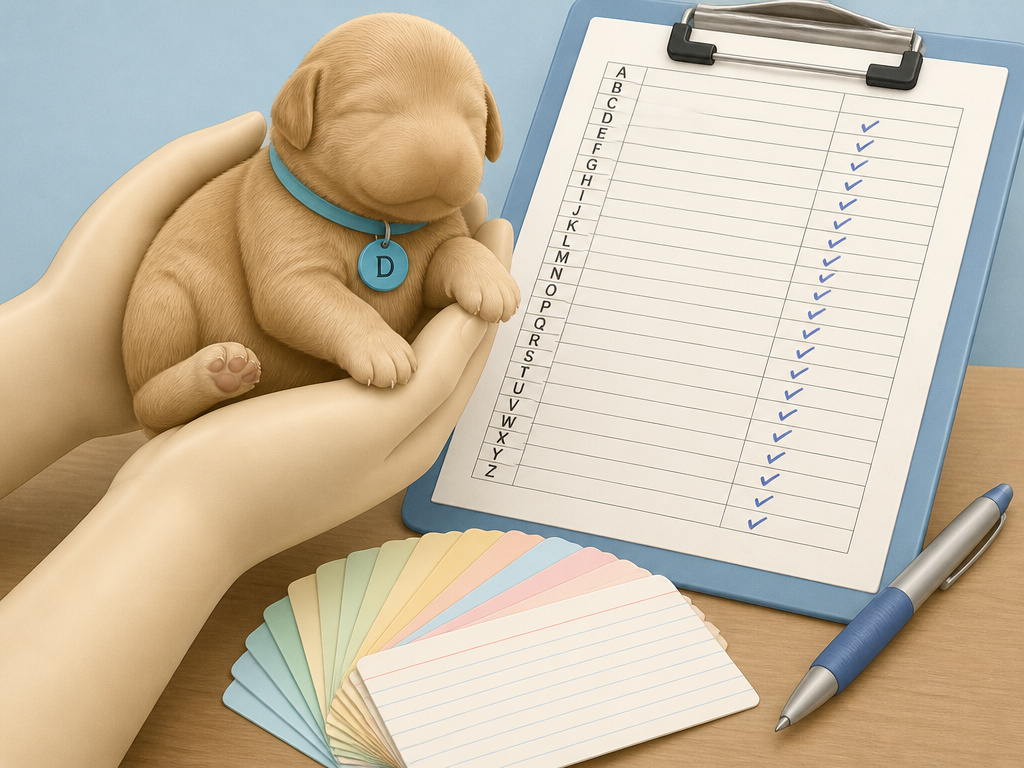
Around 500 puppies a year get a name from The Seeing Eye, which works out to roughly 42 names a month. That volume is why the school built a system instead of relying on inspiration.
The school is the oldest guide dog training school in the world. Its Puppy Development Manager, Christine Higham, generates and assigns every one of those names. The method runs like this:
- Wait until the puppy is two weeks old. Naming earlier gains nothing, because the puppy can’t respond to the sound yet.
- Give every puppy in the litter the same starting letter. Skip this and the school’s records stop matching the litters they describe.
- Move one letter forward for the next litter. A on October 1, the start of the fiscal year, then B, then C. Miss a step and the reset lands on the wrong letter.
- Restart at A when the alphabet runs out. With 65 to 70 litters a year, the school cycles through the whole alphabet a couple of times annually.
- Get creative at X and Z. Those letters have thin name pools, and Higham has to work harder to fill a litter.
Two details in that system are worth stealing. The first is the discipline of a fixed structure. The second is that many of the names are chosen by Seeing Eye donors, which means the naming manager doesn’t always get the final word.
If you’d be embarrassed shouting the name in a public space, the dog will hear that hesitation every time you call. Pick something you’d yell without flinching.
There’s a piece of institutional history attached to this, and it explains why you’ll never meet a Seeing Eye dog named Buddy again. The first Seeing Eye dog was a German shepherd named Kiss. Morris Frank, a 19-year-old college student, renamed her Buddy. After Frank died in 1980, the school retired the name in her honor.
The full method is laid out in The Seeing Eye dog naming tips, and it’s worth reading in the original. Federal working dogs follow an entirely separate set of procedures, documented in the 2023 National Canine Unit Manual, which has nothing to do with what you’d name a pet.
One more wrinkle for anyone running a working dog: the Garmin Alpha 200 Plus requires the dog’s name to be typed in on the handheld’s on-screen keyboard. Whatever you pick has to survive being entered one letter at a time in the field.
For most owners the takeaway is lighter. If you want a starting point that isn’t a top-ten list, the cute dog names collection has more range than the usual retreads.
Where Do You Find Unique Dog Names That Aren’t Just Strange?
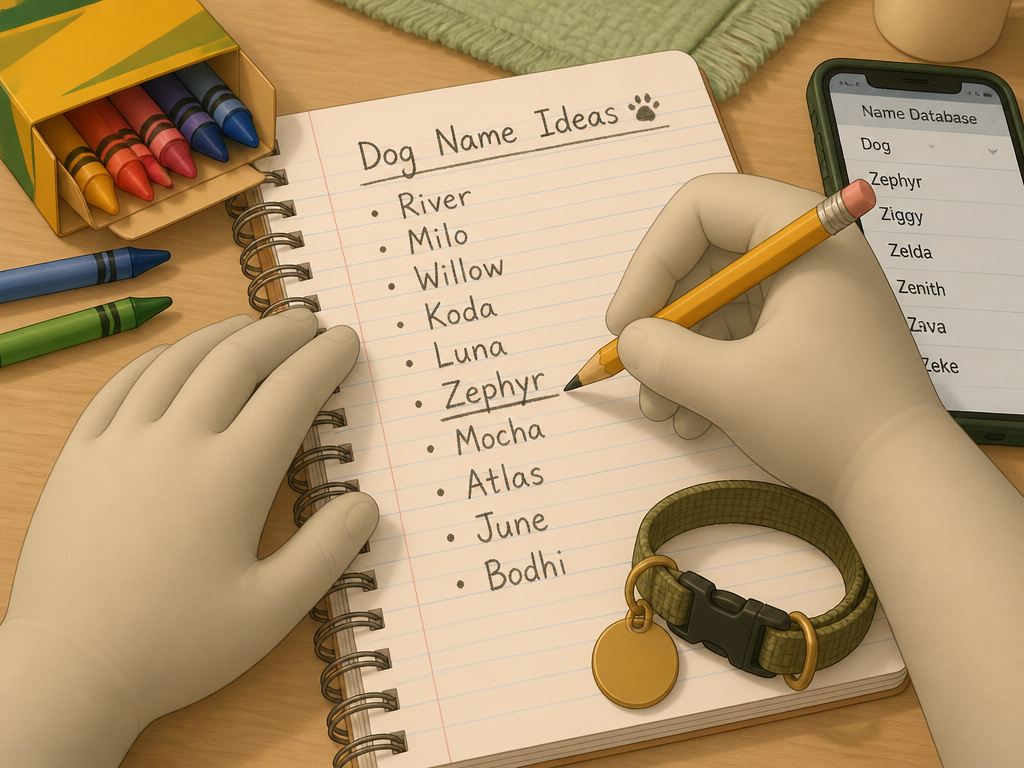
Rover’s own name database is a place to start, and their method is more practical than most. They drew their unique picks from names in the top 1,100 of their name database, which means the suggestions are unusual without being unpronounceable.
Mine Your Own Life First
The AKC suggests taking your interests into account to add a personal touch. Rover goes further and gets specific about where to look. Reading through baby name lists is a solid starting place, though Rover suggests checking with relatives before you borrow a family name.
Other angles from the same source:
- A favorite food. A dish that means something to you beats a random noun.
- Secondary characters. Skip the main character everyone else names their dog after and raid the supporting cast instead.
- A box of crayons. There are more color words than Red, Sable, and Snowy, and the crayon labels are a goldmine.
- Your roots. A word from your family’s language, or from the breed’s country of origin, reads as inspired rather than random.
Steal the Secondary Characters
Rover names Zephyr and Nimbus as examples of names you’re less likely to run into at doggie daycare. That’s the real test of uniqueness, and it has nothing to do with how exotic the name looks on paper.
Easy to miss: A name borrowed from a relative without asking. Rover suggests checking first, and the awkwardness outlasts the name.
The AKC’s list has its own anchor points if you want something recognizable. Max sits at the top of its boy dog names, and Luna is a perennial favorite for girl dogs. Neither is unique. Both are easy to shout, which is why they persist.
If you’re narrowing by sex, the girl dog names and boy dog names lists are organized that way. The American Kennel Club naming advice covers the same ground from the registry side, including its two-syllable recommendation and its warning about command collisions.
Do Unique Dog Names Actually Help at the Dog Park?
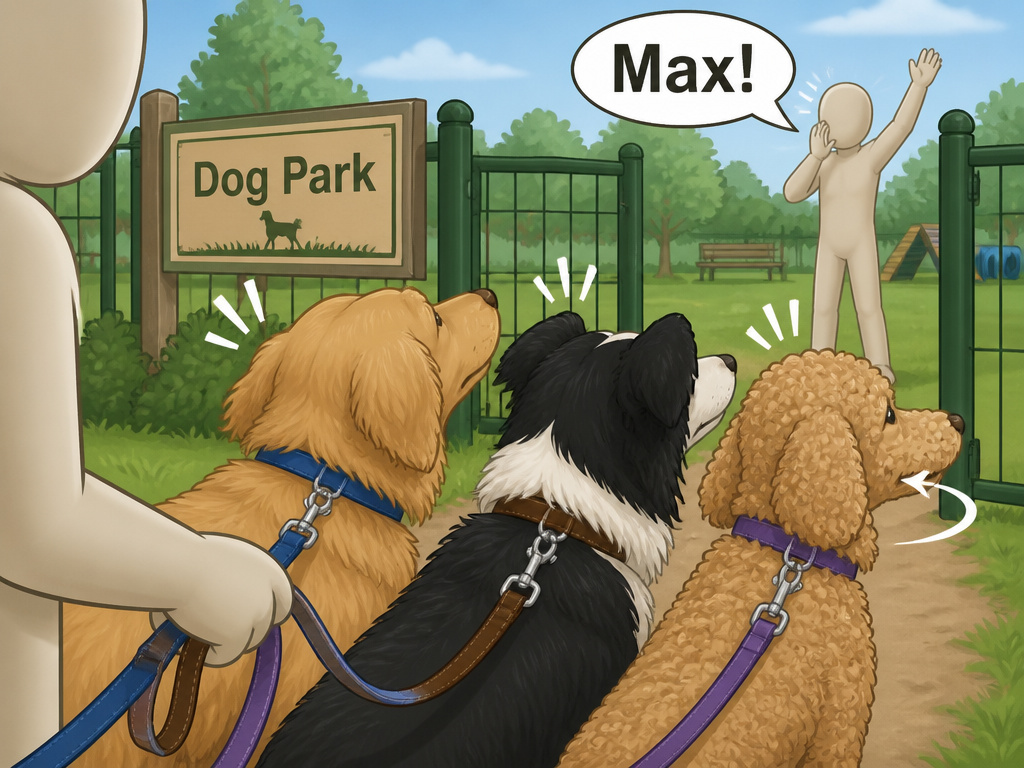
A distinctive name earns its keep in a crowd. The AKC makes this point directly: a unique name helps prevent confusion when you’re getting your dog’s attention at a dog park or a training class where other pets are around.
Stand at the gate of any busy park on a Saturday and listen. You’ll hear “Max” three times inside a minute, and three different dogs will look up.
That’s the practical case for uniqueness, and it has nothing to do with style. A name that four other dogs answer to is a name that stops working the moment you leave your own yard.
| Symptom | Likely cause | Fix |
|---|---|---|
| Dog ignores the name outdoors | Name too soft or too long | Switch to two syllables with a hard consonant |
| Dog sits when you call the name | Name rhymes with a command | Rename, or change the command word |
| Dog looks up at every dog in the park | Name too common | Add a distinct second syllable |
If you’re proofing a recall in a crowded park, a high-value treat gives the dog a reason to check in with you instead of the Labrador three gates down. That’s the whole trick. Pay the name, every time.
Small dogs and large dogs run into different versions of this. The small dog names list leans toward names that carry, and the large dog names list leans toward names that don’t sound like a correction.
Renaming a Rescue Dog Without Confusing Him
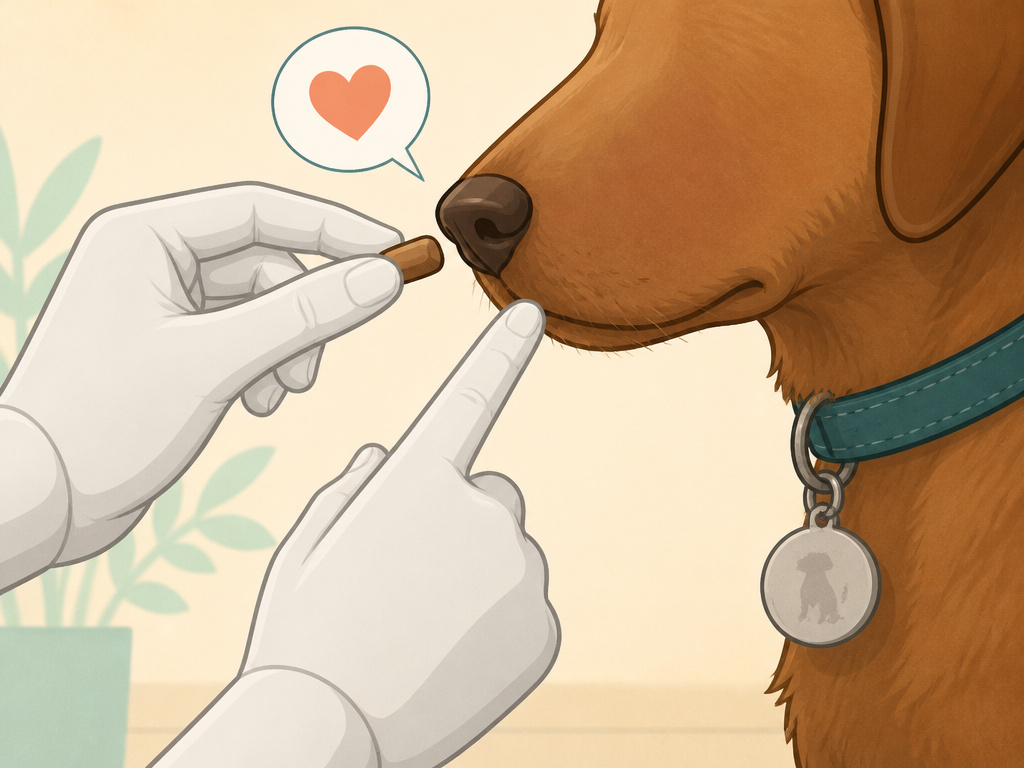
An adult rescue usually arrives with a name already attached, and the question is whether to keep it. There’s no rule that says you have to.
What matters is the transition. A dog who has heard one sound for three years doesn’t swap it overnight, and dropping the old name cold on day one is how you get a dog who stops coming when called.
Where this goes sideways: Retiring the old name immediately. The dog hears a stranger’s word and stops responding, usually inside the first week.
The workaround is to run both names in parallel for a few weeks. Say the new name, then the old one, then reward. Pair the new sound with a high-value treat so it predicts something good rather than something confusing. The old name fades on its own once the new one carries the same weight.
The full sequence is covered in renaming a rescue dog, including how long the overlap usually takes.
Fair warning: a rescue with a strong negative association to his old name is a different problem. That’s a behavior question, not a naming one, and it belongs with a trainer.
Frequently Asked Questions
Should a dog name be one syllable or two?
Two is the safer choice. The AKC recommends two-syllable names specifically because they let you vary stress and intonation when you speak. The Seeing Eye permits one or two, with occasional three-syllable exceptions, so a single syllable isn’t disqualifying. It just gives you less to work with at a distance.
When should you name a puppy?
The AKC suggests waiting until you get a sense of the dog’s personality rather than naming immediately. The Seeing Eye names puppies at two weeks old, before personality is observable, because it has to assign names at scale. An owner with one dog can afford to wait a few days.
Can you rename an adult dog?
Yes. Run the old name and the new one together for several weeks, pairing the new sound with a reward each time. Dropping the old name on day one tends to produce a dog who stops responding for a while. The overlap is what makes the switch stick.
What makes a dog name unique without being weird?
Rover drew its unusual picks from the top 1,100 names in its database, which is a useful filter. The test isn’t how strange the name looks on paper. It’s whether you’d run into another dog with the same name at daycare.
Do dogs learn short names faster?
The Seeing Eye’s stated reason for short names is that they’re easier to say and make for faster communication when paired with a command. That’s the practical argument. A name you can say cleanly in one breath, mid-command, works better than one you have to wind up for.
The Bottom Line
Before you commit to a name, write down every command you plan to use. Sit, stay, come, down, no, heel, leave it. Then read your shortlist out loud against that list. Any name that shares a vowel or a leading consonant with a command gets crossed off, no matter how much you like it.
I’d rather see a plain two-syllable name that works across a yard than a clever one nobody can shout. Uniqueness is worth having, but it’s the second priority. The first is that the dog actually turns around when you say it.
Here’s the concession. If you’re adopting an adult rescue with a name already attached, none of this applies the same way. You’re not choosing a name, you’re negotiating one, and the timeline runs in weeks rather than minutes.
Start with your dog, not the name list. A name that fits the animal in front of you will beat a name that fits a website every time.
