
Dog Names for Large Breeds: What the AKC Allows
This post contains affiliate links. As an Amazon Associate, we earn from qualifying purchases.
Dog names for large breeds work best at one or two syllables, ending in a vowel, and clear enough to shout across a yard. The AKC caps a registered name at 50 characters and adds a surcharge above 36, but the call name is the one your dog actually learns.
That split between the paperwork name and the dog names for large breeds question is the whole decision. A registered name can run to 50 characters and cost extra past 36. The name you’ll use at six in the morning in the rain gets about two syllables.
What follows is what the AKC actually enforces, where the naming sources contradict each other, and a short test you can run from the far corner of your yard before the name becomes permanent.
Key Takeaways
- One or two syllables ending in a vowel is where the AKC, most trainers, and the guide-dog schools all land, even when they disagree about why.
- 50 characters is the hard ceiling on an AKC registered name, and anything past 36 triggers a surcharge. Spaces count.
- Test it outdoors before you commit. A name that sounds fine in the kitchen can disappear at the far end of a yard.
- Command collisions matter less than you’ve been told. The AKC warns about them on one page and questions the premise on another.
- You get one shot at a name change, and only if the dog was whelped in the US and hasn’t produced a litter or won an award at an AKC event.
What the AKC Actually Checks Before It Approves a Name
The AKC’s name checker runs on rules, not taste. The person who owns the dog when the registration application goes in has the right to name it, and after that the application gets screened against a fixed list of limits.
Length is the first screen. So is the alphabet. So is a short list of words the registry simply won’t print.
An AKC registered name is limited to 50 characters, including spaces, apostrophes, and hyphens. Names exceeding 36 characters carry a surcharge. Only the standard English alphabet is accepted, diacritical marks are not printed on certificates, and roman numerals at the end of a name are prohibited because the AKC assigns them.
| Rule | What It Means in Practice |
|---|---|
| 50-character cap | Spaces, apostrophes, and hyphens all count toward it |
| Surcharge above 36 characters | A long name costs more to register than a short one |
| 37 dogs per breed | The same name can repeat 37 times within a breed |
| Roman numerals banned at the end | The AKC assigns those itself for identification |
| Standard English alphabet only | Accents and umlauts vanish on the printed certificate |
| Kennel name needs owner permission | A breeder can’t reuse a registered prefix freely |
None of this changes with the size of the dog. The large breed dogs on your shortlist face the same 50-character ceiling as a Chihuahua, and an imported dog has to be registered under the same name it carried in its country of birth, with the one exception of an added Registered Kennel Name.
The Words the AKC Strikes Out
The prohibited list is longer than most people expect, and it isn’t just about obscenity:
- Titles and show terms. “Champion,” “champ,” “sieger,” and any AKC title or show term are out.
- Body and breeding words. “Male,” “stud,” “sire,” “bitch,” “dam,” “female,” and “kennel(s)” all get rejected.
- Breed names standing alone. You can’t register a Great Dane as simply “Great Dane.”
- Obscenities and derogatory terms, obviously.
Easy to miss: A registered kennel name can’t appear in your dog’s name unless the owner of that kennel name authorizes it in writing. Breeders who reuse a familiar prefix without permission get the application bounced, and sorting it out costs you a phone call and a delay you didn’t plan for.
Why the Name on the Certificate Is Not the Name You’ll Shout
Ramblin’ Red Slamdunk Buckpasser took second in the Sporting Group at the 2023 AKC National Championship. Somebody at ringside almost certainly called him Red.
That’s the distinction the AKC draws between a registered name and a call name. The registered name is a filing label. The call name is the short, easy one the dog hears a thousand times a week.
Here is the part that surprises people. When the certificate comes back, every letter is capitalized, and any accent grave, accent acute, or umlaut you typed into the original name is simply not printed. If the spelling matters to your family, spell it in plain English from the start.
The tag matters as much as the name. A metal tag on a collar can ring against the buckle every time the dog shakes, while a silicone tag lands quietly on a hardwood floor.
I’d rather see a plain name on a good tag than a clever name on a tag that’s worn smooth. The name is for the dog. The tag is for the stranger who finds him at the end of the street.
For most households the practical answer is an engraved tag with lettering that doesn’t rub off after a year of fence-line scraping. If your dog wears tags on a working collar, silicone tags stay quiet and don’t snag. A QR tag adds a scannable profile on top of the stamped name, which is worth the extra step if your dog travels. Whichever you pick, check the dog tags against the collar width before you order.
Dog Names for Large Breeds: How Many Syllables Is Right?
Three separate organizations answer this question, and the numbers don’t line up exactly.
The AKC recommends a name of one or two syllables ending in a vowel, and gives “Sadie” and “Rocky” as examples. A second AKC piece makes the case for two syllables specifically, because two beats let you vary stress and intonation, and cites fMRI brain scan research showing dogs use the way we say words to understand meaning.
The Seeing Eye, which names around 500 puppies a year, about 42 names a month, keeps to one or two syllables and only occasionally selects a three-syllable name. Shorter names, in their reasoning, pair faster with a command.
Lemonade’s pet-insurance data lands in the same place with a caveat: dogs typically respond best to one- or two-syllable names, but a longer name is fine if you pair it with a nickname for everyday use.
- The AKC: one or two syllables, ending in a vowel, so you can bend your tone.
- The Seeing Eye: one or two, occasionally three, because speed of communication matters more than charm.
- Lemonade: one or two preferred, longer is workable with a nickname.
Stand at the far corner of your yard and say the name out loud. A vowel ending like “Daisy” arrives intact. A hard stop gets swallowed by wind and distance, and you’ll be repeating yourself while the dog looks at you.
That’s the practical case for the vowel ending, and it’s the one piece of naming advice that survives every dataset. A large dog collar with a metal buckle and a jingling tag gives you one more sound to cut through, which is why the vowel matters more on a big dog than a small one.
Does a Name That Sounds Like a Command Really Confuse a Dog?
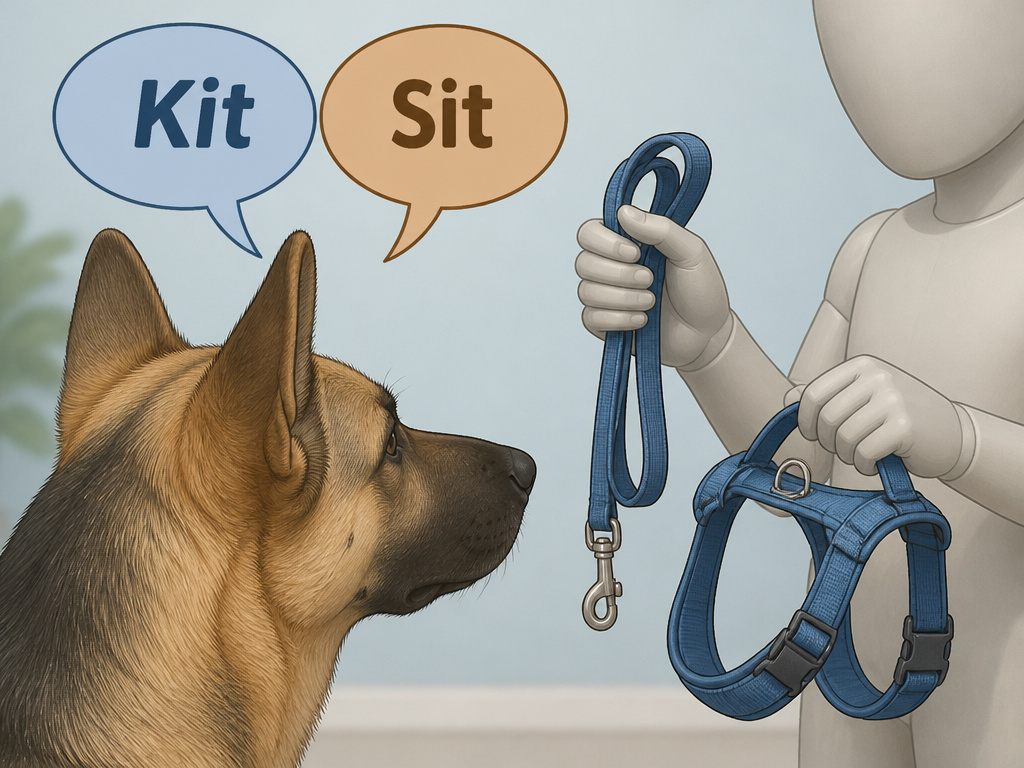
The AKC warns against command-sounding names on one page and questions the premise on another.
On its puppy-naming page, the AKC advises avoiding names that sound like commands, noting that “Joe” sounds like “no” when called and “Kit” may sound like “sit.” The Seeing Eye gives the same guidance with the same examples: “Mo” can sound like “No,” and “Kit” sounds like “Sit.”
Then the AKC’s own lifestyle article reports that recent research shows the average dog doesn’t differentiate between similar-sounding human speech sounds at all. A nonsense word like “shay” likely gets the same response as the cue “stay.”
Both positions sit on akc.org. Neither is labeled as the correction.
Where the AKC Contradicts Itself
The honest read is that this is unsettled. If dogs don’t reliably separate similar speech sounds, then the “Kit sounds like sit” warning is a precaution rather than a rule. Read the full AKC guide to choosing dog names and you’ll see both claims sitting a few paragraphs apart.
What I’d do with that: avoid a name that is literally a command you use, like “Sit” or “Down.” Beyond that, the collision risk is smaller than the internet suggests.
Where this goes sideways: Picking a name that’s one letter off a recall cue and then never proofing the recall. The dog learns “come” in the kitchen and nothing in the yard, and the name gets blamed for a training gap that was never about the name.
The Hard-Consonant Advice Nobody Can Prove
Common advice says to include a hard consonant like “D” or “K,” since those sounds may be easier for a dog to pick out than softer sounds like “S” or “F.” One AKC article states outright that dogs hear hard consonants and long vowels more easily, and offers “Lucky” and “Benny” as examples.
The other AKC article says the same advice “can’t hurt” but notes it isn’t proven, given the research on speech-sound discrimination.
So: it costs nothing to lean toward a hard consonant. Just don’t treat it as a guarantee. If your dog wears a dog harness with a handle instead of a collar, you’ll be saying the name while holding a strap, and the name needs to work in that position too.
The Great Dane Problem: Three Datasets, Three Answers
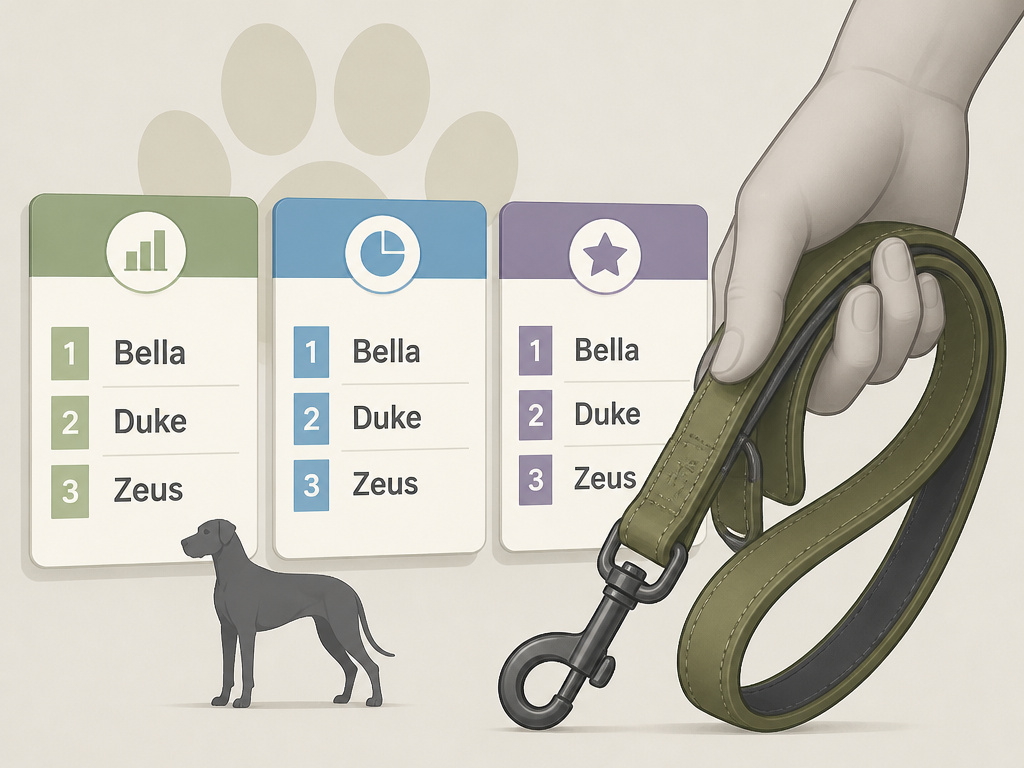
Great Dane naming data splits three ways, and the split tells you something about every popularity list you’ll read.
Vetstreet dug into a database of more than 5.6 million names across the 10 most popular large breeds and published its results in 2015. Lemonade’s numbers come from its own pet-insurance policies. The AKC publishes an all-breed top 10 from registration and Canine Partner mixed-breed enrollment data, with no breed-specific breakdown at all.
| Source | Great Dane Female | Great Dane Male | Dataset |
|---|---|---|---|
| Vetstreet (2015) | Bella, Daisy, Lucy | Duke, Zeus, Max | 5.6 million names, 10 large breeds |
| Lemonade | Moose, Luna, Winston, Odin, Duke | (combined list) | Pet-insurance policies |
| AKC (2025) | No breed breakdown | No breed breakdown | Registry and enrollment counts |
Why the Numbers Don’t Match
Three different populations. Vet records, insurance policies, and registry entries are not the same dogs, and they’re not the same years. Vetstreet’s snapshot is from 2015; Lemonade’s is current; the AKC’s is 2025 but all-breed.
There’s a second problem. Vetstreet reports that Sadie made the top 10 for all 10 large breeds, Bella made the top 10 for all breeds analyzed, and Max made the top three for every breed in the slideshow. Those cross-breed names are the closest thing to a reliable signal in any of the datasets, and they’re exactly the names the AKC suggests avoiding.
If you want a Great Dane name that fits the breed’s scale, the AKC Great Dane naming guide leans on the breed’s nickname, the “Apollo of Dogs,” along with Astro from The Jetsons and the BFG. Great Danes run 110 to 170 pounds and need consistent training and special diets from puppyhood through their senior years, so a name you can say calmly while holding a large dog leash with one hand is worth more than a clever one.
The part nobody mentions: Rover’s top 20 big-breed list is widely quoted, but the page shows no sample size and no breed-by-breed breakdown. Treat it as a list of ideas, not a ranking.
What the 2025 Popular-Name Data Actually Tells You
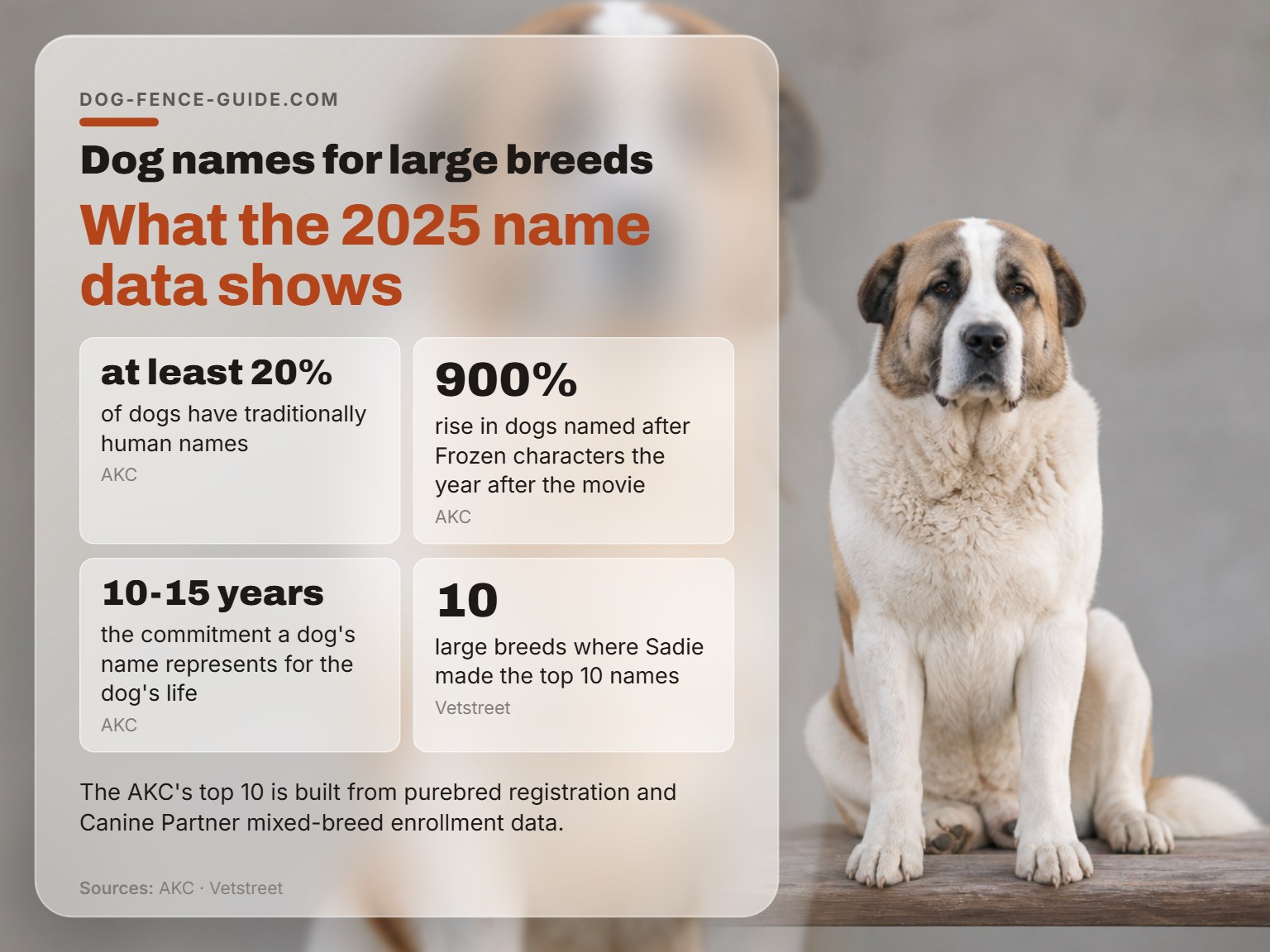
At least 20% of dogs have traditionally human names, and the top of the list barely moves from year to year.
The AKC’s 2025 top 10, compiled from purebred registration and Canine Partner mixed-breed enrollment statistics:
- Girl names: Luna, Bella, Daisy, Lucy, Ruby, Willow, Maggie, Penny, Nova, Sadie.
- Boy names: Max, Hank, Teddy, Cooper, Gus, Bear, Duke, Maverick, Charlie, Finn.
Trends do move things. The number of dogs named after Frozen characters rose 900% the year after the movie came out. When Derek Jeter retired from the New York Yankees, “Jeter” became one of the top 10 male dog names. The AKC top 100 male dog names shows the same pattern across pop culture, nature, and sports.
Here’s the tension. The AKC’s lifestyle article says to avoid common names so your dog isn’t the twelfth “Max” at the vet’s office or one of several “Lunas” at the park. The AKC’s puppy-naming page presents the same top 10 as inspiration. Both are reasonable, and they pull in opposite directions.
Most dogs learn their names within a few days to a week with consistent, positive use, which means the name you pick in a hurry is the one you’ll be saying for the next 10 to 15 years. The same test applies whether you’re naming a Mastiff or working through small breed dogs; the size changes the volume, not the rules.
How to Test a Name Before It Becomes Permanent
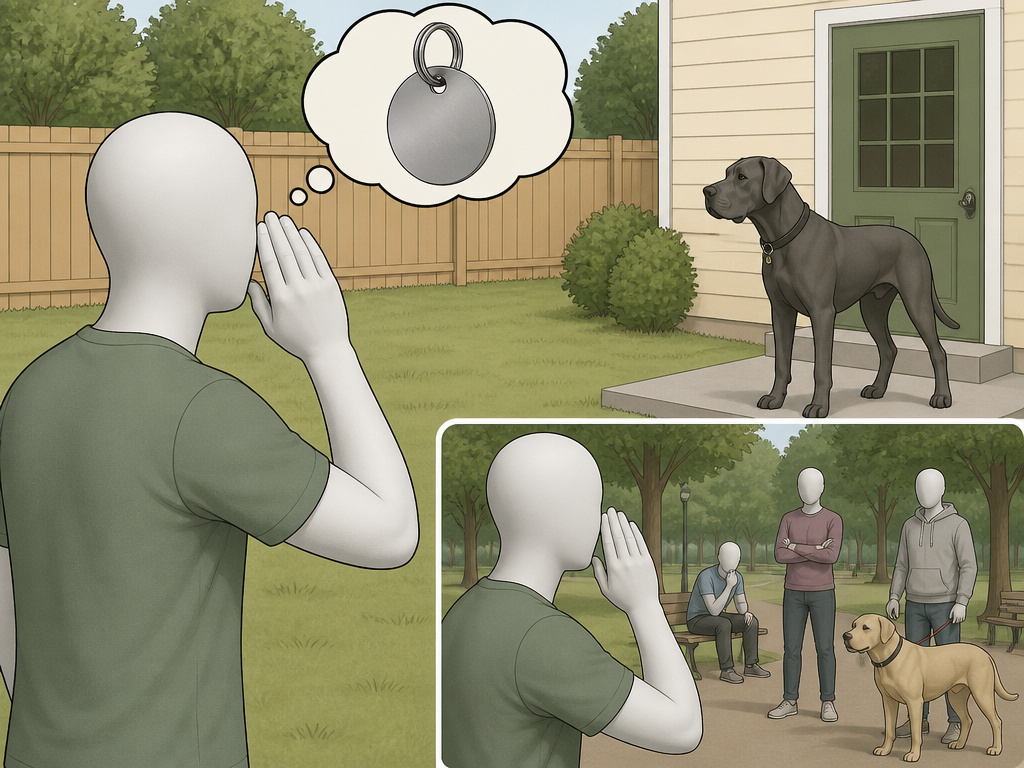
Three tests, and one of them requires shoes.
- Say it from the far corner of your yard. Not the kitchen. Stand where the dog would be if he slipped out, and call once. If you have to repeat it, the name is too long or too soft, and you’ve just learned that before it mattered.
- Shout it in public, out loud. The Seeing Eye’s test is exactly this: picture yourself running through a public space calling the name. If you’d be embarrassed, pick something else. Skipping this is how people end up with a name they whisper at the vet.
- Try it on a stranger’s ear. The AKC warns that a name like “Beast” or “Killer” can make strangers wary, and that fear around your dog can rub off and cause anxiety. Say the name to someone who doesn’t know your dog and watch their face.
- Live with it for a day or two. The AKC recommends testing a prospective name before committing. It also advises picking something that fits the dog at any age, since a puppy named “Fuzzy” may not suit an adult.
- Check the paperwork version separately. If you plan to register, run the registered name through the 50-character cap and the banned-terms list before you fall in love with it.
A name you can’t shout across a yard in an emergency is a name you’ll regret. Test it outdoors, at volume, before it goes on the tag.
One more piece of housekeeping the AKC is firm about: don’t name a dog after a friend or family member without asking first. You never know who’ll be offended, and you’ll be saying it for a decade.
Frequently Asked Questions
What is a good name for a large breed dog?
The AKC recommends one or two syllables ending in a vowel, such as “Sadie” or “Rocky,” because two beats let you vary stress and intonation. The Seeing Eye keeps to one or two syllables for the same practical reason: a short name pairs faster with a command. Names like Luna, Bella, Max, and Charlie dominate the current top 10 lists, but they’re also the names the AKC suggests avoiding if you want your dog to stand out.
How many characters can an AKC registered name be?
Fifty characters, and spaces, apostrophes, and hyphens all count toward that total. Anything over 36 characters carries a surcharge. The AKC also permits 37 dogs of each breed to share the same registered name, which is why roman numerals get assigned for identification rather than typed by the owner.
Should I avoid names that sound like commands?
The AKC’s puppy-naming page says yes, warning that “Joe” sounds like “no” and “Kit” may sound like “sit.” The Seeing Eye gives the same advice. But a separate AKC article reports research showing the average dog doesn’t differentiate between similar-sounding human speech sounds, so the risk is smaller than the standard warning implies. Avoiding a name that is literally a command you use is the safe middle ground.
Can I change my dog’s registered name later?
Only if the dog was whelped in the United States, and no change is recorded after the dog has produced or sired an AKC registered litter or received an award at an AKC-licensed or member event.
Do big dogs need different names than small dogs?
The registration rules are identical regardless of size. The practical difference is distance and volume. A large dog covers ground faster and is more likely to be called from across a yard, which pushes you toward a vowel ending and away from anything you’d have to repeat. A Mastiff and a Maltese can both be “Daisy,” but only one of them is going to hear it from the far corner of a yard.
The Bottom Line
Here’s the threshold I’d use. If you can’t get the name across the far end of your yard on the first try, without repeating it, pick something else. That single test filters out more bad names than any list of suggestions.
A dog who never leaves a fenced yard and comes every time the gate opens doesn’t need a name built for distance. The first unlatched gate changes that calculation in about four seconds.
One concession, because it’s honest: if your dog is already slipping out, a better name won’t fix it. That’s a containment question, and it usually lives at the gate latch rather than the fence line. Start with your dog, not the name, and work backward from where he actually gets out.
Editorial note: this article cites the AKC’s registration rules and naming guidance, Vetstreet’s 2015 large-breed name database, Lemonade’s pet-insurance policy data, and The Seeing Eye’s naming guidance. Where those sources disagree, both positions are shown.
