
How to Care for a Pregnant Dog: Feeding and Labor Prep
This post contains affiliate links. As an Amazon Associate, we earn from qualifying purchases.
To care for a pregnant dog, keep her on normal adult food through the first two-thirds, then transition slowly to a puppy or performance diet. Aim for 15 to 20% weight gain above her breeding weight, skip pure calcium supplements at every stage, and deworm only on a vet-approved schedule that starts no earlier than day 40.
That 15 to 20% figure is the only real scoreboard you get when you compare a how to care for a pregnant dog. A dog gaining faster than that is carrying fat into labor, and VCA Animal Hospitals names obesity the most common nutrition-related problem in pregnant dogs. Fat on a bitch at whelping time raises her risk of dystocia, which is the clinical word for a difficult birth.
What follows: the gestation numbers the major sources argue about, the two feeding timetables that don’t match, and the labor thresholds that tell you when to stop watching and start driving.
Key Takeaways
- Weigh her, don’t eyeball her. VCA puts the target at 15 to 20% above breeding weight, and that number is your early warning for both overfeeding and underfeeding.
- Hold the calcium. CSU Veterinary Health System says no pure calcium supplementation at any stage of pregnancy, which runs against what a lot of breeders do by habit.
- Day 40 is the deworming line. CSU says don’t start before day 40; the AKC starts fenbendazole around day 40 and runs it to about 14 days after whelping.
- Two hours between puppies is the call-the-vet mark. The AKC and PetMD land on the same number, and it’s the one to write on the whiteboard.
- Skip the show circuit. Canine herpesvirus moves by mouth and nose and can wipe out fetal viability in a bitch who has never been exposed.
How Long Are Dogs Pregnant? The Sources Don’t Quite Agree
Sixty-two days. Sixty-three. Sixty-four, sometimes seventy-two.
Canine gestation is measured from ovulation rather than from breeding. Whelping typically occurs 63 days, plus or minus one day, after ovulation, or 65 days, plus or minus one day, after the luteinizing hormone (LH) peak. Breeding dates alone cannot establish a due date because the timing of ovulation varies between bitches.
That’s the clinical version. Here’s what the five sources most owners land on actually publish:
| Source | Stated length | Counted from |
|---|---|---|
| VCA Animal Hospitals | 62 days, plus or minus 2 | Not stated |
| CSU Veterinary Health System | 63 days, plus or minus 1 | Ovulation |
| CSU Veterinary Health System | 65 days, plus or minus 1 | LH peak |
| PDSA | About 63 days (range 56 to 72) | Not stated |
| AKC | 62 to 64 days | Not stated |
| PetMD | About 63 days (range 57 to 72) | Not stated |
The spread isn’t sloppiness. It’s arithmetic. The CSU veterinary whelping guide counts from ovulation, and ovulation and the LH peak are two separate events roughly two days apart. PDSA and PetMD are handing you a planning average, not a stopwatch.
Which is why I’d write the breeding date on the calendar and then treat it as a marker rather than a due date. CSU is blunt about it: breeding dates can’t accurately determine due dates because of canine physiology. A dog pregnancy timeline built purely on the breeding date will be off by a couple of days for exactly that reason.
Confirming the Pregnancy: What Each Test Tells You
A relaxin blood test at 25 to 30 days is the first test that confirms pregnancy rather than hinting at it, because relaxin is only produced during pregnancy, and it’s a key part of how to care for a pregnant dog.
| Test | Earliest useful | What it tells you |
|---|---|---|
| Abdominal palpation | 3 to 5 weeks | Possible pregnancy, not accurate |
| Ultrasound | 21 to 25 days | Confirms; counts pups early on |
| Relaxin blood test | 25 to 30 days | Confirms pregnancy only |
| Radiograph | 55 days or later | Counts skulls and spines |
The two timing arguments here are small but worth knowing. PDSA says a scan works from around 25 days after mating; PetMD puts ultrasound diagnosis at around 21 days. On X-rays, the AKC says 55 days or more because puppy skeletons don’t show until then, while CSU points at one week before the expected whelping date, when the skeletons are fully formed.
Both are describing the same window from different ends. What matters is why you’d bother counting at all. CSU makes the case plainly: knowing the exact number lets you tell whether she’s finished whelping or has one pup left and has stopped progressing. That’s the difference between a wait-and-see night and a drive to the clinic.
One catch. Ultrasound gets worse at counting after day 40, according to CSU. If you want a number you can trust, that’s the radiograph late in the game, not the scan early.
How to Care for a Pregnant Dog: Start With the Scale, Not the Bowl
Somewhere in the second half of pregnancy, a dog who has always cleaned her bowl quickly starts walking away from it half full. That’s normal. The womb is pressing on her stomach and she physically can’t take a big meal anymore.
Before you start: Three things in this window can hurt her. Pure calcium supplements are contraindicated at every stage of pregnancy per CSU. A dewormer that isn’t licensed for pregnancy can pass to the fetuses, so only use a product your vet supplies. And extra weight going into labor raises dystocia risk, which is the one problem you can prevent with a scale.
The weight target is 15 to 20% above her breeding weight, per VCA. Not 15 to 20% above her ideal weight, and not “she looks about right.” Weigh her at breeding, write the number down, and weigh her regularly on the same scale.
The two feeding timetables, and where they actually split
This is the part where the sources genuinely disagree, and pretending otherwise would be dishonest.
The AKC’s position is that a dog on good-quality food at a healthy weight needs no diet change for the first two-thirds of pregnancy, and that increasing food early can be harmful. PetMD says much the same: normal adult diet for the first two trimesters, then a growth or puppy diet in the last trimester, transitioned over seven to 10 days.
CSU goes a different direction. It recommends a performance or gestation diet introduced gradually, with a hard instruction not to change her diet suddenly. PDSA simply says feed a high-quality puppy food or a food made for pregnant and lactating dogs.
Here’s the honest version. Everyone agrees she needs more food late and better food late. They disagree on when “late” starts. If your dog is already lean and eating well, the AKC and PetMD approach may suit her. If she’s a fussy eater, ask your vet about starting the transition earlier, which is closer to what CSU describes.
What “performance or gestation diet” means on the label
CSU gives you numbers to check against the guaranteed analysis panel: 28 to 32% protein and 17 to 20% fat. That’s the target for a performance or gestational formula.
Foods built for this window exist and are easy to find, such as a commercial performance or gestational diet formulated for gestation and lactation. A performance formula that lands in that protein and fat range fits the bill. A plain puppy diet is the route that PetMD and PDSA both describe.
One warning that only VCA gives: skip large-breed puppy food. VCA flags the calcium-to-phosphorus ratio as wrong for fetal bone development and milk production. CSU doesn’t carve out that exception, so if you have a big dog, this is a question worth asking rather than assuming.
More detail on matching a formula to her stage is in the guide to pregnant dog food.
Why small meals stop being optional
PDSA and PetMD both say the same thing for the same reason: the growing litter presses on the stomach, so a single large meal becomes physically difficult. Several small meals a day isn’t a luxury, it’s the only way she gets enough calories late in pregnancy.
PDSA notes she may be eating two to three times her normal amount by the end of gestation. Spread that across several smaller meals instead of two big ones.
The Calcium Rule That Surprises Most Breeders
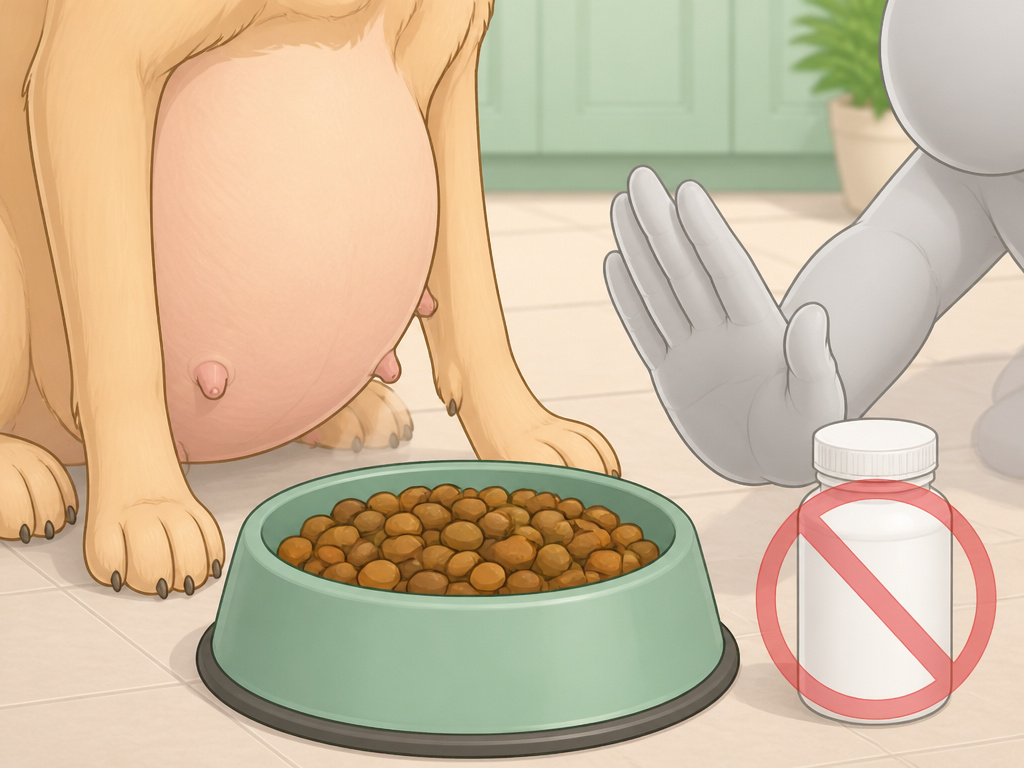
The one supplement most breeders reach for is the one CSU tells you to skip at every stage of pregnancy.
The instruction is about as flat as veterinary writing gets: do not supplement with pure calcium at any stage. Not early, not late, not in the last week to “prevent eclampsia.”
PDSA’s position is different but not contradictory. PDSA says feeding the right food reduces the risk of hypocalcaemia and eclampsia, which is the same concern pointing at the bowl instead of the bottle. Both sources are telling you the diet should carry the load.
Common mistake: Adding a calcium supplement late in pregnancy because a forum said it prevents eclampsia. CSU contraindicates pure calcium at every stage, and PDSA’s answer to the same risk is the right diet, not a pill.
If your vet has put her on a specific supplement for a specific reason, that’s between you and your vet. What I’d skip is the blanket “add calcium late” habit, because the highest-authority source in this stack says the opposite.
There’s a wider question about what else goes in the bowl, covered in this look at pregnant dog vitamins, but calcium is the one to get right first.
Deworming a Pregnant Dog: Day 40 Is the Line
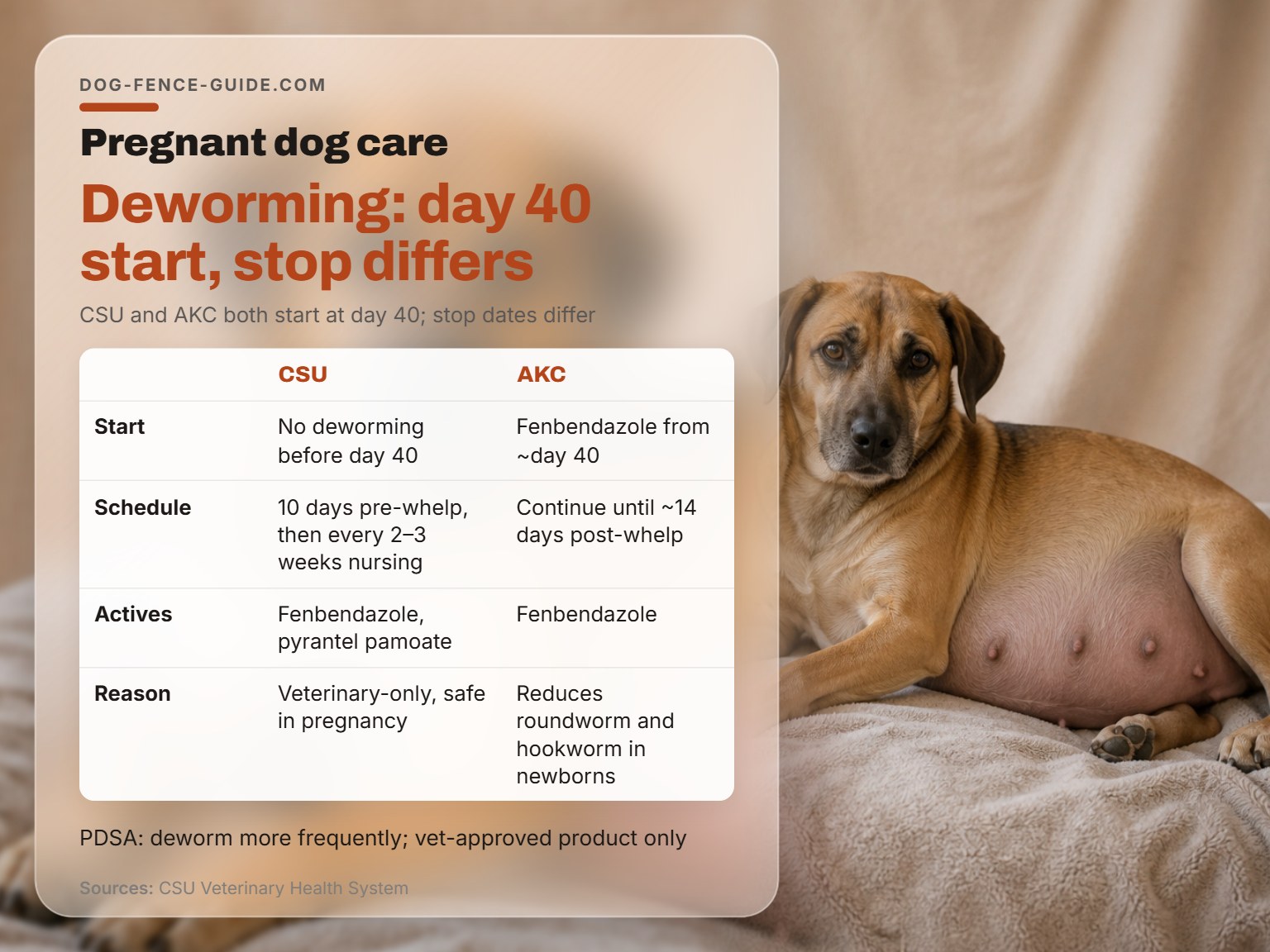
Day 40 is the line, and both major protocols respect it even though they don’t match after that.
CSU’s schedule: deworm 10 days before the expected whelping date, then every two to three weeks while she’s nursing. Do not start before day 40 of gestation. Use veterinary-only medication that’s safe in pregnancy, and CSU names the actives: fenbendazole and pyrantel pamoate.
The AKC’s schedule: fenbendazole starting in the third trimester, around day 40, continuing until about 14 days after whelping. The AKC’s stated reason is that it significantly reduces roundworm and hookworm in newborn puppies.
PDSA doesn’t give numbers. It says deworm more frequently during pregnancy and defer to your vet, because not all wormers are licensed for pregnancy.
Read those three together and the shape is clear. Everyone holds off early, everyone treats around day 40, everyone keeps going through nursing. The disagreement is about the exact stop date, not the start.
- Fenbendazole is the active the AKC names, dosed from about day 40 through roughly 14 days post-whelp.
- Pyrantel pamoate is the second active CSU names, and it’s the one to ask about if fenbendazole isn’t your vet’s first pick.
- Anything off a shelf is the wrong move here. CSU specifies veterinary-only medication for a reason.
Where this goes sideways: Deworming early in pregnancy because “it’s easier to do it all at once.” CSU says not to start before day 40, so you’ve spent the drug in the window it wasn’t meant for and you’ll still need to treat her again before whelping.
More on product selection is in the guide to deworming pregnant dogs. The schedule above is the part that matters more than the brand.
Exercise, Stress, and the Isolation Rule Most Owners Skip
A bitch in season will pace a fence line looking for the gap she found last time. I’ve watched it happen late at night with a determined male on the other side of the wire, and that’s the night I stopped trusting an electronic boundary during a heat cycle.
CSU’s guidance on routine is to change as little as possible. Keep her doing what she normally does, especially in the first half of gestation, exercise included, because staying fit helps her whelp efficiently. PDSA adds the late-pregnancy adjustment: as whelping approaches, let her decide how much she wants to do and let her rest when she’s tired.
The one routine change CSU does recommend is the one most owners skip. Avoid shows, dog trials, and anywhere a lot of unknown dogs are gathered. Keep her away from the dogs you take to those events, because canine herpesvirus spreads easily by the oronasal route, and CSU is direct about the consequence: exposure in a bitch who has never been exposed before is very detrimental to fetal viability at any stage of pregnancy.
That’s the whole argument for a boring second half. A worn-bare corner of the fence and a dog who’s figured out how to work the gate latch is a problem any week. Late in pregnancy it’s a problem with a litter attached.
Parasite control belongs in the same conversation. Not every flea product is labeled for use in pregnancy, so check the label before you dose her, and see this guide to flea treatment for pregnant dogs if you’re choosing between products.
How Do You Know When She’s Actually in Labor?
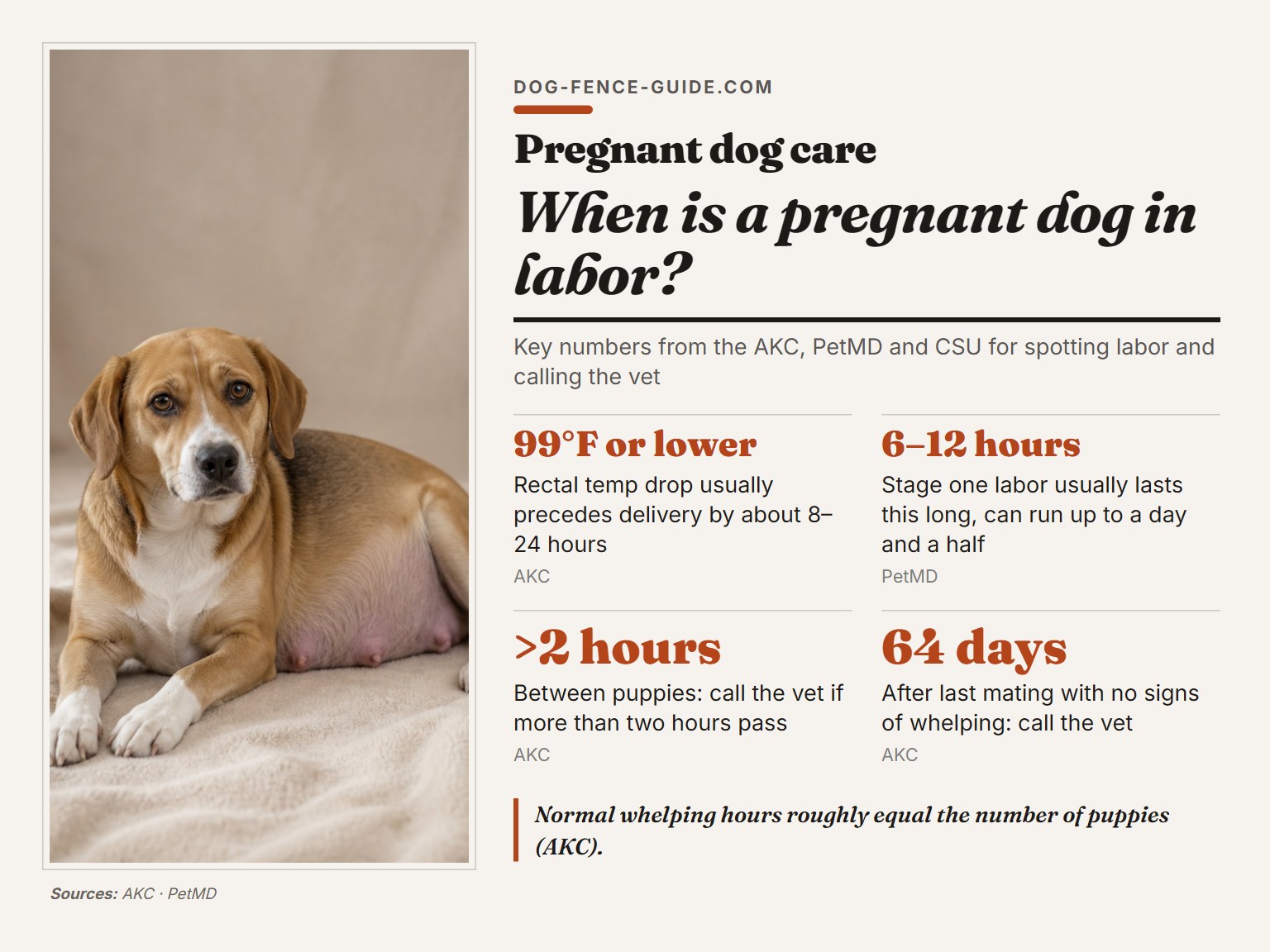
Three things tell you labor is close: rectal temperature, behavior, and discharge.
The temperature is the one you can measure. The AKC gives a normal range of 100 to 102.5 degrees Fahrenheit, and says a drop to 99 or lower usually precedes delivery by about 8 to 24 hours. Take it regularly in the last week and write each reading down, because a single number tells you nothing without the trend behind it.
Stage one itself lasts six to 12 hours in most dogs, according to PetMD, and can run up to a day and a half. It looks like a dog who can’t get comfortable. She digs at the bedding, pants, looks at her own flank, and won’t settle anywhere.
Then come the thresholds. These are the ones to have written down before the night arrives:
- More than two hours between puppies. Both the AKC and PetMD say call. Some veterinary educators give a wider four-hour window, but the two major guides agree on two, and two is the safer number to plan around.
- Strong contractions for an hour with no puppy. The AKC lists this alongside exhaustion in the mother.
- A temperature drop more than 24 hours ago with no labor starting. That’s the AKC’s threshold for calling.
- No signs of whelping 64 days after the last mating. Again from the AKC.
- A retained placenta. Count them as they come. The AKC notes a retained placenta causes problems for the mother.
One more number worth knowing: the AKC says the total hours of a normal whelping roughly equals the number of puppies. A litter of six should normally take about six hours total.
CSU adds a wrinkle for small litters. In a bitch carrying one or two pups, the progesterone drop that signals labor is inconsistent, so you can’t rely on it alone.
Rule of thumb: If the thermometer says 99 or lower and she’s restless, you’re inside the window. Sleep in the same room that night.
If you’re past the point of watching and want the procedure, this guide on how to help a dog give birth walks through it step by step. The AKC dog pregnancy care guide is the source for most of the thresholds above if you want to read them in the original.
What to Set Up Before Day 55
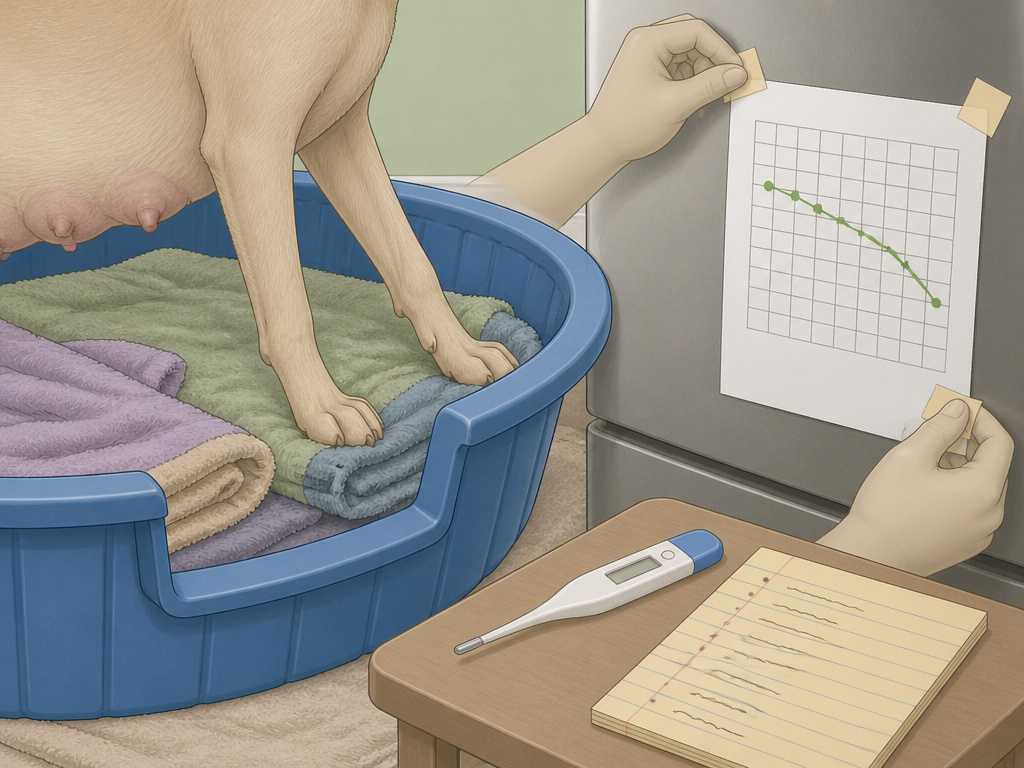
Set the box up well before the expected whelping date and then leave it alone, so she has time to accept it before she needs it.
- A box with a low front lip. Low enough that she steps over it and puppies can’t. A plastic kiddie pool does the job and hoses out easily.
- Bedding you’re willing to throw away. Old towels, not the good ones. You’ll be changing them in the middle of the night.
- A rectal thermometer and a chart. Paper, taped to the fridge, with a column for date and time.
- Her vet’s number and the nearest emergency clinic’s number, both written down. Not saved only in a phone that might be dead when you need it.
- A quiet room away from the household dogs. CSU’s isolation advice applies at home too, not just at shows.
Once the puppies arrive, the work changes shape entirely. This guide to newborn puppy care covers the first days after birth.
Frequently Asked Questions
How much should I feed a pregnant dog?
Feed normal adult portions through the first two-thirds of pregnancy, per the AKC and PetMD, then increase as she moves into the last trimester. PDSA notes she may be eating two to three times her normal amount by the end. Split that across several small meals rather than two large ones.
Can I give my pregnant dog calcium supplements?
CSU Veterinary Health System says no pure calcium supplementation at any stage of pregnancy. PDSA’s related guidance is that the right diet reduces the risk of hypocalcaemia and eclampsia. If your vet has prescribed something specific, follow your vet, but don’t add calcium on your own.
When should a pregnant dog be dewormed?
CSU says not before day 40 of gestation, then 10 days before the expected whelping date and every two to three weeks while nursing. The AKC starts fenbendazole around day 40 and continues to about 14 days after whelping. Use a product your vet supplies, because not all wormers are licensed for pregnancy.
How do I know when my dog is about to give birth?
Watch the rectal temperature. The AKC says a drop from the normal 100 to 102.5 degrees Fahrenheit down to 99 or lower usually means delivery within 8 to 24 hours. Nesting, panting, and restlessness follow, and stage one labor runs six to 12 hours in most dogs.
Should I change my dog’s food during pregnancy?
Not necessarily in the first half. The AKC and PetMD both keep her on normal adult food through the first two-thirds, then switch to a puppy or growth diet. CSU recommends gradually introducing a performance or gestation diet instead, so the timing is a conversation worth having with your vet rather than a rule.
The Bottom Line
Here’s the one thing to do first: weigh her, write the number on the calendar next to her breeding date, and weigh her again regularly. That single habit catches both overfeeding and underfeeding long before either one turns into a whelping problem.
One concession, because it matters. If she was already overweight at breeding, the 15 to 20% target needs a vet conversation rather than a diet you invent. VCA is clear that obesity is the most common nutrition problem in pregnant dogs, and cutting food hard during gestation isn’t the fix.
The dogs that whelp easily tend to be the ones that stayed a little lean and a little boring throughout pregnancy. Not glamorous, but it works.
