
Dog Pregnancy Timeline: Why the Numbers Disagree
This post contains affiliate links. As an Amazon Associate, we earn from qualifying purchases.
A dog pregnancy timeline runs 63 days from ovulation, but the same pregnancy reads as 64-66 days from the LH surge and 56-72 days from the first mating. Because semen stays viable in the bitch for 7 days or more, the breeding date alone can’t tell you when puppies are due.
Ovulation is the clock that gives the tightest answer, and it’s the one you can pin down with a blood test. The other three starting points are proxies, and each carries its own margin of error.
What follows: the four clocks and what each one predicts, the last-week signs worth tracking twice a day, and the point where waiting stops being the safer choice.
Key Takeaways
- Ovulation is the tightest clock: 63 days from ovulation, against 64-66 days from the LH surge and 56-72 days from the first mating.
- Breeding dates are unreliable because semen can stay viable in the reproductive tract for 7 days or more.
- Progesterone below 2 ng/mL means term is likely and labor is pending.
- Elective C-sections aren’t safe before 62 days; earlier than that, neonatal surfactant isn’t reliably present.
Why 63 Days Is a Range, Not a Deadline
Ask three good vets about the dog pregnancy timeline and you’ll get three different numbers, all defensible.
Normal gestation in the bitch is measured from a hormonal anchor rather than a calendar date. The Merck Veterinary Manual gives 56-58 days from the first day of diestrus, 64-66 days from the initial progesterone rise or the LH surge, and 58-72 days from the first permitted breeding. Breeding dates correlate poorly with conception.
Ovulation is the anchor with the least slack. On the day of ovulation, progesterone reaches 4-10 ng/mL in one set of measurements, while other studies report 3.4-6.6 ng/mL or a flat 6 ng/mL. Ovulation itself lands almost 48-60 hours after the LH peak.
From that point, the Animals 2021 review puts pregnancy at 63 days, with a 62-64 day range.
The trouble starts when you switch anchors. Merck gives 64-66 days from the LH surge and 58-72 days from the first permitted breeding. The underlying endocrinology is laid out in Concannon’s review of the biology of canine ovulation and parturition.
Breeding dates fail for a mechanical reason. Semen can survive in the bitch’s reproductive tract for 7 days or more, so a mating on day 3 of standing heat and a mating on day 9 can produce the same whelping date.
If you tracked dog heat cycle signs but never ran bloodwork, you’re working with the loosest clock of the four.
Implantation happens at roughly 18 days, and the deciduomata (small swellings along the uterine horns) form by about 21 days. Those are the first physical landmarks, and they’re already three weeks into the count.
The Four Clocks That Decide the Due Date
Four starting points on the dog pregnancy timeline, four different answers, and only one of them is tight enough to schedule surgery around.
| Starting point | Reported gestation length | Source |
|---|---|---|
| Ovulation (progesterone 4-10 ng/mL) | 63 days (62-64 range) | Animals 2021 review |
| LH surge or initial progesterone rise | 64-66 days | Merck Veterinary Manual |
| First day of diestrus (D1) | 56-58 days | Merck Veterinary Manual |
| First day of diestrus (D1) | 57 days (54-60 range) | Animals 2021 review |
| First permitted breeding | 58-72 days | Merck Veterinary Manual |
| First mating to parturition | 56-72 days, averaging 63 | Acorn House Vets |
The disagreement isn’t noise. Merck and the Animals 2021 review are measuring from different hormonal events, and the gap between 56-58 days and 54-60 days from diestrus is a real one that shows up in the tails.
The maternal and fetal parturition predictors review is where most of the breed and size data below comes from.
The LH Surge and Ovulation
Ovulation follows the LH peak by almost 48-60 hours, and that lag is why the surge and ovulation aren’t interchangeable anchors.
Merck puts gestation at 64-66 days from the surge. The Animals 2021 review puts it at 63 days from ovulation. Those two figures describe the same pregnancy, measured from two events roughly two days apart.
Both are correct. Pick the one your vet measured.
The First Day of Diestrus
Vaginal cytology can flag the first day of diestrus (D1), and that’s the anchor most general practices can actually get.
Once D1 is identified, pregnancy lasts 57 days, with a 54-60 day spread. D1 predicted parturition within one, two and three days in 88%, 99% and 100% of 242 monitored pregnancies. In 95% of cases, the interval between D1 and the day of cervical dilatation fell between 55 and 59 days.
Merck’s figure for the same anchor is tighter: 56-58 days. Same event, narrower window.
Owners who only recorded signs a dog is in heat and never had cytology run are stuck with the breeding date instead.
The Breeding Date
Breeding dates are the anchor almost every owner has, and the weakest one.
Merck gives 58-72 days from the first permitted breeding. Acorn House Vets gives 56-72 days from the first mating, averaging 63. Both agree on the same warning: without progesterone testing before mating, you don’t know when the pups are due.
That’s a clinical position, not a marketing line, and it’s the one I’d repeat to any owner standing in their yard counting backwards on a calendar.
The estimated canine pregnancy length research on this is worth reading if you have an uncommon breed.
Why Breed Changes the Number
Size matters, and breed name matters, and the two don’t always point the same direction.
Small bitches under 10 kg had a shorter gestational length than large and giant bitches (25-40 kg and over 40 kg) in the Animals 2021 data. But the same review found West Highland White Terriers running longer at 62.8 days than German Shepherds at 60.4, Labrador Retrievers at 60.9 and Dobermans at 61.4.
Cavalier King Charles Spaniels, a small breed, ran shorter from ovulation to parturition at 61 days than German Shepherds at 63.2, Golden Retrievers at 64.3 and Rottweilers at 65.6.
So a size rule and a breed rule can disagree for the same dog. If you have an uncommon breed, raise it with your vet rather than assuming the average applies.
How Do You Know When She’s Close?
Guessing gets expensive in the last week.
The parturition prediction in canine pregnancy review recommends a simple last-week routine: monitor rectal temperature once or twice daily, examine the vulva for discharge, check whether milk can be expressed from the mammary glands, and record whether she’s eating, nesting, or restless.
None of those checks needs a lab.
A Doppler probe on the flank picks up two rhythms at once: the slow thud of the dam’s heart and, running underneath it, the fetal heartbeat at two to three times that speed. Once you’ve heard the fast one, you won’t mistake it for anything else.
Ultrasonography is best performed at 25-35 days gestation, and before 21 days it can throw false negatives. A commercial relaxin assay detects placentas after 22-27 days.
Late gestational radiography past 55 days is the best method for counting litter size. The fetal skeleton starts calcifying as early as day 28, doesn’t show on routine radiographs until about day 42-45, and is quite prominent by day 47-48.
The timed pregnancy ultrasound in Beagles study tracked 8 bitches from day 20 to day 60 and found the gestational age markers consistent across all of them.
Easy to miss: A single puppy sitting at the end of a uterine horn can be missed on an ultrasound scan. Acorn House Vets offers a repeat scan two weeks later when the first one comes back negative, and that’s the standard follow-up.
When the temperature drops and the discharge starts, you’ve moved from prediction into dog labor stages, and the monitoring changes again.
The Temperature Drop: One Number, Twice a Day
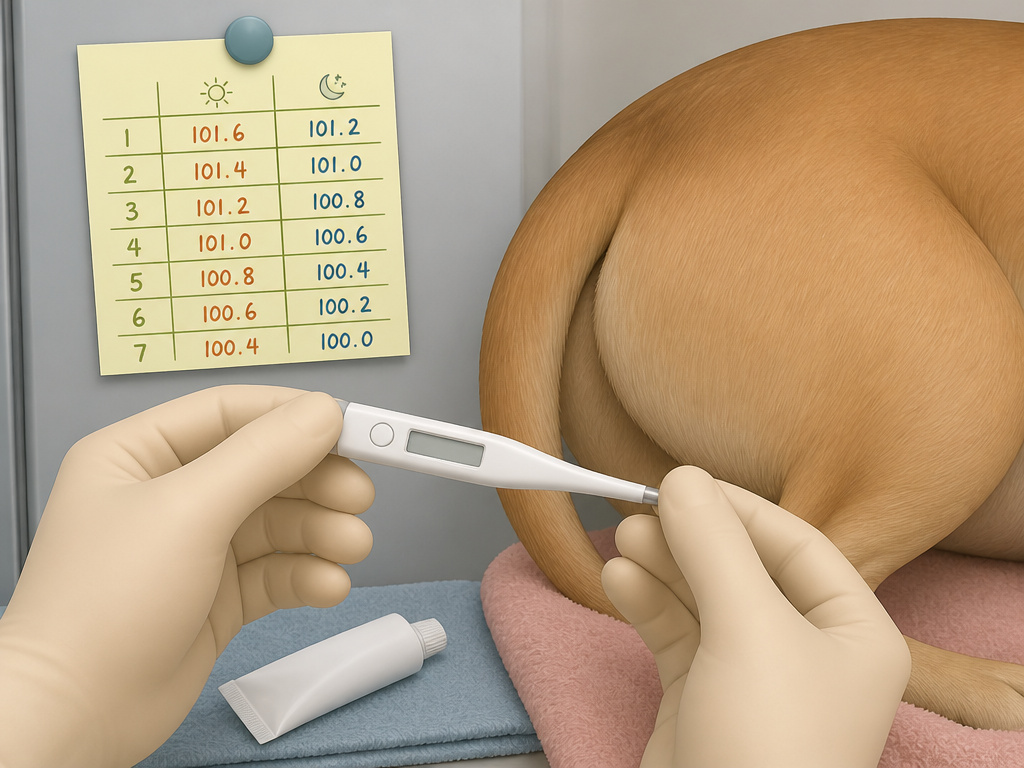
Two readings a day for the last week, written down, is the cheapest early-warning system you have.
Before you start: A rectal thermometer can tear tissue if it’s forced, so lubricate it and stop if she tenses hard. A dog in late pregnancy can still bite when she’s uncomfortable, so have a second person hold her head. Skip the reading entirely if you see blood or fresh discharge.
Merck describes a drop to a mean of 37.1 degrees C (98.8 degrees F), with a range of 36.7 to 37.8 degrees C (98.1 to 100 degrees F), in most dogs 8-24 hours before whelping.
Acorn House Vets describes the same event differently: a drop of 1-2 degrees in the 12-24 hours before whelping. Both descriptions point at the same window, and both are worth having in your head.
A bitch that has held 100 degrees F all week and reads 98.8 on Tuesday morning has crossed the line Merck describes.
Use a digital stick thermometer rather than glass. A Vicks SpeedRead reads fast, which matters when the dog has decided she’s done.
Here’s the routine that works:
- Take the reading at the same two times daily, morning and night. Skip a reading and you can’t tell a trend from a one-off.
- Lubricate and insert just past the sphincter. Forcing it further risks injury and gets you a dog that won’t stand still for the next one.
- Record the number beside the time. I write mine on a sticky note on the fridge, because I will not remember them at 3 a.m.
- Watch the trend, not the single reading. One low number means little. Two in a row is the signal.
- Call the vet if the low reading holds past 24 hours without labor starting. That’s the point where the chart stops being reassurance.
Trends decide.
The Last Week, Sign by Sign: Nesting, Milk, and the Temperature Drop
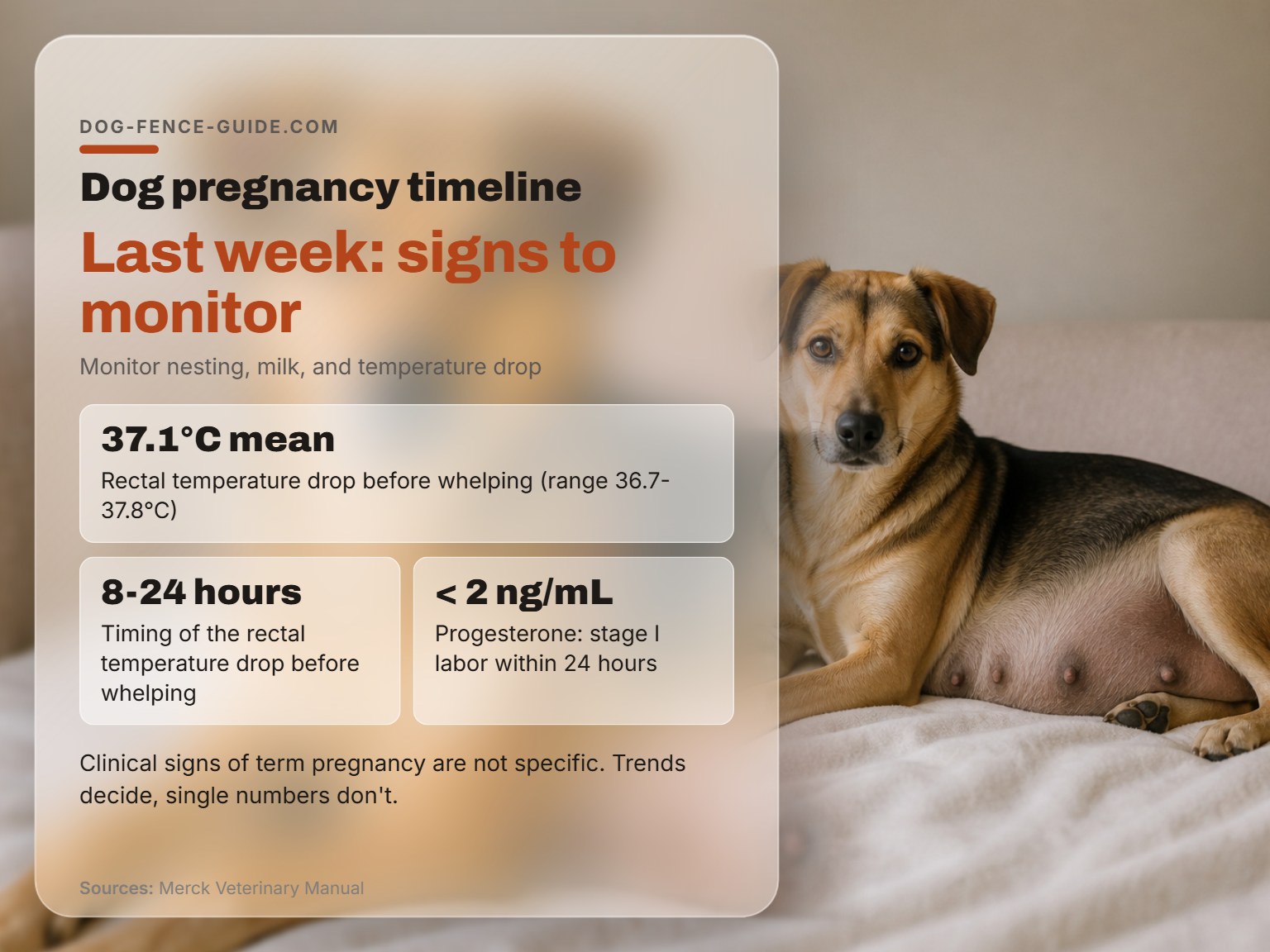
It’s 2 a.m., the bedding has been rearranged twice, and she’s turned down dinner.
That combination is normal in the last week.
| Sign | Typical timing before whelping | Reported by |
|---|---|---|
| Rectal temperature drops to a mean of 37.1 degrees C | 8-24 hours | Merck Veterinary Manual |
| Rectal temperature drops 1-2 degrees | 12-24 hours | Acorn House Vets |
| Nesting behaviour | 12-24 hours | Acorn House Vets |
| Milk expressible from the mammary glands | 12-24 hours | Acorn House Vets |
| Restlessness, seclusion, over-attentiveness | Several days | Acorn House Vets |
| Progesterone below 2 ng/mL | Stage I labor within 24 hours | Merck Veterinary Manual |
Notice how many of those signs cluster in the same 12-24 hour window. Nesting, milk and the temperature drop tend to arrive together, and none of them is precise on its own.
Merck adds a caution that matters: clinical signs of term pregnancy aren’t specific. Radiographic mineralization varies at term, and fetal size varies with breed and litter size.
What to have written down by the time you call anyone:
- The anchor you’re counting from, and the date it started.
- The most recent progesterone value, if you have one.
- Your temperature chart for the last three days.
- Whether milk expresses, and whether she’s eating.
Two low readings in a row mean more than one low reading. Trends decide, single numbers don’t.
When Should You Call the Vet Instead of Waiting?
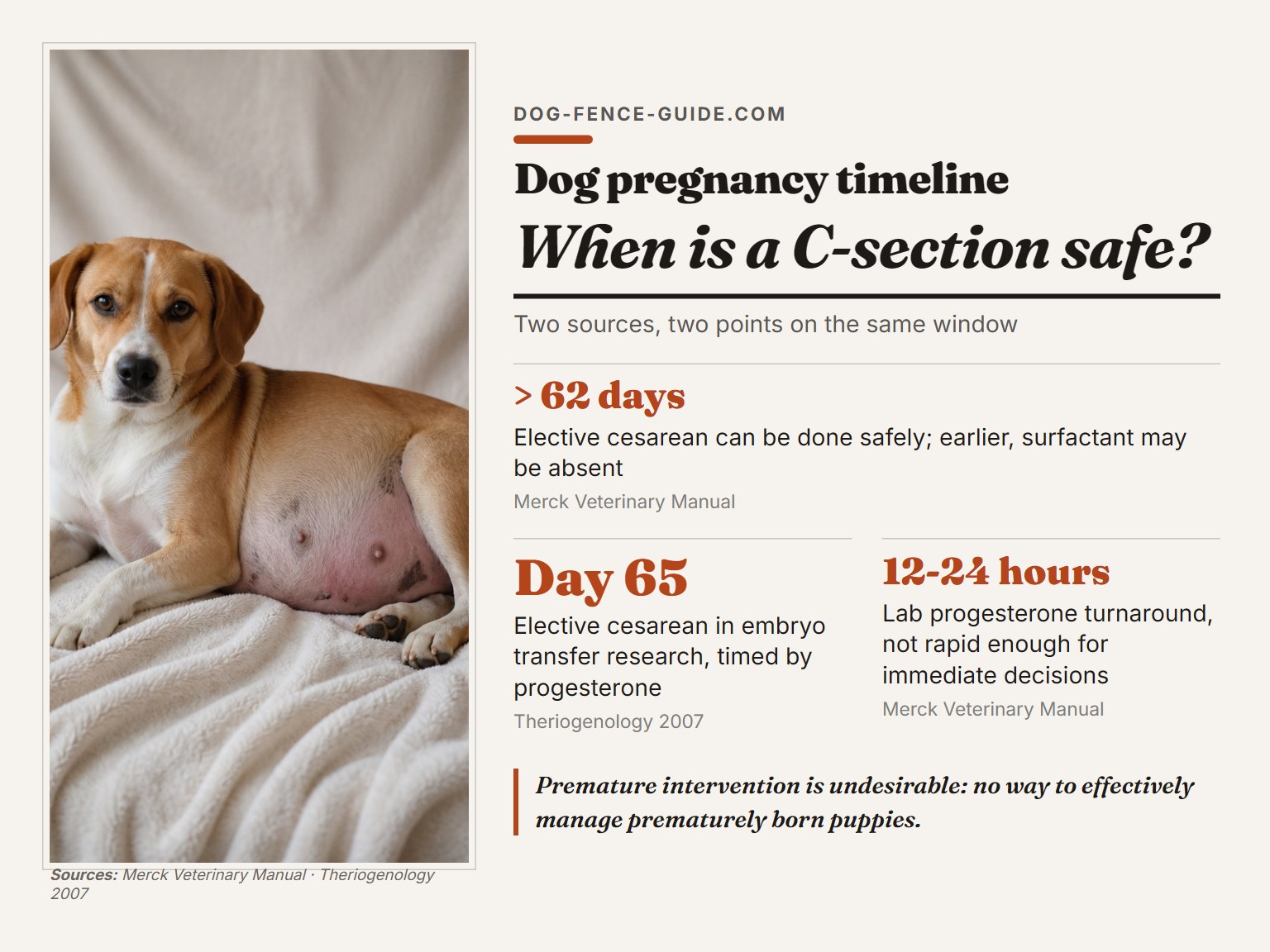
The Merck Veterinary Manual puts a hard floor under elective surgery at 62 days.
Elective cesarean sections can be performed safely past 62 days gestation. Before that point, a newborn puppy’s lungs don’t have surfactant in reliable amounts, and surfactant is what allows them to inflate on the first breath.
Theriogenology 2007 describes a different schedule from embryo transfer research: elective cesarean on day 65, timed with the progesterone method. The two recommendations sit at different points on the same window, and the difference is how much margin each clinic wants.
Merck is explicit about why waiting is usually the safer default. Premature intervention in the whelping process is undesirable because there’s no way to effectively manage prematurely born puppies.
If surgery is planned, aglepristone at 10-15 mg/kg, given under the skin and repeated in 24 hours, can improve fetal maturation, surfactant availability and functional luteolysis beforehand.
Fetal dentition becomes visible at term, and it can confirm a fetus is developed enough for an elective cesarean when ovulation timing isn’t available and breeding dates are vague.
What most people get wrong: Treating the due date as a deadline. Merck notes there’s no predictable, safe way to induce parturition in dogs, so a date that slips by two days is usually a counting problem, not a medical one.
Waiting is usually right. But not always.
The one timing problem worth knowing about is progesterone testing itself. Commercial labs running quantitative progesterone by chemiluminescence have a 12- to 24-hour turnaround, which Merck calls not rapid enough to make decisions about immediate obstetrical intervention. In-house kits are the workaround, ideally validated against chemiluminescence first.
Containment During Pregnancy: Gate Hardware Beats Taller Panels
Containment gets harder in the second half of pregnancy, and it gets hardest in the days right before whelping.
A bitch in season will find the weak point in your fence. So will every intact male within smelling distance of her.
Walk the fence line first.
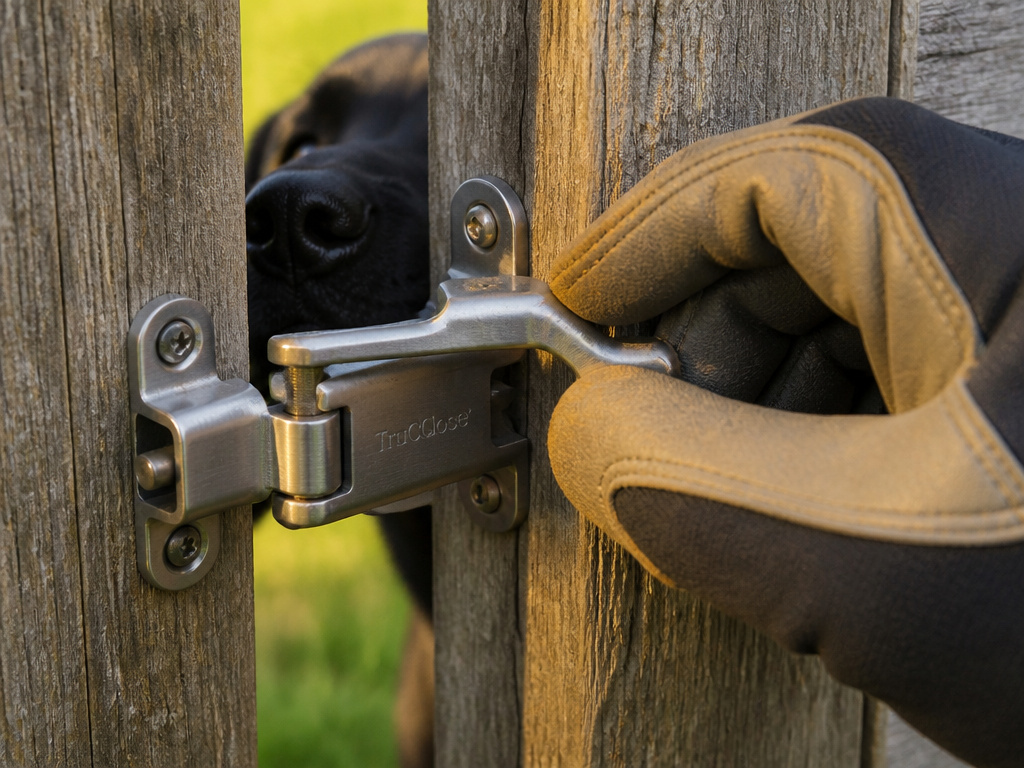
Most escapes I’ve seen happen at the gate, not along the fence line. A self-closing latch is the cheapest upgrade in dog ownership, and it beats taller panels every time.
Buying a fence for the panels alone is like buying a deck for the wood and ignoring the joist hangers. The boards are what you see. The hardware is what holds.
I keep a bitch in season on a leash in the yard for the whole cycle, even behind a six-foot fence. I’ve watched a Lab-cross clear my gate line and sit on the front walk like he’d been invited. He hadn’t been.
Two pieces of hardware do most of the work. A Petmate Vari Kennel gives her a dark, quiet spot to retreat to when the yard gets busy, and a MidWest Homes for Pets exercise pen lets you fence off a corner of the kitchen without building anything. For walks in early pregnancy, when she’s still covering ground, a Kurgo Tru-Fit Smart Harness spreads the pull across her chest instead of her throat.
Once her belly drops, switch to a flat collar and short walks.
When she’s carrying a litter, caring for a pregnant dog is mostly about routine: same walks, same yard, same gate discipline, just shorter and more supervised.
Parasite control is the one place the routine changes, and it’s a vet decision rather than a yard decision. Flea treatment for pregnant dogs has to be chosen with the litter in mind.
Biscuit treated the new gate latch as a puzzle for about a week, then lost interest. The latch won.
Food, Parasites, and Supplements: Where the Timeline Stops Helping
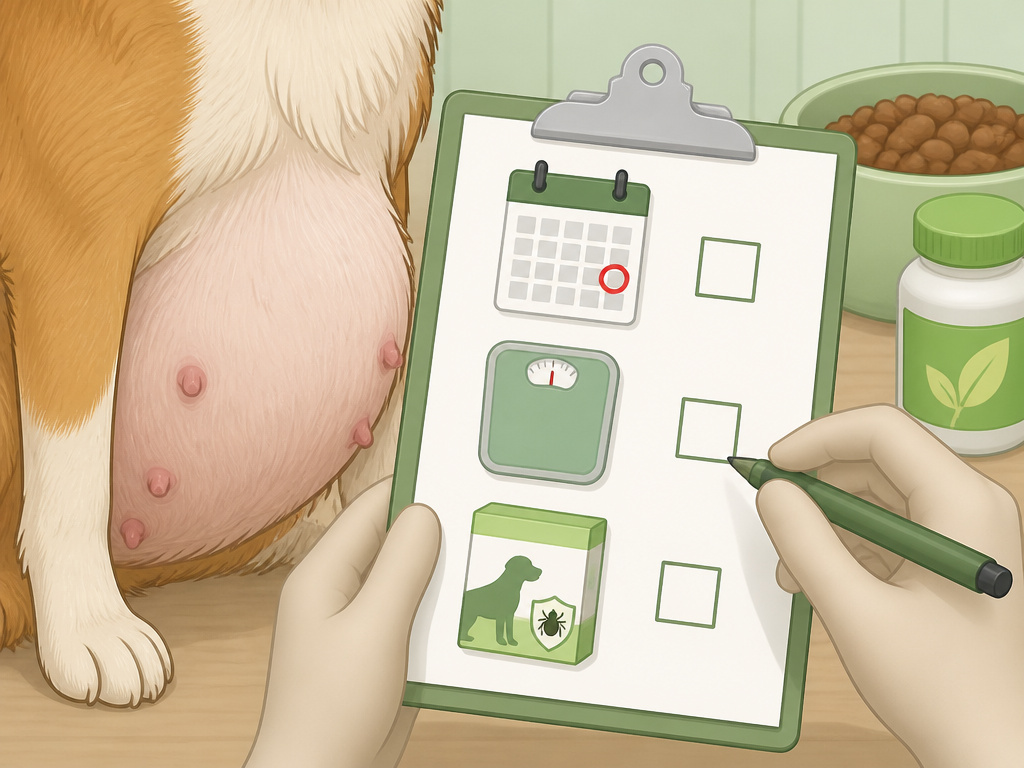
Does what she eats change the timeline?
No. The clock runs on hormones, not kibble. What changes is which products are safe to use while she’s carrying, and that’s a question for your vet rather than a blog.
The timing literature I trust doesn’t cover feeding amounts, so I’m not going to invent a number. Your vet can size it to her body condition and litter size.
A pregnant dog feeding schedule is the place to start, and your vet adjusts it from there.
The other end of the timeline matters too. When puppies leave their mother is a separate milestone with its own rules, and it’s worth reading before the litter arrives rather than after.
Three things worth having ready for that conversation:
- The anchor you’re counting from, if you have one.
- Her current weight and body condition.
- Any parasite product you’ve already used this cycle.
Frequently Asked Questions
How long is a dog pregnant?
From ovulation, 63 days, with a 62-64 day range. From the LH surge, the Merck Veterinary Manual gives 64-66 days. From the first mating, the range widens to 56-72 days, which is why the anchor matters more than the number.
Can you predict the due date from the breeding date alone?
Not reliably. Semen can stay viable in the bitch’s reproductive tract for 7 days or more, so a mating on day 3 and a mating on day 9 can produce the same whelping date. Acorn House Vets puts it plainly: without progesterone testing before mating, you don’t know when the pups are due.
What temperature drop means a dog is about to whelp?
Merck describes a drop to a mean of 37.1 degrees C (98.8 degrees F), with a range of 36.7 to 37.8 degrees C, in most dogs 8-24 hours before whelping. Acorn House Vets describes the same event as a 1-2 degree drop in the 12-24 hours before whelping.
Is 63 days from ovulation the same as 63 days from mating?
No. They’re different clocks with different margins. Ovulation is a hormonal event you can measure with a blood test. Mating is a behavior, and it can happen days before or after the eggs are ready.
How accurate is an ultrasound at predicting the due date?
Ultrasonography is best performed at 25-35 days gestation, and before 21 days it can produce false negatives. Biparietal diameter is the most accurate fetal measurement for dating, but it shouldn’t be used in the last week: accuracy drops to 50.9% within one day and 69.8% within two days.
Can a dog go past her due date?
Often, and it usually means the counting was off rather than the pregnancy running long. Merck notes that clinical signs of term aren’t specific, and that no predictable, safe way to induce parturition in dogs has been developed. That’s a conversation for your vet, not a calendar.
The Bottom Line
If you didn’t run progesterone before she was bred, you don’t know when the pups are due. That’s Acorn House Vets’ position, and it’s the honest one.
The practical version: start the twice-daily rectal temperature log in the last week of pregnancy, not the last day. Merck’s 8-24 hour window and Acorn House’s 12-24 hour window overlap, and a written chart is what turns that overlap into a decision.
If you want one answer and you have a bitch with a known ovulation date, it’s 63 days from ovulation, tracked with that temperature log. If you’re counting from a mating you didn’t write down, the chart matters even more, not less.
This all assumes a normal pregnancy with a known or estimated anchor. A bitch whelping at 68 days from a single mating isn’t running long. The anchor is loose.
I’d rather see an owner with a temperature chart and no idea what day she ovulated than an owner with a precise due date and no chart. One of those two people can tell a vet something useful at 3 a.m.
