
Cute Dog Names: The One Rule Every Expert Agrees On
This post contains affiliate links. As an Amazon Associate, we earn from qualifying purchases.
Cute dog names often work best at one or two syllables, and the AKC and Royal Kennel Club favor a vowel at the end, though the AKC’s own research note weakens the reason behind it. The Seeing Eye names about 500 puppies a year, and its guidance points to one or two syllables.
The yard is where a name gets tested for real. A name that sounds charming in a kitchen gets swallowed by wind, distance, and a dog who has found something more interesting than you. That gap between how a cute dog names candidate reads and how it carries is the whole decision.
What follows is what the Seeing Eye, the AKC, and the Royal Kennel Club actually say, where they split, and how to run a short test in your own yard before the name goes on a tag.
Key Takeaways
- One or two syllables is the usual recommendation across the sources, though the AKC allows longer names and the Royal Kennel Club asks specifically for a double syllable. The Seeing Eye rarely goes to three.
- Vowel endings get pushed by the Royal Kennel Club and the AKC, though the AKC’s own research note weakens the reason behind it.
- Kit, Mo, Bo, Joe, and Poe are the named command clashes to avoid, per the Seeing Eye, the AKC, and the Royal Kennel Club, with Poe added by a separate AKC piece.
- A name lasts 10 to 15 years, per the AKC. Test it for a day or two before it goes on a tag.
- Call it from the far end of your yard. If you can’t hear it over wind, your dog can’t either.
The One Rule Every Naming Authority Agrees On
Short wins. The Seeing Eye keeps names to one or two syllables and only occasionally selects a three-syllable one. Its stated reason is speed: a short name pairs with a command and makes for faster communication with the dog.
The Seeing Eye names roughly 500 puppies each year, about 42 names per month, across 65 to 70 litters. Litters are assigned a single initial letter and worked through the alphabet from A to Z, restarting on October 1. Names are chosen by the Puppy Development Manager when puppies are two weeks old.
The AKC lands in the same territory with a softer edge. Its AKC guide to choosing names notes that trainers recommend one or two syllables because they’re easier to say and easier for a dog to recognize consistently. A separate AKC piece adds that sometimes a longer name is too good to pass up.
The Royal Kennel Club asks for a double syllable specifically. Pedigree UK recommends a one- or two-syllable name, framed around how much easier a short name is for a dog to learn than a longer one.
Four sources, four phrasings: The Seeing Eye, Pedigree UK and the Royal Kennel Club favor short names, while the AKC says one or two syllables are usually best but sometimes longer names are too good to pass up.
When I test a name, I say it the way I’d say it at the back door at dusk, not the way I’d say it at the vet’s counter. Those are two different words, and only one of them matters.
Choosing a dog name works better as a shortlist exercise than a lightning bolt. Write six down, then cut them against the rules below.
Four Authorities, Four Different Answers on Length and Vowels
The Seeing Eye is the strictest of the four, and it isn’t close. It caps names at one or two syllables and treats three as an exception. The AKC explicitly leaves room for a long name you love. The Royal Kennel Club asks for a double syllable specifically, which is a different rule from the Seeing Eye’s one-or-two-syllable guidance.
| Question | The Seeing Eye | AKC | Royal Kennel Club |
|---|---|---|---|
| Name length | One or two syllables, rarely three | One or two usually best, longer allowed | Double syllable preferred |
| Vowel ending | No position stated | Good for stress and intonation | Easier for the dog to understand |
| Command sounds | Avoid; Mo sounds like No, Kit like Sit | Avoid; Joe sounds like no, Kit like sit | Avoid; Bo sounds like no |
| Renaming an adult dog | No position stated | No position stated | Confusing; pick a similar sound |
Read that as a set of trade-offs rather than a set of rules. Where two authorities disagree, the disagreement itself tells you the underlying evidence is thin.
The AKC’s own advice sits uneasily with its own data on popularity. One AKC article warns against the twelfth Max at the vet’s office and another Luna at the dog park, while the same organization’s top-10 list, built from purebred registration and Canine Partner mixed-breed enrollment statistics, has Max and Luna at the top. The popular dog names list is where those two live.
If you want out of that trap, the AKC unique dog names list is organized by theme rather than by rank, which makes it easier to find something nobody else on your street has.
Why Do Kit, Mo, Bo, Joe, and Poe All Fail the Same Test?
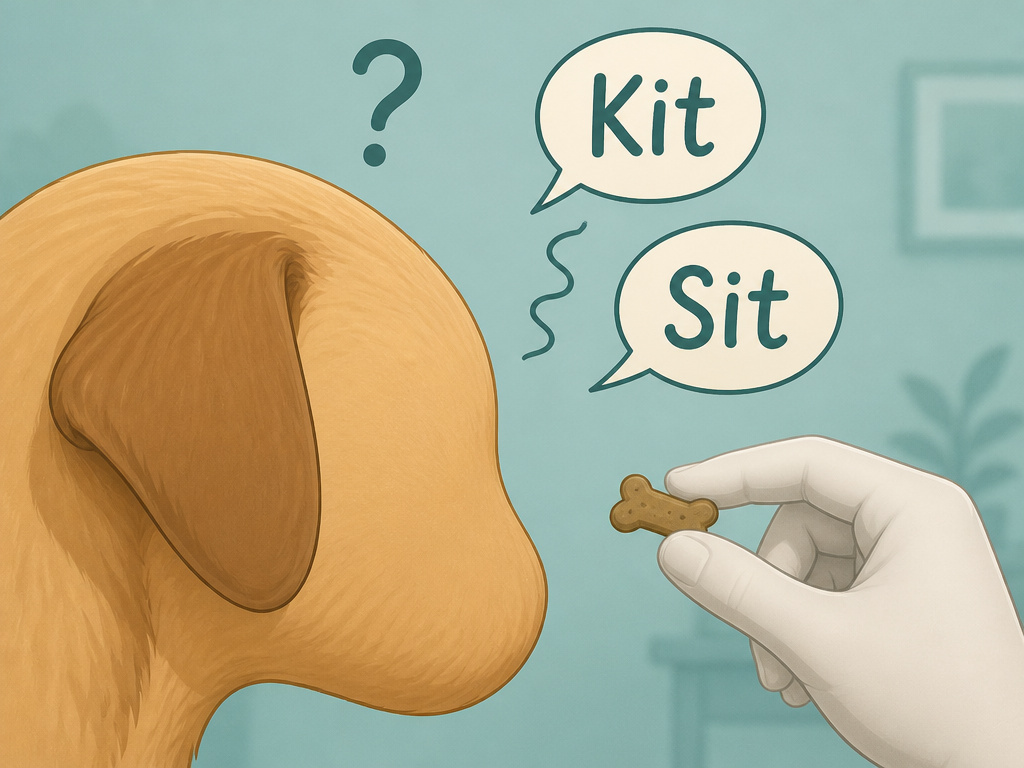
Kit sounds like sit. That’s the whole problem, and three separate authorities name it.
The Seeing Eye gives Mo and No as its example, then adds Kit and Sit. The AKC uses Joe and no, and a separate AKC piece adds Kit and sit. The Royal Kennel Club goes with Bo and no. A separate AKC piece on girl dog names adds Poe and no. Five different names, one failure mode: the dog can’t tell the cue from the call.
The AKC then undercuts its own rule. Its guidance states that recent research has shown the average dog doesn’t differentiate between similar-sounding human speech sounds. A nonsense word like “shay” will likely get the same response as the cue “stay.” Dogs may not notice the difference between Josie and Cody.
So the command-clash rule rests on a reasonable assumption rather than a confirmed mechanism, and the AKC presents both positions without resolving them.
I still follow the rule. If there’s any chance the dog is hearing a coin flip between their name and their recall, I’d rather not build that in.
A failed recall sounds like nothing at all. No tag jingle, no claws on the deck, just wind and a dog pretending not to hear.
Where this goes sideways: A name that shares its opening sound with your recall cue. Call a dog named Cody and you’ve handed them a reason to hesitate at the exact moment hesitation costs you.
Does a Vowel Ending Really Help Your Dog Hear You?
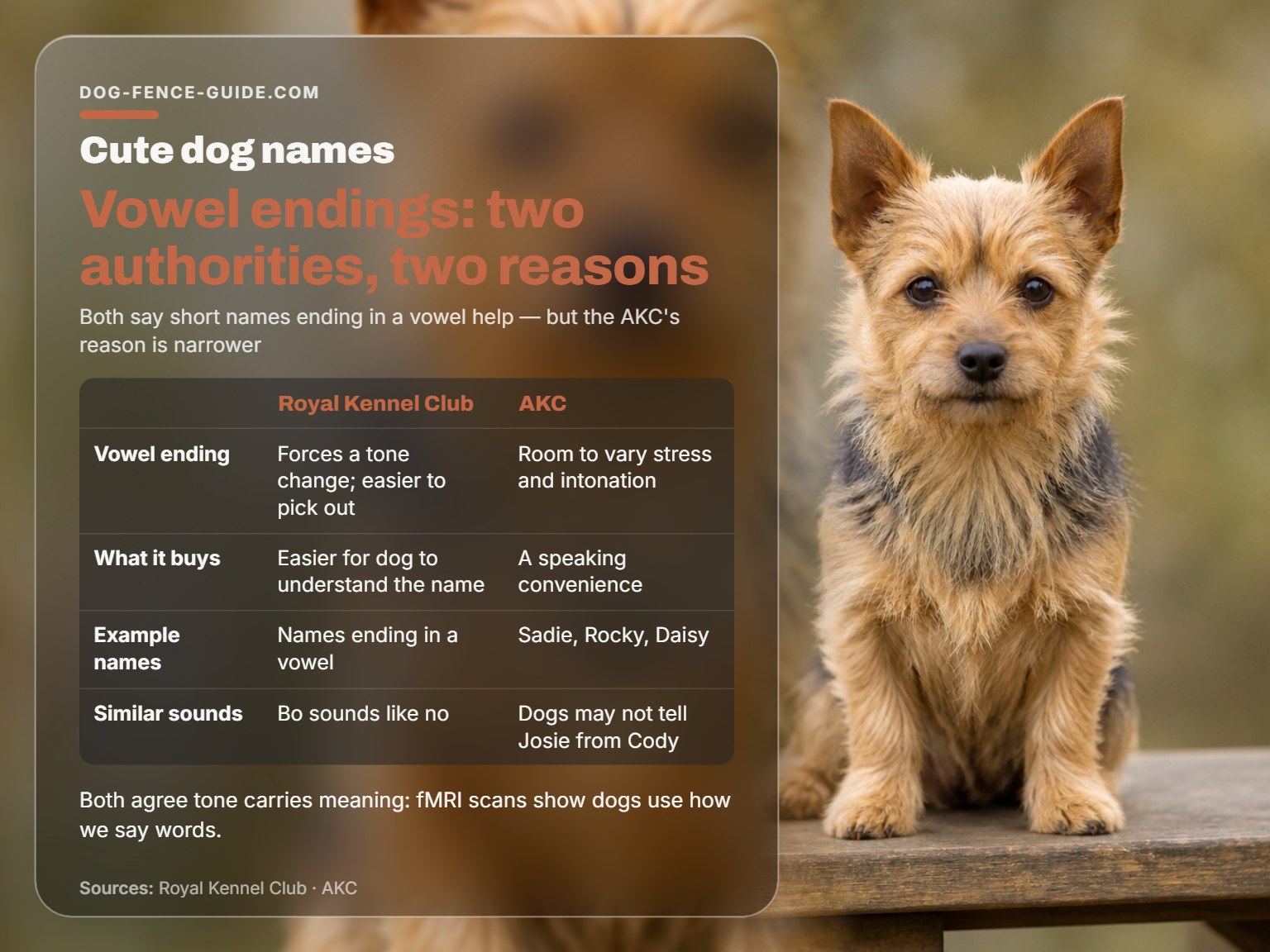
The Royal Kennel Club says yes, and gives a mechanism: a vowel ending forces you to change the tone of your voice, which makes the name easier for your dog to pick out among other words. The AKC’s version is narrower, vowel endings give room to vary stress and intonation, and its own research note says dogs may not differentiate similar speech sounds at all.
Two-syllable names ending in a vowel, like Sadie or Rocky, are the AKC’s version of the same advice. The AKC’s reason is narrower, though. It says two-syllable names ending in a vowel are great for varying stress and intonation. That’s a speaking convenience, not a claim that the dog parses the name better.
Then the AKC adds the line that complicates everything: recent research shows the average dog doesn’t differentiate between similar-sounding human speech sounds. So the vowel benefit is asserted by one authority, softened by another, and undercut by the same article that recommends it.
Where everyone does agree is that tone carries meaning. The AKC cites fMRI brain scan research showing dogs use the way we say words to fully understand what we mean, and the sources agree that tone carries meaning.
| Name shape | Example | What the sources say it buys you |
|---|---|---|
| Two syllables, vowel ending | Sadie, Rocky | Room to vary stress and intonation (AKC) |
| One syllable, hard consonant | Gus, Duke | Easier to notice in a noisy yard (AKC) |
| Three or more syllables | Sir Barks A Lot | Confuses the dog, per the AKC |
| Sounds like a cue | Kit, Mo, Bo, Joe, Poe | Confusion with sit or no (all four) |
For a starting shortlist, the girl dog names list is a reasonable place to begin if you already know the sex. The boy dog names list works the same way.
How to Test Cute Dog Names Before You Commit
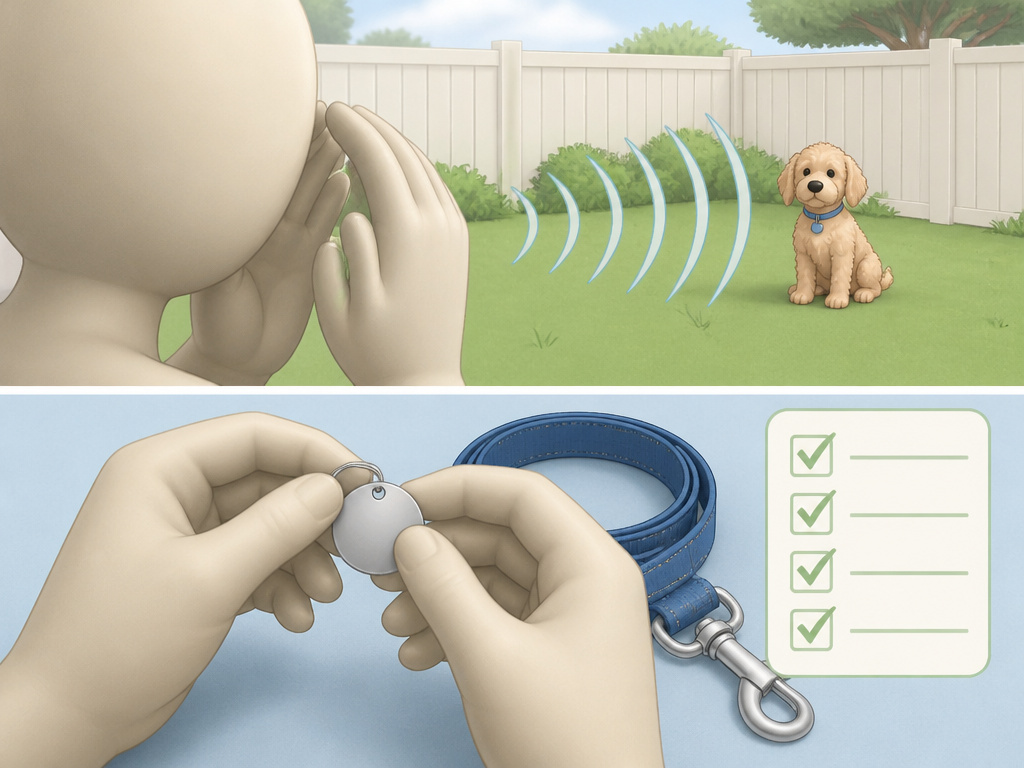
Four tests, in this order. None of them take long, and all of them happen before the name goes on a tag.
- Say it from the far corner of your yard. If you have to repeat yourself to be understood, the name is too soft for a recall. Wind eats soft consonants first.
- Pair it with your recall cue out loud. Skip this and you find out about a clash at the worst possible moment, in the middle of a street with traffic coming.
- Live with it for a day or two. The AKC suggests exactly that window. The Royal Kennel Club suggests trying a different name on each day if you’re torn between several.
- Run it past the household. The Royal Kennel Club’s example is Rob and Bob, which a dog may struggle to tell apart. The AKC’s is a daughter named Annie and a dog named Franny.
Two more checks that don’t fit neatly into a list. The AKC warns against a name that only suits a puppy, using Fuzzy as the example. And the AKC puts the stakes plainly: any name you give your dog is a 10-to-15-year commitment for the life of the dog.
The funny dog names list is worth a browse, with one caveat. A joke has to survive being shouted across a park. The unique dog names list is the antidote to the twelfth Max at the vet’s office. And if you’ve got a little dog, the small dog names list leans toward names that don’t sound oversized.
I test a name the way I test a gate latch: say it, then say it again from the other side of the yard. A latch that only works when you’re standing next to it isn’t a latch. A name that only works at three feet isn’t a recall.
You’ll know it’s working when the dog’s head turns before you finish the second syllable.
What 500 Puppies a Year Taught the Seeing Eye About Naming
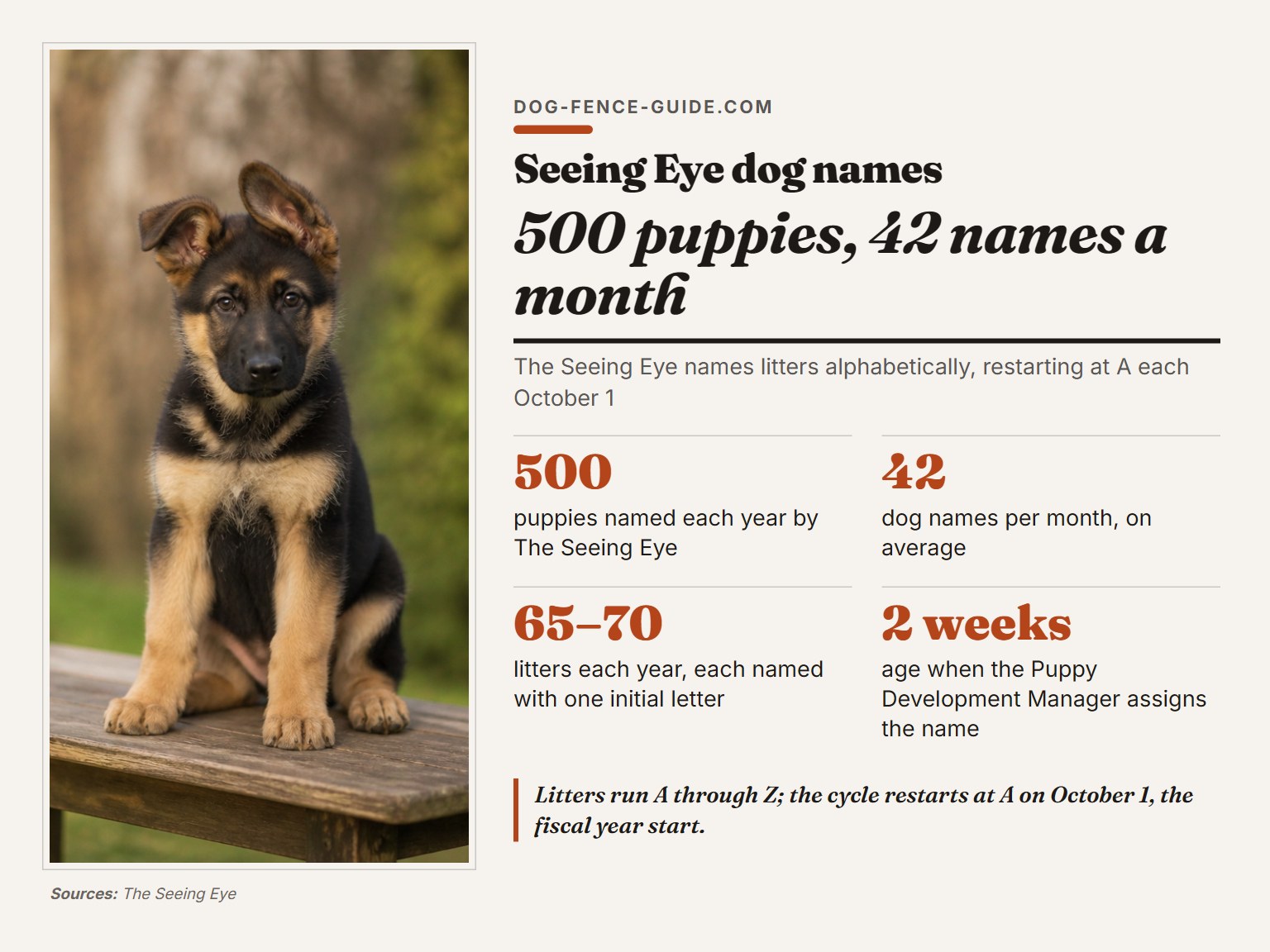
Five hundred puppies a year is about 42 names a month, and The Seeing Eye has to find all of them. The organization runs between 65 and 70 litters annually, which means the alphabet gets cycled through a couple of times a year.
The mechanics are worth understanding, because they show how much of naming is bookkeeping rather than inspiration.
- The initial letter is an internal tracking tool. Litters run A through Z, and the cycle restarts at A on October 1, the start of the organization’s fiscal year.
- Many names are chosen by Seeing Eye donors, so the person paying isn’t always the person naming.
- The tough letters force invention, since with letters like X or Z the namer has to get creative.
The Seeing Eye dog naming tips are the closest thing this topic has to an operating manual, and they come from an organization described as the oldest guide dog training school in the world.
There’s a piece of history attached to all of it. The first Seeing Eye dog was a German shepherd named Kiss. Morris Frank, a 19-year-old college student, renamed her Buddy. After his death in 1980, The Seeing Eye retired the name Buddy in her honor.
That reframes the whole exercise. For a guide dog, the name isn’t chosen by the person who’ll live with it. It’s assigned by letter, at two weeks old, often paid for by a donor.
A name is a cue before it’s a compliment. Pick the version your dog can hear, then keep the clever one for the family group chat.
Renaming a Rescue Dog Without Wrecking Their Recall
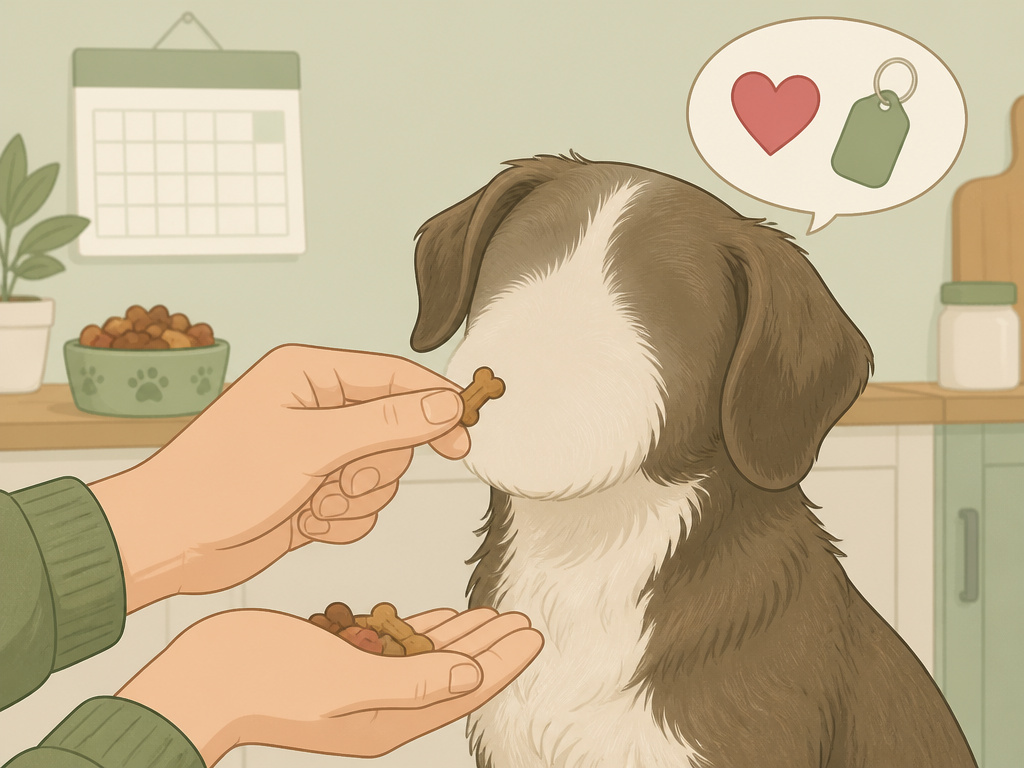
Two sources say opposite things about renaming, and both of them are right.
The Royal Kennel Club holds that changing an adopted adult dog’s name suddenly is confusing, and if you’re set on changing it, go with something that sounds quite similar, the way Arianna becomes Brianna. Pedigree UK takes the other view for puppies: they are often given a litter name, are unlikely to remember it, and you can introduce a new name straight away.
The split resolves once you look at who each source is describing. Pedigree is talking about a puppy going to a new home. The Royal Kennel Club is talking about an adult dog with an established name and months of reinforcement behind it.
Pedigree’s teaching method works for either case. Use the name a lot in a cheerful tone, reward immediately every time the dog responds, practise in different settings, and make sure every household member uses the same name and the same reward-based approach.
The renaming a rescue dog question comes up constantly, and the answer usually depends on how long the dog has had the old one.
Fair warning. A dog who has answered to one sound for three years has a lot of practice at it, and you’re asking them to start over.
The part nobody mentions: An adopted dog’s old name may be the only cue they arrived with. Swap it in one move and you’ve pulled their one reliable signal out of a strange house.
The Name Has to Survive a Tag
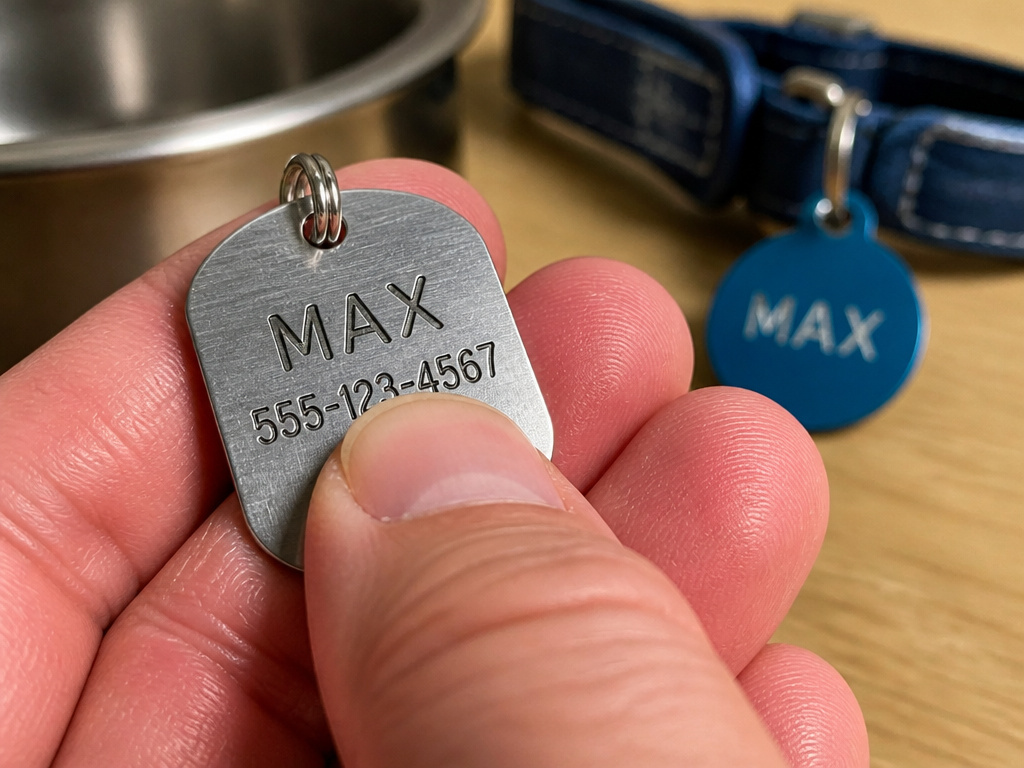
Whatever you land on has to work in three places: shouted across a yard, spoken calmly at the vet, and stamped on a piece of metal.
That third one gets skipped. A stamped stainless tag holds its lettering through years of rubbing against a collar and a water bowl. A silicone tag sits quieter against the collar, which matters if your dog sleeps in the same room you do. And a custom engraved tag will put a name and a phone number on one piece, which is the only thing that helps if the gate ever gets left open.
Start with your dog, not the product. A quiet tag on a nervous dog beats a loud one on any dog.
Easy to miss: The tag has to be readable by a stranger at arm’s length in bad light. Fancy fonts and long names both fail that test, and they fail it on the one day it counts.
Frequently Asked Questions
How many syllables should a cute dog name have?
One or two is the usual recommendation. The Seeing Eye keeps names to one or two syllables and only occasionally selects a three-syllable one. The AKC says one or two are usually best but allows longer names if they’re too good to pass up. The Royal Kennel Club asks for a double syllable.
Should a dog name end in a vowel?
The Royal Kennel Club says vowel endings are often easier for a dog to understand because they force a change in tone. The AKC’s version is narrower: two-syllable names ending in a vowel give you room to vary stress and intonation, a speaking convenience rather than a comprehension benefit. The AKC also notes research suggesting dogs may not differentiate similar speech sounds at all, so treat the benefit as unproven.
Is it bad if my dog’s name sounds like a command?
The Seeing Eye, the AKC, and the Royal Kennel Club all advise against it, though the AKC separately reports research showing dogs may not distinguish similar-sounding speech sounds, which weakens the rationale without settling the question. Their named examples include Kit and sit, Mo and no, Joe and no, Bo and no, and Poe and no.
Can I rename an older rescue dog?
The Royal Kennel Club says a sudden change is confusing for an adult dog and recommends a similar-sounding replacement, such as Arianna to Brianna. Pedigree UK says a new name can be introduced straight away for puppies who never learned their litter name. For an adult dog with years on the old name, the gentler approach fits better.
How long should I test a name before committing?
The AKC suggests testing a name for a day or two. The Royal Kennel Club suggests trying a different name on each day if you’re choosing between several. Both amount to living with the name briefly before it goes on a tag.
Should I pick a popular name or a unique one?
The AKC advises avoiding common names, warning about the twelfth Max at the vet and another Luna at the dog park, while its own registry data, drawn from purebred registration and mixed-breed enrollment, shows Max and Luna at the top anyway. A unique name reduces confusion at parks and training classes, which is the practical argument for it.
The Bottom Line
Before the name goes on a tag, walk to the far corner of your yard and call it. That single test settles more arguments than any list of rules, and it costs you the walk back.
One concession: none of this applies to a registered name. The AKC’s example is Ramblin’ Red Slamdunk Buckpasser, the Irish Setter who came second in the Sporting Group at the 2023 AKC National Championship. Registered names are for paperwork and pedigree. Call names are for the yard, and the yard has stricter rules.
Here’s the stance I’ll defend. I would rather see a plain, boring, two-syllable name that carries across a windy yard than a clever one that dies at the fence line. The clever name is for you. The plain one is for the dog, and the dog is the one who has to hear it.
