
How to Prevent Parvo in Puppies: Schedule and Bleach
This post contains affiliate links. As an Amazon Associate, we earn from qualifying purchases.
To prevent parvo in puppies, vaccinate from 6-8 weeks at 2-4 week intervals until past 16 weeks of age, keep the puppy off contaminated ground, and disinfect hard surfaces with one part household bleach to 30 parts water. Maternal antibodies block the vaccine until roughly 13-15 weeks, which is why the series runs so long.
Those maternal antibodies are borrowed protection, and they expire on their own schedule, which is central to how to prevent parvo in puppies. A puppy takes them in through the mother’s colostrum, and they keep circulating for weeks afterward. The AAHA puts the blocking window at 13-15 weeks, possibly longer. That one fact explains why a single shot at eight weeks does nothing measurable.
What follows is the schedule as four authorities actually write it, the dilution that inactivates the virus, and an honest answer on how long a yard stays hot.
Key Takeaways
- Start at 6-8 weeks and keep going past 16. The minimum age to begin is 6-8 weeks, and revaccination runs at 2-4 week intervals until the puppy is older than 16 weeks.
- Bleach at 1 part to 30 parts water is the published dilution, and it only goes on colorfast items.
- Shaded ground stays contaminated for seven months. Sunlit ground runs five months. Freezing does not clear either.
- A negative SNAP test does not rule parvo out, especially with vomiting, diarrhea, and lethargy already showing.
- The 18-20 week dose is the one people skip. AAHA prefers it in high-risk areas; AKC reserves it for kennels and rescues.
Why a Parvo Outbreak Starts in the Yard, Not the Clinic
A puppy noses a patch of grass where a sick dog defecated three weeks ago. Nothing about that patch looks different. The virus is still there, and the puppy picks it up by licking a paw.
Canine parvovirus is shed in feces, with viral shedding highest during the first two weeks after exposure. The virus survives freezing and many common disinfectants and persists in a contaminated area for up to seven months. Infection follows ingestion of contaminated material, and clinical signs appear three to seven days later.
Three things decide whether that patch makes a puppy sick: how many viral particles were there, how much immunity the dog carries, and what else is stressing the animal. The Indiana State Board of Animal Health lists all three as the determining factors. A well-vaccinated adult walks through the same grass and nothing happens.
Bleach on a concrete run smells sharp and faintly of a swimming pool for about an hour, then fades to nothing. The surface looks identical before and after. That is the part that fools people, because the work is invisible.
How to Prevent Parvo in Puppies When the Experts Disagree on the End Date
Six to eight weeks is the floor. Every authority agrees on the start.
The AAHA canine vaccination guidelines set the minimum age to begin the primary protocol at 6-8 weeks, then call for revaccination every 2-4 weeks until the puppy is past 16 weeks old. The reason is maternal antibody interference, not product weakness. The guidelines also note that CPV-2a, 2b, and 2c are 99% genetically similar, and current vaccines cover all three.
Where the four schedules agree
- Begin at 6-8 weeks. No source argues for later.
- Repeat every 2-4 weeks. A single dose in a young puppy is not a finished series.
- CPV vaccine is core for every dog, regardless of where the dog lives.
- Maternal antibodies are the obstacle. They decline on their own timeline, not yours.
Where they split
The end date is where the sources stop agreeing, and the difference matters if your puppy came from a shelter or a rescue.
| Source | Puppy series end point | Extra dose for high-risk |
|---|---|---|
| AAHA (2022) | Every 2-4 weeks until past 16 weeks | 18-20 weeks preferred in high-risk areas |
| AKC | Doses at 6, 8, 12 and 14-16 weeks | 18-20 weeks for kennels and rescues |
| PetMD | Every 3 weeks until about 16 weeks | Not specified |
| MedVet | Rounds at 6-8, 9-11, 12-14 and 16-18 weeks | Not specified |
AAHA treats the 18-20 week dose as preferred in high-risk areas. AKC narrows that to kennels and rescues. PetMD stops at roughly 16 weeks. MedVet runs a four-round schedule ending at 16-18 weeks, then a booster at one year.
If your puppy is in a shelter, a rescue, a kennel, or a neighborhood with active cases, ask the vet specifically about the 18-20 week dose. It is the cheapest insurance in the whole protocol and the one most often dropped.
The AAHA also attributes many or most so-called vaccine failures to incomplete primary schedules or to storage and administration errors. That is a useful thing to hold onto when a neighbor insists the shot “didn’t work.”
What Age Can a Puppy Go Out Safely?
Two credible sources give two different answers, and both are in writing.
The PDSA says a puppy is safe to go out for a walk and meet other dogs one to two weeks after completing its first vaccination course. PetMD says to limit or prevent access to dog parks, wooded areas, grooming salons, and pet stores. The Indiana bulletin lands closer to PetMD: dogs should not contact feces or other dogs when in a park or on the street.
If two credible sources disagree on the exact week, take the later one. A puppy that meets the world at 14 weeks instead of 12 loses nothing permanent. A puppy that picks up parvo at 12 weeks may not see 14.
Here is the honest version. Nobody has run the trial that would settle this, and the two positions come from different risk calculations. The PDSA is weighing the behavioral cost of a poorly socialized dog. PetMD is weighing the medical cost of a parvo case. Both costs are real.
The practical middle ground is protecting a puppy before vaccines are finished by controlling where the puppy’s feet go, not by keeping the puppy in a box. Carried contact, a clean friend’s vaccinated adult dog, and a hard surface you cleaned yourself are all different from a public park.
How Long Does Parvo Live in Soil, and Does Winter Kill It?
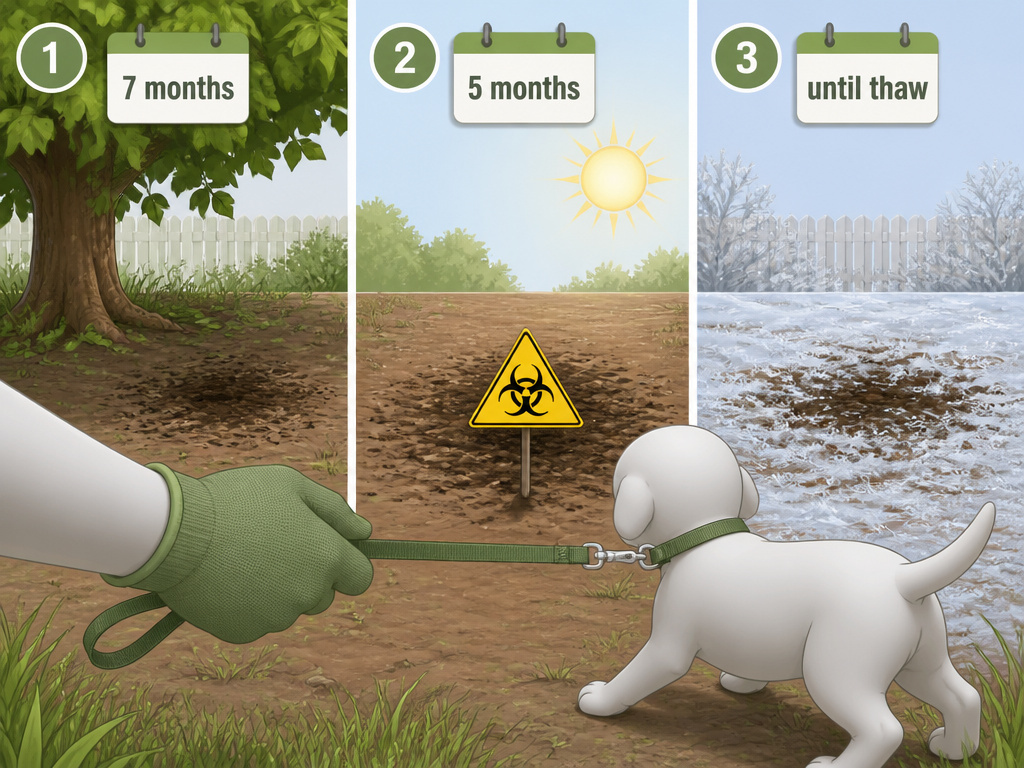
Seven months is the outside number, and it only applies to shade.
The Indiana BOAH canine parvovirus fact sheet is the only source in this set that puts actual numbers on environmental persistence. It also breaks the answer down by surface and sun exposure, which is more useful than a single figure.
| Condition | Contamination window | Source |
|---|---|---|
| Indoors, hard surfaces | About 1 month | Indiana BOAH |
| Indoors, carpeted | At least 30 days before a new puppy | Indiana BOAH |
| Outdoors, shaded | 7 months | Indiana BOAH |
| Outdoors, good sunlight | 5 months | Indiana BOAH |
| Outdoors, frozen | Until thoroughly thawed | Indiana BOAH |
| General environment | Months to years | PDSA |
Indoors: the one-month rule
The virus loses infectivity indoors in about one month. Carpet is the exception, and it is a big one. The bulletin calls for at least 30 days before a new puppy goes into a carpeted household, even after cleaning. Carpet holds organic matter down at the base of the fibers where a mop never reaches.
Outdoors: shaded, sunny, frozen
Shade keeps the virus alive longer because ultraviolet light degrades it. That is the mechanism behind the five-month versus seven-month split. A north-facing run under a fence line stays hot roughly two months longer than open lawn.
Frozen ground is the case that breaks the standard advice. Freezing protects the virus rather than killing it, so a contaminated site stays contaminated until the space is thoroughly thawed. A hard January does not clean a yard. It pauses the problem.
Easy to miss: A frozen yard looks clean. The ground is hard, the smell is gone, and nothing about it suggests anything is alive in there. Wait for the thaw before you decide the site is safe.
This is also where the sources genuinely part ways. The Indiana bulletin gives bounded numbers. The PDSA says parvo can remain in the environment for months to years and is almost impossible to remove entirely even after disinfection. Both are describing the same virus. One is describing a cleaned site, the other an uncleaned one. Plan for the longer number.
The Bleach Dilution That Actually Works (and What It Ruins)
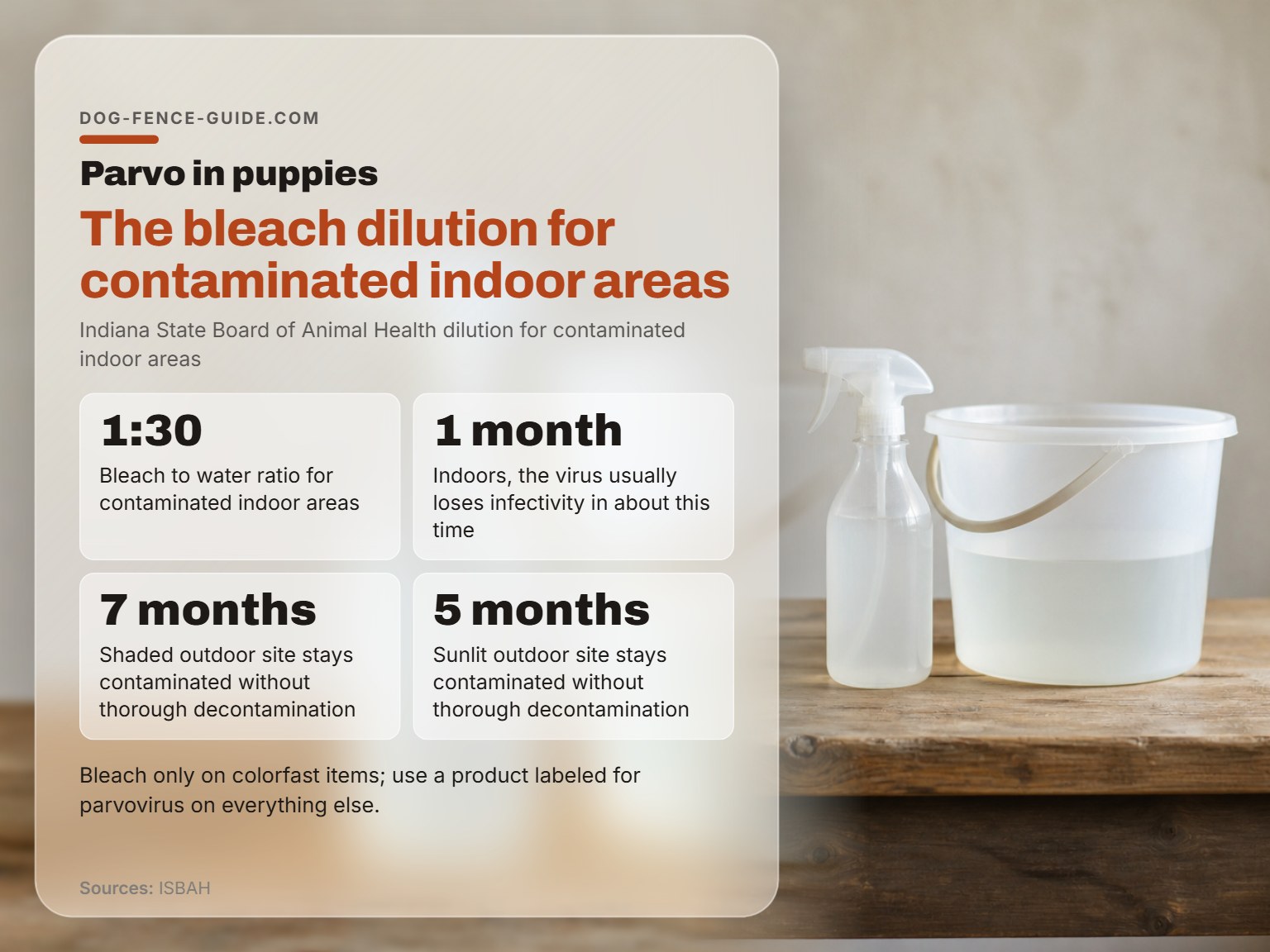
Household bleach at one part to 30 parts water is the mix the Indiana State Board of Animal Health publishes. Not a splash. Not a quarter cup in a bucket. One to thirty.
Before you start: Bleach burns skin and eyes on contact, so wear gloves and eye protection and work with ventilation. Never mix bleach with anything else, including other cleaners, because the fumes can be dangerous. Bleach permanently strips color from fabric, so test anything you care about on a hidden corner first.
The cleaning sequence
- Clear the solids first. Bag and bin all feces and vomit before you spray anything. Bleach works on a clean surface, and organic matter stops the mix from doing its job.
- Mix 1 part bleach to 30 parts water in a labeled sprayer, fresh for each job.
- Wet the whole surface and let it sit. Cover the entire area rather than spot-treating the visible mess.
- Limit bleach to colorfast items. The bulletin is explicit: bleach goes on colorfast surfaces or on items where a color change does not matter.
- Use a commercial product labeled for parvovirus on everything else. Bedding, soft toys, and non-colorfast fabric fall in this group.
Food and water bowls, toys, bedding, clothing, and shoes all need attention, not just the floor. The AKC notes that people move the virus on hands, clothes, and the bottom of shoes, which is why changing out of yard clothes matters more than most owners expect.
Rubber toys wipe down and go back in the crate. A fabric plush toy that sat in a contaminated yard goes in the bin, and no amount of washing makes that a safe decision.
For the indoor side of this, puppy-proofing your home and parvo cleaning overlap more than you would think. Both are about removing the porous things a puppy puts in its mouth.
Common mistake: Reaching for a general “pet-safe” cleaner and calling it done. A product has to be labeled for parvovirus specifically, or mixed at the 1:30 bleach ratio. A pleasant-smelling disinfectant that kills parainfluenza does nothing to CPV.
Which Puppies Face the Highest Risk?
The Indiana State Board of Animal Health publishes a breed list, and it is shorter than most owners expect.
- American pit bull terriers, Doberman pinschers, German shepherds, and rottweilers appear to carry increased risk.
- Cocker spaniels and toy poodles are listed as less susceptible.
- Puppies between 6 weeks and 6 months are the bulk of cases, per the AKC.
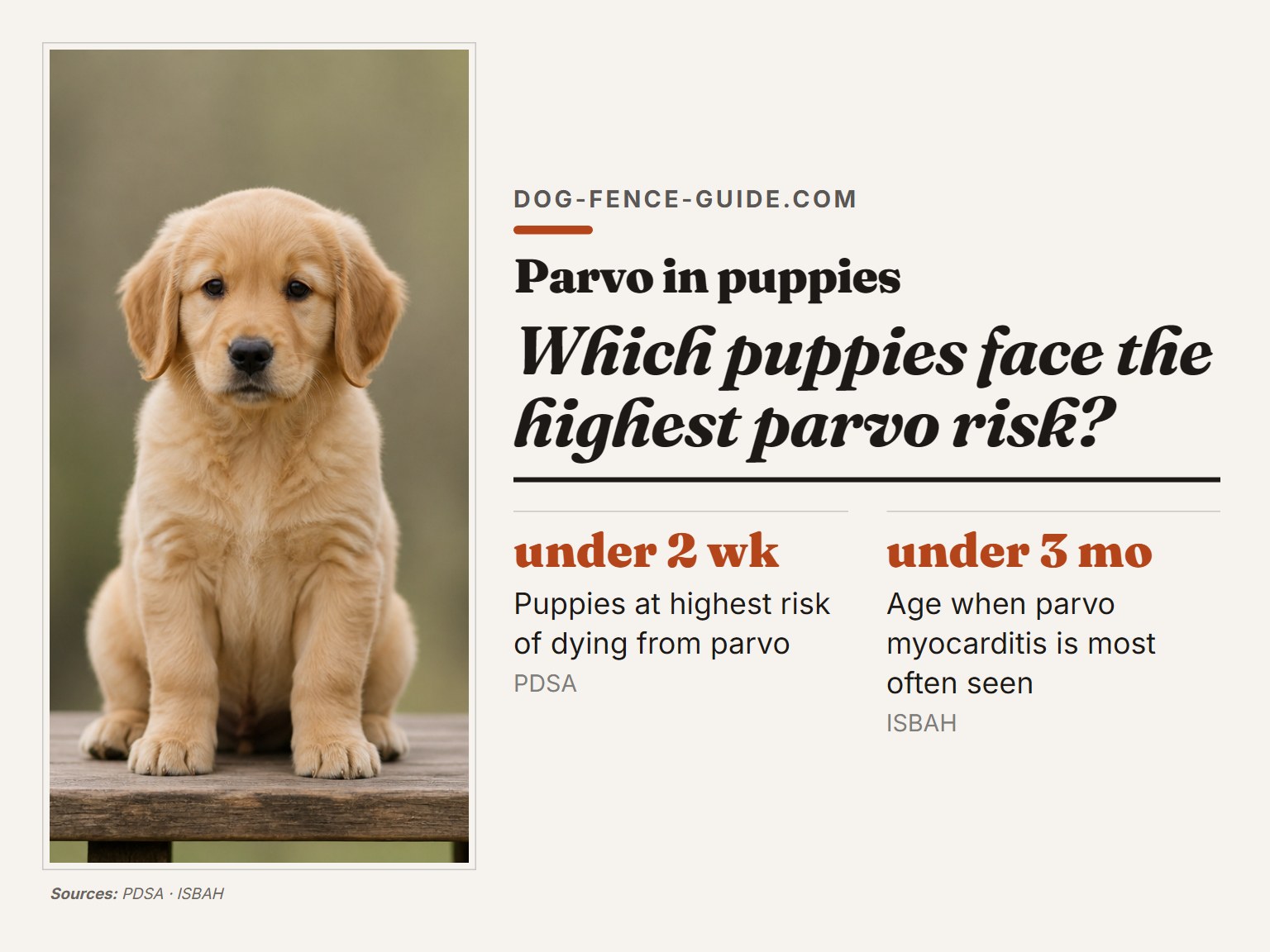
- Puppies under 2 weeks old are at the highest risk of dying, per the PDSA.
Breed risk does not change the vaccination schedule. It changes how careful you are about exposure in the meantime. A rottweiler puppy and a toy poodle puppy get the same shots on the same weeks, and one of them is walking into a higher baseline.
There is a second, less common form of the disease worth knowing about. Myocarditis, which is inflammation of the heart muscle, shows up most often in puppies under three months of age. Diarrhea is often absent in those cases, and puppies that survive usually carry permanent heart damage.
The survival numbers do not agree either. PetMD puts survival with prompt aggressive treatment at 85-95%. The AKC puts it at 68-90%. Without treatment, the AKC states that 90% of puppies do not survive. The window where death is most likely sits at 24-72 hours after symptoms appear, per PetMD, and 48-72 hours per MedVet.
If you are already past prevention and into symptoms, the parvo symptoms and treatment timeline is the thing to read next, and parvo treatment options covers what a vet can actually deploy. The AKC parvovirus in puppies guide also details Canine Parvovirus Monoclonal Antibody, approved for dogs 8 weeks and older and typically given as a single-dose IV.
One more thing worth knowing: parvovirus is species-specific. Humans cannot catch canine parvovirus from an infected dog, and dogs cannot catch the human form. That is one worry you can put down.
Bringing a New Puppy Into a Home Where Parvo Lived
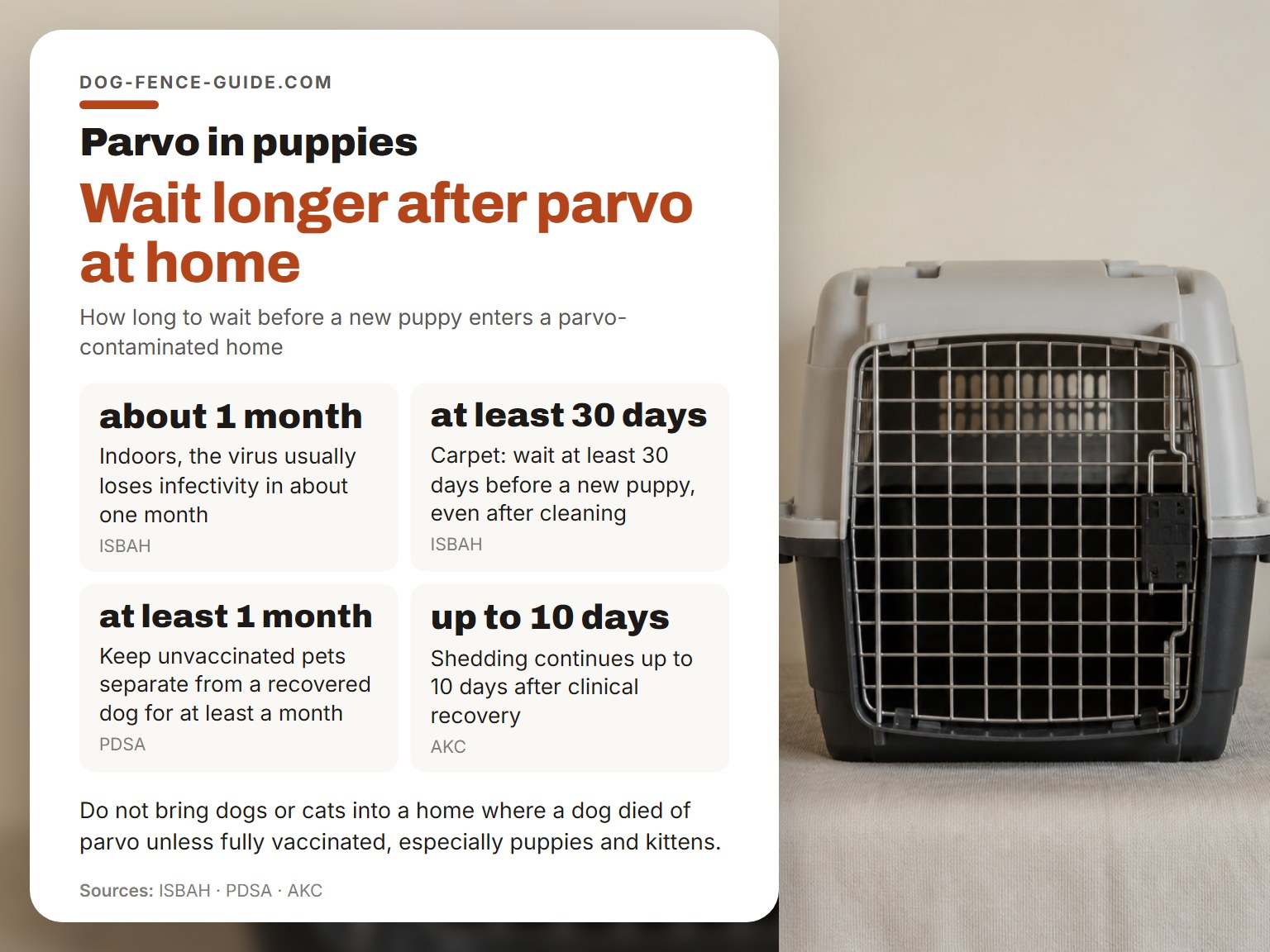
Wait longer than feels reasonable.
The PDSA is blunt about this one. Do not bring dogs or cats into a home where a dog died of parvo unless they are fully vaccinated, and that goes double for puppies and kittens. The PDSA also says unvaccinated pets should be kept completely separate from a recovered dog for at least a month after recovery and disinfection.
- Hard surfaces: about one month, per the Indiana bulletin.
- Carpet: at least 30 days before a new puppy, even after cleaning.
- A recovered dog: keep shedding in mind. The AKC notes shedding continues up to 10 days after clinical recovery, so quarantine runs through that window.
- A recovered dog’s future immunity: the PDSA says natural protection is likely but there is no evidence for how long it lasts, so keep vaccinating as the vet recommends.
A hard-sided plastic crate wipes clean, which is why it survives a parvo cleanup better than a fabric crate. If you are starting over in a house with a history, hard-sided and washable beats soft and comfortable every time.
For the weeks after the shots themselves, caring for a puppy after vaccination covers what is normal and what needs a call.
Frequently Asked Questions
Can a vaccinated dog still get parvo?
Yes. PetMD states plainly that vaccinated dogs can still get parvo, though the risk is significantly lower in fully vaccinated dogs. The AAHA attributes many or most failures to incomplete primary schedules or to storage and administration errors rather than to the vaccine itself.
Can humans catch parvo from a dog?
No. Canine parvovirus is species-specific. Humans can get a different type of parvovirus, but they cannot catch canine parvovirus from an infected dog, and dogs cannot get the human form.
How long after exposure do parvo symptoms appear?
Three to seven days. Both the Indiana State Board of Animal Health and PetMD give that incubation window. Shedding starts before that, with the AKC noting puppies are infectious within four to five days of exposure.
Does a negative parvo test mean the dog is clear?
No. PetMD warns that a negative SNAP ELISA test does not always rule out parvo, especially when vomiting, diarrhea, and lethargy are already present. A vet may send a sample to a lab if the result does not match the clinical picture.
What is the correct bleach ratio for parvo?
One part household bleach to 30 parts water, per the Indiana State Board of Animal Health. Use it on colorfast surfaces only, and use a commercial product labeled for parvovirus on anything that would be damaged by bleach.
The Bottom Line
Mix a sprayer at 1:30 this weekend, walk the fence line where the neighbor’s dog comes through, and check the gap under the gate. That is the whole job, and it takes twenty minutes.
Here is the concession. If you have a puppy under 16 weeks and a shared yard, or a house with a carpeted room where a sick dog spent a week, the cleaning math changes and the timeline stretches to a month or more. In that case the answer is not more bleach. It is a hard floor, a wire pen, and waiting.
Everything above assumes a puppy that is still healthy and still on schedule. How to prevent parvo in puppies comes down to two habits in the end: keep the shots on the calendar past 16 weeks, and keep the feet off ground you cannot vouch for.
