
How to Treat a Dog Burn: Step-by-Step First Aid
This post contains affiliate links. As an Amazon Associate, we earn from qualifying purchases.
To treat a dog burn, cool the wound with cool running water for at least 15 minutes, cover it with a non-stick dressing, and get the dog to a vet the same day. Skip butter, human ointments, and ice. Burns keep worsening for up to 72 hours, so a wound that looks minor now can look worse by Thursday.
The how to treat a dog burn 72-hour window is the part that surprises owners. A dog yelps, gets a rinse, settles down, and looks fine at bedtime. Then the wound declares itself two days later with a wet, angry edge and a smell you catch from the doorway.
What follows is the order of operations: how depth changes the plan, what to do in the first half hour, what never goes on the skin, how chemical and electrical burns break the usual rules, and the signs that mean you stop reading and drive.
Key Takeaways
- Cool for at least 15 minutes with running water, starting as close to the injury as you can; Clinicians Brief puts peak benefit within the first 2 hours.
- Skip butter, ice, peroxide, and human creams. PetMD and the AKC both warn that human topicals can be toxic to dogs, and the AKC flags peroxide as toxic to dog cells.
- Expect it to look worse before it looks better. Burns progress for the first 72 hours, so day one is a bad day to decide it’s fine.
- Above 20 percent of body surface area, a burn is severe, and at 30 percent or more the body mounts a systemic inflammatory response; burn shock can develop within 24 to 48 hours.
- Any broken skin under a collar contact point means the collar comes off until the skin is fully healed.
Burn Depth Decides the Treatment, Not the Yelping
A superficial burn on an ear and a full-thickness burn across the flank can both make a dog scream, and they need completely different care.
Burn depth is classified by which skin layers are damaged. Superficial burns involve only the epidermis and heal in three to five days without scarring. Superficial partial-thickness burns reach the superficial dermis, heal in one to two weeks, and scar minimally. Deep partial-thickness burns extend to the deep dermis and need two to three weeks, usually with surgery.
Depth is the first thing your vet assesses, because it decides whether you go home with a tube of cream or straight into surgery. Superficial burns involve the outermost layer only. They go red, they flake, and they heal on their own in 3 to 5 days with no scar.
| Burn depth | What it looks like | Healing time |
|---|---|---|
| Superficial | Red, dry, flaky, blanches under pressure | 3 to 5 days, no scar |
| Superficial partial-thickness | Mottled red, moist, blisters, painful | 1 to 2 weeks, minimal scar |
| Deep partial-thickness | Waxy white, leathery, reduced feeling | 2 to 3 weeks with surgery |
| Full-thickness | White, tan, or charred, painless | Surgery; scarring and tissue defects |
The two middle categories are where home care actually lives. Superficial partial-thickness burns blister, ooze, and hurt out of proportion to their size. Deep partial-thickness burns have reduced sensation, and full-thickness burns can be almost painless, because the nerve endings are gone.
Full-thickness burns look waxy white, tan, or charred, and the skin goes dry and leathery. Tug the hair and it lifts out in a clump. That’s a surgical burn, and it’s also the one owners most often mistake for a scab.
Fur hides most of this. PetMD points out that burns aren’t always recognized right away because the coat covers them, and some look like other wounds entirely. Your description of what the dog was doing an hour ago is worth more to your vet than your description of the wound.
Why Does the First Two Hours Matter More Than the Next Two Weeks?
The how to treat a dog burn clock starts at the moment of injury. Everything you do after that is playing catch-up.
Hydrotherapy is the clinical term for running water over a burn, and Clinicians Brief puts its peak usefulness at within 2 hours of injury. After that you’re still helping, but you’re managing damage rather than limiting it.
Here’s the mechanism, because it explains why 15 minutes matters so much. A burn creates three zones: a center of dead tissue, a ring around it where blood flow is failing, and an outer ring that recovers. Cooling in that early window is what keeps the middle ring from joining the center one.
Sources differ on water temperature: Clinicians Brief specifies chilled water or saline at 37.4°F–62.6°F, while the AKC advises cool (not cold) tap water.
Fifteen minutes of tepid water beats two hours of ice. The goal is to pull heat out of the tissue. Freezing what’s left of it doesn’t help.
AREN and the AKC advise keeping the burned dog warm with a blanket during transport, while Clinicians Brief focuses on cooling the wound itself. The AKC notes that large or deep burns can lead to hypothermia, so the dog goes into a blanket while the burn gets the water. AREN says the same thing: wrap the pet, then transport.
How to Treat a Dog Burn in the First 30 Minutes
Six steps, in this order. The order matters more than the speed.
Before you start: For an electrical burn, cut the power at the mains before you touch the dog. For a chemical burn, keep the runoff away from the eyes and mouth, and don’t let the dog lick the area. If the burn covers a large area, cool the wound only; cooling the whole dog can drop body temperature fast.
- Get the dog away from the source. A dog that stays near a hot muffler or a live cord will burn again while you’re hunting for a towel.
- Kill the power or contain the chemical. AREN is direct about this: electricity off at the mains switch before you touch the pet. For chemical burns, put the container in your pocket so the vet can read the active ingredient.
- Cool the wound with cool running water for at least 15 minutes. Two minutes under the tap feels like enough and isn’t. Heat keeps working into the tissue after the dog is off the stove.
- Skip ice, butter, and anything from the medicine cabinet. Cold constricts the vessels that are trying to keep the skin alive, and human creams can be toxic to dogs.
- Lay a non-stick dressing on the burn. Don’t wrap it. The AKC advises a non-adherent covering laid on rather than wrapped, while VCA notes that partial- and full-thickness burns are often covered with bandages changed daily in a sterile manner.
- Blanket the dog and drive. If the dog goes pale, weak, or wobbly on the way, that calls for treating a dog for shock, not more water.
The sources don’t agree on the exact endpoint, and it’s worth seeing the spread rather than pretending there’s one number.
| Source | Water temperature | Duration |
|---|---|---|
| Clinicians Brief | Chilled water or saline, 37.4-62.6 F | At least 15 to 30 minutes |
| AKC (Dr. Richardson) | Cool, not cold, tap water | 15 to 20 minutes |
| AREN | Cool running water, then a moist compress | Not specified |
Both clinical endpoints start at 15 minutes, and nobody in this set argues for less. Temperature is where they part company. Clinicians Brief’s range bottoms out at 37.4 F, which is close to freezing, while the AKC is explicit about cool rather than cold.
The American Red Cross pet burn guide adds a restriction the others don’t carry. Immersion is fine for a single burned limb, but immersing a dog with burns over a large area can cool the skin too quickly and trigger shock.
What Never Goes on a Dog Burn
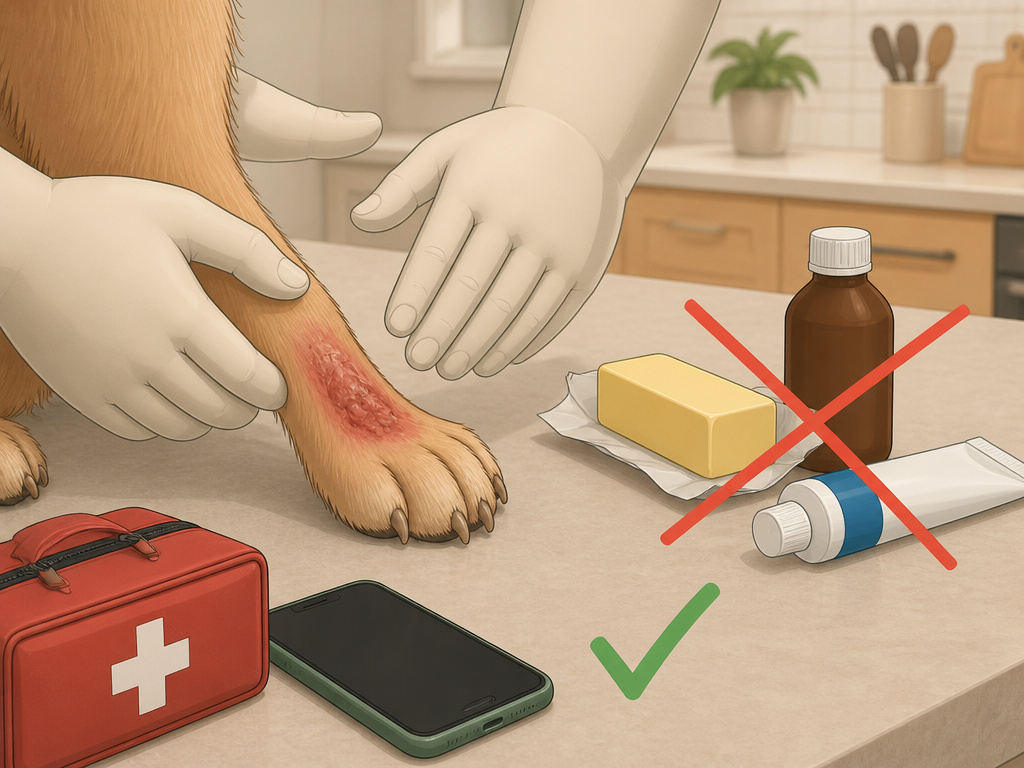
Every family has a burn remedy, and most of them were designed for human skin that isn’t covered in fur.
- Butter, oil, and grease. They hold heat against the skin and give bacteria something to eat.
- Hydrogen peroxide. The AKC notes peroxide is toxic to dog cells, which is the last thing an open burn needs.
- Human antibiotic creams. PetMD warns that human ointments and topicals often contain ingredients toxic to dogs.
- Ice and ice packs.
- Anything labeled “burn relief” on a human package.
Where the sources actually split is on who applies a topical, not whether topicals exist. Clinicians Brief lists 1% silver sulfadiazine cream as the most widely used option in veterinary medicine, alongside triple antibiotic ointment (neomycin/polymyxin B/bacitracin), mupirocin, and mafenide acetate. Those are vet-selected products applied to a wound the vet has already assessed.
PetMD and the AKC are both talking about what an owner reaches for in the kitchen at 9pm. The AKC’s line is that no topical goes on a dog burn without a vet’s input. That’s the one to follow at home.
Common mistake: Smearing a household cream on “to keep it clean” before the vet sees it. PetMD and the AKC both warn against it, and your vet then has to work out how much of what they’re looking at is the burn.
If your vet does send you home with a topical, the same rules that apply to any wound ointment apply here: thin layer, clean hands, and stop if the skin gets angrier.
Chemical, Electrical, and Contact Burns Each Break a Different Rule
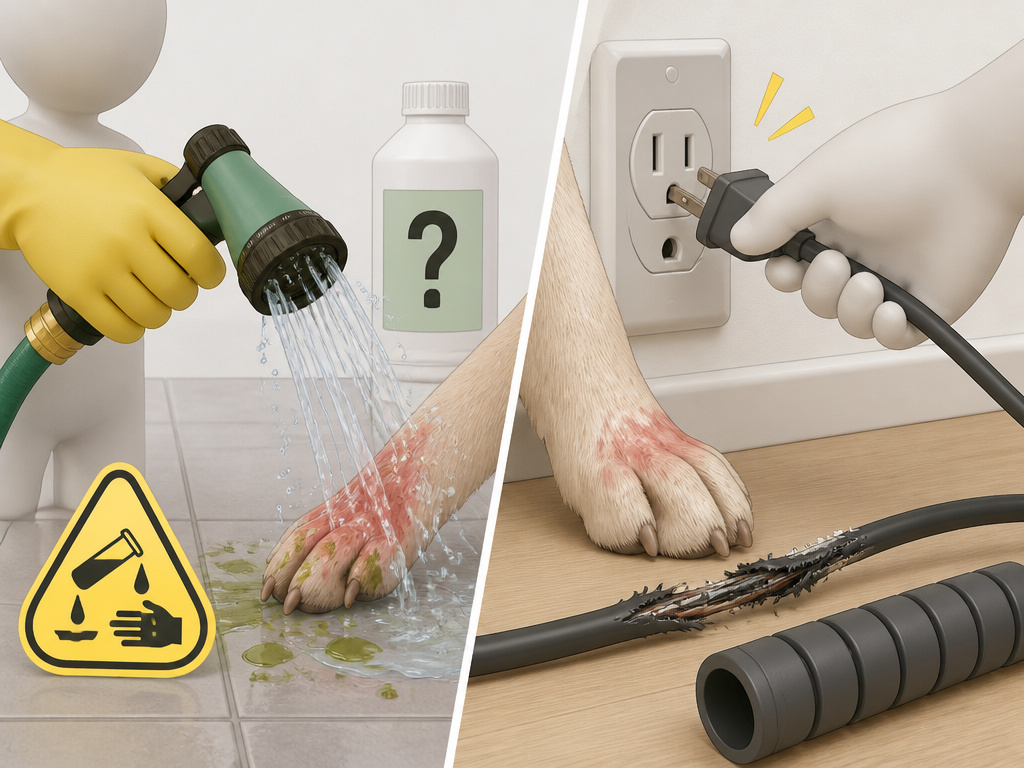
Thermal burns are the most common burns vets treat, per Clinicians Brief, but the other types each need a different first move.
Chemical Burns: Water Is Not Always the Answer
The sources flatly contradict each other here, and you should know that before you grab the hose. PetMD says chemical burn wounds will likely be flushed with large amounts of water. The AKC’s Dr. Kathleen Ham says there are some chemicals you don’t actually want to put water on, and that you should look up the substance first.
If you can’t identify the chemical, note that PetMD says chemical burns will likely be flushed with large amounts of water, while the AKC’s Dr. Ham warns some chemicals shouldn’t get water, so look up the substance first. Bring the container either way, because AREN’s instruction is to hand over the packet so the active ingredient can be identified.
Two rules hold regardless of the substance. Don’t let the dog lick the area, and don’t rub it. Once the chemical is off, the wound gets handled like any other; the same care you’d use to clean a dog wound applies, minus any scrubbing.
Electrical Burns: Cut the Power Before You Touch the Dog
A dog chewing a live cord is still connected to it. AREN’s instruction is to turn the electricity off at the mains before you put a hand on the pet.
PetMD names cord chewing as the most common cause of electrical burns in dogs, which makes this the most preventable burn on the list. A cord protector can reduce burn risks at home, which makes this the most preventable burn on the list.
Contact and Thermal Burns: The Ones That Happen in Your Kitchen
Clinicians Brief lists fire, hot liquids, heating pads, dryers, mufflers, and stoves among the causes of thermal burns. PetMD adds radiators, heat lamps, and hot pipes. These are ordinary objects on ordinary days, which is why they account for most of what vets see.
Pavement in summer is the same injury as a stovetop, just slower. If the pads are blistered or the top layer is peeling, that’s a cut paw pad problem as much as a burn, and it needs a dressing that won’t slide off.
Wrapping a paw is its own skill. Learning how to bandage a dog’s paw is worth doing before you improvise with a sock and tape, because a wrap that’s too tight does damage within hours.
When Is a Dog Burn an Emergency?
It’s Tuesday morning. The pink patch from Sunday now has a wet, dark edge, and the dog won’t let you near it.
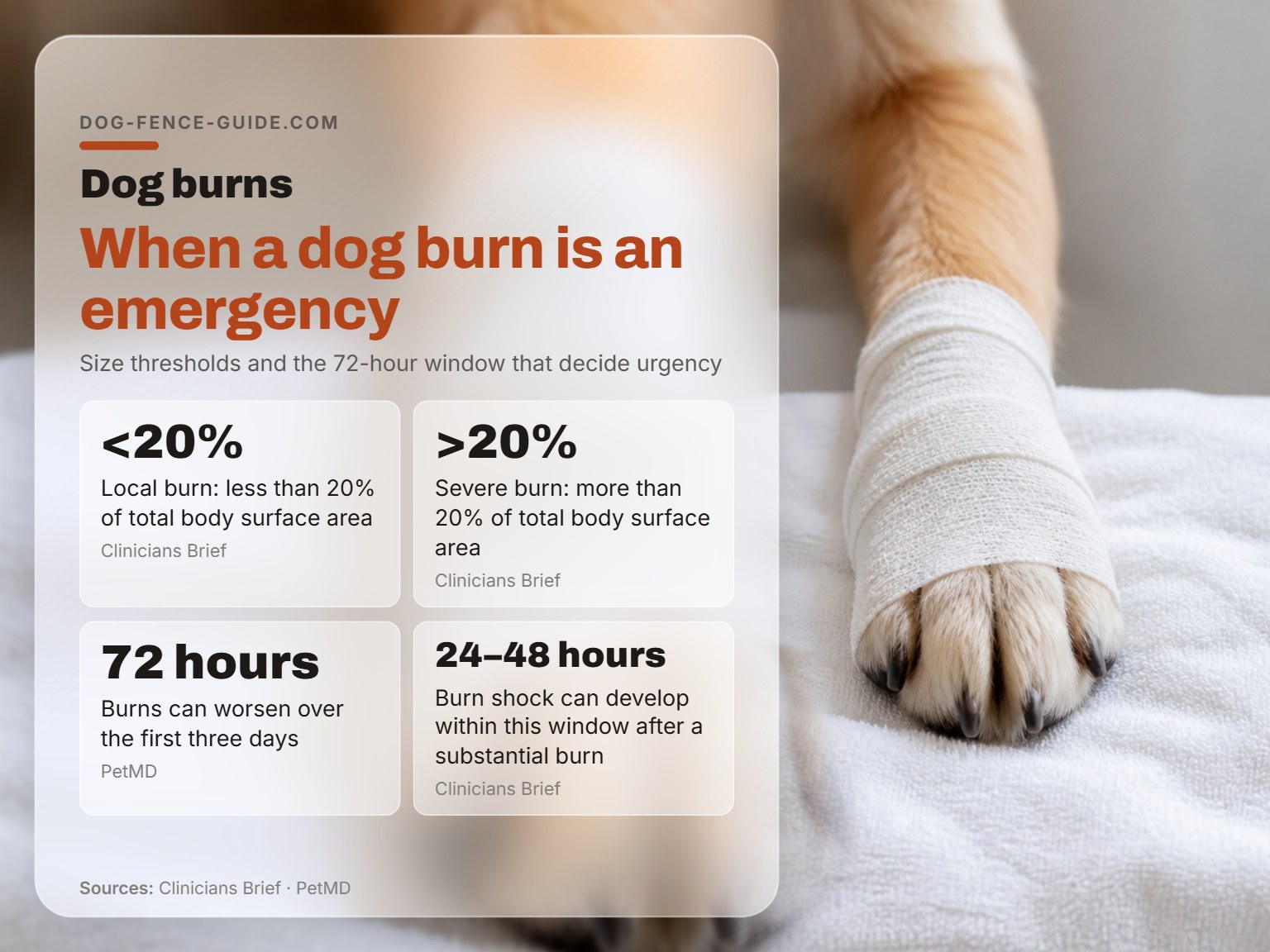
PetMD’s position is that every dog burn is a medical emergency and needs immediate veterinary care. That sounds like overkill until you read the reason: burns aren’t always obvious under fur, some look like other wounds, and they progress over the first three days.
Size is the other half of the call. Clinicians Brief classifies a local burn as involving less than 20 percent of total body surface area, and a severe burn as more than 20 percent, excluding sunburn-type superficial damage.
Here’s a detail almost nobody publishes. Clinicians Brief notes that no method for estimating total body surface area has been described in veterinary medicine, and that borrowing human body-diagram charts produces discrepancies. So when your vet says “about 15 percent,” that’s a clinical judgment. Nobody is measuring it.
Go now, not Monday, if any of these are true:
- The dog is pale, weak, or breathing fast. Burn shock can develop within 24 to 48 hours of a substantial burn.
- The burn is on the face, mouth, eyes, or anywhere near the airway.
- The skin is white, leathery, or charred, or the hair pulls out in a clump.
- The wound isn’t visibly improving after a few days, or the dog stops eating.
- The burn covers more than one body area.
Where this goes sideways: Waiting for the wound to “declare itself.” Burns progress for the first 72 hours, so the wound you’re looking at on Sunday isn’t the wound your vet will see on Wednesday.
Once the vet has seen it, home care is mostly about keeping the wound clean. The antiseptics for dogs question matters more than most owners realize, because the clinical dilutions are far weaker than what’s in the bottle.
Clinicians Brief lists chlorhexidine at 0.05% and povidone/iodine at 0.7% for wound cleaning. A dog wound antiseptic straight out of the bottle is many times stronger than that, which is why dilution is the whole conversation.
Pain is the other thing owners underestimate. Opioids are the standard for acute pain from severe burns, used intravenously in the acute phase. That’s a vet decision, and it’s the reason you don’t reach into your own cabinet for pain relief for dogs.
The Weekly Neck Check That Catches Collar Burns Early
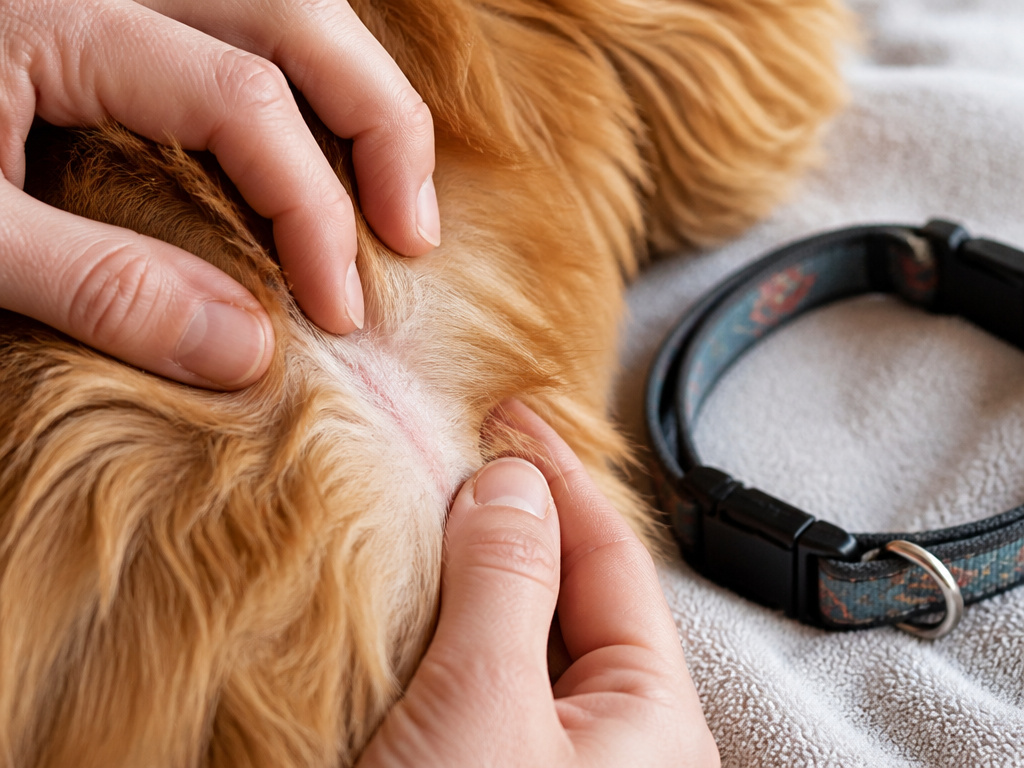
A collar that sits in one spot for weeks will eventually leave a mark, and you usually find it after the skin has already broken.
Heating pads and other heating devices are a documented cause of thermal burns in dogs, per Clinicians Brief. A device worn against the neck is the same physics at a lower temperature over a much longer time. Clinicians Brief also lists pressure necrosis among the conditions that mimic burns, which is the clinical way of saying a wound from pressure can look like a wound from heat.
Here is the honest version. If I find broken skin under a collar contact point, the collar comes off that day and stays off until the skin is fully healed. Loosening it just moves the pressure somewhere else on the neck.
I check necks at bath time, and that’s too long a gap during active training. The weekly check has to be its own habit, not something you remember while the dog is already in the tub.
Part the fur with two fingers and look at the skin directly. You’re checking for a bald patch, a shiny callus, or a pink line that wasn’t there last week. Once the skin is healing, a dog wound spray is easier to apply on a neck than a cream, simply because there’s less to rub in.
If the dog is scratching at it, a cone or a medical shirt does more than anything you can put on the skin. The AKC recommends both for exactly this reason.
Frequently Asked Questions
Should I put ice on a dog burn?
No. The AKC specifies cool water rather than cold, and ice constricts the blood vessels that are trying to keep the damaged tissue alive. Cool running water for at least 15 minutes does the job without adding a cold injury on top of a heat injury.
How long should I cool a dog burn?
At least 15 minutes. The AKC gives 15 to 20 minutes of cool tap water, while Clinicians Brief gives at least 15 to 30 minutes of chilled water or saline. Both start at 15, and Clinicians Brief puts the peak benefit window at within 2 hours of the injury.
Can I use Neosporin or Vaseline on a dog burn?
Not without your vet’s approval. PetMD warns that human ointments and topicals often contain ingredients toxic to dogs, and the AKC’s position is that no topical goes on a burn without veterinary input. The products vets do use, like 1% silver sulfadiazine, are chosen after the wound has been assessed.
How do I know if a dog burn is infected?
Watch for spreading redness, discharge, a bad smell, swelling, or a dog that stops eating. VCA Hospitals notes that if a burn looks infected, a culture and sensitivity test may be run to pick the antibiotic that actually works against the bacteria in that wound.
Will a dog burn heal on its own?
Superficial burns usually do, healing in 3 to 5 days with no scar. Superficial partial-thickness burns heal in 1 to 2 weeks with minimal scarring but carry a higher infection risk. Deep partial-thickness and full-thickness burns need surgical intervention, and full-thickness burns can be life-threatening.
Before You Go
The number worth keeping in your head is 20 percent. Below that, a burn is a local injury and the plan is cooling, a dressing, and a vet visit. Above 20 percent of body surface area, it is classified as severe, and at 30 percent or more the body mounts a systemic inflammatory response; burn shock can follow within 24 to 48 hours.
One concession: everything above assumes a dog you can handle. A frightened large dog with a burn on its flank is a two-person job, and if you can’t cool the wound safely, skip straight to the blanket and the car. Cooling a burn badly is worse than not cooling it at all.
This weekend, do one thing. Put a clean non-stick dressing and a bottle of water where you’d actually grab them, in the kitchen drawer and in the car. Two items you’ll reach for beat a kit you never open.
