
How to Clean a Dog Wound: Step-by-Step
This post contains affiliate links. As an Amazon Associate, we earn from qualifying purchases.
To clean a dog wound, flush it with large volumes of saline or warm tap water at 48 to 55 kPa (7 to 8 psi) from a 35-mL syringe and 19-gauge needle. Flush until the tissue looks glistening and debris-free. Skip hydrogen peroxide and alcohol, and stop any bleeding with 3 to 5 minutes of direct pressure first.
Pressure is the number that gets skipped, and it decides which direction the debris travels. Flush too gently and the grit stays in the pocket. Flush too hard and that same grit gets driven into healthy tissue, which is a worse problem than the one you started with. A bulb syringe handles a clean, shallow slice just fine. A torn pad off a fence line needs the harder stream, and knowing how to clean a dog wound means matching the pressure to the injury.
What follows covers the three rigs that hit that pressure target, the fluid arguments veterinarians still haven’t settled, and the wound types where the standard advice quietly changes.
Key Takeaways
- Volume does most of the work. The single biggest factor in wound lavage is how much fluid goes through the wound, not how hard it hits.
- 7 to 8 psi is the target, and a 35-mL syringe with a 19-gauge needle reaches it without a pump or a pressure bag.
- Hydrogen peroxide is out. MSD calls it toxic to healthy tissue; the AKC handout allows one use and nothing more.
- Chlorhexidine at 0.05% is the concentration with residual activity and minimal inflammation. Stronger solutions damage healing tissue.
- Discharge that stays bloody, green, or yellow for several consecutive days means a vet call, not another flush.
Volume Does Most of the Work. Pressure Decides Where It Goes.
Lavage is a plumbing problem. You’re moving material from one place to another, and the volume of water does most of that moving.
Wound lavage serves two purposes: it washes away visible and microscopic debris, lowering the bacterial load, and it allows better examination of the underlying tissue. Solution choice matters less than volume. Assuming the fluid is nontoxic, the most important factor is large volumes delivered at a pressure that lifts debris without driving it deeper.
The Joint Trauma System’s K9 clinical practice guideline cites 50 to 100 mL of fluid per centimetre of wound length, while noting that no formal standard volume exists. That’s a range with no official backing behind it, so treat it as a starting point.
A cut on a foreleg wants 50 to 100 mL of fluid per centimetre of wound length, which is the how to clean a dog wound volume most home flushes use a fraction of.
You can see the difference when you get it right. A properly flushed wound looks wet and slightly shiny, and you can see the bottom of it instead of a grey film of dirt and clotted blood.
The MSD Veterinary Manual’s guidance on initial wound management makes the same point: assuming the fluid is nontoxic, large volumes are what remove debris, and delivery pressure is what makes the volume effective.
Which brings us to the number.
How Much Pressure Should You Use on a Dog Wound?
The figure to aim for is 48 to 55 kPa, which is 7 to 8 psi.
You can’t measure that at a kitchen sink. What you can do is pick hardware that produces it, and there are three recipes in the veterinary literature that all claim the same pressure band.
| Rig | What you need | Source |
|---|---|---|
| Standard syringe | 35-mL syringe + 19-gauge needle | MSD Veterinary Manual |
| Field syringe | 20 mL syringe + 18-gauge needle or catheter | WVS Academy |
| Pressure bag | 1-litre bag, cuff at 300 mmHg, 16-22 gauge needle | JTS K9 guideline |
Pick whichever you can assemble tonight, because the how to clean a dog wound rig you actually have beats the rig you read about.
Too much pressure is a real failure mode. MSD warns that excessive pressure drives debris deeper into healthy tissue, which turns a surface contamination into a deep one. That’s the mechanism behind the whole pressure rule: the stream needs to lift material off the tissue bed, not inject it into it.
Too little pressure is the more common failure. MSD states that a bulb syringe is adequate for a clean wound, and that higher pressures are used in dirty or contaminated wounds. Match the tool to the wound, not to your nerves.
Common mistake: Reaching for a bulb syringe on a dirty wound. It’s the right call for a clean slice and the wrong one for road rash with grit packed into it.
If you want the field version, the Joint Trauma System K9 wound management guideline describes a 1-litre bag in a pressure cuff at 300 mmHg with a 16 to 22 gauge needle on an extension line. That guideline is written for military working dogs, not pets, so take the technique and leave the assumptions.
A 35-mL syringe is small enough to live in a dog first aid kit and big enough to hit the target.
Which Fluid Actually Goes in the Wound
Chlorhexidine diacetate at 0.05% is the concentration the veterinary literature keeps landing on, and it’s also the loudest disagreement in this entire procedure.
| Fluid | What the sources say | Watch out for |
|---|---|---|
| 0.9% saline | Least toxic to healing tissue; not antiseptic | No antibacterial action at all |
| Warm tap water | VCA’s first-line for most wounds | Saline still preferred where available |
| Chlorhexidine 0.05% | Sustained residual activity, minimal inflammation | Above 0.05% is tissue-toxic |
| Povidone-iodine | Effective antiseptic | Minimal residual activity; inactivated by pus |
| Hydrogen peroxide | Toxic to healthy tissue | Do not use for lavage |
MSD endorses chlorhexidine diacetate at 0.05% inside the wound, citing sustained residual activity against a broad spectrum of bacteria with minimal tissue inflammation. WVS Academy takes the opposite line: scrub the skin around the wound, but keep chlorhexidine out of the wound bed because it damages tissue and interferes with healing. The Joint Trauma System says the same thing, cleansing around the wound and not the bed.
Both positions come from people who treat wounds for a living. Cleaning at home, the conservative read is the safer one: WVS Academy and the Joint Trauma System advise chlorhexidine on the skin around the wound and saline through the wound itself, while MSD endorses chlorhexidine diacetate at 0.05% inside the wound. If you’re weighing dog wound antiseptics for a home kit, that distinction is the one that matters.
Stronger is not better here. MSD is explicit that solutions above 0.05% are toxic to healing tissue, and that gram-negative bacteria can develop resistance to chlorhexidine anyway.
Saline is the least toxic fluid to healing tissue, though it isn’t antiseptic. You can make it. VCA’s guidance on caring for open wounds in dogs gives the recipe as roughly one level teaspoon (5 mL) of salt or Epsom salt per two cups (500 mL) of water.
Tap water is the other argument. VCA recommends warm tap water for cleaning most wounds. MSD’s framing centres on saline as least toxic. The Joint Trauma System settles it in practice: tap water works in austere conditions when saline isn’t available, and studies show no increase in wound infection rate compared with saline.
So: saline if you have it, tap water if you don’t. The volume matters more than the label.
A word on the shelf of products sold for this. When you’re comparing dog-safe antiseptics, read the back of the bottle for the actual percentage rather than the front for the marketing line. Bottled antiseptic sprays are handy on a walk, but check what’s in them before you put one in an open bed.
The Step-by-Step: Cleaning a Wound Without Making It Worse
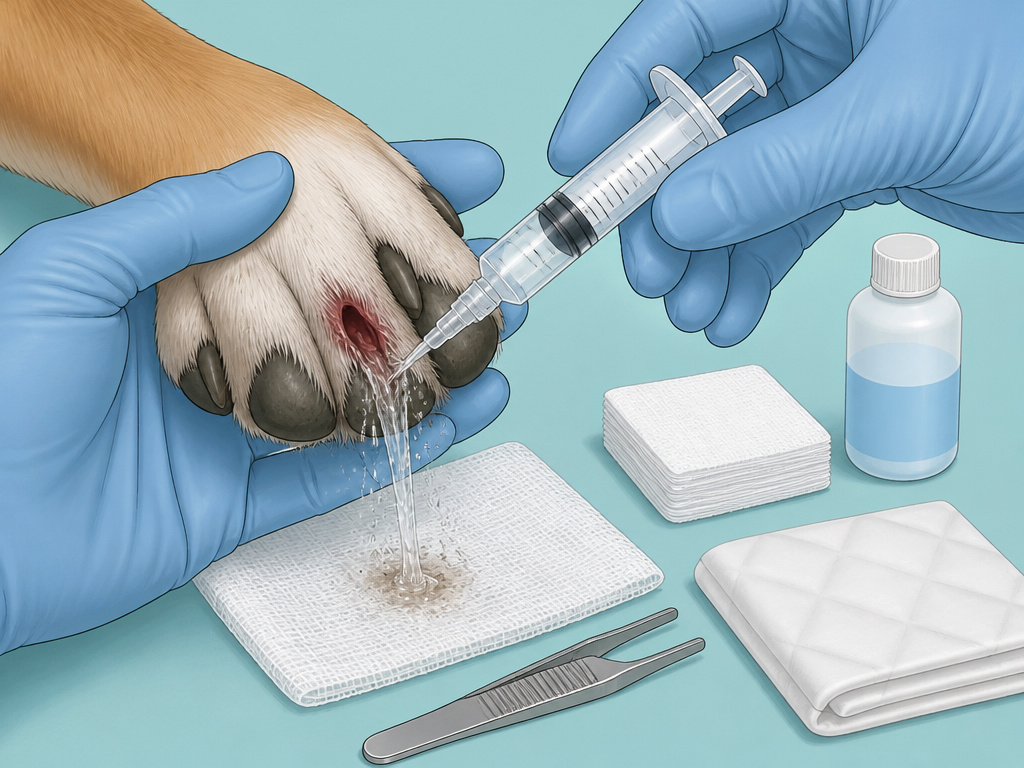
Before you start: A dog in pain bites, and a frightened dog bites harder, so muzzle or restrain before you touch the wound. Chlorhexidine above 0.05% and hydrogen peroxide both damage healing tissue on contact. Deep, spurting, or puncture wounds need a vet rather than a longer flush.
- Stop the bleeding first. Direct pressure with dry gauze for a minimum of 3 to 5 minutes. Peeking early restarts the clock.
- Restrain and muzzle. A dog in pain may react differently when you touch a torn pad.
- Cover the wound, then clip. Water-soluble gel or damp sterile gauze over the bed before the clippers come out. The gel or damp gauze helps prevent hair entering the wound during clipping.
- Scrub the skin, not the hole. Dilute chlorhexidine on a swab around the edges only. Chlorhexidine in the wound bed can damage tissue and interfere with healing.
- Flush with volume at pressure. 48 to 55 kPa, until the tissue is glistening and free of debris.
- Pick out the big pieces. Tweezers or a saline-soaked swab, gentle dabs only. Dab gently to avoid damaging healthy tissue.
- Cover it. A sterile, lint-free dressing, not a paper towel.
Expect a lot of runoff during the flush.
The AKC canine common sense wound care handout puts the direct-pressure minimum at 3 to 5 minutes and adds a detail most people skip: flush until the exposed tissue is glistening and free of debris, not until it looks clean enough.
Easy to miss: Clipping before covering. Hair goes into the wound, and you spend the next ten minutes flushing out what you just added.
If pressure isn’t holding after several minutes, the steps for stopping bleeding from a dog wound go further. MSD recommends a pneumatic cuff or pressure wrap rather than a narrow tourniquet for severe arterial bleeding, inflated until the hemorrhage is controlled, because narrow tourniquets carry neurovascular risk. The AKC handout treats a tourniquet as a last resort for bleeding that direct pressure can’t touch, while MSD recommends a pneumatic cuff or pressure wrap rather than a narrow tourniquet.
Should You Use Hydrogen Peroxide on a Dog Wound?
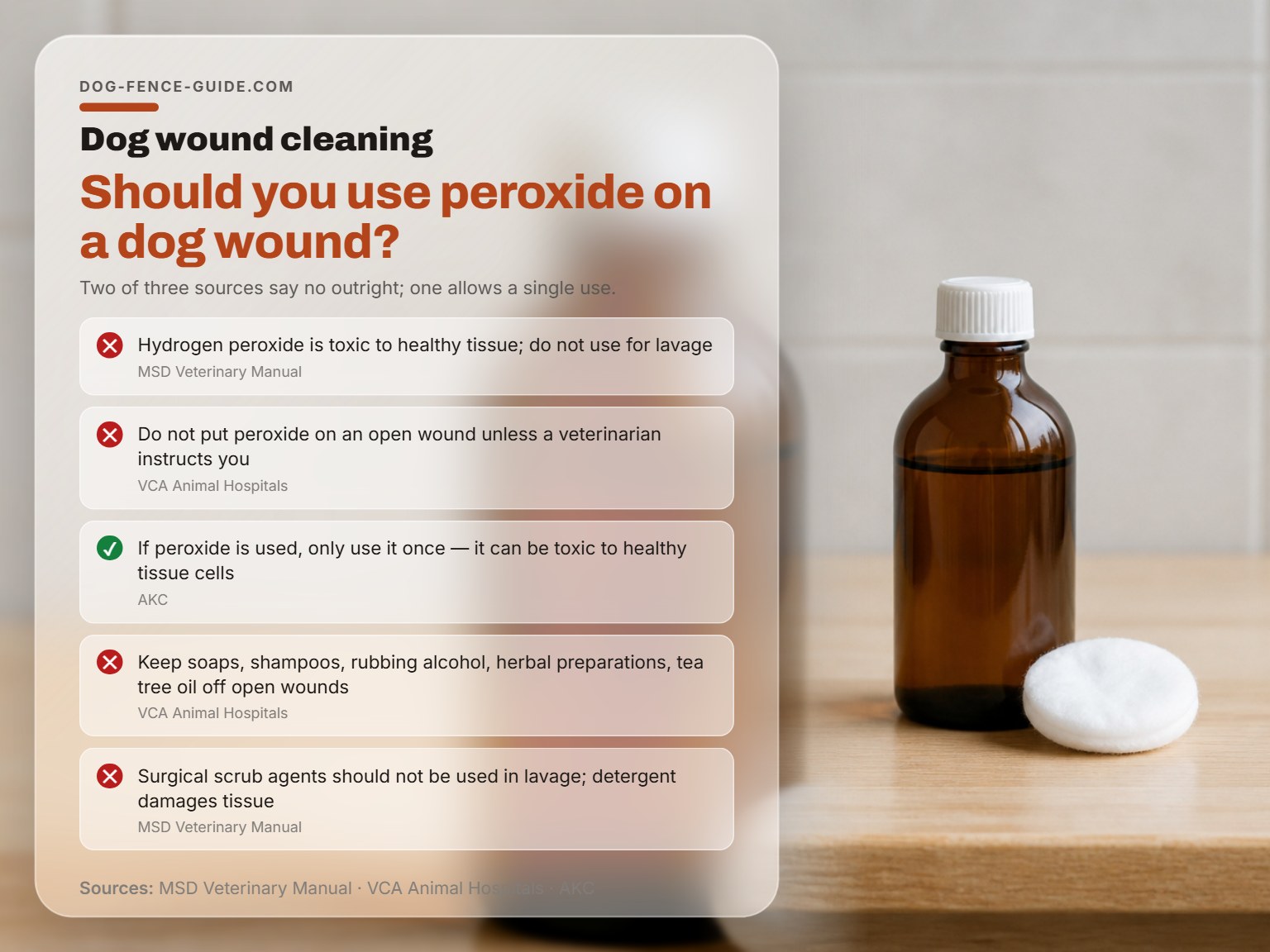
The sources don’t agree about peroxide, and the shape of that disagreement tells you more than any single recommendation.
MSD is flat: hydrogen peroxide is toxic to healthy tissue and should not be used for lavage of wounds. VCA says don’t put it on an open wound unless a veterinarian instructs you to. The AKC handout is the outlier, permitting a single use while conceding it can be toxic to healthy tissue cells.
That single-use allowance is the loosest position in the group. Two of the three sources say no outright.
The same logic covers the rest of the bathroom cabinet. VCA lists soaps, shampoos, rubbing alcohol, herbal preparations, and tea tree oil as things to keep off an open wound. Surgical scrub belongs on the skin around the wound, not in it, because the detergent components damage tissue. MSD goes further and says scrub agents shouldn’t be used in lavage at all.
The short version: If you can’t state the concentration of an antiseptic, don’t put it in a wound.
If you want something to spray, the dog wound sprays worth keeping are the boring ones: saline, nothing added, no guessing at strength.
Povidone-iodine is an effective antiseptic. MSD notes it has minimal residual activity and gets inactivated by purulent debris, so it’s a one-shot treatment that fades as discharge builds up.
And whether to add antimicrobials to lavage fluid at all is, in MSD’s word, controversial.
Puncture Wounds, Bite Wounds, and Cut Pads: Where the Standard Advice Changes
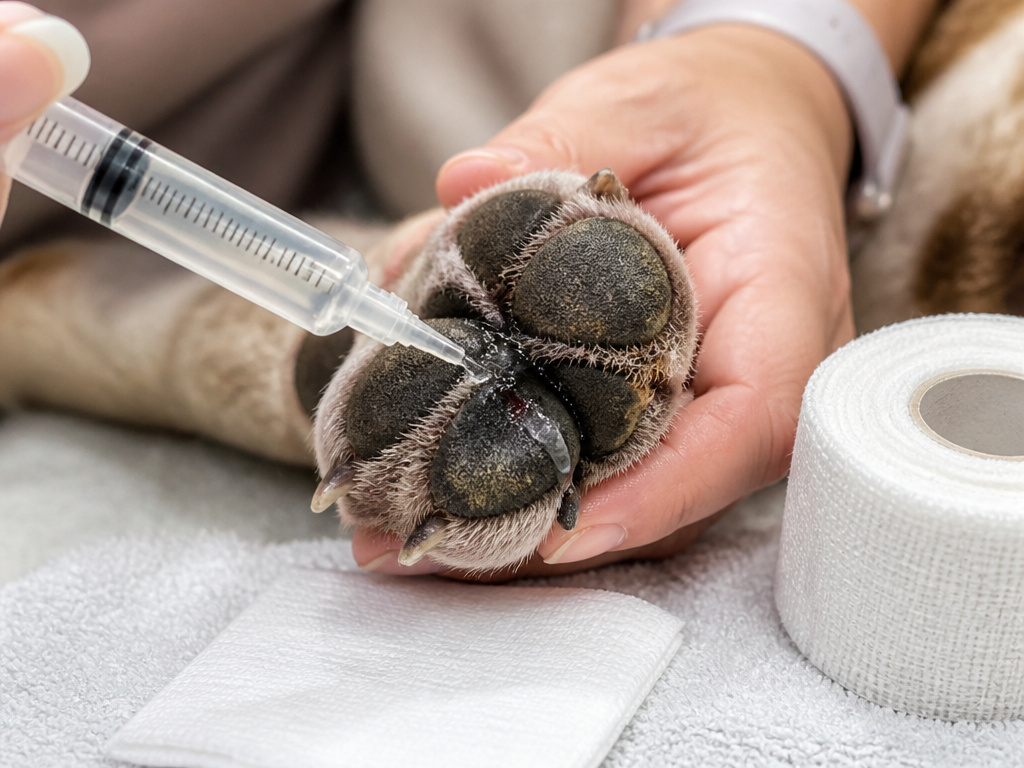
A nail through the pad leaves a hole the size of a pinhead and a pocket of grit you can’t see, and the hole closes over it by morning.
Bite and Puncture Wounds
The AKC handout advises enlarging a puncture opening with scissors or hemostats where possible, then irrigating thoroughly. Punctures are rarely sutured and are kept open to drain, so healing runs from the inside out.
The Joint Trauma System is more specific about timing. Contaminated and dirty wounds, especially bite wounds, shouldn’t be closed until healthy granulation tissue forms, which takes about 3 to 5 days.
Foreign bodies stay where they are unless they come out easily. Digging for a thorn you can’t see does more damage than the thorn.
Cut Paw Pads
A cut pad is a case where ointment is often skipped. Flush with saline, pat it dry, and bandage with a non-stick pad and wrap. A non-stick pad helps avoid the dressing sticking to the wound.
That matches the general shape of the evidence. The AKC handout notes that topical medications are rarely curative and can delay healing in some cases.
A cut paw pad needs padding under the wrap as well as over it, or the dog puts weight straight back on the injury. Learning to bandage a dog paw on a dry leg beats figuring it out on a bleeding one.
When the Wound Should Stay Open
The old rule that a wound had to be closed within 6 hours is gone. The Joint Trauma System removed that timeline from its guideline and now weighs wound location, size, and the patient’s overall health instead.
VCA’s position is that a wound gets closed and sutured wherever possible to speed healing, and left open when there’s gross contamination or deep infection. Those two positions sit closer together than they look.
What the Wound Should Look Like on Day 3

As the wound heals you should be able to see the bottom of it.
Healthy granulation tissue is pink to beefy red and finely bumpy. It’s the tissue the Joint Trauma System waits for before closing a contaminated wound, and it’s what you’re checking for each morning.
Call the vet if you see any of these:
- Discharge that stays bloody, green, or yellow for several consecutive days
- A wound getting more swollen and more painful instead of less
- Any puncture or bite wound, on day one, since antibiotics are usually indicated
- A bandage soaked through or slipped
Bandages come off and go back on at least once daily, and more often if discharge is heavy or the wrap gets soiled. Once discharge drops and a healthy granulation bed forms, the Joint Trauma System moves to every 2 to 3 days. VCA’s owner-facing guidance sticks with daily changes.
This is where dog wound ointments earn their reputation or lose it. VCA says a vet may prescribe an antibiotic cream. The AKC handout says topical medications are rarely curative and can delay healing. The Joint Trauma System puts silver-impregnated dressings first for infected wounds, with a non-adherent pad and antibiotic ointments as the fallback when silver isn’t available.
If a plain tube of antibiotic ointment is your default, know that the ointment can trap debris in a wound that still needs flushing. Saline first, ointment only on a vet’s instruction.
The licking question splits the same way. VCA says don’t let the dog lick or chew the wound and that many dogs need an Elizabethan collar. The AKC handout takes a softer line, saying licking won’t hurt unless it’s excessive but will strip off whatever you applied. The practical answer either way is a cone.
One more thing while the wound heals: if your dog wears a training collar or an e-collar for other reasons, take it off for the duration and check the neck regularly. Pressure sores from a collar left in one spot are slow to heal and easy to prevent.
Frequently Asked Questions
Can I use tap water to clean a dog wound?
Yes, for most wounds. VCA recommends warm tap water as a first-line cleaner, and the Joint Trauma System notes that tap water used in austere conditions shows no increase in wound infection rate compared with saline. Saline is still the least toxic option to healing tissue, so use it when you have it.
How often should I change the bandage?
At least once a day, and more often if the wound is discharging heavily or the wrap gets soiled. Once discharge drops and a healthy granulation bed forms, the Joint Trauma System moves to every 2 to 3 days.
Is Neosporin safe for dogs?
Ask your vet before applying it. VCA notes that a vet may prescribe an antibiotic cream, while the AKC handout says topical medications are rarely curative and can delay healing in some cases. Some dogs react to the carrier ingredients, and ointment can trap debris in a wound that still needs flushing.
How do I know if a wound is infected?
Discharge that stays bloody, green, or yellow for several consecutive days is VCA’s trigger for a vet call. So is a wound that gets more swollen and more painful instead of less over the first few days.
Should a puncture wound be left open?
Usually, yes. The AKC handout notes that punctures are rarely sutured and are kept open to drain. The Joint Trauma System advises against closing contaminated or dirty wounds, especially bite wounds, until healthy granulation tissue forms in about 3 to 5 days.
Do I need antibiotics?
For dirty, infected, or puncture wounds, MSD says antimicrobial treatment should be started, with a first-generation cephalosporin generally recommended pending culture results. The Joint Trauma System recommends at least 7 days for moderate to severe wounds, under veterinary oversight.
The Bottom Line
The flush is the whole procedure. Everything after it, the scrub, the ointment, the bandage, is secondary to getting a lot of the right fluid through the wound at a pressure that lifts debris instead of burying it.
The trigger to remember is discharge. Bloody, green, or yellow for several consecutive days means a vet call, not another flush.
And the limit of all this: none of it covers a wound that’s deep, spurting, or on a dog that’s pale and shaky. Those go to a vet before anything above matters.
Put a 35-mL syringe and a 19-gauge needle in the kit and practise the flush on a clean sponge in the sink.
