
Poodle vs Labradoodle: Which Is Right for You?
This post contains affiliate links. As an Amazon Associate, we earn from qualifying purchases.
In the poodle vs labradoodle decision, the Poodle is the predictable dog and the Labradoodle is the gamble. The AKC and FCI define Poodle size by height, and its coat is fixed by two genes. The Labradoodle has no kennel-club standard at all, so coat, shedding, and adult size vary from litter to litter.
That missing standard is the whole story. Every Labradoodle number you read is a sample rather than a definition. A breed standard fixes height at the withers and stays silent on weight, which is why the weight figures wander so much from site to site. The coat behaves the same way: a Poodle’s curl is written into its genes, and a Labradoodle’s is a coin flip you can’t call until the adult coat arrives.
What follows walks through the standards, the coat genetics, the grooming schedules that don’t agree, and what all of it means when you’re standing in your own yard with a collar in your hand.
Key Takeaways
- The Poodle is the predictable choice. The AKC and FCI define its size by height, and its coat is fixed by two genes.
- The Labradoodle has no kennel-club standard. Adult size, shedding, and coat type vary between littermates.
- No breed is hypoallergenic, per AAAAI. Allergens are Can f 1 proteins in dander, saliva, and urine, not shed hair.
- Plan grooming by coat, not by breed name. A wool Labradoodle needs Poodle-level upkeep; a hair coat needs less.
- Health odds are closer than the marketing suggests. A 2024 RVC VetCompass study found disorder prevalence largely similar between designer crosses and purebreds.
Poodle vs Labradoodle: what the standards settle and what they leave open
FCI Standard No. 172 is the only internationally binding Poodle standard, and it defines four sizes by height at the withers rather than by weight.
The FCI Standard No. 172 defines four Poodle sizes by height at the withers: Standard over 45 cm to 60 cm, Medium 35 to 45 cm, Miniature 28 to 35 cm, and Toy 24 to 28 cm. The AKC recognizes three varieties and specifies no weight at all. No kennel club standard exists for the Labradoodle.
The AKC’s version runs on three varieties and one hard rule. Any Poodle over 15 inches at the highest point of the shoulders is a Standard, whatever its parents were.
Neither standard gives a weight range.
The Labradoodle side has nothing equivalent. The Australian Labradoodle Association and IALA publish a breed development standard for the Australian Labradoodle, a multi-generation fixed line, and that document is a private registry standard with no FCI recognition. It doesn’t cover the F1 Labrador and Poodle cross that most people mean when they say Labradoodle.
I’d begin every comparison here, because a standard is the only thing that lets you predict what you’re bringing home.
| Attribute | Poodle | Labradoodle |
|---|---|---|
| Breed standard | FCI No. 172 and AKC, both by height | None from FCI or AKC |
| Size predictability | High; height bands defined | Low; varies by Poodle parent and litter |
| Coat | Single curly coat, set by RSPO2 and KRT71 | Hair, fleece, or wool; not predictable by label |
| Shedding | Very low | Wide range, from minimal to Labrador-level |
| Grooming load | High | Moderate to high, depends on coat |
| Health screening | Poodle Club of America recommends genetic and orthopedic tests | No shared baseline; varies by breeder |
Why a Labradoodle’s coat is a coin flip and a Poodle’s isn’t
Two genes decide the coat, and the difference between the breeds is which copies they carry.
Cadieu and colleagues, writing in Science in 2009, found that a dog needs at least one copy of RSPO2, the furnishings gene, and at least one copy of KRT71, the curl gene, to grow the tight low-shedding Poodle coat. Labrador Retrievers carry neither. That single fact explains the F1 problem, because the Labrador parent contributes no furnishings allele and the litter can’t reliably produce a non-shedding coat.
Run your fingers into a wool coat and it’s dense and slightly cool at the base, with nothing coming away on your hand. A hair coat leaves loose strands on your sleeve.
What F1, F1B, and F2 actually mean
OodleLife puts F1 at 50 percent Poodle and 50 percent Labrador, F1B at 75/25, and F2 at 87/13. Canine Journal describes F1B as an F1 bred back to a purebred Poodle, which lands at roughly 75 percent Poodle ancestry.
Those labels describe ancestry. They don’t guarantee a coat, and Canine Journal says so directly: even dogs with more Poodle ancestry may shed.
The three coat types IALA lists work like this:
- Hair: wavy and closer to a Labrador coat. F1 litters are the most likely to throw it, and it sheds the most.
- Fleece: soft and wavy or loosely curling, sitting in the middle of the range.
- Wool: dense and closest to the Poodle, and the least shed of the three, per OodleLife.
The adult coat doesn’t arrive until somewhere between 9 and 18 months, so the puppy in front of you is not the dog you’ll live with. If you want to see how much the curl varies across poodle coat types, that’s the place to look before you pick a breeder.
Breeders have spent decades producing poodle crossbreeds that look consistent. The genotype hasn’t cooperated.
How big does each one actually get, and whose numbers do you trust?
The Poodle has answerable sizes. The Labradoodle has estimates, and the estimates don’t match.
Start with the standards. FCI puts the Standard at over 45 cm up to 60 cm, Medium at 35 to 45 cm, Miniature at 28 to 35 cm, and Toy at 24 to 28 cm. The AKC uses three bands in inches: over 15, 10 to 15, and under 10. Neither specifies weight.
Then the weight figures, which is where it falls apart. Hepper gives Standard Poodles 40 to 70 pounds, Miniature 12 to 20, and Toy under 12. A-Z Animals gives Standard 45 to 70, Medium 33 to 42, Miniature 26 to 31, and Toy 14 to 17. Dogster gives 45 to 70 pounds and 15 to 22 inches tall. Hepper gives 10 to 24 inches and 10 to 70 pounds, which folds all three varieties into one line.
Four sources, four pictures.
What most people get wrong: Reading a Labradoodle puppy’s adult size off the parents’ weights. Littermates can mature to noticeably different sizes, so ask about the previous litter as well.
On the Labradoodle side, IALA’s Australian Labradoodle bands are Miniature 14 to 16 inches, Medium 17 to 20, and Standard 21 to 24. A-Z Animals puts Standard Labradoodles at 21 to 24 inches and 50 to 65 pounds, with Medium males at 18 to 20 inches and females at 17 to 19. Hepper gives Standard Labradoodles around 45 to 70 pounds and most minis at 25 to 35. Canine Journal says small ones land under 30 pounds and large ones can pass 65.
Height is the only figure a standard will give you. I’d want the previous litter’s numbers before I’d trust the parents’.
Grooming: the schedules don’t agree, so plan for the tightest one
Four weeks, six weeks, eight weeks, twelve. The published grooming schedules for these two breeds spread across all four, and the gap matters more than any single number.
The Poodle side
Dogster says daily brushing plus a professional groomer at least once a month. Hepper says brushing several times a week unless the coat is kept very short, with haircuts roughly every four to eight weeks. PoodleGuru recommends brushing every one to three days and professional grooming every four to six weeks.
The three disagree. The one thing they share is that a Poodle coat mats if you leave it.
The Labradoodle side
Dogster says weekly brushing, with a groomer visit every two months for smooth-coated dogs. Hepper says a trim about every 12 weeks, regular bathing, and weekly brushing. PoodleGuru says professional grooming every four to eight weeks depending on coat type.
Even the ratings conflict. Dogster rates both breeds High for grooming needs. Hepper rates the Poodle High and the Labradoodle Moderate, while Dogster rates both breeds High.
Plan for the tightest one.
Leave a fleece coat a week past its brushing schedule and the mat forms at the skin, not on the surface. Before long it pulls when the dog turns his head, and most groomers shave it out rather than dematt it.
A matted fleece coat feels like felted wool under the fingers, tight and slightly warm against the skin, and it doesn’t spring back when you press it. That’s the point where brushing stops being maintenance.
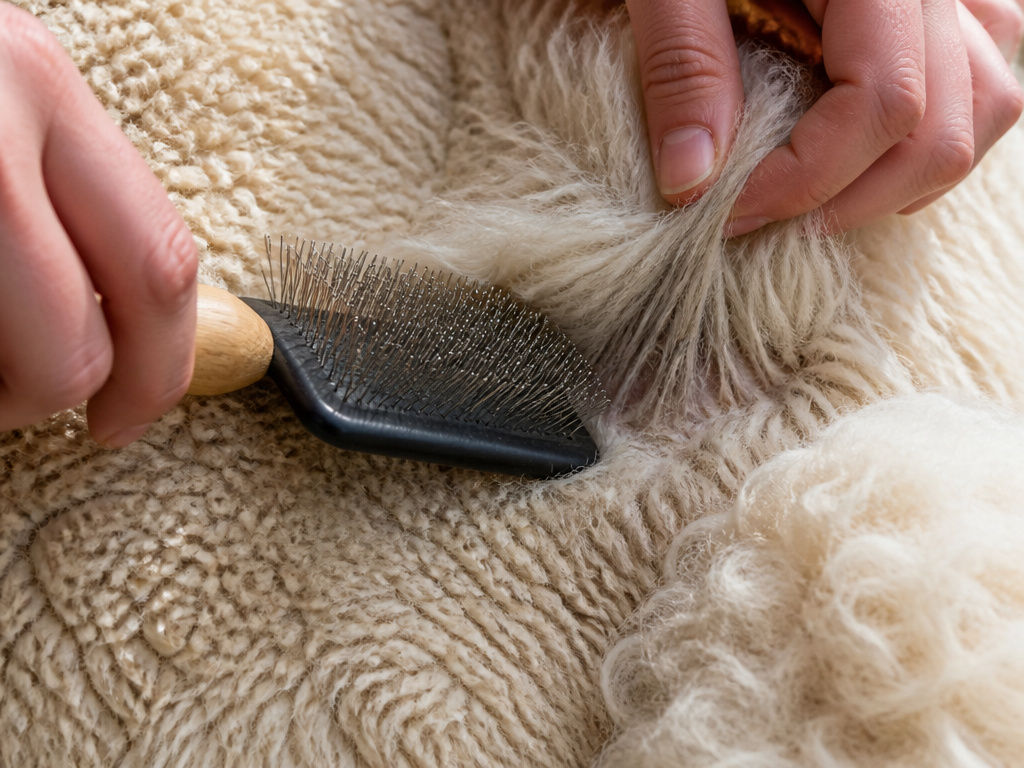
The tool matters less than the technique, but a long-pin slicker gets under a wool coat where a short-pin brush just polishes the surface. The dog brushes for Labradoodles that actually work tend to have long metal pins set in a padded head.
Can either breed be called hypoallergenic?
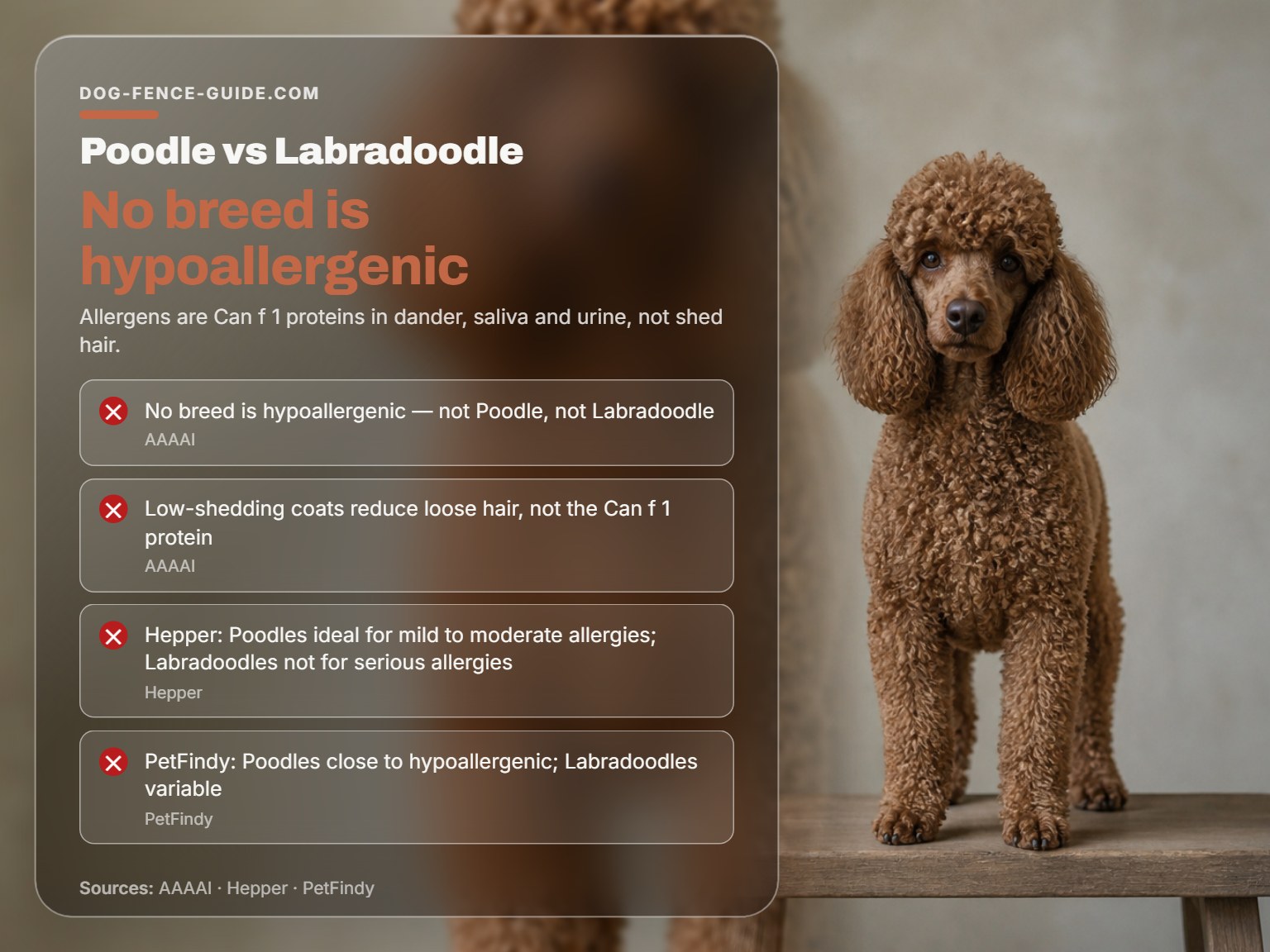
No. Not the Poodle, not the Labradoodle, not any breed.
The American Academy of Allergy, Asthma and Immunology is blunt about this: allergens are Can f 1 proteins found in dander, saliva, and urine, not in shed hair. A dog that drops less hair still produces the protein.
The consumer sites split on it anyway. Hepper calls Poodles ideal for owners with mild to moderate allergies and says Labradoodles aren’t ideal for people with serious allergies. PetFindy calls Poodles close to hypoallergenic and Labradoodles variable. Both are describing shedding, not allergen load.
I wouldn’t pay a premium for the word hypoallergenic on either breed. Spend it on a breeder who tests instead.
Easy to miss: A low-shedding coat reduces loose hair in the house. It doesn’t reduce the protein that triggers the reaction.
If you want the longer version of that argument, it’s covered in whether doodle mixes are hypoallergenic.
What the health data says, including the part breeders skip
A 2024 Royal Veterinary College study is the piece of evidence that resets this comparison.
The RVC VetCompass team compared Labradoodles and two other designer crosses against their purebred parent breeds and found overall disorder prevalence largely similar. That finding sits directly against the hybrid vigour pitch, which sells the cross as healthier than either parent.
The Poodle side carries its own liabilities. Standard Poodles have a documented elevated risk of Addison’s disease. Orthopedic Foundation for Animals data shows elevated hip dysplasia risk in both Poodles and Labrador Retrievers, so a cross inherits from both directions. The prcd-PRA mutation is documented in both parent breeds too, which is why Optigen and Laboklin both publish a test for it.
On feeding, Dogster advises splitting a Poodle’s daily kibble into two meals to reduce bloat risk, and splitting a Labradoodle’s into two or three with treats limited. There’s a longer guide to food for doodles if you want the portion side covered.
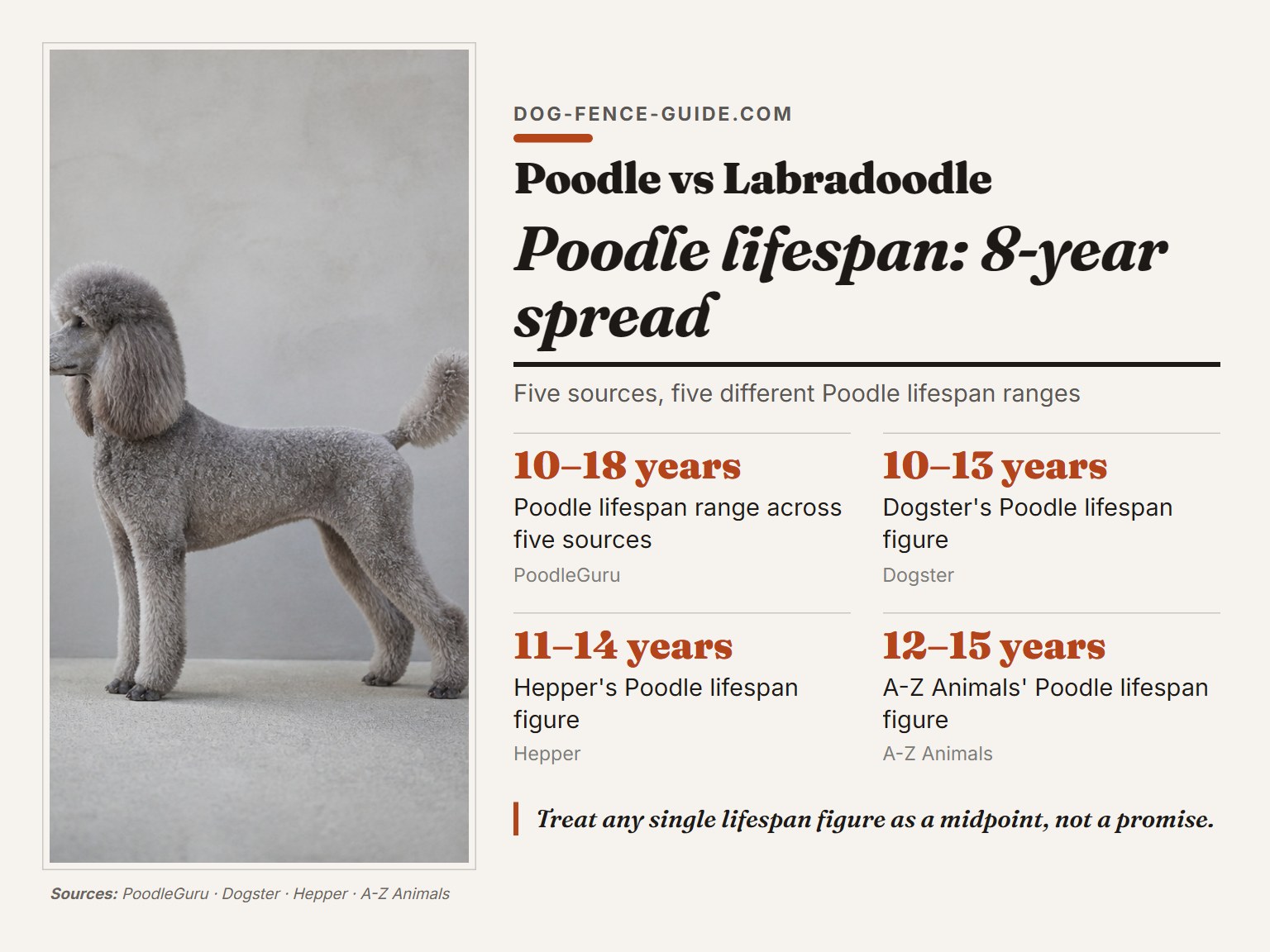
Lifespan is the number everybody quotes and nobody sources consistently:
| Source | Poodle lifespan | Labradoodle lifespan |
|---|---|---|
| Dogster | 10 to 13 years | 12 to 16 years |
| Hepper | 11 to 14 years | 12 to 16 years |
| OodleLife | A little over 11 years | Around 12 years |
| A-Z Animals | 12 to 15 years | 11 years |
| PoodleGuru | 10 to 18 years, Standard 10 to 13 | 12 to 14 years |
That’s a spread of eight years on the Poodle alone. Treat any single figure as a midpoint, not a promise.
Ask three questions instead.
- Which specific health tests were run on both parent dogs, and can you see the results?
- What did the last litter from this pair mature to in height and weight?
- Which coat type did the last litter actually throw?
The Labrador Retriever contributes its own risk list to the cross, and it’s a longer one than most buyers expect.
Which one is easier to live with?
Two reputable sites describe the same two breeds and disagree about which one barks more.
Hepper says Labradoodles are more likely to bark than Poodles. A-Z Animals says Labradoodles are not as vocal as Poodles. Both are describing the same cross.
Both can’t be right.
The training claims split the same way. OodleLife says Poodles are harder to train because of a headstrong nature, and that Labradoodles are calmer and easier. Dogster calls Poodles high-strung and Labradoodles laid-back, and says Labradoodles are often better for new dog owners. OodleLife describes Poodles as reserved and shy next to an outgoing Labradoodle. A-Z Animals rates Poodle guarding behaviour High and Labradoodle Average.
What both sides agree on is the exercise floor: at least an hour a day for either breed, per Dogster, and both rated highly trainable by Dogster and Hepper.
Judge the dog in front of you, not the label on the advert. A calm Poodle and a reactive Labradoodle both exist, and neither one read the comparison table.
The same pattern shows up in any purebred against doodle pairing, including the Golden Retriever vs Goldendoodle question, where the cross has no standard to measure against either. For the Labradoodle side specifically, the Labradoodle pros and cons are worth reading before you commit.
What this means when you’re containing one in a real yard
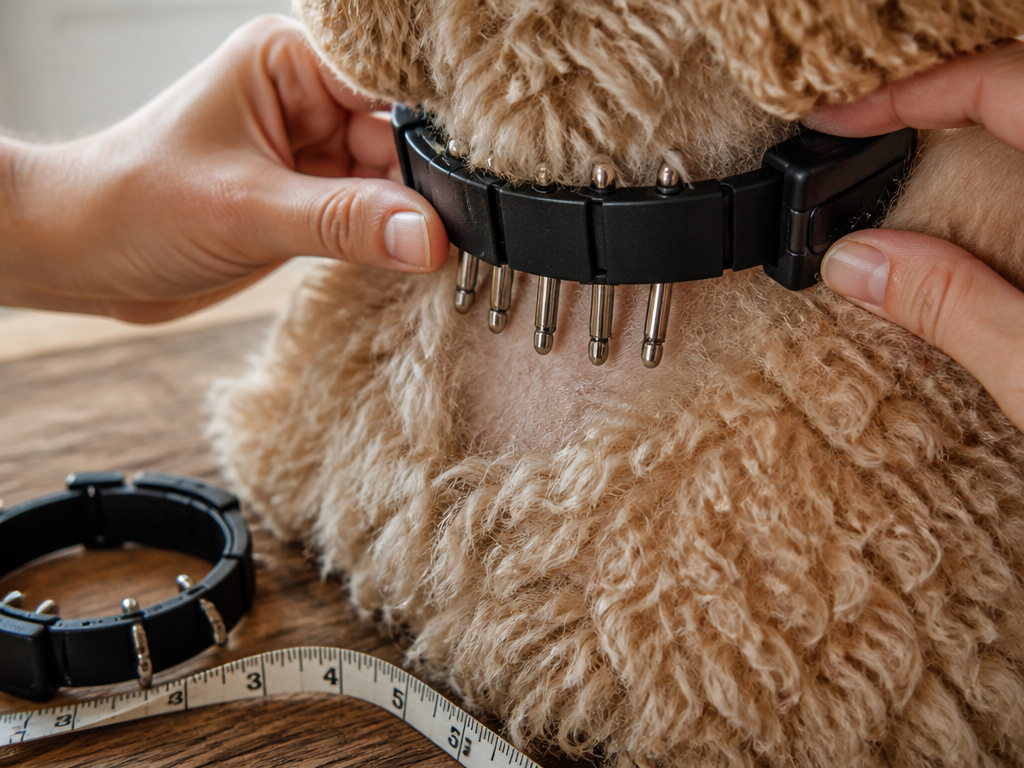
You fit the collar, walk the boundary, and cue the dog. He stands there with his ears up and does nothing at all.
That’s the coat talking. Standard contact points disappear into a Poodle’s or a Labradoodle’s curls, and the dog feels nothing until the level is high enough to startle him. Longer points plus a snug fit is the only combination I’ve seen work consistently on a curly coat. On a flat-faced breed like a French bulldog or a pug, the geometry is worse: short contact points barely touch skin at all, so the collar is decorative until the level climbs.
That’s why I compare contact point length and material before I compare anything else on a containment collar.
The order I’d work in:
- Read the coat first. Wool and fleece swallow a standard point. Hair coats take a shorter one.
- Measure the contact points against the coat, not against the box photo. If you can’t see the point touching skin with the collar fitted, the level will climb.
- Fit snug, then re-check after ten minutes of movement. A collar that rotates puts the point in a new spot, and the correction lands somewhere the dog isn’t expecting.
The same logic applies to the fence line. Walk the perimeter slowly and look at the joints, because that’s where failures happen, not on the long straight run. A gate latch that doesn’t catch and a washed-out gap under a panel are the two I find most often, and both are invisible from the kitchen window.
Fair warning: a low fence is a suggestion to an athletic dog, and the height ratings on retail pages are generous.
Some collar makers offer units that fit a curly coat if you swap to longer points, and professional installers fit the collar to the dog rather than handing you a box. That last part is worth the money on an electronic system.
Frequently Asked Questions
Is a Labradoodle healthier than a Poodle?
The evidence doesn’t support a general health advantage. The 2024 RVC VetCompass study found overall disorder prevalence largely similar between designer crosses and their purebred parents. Both sides bring real risks: Standard Poodles have a documented elevated Addison’s risk, and hip dysplasia is elevated in both Poodles and Labrador Retrievers per OFA data.
Do Labradoodles shed?
Some do and some barely shed at all, and the generation label won’t tell you which. Wool coats shed the least of the three coat types, per OodleLife, while hair coats shed the most. Cadieu’s 2009 work in Science explains why: an F1 Labradoodle has a Labrador parent that contributes no furnishings allele, so the litter can’t reliably produce a non-shedding coat.
Which is better for a first-time dog owner?
Dogster says Labradoodles are often better for new owners and describes them as more laid-back, and OodleLife calls them easier to train, though other sources describe Poodles as reserved rather than difficult. The catch is the coat, which you can’t assess until the adult coat comes in between 9 and 18 months. A Poodle gives you a predictable coat and a more sensitive temperament to manage.
How long do Poodles and Labradoodles live?
Published estimates disagree widely. Poodle figures run from 10 to 13 years at Dogster up to 10 to 18 at PoodleGuru, with Hepper at 11 to 14 and A-Z Animals at 12 to 15. Labradoodle figures run from 11 years at A-Z Animals to 12 to 16 at Dogster, Hepper, and Canine Journal.
Is a Labradoodle a recognized breed?
No. Neither the FCI nor the AKC recognizes the Labradoodle, and no kennel-club breed standard exists for it. IALA maintains a private breed development standard for the Australian Labradoodle, which is a multi-generation fixed line rather than the F1 Labrador and Poodle cross most people mean.
The Bottom Line
The poodle vs labradoodle question stops being a breed question about halfway through. If you can’t see health test results for both parents and adult heights from the previous litter, you’re buying a guess with a pedigree font.
An unstandardized dog is not the same thing as a bad dog. You’re choosing a breeder as much as a breed, and that breeder is doing the work the kennel clubs never did.
Here’s the one question I’d ask this week, before any deposit: what did the last litter from this pair mature to, in height, weight, and coat type? A breeder who answers with numbers is worth the drive. A breeder who says “about standard” is telling you they don’t know.
Before you commit, check three things in your own situation:
- The adult coat type, confirmed by a previous litter rather than predicted from a label.
- The grooming schedule you can actually sustain, budgeted at the tightest interval you found.
- The containment setup, fitted to the coat you’re getting rather than the one on the website.
