
Poodle Coat Types: Curly, Corded, and Clipped
This post contains affiliate links. As an Amazon Associate, we earn from qualifying purchases.
Poodle coat types are three presentations of a single curly coat: the tight curly coat, the corded coat that hangs in ropes of at least 20 cm under FCI rules, and the clipped coat shaped into a named show trim. All three grow from non-shedding hair.
That non-shedding trait is why the curl matters so much. A Poodle hair that sheds does not drop to the floor. It catches in the surrounding coat and becomes the core of the next tangle, which is exactly how Dogs New Zealand describes the breed’s matting problem.
What follows covers the three genes behind the coat, the two ways it gets presented, the brushing intervals the sources actually give, and the clip rules that change the day a dog turns one.
Key Takeaways
- Curl comes from KRT71 plus two copies of FGF5, and all three mutations together produce long and curly coats with furnishings.
- FCI allows a corded coat in the ring at 20 cm minimum, while the AKC and CKC require English Saddle or Continental on any Poodle 12 months or over.
- Brushing advice splits three ways: every other day from VCA, daily from Pedigree, and daily-or-weekly from Dogs New Zealand.
- Bathing every four to eight weeks is the AKC’s own guidance, and trimming can follow the same interval.
- Beige is barred under FCI and apricot is standard under The Kennel Club (UK). Colour rules are not universal.
Poodle Coat Types All Start With the Same Three Genes
A genome-wide study of more than 1,000 dogs from 80 breeds traced canine coat variation to three genes: RSPO2, FGF5 and KRT71.
Curly coats in domestic dogs require two things at once: homozygosity at FGF5, which produces long hair, and the KRT71 variant, which produces curl. Dogs carrying all three variants, RSPO2 included, grow long, curly coats with furnishings. The three loci explain the coat phenotype of 95 percent of dogs sampled.
The three genes explain the pelage phenotype of 95% of dogs sampled, covering 108 of roughly 160 AKC breeds, with 622 dogs genotyped at all three loci. The three genes governing coat variation were published in Science in 2009.
For an owner, the practical read is short. The curl is fixed at birth. You can shape it, dry it, or cut it off, but you cannot train it out.
What Each of the Three Genes Does
- RSPO2 grows the furnishings, meaning the longer hair on the muzzle, legs and tail. It is the reason a Poodle has a topknot worth banding in the first place.
- FGF5 produces long hair, and a curly coat needs two copies of that variant rather than one. A curly coat requires two copies of the FGF5 variant rather than one.
- KRT71 produces the curl itself. Without it you get long hair that hangs flat, which is what a lot of people picture when they hear “long-coated dog.”
A coat type guide helps here, because most owners mix up coat type with coat presentation. Type is genetic. Presentation is a choice you make with clippers.
Why a Curly Coat Mats and a Corded Coat Ropes
The comb stops dead halfway down the flank. The dog sits. The owner parts the coat and finds a patch that feels like felted wool.
That patch is the whole story of Poodle coat care. Pedigree describes the coat as wiry outer hair over a dense, cottony undercoat, and the two layers mat fast when sap or mud gets worked into them. Because the hair does not shed out, every loose strand stays in the coat and binds to its neighbours.
The FCI standard uses a phrase worth knowing: a correct curly coat is resistant to pressure of the hand. Run your palm over a healthy coat and it pushes back. Run it over a mat and your hand sinks.
A slicker brush dragged across a real mat makes a soft tearing sound, and that sound is your warning. Stop pulling at that point, work the mat apart with your fingers, and come back with the comb. I have watched a dog go from tolerant to hand-shy in one bad session.
Curly and corded are the same hair managed two ways. A curly coat gets combed out and kept separate. A corded coat gets deliberately allowed to bind into ropes and never combed at all. One is maintenance. The other is a commitment.
Curly wins for almost every pet owner. Corded wins only if you have the patience to wash ropes that hold water and the willingness to wait years for length. A poodle conditioner does more for a curly coat than any brush in the drawer, because it lets the comb slide instead of snag.
I have watched thick-coated dogs work a collar loose more than once, and the standard fit is usually the culprit. On a deep, dense coat, check the contact points and re-check the fit monthly. A coat that has just been scissored short can change how a harness sits overnight.
How Often Should You Brush a Poodle?
How often does the coat actually need the brush? The published answers do not match.
VCA Animal Hospitals says brushing and combing every other day is necessary to prevent matting. Pedigree says most professional groomers strongly recommend daily brushing and combing. Dogs New Zealand says a show Poodle should preferably be brushed every day, or weekly for shorter coats.
Three sources, three intervals, and none of them wrong. The variable is coat length. In the Sporting clip the body and legs are clipped or scissored to a short blanket of coat no longer than one inch in length.
The Order That Actually Works
- Comb first, brush second. A slicker brush glides over the surface and leaves the undercoat to compact underneath. Start with a metal comb and you find the mat before it becomes a pelt.
- Work in sections, not sweeps. Line brushing, where you part the coat and work one thin layer at a time, reaches skin. A pass over the whole dog reaches the top inch only.
- Check the armpits, behind the ears and the tail base every session. These are the spots where a small tangle can become a shaved patch if missed.
- Bathe on the four-to-eight-week interval the AKC Standard Poodle grooming guide gives through handler Gail Wolaniuk. Trimming can follow the same rhythm.
The best brushes for poodle coats are the ones that reach skin without scraping it, and a poodle shampoo matters less than how thoroughly you dry afterward. A coat that stays damp near the skin is where the smell starts.
Where this goes sideways: Brushing a dry, matted coat without conditioner. The comb catches, the dog yelps, and you write the whole coat off as hopeless. Work a light conditioner into the mat first and the same comb passes through.
You can prevent matting with regular combing. You cannot undo it once it reaches the skin.
Twelve Months Is Where Poodle Coat Rules Split
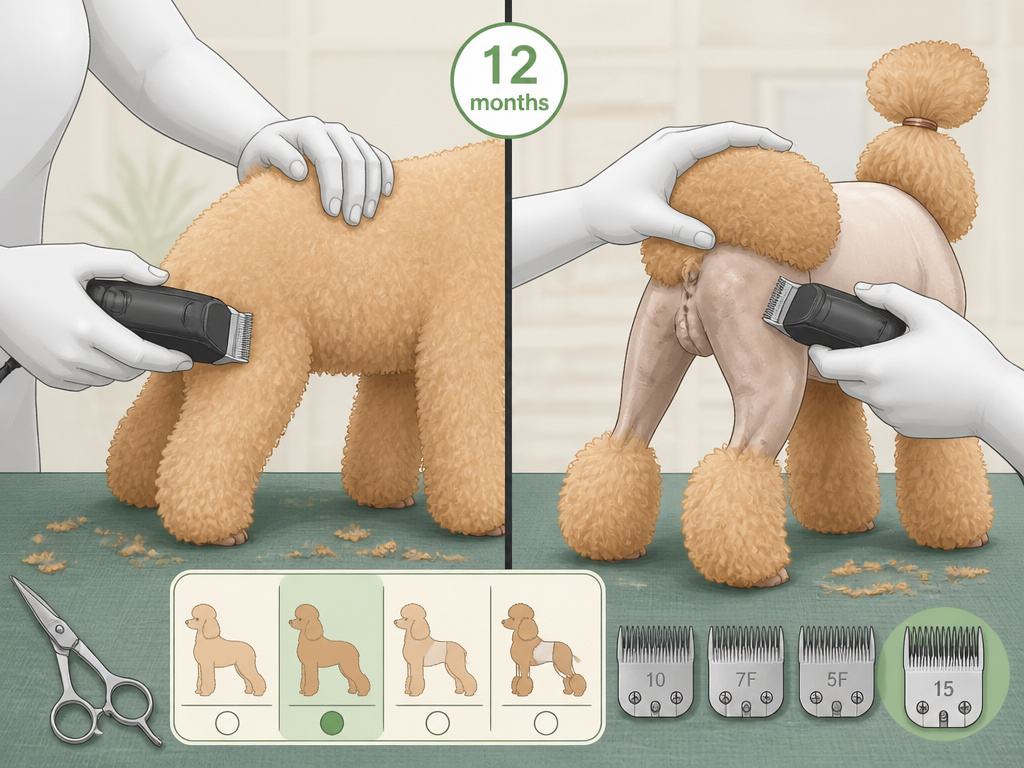
Twelve months is the line. Below it, a Poodle can be shown in a Puppy clip. Above it, the rules tighten sharply.
The AKC standard states that in all regular classes, Poodles 12 months or over must be shown in the English Saddle or Continental clip, and any other clip is a disqualification. The Canadian Kennel Club uses the same 12-month threshold and the same disqualification language, and adds unorthodox clip to its disqualification list outright.
Both clubs carve out an exception. The AKC allows the Sporting clip in Stud Dog and Brood Bitch classes and in a non-competitive Parade of Champions. The CKC simply says the Brood Bitch and Stud Dog may be shown in any clip.
The Poodle breed standard PDF lists all four clips by name and describes what gets shaved in each one.
The Four AKC Clips at a Glance
| Clip | Who it is for | What stays long |
|---|---|---|
| Puppy | Poodles under 12 months | Full coat, shaped for a smooth line |
| English Saddle | Adults in regular classes | Body coat, with puffs and a tail pompon |
| Continental | Adults in regular classes | Body coat, with bracelets and optional hip pompons |
| Sporting | Stud Dog, Brood Bitch, Parade of Champions | Scissored blanket, no longer than one inch |
The poodle clippers recommended by Wolaniuk are Andis or Oster. She uses size 15 or 30 blades on the face, feet and tail base, and a 4 to 7 blade for clipping the body short.
One rule crosses every clip. Elastic bands go on the topknot and nowhere else. The UKC states that bands may not sit past the occiput, though it sets no limit on how many you use.
Who Actually Shows a Corded Poodle?
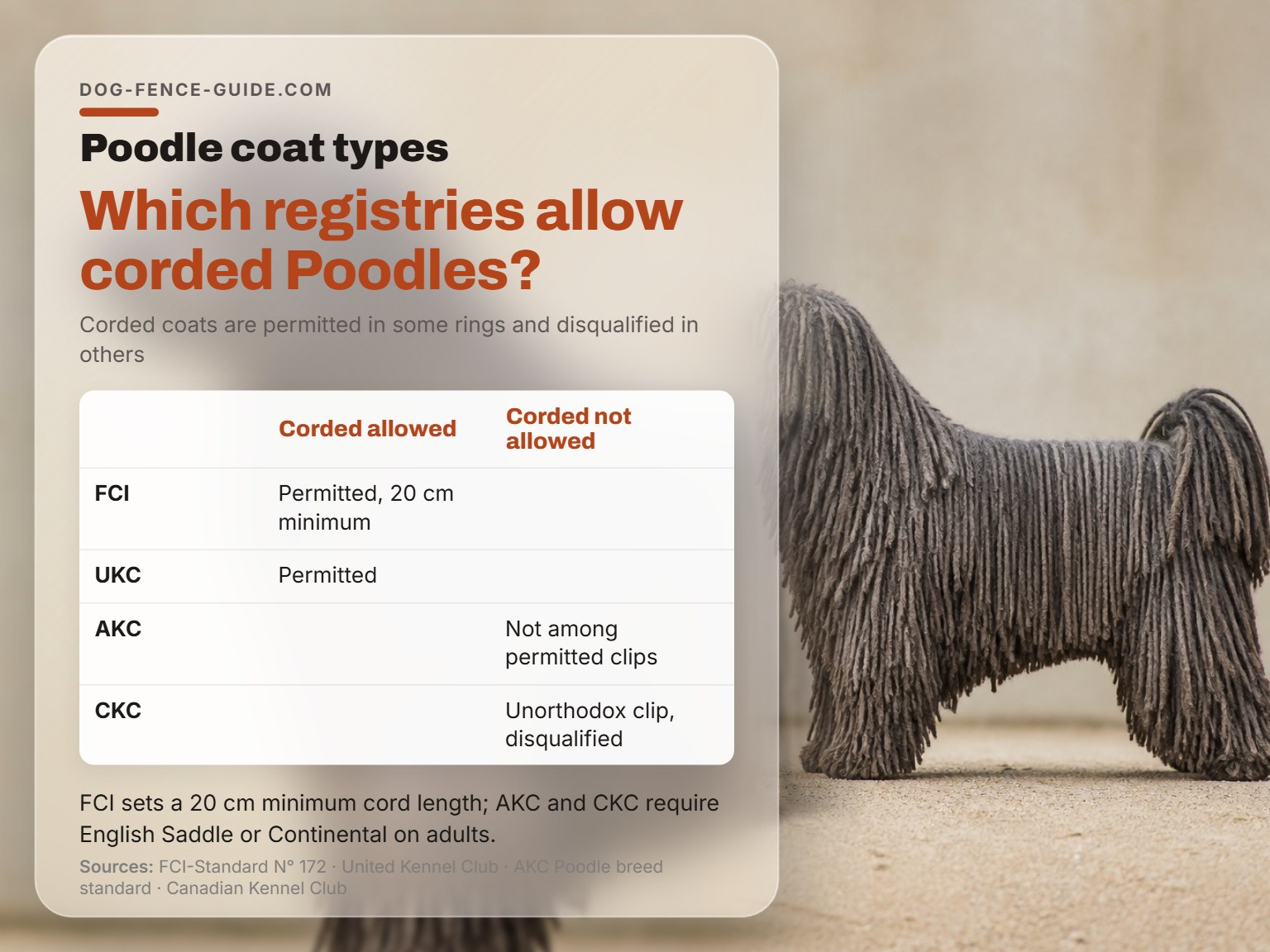
Corded coats are legal in some rings and impossible in others, and that split is the most useful thing to understand about them.
The FCI standard permits corded presentation explicitly and sets a length gate: cords should measure at least 20 cm. The UKC also allows it, describing the coat as presentable naturally, corded, or in one of the described clips. Then the AKC and CKC close the door, because neither names corded among the clips allowed on an adult in regular classes.
| Registry | Adult clip requirement | Corded coat status |
|---|---|---|
| FCI | Corded explicitly permitted | Permitted, 20 cm minimum |
| UKC | Natural, corded, or any described clip | Permitted |
| The Kennel Club (UK) | All traditional trims, judged on equal merit | Not separately addressed |
| AKC | English Saddle or Continental | Not among permitted clips |
| Canadian Kennel Club | English Saddle or Continental | Unorthodox clip, disqualified |
| Dogs New Zealand | Traditional lion clip strongly recommended | Not separately addressed |
VCA Animal Hospitals notes that corded coats take a lot of work and are difficult to wash, which is why the style has fallen out of favour. VCA also points out that a full coat can weigh a dog down when swimming.
That last detail is the practical objection. Cords hold water against the skin, and a wet corded coat is heavy.
Skip this if: You want a coat you can wash and dry in an afternoon. Cords are difficult to wash and hold water against the skin.
The UKC standard includes a line that applies well beyond the show ring: quality is never to be sacrificed in favour of grooming skill or the type of clip. A badly corded dog is not a stylish dog.
Coat Colour Can Disqualify a Dog, and the Registries Disagree
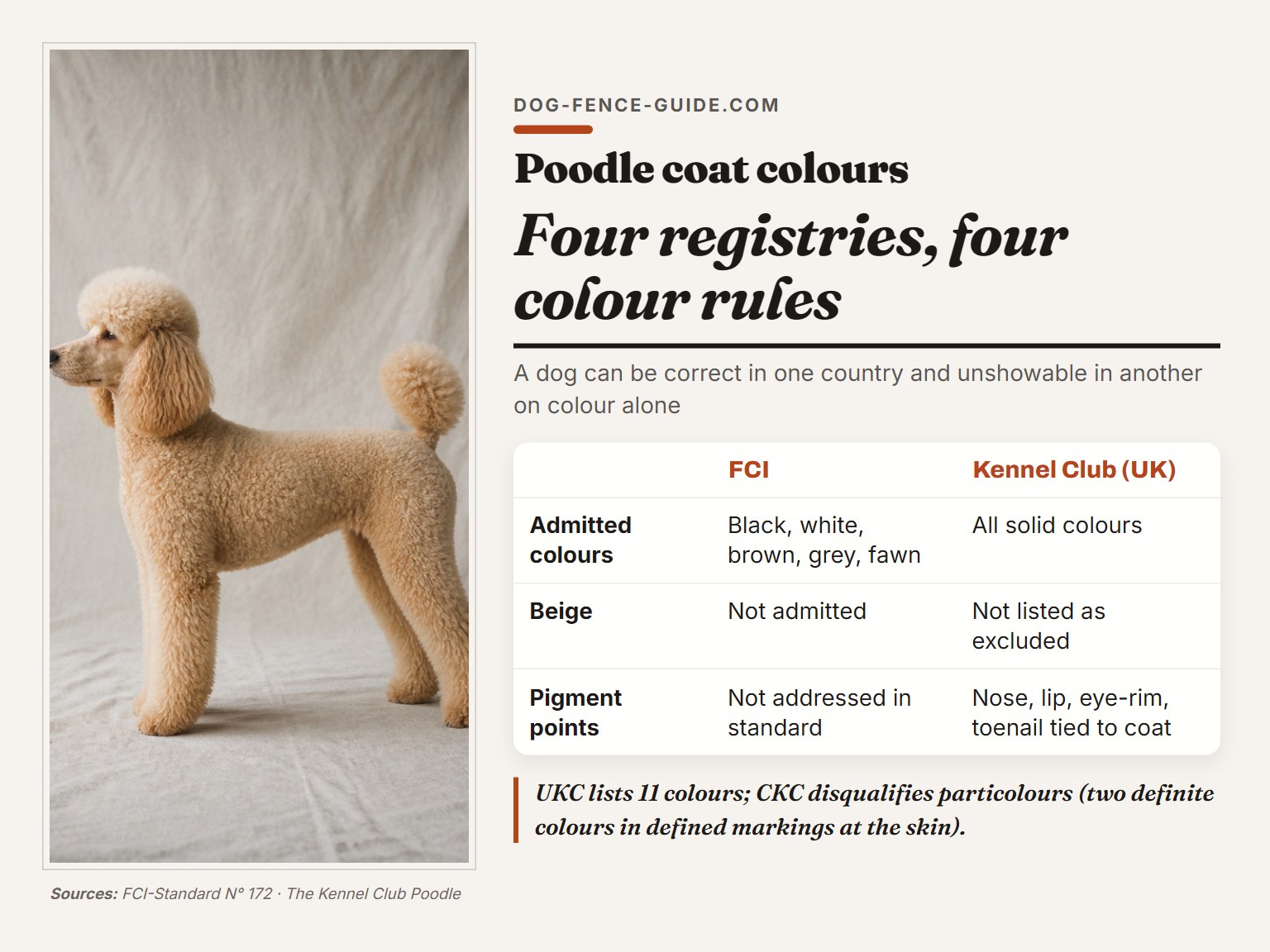
Colour looks cosmetic until a judge reads the pigment on the nose.
The FCI admits black, white, brown, grey and fawn, and states plainly that beige and its paler derivatives are not admitted. The Kennel Club (UK) admits all solid colours, naming apricot, red, silver, blue and cream among them. The UKC lists eleven colours, including caf-au-lait and silver beige. The CKC disqualifies particolours, defined as at least two definite colours in clearly defined markings at the skin.
Four registries, four different admissible sets. A dog can be correct in one country and unshowable in another on colour alone.
Pigment is paired to coat colour, and this is where a coat can still fail. The Kennel Club (UK) ties nose, lip, eye-rim and toenail colour to the coat: browns carry dark liver points and dark amber eyes, while blacks, silvers and blues carry black points. A correct coat with the wrong points is a fault.
Easy to miss: Creams, apricots, reds, browns, silvers and blues may show varying shades of the same colour up to 18 months.
Frequently Asked Questions
Do Poodle coat types shed differently?
No. All three presentations come from the same non-shedding hair, so the shedding rate is identical. What changes is where the shed hair goes. In a curly or corded coat it stays trapped and binds into tangles, which is why brushing frequency matters more than shedding volume.
Is a corded coat cruel?
The standards do not treat it that way. The FCI permits corded presentation with a 20 cm minimum, and the UKC lists it as a normal option. The real objection is practical: VCA notes cords are difficult to wash and the style has fallen out of favour, largely because of the work involved.
Can I show a Poodle in a puppy clip?
Only under 12 months. The AKC and the Canadian Kennel Club both allow the Puppy clip for dogs under a year. At 12 months and over in regular classes, both require English Saddle or Continental, and any other clip is a disqualification.
Why does my Poodle’s coat change colour?
In blues, grays, silvers, browns, cafe-au-laits, apricots and creams the coat may show varying shades of the same colour without being faulted. The Kennel Club (UK) and Dogs New Zealand both allow creams, apricots, reds, browns, silvers and blues to show varying shades up to 18 months.
How do I know which coat type my Poodle has?
Look at the hair, not the haircut. If it forms even curls that spring back when you push a hand into it, you have the curly coat. If it hangs in solid ropes that never get combed out, it is corded. Anything scissored into a named shape is a clip, and the coat underneath is still curly.
The Bottom Line
If your Poodle is under 12 months and you plan to show it, you have more freedom than you will have in a year. Use that window to learn the coat, because the clip rules tighten the month the dog turns one and they do not loosen again.
One threshold worth writing down: if a comb will not pass through a section of coat without catching, stop brushing and work that section apart by hand first. Brushing over a mat pushes it tighter against the skin, and a mat that reaches skin is a shave, not a detangle.
The honest limitation here is that coat type tells you what the hair will do, not what your individual dog will tolerate. Some Poodles tolerate long line-brushing sessions. Some will not. If your dog falls into the second group, a short clip is a kinder answer than a daily fight, and no standard in any country penalises you for it at home.
