
How to Prevent Matting in Long Coats: Step-by-Step
This post contains affiliate links. As an Amazon Associate, we earn from qualifying purchases.
Matting in long coats builds slowly from rubbing, abrasion, and the agitation of cleaning, so learning how to prevent matting in long coats means a short daily brush in the direction of the fibre, at least 24 hours of rest between wears, and a clean coat going into seasonal storage rather than coming out of it.
The cleaner usually takes the blame for it. Dry Cleaning and Laundry Institute guidance is explicit that the damage typically surfaces only after cleaning, and that it traces to four combined inputs: fibre content, fabric construction, how the coat was worn, and the cleaning process itself.
That reframes the how to prevent matting in long coats question. You are managing wear and agitation across the life of the coat, not hunting for one culprit at the counter.
What follows covers why matting hides until after a clean, the brushing routine that does most of the work, where the care sources contradict each other outright, and the fibre-by-fibre rules that change the answer.
Key Takeaways
- Brush for 30 seconds after every wear, with a natural-bristle brush; Murmells and BRAVON say brush in the direction of the fibre, while UNIQLO says brush top-to-bottom then bottom-to-top against the surface fibers for dust release.
- Rest the coat at least 24 hours between wears; a piece worn on consecutive days loses its shape sooner.
- Clean at the end of the season, before storage, never at the start of the next one.
- Never store wool in plastic; trapped nitrogen oxides react with the fibre and accelerate yellowing.
- Expect the worst pilling in the first 15 to 20 wears, after which the fibre settles.
Why Does Matting Show Up After Cleaning?
The coat goes into the bag smooth and comes back fuzzy, and the timing makes the cleaner look guilty. DLI’s technical note on wool coats explains the sequence.
Surface nap on a wool coat mats gradually through rubbing and abrasion during normal wear. Cleaning agitation mats it further and produces a pilled appearance. The damage usually becomes visible only after cleaning, and it is attributed to fibre content, fabric construction, consumer use, and cleaning procedure combined. No single handling error explains the result.
That last line is worth pinning to the wall. The DLI wool coat care guide treats post-cleaning matting as a predictable outcome of four inputs, and cleaning is only one of them.
The first coat I sent out came back fuzzier than it went in, and I assumed the cleaner had wrecked it. DLI’s explanation is less satisfying and more useful: the matting was already sitting in the nap, and the agitation simply made it visible. Nothing was ruined. Something was revealed.
Where this goes sideways: Demanding a re-clean to fix it. A second cycle adds fresh agitation to a nap that has already matted, and the surface usually comes back worse after one round trip.
Worsted wool has a second failure route. DLI’s bulletin WET No. 1, “Effects of Moisture on Worsted Wool,” flags moisture as a distinct problem for that weave, which is why a damp coat left crumpled in a warm car is a bigger risk than a dry one worn hard.
Matting is cumulative, and it hides. By the time you see it, the fibres have been locking for weeks.
The 30-Second Brush That Keeps Long Coats Smooth
A coat comes off after a long day and lands on the back of a chair. That is the moment the nap starts to set.
Murmells is specific about the fix: a natural-bristle brush, in the direction of the fibre, after every wear; UNIQLO, however, advises brushing top-to-bottom then bottom-to-top against the surface fibers for dust release. BRAVON gives the same directional advice. The claim attached to it is that brushing lifts dust and restores the nap before abrasion gets a chance to felt it.
The sequence is the same one behind a good grooming routine: loosen the surface, lift what is sitting in it, then work with the lie of the fibre rather than against it. The rule that governs brushes for long-haired dogs holds here too. Match the tool to the fibre length, not to the label on the handle.
A matted nap looks dull and slightly cloudy under a window, and it feels faintly rough when you run a palm down the sleeve. A healthy one has a soft directional sheen. That difference is your early warning system when you compare a how to prevent matting in long coats.
I would rather see a coat brushed for thirty seconds every day than cleaned twice a season. The brush is doing the work the cleaner gets blamed for.
Work in this order and the job takes under a minute:
- Collar and shoulders first, where a bag strap and a seat belt rub hardest.
- Cuffs and pocket edges next, the two places pills appear first.
- Then the body in long strokes, one direction only.
- Skip buttons and zipper tape entirely; abrasion there frays thread.
Murmells also warns against prolonged contact with rough surfaces and zippers. A tote strap worn on the same shoulder every day will mat that panel before anything else on the coat.
Thirty seconds a day is the whole routine. The rest of wool care is damage control for the days you skipped it.
Where the Care Sources Actually Disagree
Mary Gwen and UNIQLO both print dry clean only on their wool coats. Wirecutter tells readers to wash a wool coat at home on cold. Both positions are documented, and the gap between them is wide enough to matter.
| Question | One position | The other position |
|---|---|---|
| Washing at home | Mary Gwen and UNIQLO: dry clean only | Wirecutter: wool or gentle cold cycle |
| Brushing direction | Murmells and BRAVON: with the fibre | UNIQLO: against the fibre to lift dust |
| Grease stains | Murmells: no water, straight to a professional | Wirecutter: blot, then water and mild soap |
| Long-term storage | Murmells: fold cashmere coats | BRAVON: broad hanger with shoulder space |
If the Label Says Dry Clean Only
A maker’s care label outranks a general guide every time. Mary Gwen’s warranty clause is blunt about it: items cleaned incorrectly will not be replaced. If the label says dry clean only, that is the instruction you follow.
The label is not always where you expect it, either. UNIQLO sews the wool coat care label inside the left pocket, which is worth knowing before you conclude the coat has none.
If Home Washing Is Sanctioned
Where the maker allows it, Wirecutter’s tested procedure is precise. Turn the coat inside out to limit pilling, run a wool cycle or the gentle cold cycle, and never wash wool on hot, because heat weakens the fibres and shrinks the fabric. The Wirecutter wool coat restoration guide names Eucalan’s no-rinse formula as its wool detergent, and some laundry experts add a mesh bag for extra protection.
BRAVON’s list of things to avoid lines up with that: hot water, long soaking, heavy agitation, high spin, and an overloaded drum that can distort the construction.
Slip is the whole trick behind any of it. A conditioner for matted hair does that job on a dog’s coat; on wool, a mild no-rinse wash does the equivalent, letting fibres slide past each other instead of locking.
Grease is the one stain where the sources split hardest: Murmells says keep water off it and go straight to a professional, while Wirecutter suggests blotting, then patting with a little water and a dab of mild soap. Where the stain is oil-based and the coat is expensive, the conservative route costs you less.
Which Fibre You Own Changes the Rules
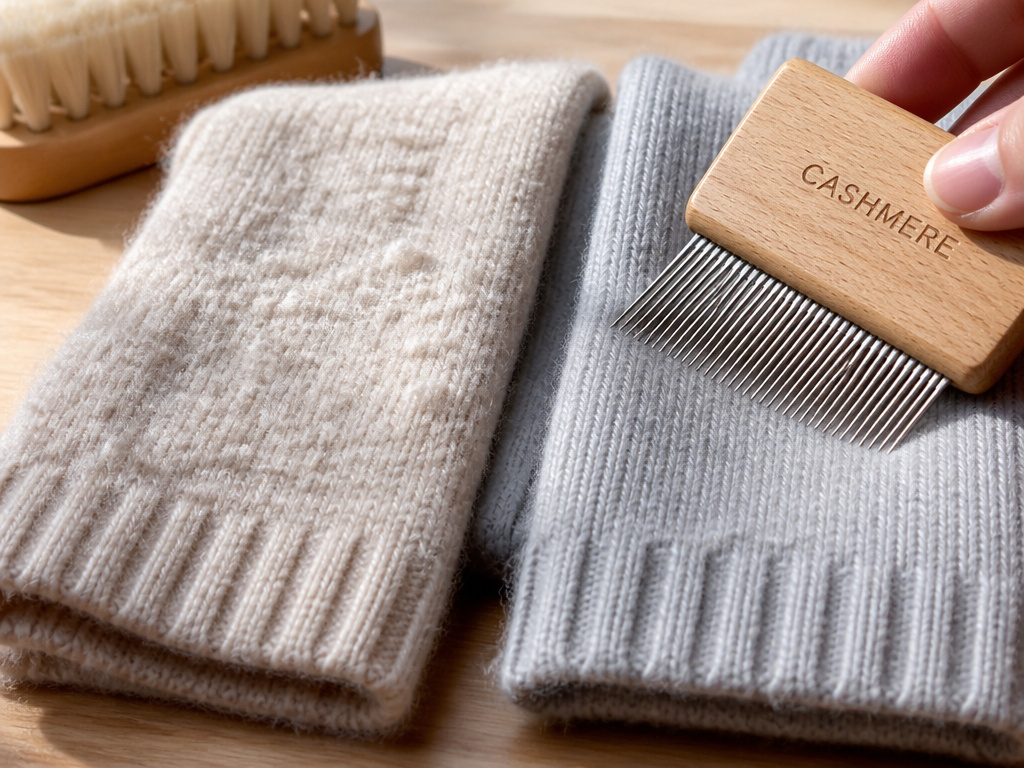
Pure cashmere pills more than a fifty-fifty cashmere and virgin wool blend, and fibre length explains why. The longer virgin wool fibre stabilises the blend and holds the shorter cashmere in place, which is why the 50/50 blend resists pilling significantly better than pure cashmere on its own.
| Fibre | Main matting risk | Right tool |
|---|---|---|
| Pure cashmere | Heavy pilling in the first wears | Noble-fibre brush or cashmere comb |
| Cashmere and virgin wool 50/50 | Light pilling, mats at the cuffs | Cashmere comb, one direction |
| Short-hair alpaca | Surface fuzz and trapped dust | Natural-bristle brush after each wear |
| Long-hair alpaca | Crushed, flattened pile | Vertical steam only, never an iron |
| Worsted wool | Moisture damage | Solvent F dry cleaning |
Double-Face Cashmere and Water
Double-face cashmere coats cannot be hand washed. The unlined construction is joined at a pick stitch, and that seam comes apart in water. Professional dry cleaning with solvent F is the route, full stop.
Cashmere does have natural self-cleaning properties that cut down how often it needs attention at all. Murmells says store it folded for the long term and hang it on a wide wooden hanger for regular use, while BRAVON recommends a broad supportive hanger with enough space around the shoulders during long storage; both agree to keep it out of plastic entirely.
Alpaca: Short Hair vs Long Hair
The finish decides the care. Short-hair alpaca wants a gentle brush with natural bristles after each wear. Long-hair alpaca wants the opposite treatment: keep it away from handbags and seat belts, and never iron it, because pressure crushes the character of the cloth. Vertical steam handles creases instead.
Thick, dense fibre behaves differently from a flat one, which is why double coat care is treated as its own discipline rather than a variation on the basic routine. The principle carries across.
How Do You Remove Pills Without Thinning the Cloth?
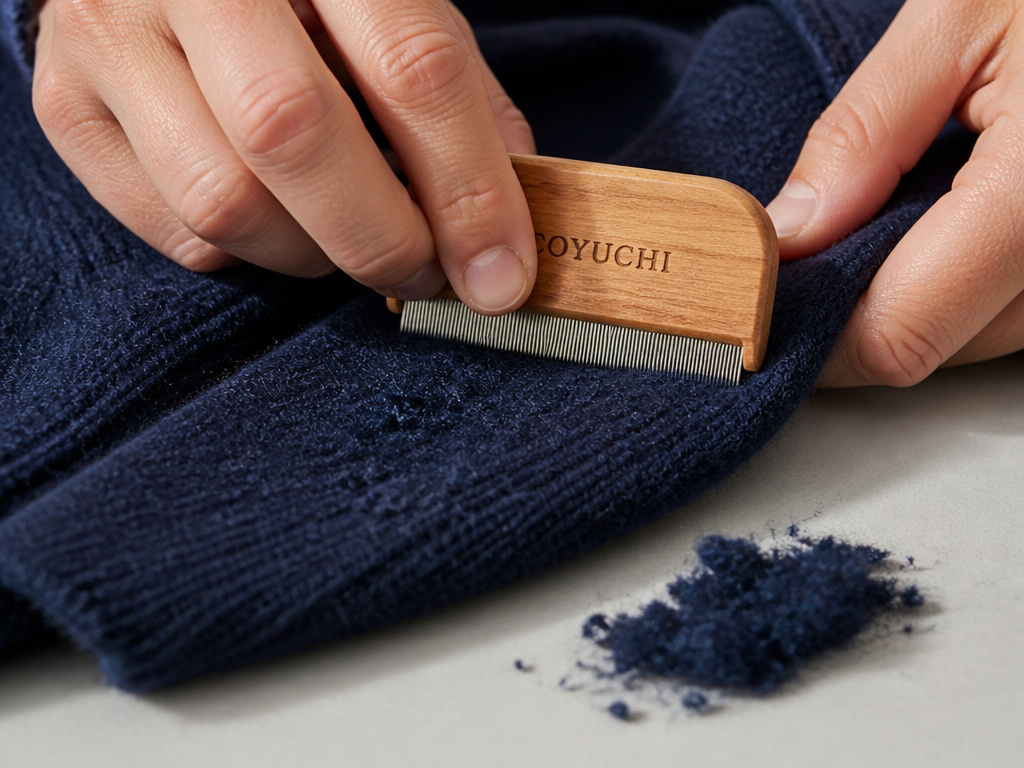
A pill is a small ball of loose fibre sitting on the surface. A mat is a felted patch where fibres have locked into each other. They need different tools, and using the wrong one costs you cloth.
- Let the coat dry completely first. Damp fibre stretches and tears under a comb.
- Work one section at a time, starting at the outer edge of the patch.
- Use a cashmere comb in one direction with light pressure, lifting rather than dragging.
- Check with your fingertips between passes and stop while the surface still has nap.
Murmells forbids razors and aggressive electric shavers outright, because they thin the cloth, while UNIQLO suggests narrow-tip scissors or a pilling remover and NYT Wirecutter mentions a garment comb, fabric shaver, or other removers. UNIQLO suggests narrow-tip scissors or a pilling remover. Wirecutter’s tester spent almost 30 minutes removing pills from a women’s full-length coat, which tells you what an honest timeline looks like.
A felted patch needs the edge-in patience of removing mats from a dog’s coat: work from the outside toward the centre and never pull from the root.
Run your fingertips over the patch after each pass. You will feel the difference before you see it, and you will stop before you have gone too far.
Easy to miss: Pilling in the first weeks is normal behaviour for noble fibres, not a quality problem. Murmells is direct about that, and the fibre settles once the loose ends have worked free.
Storage Decides Next Winter

A coat that goes into the wardrobe dirty comes out with moth holes in June, and no amount of brushing undoes that.
Three sources converge on cleaning before storage. Murmells is the most direct: clean at the end of the season, not the start of the next one, because moths eat the residues of skin, perspiration and food rather than clean wool; NYT Wirecutter and BRAVON also emphasize cleaning before storage. Wirecutter makes the same point about summer storage. BRAVON adds the drying condition, which is that a coat goes away clean and completely dry.
- A breathable cotton or linen bag, never sealed plastic.
- A broad supportive hanger, never thin wire.
- Enough space around the shoulders that the coat is not compressed.
- Cashmere folded for long-term storage, hung for regular use.
Plastic is the mistake that keeps repeating. Murmells explains the mechanism: plastic traps nitrogen oxides from the air, those oxides react with phenolic compounds in the fibre, and the yellowing accelerates. BRAVON adds trapped condensation to the same argument.
Pressure is the quieter problem. BRAVON flags prolonged pressure and heat as a way to mark the face fabric and affect fused internal construction, which is what happens to a coat crammed against six others for eight months.
For small pieces that hold an odour, there is a shortcut worth knowing. Twenty-four hours in a sealed bag in the freezer eliminates bacteria and neutralises odours without disturbing the fibre. It does not work on a full coat.
When to Stop and Pay a Professional

Six situations justify the trip to a cleaner, and Murmells lists them plainly:
- Stains that do not lift with immediate blotting.
- Persistent odours that do not fade with airing.
- Extensive pilling across large areas.
- Tears, loose stitching, or small holes.
- End-of-season cleaning before storage.
- Start-of-season inspection before wear.
Ask what solvent the cleaner uses before you leave the coat. Murmells specifies hydrocarbon solvent F, not perchloroethylene and not trichloroethylene, because hydrocarbon does not affect the fibre’s structure and preserves the cloth’s original strength.
Murmells also frames end-of-season cleaning as preventive care rather than repair, and argues it extends the life of a coat more than any other single form of attention. Given how much of this article is about preventing abrasion, that is a fair claim to sit alongside it.
Frequently Asked Questions
Can brushing make matting worse?
Only if you brush against the lie of the fibre or use a stiff tool on a soft cloth. Murmells and BRAVON both specify a natural-bristle brush worked in the direction of the fibre. A rough brush on a matted patch drags loose fibres into new tangles rather than lifting them out.
Is pilling a sign of poor quality?
No. Murmells describes pilling as a natural behaviour of noble fibres rather than a defect, and DLI treats post-cleaning matting as an outcome of fibre, construction, wear and cleaning combined. The first 15 to 20 wears produce the most pilling, after which the fibre settles.
Can I use a razor or electric shaver on pills?
Murmells advises against both, because they thin the cloth. A cashmere comb used in one direction with light pressure, or a brush made for noble fibres, removes pills without cutting into the weave. UNIQLO suggests narrow-tip scissors or a pilling remover instead.
How often should a wool coat be dry cleaned?
Murmells recommends professional cleaning at the end of each season, positioned as preventive care rather than a response to visible dirt. Cleaning more often than that adds agitation cycles, and agitation is one of the four inputs DLI links to matting.
Does steam help a matted wool coat?
DLI recommends light steaming followed by a stiff bristle brush to improve the appearance and texture of a matted coat. For light creases, Murmells uses vertical steam from a handheld steamer or a hot shower. If you iron at all, the Woolmark figure is a maximum of 110°C / 230°F with the steam off and a press cloth between iron and wool.
Before You Go
The trigger to watch for is a nap that stays rough after a brush. Once the fibres have locked into a felted patch, brushing will not undo it, and you are into comb-and-patience territory. Catch it at the dull-sheen stage and a thirty-second pass handles it.
Two questions worth asking yourself before the season starts. Is the coat clean and bone dry going into storage, and is it hanging with room to breathe rather than pressed against a wall of other coats? Those two answers decide more about next winter than any product you could buy.
One concession: if the label says dry clean only and the coat is a fused or bonded construction, the washing section of this piece does not apply to you. Everything else does.
The long coats that survive ten winters are rarely the expensive ones. They are the ones that got brushed on the ordinary days.
