
How to Tell If a Dog Is Dehydrated: Mild to Severe Signs
This post contains affiliate links. As an Amazon Associate, we earn from qualifying purchases.
To tell if a dog is dehydrated, check four things in order: mucous membranes, skin turgor at two or three consistent spots, the eyes, and body weight. Clinical signs only appear after more than 5% body weight loss, so a normal-looking dog can already be down fluid.
A dog can lose water steadily for a day and still trot to the gate wagging. The physical findings vets grade against don’t appear until the loss passes that 5% mark, which leaves the early stage invisible to your hands.
What follows is the order I check in, the numbers behind each sign, and the point where home checking stops being useful.
Key Takeaways
- Below 5% body weight loss, a dog looks normal on exam. Tacky gums are the first thing you can actually feel, and they correspond to less than 5%.
- Test skin turgor in the same two or three spots every time. The test is subjective, and moving the pinch point changes the answer.
- A dry nose proves nothing. Clinical assessment doesn’t use the nose at all.
- Resting dogs need roughly 40 to 60 ml per kilogram per day, and that figure climbs three to four times with hard exercise or heat.
- Sunken eyes and a persistent tent mean a vet visit now, not a bowl of water.
Why the Home Checks You Already Know Miss the First 5%
Below 5% of body weight, dehydration in dogs isn’t detectable on a clinical exam at all. That figure comes from experiments the AJVR skin turgor dehydration study cites, and it matches the grading table veterinary nurses work from.
Dehydration is graded as a percentage of body weight lost. Below 5% no clinical sign is detectable. From 6% to 8%, dry mucous membranes and decreased skin turgor appear. From 8% to 10%, the globes retract within the orbits. From 10% to 12%, a persistent skin tent, dull corneas and hypovolemia are present.
A dog sitting at 4% looks like a dog at zero. Bright eyes, gums that are moist and shiny, a nose that’s cold and slightly damp. Nothing on the outside has changed yet, which is why how to tell if a dog is dehydrated at this stage is so difficult.
That’s the blind spot.
You don’t fix a weeping joint by buying a bigger bucket. You find the joint. Same logic here: the useful question isn’t “is this dog dehydrated,” it’s “how far down is this dog, and how fast is it getting worse.”
What the home checks do well is the middle of the range. Dry gums plus a slow tent puts you somewhere in the 6% to 8% band, and that’s a dog that needs a vet visit.
Dehydration and heatstroke overlap, and heatstroke moves faster.
How to Tell if a Dog Is Dehydrated, From Mild to Severe
The sign you can feel maps to a rough percentage, and the percentage tells you how much water the dog is missing. That’s the useful part.
| What You Find | Estimated Dehydration |
|---|---|
| Nothing detectable on exam | Below 5% |
| Gums tacky to the touch | Below 5% |
| Dry gums plus a slow skin tent | 6% to 8% |
| Eyes pulled back into the sockets | 8% to 10% |
| Skin stays tented, corneas dull | 10% to 12% |
Two published versions of this table disagree at the low end. The AAHA fluid therapy guidelines reproduce a version with a distinct 5% to 6% tier described as some change in skin turgor. Clinicians Brief folds tacky membranes into the under-5% band and jumps straight to 6% to 8% for dry gums plus a slow tent.
Neither reading changes what you do next. Both put a normal-looking dog below 5%, and both agree the eyes don’t sink until 8% or worse.
A dog that’s 5% down looks fine. That’s exactly why the percentage bands exist.
For the clinical version of this grading, the NCBI StatPearls canine dehydration evaluation lays out the same bands in a hospital context.
How Do You Run the Skin Tent Test Correctly?
Pinch a fold of skin, let go, and count how long it takes to flatten. That’s the whole test. The trouble is that almost nobody does it the same way twice.
Where to Pinch, and Why the Spot Matters
The Wilderness Medical Society puts the spot between the shoulder blades, on the dog’s back, with a normal return of one to two seconds, though Clinicians Brief notes skin turgor is a subjective assessment that can be falsely increased by obesity and falsely decreased by cachexia and geriatrics. The skin comes back with a soft snap against your fingers, like a rubber band that still has its stretch.
The AJVR study found that the location you monitor can change how sensitive the test is, so pick your spots and stay with them. Clinicians Brief recommends testing two to three locations in the same dog every time, for the same reason.
Counting Seconds the Same Way Every Time
Count out loud. The AVMA researchers used “one-one-thousand” during data collection, and they noted a stopwatch would be more exact but is awkward in a field setting.
- Pinch a fold between the shoulder blades, parallel to the spine, and lift it straight up.
- Release and count out loud from “one-one-thousand” until the skin flattens.
- Repeat on two more spots you’ll use on this dog for the rest of its life, then write down what you got.
Here’s the number that should make you humble about this test. Three separate video analyses of the same skin tents had a mean coefficient of variation of 21.22%.
Same dogs, same clips, a fifth of the measurement bouncing around.
So compare the dog to itself, on your spots, with your counting rhythm. Comparing it to some ideal is how people talk themselves into a vet visit they didn’t need, or out of one they did.
When the Tent Test Lies
Obesity makes the skin snap back faster than it should, so a heavy dog can read as well hydrated when it isn’t. Cachexia and old age slow the return, so a thin senior dog can read as dehydrated when it’s fine.
Neonates are a separate problem. High water and fat content in puppy skin raises elasticity, which makes turgor close to useless in that age group.
My own routine, for what it’s worth: three spots, same three spots, counted out loud, written down. Dull work, and it works.
What Do the Gums and Eyes Actually Tell You?

Lift the lip, run a thumb along the gum line, and notice whether your finger slides or drags. That drag is the signal.
Normal gums are moist to the touch and shiny. Tacky gums have a sticky quality and, per Clinicians Brief, land in the under-5% band, while the Wilderness Medical Society does not assign a percentage to tacky gums. Dry gums that have gone dull point at something more serious, usually the 6% to 8% range.
Tacky gums feel like a finger dragged across a clean windowpane. Dry gums feel like the same finger on chalk.
Two common situations flip this reading. Clinicians Brief notes a healthy dog that’s been panting hard can have dry gums and be perfectly hydrated, while other anecdotal sources present dry and tacky gums as signs of dehydration to check at home. A nauseated dog with heavy drooling can have gums that feel wet while the dog is genuinely short on fluid.
What most people get wrong: Reading a dry nose as proof of dehydration. Clinical assessment doesn’t use the nose at all, and a dog can be several percent down with a nose that’s still cold and wet.
Beyond the Mouth: Conjunctiva, Prepuce, Vulva
When the mouth is unreliable, the same moisture check works at the conjunctiva of the lower eyelid or the mucous membrane lining the prepuce or vulva. Pull the lower lid down and look at how wet the pink tissue is.
The eyes carry their own scale. Retracted globes, where the eyeball sits back in the socket, correspond to roughly 8% to 10%. Sunken eyes with dull corneas point at severe dehydration.
Gum colour and capillary refill time add a second layer, and how to check a dog’s gums walks through both without the guesswork.
Water In, Water Out: The Numbers Behind the Signs

A resting dog needs roughly 40 to 60 ml of water per kilogram per day. For a 50-pound dog, that works out to about one liter.
Activity and heat change the math fast. Requirements climb three to four times with hard work or temperature extremes. Hunting dogs working in Norwegian winter conditions drank around 3.5 liters a day, which is the same range as hot-weather work.
Hiking with a 50 to 75 pound dog, the Wilderness Medical Society canine hydration guidance suggests at least two one-liter bottles per dog per day, split across many stops rather than offered all at once. A water bottle in each side pocket of a pack is the simplest way to carry it, and a travel bowl means the water is actually reachable at every stop.
Dogs don’t sweat much. They only sweat from their paw pads, so almost all their water loss happens through evaporation while panting. That’s why a dog in a hot yard can go through water faster than the bowl suggests.
Diet shifts intake too. Dogs on mostly wet food drink less than dogs on kibble or dehydrated food, and that’s normal rather than a problem.
Easy to miss: A dog on wet food drinks less and is fine. A dog on wet food that suddenly starts draining the bowl is the one to watch.
What shifts the number:
- Hard exercise in warm weather, which can triple or quadruple the daily need.
- A bowl that gets knocked over or shared with another dog.
- Dry kibble as the whole diet, which pushes intake up.
- Age and kidney function, which change how well a dog concentrates urine.
If the bowl is emptying faster than usual for no obvious reason, why is my dog drinking so much water covers the medical reasons behind increased thirst.
A baseline beats any single reading. An acute drop in body weight is usually water loss, which is why weight gets recorded on admission and then at least daily. How much water a dog should drink breaks the daily target down by size.
The Rehydration Math Most Owners Get Wrong

Percent dehydration times body weight in kilograms equals liters of fluid lost. That’s the formula, and it’s the part people skip.
A 50-pound dog, about 22 kilograms, estimated at 7% dehydration needs roughly 1.5 liters of water beyond normal intake to correct. Does that sound like a lot? For a dog, it is.
How fast you replace it depends on what you know. Acute losses get corrected over one to four hours with close monitoring. If you don’t know how long the dog has been down, the guidance is to rehydrate slowly over 24 hours.
Never push a full bowl at a dog that’s been without water for a day or more. Water intoxication and cerebral edema are real risks in long-standing dehydration, and the safe path is small amounts every few minutes.
The AAHA fluid therapy guidelines also flag a common shortcut as wrong. Giving fluids at twice the maintenance rate is a misconception, and it can be either too much or too little depending on the patient.
| Situation | What to Do | Timeline |
|---|---|---|
| Alert, mildly tacky gums | Small amounts of water, flavored if needed | Over 1 to 4 hours |
| Won’t drink, slow skin tent | Call your vet about subcutaneous fluids | Same day |
| Sunken eyes, dull corneas, unsteady | Veterinary hospital for IV fluids | Now |
| Down for an unknown time | Small amounts often, with vet guidance | Over 24 hours |
I keep a kitchen scale by the door and weigh my dogs the way I’d weigh a suitcase before a flight. A dog that’s lighter than yesterday is telling you something a gum check won’t.
Getting a reluctant dog to drink is its own problem. Bouillon or meat flavoring in the water works for many dogs, and Fortiflora sprinkled into the bowl gets a lot of them started. The individual pouches travel well in a day pack.
Human electrolyte drinks get recommended for dogs, but most dogs won’t touch them. If you want to try anyway, dog electrolytes covers what’s worth mixing and what isn’t.
For dogs that need more than a bowl, rehydration strategies goes through the options between plain water and a vet visit. A compact first-aid pouch in the car covers the basics without turning into a kit you never open.
When to Stop Checking and Call the Vet
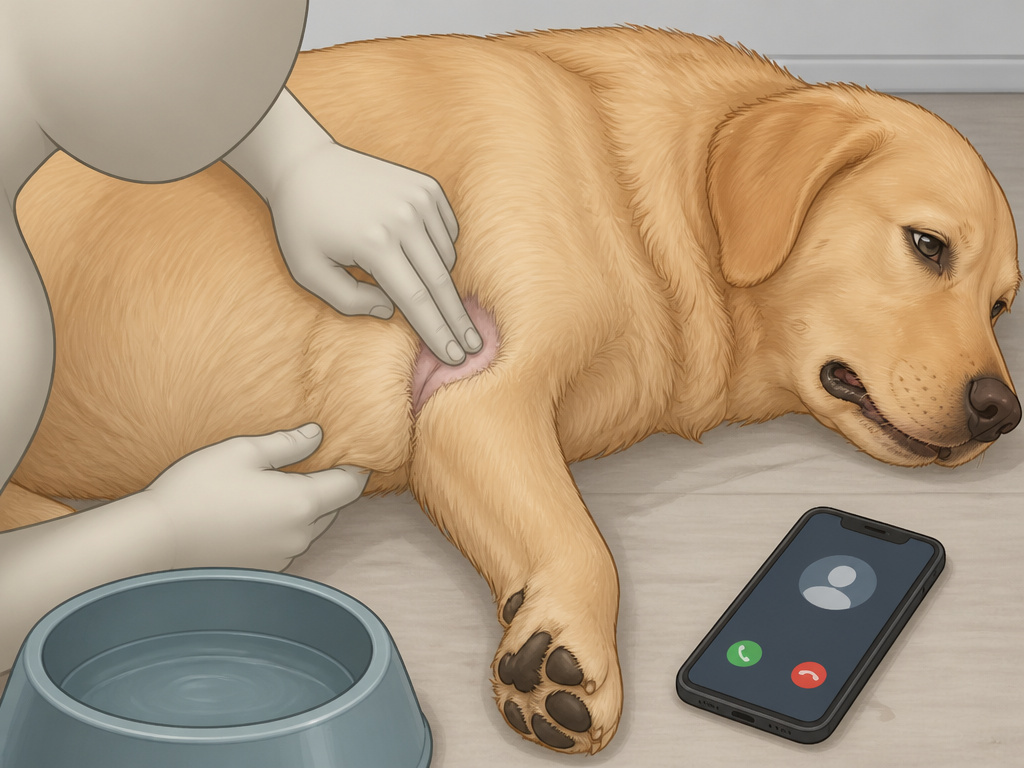
Some findings end the home assessment. A dog that’s slow to respond, off balance, or dull in the eyes has moved past what a bowl of water fixes.
Severe dehydration shows up as slowed response times, ataxia, dull mentation, a heart rate above 140, and poor pulses. Those dogs are often in shock, even if they’re still standing.
You can feel pulse quality on the inside of the upper thigh. A weak, thready pulse alongside the other signs means a veterinary hospital, not a home remedy. IV catheter placement is a hospital job.
Go now if you see:
- Eyes sitting back in the sockets with dull, dry corneas.
- Skin that stays tented instead of flattening.
- A dog that’s unsteady, pressing its head against a wall or door, or not tracking you.
- Dry gums plus a pulse that feels weak under your fingers.
A dog that’s just low energy with no other signs is a different question. The signs of illness that matter there are slower and broader, and lethargy on its own usually points somewhere other than water.
Frequently Asked Questions
Can I tell if my dog is dehydrated by checking the nose?
No. Clinical assessment uses mucous membranes, skin turgor, the eyes, body weight, and lab work. The nose isn’t on that list. A dry nose happens for plenty of reasons, and a wet nose doesn’t rule out a deficit.
How much water should a dog drink in a day?
Roughly 40 to 60 ml per kilogram of body weight at rest, which is about a liter for a 50-pound dog. Hard exercise and heat can push that three to four times higher. Wet food lowers it.
Does a slow skin tent always mean dehydration?
No. Obesity makes the skin return faster and can hide a deficit, while cachexia and old age slow the return in a dog that’s fine. In newborns the test is unreliable because puppy skin is more elastic.
Can a dehydrated dog have wet gums?
Yes. A nauseated dog with heavy drooling can have gums that feel wet while it’s genuinely short on fluid. Check the conjunctiva of the lower eyelid or the prepuce instead.
How fast can I rehydrate a dog at home?
Correct a known, recent deficit over one to four hours with monitoring. If you don’t know how long the dog has been down, stretch it over 24 hours and go slowly.
When is dehydration an emergency?
Sunken eyes, dull corneas, a persistent skin tent, unsteadiness, a heart rate above 140, or a weak pulse. Those need a hospital and IV fluids, not a bowl.
The Bottom Line
Knowing how to tell if a dog is dehydrated is worth less than knowing what your dog weighs on a normal Tuesday. A number on the fridge beats a guess at the bowl.
So here’s the one thing to do this weekend. Weigh your dog on a kitchen scale, write the number somewhere you’ll see it, and pick the two or three spots you’ll use for the tent test from now on.
One concession, because it matters. If your dog is elderly, very thin, very heavy, or under a few weeks old, the tent test is close to useless. Go by weight and gums instead, and let your vet do the grading.
Fresh water, a bowl you actually wash, and the habit of looking at the dog instead of the bowl. That’s the rest of it.
