
How to Recognize Heatstroke in Dogs: 5 Signs to Act On
This post contains affiliate links. As an Amazon Associate, we earn from qualifying purchases.
To recognize heatstroke in dogs, watch for heavy panting that won’t settle, thick ropey drool, gums that turn dark red or pale, wobbliness, and collapse. Act on any one of them, because a dog’s normal 100.5 to 102.5 degrees Fahrenheit can climb to 105 or higher fast.
Panting is the only real cooling tool a dog has, since the sweat glands sit on the paw pads and nowhere else. That means the gap between a dog that is fine and a dog at 105 degrees gets filled by air movement, humidity, and how much fur is in the way. Knowing how to recognize heatstroke in dogs matters because that gap can close fast.
What follows is the sign list in the order it usually shows up, the temperature numbers four veterinary sources give, and the cooling steps that hold up when you read them side by side.
Key Takeaways
- Any one sign is enough to act on. Heavy panting, ropey drool, a gum color change, wobbliness, or collapse all point the same direction.
- 105 degrees Fahrenheit is Cornell’s heatstroke threshold, but a normal reading on arrival does not rule heatstroke out.
- Cool water beats ice. VCA says ice packs and rubbing alcohol are out; the RSPCA says cold water rarely causes shock.
- VCA says stop cooling at 103 degrees Fahrenheit so you don’t push the dog into hypothermia, while Kuo recommends active cooling above 103.5 degrees Fahrenheit.
- Flat-faced, muzzled, older, overweight, and thick-coated dogs get into trouble at temperatures that feel mild to you.
Why a Dog Overheats Faster Than You Expect
A dog’s sweat glands sit on the paw pads and nowhere else, so panting does almost all of the cooling work. That one fact explains why a dog can be in serious trouble while you are comfortable in the same yard.
Kendon Kuo, a veterinary emergency and critical care specialist, breaks how dogs cool down into four routes in his 2025 lecture notes: convection into moving air, conduction into a cool surface, radiation into open space, and evaporation. In mild weather the first three carry the load. Once the air temperature climbs toward body temperature, evaporation takes over, which is why dogs pant rather than sweat.
Evaporation is the dog’s main heat-loss route once air temperature approaches body temperature. Convection and radiation do the early work in mild conditions. High humidity removes the evaporation gradient, so panting moves air but sheds little heat, and core temperature climbs while the dog looks otherwise normal.
Humidity is the variable that catches owners out. Kuo lists increased humidity, poor ventilation, and dehydration among the causes of decreased heat loss, alongside brachycephalic airways, laryngeal paralysis, obesity, and a thick hair coat. Every one of those makes the same pant less effective. Dehydration belongs on that list too, and the signs of dehydration in dogs are easy to miss in an animal that is already panting hard.
Listen to the pant. The how to recognize heatstroke in dogs question comes down to a flatter, harsher sound, less the rhythmic open-mouth puff and more a raw pull of air.
Here is the catch. A thick-coated, flat-faced dog can be at 105 degrees while the person holding the leash is wearing a light jacket.
The 5 Signs That Decide It
Five signs matter, and any one of them is enough to pick up the phone.
- Heavy panting that does not slow down. Cornell’s Riney Canine Health Center lists heavy panting first. If the dog is still hammering away after you stopped moving and stepped into shade, treat that as a warning rather than effort.
- Thick, sticky drool. The RSPCA describes drool that is thicker and stickier than usual as a symptom. Normal drool is thin and drips. This version hangs off the jaw in strings.
- A change in gum color. VCA Animal Hospitals lists abnormal gum color and bruising in the gums. Lift the lip and look at it directly.
- Wobbliness, confusion, or unusual weakness. VCA names lethargy and disorientation, and Cornell lists weakness. Kuo adds fatigue and muscle tremors to the signs of heat exhaustion.
- Vomiting, diarrhea, collapse, or a seizure. Cornell lists vomiting, diarrhea, and collapse. The RSPCA notes that blood in the stool or diarrhea means the heatstroke has become more severe.
What owners tend to notice first is color. When you compare a how to recognize heatstroke in dogs, gums that were a normal pink shift toward dark red or purple, or go the other way into a washed-out pale.
The sign that gets missed: the dog that goes quiet
A dog in real trouble often stops thrashing and gets still, though sources differ on how reliably this appears. That stillness reads as calm from ten feet away, which is how a collapse happens in a backyard with three people standing in it.
Common mistake: Waiting for vomiting or collapse before making the call. Cornell and VCA both list those as signs, which means a dog showing them is already deep into the emergency, not at the start of it.
What Do the Temperature Numbers Actually Mean?
Four sources, four numbers, and they do not line up.
| Source | Number | What it describes |
|---|---|---|
| Cornell Riney Canine Health Center | 100.5 to 102.5 F | Normal body temperature for a dog |
| Cornell Riney Canine Health Center | 105 F or higher | Where heatstroke begins |
| Kendon Kuo, DVM, DACVECC | Above 103.5 F | Where active cooling is recommended |
| VCA Animal Hospitals | 103 F (39.4 C) | Where cooling stops, to avoid hypothermia |
The Cornell heatstroke medical emergency guide gives the normal range and the 105 degree trigger. Kuo’s lecture notes set active cooling at anything above 103.5 F. VCA stops cooling at 103 F. Read together, those last two bracket a narrow working window, and both are talking about a dog already in treatment.
Kuo is blunt about the thermometer itself. He writes that the rectal temperature on presentation is not useful for determining severity, that it may not reflect core body temperature, and that peripheral vasodilation can lead to overestimating it. Cornell takes a different angle, saying prognosis depends on how high the temperature gets and how long it stays elevated.
Both can be true. The number tells you where the dog is right now. The history tells you where it has been.
Why a normal temperature does not clear a dog
Kuo states it plainly: a normal temperature does not rule out heatstroke. A dog that was hosed down in a driveway or sat in air conditioning on the drive over can read normal and still be in a systemic crisis. That is why the history matters more than the beep.
A thermometer reading feels like an answer. It is one data point, and a high reading is not automatically a fever, so how to tell if a dog has a fever is a separate question from whether the dog is overheating.
Which Cooling Method Actually Works?
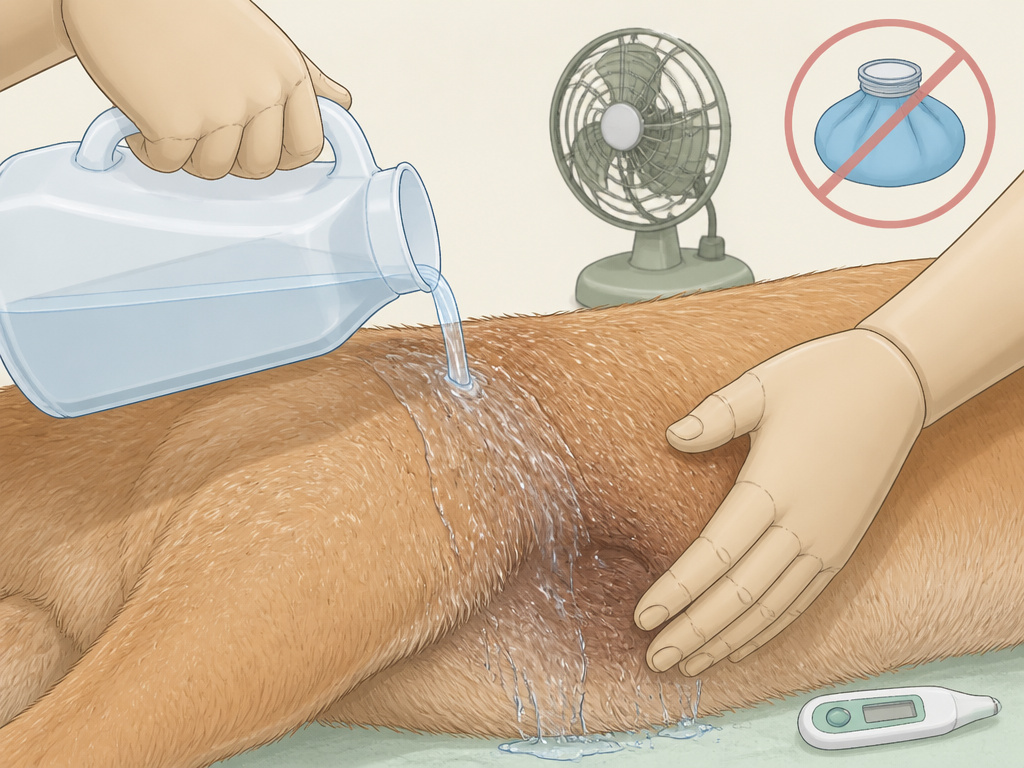
Ice packs and rubbing alcohol are out. VCA Animal Hospitals states directly that neither is recommended anymore as a way to bring a dog’s temperature down.
| Method | Verdict | Who says so |
|---|---|---|
| Cool water over head, stomach, armpits, feet | Yes | VCA Animal Hospitals |
| Misting plus a fan or air conditioning | Yes | VCA Animal Hospitals |
| Wet towels wrapped around the dog | No | VCA Animal Hospitals |
| Ice packs and rubbing alcohol | No | VCA Animal Hospitals |
| Full-body immersion in cool water | Yes, with exceptions | RSPCA |
Before you start: A dog in pain can bite a familiar hand, so clip a leash on before you start pouring. A wet floor plus a tiled clinic lobby is a slip risk, so carry a wobbly dog instead of walking it. Keep the car’s air conditioning on full and the dog directly in front of a vent on the drive.
Here is where the sources genuinely split. VCA says cool water, not cold, and rules out ice packs. The RSPCA says the opposite in spirit, arguing that cold water rarely causes shock in an overheating dog and that dousing or immersing the dog in cold water is vital to recovery. Both are describing the same goal with different risk tolerances.
The RSPCA adds a set of exceptions that matter. Don’t submerge an unconscious dog, a dog with health conditions, or an elderly dog. Spray those dogs with room-temperature water instead.
Water temperature is easy to judge by hand. VCA advises cool water, not cold, while the RSPCA argues cold water rarely causes shock and is vital to recovery.
I would rather have a wet dog and a wet car seat than a dry dog and five extra minutes of climbing core temperature. Everything in a good keeping dogs cool routine assumes the dog is still standing, and this is the part for when it isn’t.
A dog in that state may also be heading into shock, and how to treat a dog for shock is worth reading before you need it rather than during.
When to Stop Cooling and Head for the Vet

VCA says stop cooling at 103 degrees Fahrenheit, while Kuo recommends active cooling above 103.5 degrees Fahrenheit.
VCA discontinues cooling once the dog’s temperature falls to 103 F (39.4 C), specifically to avoid hypothermia. That is the number that ends the hose session. Going past it trades one emergency for another.
On transport, the sources line up more than they appear to. The RSPCA says act fast to reduce body temperature first, then get help. Cornell says start cooling immediately by wetting the dog with cool water and placing it in front of the car’s air conditioning on the way. Kuo lists cooling measures en route to the veterinarian as part of the plan. All three want a wet dog in a moving car.
Kuo’s prognosis notes are the ones to remember at 2 a.m. Most deaths occur during the first 24 hours, and dogs still alive at 72 hours all survived to discharge. Cornell adds that survivors are at greater risk of heatstroke again in the future, so the dog that pulls through needs a tighter plan next summer.
What the vet will do when you arrive
VCA lists intravenous fluids, mild sedation, and low-concentration oxygen therapy as common hospital treatments. Cornell notes that diagnosis rests on a history of heat exposure plus the clinical signs, with a physical exam and blood work to check for organ damage. Kuo describes the underlying cascade as a systemic inflammatory response that leads to multiorgan dysfunction, with the central nervous system hit hardest.
If the dog goes down before you get there, what to do if a dog collapses covers the positioning and the call.
The Dogs the Standard Advice Misses

The dog is muzzled, the afternoon is mild, and nobody is sweating. That combination still puts dogs in the emergency room.
VCA is specific about why. Muzzled dogs are at greater risk because the muzzle restricts their ability to pant. Brachycephalic breeds such as pugs, boxers, and bulldogs can show clinical signs when the outside temperature and humidity are only moderately elevated.
The full risk list is longer than most owners expect:
- Flat-faced breeds, which VCA says can show signs at only moderately elevated temperature and humidity
- Muzzled dogs, because panting is the cooling mechanism and the muzzle blocks it
- Thick-coated dogs, which the RSPCA notes trap heat in
- Puppies and senior dogs, whose temperature regulation is weaker, plus older and overweight dogs per Cornell
- Laryngeal paralysis, obesity, and dehydration on Kuo’s list of decreased heat-loss causes
- Exercise, seizures, and toxins such as metaldehyde, strychnine, and amphetamines, which raise heat production
- Hair dryer exposure for an extended time, which VCA lists as a common cause
The RSPCA puts the car question in perspective with a number worth remembering: dogs are 10 times more likely to experience heat-related illness out in hot weather than by overheating in a car. The car is the headline. The walk is the bigger exposure.
Easy to miss: A muzzled dog cannot pant properly, and VCA treats muzzles as a risk factor on their own. If your dog wears one for grooming, travel, or reactivity, that dog needs shade and water breaks with the muzzle off.
Cars still deserve their reputation. VCA calls inadequate ventilation in a car the most common cause of heat stroke, with body temperature rising within minutes. Cornell notes the same rapid rise. Kuo describes a dog trapped in a vehicle as a disastrous combination of risk factors in one place.
What to Have Ready Before It Happens
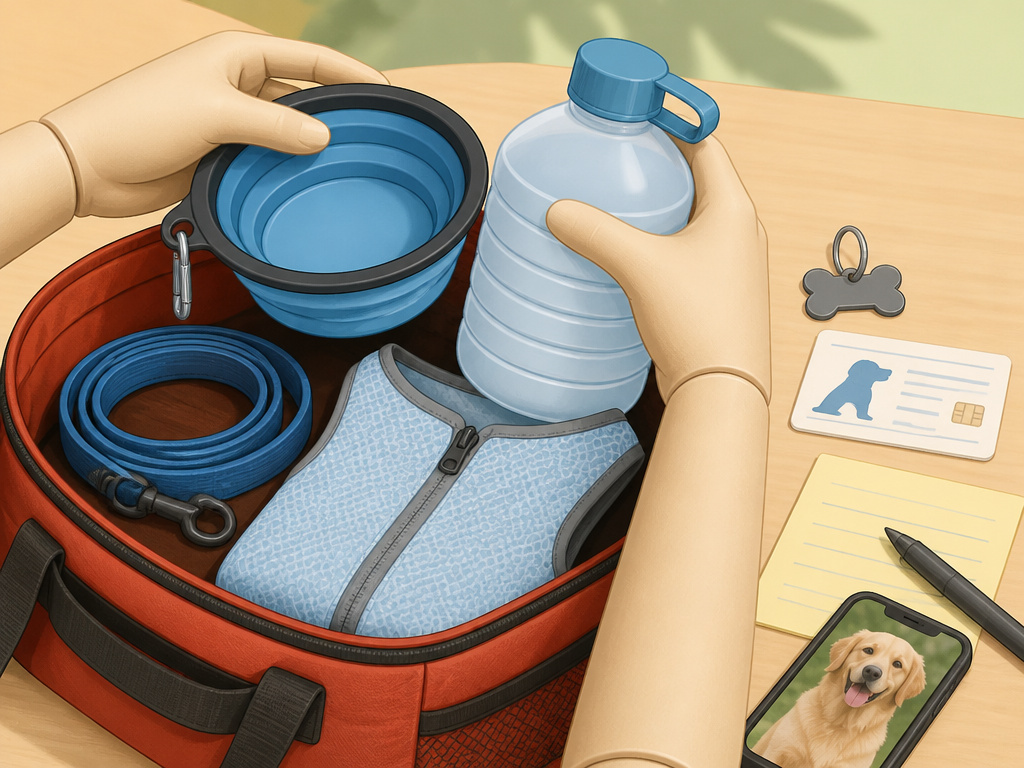
The plan you build in April is the one you’ll actually use in July.
Start with identification, because a dog that panics and bolts in heat is a dog that may end up in traffic. A current ID tag, a microchip that is actually registered and updated, and a recent photo on your phone cover the first hour. Microchip registries run registration lookups, and the check takes less time than the drive to the store where you bought the tag.
Then the practical kit:
- A leash by the front door, because you cannot cool a dog that won’t hold still
- A jug of water and a collapsible bowl in the car
- The emergency vet’s address and phone number written somewhere you can read without your glasses
- A cooling vest for summer walks, which works by evaporation once it is wet
GPS trackers are a backup, not a plan. A tracker is useful for finding a dog that got out, but batteries die and coverage drops, which is exactly the scenario where you needed it. The microchip registration check is the underrated one. Plenty of chips were never registered in the first place, or still carry a phone number from three moves ago.
The fence failure nobody plans for
A dead fence battery or a broken wire lets a dog out, and a dog that panics in heat is the worst possible combination. That is the argument for walking the fence line before the first hot week rather than during it. It is also the argument for testing the collar on the same schedule you check your smoke alarms.
Check the fence, check the chip, check the tags. Not glamorous, but it works.
Frequently Asked Questions
How fast can a dog overheat?
VCA says body temperature in a car with inadequate ventilation can rise within minutes, and Cornell notes the same rapid increase. There is no safe parking window to leave a dog in a car on a warm day, even with the windows cracked.
Can a dog get heatstroke in the shade?
Yes. Kuo lists increased humidity, confinement with inadequate ventilation, obesity, a thick coat, and dehydration as causes of decreased heat loss, and none of those require direct sun. Exercise and seizures raise heat production from the inside.
Should I use ice or cold water to cool a dog down?
The sources disagree. VCA advises cool water rather than cold, and states that ice packs and rubbing alcohol are no longer recommended. The RSPCA argues that cold water rarely causes shock in an overheating dog and that dousing or immersing the dog is vital to recovery, with exceptions for unconscious, ill, or elderly dogs.
Is panting always the first sign?
Cornell and VCA both list heavy panting and elevated breathing rates first. That said, Kuo notes that a normal temperature does not rule out heatstroke, and VCA notes that flat-faced breeds can show signs when conditions are only moderately elevated, so a dog can be further along than the panting suggests.
My dog seems fine after cooling down. Do I still need the vet?
Yes. Kuo’s notes state that a normal temperature does not rule out heatstroke, and that prior cooling can produce a normal or even low reading. Cornell adds that dogs that survive are at greater risk of heatstroke again later.
The Bottom Line
The cooling advice genuinely conflicts, and you will read three different versions before lunch. Here is how I’d resolve it in the moment: if the gums have changed color, or the dog has gone wobbly or quiet, skip the debate and drive with the air conditioning on and the dog wet.
That is the trigger. Color change, wobbliness, or stillness means the window for home treatment has closed.
One thing to do this weekend, and it takes five minutes: look up your dog’s microchip number and confirm the registration still has your current phone number on it. Every other part of this plan assumes you get the dog back.
Peace of mind is the real goal.
