
How to Teach a Puppy Its Name: Step-by-Step
This post contains affiliate links. As an Amazon Associate, we earn from qualifying purchases.
To teach a puppy its name, say the word once in a bright, happy tone while the puppy isn’t looking at you, then mark and treat the instant it turns. Helpful Hounds runs eight to ten reps over a couple of minutes. Most puppies connect the word within a few days.
The timing in that how to teach a puppy its name sentence carries more weight than the word itself. A treat that lands as the head comes around teaches the puppy that the name predicts something worth having. A treat that lands late teaches it that nice things appear at random, and the puppy starts watching your hand instead of listening to your voice.
What follows is the six-step version, the two places where the national kennel bodies flatly disagree, and the setup I’d use for a puppy too young for anything with a collar on it.
Key Takeaways
- Sources split on repeating the name. The American Kennel Club and Purina warn that repeating it teaches a puppy to wait for the third or fourth call before bothering to look, while the Royal Kennel Club says the name 10 times with a reward after each and Helpful Hounds says it once, then again after a pause with a kissy noise.
- Reward inside one second. PetMD notes that any delay muddies what the puppy thinks it’s being paid for.
- Eight to ten reps is a whole session for Helpful Hounds. It caps it there because more than that and the puppy will get bored, while Purina says less than five minutes a day is enough and the AKC says repeat the process several times throughout the day.
- Build the hold time 2 seconds, then 3, then 4, then 5. That ladder is the step nearly everyone skips.
- Never attach the name to anything unpleasant. Both the AKC and Purina name this as the fastest way to ruin a cue.
What “Knowing Its Name” Actually Means
The Royal Kennel Club’s protocol starts with one behaviour: the dog stops what it’s doing, looks at you, and waits for the next instruction.
Name response training pairs a spoken word with an immediate food or toy reward. The word starts as neutral sound and acquires value through repetition, until the sound reliably predicts a reward. The behaviour being trained is a head turn and sustained attention toward the handler, not recognition of the word itself.
That how to teach a puppy its name distinction matters more than it sounds. PetMD, citing the American Psychological Association, notes that dogs understand more than 150 words, with the brightest learners reaching 250. Your puppy can absolutely learn the sound of its name. What it has to be taught is what to do when it hears it.
So treat the name as a cue with a job, the same way “sit” has a job. It means: stop, find the human, wait. Everything else you’ll teach later hangs off that one turn of the head.
Pick a name you can shout across a yard
PetMD recommends one or two syllables, and warns against names that sound like a command. “Kit” blurs into “sit.” “Bo” blurs into “no.” Best Friends Animal Society makes the same point from the calling side: choose something easy to shout, and something that doesn’t collide with the other words you’ll use as cues.
If you’re still deciding, the shortlist matters less than the test. Stand at your back door and say it at the volume you’d actually use at seven in the morning. If it feels ridiculous, it’ll get shortened into a nickname by week two. Best Friends suggests teaching the nicknames too, which is fair, because the dog will hear them anyway.
How to Teach a Puppy Its Name: The 6-Step Name Game
Six steps, about two minutes, one pocket of treats.
Before you start: Keep every rep indoors or in a fenced garden with the puppy on a lead. PetMD warns that teaching a name off-leash outdoors risks a puppy bolting mid-session, and a puppy that bolts is a puppy loose near a road, while the Royal Kennel Club reteaches outside in the garden or on a walk with the dog on lead and the AKC moves lessons outside once attention is consistent. Quiet room first, garden on lead second.
- Pick a quiet room and a relaxed moment. Purina suggests starting when the puppy is calm but not asleep, with no distractions in the room. Skip it entirely if the puppy is tired, over-excited, or already locked onto something interesting, because Helpful Hounds is blunt about that state producing nothing.
- Wait until the puppy isn’t looking at you. Then say the name once, brightly. Saying it while you already have eye contact teaches the puppy nothing new, and Purina’s whole method depends on the puppy choosing to turn.
- Mark the instant the head comes around. A marker word like “yes” or “good,” or a click, delivered the moment the puppy’s eyes find you. If you’re new to this, marker word training and clicker training both cover the timing in detail.
- Get the treat in within a second. PetMD is explicit that a delayed treat confuses the puppy about what earned it. Soft, small, swallowable pieces beat anything the puppy has to chew. Puppy treats that take three seconds to eat kill the rhythm of the session.
- Break the attention, then go again. Helpful Hounds throws a treat away so the puppy turns off, then says the name once more. That reset is what makes rep two a real rep instead of a dog staring at your pocket.
- Stop at eight to ten, then repeat every couple of hours. Helpful Hounds caps the cycle because more than that and the puppy will get bored, while Purina says less than five minutes a day is enough and the AKC says repeat the process several times throughout the day.
Then do it in a different room. Purina’s advice is to practise everywhere until the puppy looks the moment it hears the word, every time, while PetMD says never teach a name off-leash outside and to start inside where there are fewer distractions.
How Many Times Should You Say the Puppy’s Name?
Four published protocols, four different answers, and the split matters more than it looks.
| Source | Reps per session | If the puppy doesn’t respond |
|---|---|---|
| Royal Kennel Club (UK) | 10, rewarded after each | Lure with a treat under the nose; don’t repeat the name |
| Helpful Hounds (UK) | 8 to 10 over a couple of minutes | Pause, then try once more with a kissy noise |
| American Kennel Club | One, several times through the day | Walk away from the distraction and try again |
| Purina | One, repeated across the day | Nothing. The puppy missed its chance |
Read the first two rows closely, because the numbers are nearly identical and the intent is opposite. The Royal Kennel Club runs a drill: ten repetitions, reward after each, building the association through volume. Helpful Hounds runs a short burst and then stops before the puppy’s attention falls off a cliff.
Both work. The sources disagree on what to do if the puppy doesn’t respond: the Royal Kennel Club lures with a treat under the nose rather than repeating the name, Helpful Hounds tries once more after a pause with a kissy noise, the AKC says don’t say it multiple times in a row, and Purina says don’t repeat it at all.
Where this goes sideways: Repeating the name until the puppy finally looks. The AKC warns that a puppy trained this way learns to require the repetition, and you end up with a dog that waits for the fourth call before it bothers.
The sources disagree on what to do if the puppy doesn’t respond. The Royal Kennel Club puts the response window at a second or two and says to lure with a treat under the nose rather than repeat the name, while Helpful Hounds says try once more after a pause with a kissy noise, the AKC says don’t say it multiple times in a row, and Purina says don’t repeat it at all. If the puppy hasn’t turned by then, it isn’t going to, and the useful move is to put a treat under its nose rather than say the word again.
Should You Say Your Dog’s Name Before a Command?
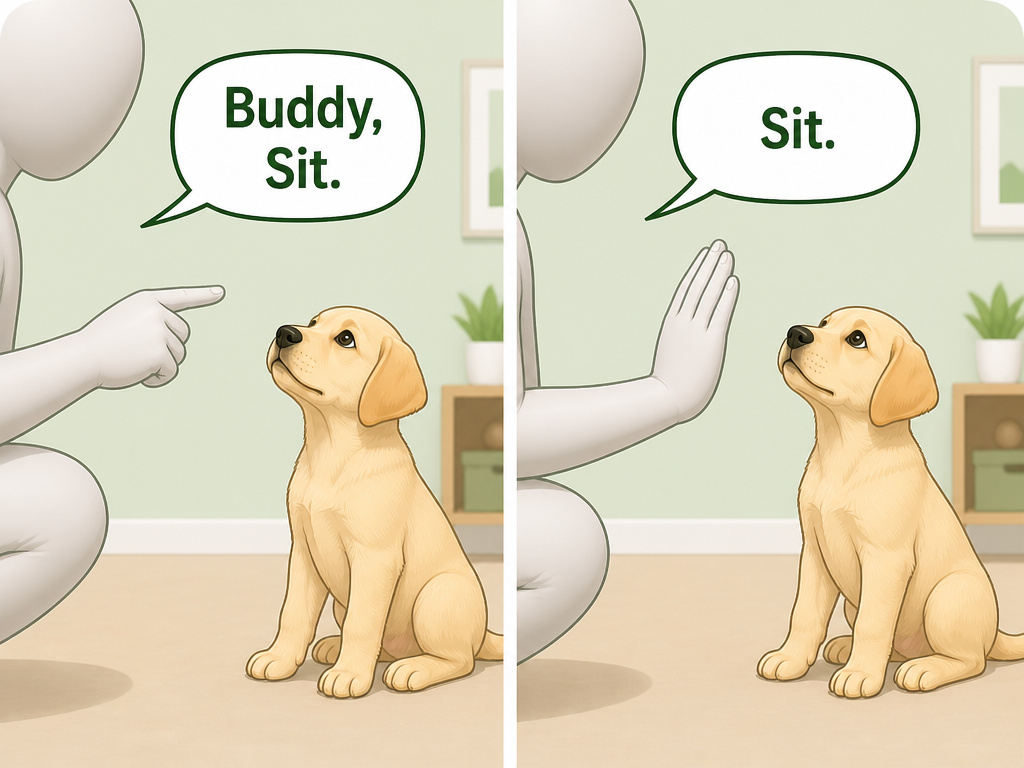
Two national kennel bodies answer this one in opposite directions, and both answers hold up in their own context.
The Royal Kennel Club builds the name into a chain. Once the dog is responding well, you use the name and then ask it to sit or come. The name becomes a pre-cue, a signal that a request is coming.
The American Kennel Club takes the other position. It says you should be able to say “sit,” “stay,” or “down” without repeating the name first, because a dog that hears its name before every cue learns to wait for it, while the Royal Kennel Club says to use the name and then ask for sit or come. PetMD lands on the same side, warning that puppies can confuse the name with the action being taught.
Here’s how I’d hold both. Use the name to get attention when you don’t have it, at distance, in the garden, with the puppy facing away. Drop the name when the puppy is already looking at you, and give the cue by itself. That gives you the Royal Kennel Club’s chain when you need it and the AKC’s clean cues when you don’t. If you’re working on the sit command specifically, teach it without the name attached first.
The 2-Second Ladder Most Owners Skip
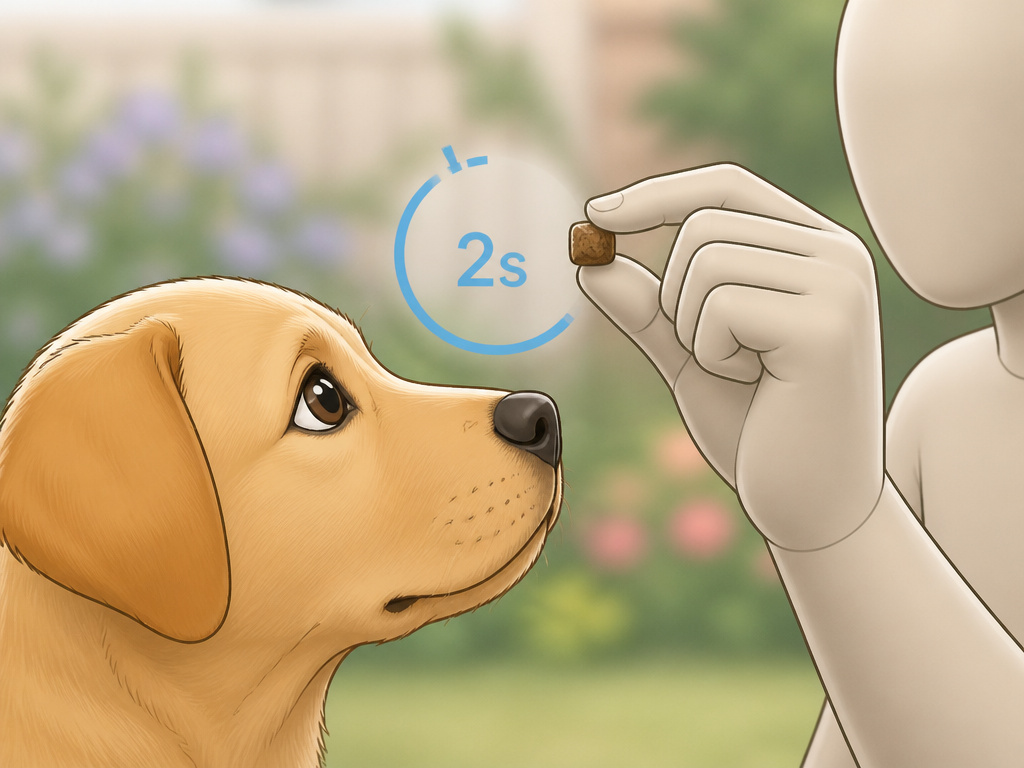
Two seconds is the entire starting target.
Helpful Hounds builds attention in stages: mark the moment the puppy looks, then wait two seconds before delivering the treat. Then three. Then four. Eventually the puppy holds your face for at least five seconds before the reward lands. That progression is what turns a head turn into actual focus.
- Two seconds. Most puppies clear this in the first session.
- Three seconds. Still easy, and this is where the treat starts feeling earned.
- Four seconds. The first stage where puppies break, especially in a new room.
- Five seconds or more. This is the target, and it’s the one that survives a garden full of smells.
If the puppy can’t hold attention at any stage, Helpful Hounds says drop back a time period for the rest of the session and finish on a win. Don’t grind at the stage that’s failing. You’ll both end up frustrated and the puppy will learn that its name precedes a hard time.
This is also where look at me work overlaps almost completely. Same behaviour, different label.
The treat-fading question
The sources don’t agree here either: the AKC shifts to intermittent treats and eventually treats won’t be necessary, while the Royal Kennel Club keeps a reward in the loop throughout and never describes full fading.
The AKC describes shifting to intermittent treats, always keeping verbal praise, with the eventual goal that the dog responds for praise alone, while the Royal Kennel Club never describes full fading and keeps a reward in the loop the whole way through, whether that’s a treat, a toy, or your voice.
My read: fade the food, keep the warmth. A dog that gets a “good dog” in a genuinely pleased voice every time, and a treat maybe one time in four, will keep turning for years.
Where Name Training Goes Wrong: The Poisoned Name
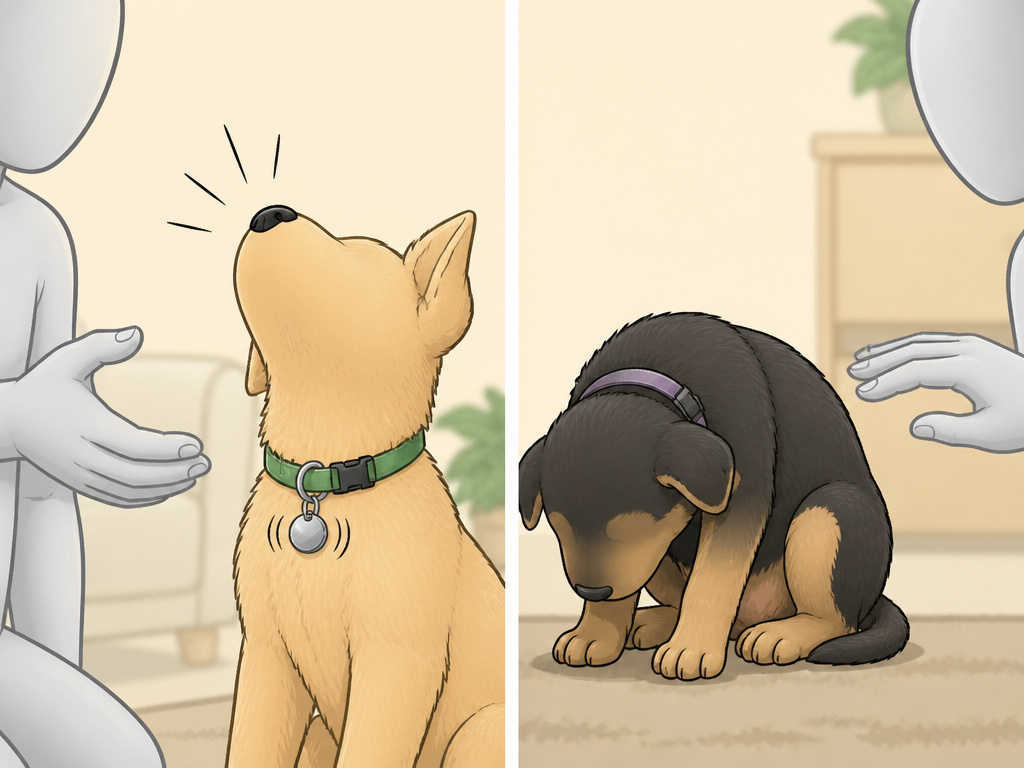
The puppy hears its name and drops. Ears back, tail low, no treat anywhere in sight.
That’s a dog whose name has been attached to corrections. The AKC is direct about it: many dogs don’t like the sound of their own name because owners pair it with verbal corrections. “Rover, down.” “Ginger, quiet.” Best Friends makes the same point from the interruption angle, noting that even when you’re using the name to stop something, the tone has to stay happy.
Purina adds the other half of the rule. Never call a puppy to you for something it dislikes. If the only time the name means “come here” is nail trims and bath time, the name becomes a warning.
I won’t say a dog’s name and then do something the dog hates. Not for a nail trim, not for the crate on a work morning. If the name is going to mean “something good is about to happen,” it can’t also mean “brace yourself.”
The tell is in the sound of the room. A puppy that’s been trained well snaps its head around fast enough that you hear the collar tag jingle. A puppy with a poisoned name flicks one ear and looks at the floor. Same word, completely different response, and you can hear which one you’ve got from across the kitchen.
Puppies, Yards, and the Containment Question
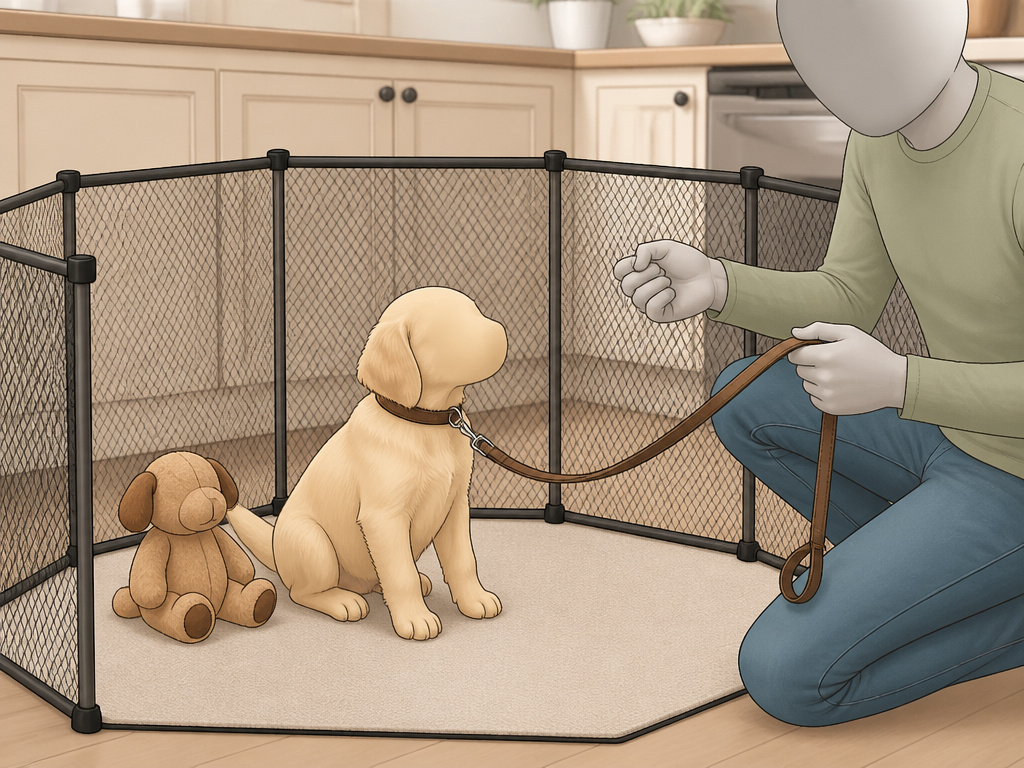
A puppy learning its name needs a space small enough that success is the only option.
That’s why I don’t hand a young puppy the run of the yard. The mistake I see most is full yard access in week one, with an owner standing on the patio calling a dog that has no idea where the edges are and no reason to care. The puppy isn’t stubborn. It’s a bundle of curiosity in a space far bigger than it can handle.
An exercise pen solves this. A pen gives you a defined area where the puppy can be loose, safe, and close enough that saying its name actually competes with the interesting smells. Set it up in the kitchen, put a stuffed toy inside, and you’ve got a training space and a place to park the puppy while you cook.
Easy to miss: A pen doesn’t replace the lead work. Do the name reps with the puppy on a lead even inside the pen, because a lead is what teaches the puppy that a human at the end of it is worth checking in with.
I also don’t put a puppy on a collar-based containment system at all. Not until it’s older and has basic training under its belt. Early electronic training scares more puppies than it teaches, and a puppy that’s already nervous about the garden is a puppy that won’t train well in it. If you’re mapping out the first months, when to start training covers the order I’d do things in.
How Long Until the Puppy Knows Its Name?

Purina’s answer is the most encouraging: less than five minutes a day, and in not very many days, you’ll have a puppy that recognizes its name.
The AKC is a shade more careful. Many dogs begin recognizing their name within a few days of consistent training, though reliable responses in distracting environments often take longer. PetMD points to studies showing dogs can learn names and other words within one week.
Notice what none of them give you: a timeline for reliable response in a distracting environment. That’s the honest gap in this whole topic. Nobody publishes a precise day by which your puppy will respond in a busy park, because it depends on the dog, the trainer, and how gradually the distractions went in.
What I can tell you is the sequence. Once the puppy is reliable in the kitchen, Purina suggests dropping the treat on the floor beside you instead of throwing it, so the puppy has to come to you. That’s the first step of recall training, and it’s the reason name work is worth the two minutes a day. You’re not teaching a party trick. You’re building the front half of the cue that brings your dog back across a field.
Frequently Asked Questions
How long does it take to teach a puppy its name?
Purina describes a puppy recognizing its name in not very many days with under five minutes of daily practice. The AKC says many dogs begin recognizing their name within a few days of consistent training, while reliable responses around distractions take longer. PetMD cites studies showing dogs learn names and other words within one week.
Should I say my puppy’s name when I correct it?
No. The AKC warns that combining the name with verbal corrections turns a positive association negative, and notes that many dogs end up disliking the sound of their own name for exactly this reason. Use a separate interruption sound, and keep the name clean.
Can I teach an older rescue dog a new name?
Yes. The AKC says adult dogs can learn a new name through the same process, by repeatedly pairing it with positive experiences like treats, praise, and play. Expect the same short sessions and the same one-word rule.
Is it bad to use nicknames with my puppy?
Best Friends advises teaching the nicknames along with the real name, since the dog will hear them regardless. PetMD notes that dogs can recognize nicknames as similar sound cues. Just don’t let the nickname become the only thing the dog answers to.
What if my puppy only responds when it hears the treat bag?
That’s a cue problem, and a common one. The crinkle of the bag has been paired with food more reliably than the name has. Move the treats out of sight, as the Royal Kennel Club suggests, and reward from a pocket or a surface the puppy can’t see. The name has to be the predictor, not the packaging.
Before You Go
Three things to check in your own house before tomorrow morning.
- A door you can close. Name training fails in an open-plan kitchen with a cat in it. Find the smallest quiet room you have.
- Treats you can deliver in under a second. If you’re fumbling with a bag, the reward lands late and the puppy learns the wrong thing.
- A pen or a lead, not the whole yard. Small space, high success rate, and no chance of a puppy discovering the back gate before it has learned to check in with you.
If the puppy’s response gets worse instead of better, drop back a step and finish the session there. That’s Helpful Hounds’ rule and it’s the one I’d tattoo on the fridge. Progress in this is not a straight line, and a session that ends on an easy win is worth more than a session that pushes through three failures.
One last thing, and I mean it as a limit on my own advice. I’m not a behaviourist. A puppy that flinches at its own name, or one that panics when separated from you, needs a professional assessment. No treat protocol fixes a fear response, and treating one like a training gap just wastes months.
