
How to Stop Puppy Whining at Night: What Actually Works
This post contains affiliate links. As an Amazon Associate, we earn from qualifying purchases.
To stop puppy whining at night, settle the puppy in a covered crate beside your bed, answer crying with a calm toilet break and a quiet return to bed, and skip the fuss. The Generation Pup study of 145 puppies found that owners who fussed over puppies in response to ‘bad’ behaviour on return had 5.76 times the odds of separation-related behaviour at six months.
That figure comes from owner questionnaires filled in at six months, and the authors are careful to call the result correlational rather than proven. What it does show is that how you respond in the moment, and how to stop puppy whining at night, leaves a mark on how the puppy handles being alone later.
What follows covers the settling routine, the crate question, the sleep numbers, and the one argument between animal welfare organisations that you’ll hit in every search result on this topic.
Key Takeaways
- Put the crate beside your bed and cover it. The AKC notes that many owners place the crate in their bedroom so the puppy feels the family close by, and a crate cover makes a wire crate darker and more den-like.
- Answer crying with a toilet trip, not a cuddle. PDSA vets advise checking whether the puppy needs the toilet first, then settling them back down with minimal fuss.
- Nine hours of sleep or more at 16 weeks or earlier is linked to lower separation risk at six months. Ten-plus hours showed the strongest association in the Generation Pup cohort.
- Punishment and time-outs carry the biggest risk in the data. Two or more aversive techniques at six months came with 11.09 times the odds of separation-related behaviour, and time-out methods used while the puppy was relaxing at home came with 97.96 times the odds.
- Expect about a month, not a weekend. Chewy’s veterinary reviewer puts the typical drop-off in whining at roughly four weeks in a new home.
Why a puppy screams the moment the lights go out
A puppy that has slept in a pile of littermates since birth wakes up alone in the dark, and the only tool it has is its voice. PDSA vets describe the first nights exactly this way: the puppy has spent its whole life sleeping next to its mother and siblings, and waking to an empty room is a genuine shock rather than a tantrum.
Puppy vocalisation at night follows a predictable pattern: the puppy wakes, finds no littermates and no familiar scent, and signals distress. Because a young puppy cannot yet hold the bladder through the night, the waking event is frequently a toilet need rather than anxiety alone.
The sound can help you work out which problem you’re dealing with, and how to stop puppy whining at night. A whine that stops the instant your feet hit the floor suggests a company problem, while a whine that carries on while you’re standing right there may point to the bladder, or to something hurting.
PDSA makes a related point that gets skipped: during the day the puppy has you nearby most of the time, so it naps, wakes, finds you still there, and settles. Night removes that anchor all at once. If you want the full picture of what different whines mean, the breakdown of dog whining causes is worth ten minutes before you start changing anything.
How to stop puppy whining at night: the six-step settling routine
The routine below is assembled from PDSA, Chewy’s veterinary review, and AKC guidance. The sources disagree on some steps, including whether to restrict food and water before bedtime, as well as on how you respond once the crying starts.
- Feed the last meal and pull the water several hours before bed. The AKC recommends restricting food and water intake for several hours before bedtime, while PDSA states no feeding cutoff and advises checking whether the puppy needs the toilet when they wake and cry. Skip it and you’re signing up for a 2 a.m. Toilet trip with a full bladder behind it.
- Take the final toilet trip on a lead, immediately before the crate. Calm, boring, no play. Arousal before bed buys you a puppy that’s wide awake at the exact moment you want it asleep.
- Warm the bed and add one safe comforter. PDSA advises a warm, comfortable bed and notes that a teddy works as a soft, bulky snuggle object as long as it can’t be chewed up and swallowed. A puppy heartbeat toy does the same job by simulating a mother’s presence, per the AKC.
- Cover the crate and put it where the puppy can smell you. A crate cover over a wire crate makes it darker and more den-like, and the AKC notes that many owners keep the crate in their bedroom.
- When the puppy cries, check the toilet first, then settle it back down with minimal fuss. That’s PDSA’s sequence word for word. No cuddles, no talking beyond quiet praise for toileting in the right place, no play.
- Reward the quiet, not the noise. Chewy’s reviewer is direct on this: offer treats, praise or affection when the puppy is calm, and don’t reward whining with attention.
A puppy schedule that holds the same bedtime every night does more for step one than any product you can buy. Dogs thrive on routine, and the AKC puts consistency across feeding, walks, potty breaks and crate use near the top of the settling list.
The 3 a.m. Version
If you’re reading this at 3 a.m. With a screaming puppy, here’s the compressed version. Check the toilet. Settle the puppy back down with as little contact as you can manage. Go back to bed. Repeat tomorrow with an earlier last meal and a covered crate.
Should you let a puppy cry it out?
This is where the guidance splits, and pretending otherwise would be dishonest. Two reputable sources give opposite instructions on the single most-searched question in this topic.
| Question | PDSA (UK veterinary charity) | Chewy (reviewed by Hannah Hart, DVM) |
|---|---|---|
| Crying at night | Never ignore it, especially in the first few nights | Ignoring attention-seeking whining can teach independence |
| What to do instead | Check the toilet, settle gently, minimal fuss | Don’t reward whining with attention; reward quiet |
| Risk of cry-it-out | Can make the puppy more anxious about being alone | Can discourage attention-seeking behaviour |
PDSA is blunt about the downside: leaving a puppy to cry it out can have the opposite effect and make it more anxious about being alone, and being quiet doesn’t mean the puppy is OK. Chewy’s position, reviewed by a veterinarian, is that ignoring whining in some cases is fine, particularly when the whining is attention-seeking.
The case for answering every cry
PDSA’s reasoning rests on what the puppy is learning. In the first week or so it’s grieving the loss of its dog family, and ignoring that doesn’t build confidence. PDSA also flags the practical point that a crying puppy may simply need the toilet, and that limiting contact rather than limiting presence is the lever that stops crying becoming a trained behaviour.
The case for ignoring attention-seeking whining
Chewy’s reviewer, Hannah Hart, DVM, frames it as a learning problem: give attention every time the puppy whines and it learns that whining works. On that reading, a puppy that has just been out, has just been fed, and is whining at a closed crate door is testing a lever, not signalling distress.
Where this goes sideways: Applying the ignore-it advice to a puppy that needs the toilet. You get a crate accident overnight, the bedding soaks, and the puppy is now both cold and stressed. Rule out the toilet before you rule out attention.
My own reading of both positions: the disagreement is smaller than it looks. Neither source says leave a frightened puppy alone for hours. PDSA says never ignore a crying puppy and instead attend and settle, while Chewy says ignoring attention-seeking whining in some cases is fine and teaches independence. Both land on calm, brief, boring behaviour from you.
Where the crate goes decides how night one goes
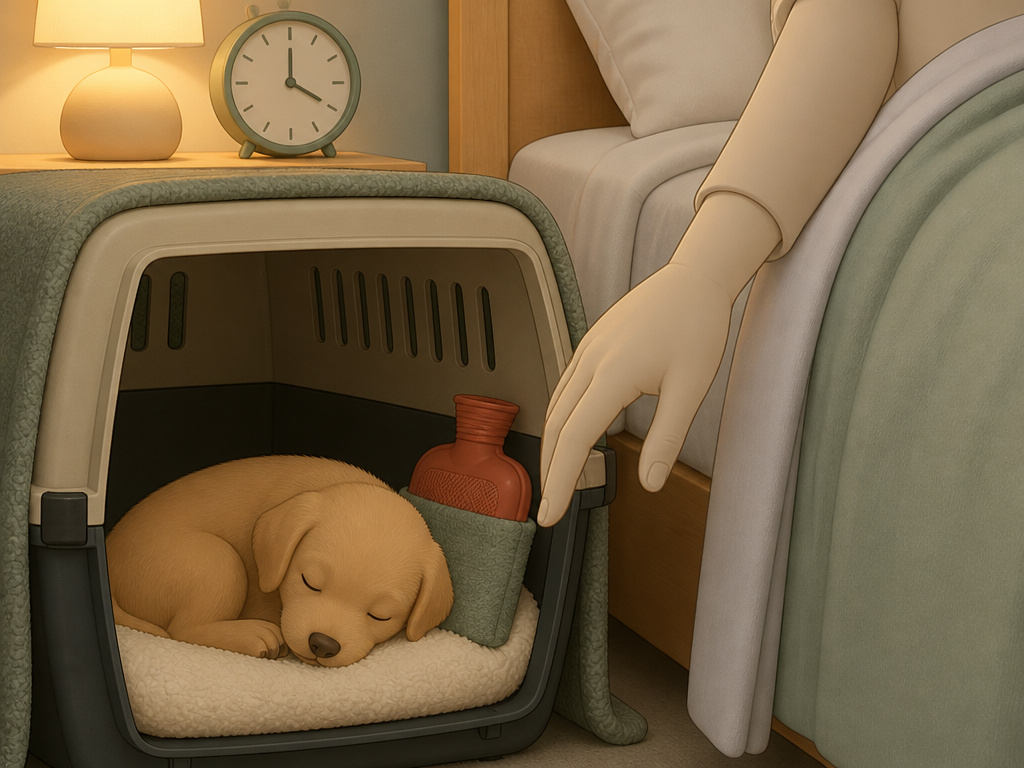
The early nights are the worst, and moving the crate next to the bed was the single change that fixed it for me. Whining dropped sharply by the fourth night. Nothing else changed. Same bedding, same bedtime, same puppy.
I also tried the cry-it-out method exactly once. A long stretch of a puppy screaming like it was being hurt, and I was the one who caved. I’m not going to pretend that was a controlled experiment, but it told me what I needed to know about my own tolerance and about how fast a small puppy can escalate.
What most people get wrong: Putting the crate in a spare room to “teach independence” in week one. The puppy can’t smell you, can’t hear you, and has no reason yet to believe you’re coming back. You get a longer, louder night and a puppy that’s harder to settle on night two.
The AKC’s version of this is gentler than mine: decide on a place where the puppy won’t feel isolated, and note that the sound of your voice and some petting may help it feel secure. PDSA frames sleeping in the same room as a temporary confidence-building measure rather than a permanent arrangement, which is the right way to think about it.
Bedding matters more than people expect here. PDSA warns that a bed which is too open and exposed can make a puppy feel vulnerable, and the practical version of that is a covered crate with puppy bedding that holds warmth without being chewable. A wrapped hot water bottle under a towel works too, per the AKC, as long as the puppy can’t get at the bottle itself.
Easy to miss: A ticking clock near the crate is an old trick the AKC still lists, on the logic that the sound mimics a mother’s heartbeat. It costs nothing to try on night one and it either helps or it doesn’t.
If you’re still in the early days, the practical playbook for the first week with a puppy covers the daytime side of the same problem. Night behaviour is downstream of daytime arousal, and a puppy that napped badly all afternoon is a puppy that’s overtired and wired by 10 p.m.
What the Generation Pup data says about sleep, house-training and punishment
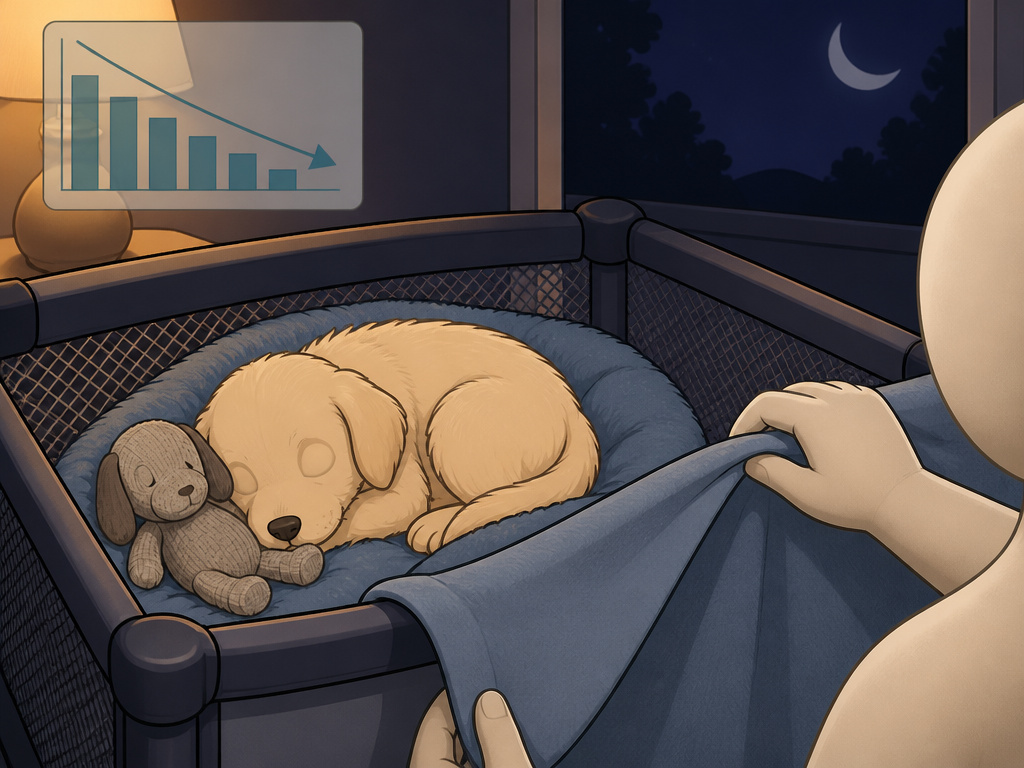
The Generation Pup study is the most useful piece of evidence in this whole topic, and almost nobody writing about night whining cites it. It followed 145 puppies from early life to six months and looked at which early factors showed up alongside separation-related behaviour later.
| Factor at 16 weeks or earlier | Odds of separation-related behaviour at 6 months | Plain meaning |
|---|---|---|
| Enclosed overnight | 0.029 times the odds | Substantially lower risk |
| Nine hours’ sleep at night | 0.142 times the odds | Lower risk |
| Ten-plus hours’ sleep at night | 0.019 times the odds | Lowest risk in the model |
| Not house-trained (4+ accidents a week) | 13.25 times the odds | Substantially higher risk |
| Two or more aversive techniques | 11.09 times the odds | Substantially higher risk |
Two things jump out. The first is that house-training progress at 16 weeks is a stronger signal than anything about the crate itself. A puppy having four or more accidents a week is a puppy that hasn’t yet learned that the house isn’t the toilet, and the study links that directly to higher odds of separation problems at six months.
The second is the punishment finding. Using two or more aversive techniques at six months came with 11.09 times the odds of separation-related behaviour, and time-out methods used while the puppy was relaxing at home came with 97.96 times the odds. Those are large numbers, and they point at something specific: a puppy that learns that being alone or inactive gets it isolated has a reason to panic when you leave.
Worth knowing before you start: The authors state plainly that these results are correlational and that interventional data is needed to confirm them. Breed, sex and source showed no significant association at all, which cuts against most of the folk wisdom about which dogs are clingy.
The practical read is that the crate isn’t the intervention. The overnight enclosure is a proxy for a puppy that has a safe place it chooses to be, and the sleep number is a proxy for a puppy that isn’t being woken repeatedly. Build the conditions and the behaviour follows.
How much sleep does a puppy need at night?
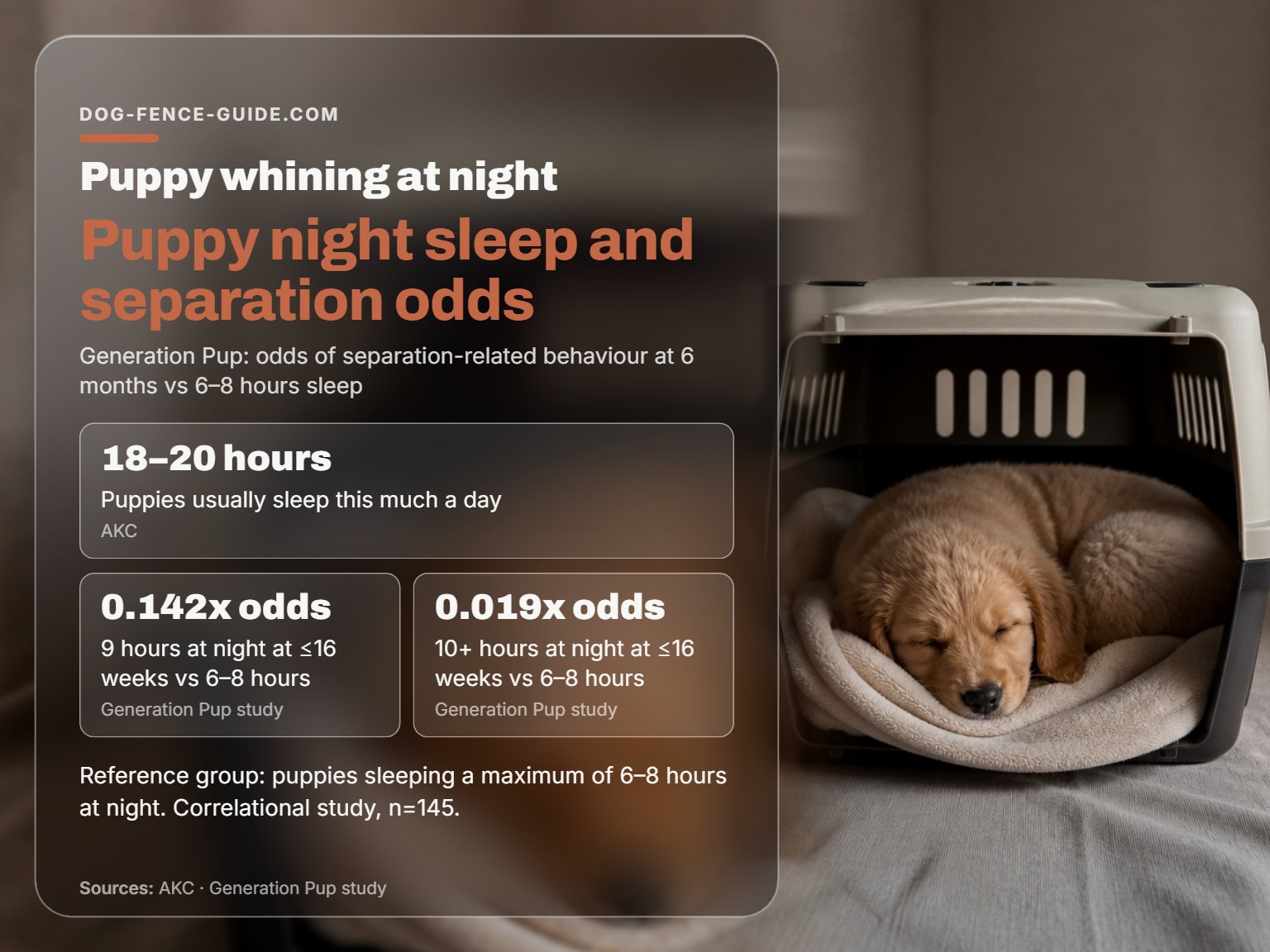
More than you think, and more than the average owner allows. Puppies sleep 18 to 20 hours a day according to the AKC, and individual naps run anywhere from 30 minutes to two hours. A puppy that’s awake and interacting for a full evening is running a sleep deficit by bedtime.
The Generation Pup numbers line up with that. Puppies getting nine hours at night at 16 weeks had 0.142 times the odds of separation-related behaviour at six months compared with puppies capped at six to eight hours. Puppies getting ten-plus hours were at 0.019 times the odds. The reference group in both comparisons is the six-to-eight-hour puppy, which is probably the most common household reality.
Getting there means protecting sleep rather than adding it. The AKC’s advice is to leave the puppy alone when it’s sleeping so it doesn’t become dependent on you to fall asleep, keep the room quiet and dark, and cut the TV volume or add blackout shades, while PDSA says owners may sleep in the same room as a puppy that struggles to settle to build confidence. There’s a fuller picture of normal dog sleep patterns if you want to know what’s realistic at each age.
If your puppy is getting fewer than nine hours at night by 16 weeks, fix the schedule before you buy anything else. A tired puppy settles. An overtired puppy fights sleep and loses.
When whining isn’t a settling problem
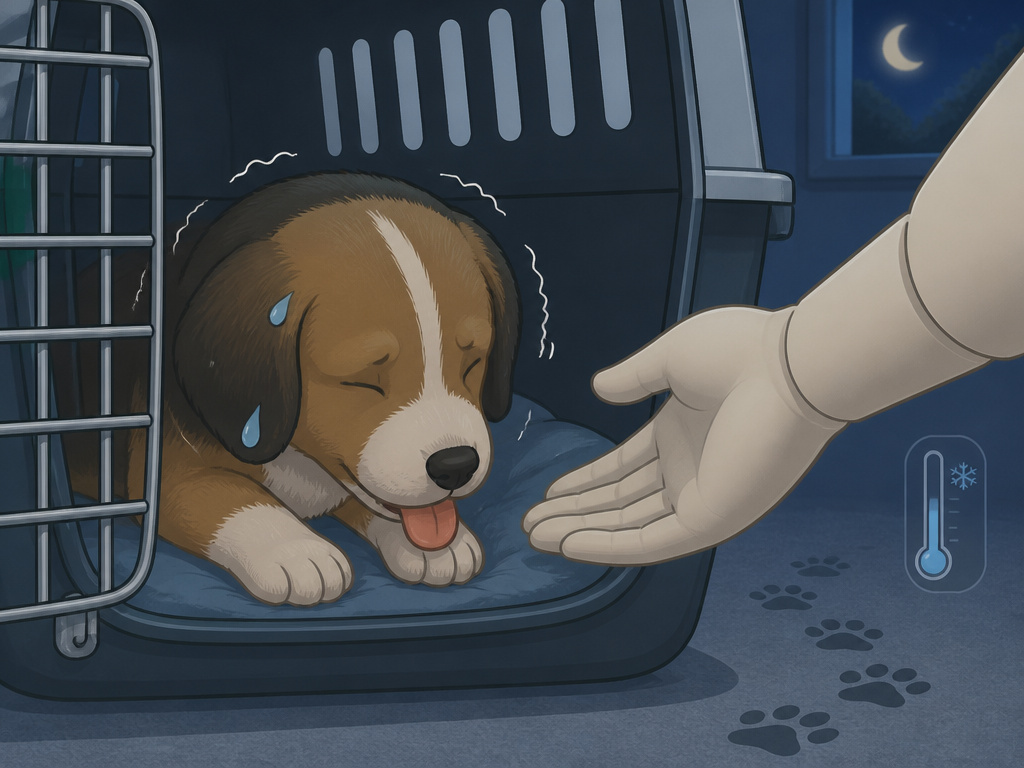
Some night noise has nothing to do with the routine, and treating it as a training problem wastes days. Chewy’s guidance is to address whining that signals pain, fear or a need to go potty right away, and to look at the context before the sound.
The tells are specific. A puppy that whines when moving around may have an injury rather than a crate complaint. A puppy that paces, trembles or pants alongside the whining is likely frightened rather than bored. A puppy that was quiet and then starts again at night, with no change to the routine, is a vet question rather than a training question.
Fair warning on the timeline: a puppy that has been in the new home about a month is the point where most owners see a real drop in whining, per Chewy, and that timeline varies with the individual and the household. If you see no improvement at all after about a month, that’s worth a conversation with your vet rather than another week of the same routine.
For the daytime version of the same problem, leaving a puppy alone without drama is the skill that decides whether night settles too. A puppy that panics at a closed bathroom door during the day will panic at a closed crate door at night.
If your puppy is genuinely struggling with being alone rather than just objecting to the dark, the signs of separation anxiety in dogs are worth knowing because the response is different. A sleep aid for dogs or a trial of white noise for dogs can take the edge off the settling period, and calming treats for puppies are a reasonable bridge while the routine takes hold. None of them replaces the routine.
Frequently Asked Questions
Should I ignore my puppy whining at night?
PDSA says never, especially in the first few nights, because ignoring can make a puppy more anxious about being alone. Chewy’s veterinary reviewer says ignoring attention-seeking whining in some cases is fine and teaches independence. PDSA advises ruling out the toilet first.
How long does puppy whining at night last?
Chewy’s reviewer puts the typical drop-off at about a month in a new home, with real variation between individual puppies and households. Owner experience suggests the sharpest improvement comes early if the crate is close enough for the puppy to smell you.
Should I sleep in the same room as a new puppy?
PDSA says you may sleep in the same room while still following the bedtime routine, framing it as a confidence-building measure rather than a permanent setup. The AKC notes many owners put the crate in their bedroom so the puppy feels the family nearby.
Is it OK to put a puppy in a crate at night?
The Generation Pup study found that puppies that experienced being in an enclosed space overnight at 16 weeks or earlier had significantly lower odds of separation-related behaviour at six months than puppies that weren’t. That’s a correlational finding, not proof, but it lines up with the crate guidance from both PDSA and the AKC. Never use the crate as punishment.
Why does my puppy whine at night but not during the day?
During the day the puppy naps, wakes, and finds you still there. At night it wakes to an empty, dark room. PDSA makes exactly this point, and it’s why the fix is usually proximity and a covered bed rather than more training.
The Bottom Line
Here’s the threshold I’d give anyone starting night one: if your puppy is still crying after a toilet trip and a settle, change the crate position before you change anything else. Move it closer, cover it, put something that smells like you in it. The proximity fix is free and it’s the one that worked on my own worst case, cutting the whining sharply by the fourth night.
The first thing to do this week is not buying a heartbeat toy. It’s setting a fixed bedtime and moving the crate into your bedroom, even if that’s not where you want it long term. You can move it out once the puppy has stopped treating night as a crisis.
One concession, because it matters: none of this is proven causation. The Generation Pup authors say outright that interventional data is needed, and the PDSA and Chewy positions genuinely conflict on whether to answer a cry. What the evidence supports is a narrow claim. Proximity, sleep, house-training progress and an absence of punishment all point the same direction, and that direction is a puppy that isn’t left to figure out the dark alone.
