
How Much Sleep Do Dogs Need? What the Studies Say
This post contains affiliate links. As an Amazon Associate, we earn from qualifying purchases.
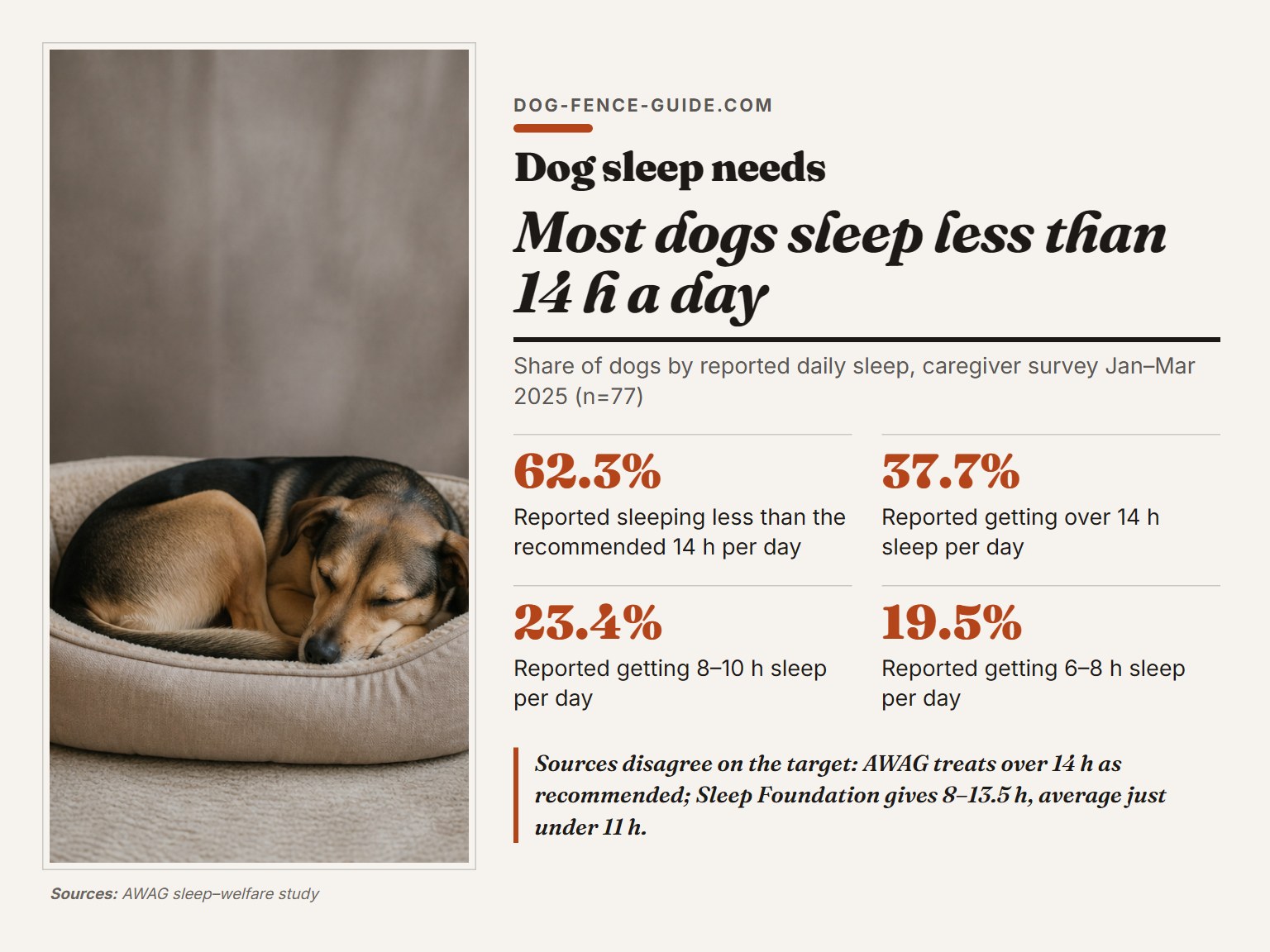
How much sleep do dogs need? The Sleep Foundation puts most adult dogs between 8 and 13.5 hours a day, averaging just under 11. The familiar 12 to 14 hour figure is a convention that hardened into advice; a 2025 survey of 77 dogs found 62.3% sleeping under the 14 hours it treated as optimal.
The gap between 10.1 and 14 hours comes from where each number was born. The low end comes from cohorts that counted hours, either through caregiver diaries or activity monitors. The high end comes from a welfare study that applied 14 hours as a benchmark, then reported that most dogs fell short of it.
What follows is what each study actually measured, where the numbers genuinely conflict and who holds each position, and the two or three things in your own dog’s day worth checking before you change anything.
Key Takeaways
- Adult dogs average just under 11 hours a day, per Sleep Foundation’s review of adult dog sleep.
- The 12 to 14 hour figure is a convention, not a measurement. The AWAG study treats over 14 hours as optimal, while PetMD puts most dogs at 12–16 hours and the Sleep Foundation says adult dogs typically sleep 12 to 14 hours.
- 62.3% of dogs in a 77-dog welfare survey slept under 14 hours a day, and shorter sleep tracked most strongly with fear and frustration.
- Puppies and seniors both sleep more than the adult average, but for opposite reasons: growth versus pain and night waking.
- A sudden change in sleep, paired with lethargy or appetite loss, is a vet visit, not a schedule tweak.
What the Measured Numbers Actually Say
62.3% of the dogs in a 2025 welfare survey slept less than 14 hours a day. That study, published in Discover Animals, pulled caregiver-reported sleep scores from 77 dogs assessed between January and March 2025: 40 in shelters, 25 in homes, and 12 assistance dogs.
Canine sleep is distributed across multiple periods rather than consolidated into one block. Adult dogs typically take 60% to 80% of the hours between 8 p.m. And 8 a.m. At night, and may sleep for up to 37% of the daylight hours in naps. Estimated REM sleep totals about 2.9 hours per day.
The spread inside that group is wider than any single average suggests. Just over a third of the dogs, 37.7%, cleared 14 hours. The 12 to 14 hour bracket held 6.5% and the 10 to 12 hour bracket held 5.2%. Nearly a quarter, 23.4%, landed between 8 and 10 hours, and 19.5% sat between 6 and 8.
The tails are the interesting part. Shelter dogs ranged from under four hours to over 14. Home dogs ran from under eight to over 14, and assistance dogs from under eight to over 12. The authors ran no statistical tests on those differences because the groups were too small.
Then there is the cohort work. The Sleep Foundation reports that most adult dogs seem to need between eight and 13.5 hours of sleep every day, with an average of just under 11 hours.
The spread is enormous.
The Sleep Foundation dog sleep hours guide lands in the same neighbourhood: most adult dogs between 8 and 13.5 hours, averaging just under 11, while PetMD puts most dogs at 12–16 hours and the AWAG study treats over 14 hours as optimal.
How Much Sleep Do Dogs Need? Where the Sources Split
Four credible sources give four different answers here, and none of them is fabricating.
Where the Sources Split
| Source | Daily sleep figure | What it rests on |
|---|---|---|
| AWAG welfare study (2025) | Over 14 h treated as optimal | 77 caregiver-reported dogs, Jan-Mar 2025 |
| Sleep Foundation | 8-13.5 h, average just under 11 | Review of actigraphy and survey work |
| PetMD | 12-16 h, up to 16 h total | Veterinary editorial, no cohort cited |
| Sleep Foundation | 8-13.5 h, average just under 11 | Review of actigraphy and survey work |
| PetMD | 12-16 h, up to 16 h total | Veterinary editorial, no cohort cited |
| Tooley and Heath (2022) | No optimal duration determinable | 1,330-dog caregiver questionnaire |
The disagreement is real and it will not resolve. Tooley and Heath, working from a 1,330-dog caregiver questionnaire, state plainly that “it is not possible to determine an optimal canine sleep duration.” The AWAG authors applied a 14 hour threshold anyway, citing earlier work.
The AWAG team also conceded a limitation in their own design. Sleep duration forms part of the cumulative welfare assessment score, so the link between sleep and welfare is partly circular by construction. They call it partial non-independence and ask readers to weigh it.
The AKC why dogs sleep so much explainer is a fair example of how the 12 to 14 framing travels: it reads as settled fact, and the peer-reviewed cohorts do not settle it.
What most people get wrong: Treating 14 hours as a target to hit. The AWAG study treats over 14 hours as optimal, while the Sleep Foundation puts most adult dogs at 8–13.5 hours averaging just under 11 and PetMD puts most dogs at 12–16 hours.
I would trust the cohort means over the benchmark every time.
Do Dogs Sleep More at Night or in Daylight?
Have you ever added up your dog’s naps and arrived at a number that seemed impossible?
Both patterns are normal, because canine sleep spreads across the clock rather than consolidating. Sleep Foundation puts adult dogs at 60% to 80% of the hours between 8 p.m. And 8 a.m., with daytime naps covering up to 37% of the day. PetMD splits it more simply: six to eight hours overnight, four to eight hours of napping, up to 16 total.
The measured cohort data is less generous. Sleep Foundation reports that adult dogs may sleep for up to 37% of the day in daytime naps, and typically take 60% to 80% of the hours between 8 p.m. And 8 a.m. At night.
Objective measurement is thin here. The sleep-wake cycles in dogs study used functional linear modeling on activity data, which beats a diary but still infers sleep from movement.
If you want to know which side of that split your dog is on, listen. A dog settling for the night drops onto the floor in one motion and the nail clicks stop within a minute. A dog who is not settling clicks up and down the hallway at two in the morning.
The dog circadian rhythm does a lot of that work, which is why the timing of meals and walks shifts the pattern more than most owners expect.
I have stopped trusting my own nap count. Watch the clock instead.
Puppies, Seniors, and the Ages That Break the Average
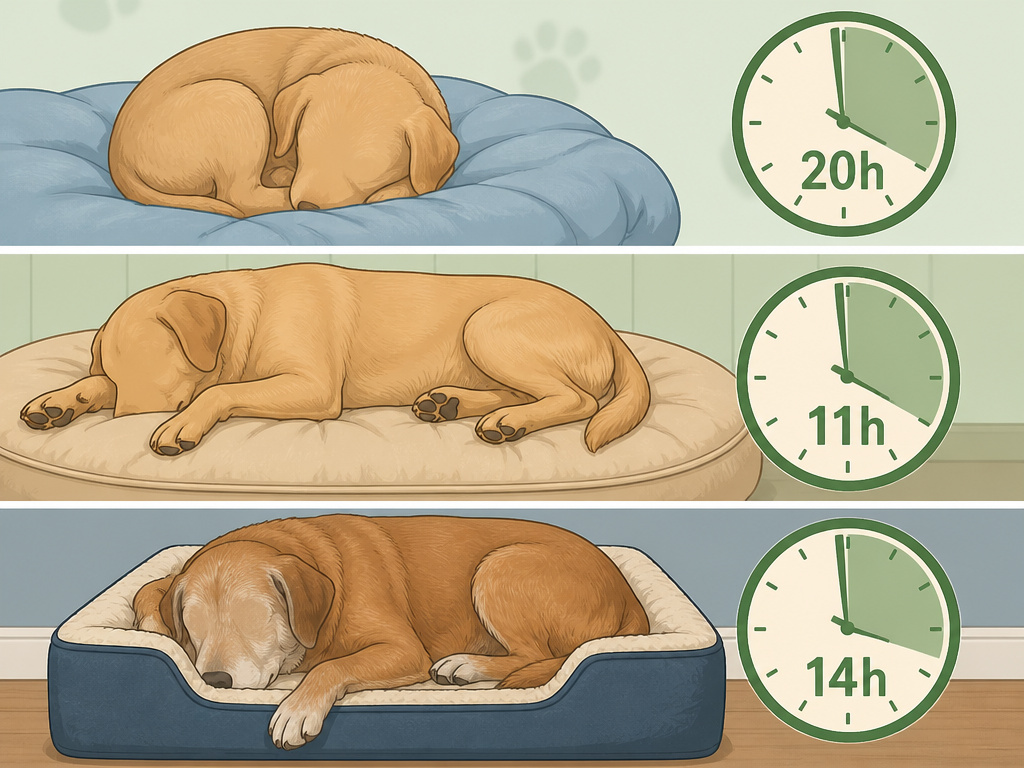
Age moves the number more than breed does.
| Life stage | Reported daily sleep | What shifts it |
|---|---|---|
| Puppies under 16 weeks | Up to 20 h (PetMD); at least 11 h in one study | Growth; more daytime sleep, less at night |
| Adult dogs | 8-13.5 h typical; 10.8-11.2 h measured mean | Activity level, caregiver presence |
| Senior dogs | More than the adult baseline | Night waking, pain, cognitive dysfunction |
| Shelter dogs | Under 4 h to over 14 h | Noise, routine disruption, kennel environment |
| Assistance dogs | Under 8 h to over 12 h | Task schedule and working demands |
The 16-Week Puppy Sleeps More, and Less at Night
PetMD puts young puppies at up to 20 hours a day during growth cycles. Sleep Foundation cites one study showing puppies sleeping at least 11 hours a day, a much lower floor. Both can be true, because the range is wide and the samples are thin.
The 2020 work on sleep behaviours in young dogs found puppies sleeping more in total but less at night than they would at a year old. A single adult figure misrepresents both ends.
That is why a puppy schedule matters more than a puppy target. You are shaping when the sleep happens, not how much of it there is.
Senior Dogs Drift Earlier and Wake More
Sleep Foundation notes that middle-aged and senior dogs wake less often overnight and sleep later in the morning, then nap more during the day. PetMD adds the reason some of that goes wrong: canine cognitive dysfunction leaves older dogs restless at night, which pushes the napping upward.
A thin mat is a poor answer to that. Beds for old dogs need loft and a low entry lip, because a stiff dog will skip the bed entirely rather than climb onto it.
I would plan for the senior shift rather than be surprised by it.
The 0.92 Correlation Between Short Sleep and Fear

A correlation of 0.92 is about as strong as caregiver survey data ever gets.
In the AWAG dataset, sleep score and the frequency of fears, anxieties and frustrations moved together at a Spearman correlation of 0.92. Reaction to stressors came in at 0.59 and mobility and activity at 0.43. The composite welfare score correlation was 0.46.
Read that carefully. The weakest of those links is the one to the overall welfare score. The strongest is the one to fear and frustration, which is the part owners notice as barking, pacing, and a dog that cannot settle when the doorbell rings.
The sleep and problem behaviours in dogs work found the relationship is not linear.
Tooley and Heath also pushed back on the standard behavioural advice to increase activity for problem behaviours. They argue it “may not be appropriate when it results in deprivation in relation to species-specific sleep requirements.”
A dog sleeping six hours a day and barking at the mailbox is not automatically a training case. Check the sleep before you book the trainer.
I would start with a sleep log, not a behaviour modification plan.
How Much Sleep Is Too Much, and When Do You Call the Vet?

What does it look like when the number runs wrong in the other direction?
PetMD lists the possibilities behind a dog who sleeps far more than usual: parasites, thyroid problems, heart disease, and pain. Sleep Foundation’s line is simpler and more useful. A sudden change in sleeping habits, especially alongside lethargy, appetite changes, or unusual behaviour, calls for a vet rather than a new schedule.
Five things worth writing down before that call:
- Sleeping well past the household baseline, particularly with weight loss or a dull coat.
- Pacing or crying at night in an older dog, which can point to pain or cognitive dysfunction.
- Collapsing during play or excitement, which is how narcolepsy tends to show up.
- Loud snoring with long pauses in breathing, the pattern behind obstructive sleep apnea.
- Violent movement in sleep, including howling, limb thrashing, and biting at nothing.
Sleep Foundation notes that REM sleep behaviour disorder usually shows symptoms before a dog turns one, and that medication is effective in more than three quarters of cases. That is a good prognosis for something that looks alarming at 3 a.m.
The ordinary version, the paddling paws and muffled yips, is a different thing entirely. Signs your dog is dreaming covers what normal looks like so you can tell the two apart.
The Room Beats the Supplement Aisle
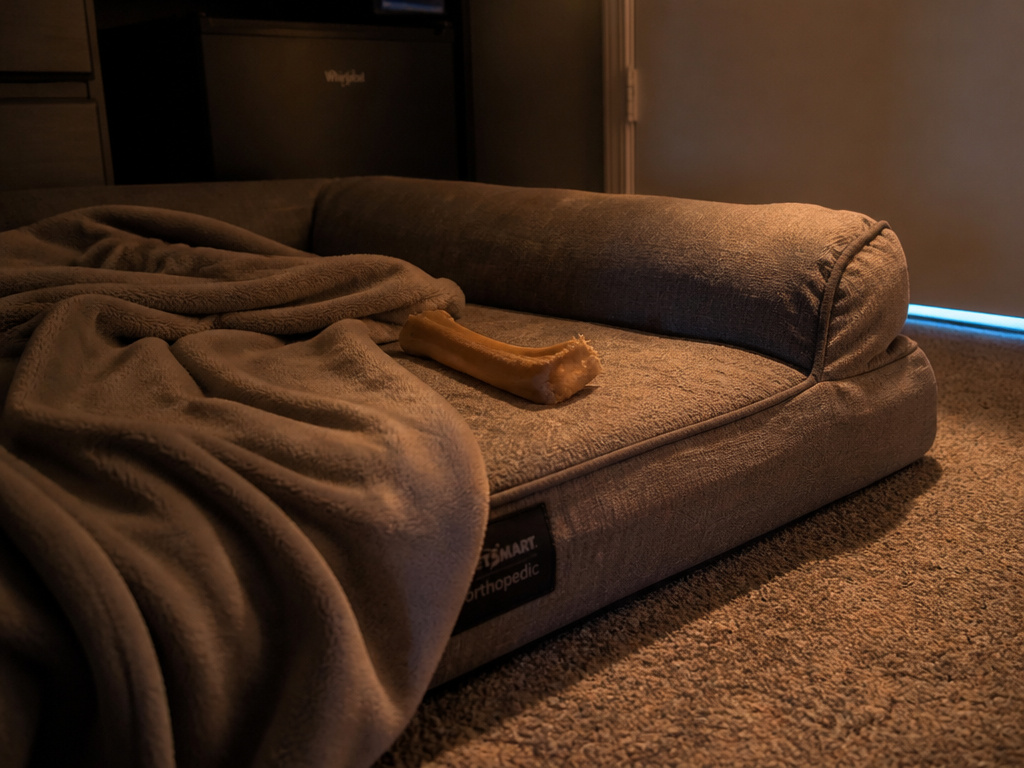
Fix the room before you buy anything in a bottle.
The most useful finding in this whole body of research sits inside an edge case. Dogs with night access to people chose to be around people, yet owners most commonly settled their dogs alone in a room. That gap between what the dog picks and what the household provides is where a lot of sleep trouble starts.
Sleep Foundation found that dogs who sleep more during the day are more relaxed and appear happier. Daytime rest is doing real work and should not be treated as wasted time.
Five things in a room decide most of this. Light comes first, and light colors for dog sleep covers which wavelengths actually suppress rest and which ones do nothing.
- Light: keep the sleeping room dim after dark, and check the colour of whatever is left on.
- Temperature and draught: a bed on a floor beside a door gap runs colder than the room reads.
- Noise: a fridge compressor cycling on at three in the morning is enough to fragment light sleep.
- Loft: a thin mat over hardwood is not a bed, whatever the label says.
- Something to lean against: most dogs press a flank or shoulder into a bolster before they settle.
The bed is the part worth spending on. Big Barker builds a thick orthopedic slab that holds its shape under a large dog, and Kuranda’s raised cot gets the dog off the floor and out of the cold layer entirely. Furhaven’s orthopedic sofa beds give a dog a bolster to press against, which is what most dogs are looking for when they circle three times before lying down. The how to choose a dog bed question comes down to loft, bolster, and whether the dog runs hot.
I would spend the money on the bed before the diffuser. A dog that cannot get comfortable on a hard floor will not settle because a plugin says so.
Calming products have a narrow place. A ThunderShirt applies gentle constant pressure and helps some dogs settle. An Adaptil diffuser releases a dog-appeasing pheromone that some households find useful and others find does nothing at all. If light, noise and the bed are already handled, a dog sleep aid is the next thing to look at rather than the first.
The part nobody mentions: In one 1,330-dog survey, dogs slept longer on days when the caregiver stayed in bed. Sleeping alone is a variable worth logging.
Five Changes to Make This Week, Starting With the Free One
Before you start: Do not give a dog any human sleep medication. Melatonin is sold over the counter for dogs, but the dose depends on the dog’s weight and it can interact with other medication, so it is a vet question rather than a label question. If your dog is already on thyroid or pain medication, that check comes first.
- Log three days before you change anything. Write down when the dog actually settles and when the dog actually gets up. Skipping this means you are guessing at the baseline, and a bad guess sends you chasing the wrong fix for a fortnight.
- Move the bed out of the traffic lane. A bed in the hallway between kitchen and back door gets stepped past fifty times a day. Moving it to a corner outside the walk-through shortens settling time from minutes to seconds.
- Fix light and noise together. One without the other rarely helps. A dim room next to a fridge that cycles at three in the morning still fragments sleep.
- Watch the first ten minutes after lights out. A dog still circling after ten minutes has not settled, and that is the signal to change the room rather than the dog.
- Give it more than one night. One bad night is noise; a week of the same bad night is a pattern.
Frequently Asked Questions
Is 14 hours a day really the target for dogs?
No single study establishes 14 hours as a target. The 2025 AWAG paper applied it as a benchmark drawn from earlier work, and 62.3% of its 77 dogs fell short of it. Tooley and Heath, working from a much larger questionnaire sample, concluded that an optimal canine sleep duration cannot be determined at all, while the AWAG authors applied 14 hours as the recommended optimal.
Why does my dog sleep 16 hours some days and 10 on others?
Day-to-day variation is normal and the research supports it. Home dogs in the AWAG data ranged from under eight hours to over 14. Puppies sleep more in total than adults, and senior dogs nap more as night sleep fragments. A single day tells you very little; a week of the same pattern tells you something.
Should I let my dog sleep in my room?
The evidence leans that way. In a 1,330-dog survey, dogs slept longer when the caregiver was in bed than when the caregiver was up. Dogs with night access to people chose to be near them. That is a preference rather than a rule, and plenty of dogs settle fine alone.
How do I know if my dog’s sleep is a welfare problem or just a habit?
Look at what comes with it. In the AWAG data, sleep score tracked fears, anxieties and frustrations at a correlation of 0.92, and reaction to stressors at 0.59. A dog sleeping eight hours and coping is a different case from a dog sleeping eight hours and unable to settle when the doorbell rings.
Do puppies need more sleep than adult dogs?
PetMD puts young puppies at up to 20 hours a day during growth cycles, while Sleep Foundation cites one study showing at least 11 hours. The 2020 cohort found puppies sleeping more in total but less at night than they would at a year old. Both figures point the same direction even though the numbers differ.
The Bottom Line
Here is the catch. Almost everything above assumes a healthy adult dog in a normal household. If your dog is on thyroid medication, has been diagnosed with pain, or is a senior who has started pacing at night, the numbers here are background reading and your vet is the primary source.
The threshold I would actually use: if your dog is sleeping less than usual and showing fear, frustration, or an inability to settle, treat the sleep as a possible cause rather than a symptom. In the AWAG data, the fear and frustration link was the strongest correlation in the whole set, at 0.92.
The honest answer to “how much sleep do dogs need” is a range, not a number, and the range is wider than any single guide admits.
One thing to do tonight: put the bed somewhere your dog can see the room’s only door and still sit outside the walk-through. Leave it there for a week, and count how long it takes the dog to stop moving.
