
How to Foster a Dog: The 2-Week Rule Most Guides Skip
This post contains affiliate links. As an Amazon Associate, we earn from qualifying purchases.
To foster a dog, apply through a shelter’s foster program, then keep the dog separated from your own pets for two weeks, on a 4-to-6-foot leash outdoors, in a flat buckle or martingale collar with an ID tag. No fenced yard is required; controlled leash handling is the substitute.
Two weeks is the number that catches people out in the MCAS and KCAS handbooks, though Best Friends softens it to ‘the first couple of weeks’ and VCAS warns separation may run longer, or may never end. Symptoms can show up after a dog leaves the shelter, and the handbook treats anything you can’t wipe down with a 1-to-32 bleach solution as a possible carrier.
What follows walks the pickup, the separation setup, the gear that actually holds a dog, the introduction order for resident pets, and the health thresholds that mean you stop waiting and make a call, all part of how to foster a dog. All of it comes from shelter-issued manuals rather than blog consensus.
Key Takeaways
- Two weeks of separation from resident pets, with separate bedding, is the floor in the Multnomah County handbook, while Best Friends softens it to ‘the first couple of weeks’ and VCAS warns separation may run longer, or may never end.
- A fenced yard is not required. A 4-to-6-foot leash and supervision outside are.
- Skip the retractable leash. The manual names it as a control problem and an injury risk.
- Diarrhea past 72 hours in an adult, or 24 in a puppy, is a phone call, not a wait-and-see.
- Dry dog food and fresh water only. Chocolate, caffeine, grapes, raisins, mushrooms, onions, garlic and xylitol stay out of reach.
What a Shelter Foster Program Actually Requires
The commitment starts before the dog does. Multnomah County Animal Services sends foster requests out roughly once a week, and each one lists age, breed, weight, special needs, and expected length of stay.
A foster dog is placed in a separate area, with separate bedding, and no contact with resident animals for two weeks. Symptoms can appear after a dog leaves the shelter. Anything that cannot be cleaned with a 1-to-32 bleach and cold-water solution is treated as a potential germ carrier to other pets.
Pickup is a paperwork appointment, not a meet-and-greet. MCAS states plainly that it cannot facilitate introductions between your personal pets and an eligible foster animal before placement. You sign the foster agreement, collect medical records and supplies, and take the dog home.
The shelter generally provides food, a crate, a collar, a leash and potty pads, so don’t buy a second set of everything on day one. Ask what’s coming in the bag before you shop.
Rechecks run at least monthly at MCAS, while KCAS requires foster dogs brought in every 1–2 weeks. If the dog needs frequent medical appointments, the foster team flags it in the request summary. The adoption process only opens once Animal Health clears the dog, so those appointments are the gate.
Two rules carry real consequences. You may not take a foster pet to any veterinarian other than MCAS or the approved emergency vet, and you may not give any medication, prescription or otherwise, without prior authorization from MCAS veterinary staff. Break either one and the care isn’t reimbursed.
How Long Should a Foster Dog Stay Separate From Your Pets?
Two weeks is the figure in the MCAS and KCAS handbooks, while Best Friends softens it to ‘the first couple of weeks’ and VCAS warns separation may run longer, or may never end.
| Source | Separation from household pets | Distance buffer on walks |
|---|---|---|
| Multnomah County (MCAS) | Two weeks, separate bedding | Five feet |
| Kern County (KCAS) | At least two weeks | No figure given |
| Ventura County (VCAS) | Longer periods, or possibly never | Ten feet |
| Best Friends Animal Society | “First couple of weeks” | No figure given |
Read that table before you plan your first fortnight. Kern County matches MCAS on the two-week floor, while Best Friends softens it to ‘the first couple of weeks’ and VCAS warns separation may run longer, or may never end. Best Friends softens it to “the first couple of weeks” with no enforcement language attached, while VCAS warns separation may run longer, or may never end. Ventura County goes furthest, warning that separation may run longer, or may never end for some pairs, while MCAS and KCAS require at least two weeks.
The practical version: treat two weeks as the minimum under the MCAS and KCAS handbooks, while Best Friends describes a softer ‘first couple of weeks’ and VCAS warns separation may run longer, or may never end.
Cold water and bleach has a sharp, swimming-pool smell to it, and that smell is the whole first fortnight. Bedding, blankets, toys, food bowls, the towel by the door. If it can’t take the solution, it doesn’t go between the foster and your own animals.
Easy to miss: The two-week rule covers bedding, not just the dog. A shared blanket moves germs between animals as effectively as nose-to-nose contact, and the handbook treats anything you can’t bleach as a carrier.
The decompression period is doing two jobs at once here. It’s a disease firewall and a settling window, and rushing it costs you on both counts.
How to Foster a Dog in a Home With No Fenced Yard
A Tuesday afternoon, an unfenced back lawn, a foster dog on a lead line, and a squirrel at the property line. That’s the scenario the manuals spend the most words on, and it’s the one most foster guides skip entirely.
MCAS does not require foster parents to have a fenced yard. What it requires instead is control: a leash or lead line any time you’re outside, and supervision at all times outdoors. No exceptions for a dog that “seems fine.”
There’s a specific trick in the handbook that I’d never have thought of on my own. Let the foster dog drag a leash for the first few times in the yard, in case they bolt. You’re not holding anything; the dog is just trailing six feet of webbing that you can step on.
Inspect the yard the way you’d inspect a deck before a party. Look for holes, broken boards, and gaps between the fence and the ground. Look for anything a dog can climb or jump from. A determined dog is often stronger or much smaller than you expect, and the manual says so directly.
Best Friends takes a different position on outdoor space: foster dogs housed indoors only, with a garage, backyard or outdoor run ruled out as accommodation. That’s a genuine disagreement with the county handbooks, and it matters if you were planning to set up a kennel run.
Before the dog arrives, it’s worth an hour spent preparing for a rescue dog rather than an hour spent shopping. Block the sightline to a busy street if you can. Street activity, loud cars, people walking past, other dogs, all of it can trigger reactivity in a dog with an unknown history.
The Gear That Actually Holds a Foster Dog
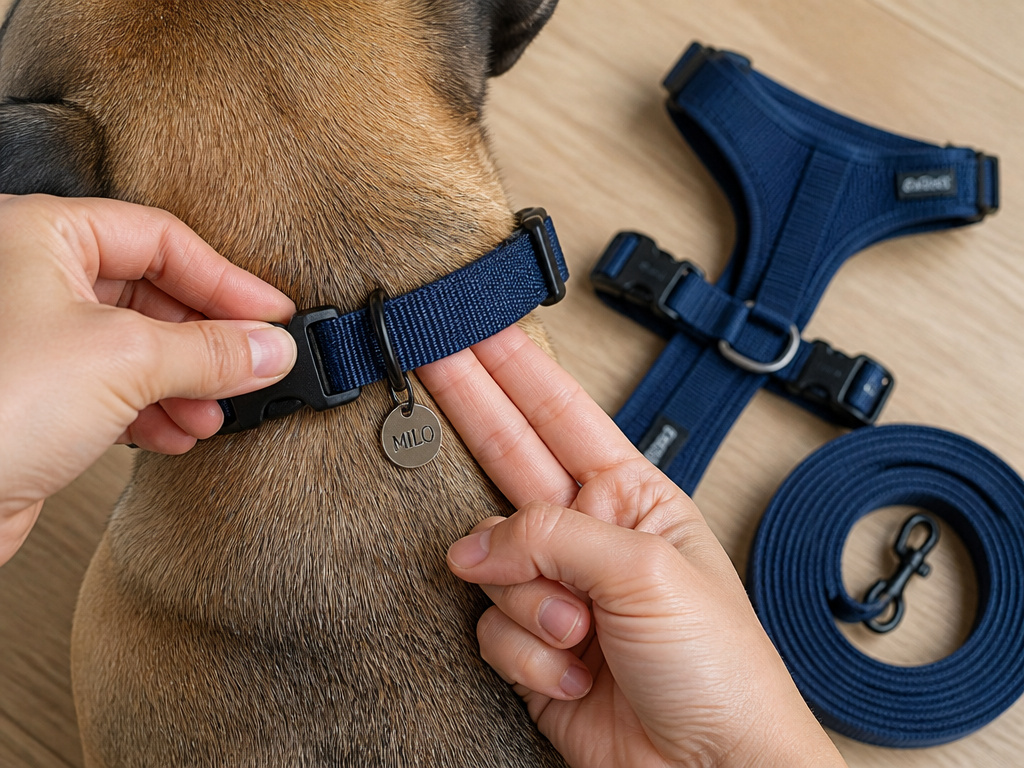
Spend your money on the collar, the leash, and the latch. The panels can wait.
MCAS recommends a 4-to-6-foot leash for walks and training, and recommends against flexi-lead or retractable leashes specifically for foster dogs. The reasoning is control and injury, not brand preference. When you need more length, use a long-line in a secured space away from other dangers.
A retractable leash makes a soft ratcheting click with every step the dog takes, then a hard zing when the lock engages. That zing is the sound of a spring-loaded thumb button taking a load it wasn’t built for.
I won’t hand a retractable leash to anyone fostering. The lock is a thumb button on a spring, and a dog hitting the end of the cord puts a load on it that the button was never designed to hold. The manual’s reason is simpler: control gets hard and injuries are real.
The collar spec is where people improvise and shouldn’t. A flat buckle or martingale collar with the MCAS Foster ID tag, fitted snug enough that only two fingers slide underneath. Corrective collars of any kind are prohibited outright.
Here’s the short list I’d actually assemble:
- Leash: 4-to-6 feet of flat webbing, plus a long-line for secured spaces.
- Collar: flat buckle or martingale, ID tag on, two fingers of slack.
- Harness: A harness spreads load across the chest instead of the throat, which is what you want on a dog you haven’t walked before.
- Crate: big enough to stand up and turn around, not much bigger.
- Toys: durable, safe size, and no rawhides, human toys, old socks or shoes.
It does the same job on a dog that isn’t a serious puller.
Pick up every toy when young children or other pets are in the room. Rotating toys keeps them novel without spending anything, which is the one gear tip in the manual that saves money instead of costing it.
Introducing a Foster Dog to Your Dog and Your Cat
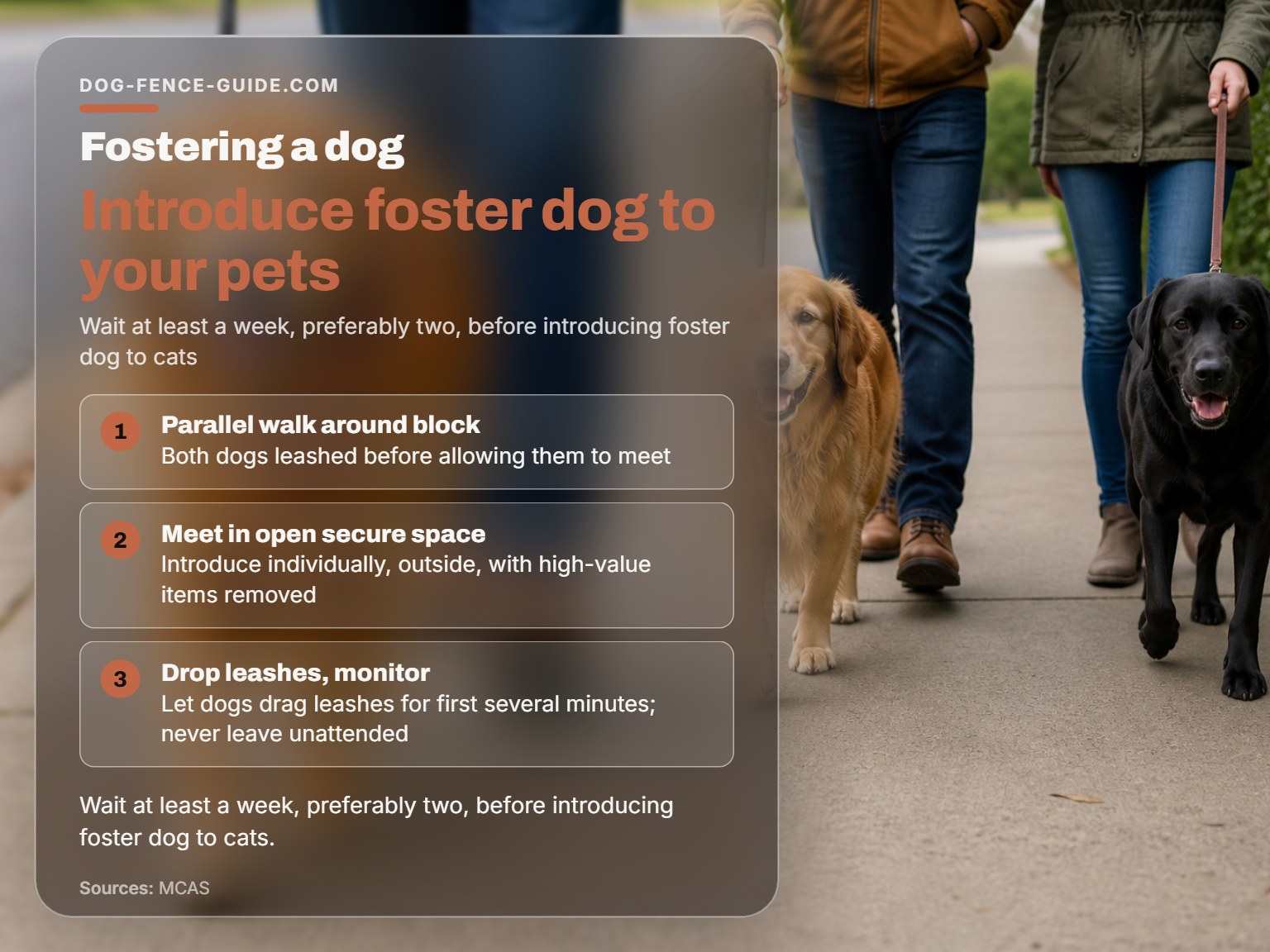
Multnomah County runs dog-to-dog introductions in a fixed order, and the order is the whole point.
Before you start: Two leashed dogs in an open yard can wrap a handler in seconds. Recruit a second person, keep both leashes short, and hold the foster’s leash so you can pull the dogs apart without stepping between them. Never leave the pair alone, even after they settle.
- Put your resident dog away first. Yard, separate room, or crate. Let the foster dog explore the house off leash and check out the rooms, toys and smells without interference.
- Walk them in parallel around the block. Both dogs leashed, handlers walking together, dogs on the outside. They see each other without having to engage.
- Meet on leash in the yard if the walk went well. Hold the leash at the top and move with the dog so there’s no tension and nothing to tangle.
- Drop the leashes and let them drag for the first several minutes of free interaction.
- Monitor everything. Never leave the foster dog with your dog unattended.
Introduce the foster to each resident dog individually, outside, in an open secure space, with all high-value items removed first. Doing two at once turns a greeting into a crowd.
If you’re bringing in a puppy rather than an adult, the introducing a puppy to other dogs sequence is gentler and worth running instead. Puppies read adult body language badly and need more escape room.
Cats get a longer runway. Wait at least a week, preferably two, and keep the two entirely separate before any face-to-face meeting. They can smell each other under the door, which is enough for now. When you do introduce them, the foster dog stays on a leash and the cat roams free. Multiple cats go one at a time.
If you’re still deciding which dog to take home, rescue dog temperament matters more than the breed label on the kennel card. A dog described as dog-social can still dislike your specific dog.
Housetraining, Crating, and Leaving the Dog Alone
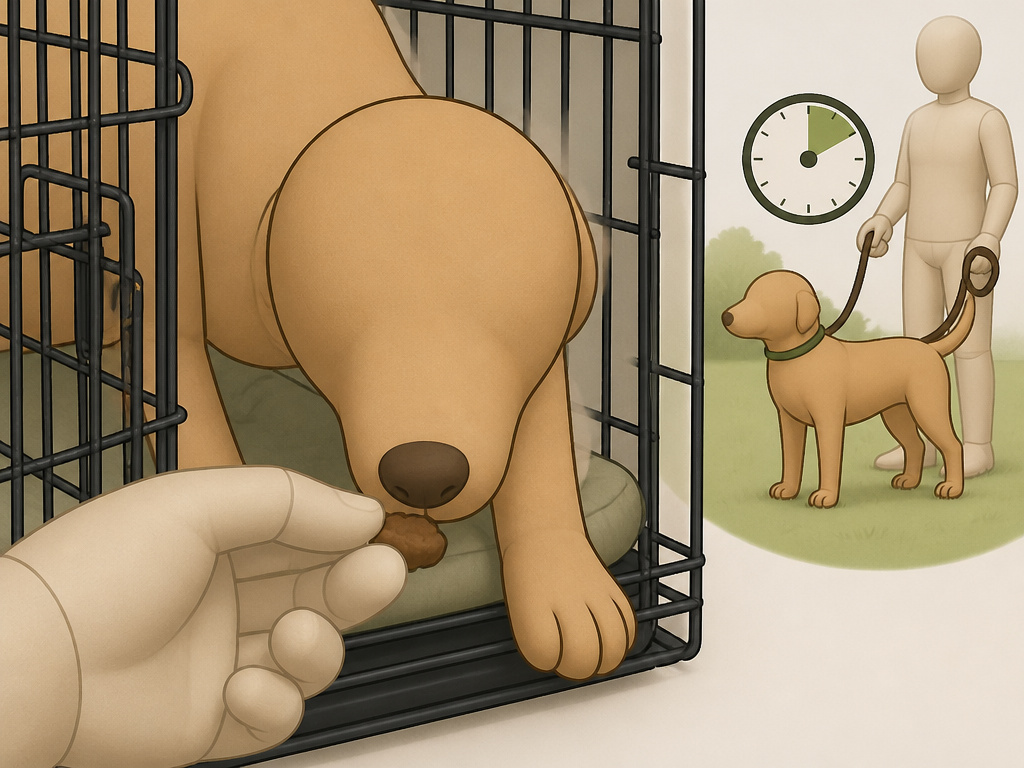
Every 45 minutes for a puppy, every two hours for an adult. Those are the handbook numbers for dogs over eight weeks, and they’re not negotiable in the first week.
Take the dog out at every transition: waking up, after eating or drinking, after play. Stand with them outside for five minutes. If nothing happens, back inside and try again every 15 minutes until it does.
A wire crate door has a particular rattle to it, and you’ll learn to hear the difference between a dog shifting position and a dog working the latch. That’s the sound that tells you whether crate training is landing.
Crate training runs in small steps. Toss treats in with the door open until the dog goes in and out easily. Then close the door, open it immediately, praise. Then close it and wait 15 to 30 seconds before treating and letting them out. Practice the whole routine for a couple of days before leaving the dog home alone.
If a foster dog can’t be left for five minutes without panic, the answer is more five-minute sessions, not a longer one. Build duration from the bottom.
Never leave a foster dog for an entire working shift the first time. Use several short 5-to-7 minute sessions across the day and assess how the dog did between them.
Before you leave, exercise the dog for 20 to 30 minutes. Leave and return calmly, and ignore the over-excitement on your return until the dog settles. Run bits of your leaving routine at random times, grab your keys and then make dinner, so the cues stop predicting an absence.
Pheromone products are fine in principle, but talk to the Foster Team before using one. That’s a direct instruction in the manual, not a suggestion.
Common mistake: Correcting a dog for an indoor accident. It makes housetraining slower, not faster, and the manual is explicit about it. Clean with an odor neutralizer and put the schedule back in place.
If you want the longer version of the mechanics, crate training and train a dog at home both go deeper than a foster-length stay needs.
Feeding, Water, and the Foods That Send You to Animal Health
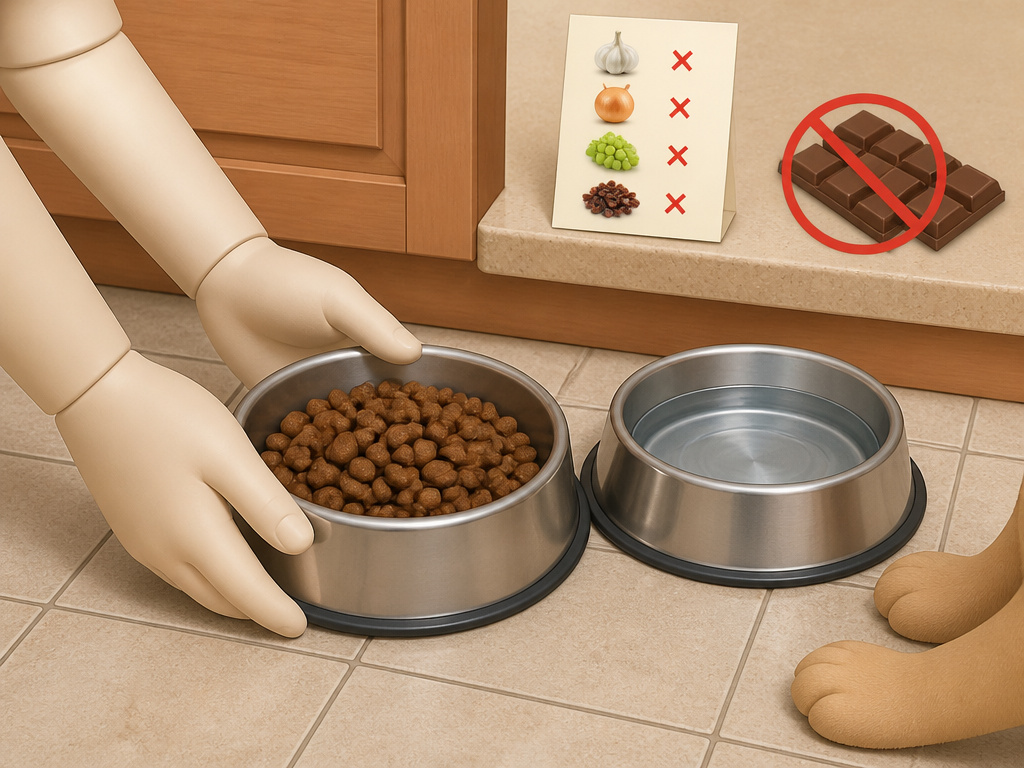
Three rules cover most of it: dry food, fresh water, nothing from your plate.
Adult dogs get a dry dog food that is breed and size appropriate, fed once or twice daily following the brand’s directions on the bag. Canned food is fine as an addition if the dog needs encouragement to eat. Human food is off the table unless the manual says otherwise.
Keep the poisonous list where you’ll see it, because half of it lives in a normal kitchen:
- Chocolate and anything with caffeine in it
- Grapes and raisins
- Mushrooms
- Onions and garlic
- Xylitol, the sweetener in sugar-free and low-sugar products
Fresh water at all times, and that applies to every dog and puppy over three weeks old. Puppies under six months, plus pregnant and nursing moms, get food formulated for puppies instead of adult kibble.
Weaning follows a schedule if you’re fostering a litter. Gruel of canned puppy food and water at around four weeks, soaked kibble introduced by week five, dry kibble offered at six weeks, fully weaned by eight weeks. Expect very messy puppies while they learn to coordinate.
Feeding frequency tightens as puppies grow: every 2 to 3 hours in the first week, roughly every 4 hours by weeks 3 to 4, gruel four times a day at weeks 5 to 6, at least three meals a day at weeks 6 to 7, three to four times daily at weeks 7 to 8, and three times daily from eight weeks on.
If you’re raising a litter rather than a single adult, socialize a puppy through the exposure window while they’re still with you. Keep it slow, keep it positive, and never force a puppy into something that frightens them.
One bathing note that catches fosters out. Young puppies can’t regulate body temperature, and full submersion can drop it fast enough to cause sickness. Use a damp rag on the necessary parts instead. If a full bath is genuinely needed, warm water, keep it short, and dry the puppy completely in a warmed towel before it goes back to bed.
When Do You Call Animal Health Instead of Waiting?
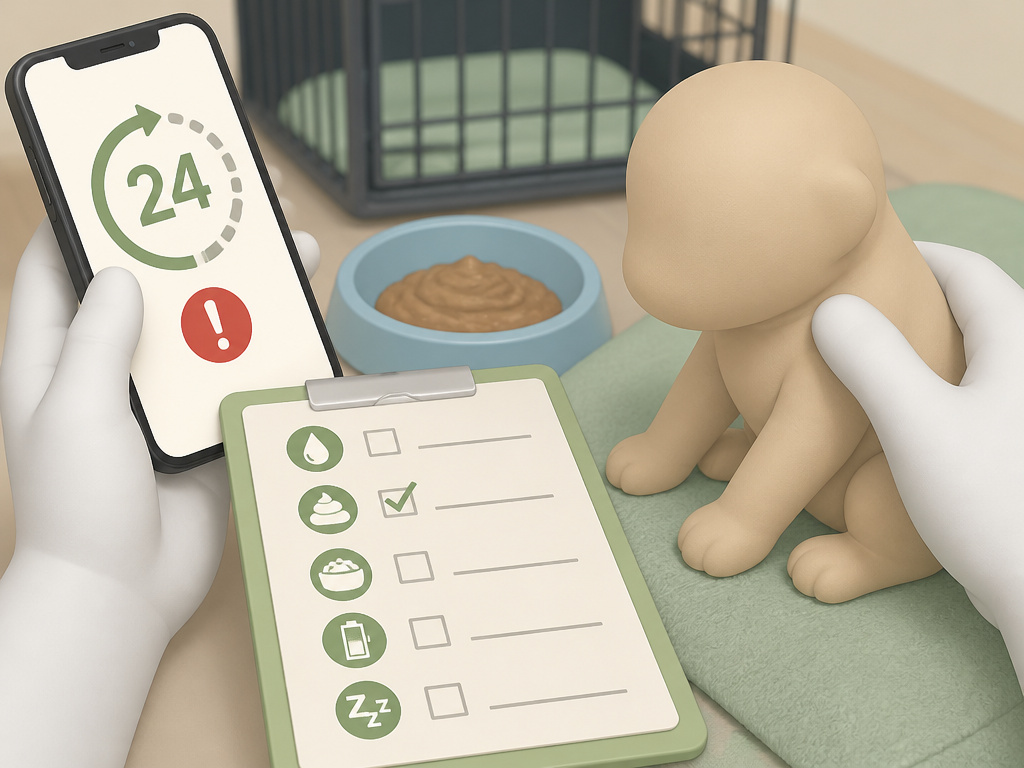
Diarrhea in a new foster dog is usually stress and a diet change, and the manual says to expect soft stool for the first couple of days. The question is when it stops being that.
| Symptom | Call Animal Health if… | Applies to |
|---|---|---|
| Diarrhea | More than 72 hours | Adult dogs |
| Diarrhea | More than 24 hours, or any blood | Puppies |
| Vomiting | More than 48 hours | Adult dogs |
| Vomiting | More than 24 hours | Puppies |
| Live fleas after treatment | Still visible past 24 hours | Any age |
Diarrhea with lethargy, loss of appetite, excessive lip licking or vomiting moves to the front of the queue regardless of the clock. So does vomiting paired with lethargy or a dog that stops eating.
Never wait out a puppy with diarrhea. The handbook’s cutoff is 24 hours, not 72, and a puppy dehydrates faster than an adult by a wide margin. Blood in the stool means you call the same day, not the next morning.
Fleas are the one item where seeing them again isn’t failure. MCAS treats before the dog goes home, and live fleas or flea debris can still show up for the next 24 hours as the treatment works through. Past that, call Animal Health to schedule follow-up.
Ear problems have their own tells. Brown or yellow discharge, redness and a bad odor point to infection; crusty black debris that looks like coffee grounds points to mites. Head shaking and pawing at the ears show up in both. Either way, that’s a call, not a home remedy.
Writing an Adoption Bio That Actually Gets the Dog Seen
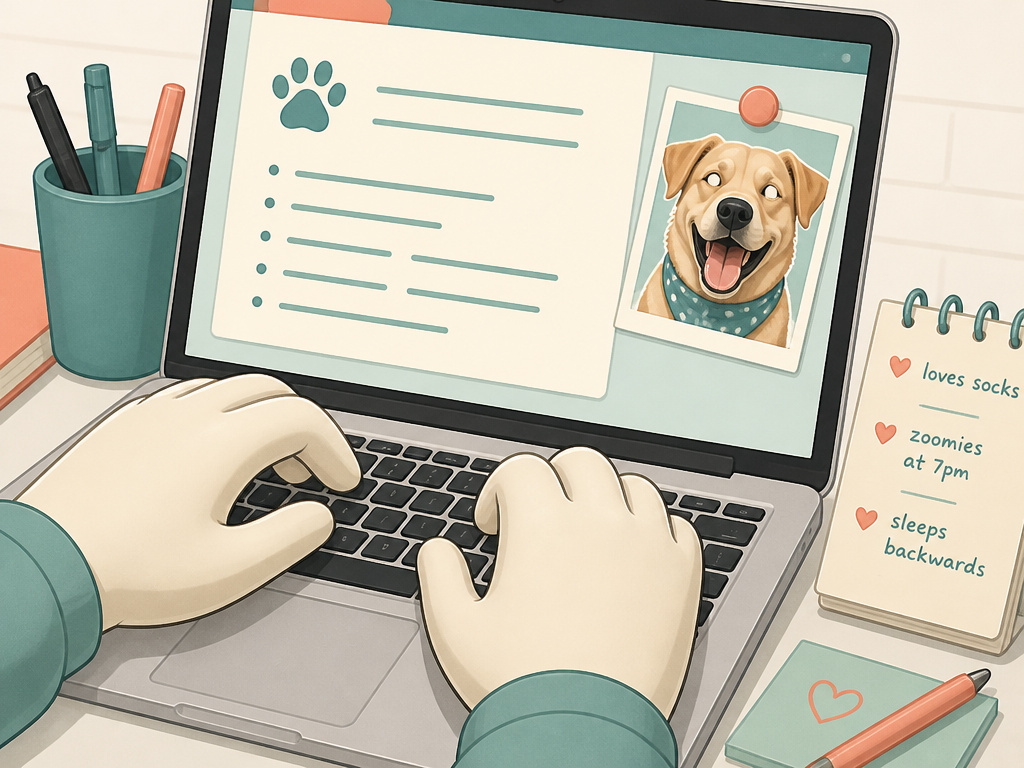
The bio is the only part of fostering that reaches strangers. Write it in the first person, from the dog’s perspective, and lead with the quirks rather than the generic adjectives.
A clear photo and a compelling biography go to the Foster Team before the dog is listed. Highlight the unique quirks, the exercise needs, and how the dog handles people and other pets. Adopters apply through the official website, and adoptions are processed first-come, first-served among qualified applicants.
Here’s the trigger most fosters never hear about. If the dog gets no interest within the first two weeks, send a new photo or suggested bio edits. Highlighting a different characteristic is often what connects the right adopter, and it costs you ten minutes.
Frequently Asked Questions
Can I foster a dog if I work full-time outside the home?
Yes, many shelter foster programs place dogs with people who work regular hours, but you should be honest about your schedule during the application. A dog that needs midday medication or has high energy may not suit a household that is empty for nine hours, while a lower-key senior often settles fine with a lunchtime potty break arranged in advance. Ask the foster coordinator which dogs on the list fit a working schedule rather than assuming you have to be home all day.
What happens if the foster dog and my resident dog do not get along?
Tell the foster team immediately rather than trying to force a friendship. Because the separation period keeps them apart at first, you have a built-in window to observe reactions through barriers and during parallel walks before any face-to-face meeting. If tensions persist after a careful introduction, the shelter can usually move the dog to another foster home or a different placement, and returning a foster is not a failure on your part.
Do I have to pay for vet care while the dog is in my home?
In most shelter foster programs the placing organization retains financial responsibility for medical care and supplies, which is why you collect records and food at pickup. Never arrange treatment on your own without contacting the foster team first, since the shelter needs to authorize procedures and use its own veterinary partners. Keep receipts for anything you buy out of pocket and ask about reimbursement before you spend.
How long does a typical foster placement last?
It varies widely, from a few weeks for a dog recovering from a routine procedure to several months for one needing behavioral work or a litter of puppies. The foster request summary usually states an expected length of stay, but treat it as an estimate rather than a promise. Ask upfront whether the dog is already on an adoption waitlist, since that often shortens the timeline considerably.
The Bottom Line
One question decides whether a foster placement works in a home without a fence, and it isn’t about the dog’s size. Ask the foster team directly whether this dog has a history of jumping, digging, or door-darting, and build the containment plan around that answer rather than around the breed label.
If the answer is yes and you have no physical barrier, I’d rather you say no to that particular dog than take it and lose it at the property line. That’s a hard thing to hear when you’re trying to help, and it’s still the right call.
Here is the honest version of how to foster a dog: the two-week separation, the 4-to-6-foot leash, the two-finger collar fit and the 24-hour puppy diarrhea rule are the whole job in miniature. Everything else is scheduling.
Start this week with one concrete step. Walk your own yard at dog height, on your hands and knees, and find the gaps before a foster dog finds them for you.
