
How to Help a Rescue Dog Settle in: Step-by-Step
This post contains affiliate links. As an Amazon Associate, we earn from qualifying purchases.
To help a rescue dog settle in, set up a quiet den it can retreat to, hold a fixed daily routine, and let the dog choose contact instead of forcing it. The San Francisco SPCA’s 3-3-3 guideline offers a rough shape, three days, three weeks, three months, but it is a guideline, not an exact timeline, and the National Animal Welfare Trust puts the real window at three weeks to six months or longer depending on the dog.
That six-month end of the range is where most how to help a rescue dog settle in advice quietly gives up. The 3-3-3 numbers get repeated everywhere, but the San Francisco SPCA calls them a guideline, and the National Animal Welfare Trust puts the real window at three weeks to six months or longer depending on the dog.
What follows is the order I’d actually run it in: den first, containment second, visitors third, and any fence decision last, after you’ve watched the dog work a boundary.
Key Takeaways
- Build the den before the dog arrives. A quiet corner off the main hallway, with a bed the dog can stretch out in and nothing electrical within reach.
- Visitors vary by source. Dogs Trust asks for none at all during the first few days; the National Animal Welfare Trust allows only essential people for the first week or two; Rowan County permits calm one-at-a-time introductions.
- Wait until you understand the dog’s behavior before you buy any containment system. A dog that looks calm in a concrete run can behave completely differently at a fence line.
- Growling is a warning, not a challenge. Houston BARC warns that correcting it teaches the dog to skip the warning entirely.
- Refusing treats means you’ve pushed too far. Back up, give space, and try again later.
What the 3-3-3 Guideline Actually Says, and Where It Stops Being Useful
The San Francisco SPCA’s 3-3-3 guideline divides the transition into three stages: three days to decompress, three weeks to build a routine and basic skills, and three months before the dog feels fully at home, though the SPCA frames it as a guideline, and Rowan County Animal Services says adjustment follows no exact timeline.
The 3-3-3 guideline splits a rescue dog’s first months into three stages: three days of decompression, three weeks of settling into routine, and three months before the dog feels fully at home. The originating organization describes it as a helpful guideline rather than a measured interval, and not every dog follows it exactly.
The how to help a rescue dog settle in framework is a map, not a schedule. The SPCA says as much itself, and no study sits underneath the specific 3/3/3 numbers.
| Source | Timeline given | How it’s framed |
|---|---|---|
| San Francisco SPCA | 3 days, 3 weeks, 3 months | A guideline, not a measured interval |
| National Animal Welfare Trust | 3 weeks to 6 months or longer | Depends on the individual dog |
| Rowan County Animal Services | No fixed timeline | Some adjust fast, others need space |
Three organizations, three different answers. Read the 3-3-3 guideline for rescue dogs as the shape of the curve, then plan for the long tail.
Rowan County Animal Services puts it bluntly: adjustment doesn’t follow an exact timeline. Some dogs are comfortable inside a week. Others need months and a lot more room.
The National Animal Welfare Trust gives the widest range, three weeks to six months or longer. That’s the number I plan around, because it’s the one that doesn’t set an adopter up to feel like a failure on day 22.
Set Up the Den Before the Dog Walks Through the Door
A den is the one piece of furniture that has to be finished before the dog arrives.
Dogs Trust wants it in a quiet spot away from the main, busy thoroughfares of the house. The San Francisco SPCA is flexible on the form: a crate, a cozy bed, or a separate room, whichever the dog will actually use.
You’ll hear the difference before you see it. A dog with a working den often settles quickly after arrival. A dog without one may pace the hallway at night until somebody gives up and sleeps on the floor beside it.
Crate, Bed, or Whole Room?
A crate suits a dog that relaxes when enclosed, and the SPCA is clear that not every dog does. If yours can’t settle in one, don’t force it.
A whole room suits the dog that panics in small spaces. If you’re still assembling the basics, the checklist for prepare your home for a rescue dog covers bowls, bedding, and the cleaning products nobody remembers until hour three.
If you do go the crate route, set up a dog crate in a room the household actually uses, not a garage. A safe room beats a crate for any dog that has already shown you it panics when a door closes.
- Pick the quietest corner you have. A den beside the front door collects every doorbell, and the dog never gets the uninterrupted rest the space exists for.
- Size the bed so the dog can stretch out. Dogs Trust is specific here: room to stretch, water and toys within reach, and nothing near wires or sockets.
- Keep it away from the ground-floor window. Traffic noise and passing silhouettes at night keep a nervous dog scanning instead of sleeping.
- Never reach in and pull the dog out. Rowan County’s handbook is firm that a crate is never a punishment, and a frightened dog shouldn’t be forced into one unless it’s a safety or transport issue.
A den works because the dog chooses it. Start opening and closing it on your schedule and it stops being a retreat.
Why Fewer Visitors Beat More Socializing in Week One
The urge to show the new dog off to the whole family is strong. In the first few days it works against you.
- Dogs Trust asks for no visitors at all during the first few days, while the National Animal Welfare Trust allows only essential people for the first week or two and Rowan County permits calm one-at-a-time introductions.
- The National Animal Welfare Trust allows essential people only for the first week or two, which in practice means a dog walker or a pet sitter.
- Rowan County permits calm one-at-a-time introductions, starting with one calm child and one responsible adult.
- Securing the dog before you open the door is the step that keeps a greeting from turning into a door dart.
Those aren’t the same rule, and the gap matters. The Rowan County shelter dog handbook also makes a point the charity guides leave out: it’s fine to keep the dog separated from visiting children. A dog doesn’t owe every person who walks in a greeting.
My own line sits at the strict end. No visitors for the first few days, then one person at a time, and the dog always has a closed door it can hide behind. If a visitor pushes for more, the answer is no.
Choose Containment After Three Weeks, Not Three Days
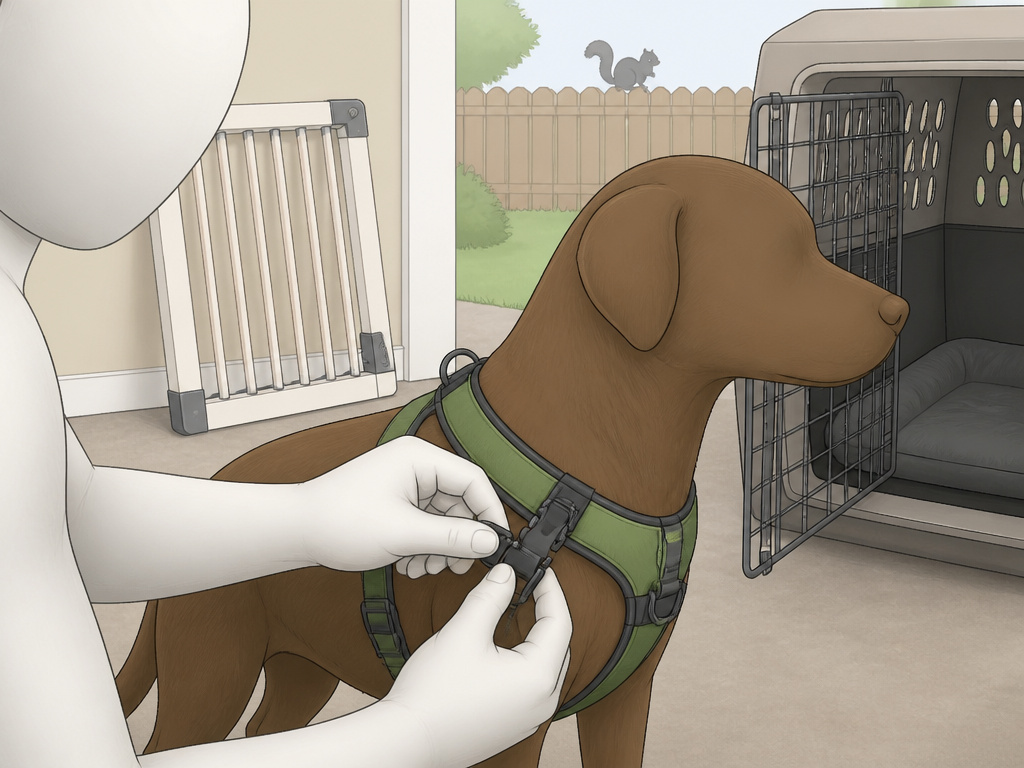
The shelter form said “good with everyone.” Later the same dog is up on the back fence with its front paws, screaming at a squirrel.
I’ve watched adopters buy a wireless fence before they collected the dog. The dog hadn’t been in the house long enough to show a single real behavior, and the containment choice was already locked in based on how it acted in a concrete run. My own rule is to wait until I understand the dog’s behavior before I’d pick a fence type. A dog that ignores the mailman at the shelter can turn into a different animal at a fence line with a squirrel on the other side.
Here is the honest version. Many containment failures I hear about were decided early, by someone standing in a yard with a dog that hadn’t unpacked yet.
| Setup | What it looks like | Best for | Watch out for |
|---|---|---|---|
| Crate | Crate with the door left open | Dogs that relax when enclosed | Forcing a panicking dog inside |
| Safe room | Spare room, baby gate across the door | Dogs that panic in crates | Wires, plants, chewable trim |
| Indoor long line | Training line, supervised only | Teaching house rules early | Left on unsupervised, it snags |
For walks in the meantime, a well-fitted harness beats a collar for a dog that startles, and a front clip can turn a lunge into a mild turn instead of a choke.
If you’re using a crate as the main containment, crate train an older dog slowly, in daylight, with food going in before the door ever closes.
Which Signals Mean Back Off Right Now?
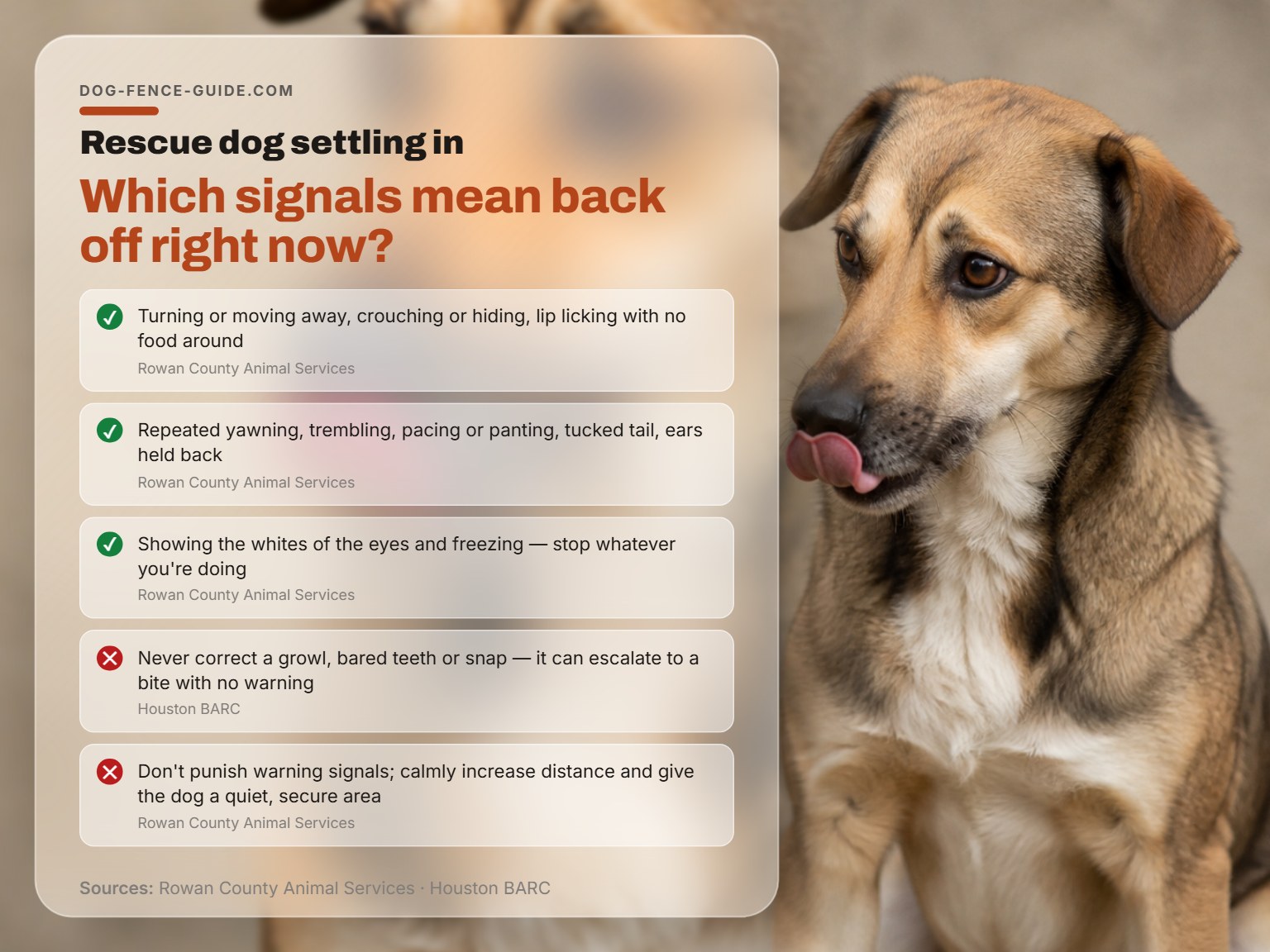
Turning away, lip licking with no food around, and a tucked tail all mean the same thing: the dog wants distance, and it’s asking politely.
Rowan County’s list is the one I’d print and stick on the fridge. It covers turning or moving away, crouching or hiding, lip licking, repeated yawning, trembling, pacing or panting, a tucked tail, ears held back, showing the whites of the eyes, freezing, and then the louder set: growling, barking, snapping, lunging.
You’ll see the whites of the eyes before you hear anything at all. That’s your cue to stop whatever you’re doing.
Never correct a growl. Houston BARC warns that reprimanding a dog for growling, baring teeth, or snapping teaches it to stop warning you, and the next escalation is a bite with no warning in front of it.
The Houston BARC shelter dog welcome guide is the source I’d hand a first-time adopter on this point, because it’s the one place the consequence is spelled out plainly.
Touch duration is where the two UK charities part company slightly. Dogs Trust suggests stroking the chest or shoulders for three to four seconds if the dog leans in, then waiting to see if it asks for more. The National Animal Welfare Trust frames the same idea as a three-second rule for reading the dog’s limits. Either way, the dog sets the clock.
Why Is Your New Dog Sleeping All Day and Refusing Food?
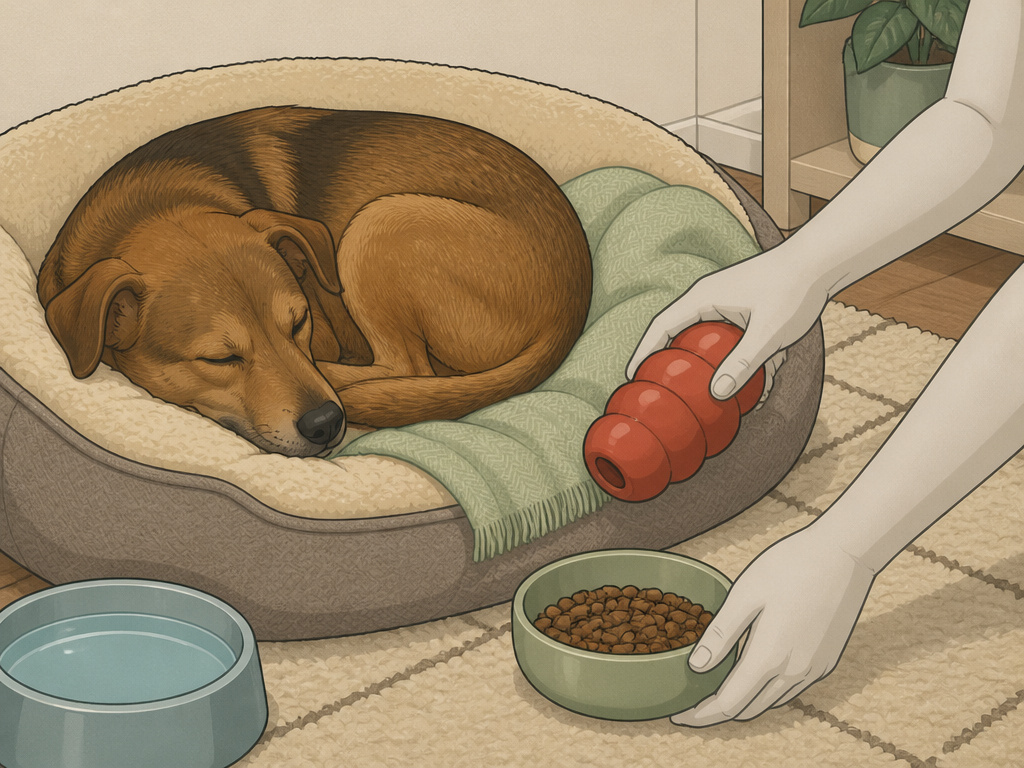
Sleeping through most of the first few days is normal.
Houston BARC notes that a shelter dog may sleep much of the time for the first few days at home while its body catches up. The National Animal Welfare Trust adds that eating less than usual on arrival is very common, because stress and change affect appetite.
A dog that slept through the first few days and is still sleeping much of the time later on is a different story. So is one that won’t eat or drink at all.
- Won’t eat or drink: call your vet, per Rowan County’s escalation list.
- Repeated vomiting or diarrhea: same list, same response.
- Appears ill, injured, or unusually lethargic: vet, not a wait-and-see.
- Refuses treats mid-interaction: the SPCA reads this as the dog saying it’s uncomfortable, so step back first.
Enrichment does a lot of the work here without demanding interaction. A stuffed Kong gives a worried dog something to do that doesn’t involve eye contact with you.
Once the dog is eating reliably, start training your rescue dog at home with short reward-based sessions. The Oregon Humane Society new dog book states that positive reinforcement is proven far more effective than punishment-focused methods, and recommends avoiding punishment altogether.
If your dog can’t be left alone without distress, treat that separately. Separation anxiety is its own problem with its own plan, and Dogs Trust suggests sleeping nearby at first and then gradually moving yourself or the bed further away.
For the first vet trip, calm a dog at the vet before you go rather than in the waiting room.
How to Help a Rescue Dog Settle In When There’s Already a Dog at Home
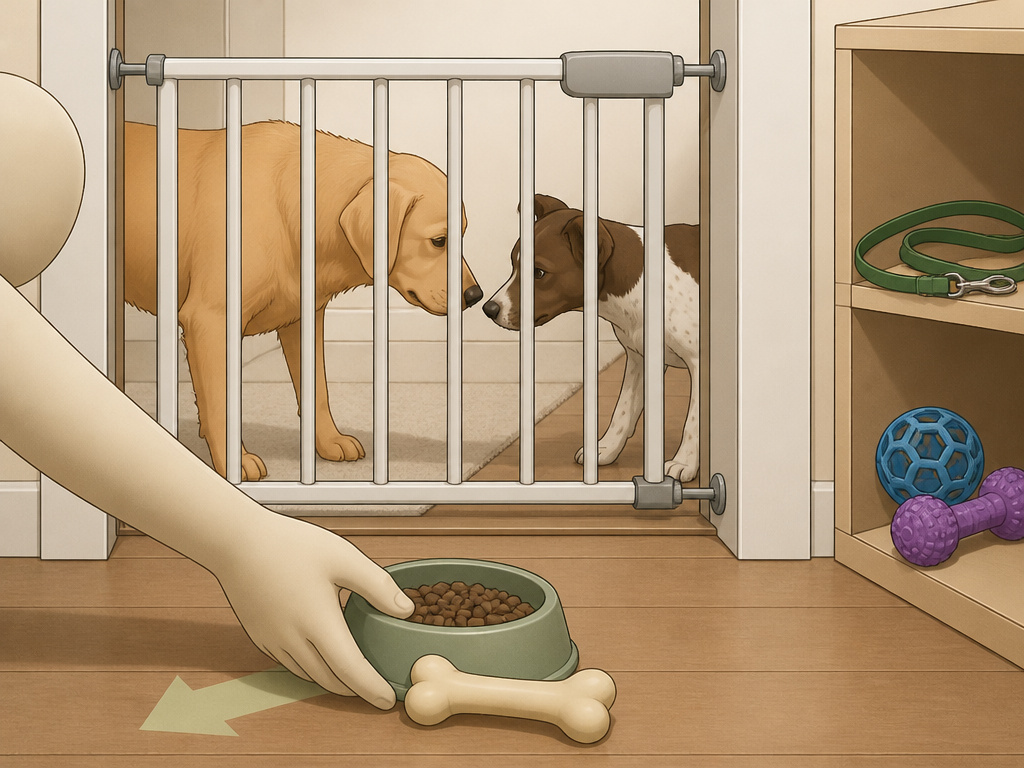
Rowan County notes that most dog bites to humans happen while someone is trying to separate a dog fight. That single sentence should shape every introduction you run.
Clear the room before the first meeting. Food bowls, treats, bones, and high-value toys belonging to the resident animal all come out, and a baby gate goes up so the two dogs can see each other without a shared doorway.
Children: One at a Time, Never in the Middle of a Fight
Rowan County’s child rules are the most specific of any source here, and they’re worth reading in full. No running from or chasing the dog, no wrestling, no tug without an adult directing it, no reaching into the bowl, no waking a sleeping dog by climbing on it, no opening the crate, and no holding the leash during early introductions.
- Separate the animals first, assess second. Children must never attempt it, and adults should use a barrier rather than hands if they can.
- Remove the resident dog’s resources before any meeting. Bowls, bones, and chewed toys are the usual flashpoint.
- Introduce on neutral ground if the household allows it. The National Animal Welfare Trust notes some rescue dogs are calmer meeting new people outdoors than inside the house.
- Report every bite to animal control. Rowan County requires it, and on weekends or holidays you call 911 so dispatch can reach the on-call officer.
When you’re ready to introduce two dogs, introduce two dogs on parallel walks before you ever put them in the same room loose.
Here’s the part I’d change about the adoption process itself: escape history should be disclosed upfront. A shelter that downplays a dog’s fence-jumping or door-darting record sets that dog up to fail in a home that was never built for it. Ask directly, and build the containment plan around the answer rather than the breed label.
Frequently Asked Questions
How long does it take a rescue dog to settle in?
It varies more than most guides admit. The National Animal Welfare Trust gives a range of three weeks to six months or longer, while Rowan County Animal Services says outright that adjustment doesn’t follow an exact timeline. The 3-3-3 framework is a useful shape for the curve, not a deadline.
Should I crate my new rescue dog at night?
Only if the dog relaxes in a crate. The San Francisco SPCA is explicit that not every dog needs crate training and that a dog unable to relax in one shouldn’t be forced. Dogs Trust suggests introducing the bed during the day, then settling the dog in it before you go to bed yourself.
Is it normal for a rescue dog to not eat for the first two days?
Reduced appetite on arrival is very common, according to the National Animal Welfare Trust, because stress and change affect eating. Monitor weight and intake. If the dog refuses food for an extended period or shows signs of illness, contact your vet.
Can I leave my new rescue dog alone in the yard?
Not until you understand its behavior. Rowan County advises against leaving a shelter dog loose and unattended in the home until the caregiver has a better understanding of how the dog acts. Houston BARC adds that escape routes should be blocked and the fence checked for holes before the dog is left at all.
Should I rename a rescue dog right away?
Wait until the dog is eating and sleeping normally. A new name is one more unfamiliar thing in a week already full of them, and it lands better once the dog has a routine to attach it to.
What if my rescue dog growls at me?
Increase distance calmly and give the dog a quiet, secure space. Both Houston BARC and Rowan County warn against punishing a growl, because it suppresses the warning rather than the discomfort behind it. If it keeps happening, bring in a qualified trainer or veterinary behaviorist.
The Bottom Line
Here’s the threshold I’d give any adopter: if the dog is still pacing, hiding, or refusing food after the settling-in period, stop adding new experiences and get a trainer or veterinary behaviorist involved. That’s not failure. That’s the point where a generic settling-in plan runs out of road.
The concession is this. None of the above fixes a dog whose problem is boredom or anxiety rather than adjustment, and no fence, crate, or routine will contain a dog that’s escaping because it’s frightened. If the behavior has a driver, the driver has to be addressed first.
Start with the den this week. One quiet corner, one bed the dog can stretch out in, one door that stays closed. Everything else below builds on that room.
Peace of mind is the real goal, and it starts smaller than most people expect.
