
How to Exercise a Dog for Weight Loss: Start Small
This post contains affiliate links. As an Amazon Associate, we earn from qualifying purchases.
To exercise a dog for weight loss, build walking toward 30-45 minutes a day and pair it with measured meals. The 2014 AAHA guidelines put a dog’s burn at about 1.1 kcal per kilogram per kilometer at a brisk pace, so exercise supports the plan while food restriction drives it.
That 1.1 figure is the only how to exercise a dog for weight loss calorie number you’ll get. The same AAHA guideline states plainly that, walking aside, caloric expenditure for other forms of exercise in dogs is largely undocumented. A 45 kg dog covering 4.82 km at a brisk pace burns about 240 calories by the guideline’s own worked example. Everything else you read about swimming and fetch is a recommendation without a dose.
What follows is the walking arithmetic, the two published starting protocols that disagree with each other, the treat math that erases a week of walks, and the dogs for whom the standard plan is the wrong plan entirely.
Key Takeaways
- Food restriction drives weight loss; exercise supports it. Cambridge, Cornell and AAHA all land in the same place, even though AAHA calls the exercise evidence preliminary.
- Start smaller than feels useful. AAHA says 5 minutes three times a day. Clinician’s Brief says 2 minutes five times a day.
- Weigh the dog every two weeks and aim for 1-2% of body weight per week, per Cornell.
- No jogging with puppies. PDSA’s ceiling is 5 minutes of walking per month of age.
What the 1.1 kcal Rule Actually Buys You
The 1.1 kcal/kg/km figure comes from the 2014 AAHA Weight Management Guidelines, and it’s the only exercise calorie number in the veterinary literature that’s quantified for dogs.
A dog walking at a brisk pace of 10 to 10.5 minutes per kilometer expends about 1.1 kcal per kilogram of body weight per kilometer traveled. At that pace, a 45 kg dog covering 4.82 km expends 240 calories, an amount equal to a small fraction of a single daily ration.
That number is smaller than it feels. A brisk four-kilometer walk is a serious outing for most households, and it buys a couple of hundred calories at best. Check the body condition score before you plan a route, because a dog at BCS 7 needs a target before it needs a schedule.
Cornell uses a 1-9 scale where 4 or 5 is ideal, and each point above ideal is roughly 10% of the dog’s current weight. A 75 lb dog at BCS 7 is carrying about 20% extra, which puts the target at 60 lb. That’s the number the walking is working against.
I weigh the kibble on a kitchen scale every meal. It takes about as long as scooping, and it’s the only part of this I’ve never once regretted.
Walking is the only exercise with a published calorie cost, and that fact alone tells you how much confidence to put in the rest of the menu. Cornell recommends low-impact work like walking or swimming for keeping muscle mass and joint mobility intact, and the Cornell canine obesity guide is honest about which half of the plan does the heavy lifting.
The Two Published Starting Protocols Do Not Agree
Two clinical sources, both credible, hand you different first weeks.
| Source | Starting point | Daily target | Notes |
|---|---|---|---|
| AAHA 2014 | 5 min walk, 3x/day | 30-45 min walking | Written for obese dogs with no orthopedic restriction |
| Clinician’s Brief | 2 min walk, 5x/day | 3 min, 5x/day after week 1 | Case-based, stepwise increase |
| PDSA | Not specified | At least 30 min | General dog population, not a weight-loss protocol |
You don’t merge those into an average. You pick one, and the 2014 AAHA obesity guidelines build gradually until the dog’s limit is reached or 30-45 minutes a day is achieved. That “or” is doing real work in the sentence.
PDSA takes a different view on structure entirely. If a dog prefers fewer, longer walks over shorter, more frequent ones, PDSA says stick with the dog’s favourite. Clinician’s Brief prescribes the opposite shape. Both can be right for different dogs.
I’d start at the lower end. A dog that quits on day three has learned that walks are a chore, and unlearning that costs more than the week you saved. The weight loss plan that gets finished beats the one that looks correct on paper.
How to Exercise a Dog for Weight Loss: The 6-Step Build
Six steps, in this order, and the first one has nothing to do with walking.
Before you start: A dog carrying extra weight overheats faster than a lean one, and PDSA notes obese dogs struggle in hot weather specifically. In summer, walk early morning or late evening at a slow pace. Wait at least an hour after a meal before heading out.
- Get a target weight from your vet, not from the scale alone. Cornell’s scale puts ideal at 4 or 5 out of 9, and each point above that is about 10% of current weight. Skip this and you’re walking a dog toward a number nobody chose.
- Measure the food before you plan the walks. Cambridge is blunt that limiting food intake is the most important part of the plan. If the meals stay the same, the walking just builds a fitter fat dog.
- Start at 5 minutes, three times a day if there’s no orthopedic restriction, per AAHA. Or 2 minutes five times a day per Clinician’s Brief. Pick one and write it down.
- Add 5 minutes a week to the longest walk only. Cornell warns that inactive dogs must acclimate slowly to avoid injury. Blowing through this is the fastest route to a lame dog and a stalled plan.
- Warm up and cool down for 5 minutes each, per PDSA. A slow sniff-and-ramble at the start counts. So does the same at the end.
- Weigh the dog every two weeks and log it. Cornell’s safe rate is 1-2% of body weight per week, which for a 50 lb dog means half a pound to a pound.
There’s a moment in week two when the leash stops going taut. The dog stops sitting down at the four-minute mark and just keeps walking. That’s your signal to add time, not the calendar.
I time the first week on my phone. It sounds ridiculous and it takes four minutes a day.
PDSA’s rule is at least an hour between a meal and a walk, and no food straight after. That’s the conservative end of the feeding and exercise question, and it’s the end I’d follow.
Which Dogs Need a Different Exercise Plan?
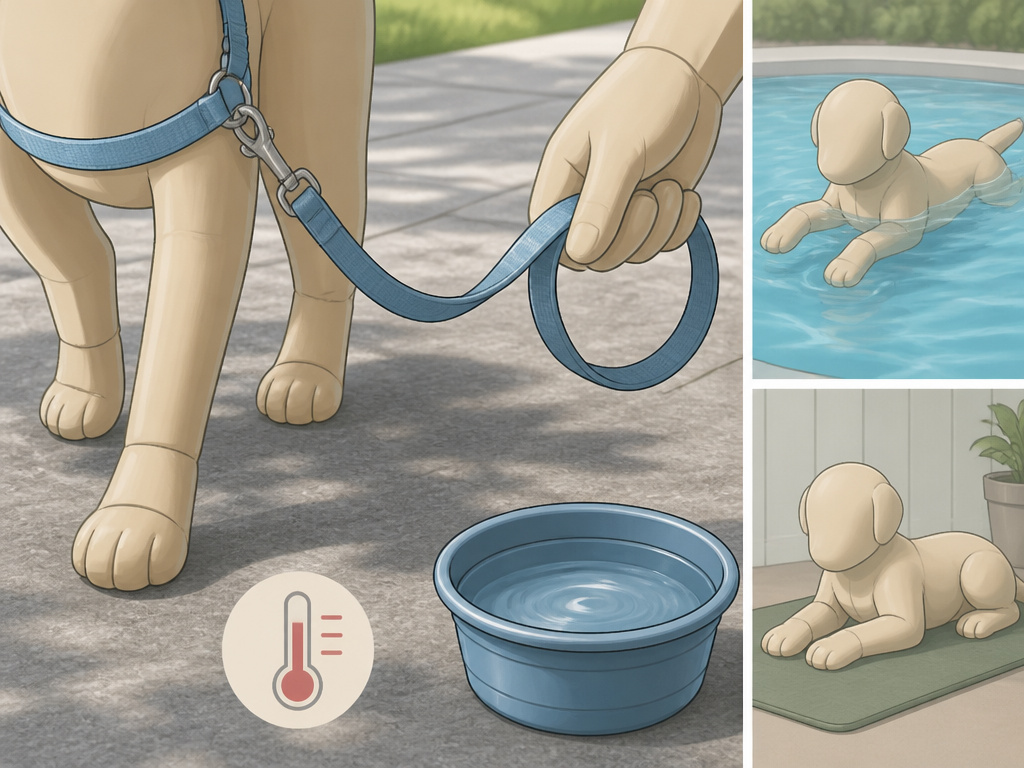
Four groups need a modified plan: flat-faced breeds, dogs with joint disease, puppies, and any dog in a heatwave. The standard walking build assumes a normal airway and normal joints.
Flat-Faced Dogs
PDSA advises lead-walking only, at a comfortable pace, to prevent overexcitement and overheating. The Cambridge handbook names brachycephalic obstructive airway syndrome, collapsing trachea and bronchitis as conditions where getting an affected dog to exercise safely is genuinely hard. Physiotherapy and hydrotherapy are the noted alternatives.
Dogs With Arthritis or Joint Disease
AAHA directs owners toward low-impact options such as swimming or a rehabilitation therapist. Clinician’s Brief adds passive range of motion and balance exercises, performed by a vet tech specialist in physical rehabilitation, with home exercises handed to the client.
Puppies and Giant Breeds
PDSA’s rule is 5 minutes of walking per month of age, so a four-month-old gets 20 minutes at a time. Jogging is specifically called out as a risk to developing joints.
Stop the walk and call the vet if any of these show up:
- The dog lies down before the time is up, the way the Clinician’s Brief case dog did at five minutes.
- Breathing that stays fast a full minute after you stop moving.
- Pulling toward home on a route the dog normally enjoys.
- Any limp at all.
Breed matters less than condition here, but the breed exercise needs vary enough that a Bulldog and a Border Collie shouldn’t share a schedule.
Treat Math: Why a Week of Walks Disappears
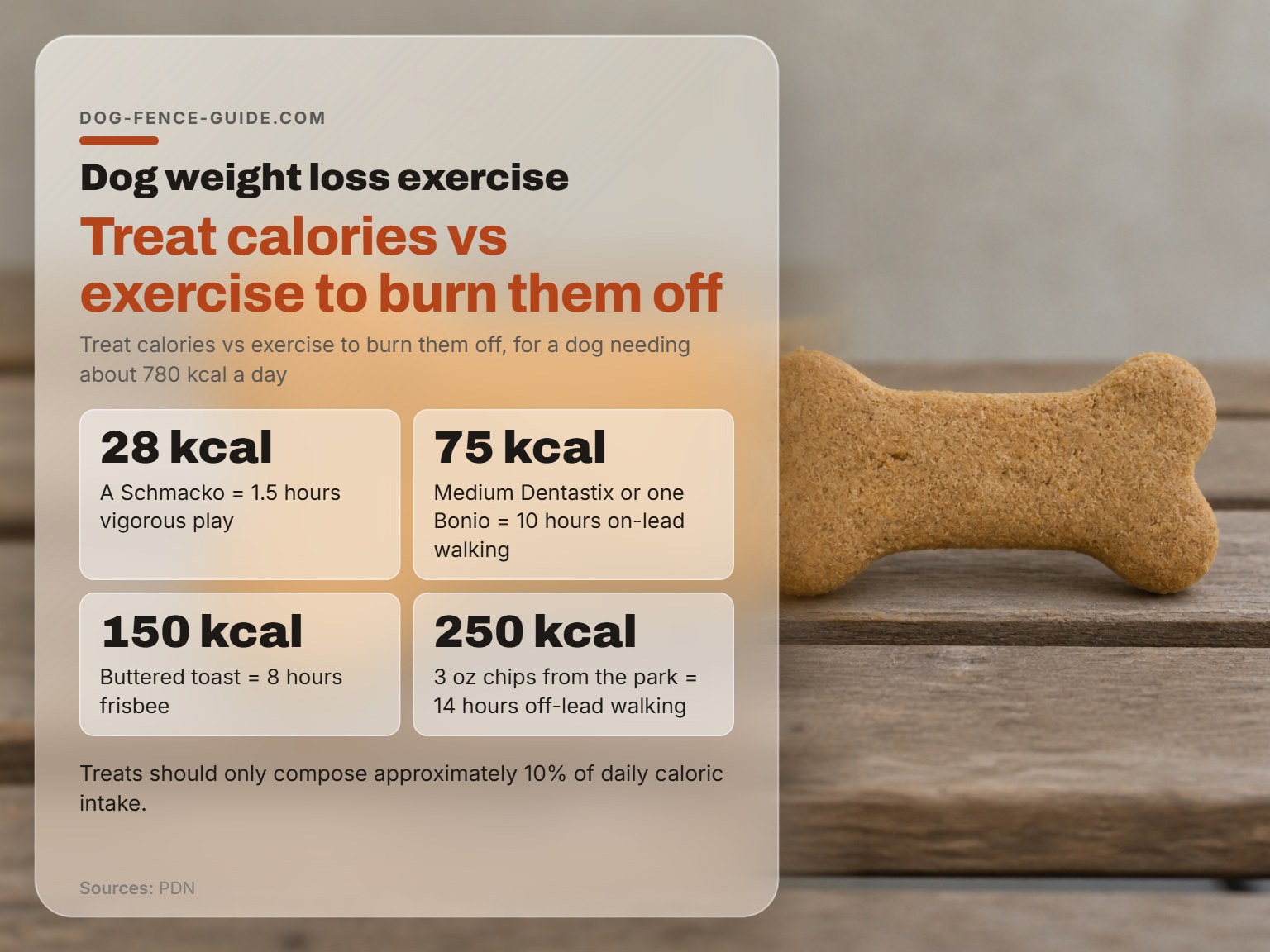
The biscuit is gone in four seconds. The walking to pay for it takes ten hours.
| Treat | Calories | Exercise to burn it off |
|---|---|---|
| Schmacko | 28 kcal | 1.5 hours vigorous play |
| Medium Dentastix or one Bonio | 75 kcal | 10 hours on-lead walking |
| Digestive biscuit | 70 kcal | 6 hours swimming |
| Rasher of bacon | 80 kcal | 12 hours lead walking |
| Buttered toast | 150 kcal | 8 hours frisbee |
| 3 oz chips from the park | 250 kcal | 14 hours off-lead walking |
Those figures come from the Cambridge handbook’s worked example for a dog needing about 780 kcal a day. The exercise conversions are the handbook’s own.
The 10 Percent Rule in Practice
Cornell puts treats at about 10% of daily calories. Clinician’s Brief runs the same number through a real case: an 85 lb dog on 750 kcal a day gets 75 kcal of treats and 675 kcal of meals.
Weigh the treats. Three Bonio biscuits is most of a day’s allowance for a small dog, and nobody counts biscuits. If you want something to hand out more freely, a low-calorie dog treat list belongs on the fridge door, and a Kong Classic stuffed with part of the measured kibble buys ten minutes of quiet for no extra calories.
The treats and weight gain math is unforgiving precisely because it’s invisible.
The part nobody mentions: A dog that scavenges adds calories you never see. Cambridge suggests avoiding walks through areas with lots of discarded food, and a muzzle off-lead if your dog is a serious forager.
Do You Actually Need to Walk 30 Minutes a Day?
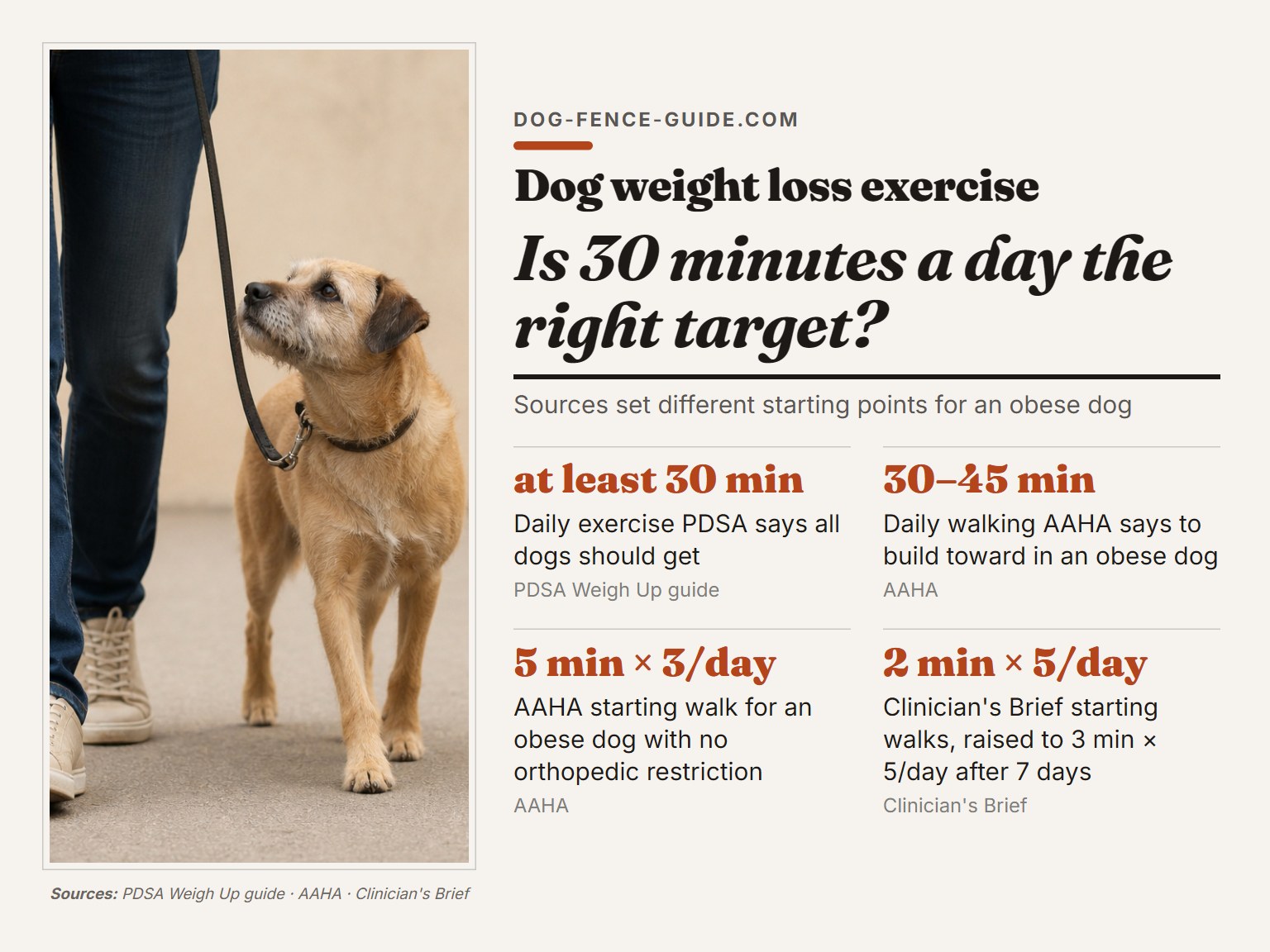
No single number applies to every dog, and the sources don’t agree on one. PDSA says all dogs should get at least 30 minutes of exercise a day. AAHA treats 30-45 minutes of walking as a target to build toward in an obese dog, not a floor every dog must clear on day one.
Clinician’s Brief starts a case dog at 10 minutes a day and steps to 15 after a week, which sits below the 30-minute figure entirely. That’s not a contradiction so much as a difference in what the number is for.
Thirty minutes works as a target. As a floor it fails, because it makes week one a failure for a dog that can manage five minutes.
A dog that finishes a walk still pulling has done enough for that day. A dog that finishes by lying down has done too much. Adjust by the dog, not by the clock.
The healthy weight target and the exercise target are two different numbers. Confusing them is how people end up walking six miles a week and wondering why the scale hasn’t moved.
What to Do When the Weight Stops Moving
Week five arrives, the walks are longer, the food is measured, and the scale reads the same number it read in week three.
AAHA says to reassess exercise expenditure at a plateau and recommend changes. Cornell says a rate slower than 1-2% per week is feedback that the diet needs adjusting. Neither one says to add more distance and hope.
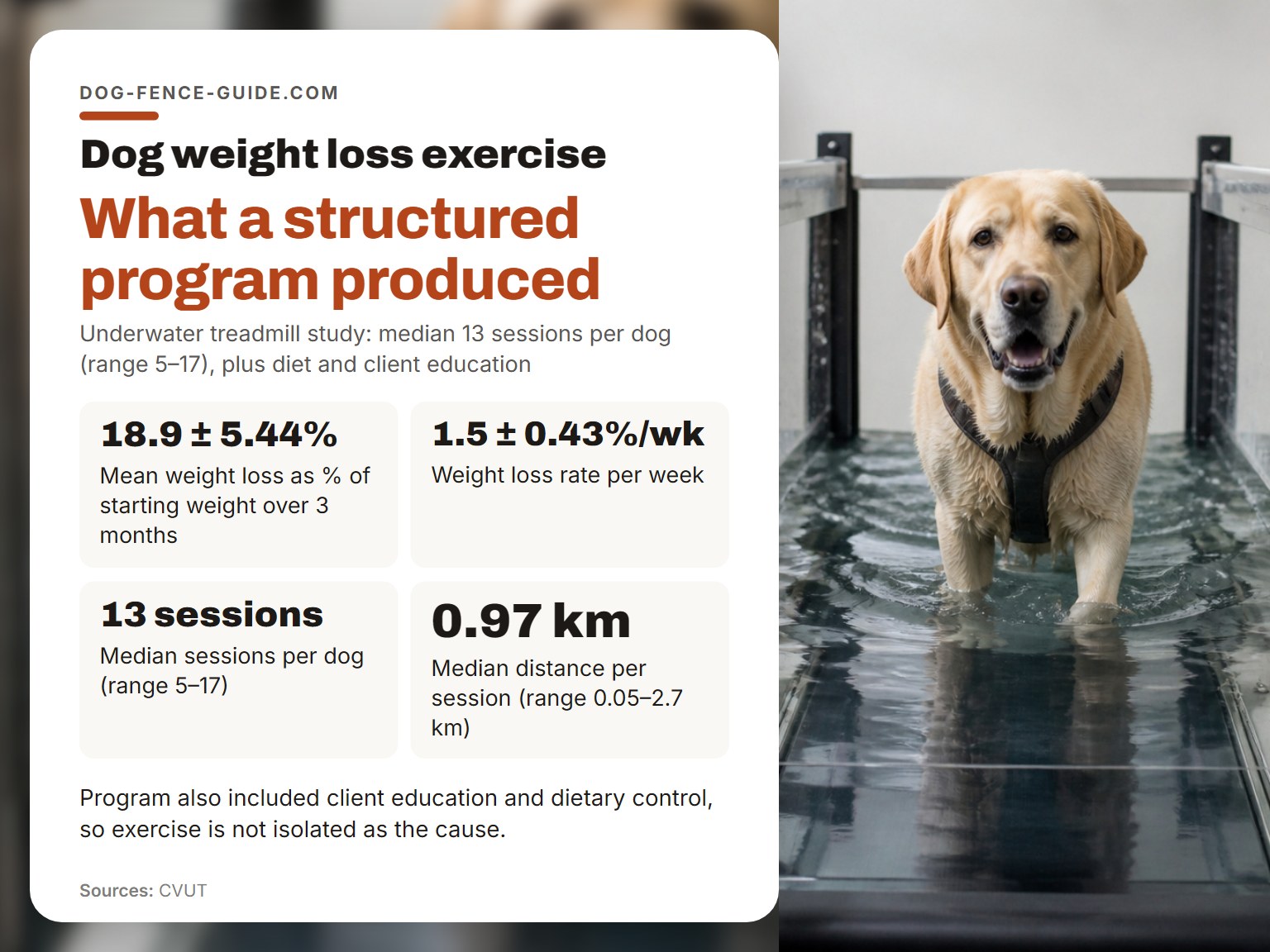
The best-documented exercise intervention in dogs is a 2011 study in the Canadian Veterinary Journal, run on eight obese dogs over three months. Median dose was 13 sessions per dog, median 0.97 km per session. Mean weight loss was 18.9% of starting weight with a standard deviation of 5.44, at a rate of 1.5% per week, and both thoracic and abdominal girth fell. The underwater treadmill exercise study is worth reading for the protocol detail.
That program also included client education and dietary control, so it doesn’t isolate exercise as the cause. It shows what a structured program produces when both halves are present.
When to Ask for Hydrotherapy
AAHA suggests water therapy or a supervised physical activity program, especially where pre-existing medical problems affect exercise tolerance. The Cambridge handbook lists physiotherapy and hydrotherapy as options for dogs whose airways or joints complicate normal walking.
Work through this list before you change anything else:
- Ask the vet to recalculate the calorie target, not just re-weigh the dog.
- Weigh the treat allowance for one week. Most plateaus live here.
- Check whether the walking quietly stopped because of weather, a bad knee, or a busy month.
- Book the two-week recheck. Clinician’s Brief schedules weight, body condition, muscle condition and pain scoring every two weeks.
Where this goes sideways: Cutting calories and adding miles in the same week. Cornell notes that faster-than-expected loss can mean calories have been restricted too severely. Pick one lever per fortnight.
Yard Time Is Not Exercise
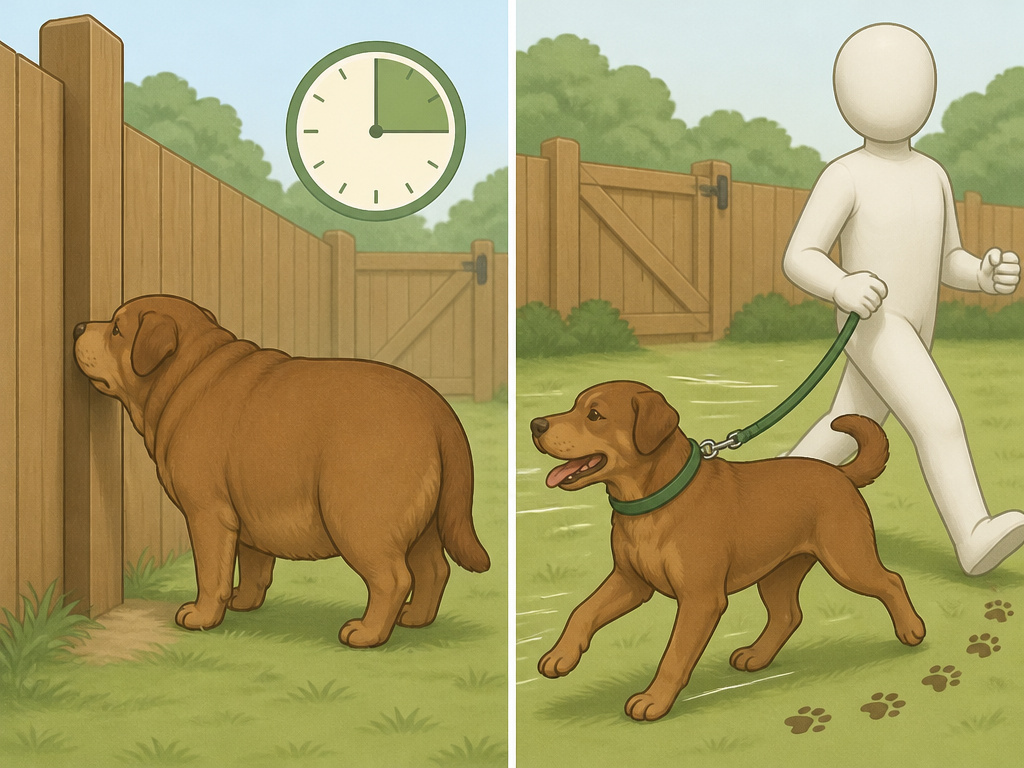
A dog standing at the fence line for four hours has not answered how to exercise a dog for weight loss.
This is the mistake I see most: free yard time counted as exercise for an overweight dog. The dog is outside, therefore the dog is active. That logic collapses the moment you actually watch.
Watch a dog alone in a yard for ten minutes. Most of it is standing, sniffing one fence post, and looking at the gate. The gate is the interesting part, and it’s also where your containment actually lives.
Cambridge is clear that keeping a dog on a lead all the time isn’t the answer either, because exercise is an important part of weight loss. The middle ground is supervised activity with a person attached to the other end of it.
When the weather kills the walk, the keeping a dog active in winter playbook matters more than the fence does.
My own gate gets checked every Sunday, and so does the latch on the side return. That’s a containment habit, not an exercise one, and I keep the two separate on purpose.
I’ve watched owners buy a bigger yard to fix a fat dog. The dog used about nine feet of it. Buy a leash and a kitchen scale instead; the yard was never the problem.
Frequently Asked Questions
How long does it take for a dog to lose weight with exercise?
Cornell’s safe rate is 1-2% of body weight per week, so a 50 lb dog losing half a pound to a pound a week is on track. A dog that loses nothing across three weeks needs the calories re-checked before the distance goes up.
Can I exercise an overweight dog without changing their food?
Not according to any of the four sources here. Cornell states that physical activity only makes enough difference when included with dietary changes, and the Cambridge handbook goes further, calling food restriction the most important part of the plan. AAHA describes the evidence that exercise improves weight loss as preliminary.
Is swimming better than walking for an overweight dog?
There’s no published calorie figure for swimming in dogs, so nobody can give you a dose. AAHA states that, walking aside, caloric expenditure for other exercise is largely undocumented while still recommending swimming as a low-impact option for joint disease. It’s a low-impact option for a dog with joint disease, just not a measurable one.
Should I walk my dog before or after dinner?
PDSA advises waiting at least an hour after a meal before exercise, and no food straight after the walk. Some owner-facing advice suggests a short walk 30 to 60 minutes after eating instead. The PDSA guidance is the more conservative of the two, and it’s the one I’d follow with a dog carrying extra weight.
How do I know if the exercise is too much?
Stop if the dog lies down before the time is up, if breathing stays fast a minute after you stop, or if there’s any limp. Cornell notes that dogs who haven’t been active must acclimate slowly to avoid injury.
What if my dog refuses to walk?
Start with the driveway. A dog that plants itself at the end of the block will usually manage five minutes of sniffing in a familiar spot. The Clinician’s Brief stepwise approach of 2 minutes, five times a day exists for exactly this dog.
The Bottom Line
Here’s the threshold I’d use: if your dog hasn’t lost anything in three weeks of measured meals and consistent walks, stop adding distance and re-check the calories. Adding mileage to a dog already at its limit just produces a sore dog and a shorter walk next week.
None of this applies cleanly to a dog with a heart condition, a collapsing trachea, or a fresh cruciate repair. For those dogs the exercise conversation belongs to your vet and a rehab specialist, and the walking build above is the wrong tool.
This week: weigh the dog, weigh one day of food including every biscuit, and take a five-minute walk three times a day. That’s the whole plan. The rest is that plan repeated for twelve weeks with small additions.
Most guides will tell you the goal is thirty minutes a day. I’d rather see a dog do three honest five-minute walks in week one than one heroic thirty-minute march that ends with the dog refusing the lead on Thursday.
