
Do Treats Cause Weight Gain in Dogs? How to Count Them
This post contains affiliate links. As an Amazon Associate, we earn from qualifying purchases.
Treats do cause weight gain in dogs when they push daily calories past what the dog actually burns. The WSAVA Global Nutrition Committee puts the ceiling at no more than 10% of daily calorie intake, and one bully stick alone delivers about 9% of a 23 kg dog’s daily calories.
The bully stick number is the one that catches owners off guard, because a chew doesn’t look like a meal. It is a meal, or close to one. Do treats cause weight gain in dogs? Yes, when they are this calorie dense.
That gap between what a treat looks like and what it costs is where the weight creeps in, which is why the do treats cause weight gain in dogs question keeps coming up. The math is simple. The counting is not.
What follows is the actual calorie math, the places where the published guidance splits, and a counting method you can run in your head at the treat jar. By the end you’ll know which chews to hand over whole and which to break in half.
Key Takeaways
- Cap treats at 10% of daily calories. That ceiling comes from the WSAVA Global Nutrition Committee and the University of Illinois I-PETS guide, and it covers chews, supplements, and the food you hide a pill in.
- A 4.5 kg dog blows the budget with one bully stick. The same chew that costs a 23 kg dog about 9% of daily calories costs a small dog around 30%.
- Calorie content isn’t required on treat packaging. If the number isn’t printed, WSAVA says contact the manufacturer directly.
- Weigh the dog, not just the treat. If the ribs get harder to find, cut the treat allowance before you change anything else.
- Yard time is not exercise. A fenced yard gives a dog somewhere to be, not a reason to move.
What the 10% Treat Ceiling Actually Means
The ceiling is a share of calories rather than a count of biscuits. Ten percent of a 10 kg dog’s daily energy needs is a very different allowance from ten percent of a 40 kg dog’s, which is why the same handful of treats lands differently on every dog in the house.
Daily energy needs for a healthy adult dog can be estimated with the maintenance energy requirement formula: MER in kilocalories per day equals 95 multiplied by body weight in kilograms raised to the power of 0.75. Treats are then capped at one tenth of that total, which keeps the main diet providing the other ninety percent.
Run that formula on a 20 kg dog and the daily total comes out from the formula itself. Ten percent of that is the treat allowance, which a single dental stick can consume much of. A single rawhide can take up a large share of the allowance on its own.
That is why the treat allowance has to be worked out per dog rather than copied from a chart on the back of a bag, and it is the practical answer to do treats cause weight gain in dogs.
The WSAVA guide to feeding treats is blunt about what counts. A treat is any food given on top of a complete and balanced diet. Snacks, chews, supplements, and the cheese around a tablet all sit in the same bucket.
That last one surprises people. It shouldn’t. Calories don’t care what you call them.
Do the Sources Agree on the 10% Rule?
Not entirely. The number is the same across the major sources. The framing around it isn’t, and the difference matters when your dog is already carrying extra weight.
The Hard Ceiling Camp
WSAVA states that treats should always make up less than 10% of a dog’s daily calorie intake. The University of Illinois treat guidance sets the same limit for healthy adult dogs and adds the reason: going past it means excess calories, gradual weight gain, and a main diet that no longer adds up to complete and balanced.
The Conditional Camp
The University of Cambridge weight management handbook frames treats differently: it treats them as acceptable only if you reduce the main ration to compensate, though other sources warn that cutting the main ration too far can leave the diet short on nutrients. That is a conditional rule rather than an absolute one, and it puts more weight on the owner’s judgement.
| Position | Who holds it | What it means in practice |
|---|---|---|
| Hard ceiling | WSAVA Global Nutrition Committee; University of Illinois I-PETS | Treats stay under 10% of daily calories, full stop |
| Conditional | University of Cambridge PDN handbook | Treats are fine if the main ration comes down to match |
| Clinical reality | Dr. Justin Shmalberg, DVM, writing for PetMD | Biscuits routinely reach more than a third of daily calories |
Here is the honest version. For most healthy dogs the two camps land in the same place, because trimming the main meal to make room for treats is what the 10% math does anyway.
Where they split is what happens when you trim too far. An assessment of the 10% snack recommendation study tested whether the substitution holds up nutritionally.
All the dog diets still met protein and fat minimums with 10% of calories swapped for treats. For inactive cats, some diets failed. Same rule, opposite conclusion by species.
Common mistake: Treating 10% as a target to hit. It’s a ceiling. A dog at a healthy weight does fine well under it.
The Treat Calorie Table Nobody Prints on the Bag
Calorie content is not required on pet treat packaging. That single fact explains most of the guesswork around this topic, and it’s why the published tables matter more than the marketing on the front of the bag.
WSAVA publishes a bodyweight table for treat calories. Here it is as printed.
| Dog’s weight | Daily calories from treats |
|---|---|
| 2 kg | 14 kcal |
| 4 kg | 24 kcal |
| 6-40 kg | 32 kcal |
| 45 kg | 146 kcal |
Look at the middle of that table. A 6 kg dog and a 40 kg dog both get 32 kcal, which means a dog seven times the size gets the same allowance. That plateau doesn’t match the MER formula, and it doesn’t match the 45 kg figure at the bottom either.
The table’s own footnote says it’s based on an average healthy adult dog in ideal body condition, and that owners should ask their vet for their own dog’s requirement. Take that footnote seriously. Use the formula or the vet, and treat the chart as a rough starting point.
The peer-reviewed dog treat review published in Frontiers in Animal Science makes the same point from the other direction. The energy content of treats varies widely, and in some cases a treat can exceed a dog’s recommended daily energy intake on its own.
If you want to swap in low-calorie treats, the swap only works when the total stays under the ceiling. A low-calorie treat eaten in quantity is just a regular treat with better branding.
Why One Bully Stick Blows a Small Dog’s Budget
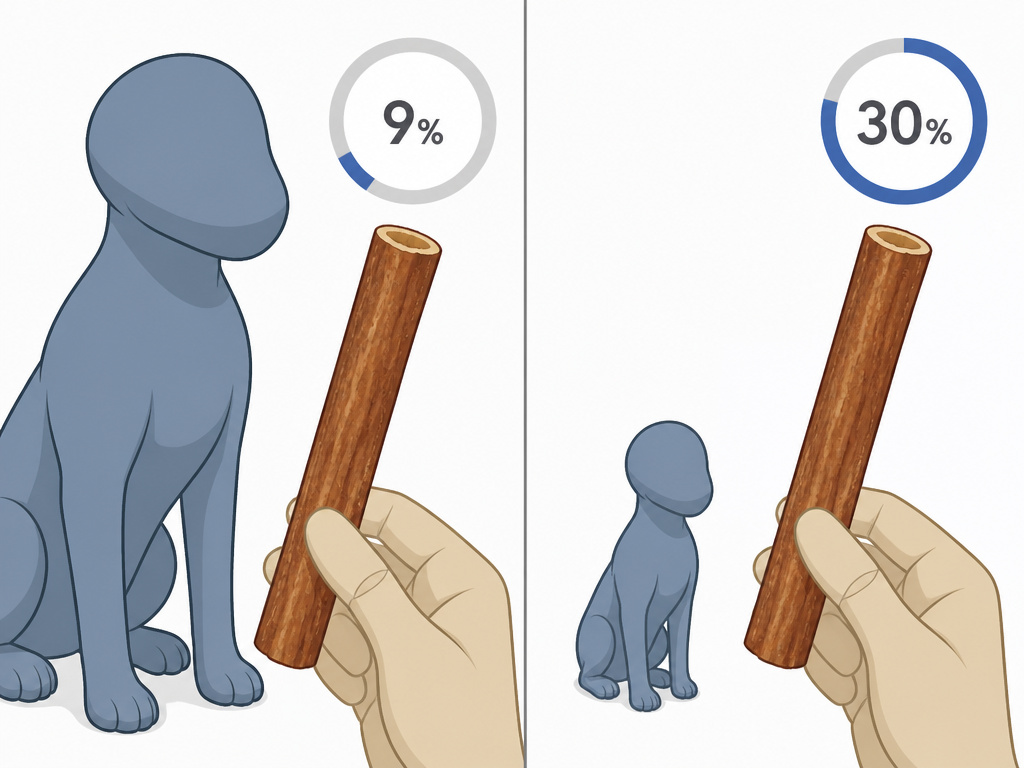
One bully stick a day supplies about 9% of a 23 kg dog’s daily calories. Hand the same chew to a 4.5 kg dog and it covers roughly 30%.
Same chew. Three times the ceiling.
That’s the whole problem with chews in one line. A chew is a fixed size, and the dog isn’t. The Frontiers review lays out the calorie density across treat categories, and the spread explains a lot of unexplained weight gain.
| Treat type | kcal per 100 g | Typical kcal per treat |
|---|---|---|
| Biscuits | 329 | 22 |
| Soft treats | 294 | Wide range |
| Jerky | 284 | 29 per strip |
| Dental sticks | 268 | 55 per stick |
| Rawhide | 310 | 133 per chew |
| Animal parts | 312 | 11 per piece |
Read that rawhide row again. A single rawhide averages around 133 kcal. For a small dog, that’s most of a day’s calories in something you handed over to keep the dog quiet for an hour.
Why the Chew Category Is the Hardest to Budget
A dental stick disappears quickly. A rawhide can keep a dog busy for a long stretch, and that is exactly why owners hand them over without doing the math.
The trade feels fair. A stretch of quiet for one chew. What the trade actually costs is roughly a meal.
Rawhide carries a second problem that has nothing to do with calories. Swallowing large pieces can cause a gastrointestinal obstruction, and dry matter disappearance after the intestinal phase ranges from 35.10% to 95.70% depending on the product. That’s a huge spread, and you can’t tell which end of it you bought.
Rawhide is also discouraged for dogs on controlled protein intake or prone to calcium oxalate stones. If either applies, skip it entirely.
Owners reach for healthy dog treats assuming the word on the bag settles the calorie question. It doesn’t. A pig’s ear is natural and it’s still a calorie bomb, and WSAVA flags unprocessed raw animal treats as a pathogen transmission risk on top of that.
Older work on weight and water retention in dogs during overfeeding made the same point current guidance does. Extra calories show up on the scale.
How to Count Treats Without a Spreadsheet
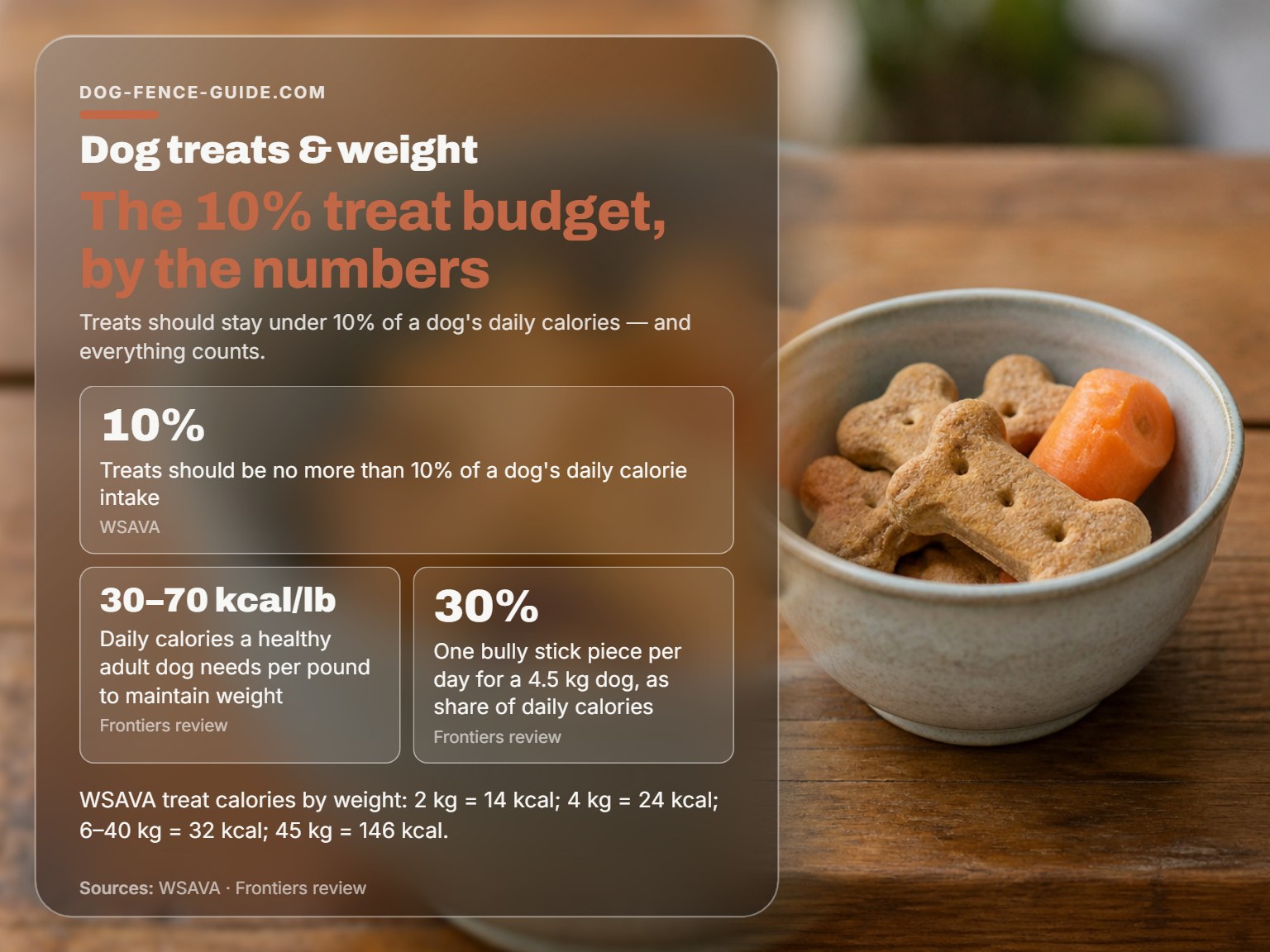
Three numbers decide the whole thing: the dog’s weight, the daily calorie total, and ten percent of it. Everything else is bookkeeping.
Before you start: Check every treat against the toxic list before it reaches the bowl. Chocolate, macadamia nuts, onions, garlic, grapes, raisins, xylitol, alcohol, raw yeast dough, and anything caffeinated can send a dog to the vet. Cooked and raw bones can splinter or block the gut, and antlers and hooves crack teeth.
Here’s the method I’d run in any household.
- Weigh the dog weekly on the same scale. Same time of day, same conditions. Skip this and you’re guessing at the one number the whole calculation depends on.
- Work out the daily calorie total. Use the MER formula or ask your vet. Guessing here throws the 10% figure off by hundreds of calories on a large dog.
- Take ten percent of that number. Write it on the inside of a cupboard door. That’s the entire treat budget, and it doesn’t reset because the treats were small.
- Count everything that goes in the mouth. Chews, supplements, training rewards, table scraps, the cheese around a pill. Leave one out and the budget is fiction.
- Measure the day’s treats in advance. Put them in a bowl in the morning. When the bowl is empty, the dog is done, and nobody has to do arithmetic at seven in the evening.
- Adjust the main meal if the treat total runs high. Cut the kibble rather than the ceiling, and only by the amount the treats replaced.
The Things Owners Forget to Count
The bowl method only works if the bowl is honest. These are the items that quietly go missing from the tally.
- The cheese around a pill. It counts, and so does the peanut butter.
- Training rewards. Twenty reps in a session means twenty training treats, and tiny ones still stack up.
- The long-lasting chew. One chew can be a third of the day.
- Table scraps. WSAVA lists human food and scraps as unhealthy and potentially dangerous, and PetMD notes they’re high in calories and fat.
- Supplements. WSAVA’s definition of a treat includes them.
Easy to miss: The chew you hand over on the way out the door. It takes ten seconds to give and it can carry more calories than the dog’s breakfast.
Does Yard Time Cancel Out the Extra Treats?
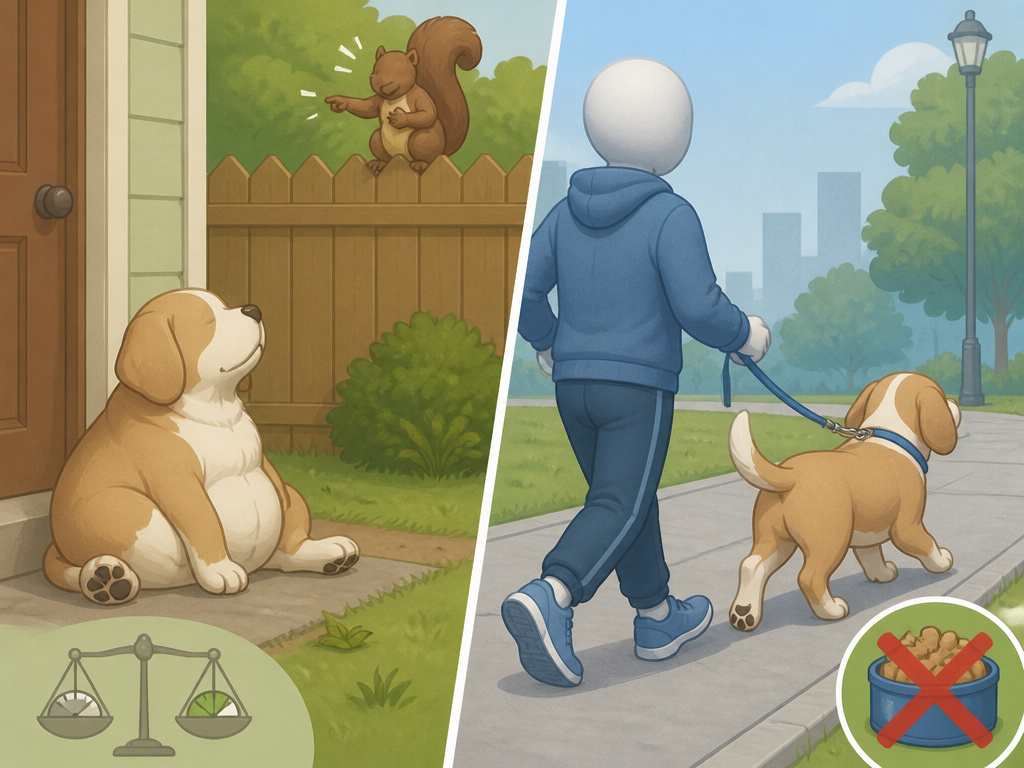
A fenced yard gives a dog somewhere to be. It doesn’t give the dog a reason to move.
Let a dog out at seven in the morning and most are back at the door by ten past, having patrolled the fence line once and barked at a squirrel. That’s not exercise. That’s a security round.
PetMD puts the useful baseline at a daily 20- to 30-minute walk for most dogs. Both halves of that matter.
An overweight dog shouldn’t be left to self-exercise in the yard and expected to sort itself out. Structured exercise for weight loss means a leash, a route, and a pace, not an open door.
A dog’s daily energy balance works like the plumbing in an old house. You don’t judge it by the strongest joint. You judge it by the one that lets go, and around here that’s usually the hour between dinner and bed when the biscuits come out.
If you want the dog at a healthy weight, the leash does more work than the fence does. That’s an uncomfortable sentence for a site about fences, and it’s still true.
When Treats Aren’t the Whole Story
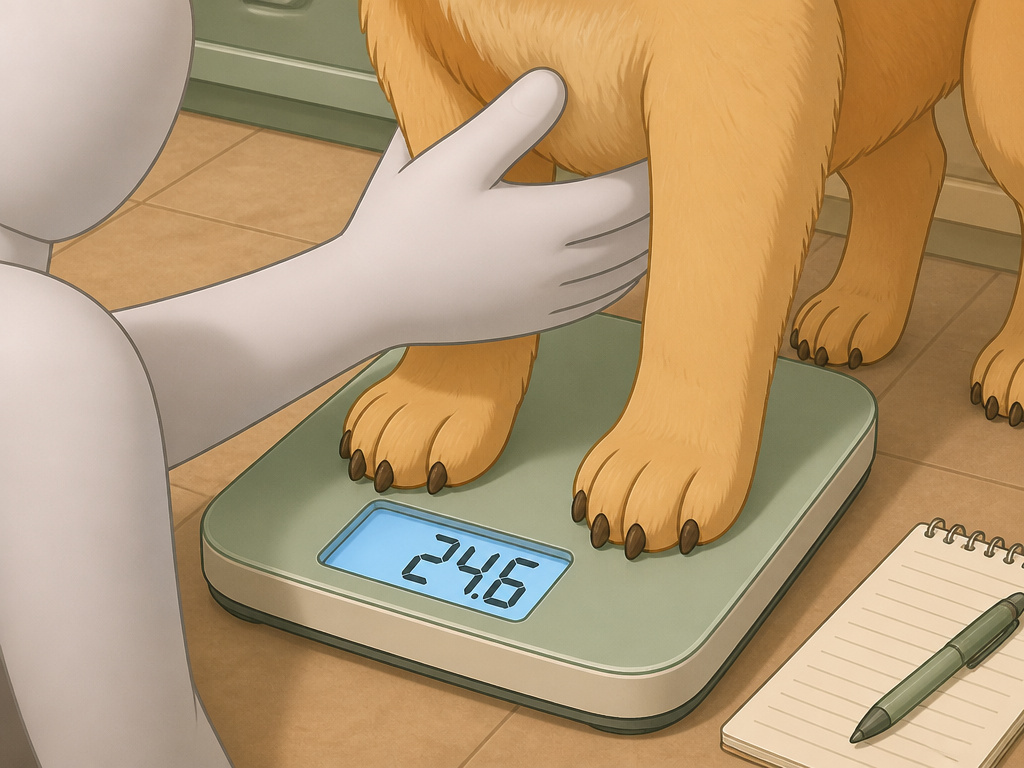
A dog can gain weight on zero treats.
WSAVA is clear that conventional treats may not be appropriate at all for a dog with a medical condition, dietary sensitivities, or a veterinary-prescribed diet. I-PETS limits its 10% guidance to healthy adult dogs and says to consult a vet first for puppies, seniors, and dogs that aren’t at ideal weight.
I learned the weighing habit on puppies. Same scale, same time every morning, before breakfast. A puppy that drops weight overnight or turns down breakfast gets a vet call that day, because small breeds can slide into hypoglycemia fast. The habit transfers straight to adult dogs.
The Weigh-In Habit
A dog that has put on weight feels different before it looks different. The ribs go from easy to find to something you have to press for.
I-PETS recommends monitoring weight regularly and adjusting the treat allowance if the dog gains. That’s the whole feedback loop in one sentence. Weigh, compare, adjust, repeat.
Call the vet rather than adjusting alone if any of these apply.
- The dog is a puppy, a senior, pregnant, or nursing.
- There’s a diagnosed condition or a prescription diet in play.
- The dog is already above ideal weight.
- Weight is climbing with no change to feeding.
If treats aren’t the driver, the why dogs gain weight question has other answers worth working through. And if the vet puts the dog on a weight-loss plan, the weight loss dog food guide covers what those diets actually do.
The part nobody mentions: A dog on a prescription diet usually can’t have ordinary treats at all. Ask the vet what’s allowed before you improvise.
Frequently Asked Questions
How many treats can I give my dog a day?
Work it out from calories rather than from a count. Take 10% of your dog’s daily calorie requirement and that’s the whole budget, chews and training rewards included. The WSAVA table gives a starting point, but ask your vet for your dog’s actual number.
Do healthy treats still cause weight gain?
Yes, if they push calories past what the dog burns. A carrot and a biscuit land in the same daily total. WSAVA’s definition of a treat covers snacks, chews, supplements, and food used to hide a pill, so “healthy” doesn’t remove anything from the tally.
Can one bully stick really be too much for a small dog?
For a 4.5 kg dog, one bully stick supplies around 30% of daily calories. That’s three times the ceiling in a single chew. Break it into pieces, or pick a lower-calorie chew and save the bully stick for a bigger dog.
Should I cut my dog’s meals to make room for treats?
The University of Cambridge weight management handbook says treats are acceptable when the main ration comes down to compensate, though other sources warn that cutting too far can leave the main diet short on nutrients. The catch is that cutting too far can leave the main diet short on nutrients. Talk to your vet before you trim.
Do dental chews count toward the 10%?
Every chew counts. A dental stick averages around 55 kcal, which can exceed a small dog’s entire daily treat budget. If the dog gets one, that’s the treat for the day.
My dog gets treats constantly and stays thin. Why?
Age, activity, and body condition all move the number. Activity and body condition all move the number. Check the ribs and the waist rather than trusting the scale alone, and recheck the treat allowance as the dog ages.
The Bottom Line
This all assumes a healthy adult dog at a reasonable weight. If your dog is a puppy, a senior, on a prescription diet, or already carrying extra weight, the 10% figure is a starting point for a conversation with your vet rather than a rule you apply alone.
The first step this week doesn’t cost anything. Put today’s treats in a bowl before the dog gets any, and count what’s in it. Most owners find two or three things in there they never thought of as treats.
I’d rather see an owner hand over half a biscuit and take the dog for a 20- to 30-minute walk than hand over a whole dental chew and call the yard exercise. One of those actually moves the needle.
Two questions before you change anything. Is the dog at a healthy weight right now, or am I guessing? And what’s actually in the bowl today, including the bits that don’t feel like they count?
