
How to Care for a Blind Dog: A Practical Home Setup
This post contains affiliate links. As an Amazon Associate, we earn from qualifying purchases.
To care for a blind dog, keep the furniture, the food bowls, and the yard layout exactly where they are, talk before you touch, and guide with sound and texture instead of sight. Learning how to care for a blind dog means keeping routines steady. The RSPCA puts adjustment at six to eight weeks once any underlying disease is managed, while Texas A&M says adapting to a new environment can take several months, and eyesight ranks third behind hearing and smell in how a dog reads a room.
That ranking explains why the how to care for a blind dog question starts with the back door, the water bowl, and you. The nose and ears were already carrying most of the navigation work, so losing sight takes away a backup channel. What changes is your role. You become the one fixed point in an environment that has to stay predictable.
What follows is the order I would do it in: the vet visit first, then the house, then the yard, then the cues. Two of those steps have genuinely split professional opinion, and you will see both sides rather than one tidied-up version.
Key Takeaways
- Freeze the layout. Moving furniture or swapping a large rug undoes a map the dog built over weeks.
- Get a vet or veterinary ophthalmologist to look first. Cataracts can be correctable and glaucoma is painful, so home adaptations come after a diagnosis.
- Six to eight weeks is the usual adjustment window, though a dog settling into a brand-new home can take several months.
- Talk before you touch. A hand that arrives without warning triggers a startle the dog cannot control.
- A bell and a scent trail do more than a night light, because eyesight sits third behind hearing and smell.
Which Senses Take Over When a Dog Loses Its Sight?
The Texas A&M vet med pet talk on blind dogs puts eyesight third among the five senses, behind hearing and smell. That ordering comes from Dr. Lucien Vallone, a clinical assistant professor there, and it reframes the entire job.
A dog’s visual system contributes less to daily navigation than the olfactory and auditory systems. Eyesight ranks third among the five senses in dogs, behind hearing and smell. A blind dog therefore loses a secondary channel, while the primary channels continue to supply spatial information from scent trails, echoes, and familiar sound cues.
A dog blind from birth never had a visual map to lose. A dog that went blind last month still reaches for one, and that gap is where the frustration lives. If you are adopting a blind dog, the adjustment starts before the dog comes through the door.
Onset matters more than most guides admit. The PDSA notes that gradual blindness is often surprisingly hard to notice, because dogs adapt as they go. Sudden blindness is obvious and many dogs struggle to adapt to it quickly.
| Onset | What You Notice | How the Dog Copes |
|---|---|---|
| Gradual, over months | Hesitates in dim light, clips the coffee table, slows on stairs | Often adapts well and the loss goes unnoticed for a while |
| Sudden, over days | Bumps things in full daylight, barks at nothing, stands still | Struggles to adapt and needs a vet urgently |
| Day-only or night-only | Navigates fine at noon, fails at dusk | Partial deficit, still worth a vet exam |
That third row is the one owners miss. Vallone notes many dogs are affected by visual deficits only in day or night light settings, which is why a dog can seem fine on a morning walk and hopeless after sunset.
The adjustment timeline is where the sources genuinely part company. The RSPCA’s chief veterinary officer, Caroline Allen, puts it at six to eight weeks once any underlying disease is managed. Texas A&M says adapting to a new environment can take several months. Both are describing real dogs. A dog going blind in the house it has lived in for six years is not doing the same job as a dog learning a strange house while also losing its sight.
What the Vet Has to Rule Out First
Book the appointment before you buy a single gate or mat. Vallone is direct on this: a recently blind dog should always be evaluated by a veterinarian or veterinary ophthalmologist.
The reason is that when you compare a how to care for a blind dog, some causes are fixable and some are painful. Cataracts can be correctable. Glaucoma causes severe discomfort and needs managing. Your vet may use an ophthalmoscope to look at the whole eye, front and back, and a tonometer to measure pressure inside the eye and check for glaucoma.
Before you start: Stairs are the first injury risk, so gate them at the top before the dog finds them at speed. Fence off steep banks and any water, because supervision fails the moment you turn your back. Tape down loose cords, since a blind dog drags its feet more and catches a cable a sighted dog steps over.
The Three Signs That Mean Today, Not Next Week
- Squinting, a change in eye colour, or discharge. Vallone lists all three as possible signs of severe eye disease needing prompt attention.
- Sudden blindness. The RSPCA advises seeing your vet urgently rather than waiting to see if it settles.
- Reluctance to move at all. Pacing aimlessly or standing in one place looking lost is a welfare signal, not stubbornness.
Discharge that keeps coming back needs more than flushing a dog’s eye at home. It needs a diagnosis.
One more thing worth saying plainly: do not write off vision loss in an old dog as just age. Allen warns that deterioration can be a sign of other problems, and early treatment reverses vision loss in some situations. That single sentence has saved more dogs’ sight than any home hack here.
Why Rearranging the Furniture Is the Fastest Way to Undo a Blind Dog
Everyone’s first instinct is to clear the floor and shift the coffee table out of the way. That instinct makes the house harder to navigate, not easier.
The AAHA blind pet care tips call consistency the single most important thing you can do, because a blind pet maps the space mentally and rearranging furniture or swapping large decor causes accidents and injury. Vallone says the same thing in stronger terms: providing consistency is the most important part of owning a blind dog.
The RSPCA’s Hannah Doyle explains the mechanism. A dog builds a mind and scent map of the house within a short time and gets around fine, right up until you change things. Move the sofa and you have handed the dog a room it has never been in.
Here is the honest version. I have walked a lot of fence lines with dogs that could not see the mesh, and the failures always cluster at the same three places: the gate gap, the dug corner, and the one spot where the ground changes underfoot. Indoors it is the same story. The dog knows the whole house and gets lost at the one seam you moved.
Common mistake: Relocating the dog’s bed to a “better” spot while you tidy. The bed is usually the first landmark a blind dog learns, and moving it can cost you a week of pacing at two in the morning.
The physical cues do the heavy lifting. Vallone suggests a foot mat below and above stairways so the dog feels the stairs coming before it reaches them. Trainers at Battersea use textured rugs to mark different rooms, and mats or carpet tiles to flag an obstacle like a step or a piece of furniture. A dog reads that change from hardwood to pile the way you read a road sign.
Then work through the boring list:
- Sharp table and hearth corners get covers, and a bumper guard keeps the dog’s face and eyes off the impact point.
- Shoes go in the closet, not on the floor, and every loose cable gets taped down or run under a rug.
- Baby gates go at the top and bottom of the stairs, and the dog does not do stairs alone.
Not glamorous, but it works. None of it costs much, and all of it beats a trip to the emergency clinic.
How Do You Set Up a Yard for a Dog That Can’t See the Fence?
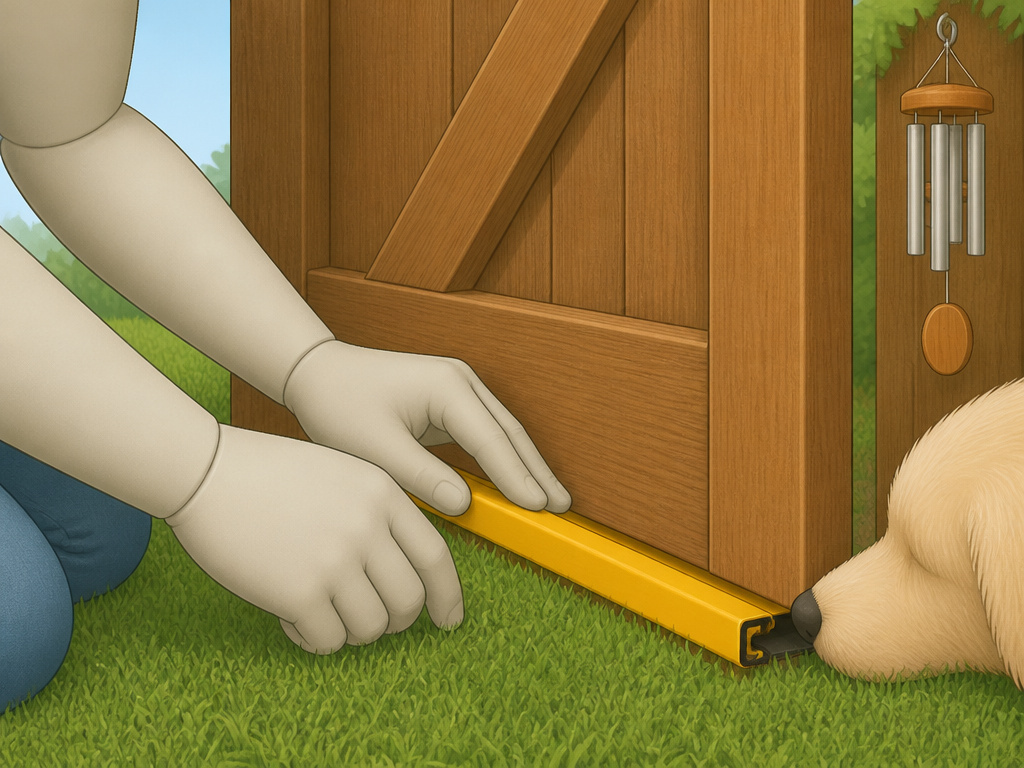
Start at the gate, not the perimeter. The gate gap is the first thing a blind dog finds by feel, and it is the first thing you should close.
Vallone’s guidance is that blind dogs should be enclosed within a fenced yard, with steep areas and bodies of water fenced off separately. The AAHA adds a small, fenced-in potty spot outdoors so the dog has one reliable place to be let out without a tour of the garden. The PDSA flags the hazards that indoor-only advice ignores: low branches, thorns, and uneven surfaces.
As your dog ages, this checklist overlaps heavily with senior dog care, because slippery decking and a single step down to the lawn become genuine hazards once the dog is guessing where the edge is.
Where this goes sideways: Trusting the fence because it is tall. A blind dog finds gaps by feel, and the gap under the gate is the one it finds first. Walk the line on your hands and knees once and you will find three you did not know about.
The Three Yard Hazards That Wreck the Setup
- The gate gap. Fill it or add a threshold bar. A dog that gets its nose under a gate will keep working at it.
- Water and level changes. Pond edges, steep banks, and the drop from a deck to grass all need a barrier, not a reminder.
- Ground that moves. Loose gravel and wet decking give no reliable feedback underfoot, so keep the dog’s route on stable surfaces.
Sound can mark the way out. A wind chime hung outside the dog flap gives the dog a target to walk toward when it needs to toilet, and it learns the association fast.
Here is where owners and professionals disagree, and it is worth knowing. One survey of 50 blind dogs found 6 of the 50 were still allowed to roam at large, and of the 32 owners who walked with their dogs, 8 said a lead was unnecessary. Every professional body cited here says the opposite. The RSPCA recommends open, flat ground and a lead. The AAHA recommends leash training for safety. The gap between the guidance and what people actually do is wide.
Sound, Scent, and Touch: Where the Advice Splits
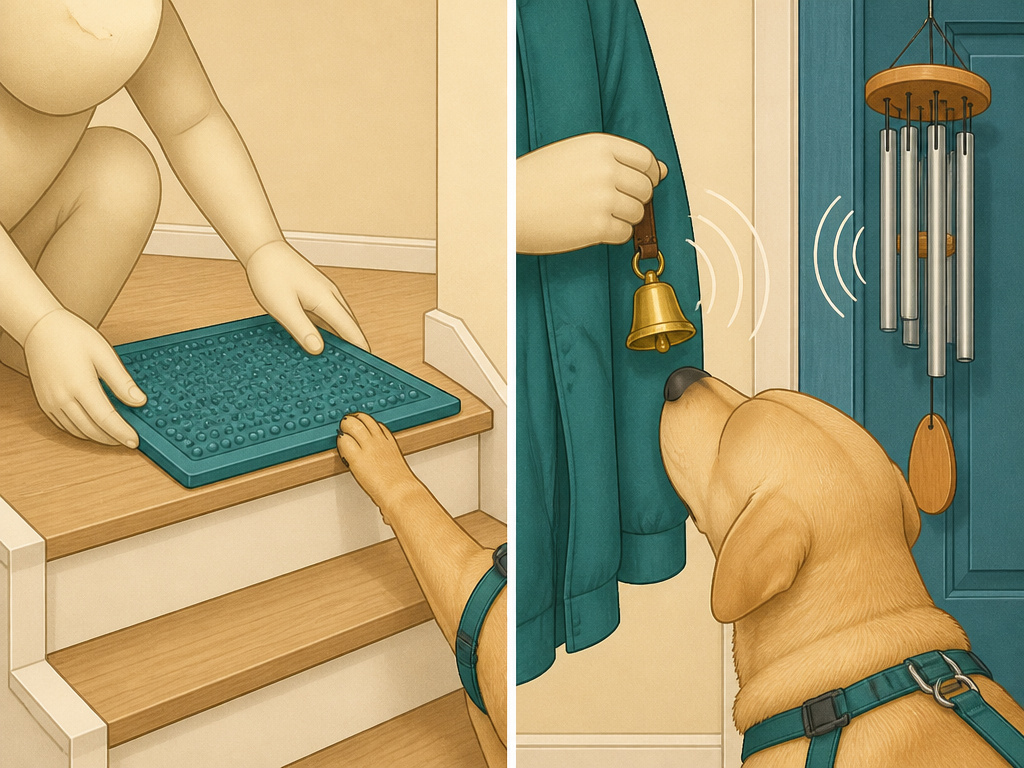
Texas A&M’s Vallone recommends tactile cues, while the PDSA recommends auditory cues, and both are worth hearing.
Vallone recommends tactile cues. A foot mat above and below the stairs warns the dog of the drop. The PDSA recommends auditory cues instead, a bell on your coat on walks, a bell on a companion dog’s collar, a wind chime at the door, a radio left playing, while Texas A&M’s Vallone favors tactile cues such as foot mats above and below stairs. Different primary sense, same problem.
My read is that this is not a contradiction so much as two people solving different halves of it. Tactile cues tell the dog where a fixed hazard is. Auditory cues tell the dog where a moving person is. Most blind dogs end up using both, and neither source would object to that.
Scent Markers or a Scent-Free House?
This one is a genuine conflict and you should not let anyone merge it for you.
The AAHA suggests marking certain spaces in the home with different scents to lead the pet from place to place, while the PDSA advises avoiding scented products and air fresheners because they mask the familiar smells a blind dog relies on. The PDSA position runs the other way: scented products and air fresheners mask the familiar smells a blind dog relies on. One body says add scent. The other says clear the competing scent out.
The practical version I would give a neighbour: keep your own household smells stable, and be careful with anything that fills a room. A plug-in air freshener in the hallway is the equivalent of repainting the road markings every night.
Rule of thumb: A blind dog navigates on a map that only two things can erase, and both are things you control. You can move the furniture, or you can cover the smell of it. Do neither and the dog is fine.
The Commands That Replace Eye Contact
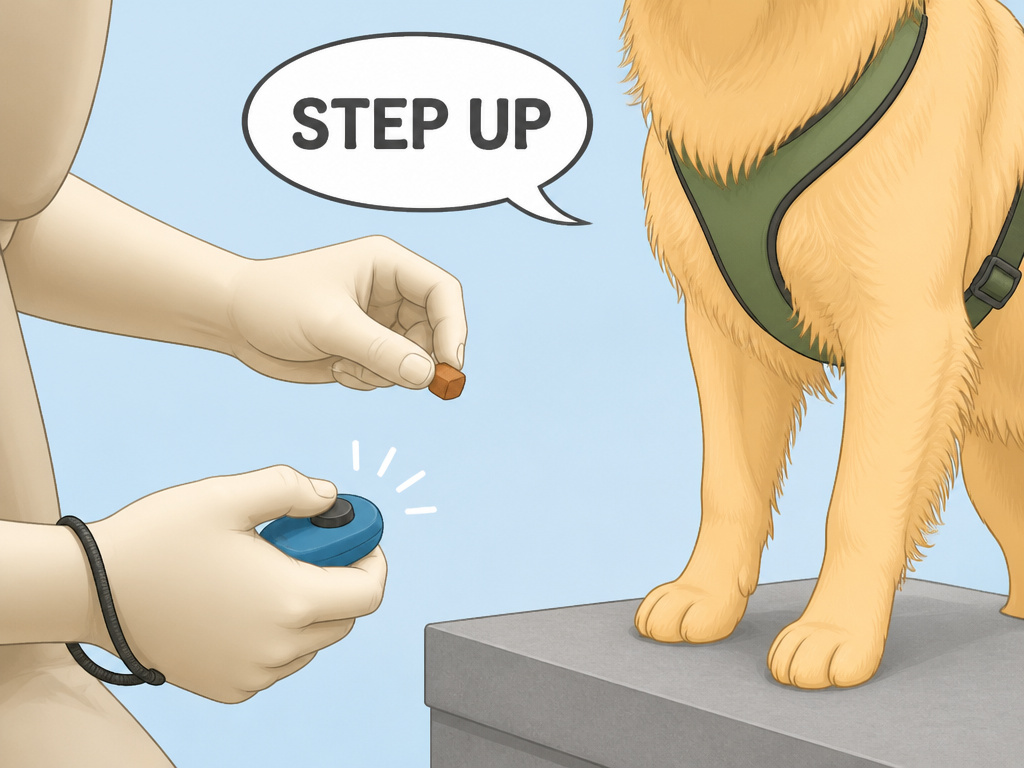
A blind dog navigates on words, and the vocabulary is short.
The RSPCA teaches “careful”, “step up”, and “step down” for kerbs. Battersea’s training team uses a wider set: “wait” or “stop” before you stop walking, “walk on” to resume, “hup” or “step up” at a step up, “step down” at a step down, “right” and “left” for turns, and “who’s this” to announce a new person or dog before it arrives.
Training a blind dog works the same way any other training does, with one adjustment: the marker has to be audible. The AAHA notes a traditional clicker works great for a blind dog, because the click is quick, distinct and consistent.
The Order I Would Teach Them In
- “Wait” first. It is the command that stops the dog before a kerb, a car, or an open gate, and everything else is easier once it lands.
- “Step up” and “step down” second. Pair each one with the actual step so the word and the sensation arrive together.
- “Left” and “right” last. These take the longest and matter least in the first month, because you can steer with a lead until they stick.
Sessions stay short and in a familiar room with no distractions, and you adjust the dog’s food intake to account for training treats. Talk before you touch, every time. Battersea’s trainers are blunt about why: a hand that arrives silently startles a dog that cannot see it coming, and a startled dog snaps before it thinks.
Walks, Toys, and the Play That Still Works
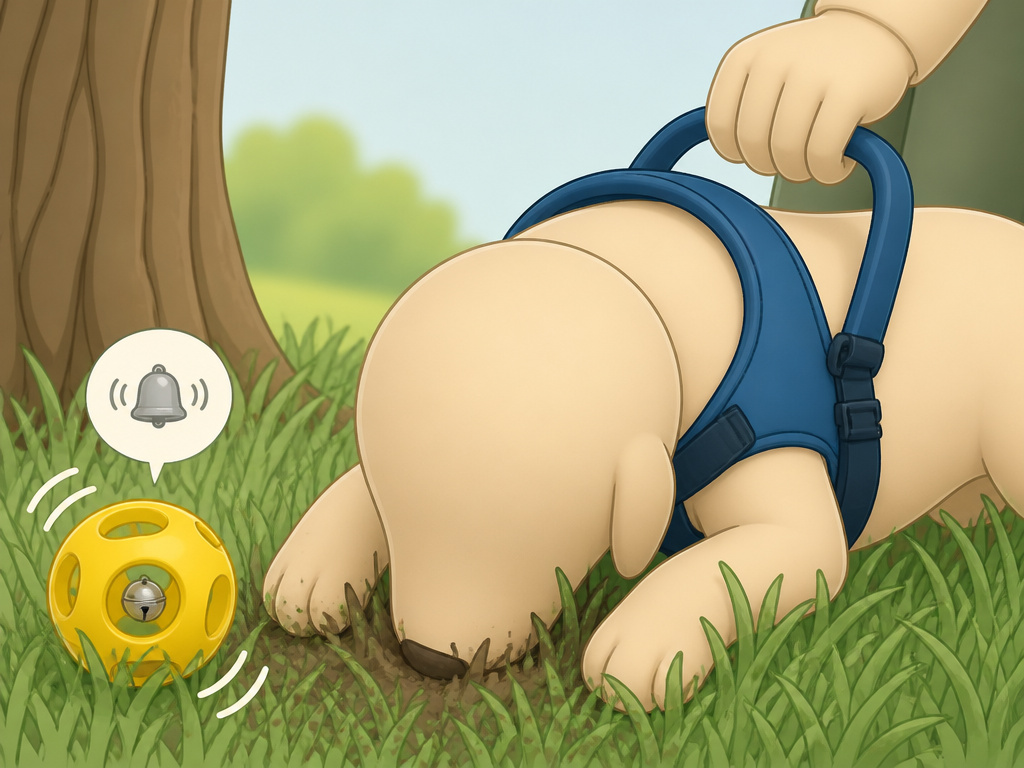
The ball lands off to the left and the dog walks straight past it, nose down, working the grass. Then the bell inside the ball rolls and the head comes up. That is the whole trick.
The PDSA recommends rubber balls with a bell inside for ball-obsessed dogs, because the sound lets them track the toy. The RSPCA suggests noisy toys and scent work to keep a blind dog playing. Battersea’s team lets the dog sniff the toy before the throw so it knows what it is hunting for.
The best toys for blind dogs all share one feature: they announce themselves. A silent plush toy is a decoration. A ball with a bell, a squeaky rope, or a stuffed toy frozen with wet food is a job.
- A bell ball for the dog that still wants to chase.
- A frozen stuffed toy for the dog that needs a stretch of quiet work.
- A snuffle mat or scatter feed for the dog that has stopped bothering with toys entirely.
Walks stay on a lead, on open flat ground, per the RSPCA. For handling, a harness beats a collar because you can steer from the trunk instead of the neck. A harness with a handle over the shoulders lets you lift the front end over a kerb rather than hauling on the throat.
I would skip the halo collar for a dog that already knows its own hallway. The bumper catches on doorframes and stair rails, and a dog with a working map does not need it. Save it for the newly blind dog that is still walking into things, which is exactly the case Dr. Margot Vahrenwald at the AAHA describes.
Is It Unkind to Keep a Blind Dog?
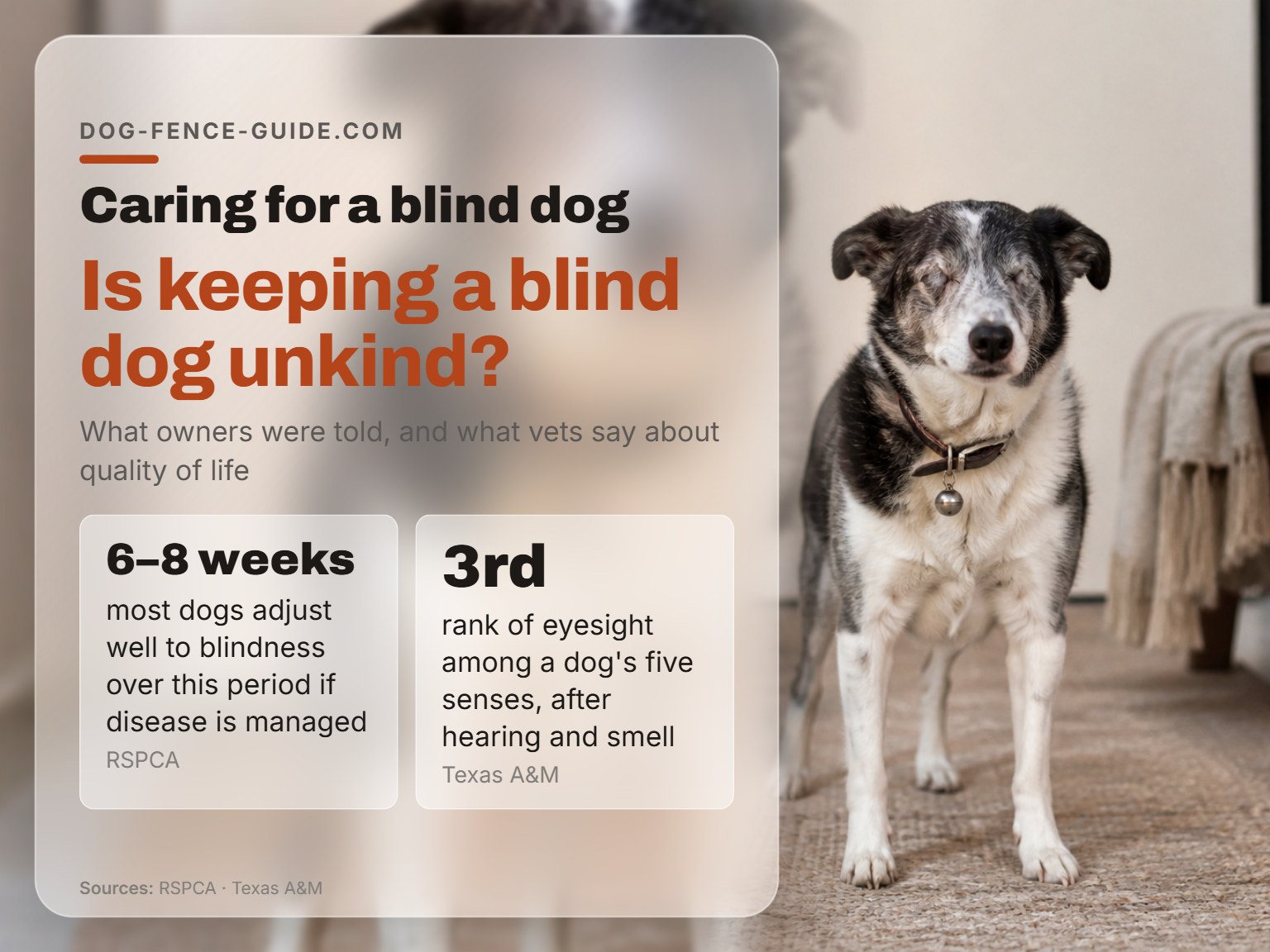
Twenty-eight of the fifty owners in a published survey had been told, by someone, that keeping a blind dog was unkind. That number is the most useful thing in this whole article, because it tells you what you will hear from neighbours.
The clinical position is not ambiguous. Vallone says blind dogs are certainly adoptable and that most owners report their dog’s quality of life is excellent. The PDSA says most dogs adapt really well and continue to live happy lives. A survey of 50 blind dogs is old and small, but it is the only owner-reported data of its kind, and it is the reason that “unkind” claim keeps circulating.
There is one honest caveat. The PDSA does say that if you or your dog are genuinely struggling to cope, there may be instances where it is kindest to consider putting the dog to sleep. That is a conversation for you and your vet, not a verdict from a neighbour, and it sits at the far end of the road from the day your dog first bumps a doorframe.
When the Dog Is Also Old, Deaf, or Confused
A dog that loses both hearing and sight needs deaf dog training folded into the plan, and the cues switch to touch and vibration. The AAHA’s advice for pets that are both blind and deaf is to combine both sets of strategies and adjust with care and patience.
Watch for the dog that seems to forget the layout it already knew. Pacing, standing in corners, and getting stuck behind doors can be cognitive dysfunction rather than a vision problem, and that changes what you do about it.
Breed background is worth knowing too. The AAHA notes that breeding two merle-gene dogs together produces double merle puppies that are usually white with hearing and vision impairments. The PDSA flags Collie eye anomaly in Collie breeds, and the RSPCA notes SARDS, a rare and incurable condition seen more often in dachshunds.
Frequently Asked Questions
How long does it take a dog to adjust to blindness?
The RSPCA puts it at six to eight weeks once any underlying disease is managed. Texas A&M says adapting to a new environment can take several months. A dog losing sight in a familiar home usually lands nearer the shorter end.
Should I move furniture out of the way for a blind dog?
No. Keep the layout exactly as it was. A blind dog builds a mental and scent map of the room, and moving furniture or swapping large decor causes accidents and injury. Clear the floor of loose objects instead.
Do blind dogs need a companion dog?
Not necessarily, but a companion helps. The PDSA suggests attaching a small bell to a companion dog’s collar so the blind dog can use it as a guide. Cat collar bells work well for this.
Can a blind dog still go for walks?
Yes, on a lead and on open, flat ground. The RSPCA recommends keeping walks on even surfaces with the dog on-lead. Let the dog set the pace and talk to it constantly so it knows where you are.
Will my blind dog be depressed?
Most are not. Vallone reports that most owners describe their blind dog’s quality of life as excellent, and many find the dog becomes more attached to the owner or other pets. Dogs pick up on your mood, so a cheery voice and normal routines do more than sympathy.
Before You Go
The thing that decides how this goes is whether the map stays still.
If your dog has lost sight suddenly rather than gradually, stop reading and call the vet today. Sudden blindness is the one case where hours matter, and it is the one case where a correctable or painful cause is most likely to be sitting behind the symptom. Gradual loss can wait for a scheduled appointment. Sudden loss cannot.
Everything else here is a slow build. Gate the stairs, tape the cords, put a bell on your boot, and leave the sofa exactly where it is.
Walk the fence line this weekend with a torch and a pair of gloves, and fill the gap under the gate before Monday.
