
How to Train a Deaf Dog: Hand Signals That Stick
This post contains affiliate links. As an Amazon Associate, we earn from qualifying purchases.
To train a deaf dog, replace your voice with a visual marker, usually a thumbs up, and reward within three seconds of the mark. Cues come from three channels: hand signals, touch, and scent. Start with eye contact in a quiet room, then add distance and distraction.
The three-second window is where training quietly falls apart. A marker only works if the dog can tie it to the exact behavior, and a deaf dog gets no filler praise while you dig a treat out of the pouch. This is why how to train a deaf dog comes down to timing. Miss the window and you’ve marked the digging.
What follows is the order I’d teach it in: attention, then the marker, then the three cue channels, then the safety rules. The major organizations don’t agree on all of it, and I’ll show you exactly where they split.
Key Takeaways
- Reward within three seconds of the visual marker, or the dog links the treat to whatever happened last.
- One cue, one behavior, delivered the same way by every person in the house.
- Sessions run 5 to 15 minutes, several times a day, or as long as the dog remains interested.
- Off-leash rules vary by source. VCA is absolute that a deaf dog should never be off-leash in an open, unfenced area; SPCA New Zealand and Toronto Humane allow off-lead only inside secure fencing; Dr. Nelson hikes with his deaf dog off leash using the vibrating collar as a safety net.
- Skip shock entirely. Vibration-only collars exist, but even those don’t work for every deaf dog.
Why Eye Contact Comes Before Any Other Cue
Three seconds is the tolerance VCA Animal Hospitals gives for delivering a reward after the marker. That number only means something when you compare a how to train a deaf dog approach that depends on the dog watching when the marker happens.
A cue only lands if the dog is looking at you.
Attention functions as the delivery channel for every other signal. A deaf dog facing away receives no marker, no treat, and no information about which behavior earned the reward. Training starts by rewarding voluntary check-ins, then attaching a name to the moment the dog turns and makes eye contact.
Dr. David Nelson at the Texas A&M College of Veterinary Medicine puts the same idea in plain terms: if the dog isn’t looking, they can’t receive feedback, and they don’t know you have information to provide. SPCA New Zealand builds on that by rewarding the dog every single time they look at you on their own. No cue given, no prompt, just pay the check-in.
The Toronto Humane Society teaches “watch me” as the first formal cue. Here’s their progression, with the failure mode attached to each step:
- Hold a treat under the dog’s nose. Skip this and you’re asking for eye contact from a dog whose head is already scanning the room.
- Raise your hand to your face and point your index finger at your eyes. Move too fast and the dog tracks the hand, not the eyes.
- Mark the instant the gaze follows with a thumbs up. Late marks teach the dog that looking away gets paid.
- Deliver the treat from the other hand. Same hand as the marker and the dog starts watching your pocket instead of your face.
- Stop while the dog is still interested and take a break. Pushing too long in the first session is how you get a dog that walks off at the sight of the treat pouch.
One thing worth doing early, even if your dog is already deaf: teach visual and verbal cues together. VCA points out that many dogs lose hearing in old age, so a dog who already understands both keeps working when one channel fails. If you’re starting with a dog who’s losing hearing rather than born without it, the senior dog training sequence is the same one you’d use here, just slower.
How Do You Mark a Correct Behavior Without a Clicker?
Three visual markers show up across the major guides: a thumbs up, a hand flash, and a penlight flick. The clicker isn’t on the list, because the dog can’t hear it.
| Marker | Best For | Limitation |
|---|---|---|
| Thumbs up | Indoor sessions, close range | Needs a clear line of sight |
| Hand flash (fist opening) | Daylight, medium distance | Needs a clear line of sight |
| Penlight or keychain light flick | Dim rooms, dusk, night | Never shine it toward the eyes |
| Shoulder tap | Deaf-blind dogs, physical contact | Requires you to be within reach |
VCA recommends the thumbs up as the default. SPCA New Zealand offers a thumbs up or a brief torch flash. Toronto Humane describes the hand flash in more detail: your hand starts in a fist, then opens with the fingers spreading out. In dark or dim conditions, they suggest the flick of a penlight or keychain light, with a clear warning not to shine it in the dog’s eyes, and any how to train a deaf dog guide should repeat that warning.
If you’ve used clicker training with a hearing dog, the mechanic is identical. The marker predicts the treat. Only the delivery channel changes.
I’d skip the penlight for a first-time deaf dog. It’s the hardest marker to deliver consistently, and the failure mode is genuinely bad: a light in the eyes creates a flinch, and a flinch at the marker poisons the marker. Get the thumbs up boring and reliable first.
Treat size matters more than most people expect. VCA specifies pea-sized or pencil-eraser-sized treats, smaller for tiny dogs, and says to deduct those calories from the daily ration. A soft, smelly treat the dog can swallow fast keeps the session moving; a hard biscuit adds chewing time to every rep and drags the marker-to-reward gap past the window.
The Three Cue Channels: Visual, Tactile, and Scent
VCA sorts deaf-dog cues into three channels: visual, tactile, and olfactory. Most owners only ever use the first one, which is why their dog stalls out at distance.
Hand signals, including the one-handed version
Standard obedience hand signals work fine, and so do signs you invent yourself. VCA’s guidance is blunt about this: cues should be distinct, each signaling a single behavior, and used consistently by every caregiver.
VCA flags a practical variant that most guides skip. Some owners modify American Sign Language signs for one-handed use so the other hand stays free to hold the leash. If you’re walking a dog on a lead, that adaptation isn’t optional. A two-handed sign you can’t perform while holding the leash is a sign you’ll never use.
Be deliberate with your body, too. Toronto Humane notes that hand movements, posture, and facial expressions all carry information for a deaf dog, so a casual wave and a deliberate cue can read as the same thing.
The shoulder tap, built in increments
Toronto Humane teaches a shoulder tap meaning “look at me,” and the progression matters more than the tap itself. Start by tapping when the dog is already looking at you, then treat. Then tap from your side. Then work in increments until you can tap from behind without startling them.
Rush that ladder and you get a dog who flinches at the first tap from an unexpected angle. That flinch is hard to undo.
Scent cues
VCA lists olfactory cues as a legitimate channel, and that’s about as far as the sources go. Nobody in my research gives a step-by-step protocol for scent-based cues with deaf dogs. I’m not going to invent one. If you want to experiment, pair a specific smell with a specific routine and keep it consistent, but treat this as the least-documented of the three channels.
How Long Should a Training Session Actually Run?
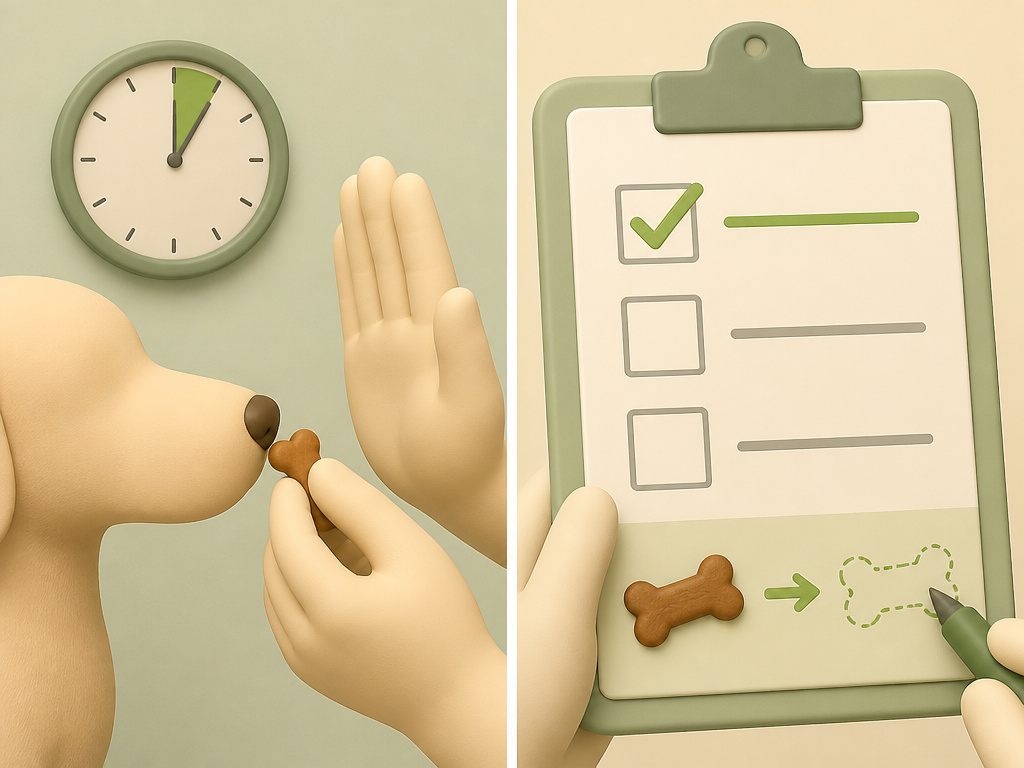
Five to fifteen minutes, several times a day, is the working range The Acorn Project recommends, with one condition attached: keep going only as long as the dog remains interested.
The Acorn Project adds two rules that are easy to skip and expensive to skip. Always finish on a positive note, and never let the dog feel you’re disappointed in her.
Common mistake: Running one long session instead of several short ones. A long block feels productive to the human and produces a dog who checks out partway through, then rehearses the checking-out for the rest of the block.
Fading food lures has a number attached to it. The Acorn Project’s sequence: lure the behavior, mark it, reward from the other hand. After several reps, lure with an empty hand and keep rewarding from the other hand. Do that until the dog hits an 80% success rate without the lure, then move food rewards to intermittent.
That 80% figure is the part people skip. Fade too early and the behavior collapses the first time you’re out of treats. Fade too late and you’ve trained a dog who only performs for food.
Adding Distraction Without Losing the Cue
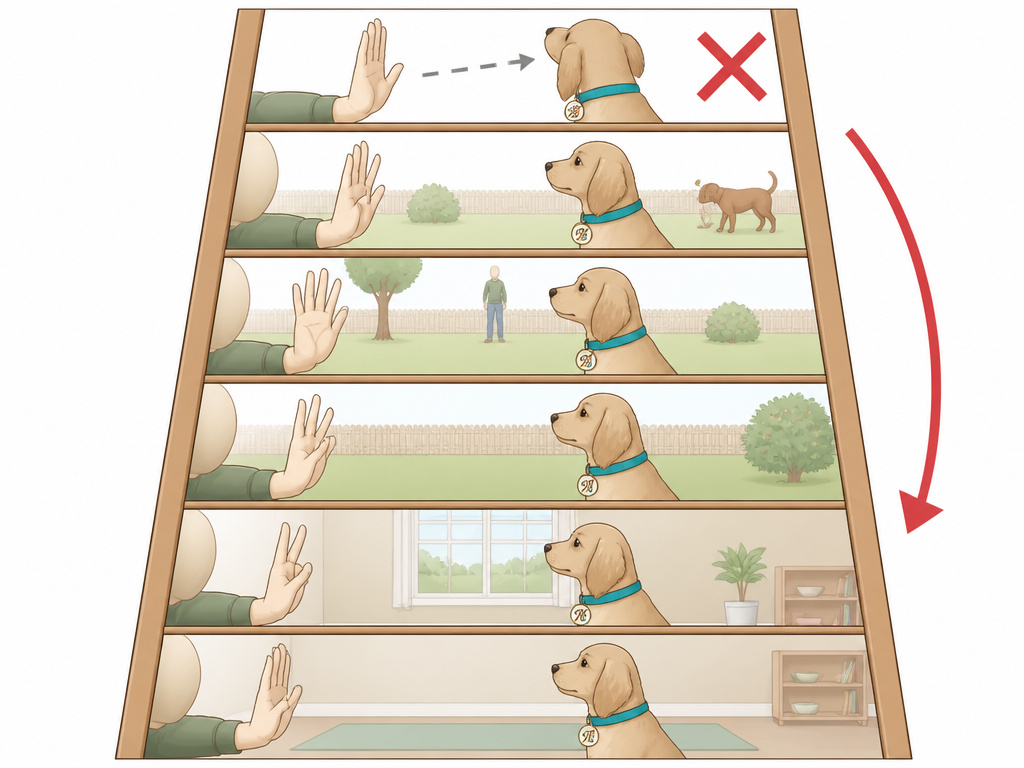
I once built a training plan around an owner’s deadline instead of the dog’s readiness. We skipped the gradual distraction phase because she wanted it finished by the weekend. The dog was flawless in an empty yard and came apart the first time a neighbor’s dog walked the fence line. That was my error, not the dog’s, and I’ve set the pace by the dog ever since.
A deaf dog in a quiet yard has almost nothing competing for attention. That’s the problem. The cue looks solid because the environment is doing half the work.
SPCA New Zealand’s order is start in a calm, distraction-free space and add challenges gradually. VCA says the same thing more briefly: minimize distractions, especially early. Neither source gives you a shortcut, because there isn’t one.
The practical version is a ladder. Same cue, quiet room. Then same cue, room with a window. Then yard with nobody around. Then yard with a person visible at the far end. Then yard with another dog. If the cue breaks at any rung, you climbed too fast.
Getting Attention Without Startling Your Dog
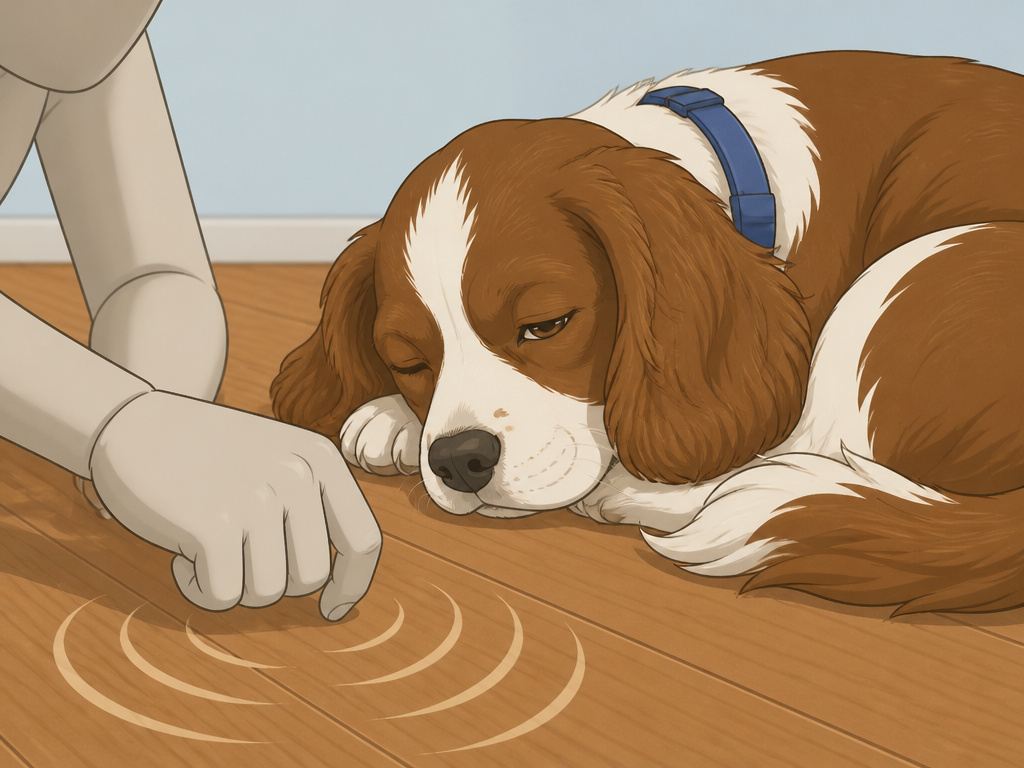
Sources differ on where to touch: SPCA New Zealand suggests lightly touching the shoulder, while Dr. Nelson uses a communication spot on the top back of the head. Both beat reaching for the collar.
A deaf dog asleep on a hardwood floor doesn’t flick an ear at the fridge door. The whole ribcage goes still, and then nothing. That stillness is why an unexpected hand on the collar produces a startle so violent it looks like aggression.
SPCA New Zealand’s approach: gently tap the floor near the dog, wave a hand in their line of sight, or lightly touch the shoulder, especially if the dog is asleep. Toronto Humane adds the floor stomp, a harder vibration that carries through the floor and wakes a sleeping dog without contact. You feel the thump through your boots before the head lifts.
Dr. Nelson uses what he calls a communication spot, and his is the top back of the head. His dog is trained that a touch there means a person he knows. Pick one spot, use it every time, and never use it for anything unpleasant.
Where this goes sideways: Reaching for the collar before the dog sees your hand. VCA warns that even an unexpected pat can startle a dog and make them afraid of being trained. The fear generalizes to the training session itself, and you’ll see the avoidance within a week.
Off-Leash, Long Lines, and Where the Experts Split
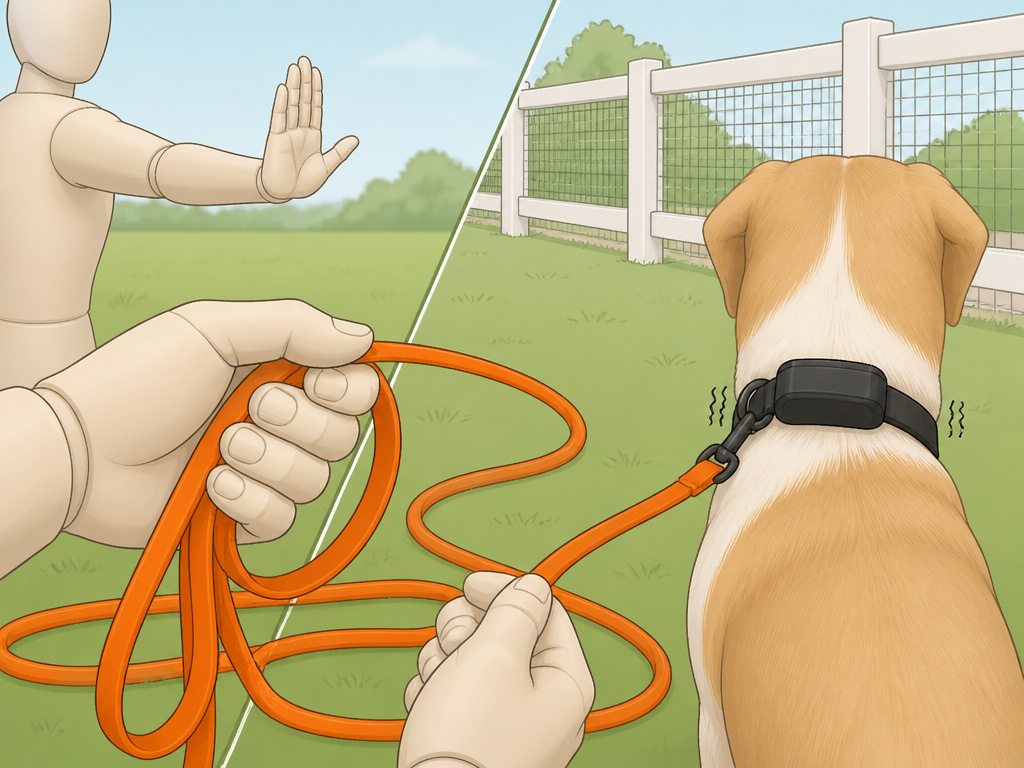
VCA says never off-leash in an unfenced, open area. SPCA New Zealand and Toronto Humane say off-lead only inside secure fencing. Dr. David Nelson hikes national forests with his deaf dog off leash and describes the dog as easier to manage than his hearing dog.
That’s a real disagreement, and it’s worth showing rather than smoothing over.
VCA’s position is absolute: never allow a deaf dog off-leash in an unfenced, open area, because it’s too easy for a deaf dog to get spooked or distracted and run into harm’s way. Their alternative is a long line or drag line, which gives the dog room to explore while staying within your view.
SPCA New Zealand and Toronto Humane land in a similar place with softer wording. Deaf dogs should only be off-lead in safely enclosed areas, which permits off-lead work inside secure fencing but not in open ground.
Dr. Nelson’s position is the outlier, and he’s specific about how it works. His dog checks back visually, comes to a hand sign without delay, and the vibrating collar sits there as a safety net that rarely gets used. That’s a trained dog with a trained handler in an environment he knows.
My own read, after years of testing containment systems: the difference between those positions is mostly about what’s holding the dog when the training fails. A fence holds. A long line holds. A collar and a recall hold only as well as the last hundred reps. For the long line itself, a long line that stays limp in cold weather matters if you’re training in a northern winter.
If you want the recall work that makes any off-leash discussion possible, distance training covers the mechanics of sending cues across a yard.
Vibration Collars: Where the Advice Gets Complicated
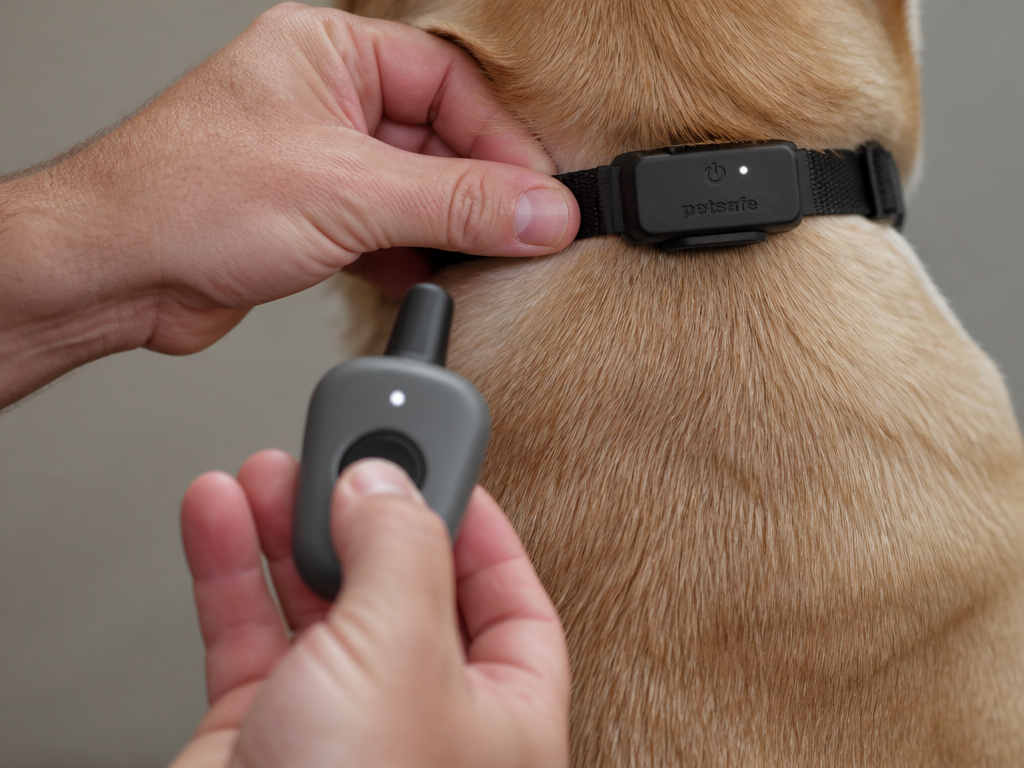
The Texas A&M guidance treats a vibration collar as a reward cue. VCA warns that many dogs find the same vibration aversive and can become frightened. Both of those are true at once.
Here’s the tension in full. VCA acknowledges that vibration collars are sold for dogs that can’t hear and can be trained as a recall cue, then concludes it’s almost always safer and more humane to keep deaf dogs fenced or on a long line. SPCA New Zealand separately says not to rely on shock collars at all, because they can be distressing and damage your relationship.
Toronto Humane draws the line clearly: a vibrating collar is not a shock collar, and they don’t advocate shock collars. They also note that some, but not all, deaf dogs respond successfully to vibration collars.
The Acorn Project adds a product detail worth knowing. Vibration is taught as a technique for getting the dog’s attention at a distance, and vibration-only collars are available from Wolfwill and PetSafe. Shock should never be used. Vibration-only units are available from Wolfwill and PetSafe, and if you go this route, buying a vibration-only model removes the possibility of a setting mistake entirely.
Dr. Nelson’s conditioning method is the most detailed version I found. A push of the radio transmitter causes a vibration, and you condition the dog that the vibration predicts a reward. The critical rule: the vibration should never carry a negative connotation, or the dog will be afraid to respond in the future.
If a vibration collar is doing the work your recall should be doing, you’ve bought a remote control, not a trained dog. Condition it as a cue, keep it positive, and keep the long line on until the dog is coming reliably without it.
I test physical containment, not app interfaces or subscription plans, so I stay out of that argument entirely. If you want the hardware comparison, vibration collars for deaf dogs covers the models.
When the Dog Is Deaf and Blind
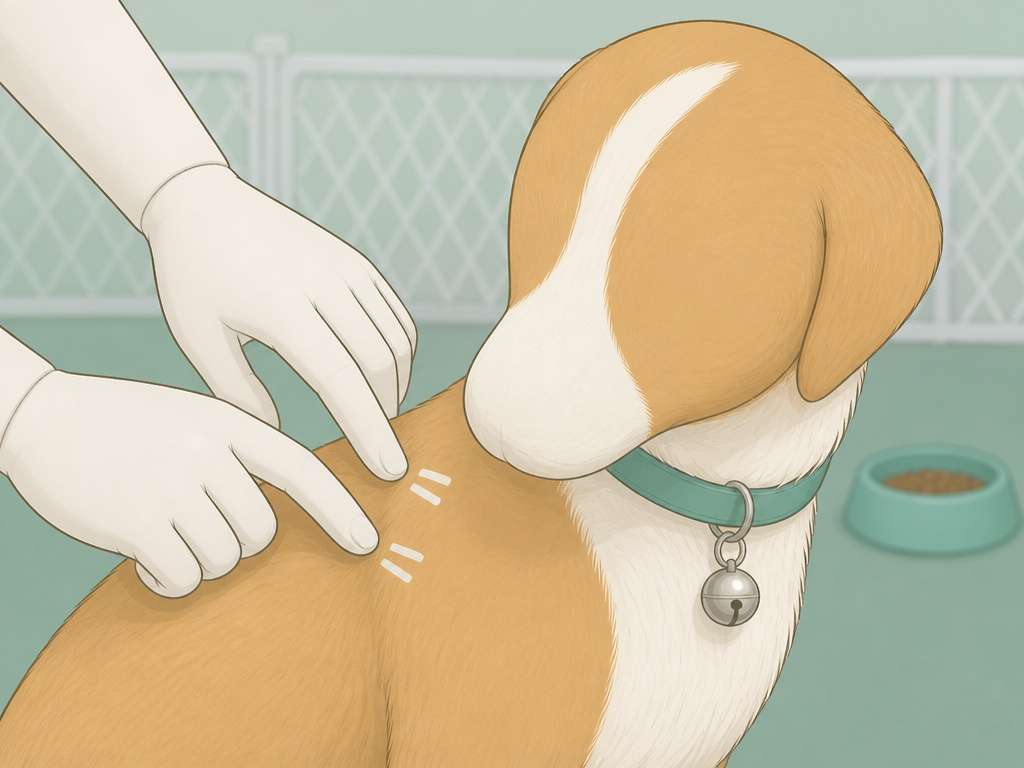
Visual markers fail when the dog can’t see them, which is why the Humane Society Silicon Valley guide switches to tactile markers for deaf-blind dogs. The thumbs up is useless here. Touch is the channel.
HSSV makes a distinction that changes your timeline. Dogs born deaf and blind adjust from day one, because they don’t know anything different. Dogs who lose both senses later in life take longer to adjust, and the training plan needs to account for that.
Their environmental setup is worth copying even for a deaf-only dog. Keep feeding and potty times very routine. Keep food and water bowls in the same spot. Start the dog in the same patch of yard for potty breaks. At first, keep a blind dog in a limited space like an x-pen or a small room when nobody’s home, so they aren’t navigating a large house alone.
If there’s another dog in the house, put a bell or jingly tags on the companion dog so the deaf-blind dog gets a heads-up when someone approaches. HSSV also recommends leashed first meetings between dogs, with the blind dog free to move away if they show discomfort.
Easy to miss: A deaf-blind dog can’t read the body language other dogs use to signal intent. HSSV notes they miss those visual cues entirely, which is why every dog-to-dog introduction needs supervision rather than a hopeful assumption.
The tactile work overlaps heavily with blind dog training, and if you’re bringing home a dog with combined sensory loss, special needs dogs covers what to sort out before the dog arrives.
Frequently Asked Questions
Can a deaf dog learn the same commands as a hearing dog?
Yes. VCA states that deaf dogs can learn the same skills as dogs with normal hearing, and that deafness doesn’t change the dog’s ability to learn, only how they receive information. SPCA New Zealand agrees on capability but adds a caveat: deaf dogs may need more repetition and consistency to get there.
How do I wake a sleeping deaf dog without scaring them?
Stomp on the floor to send a vibration through it, or gently tap the floor near the dog. SPCA New Zealand also suggests waving a hand in their line of sight or lightly touching the shoulder. Dr. Nelson’s approach is a trained communication spot, and his is the top back of the head.
Is a deaf dog safe around children?
Dr. Nelson is direct on this: it’s not deafness that determines a dog’s suitability to be with children, but the personality of the dog, the child, and the home environment.
How do I find out whether my dog is actually deaf?
SPCA New Zealand says to start with your vet, who can rule out other medical issues and confirm the diagnosis. At-home tests include clapping your hands or clanging pots and pans behind the dog. When those are inconclusive, Texas A&M Vet Med says BAER testing is the most reliable option, though it’s costly, and Humane Society Silicon Valley notes it’s especially useful for detecting deafness in one ear.
Do I need a professional trainer for this?
Not for the basics. For sit, down, come, and a settled check-in, the protocols from the humane organizations are detailed enough to run yourself.
The Bottom Line
This week, teach one thing: your dog’s name in sign, delivered at close range, marked with a thumbs up and rewarded inside three seconds. A few short reps a day, in a quiet room, over several days. That’s the whole starting sequence, and everything else below sits on top of it.
One concession worth stating plainly. Everything above assumes a dog who can still see. If your dog is losing sight along with hearing, the visual marker stops working and the entire sequence shifts to touch, which is a slower and more patient kind of training.
And if you take nothing else from the disagreement between VCA, SPCA New Zealand, and Dr. Nelson, take this: the leash, the fence, or the long line is what keeps your dog alive while the training catches up. Peace of mind is the whole point, and it comes from the equipment and the reps together, never from one alone.
