
Can Dogs See Color: What Two Cones Really Mean
This post contains affiliate links. As an Amazon Associate, we earn from qualifying purchases.
Dogs can see color, just not the range you see. They have two cone types instead of three, so blue and yellow read clearly while red and green blur into brownish gray. Sharpness sits near 20/75, and the nose picks up most of what the eyes miss.
Two cone channels instead of three is the whole mechanism. Each cone responds to a narrow band of wavelengths, and the brain builds a color by comparing the signals from those channels. With only two channels, the wavelengths that separate red from green for you land in nearly the same place, so both arrive as the same muddy brown.
What follows is the cone evidence, the one number two credible sources still argue about, what a 2013 experiment changed, and how all of it should shape the next toy you buy.
Key Takeaways
- Two cones, not three. Dogs are dichromatic, so blue and yellow separate cleanly while red and green collapse toward brown and gray.
- The short-wave cone number is contested. Neitz, Geist and Jacobs computed 429 nm; dvm360 publishes about 440 nm. Both agree on 555 nm and on dichromacy.
- Color matters more than the old textbooks claimed. Kasparson et al. (2013) found color more informative than brightness for eight untrained dogs under natural daylight, though only half the dogs chose exclusively by color.
- Blue wins for fetch, red wins for scent games. The most popular toy colors are the two dogs see worst.
- Acuity is about 20/75. Color is one small part of a dog’s visual world; motion and dim light matter more.
What Does Dichromatic Actually Mean for a Dog?
Dichromatic means two cone types, and that single fact explains most of the gap between your sight and your dog’s when you ask can dogs see color.
Dogs carry two cone photopigment populations with absorbance peaks near 429 nm and 555 nm, per Neitz, Geist and Jacobs (1989). Humans carry three. The missing third channel sits in the red region of the spectrum, so wavelengths that read as red or green to a human land in the same response zone for a dog.
The 1989 study is the one most of this literature stands on. You can pull the original color vision in the dog record if you want to read the methods yourself.
Here’s the comparison side by side.
| Measure | Dogs | Humans |
|---|---|---|
| Cone types | Two | Three |
| Colors that separate cleanly | Blue and yellow | Red, blue, green |
| Visual acuity | About 20/75 | About 20/20 |
| Low-light advantage | Tapetum lucidum, six times less light needed | None |
| Rod-to-cone balance | More rods than cones | More cones than rods |
Acuity is the part owners underestimate. A dog standing 20 feet from an object sees it about as well as you would at 75 feet. Motion helps. Shape helps. Color is one of several cues and not the loudest one.
Can Dogs See Color, and Which Ones?
A ball lands in the grass a few feet from the fence. Your dog runs the arc, slows down, and starts hunting with its nose.
That’s the sequence the vision researchers describe. Blue, blue-green and violet come through as shades of blue. Red and green slide toward brown and gray, according to PetMD’s summary of the studies.
| What you see | What the dog likely sees |
|---|---|
| Red | Dark brown or gray |
| Orange | Brownish yellow |
| Yellow | Yellow |
| Green | Yellowish gray |
| Blue | Blue |
| Violet | Blue |
The AKC frames it a little differently. Dogs can pick out yellow and blue, plus combinations of those two, and they can tell both from green. The club suggests that’s why some dogs go straight for a yellow tennis ball and ignore the same ball in pink.
429 nm or 440 nm: Why Two Good Sources Disagree
429 and 440 are both published figures for the same short-wave cone, and neither source is sloppy.
Neitz, Geist and Jacobs computed peaks of roughly 429 nm and 555 nm. The veterinary trade publication dvm360 lists absorbance peaks of about 440 and 555 nm for cats, dogs, cattle and horses. The long-wave number matches. The short-wave number doesn’t.
Eleven nanometers is a small gap, and it’s still a real one in the record. I’d rather show you both than quietly pick the tidier figure.
When two credible sources publish different numbers for the same structure, name both and say who reported what. Averaging them is how a small error becomes the default answer everywhere.
For the retinal anatomy underneath all this, a vision in dogs scientific review goes deeper than any consumer article will.
The argument is about one number. The finding holds either way. Both sources put dogs at two cone populations, both put the long-wave peak at 555 nm, and both describe the same red-green confusion.
Do Dogs Use Color at All, or Just Brightness?
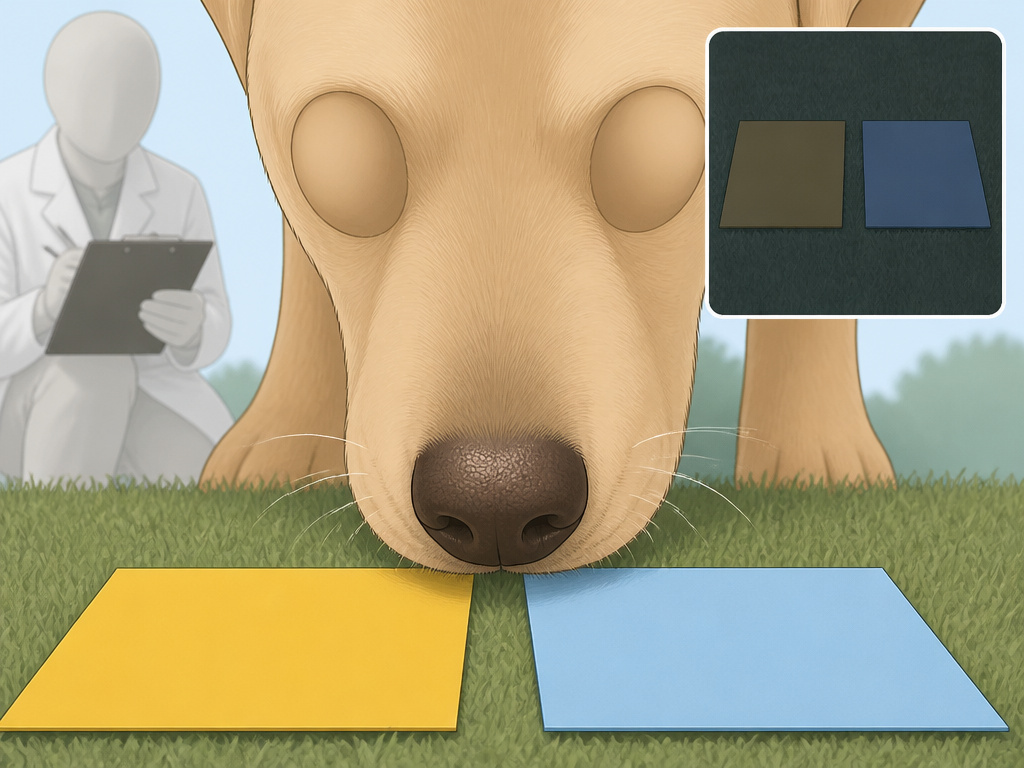
For decades the working answer was that color barely mattered to a dog going about its day. A 2013 experiment made that answer hard to defend.
Kasparson, Badridze and Maximov worked with eight untrained dogs, split them into three groups, and tested each group with different combinations of color and brightness. Every session used a fresh set of paper stimuli. The codes were dark yellow, light blue, light yellow and dark blue.
Color turned out to be more informative than brightness even when brightness was available. Three of the four tabulated dogs scored 10:0 on test trials (p=0.001). The fourth, Ji, scored 16:4 (p=0.006) after needing 10 extra training sessions to get there. The full write-up is in the colour cues versus brightness in dogs paper.
Half the dogs chose exclusively by color across all 10 tests. The other half didn’t.
Half the dogs in that experiment picked by color every single time, and the other half never did. If your dog walks past a blue toy sitting still in the grass, that proves very little. It’s one dog on one afternoon.
One caveat carries real weight. The result holds under natural photopic lighting, which means daylight. Under scotopic conditions, meaning dim light, dogs shift toward rod-dominated vision and color drops out of the picture.
The study also takes a swing at the standard method. Equalizing stimulus brightness depends on assumptions about a dog’s luminous efficiency function that the authors call often groundless or completely incorrect. I’d trust the 2013 result over the older textbook line, and I’d still call it one study.
The Red-Green Comparison Is Useful and Slightly Wrong
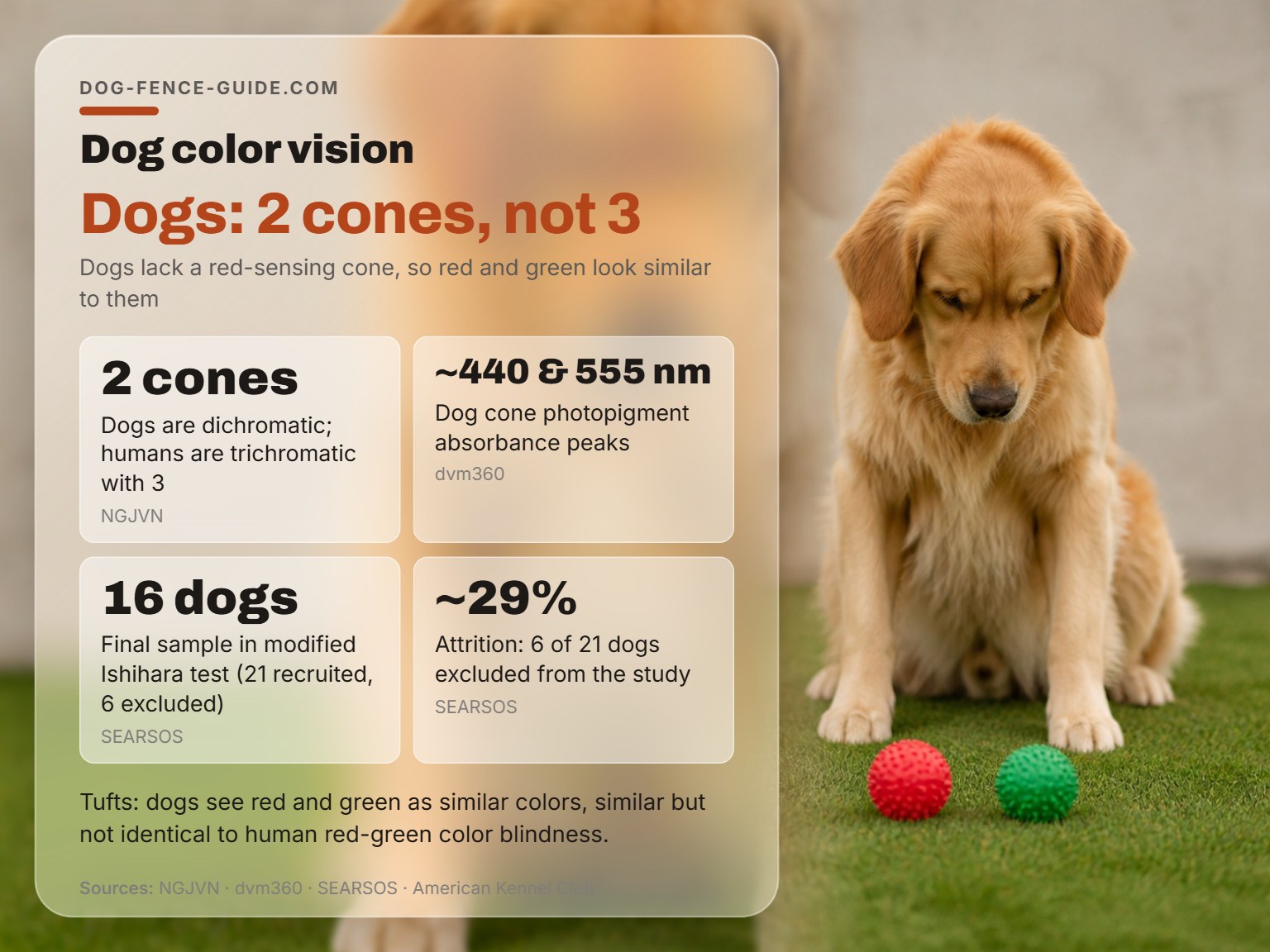
The University of Washington’s ophthalmology department states it plainly: dogs do not have red-sensing cones, so their sight is similar to that of someone with red-green color blindness, though Tufts notes the analogy is similar but not identical.
Tufts Cummings School agrees and adds a qualifier. Dogs and cats have color vision similar but not identical to red-green color vision deficiency, and they see red and green as similar colors. The word “identical” is doing real work there. A dog is missing a red-sensing cone outright, while the human version of red-green color blindness comes in more than one form.
Siniscalchi and colleagues tested the comparison directly in 2017, using a modified Ishihara test on 16 dogs. The reference plate was number 22. The stimuli were two animated cat images, RG-Cat-2 and RG-Cat-6. The are dogs red-green colour blind study is the paper to read for the plate-by-plate detail.
Six of 21 recruited dogs never made the final sample, which is roughly 29% attrition. Four stopped looking at the stimuli after the attention beep. Two were pulled because an owner repositioned the dog’s head. Anyone who has tried to hold a dog’s attention through a test will recognize that failure rate.
The authors flag two artifacts worth knowing. A dog that habituates to a moving target can produce a false negative. A dog that orients its head and eyes without really tracking can produce a false positive. Behavioral vision testing is fragile, and the paper says so out loud.
Why the Red Toy Aisle Is Built for You, Not Your Dog
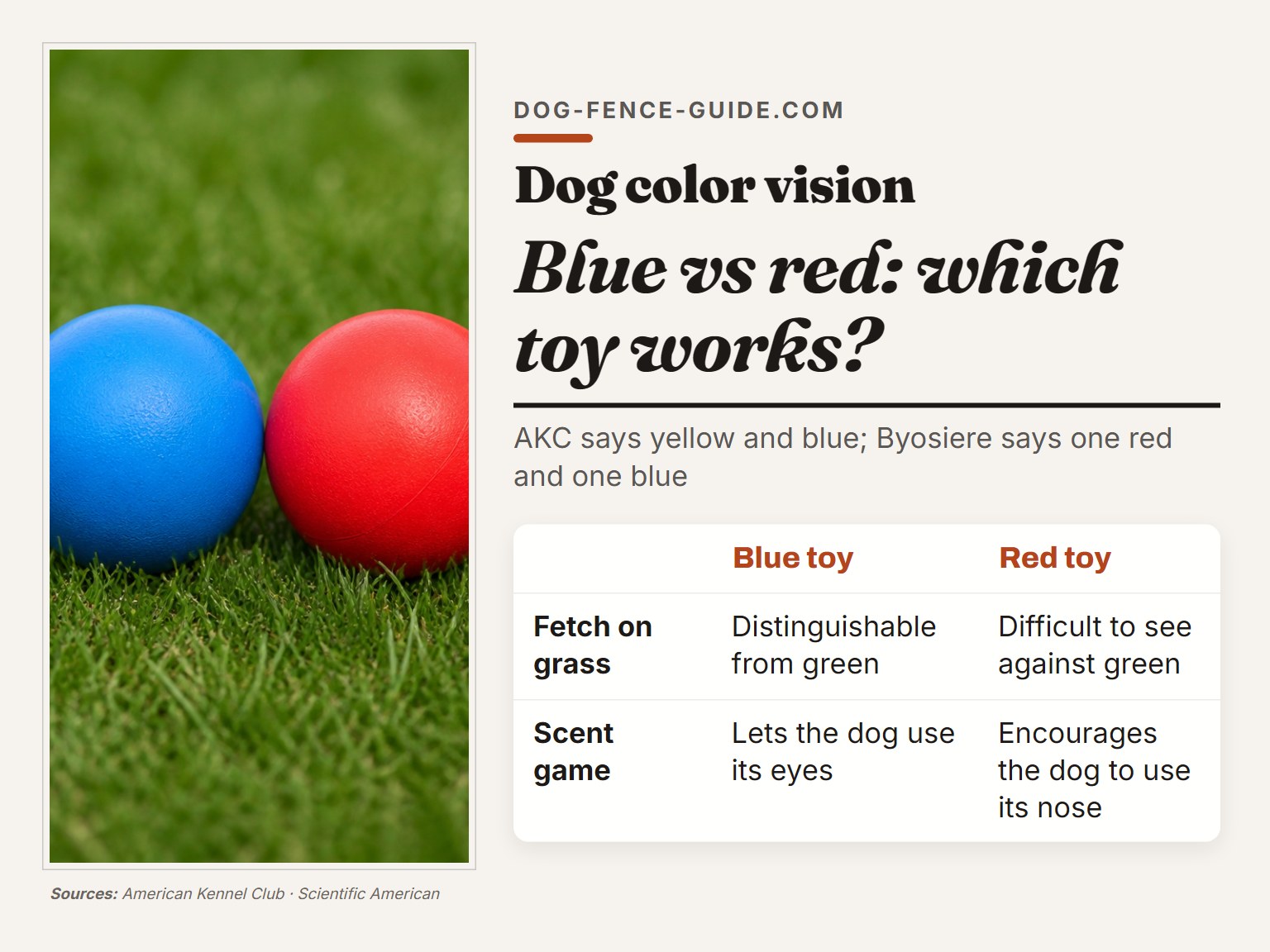
Stanley Coren’s observation about the pet aisle is the one that sticks. The most popular colors for dog toys are red and orange, and those are the two colors dogs see worst.
The AKC’s guidance follows from that: choose products in the colors dogs can see, meaning yellow and blue, and skip the red or orange ball that disappears against a lawn, though Byosiere, cited by Scientific American, recommends one red and one blue toy to enrich play.
Byosiere’s advice runs a little wider. She suggests one red toy and one blue toy, thrown in that order. The red one on green grass pushes the dog to use its nose. The blue one lets the dog use its eyes. Whether that’s enriching or frustrating depends on the individual dog.
So the two credible recommendations don’t match. Short version: the AKC recommends yellow and blue toys, while Byosiere, cited by Scientific American, recommends one red and one blue toy, so try the two-toy approach if your dog enjoys a puzzle.
A few rules I’d actually follow:
- Buy blue for fetch. A blue ball holds contrast against green grass; a red one doesn’t.
- Keep the red rubber for chewing. A red rubber chew toy is still a chew toy. Color matters for tracking, and a chew toy never gets tracked.
- Try one blue and one red if your dog likes a challenge. Watch which one gets found faster and let that settle it.
- Skip the orange and pink balls unless your dog finds them by scent anyway, which plenty do.
For a fetch toy, a blue ball is the easy pick. Choose a blue ball over a green one, so you can pick the one your dog can actually track across a yard.
Blue wins on fetch. Red wins on scent games. If you’re buying one toy this week, buy blue.
Smell Covers Most of What Color Can’t
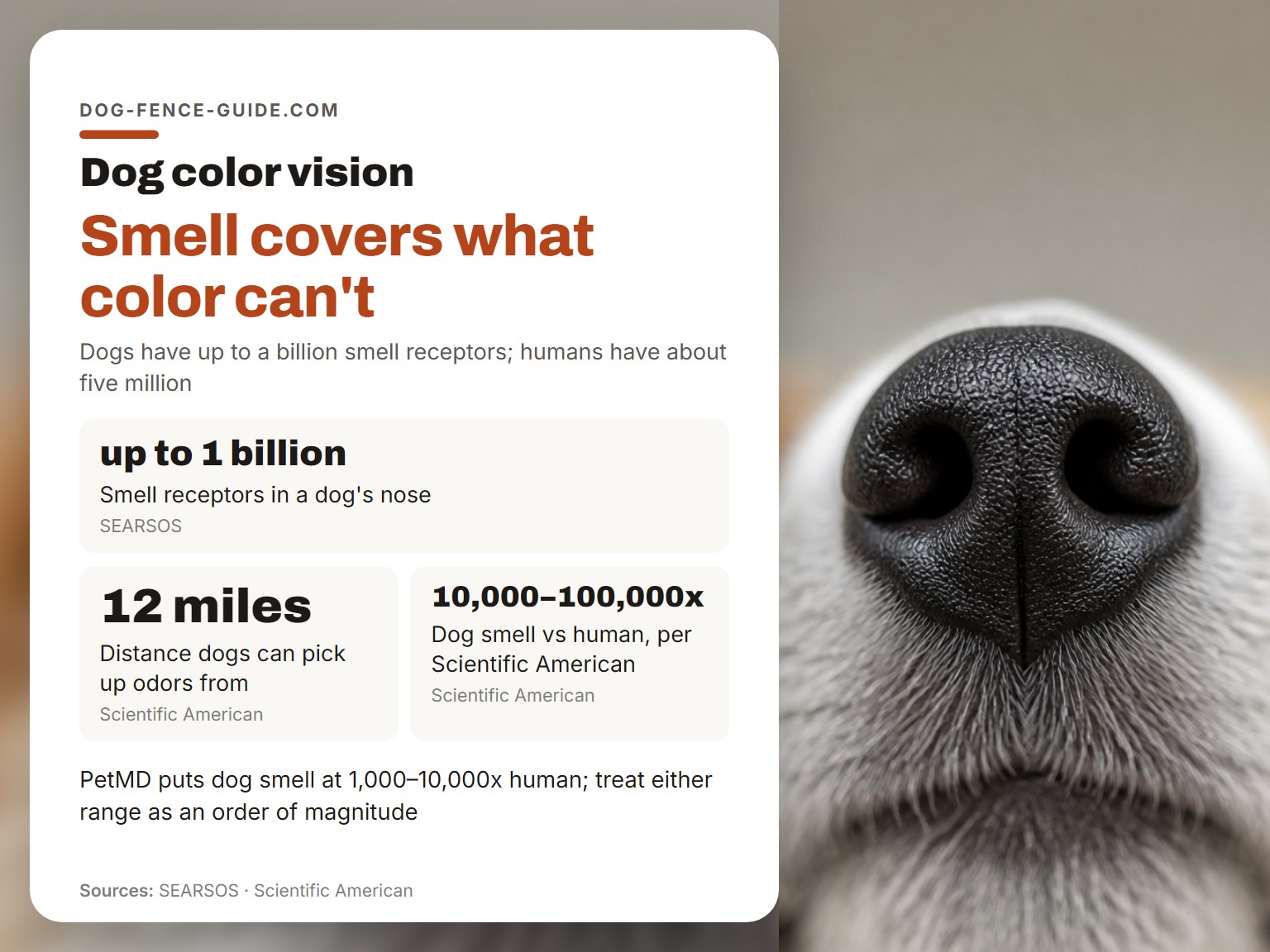
Smell is the sense doing the heavy lifting when a dog loses a toy in the grass.
Watch a dog work a scent line and the head drops, the mouth opens slightly, and the pulls of air get short and fast.
The numbers here don’t agree either. PetMD puts a dog’s sense of smell at 1,000 to 10,000 times better than a human’s. Scientific American puts it at 10,000 to 100,000 times. Both are describing the same animal, and the gap between those ranges is wide enough that you should treat either figure as an order of magnitude rather than a measurement.
The receptor count is easier to hold onto. Dogs have up to a billion smell receptors. Humans have about five million. Dogs can pick up odors from as far as 12 miles away.
The part nobody mentions: A dog that can’t spot a red ball can still smell exactly where it landed. The nose isn’t a backup system. It’s the primary one.
There’s a structural reason for that. A study in the Journal of Neuroscience found a direct connection between a dog’s olfactory bulb and its occipital lobe, the smell-processing and sight-processing regions. That wiring hadn’t been observed in any other species. A dog’s sense of smell works on a different scale than yours, which is why a lost ball is rarely lost for long.
When Was the Last Time You Looked at Your Dog’s Eyes?
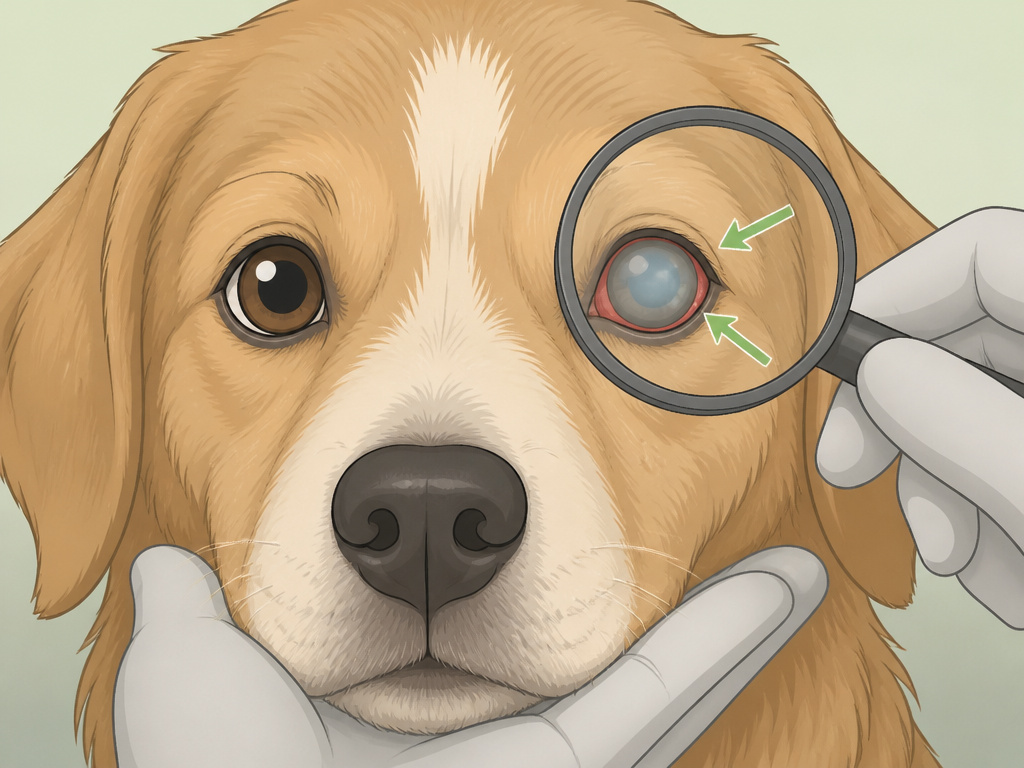
Tufts lists three things that should send you to the vet rather than to a search engine: squinting or tearing, redness or cloudiness, and any change in vision.
Working dogs get annual eye exams, per Tufts, and screening before breeding helps reduce heritable eye disease within a breed. Genetics set the baseline for both vision and eye-condition risk.
A home check takes about a minute:
- Watch the dog in dim light. Note whether it hesitates at the stairs or the fence line.
- Look at both eyes from the front. Redness or a cloudy film is a reason to book an exam.
- Check for squinting and tearing after a walk in tall grass or wind.
- Note any change in how the dog tracks a thrown toy, especially if the change came on over several weeks.
Easy to miss: Squinting that comes and goes looks like a nap. Tufts lists squinting and tearing as reasons to have a vet look, not reasons to wait.
If your vet sends you home with drops, follow the vet’s instructions on how long to use them. Don’t stop a course early either.
If your dog rides in a truck bed or hikes exposed ridges, dog goggles do more for the eyes than any supplement will. For bright water and snow, dog sunglasses cover the UV angle. And if you’re already weighing eye supplements, read the ingredient panel before you read the marketing.
When Vision Goes, the Routine Changes
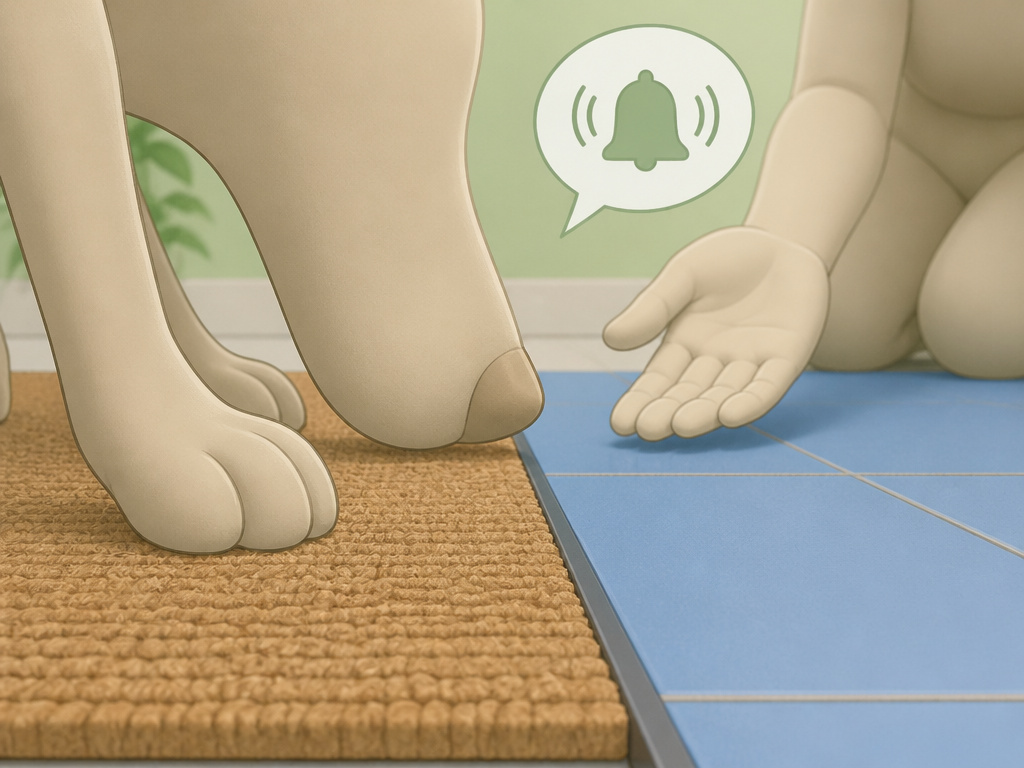
Tufts confirms that a dog can recognize its owner by sight under the right conditions, and that smell and hearing carry a lot of the load. That’s why a dog losing vision often copes better than the owner expects.
I’m not a behaviorist, and I’ll stay in my lane here. A dog that bolts because it’s frightened and a dog that can’t see the fence line are different problems, and the first one needs a professional.
The practical adjustments are mostly about predictability:
- Keep the furniture where it is. A moved chair is a brand new obstacle.
- Mark the edges. A change in texture underfoot at the door and the gate helps a dog map the yard.
- Talk before you touch. A hand arriving without warning startles a dog that can’t see it coming.
Sound cues come first, which is where training a blind dog starts. The household layout comes second, which is what blind dog care is mostly about.
Frequently Asked Questions
Are dogs completely color blind?
No. Dogs are dichromatic, which means two cone types rather than three. They see blue and yellow well and struggle with red and green. Black-and-white vision would be monochromatic, and that’s a different thing entirely.
Can dogs see red?
Not the way you do. Dogs don’t have a red-sensing cone, so red objects land somewhere between dark brown and gray. A red ball on green grass is close to invisible at a distance, which is why the AKC steers owners toward blue and yellow.
Do dogs see better in the dark than humans?
Yes, and the tapetum lucidum is the reason. It’s a mirrorlike membrane behind the retina that reflects light back for a second pass, and it allows dogs to see in about six times less light than a person needs. It’s also why their eyes glow in photographs.
Does a dog’s color vision affect training?
It affects toy-based training more than anything else. A dog that can’t track a red target visually falls back on scent and motion, which changes how fast it finds the reward. Blue and yellow targets remove that variable.
Can my dog recognize me by sight?
Tufts says yes, under the right conditions. Dogs also use smell and hearing, and their brains respond more strongly to images of other dogs than to images of humans. A dog that doesn’t spot you across a field isn’t snubbing you.
Before You Buy Another Toy
Here’s the threshold I’d use. If your dog finds a blue toy faster than a red one in open grass, twice in a row, color is doing real work for that dog and it’s worth shopping accordingly. If the two come out even, stop buying on color and buy on durability and scent instead.
None of this matters much for a dog that’s losing vision. Then the question shifts from color to texture and smell, and the eye exam moves to the top of the list.
Three things to check before you spend anything:
- Hold the toy against your own grass, not against the store shelf.
- Watch one fetch session with the toys you already own before adding another.
- Book the eye exam if anything about the eyes has changed since last year.
That’s it. The vision science is settled enough to act on, and the toy aisle is not.
