
9 Best Robot Dogs For Adults in 2026
This post contains affiliate links. As an Amazon Associate, we earn from qualifying purchases.
The Unitree Go2 Pro Robot Dog is our Best Overall pick because it combines 3D LiDAR navigation with real-time HD video streaming and impressive agility. It can climb 40-degree slopes, so it handles uneven terrain well. For tech enthusiasts who want an AI vision platform, the HIWONDER ROSPug Quadruped Robot Dog offers OpenCV library support, while the Loona Robot Pet Dog stands out as the Best AI Companion Robot for conversational interaction and home monitoring.
The real challenge with robot dogs for adults isn’t finding one, it’s finding the one that matches your actual goal. Some are built for coding and ROS development, others for speed and outdoor exploration, and a few are designed simply for companionship. The specs that matter shift dramatically depending on whether you want a learning tool, a tech toy, or a home monitor.
We built this guide by analyzing manufacturer specifications, expert round-ups, and patterns in owner feedback across nine distinct models. Each pick is matched to a specific use case so you can skip the models that don’t fit your needs and focus on the ones that do.
Top 9 Robot Dogs For Adults in the Market
Certain content that appears on this site comes from Amazon. This content is provided "as is" and is subject to change or removal at any time.
The Best Robot Dogs For Adults, Reviewed
Unitree Go2 Pro Robot Dog

What We Like
- 3D LiDAR with 360°x96° perception
- Climbs 40° slopes and 6.3" obstacles
- HD camera streams 1280×720 video
- WiFi6 and Bluetooth 5.2 connectivity
Trade-offs
- Not waterproof, avoid rain or water
- Obstacle avoidance must be manually enabled
- 4G modules unavailable in North America
Climbing 40-degree slopes and hitting 3.5 m/s means this robot can scramble over backyard terrain and keep up with a brisk walk, so it feels more like a capable machine than a typical toy. Its 3D LiDAR provides a 360-degree view around it, letting it dodge furniture and obstacles automatically, though you have to turn that feature on first. For adults who want a responsive companion for tech exploration or just watching it move, this model delivers the most right out of the box.
The downside is that it’s not waterproof, so puddles and rain are off-limits, and the obstacle avoidance needs to be manually enabled each time you power it up. Compared to the Petoi Bittle X V2, which weighs just 1.3 pounds, the Go2 Pro is a heavier, more complex machine that offers a live camera feed you can view from your phone. If you want a robot dog that can actually tackle real-world terrain and stream video, this is the one to get.
HIWONDER ROSPug Quadruped Robot Dog
What We Like
- AI vision with OpenCV library
- SLAM mapping and navigation
- Adjustable gait via inverse kinematics
- Live camera feed to app
Trade-offs
- Requires programming knowledge for full use
- Heavier than most toy robot dogs at 3.5 pounds
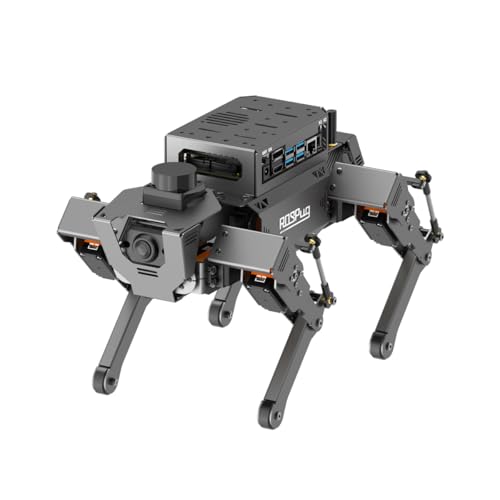
The Jetson Nano processor and 12 high-voltage intelligent serial bus servos give this robot dog the ability to run AI vision tasks like target recognition, face detection, and line following using the OpenCV library. The HD wide-angle camera feeds live video to the app, so you get a first-person view while controlling it via phone, PC, or the included PS2 handle. That setup makes it a development platform for adults comfortable with Python and ROS.
The trade-off is that ROSPug demands more from you than a ready-to-run companion robot. You’ll need comfort with Python and ROS to tap into its SLAM mapping, path planning, and inverse kinematics adjustments. Compared to the Unitree Go2 Pro, which is about 32 inches long, this HIWONDER model is smaller at 13.5 inches and more of a development platform. If you want a project you can build on, that trade-off is exactly the point.
SunFounder PiDog AI Robot Dog Kit

What We Like
- Supports multiple large language models
- 32 realistic dog-like movements
- Rich sensor suite for interactive play
- Comprehensive learning resources included
Trade-offs
- Raspberry Pi not included
- Designed for ages 15 and up
- Targets engineers, not casual users
The ability to run ChatGPT, Gemini, Grok, or even a local LLM on a Raspberry Pi means this robot dog can hold a conversation, recognize hand gestures, and identify math problems after you supply and set up the board. Its 12 servos let it walk, sit, wag its tail, and respond to touch and voice, making interactions feel lively. It’s a kit built for makers and students who want to explore AI robotics without being locked into a closed ecosystem. The online tutorials and forum community make it approachable even if you’re new to Python or OpenCV.
You need to supply your own Raspberry Pi and be comfortable with a bit of setup, so this isn’t a plug-and-play toy. The Unitree Go2 Pro, which is a larger robot dog (32 inches long) with its own onboard computer, demands less upfront effort from its owner. But if you’re the kind of person who enjoys tinkering and wants to customize your robot’s behavior, the flexibility of OpenClaw and multi-LLM support is hard to beat. Just know that this is a project for engineers and curious adults, not a gift for younger kids.
Petoi Bittle X V2 Robot Dog

What We Like
- Fully assembled, ready to code
- Open-source Arduino and Python support
- Voice control with 35+ lifelike actions
- Lite feedback servos for realistic movement
Trade-offs
- Optimized for flat, hard surfaces only
- 1-hour playtime limits extended sessions
- No onboard camera or advanced sensors included
At just 1.3 pounds and small enough to fit in a backpack, the Petoi Bittle X V2 is the robot dog you can actually take with you. It comes fully assembled, so you’re not spending hours snapping legs into place, you charge it, pair the app, and start coding in block, Arduino C++, or Python. That open-source flexibility means it’s not a toy you outgrow; you can add optional sensors, a Raspberry Pi, or ROS/ROS2 support to turn it into a real research platform. For adults who want a lightweight, portable introduction to quadruped robotics, this is a practical option.
The trade-off for that portability is surface sensitivity. Bittle X V2 is built for flat concrete and hardwood, put it on carpet, grass, or snow and those tiny feet lose traction fast. That’s a real limitation if you want to run it around the yard or a living room rug. Bittle fits a different niche: it’s a coding companion for the desk, the classroom, or the coffee table, not an all-terrain rover. If your floor is hard and your curiosity is big, it’s a smart, affordable way to learn robotics.
LewanSoul MechDog Robot Dog Kit

What We Like
- No assembly required, ready to program
- Cross-platform control via PC and app
- Inverse kinematics for lifelike movement
- Compatible with LEGO and extra sensors
Trade-offs
- Small size limits outdoor terrain capability
- No built-in camera for advanced vision tasks
Weighing just 1.2 pounds and measuring 5.1 inches long, the MechDog is small enough to sit on a desk or fit in a backpack, which makes it a natural fit for learning programming without needing a dedicated workshop. It comes fully assembled, so you can jump straight into coding with Python, Scratch, or Arduino. The eight coreless servos give it surprisingly nimble movement thanks to built-in inverse kinematics. For a student or hobbyist who wants to understand how quadruped robots work without wrestling with a soldering iron, this kit keeps the focus on software and logic rather than hardware headaches.
The trade-off for that low price and small footprint is that it won’t handle rough grass, gravel, or uneven pavement the way a larger robot like the Unitree Go2 Pro can. Its lightweight plastic construction and compact legs mean it’s best suited for smooth indoor floors or a clean patio. If you need a robot dog that can patrol a backyard or carry sensors over obstacles, you’ll want something heavier and more rugged. But for anyone whose goal is to learn programming and AI concepts on a budget, the MechDog delivers exactly that without the assembly hassle.
Product photos
LewanSoul MechDog Pro Robot Dog

What We Like
- 3DOF robotic arm for object gripping
- Inverse kinematics for lifelike movement
- AI vision and voice interaction
- Cross-platform programming options
Trade-offs
- Small size limits outdoor terrain use
- Assembly required for full setup
- No built-in battery life stated
The support for a 3DOF mini-robotic arm sets this robot dog apart from most competitors, letting it autonomously grip and transport small objects rather than just walk around. It’s a natural fit for students or hobbyists who want to learn mechanics, electronics, and AI through hands-on projects. That’s especially true if they already have some familiarity with Arduino, Python, or Scratch. The inverse kinematics give it surprisingly fluid, lifelike movements for its size, and the AI vision and voice interaction add a layer of responsive behavior that makes it feel more like a real pet than a basic kit.
Its compact build is the main limitation: at just 5 inches long and 4.3 pounds, it’s best suited for tabletops or smooth indoor floors rather than rough backyards or uneven trails. If your goal is a programmable robot with a manipulator arm for educational tinkering, this is a focused tool. If you need something that can handle grass or gravel, you’ll want to look at the bigger options.
Product photos
HIWONDER PuppyPi Robot Dog

What We Like
- Full ROS1/ROS2 support
- ChatGPT integration for natural interaction
- Lidar and robotic arm expansion ready
- Inverse kinematics for precise motion
Trade-offs
- At 3.5 lb, not for outdoor rough terrain
- Raspberry Pi 5 requires separate setup knowledge
- Standard kit lacks lidar and arm included
Full ROS1 and ROS2 support means you can start working with SLAM navigation and multi-joint motion control without switching environments. The Raspberry Pi 5 4GB handles AI vision and voice tasks, and the ChatGPT integration allows scene and voice understanding. Inverse kinematics algorithms enable coordinated leg movement for a 3.5-pound robot dog. If you want to program and customize an AI robot dog, this kit gives you the tools and source code to do it.
At 3.5 pounds, this robot dog is light enough to carry in one hand, so it stays on a desk or smooth floor rather than the backyard. The standard kit doesn’t include lidar or a robotic arm, but you can add those expansion modules later. That’s the whole idea: you build up the capabilities yourself, learning how each piece works along the way.
Product photos
Faraday Future FX Aegis Pro Robot Dog
What We Like
- Runs up to 3.7 m/s
- 12-hour battery life
- 4K camera for streaming
- Climbs 16 cm steps
Trade-offs
- App control still in development
- At 23.8 inches long, not compact
- Aluminum-alloy body adds weight
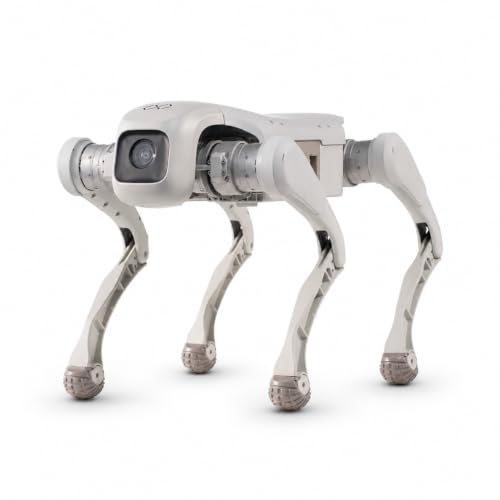
The 4K camera adds a practical layer for real-time monitoring or entry-level robotics projects, and the 30-day return policy takes the edge off a premium purchase.
The app control is still in development, so you’re stuck with the included remote for now. That’s not a dealbreaker for STEM learners, but it’s less convenient than some competitors that offer ready-to-use programming environments. At 23.8 inches long, it takes up more floor space than smaller kits, so you’ll want a clear area to let it roam rather than a cramped desk. For adults who prioritize speed and battery life over portability or app polish, this is a strong option.
Product photos
Loona Robot Pet Dog

What We Like
- Auto-charging with multiple preset routes
- Home monitoring via camera and speaker
- Voice and gesture recognition
Trade-offs
- Needs well-lit environment for camera accuracy
- Requires quiet space for clear voice responses
- Charging dock needs open, unobstructed area
A 2.4-pound robot dog that talks back with ChatGPT and finds its own charging dock means you get a genuinely interactive companion without babysitting the battery. Loona recognizes faces, follows gestures, and responds to voice commands in real time, so it feels less like a toy and more like a pet that actually pays attention to you. The built-in camera doubles as a home monitor, letting you check in when you’re away. This is the robot for someone who wants conversation and connection, not just a programmable gadget.
Loona’s smarts depend on good lighting and quiet rooms, so dim corners or noisy spaces will trip up its camera and voice recognition. The Unitree Go2 Pro is built for rugged outdoor autonomy and heavier payloads, while Loona is lighter, smaller, and clearly designed for indoor companionship. It won’t climb stairs or carry gear, but if your priority is a chatty, self-charging robot that keeps you company and watches the house, Loona delivers where the others focus on coding or durability.
Product photos
How We Evaluated Robot Dogs For Adults
Our evaluation started with the technical specifications that actually separate one robot dog from another: sensor arrays, programming language support, battery life, terrain capability, and onboard cameras. We cross-referenced manufacturer documentation with expert round-ups to verify claims about LiDAR range, slope climbing, and motion capabilities. We also looked at patterns in owner feedback to identify which features work reliably in real-world conditions and which ones require extra setup or software updates.
The four criteria that mattered most were autonomy level (does it navigate on its own or need constant input?), programmability (open-source support versus closed firmware), physical capability (speed, obstacle clearance, surface compatibility), and practical extras like cameras or auto-charging. A robot dog that can climb stairs but needs a perfectly flat surface to balance is less useful than one that matches its advertised environment honestly.
This is a research-led evaluation, not a hands-on test. We cannot tell you how any of these models feel after a week of use. What we can do is give you the facts to compare them side by side, so you can match the right specs to your own project or play style. If you are just starting your search, our best robot dogs guide covers a wider range of models and price points.
What To Look For In Robot Dogs For Adults
Before you buy, understand the three factors that define every robot dog experience: how it moves, how you control it, and what it can sense. The wrong combination means a frustrating setup or a robot that sits on a shelf.
Focus on programming access, terrain capability, and sensor quality. A robot dog that requires coding but has no learning resources is a brick. One that can’t handle your floors is a paperweight.
Programming Access and Learning Curve
Some robot dogs work right out of the box with a phone app. Others require you to write Python or Arduino code before they take their first step. The HIWONDER ROSPug and PuppyPi models assume you know ROS and inverse kinematics.
The SunFounder PiDog provides comprehensive learning resources but demands a separate Raspberry Pi. If you want to code, look for open-source support and active community forums. If you want a companion that responds to voice commands immediately, the Loona or Unitree Go2 Pro are better fits.
For a broader look at what’s available, our roundup of top robotic dog models for adults breaks down the programming requirements for each.
Terrain and Surface Compatibility
Not all robot dogs walk on the same ground. The Unitree Go2 Pro climbs 40-degree slopes and clears 6.3-inch obstacles, making it the most capable outdoor model here. The Petoi Bittle X V2 is optimized for flat, hard surfaces only, carpet and grass will stall it.
The LewanSoul MechDog models are small and best for indoor tabletops or smooth floors. Check the surface you plan to use most and match it to the robot’s advertised terrain limits. If you want something that looks and moves more like a real animal, our guide to realistic robot dogs covers models with lifelike gaits and appearances.
Sensor Quality and Autonomy
A robot dog with 3D LiDAR and SLAM mapping can navigate a room without bumping into furniture. One with only ultrasonic sensors will need constant course correction. The Unitree Go2 Pro’s 360×96-degree LiDAR is the most advanced sensor package here, but obstacle avoidance must be manually enabled. The HIWONDER ROSPug uses OpenCV for AI vision, which gives it object recognition but requires programming to tune. If you want a robot that explores on its own, prioritize models with LiDAR or structured-light sensors over basic infrared.
- Confirm whether the robot ships assembled or requires soldering and wiring.
- Check battery life and charging method, some models auto-dock, others need manual USB charging.
- Verify that the companion app is available on your phone’s operating system.
- Look for expansion ports if you plan to add a camera, robotic arm, or LiDAR later.
- Read the fine print on waterproofing, most robot dogs cannot handle rain or puddles.
A robot dog that matches your skill level and floor type will get used. One that doesn’t will collect dust.
Robot Dogs For Adults Compared
The table below compares the nine robot dogs side by side, focusing on the specs that matter most for adult buyers: programming access, terrain capability, sensor type, and special features.
| Product | Weight | Dimensions | Programming |
|---|---|---|---|
| Unitree Go2 Pro Robot Dog | 33 lbs | L 32.0 inches, W 20.0 inches, H 13.0 inches | N/A |
| HIWONDER ROSPug Quadruped Robot Dog | N/A | 13.5 x 13.5 x 7.8 inches | Python |
| SunFounder PiDog AI Robot Dog Kit | N/A | 10.4 x 7.0 x 3.4 inches | Python |
| Petoi Bittle X V2 Robot Dog | 1.3 pounds | L 4.3 in, W 7.6 in, H 4.3 in | Block, Arduino C++, Python |
| LewanSoul MechDog Robot Dog Kit | 1.2 pounds | 5.1 x 8.3 x 5.5 inches | Python, Scratch, Arduino |
| LewanSoul MechDog Pro Robot Dog | 4.3 pounds | L 5.0 x W 8.0 x H 12.0 in | Python, Scratch, Arduino |
| HIWONDER PuppyPi Robot Dog | 3.5 pounds | 12.6 x 12.6 x 6.7 inches | N/A |
| Faraday Future FX Aegis Pro Robot Dog | N/A | L 23.8 inches, W 14.0 inches, H 15.8 inches | N/A |
| Loona Robot Pet Dog | 2.4 pounds | 19.0 x 18.0 x 18.0 inches | N/A |
Frequently Asked Questions
What is the best robot dog for adults who want to learn programming?
The SunFounder PiDog AI Robot Dog Kit supports multiple large language models and includes comprehensive learning resources, making it a strong choice for makers and students. It requires a separate Raspberry Pi and is designed for users ages 15 and up. For a more accessible entry point, the LewanSoul MechDog Robot Dog Kit works with Python, Scratch, and Arduino and comes pre-assembled.
Can robot dogs climb stairs or navigate uneven terrain?
The Unitree Go2 Pro can climb 40-degree slopes and clear 6.3-inch obstacles, making it the most capable model for uneven terrain. Most other robot dogs in this guide are optimized for flat, hard surfaces. The Petoi Bittle X V2 and LewanSoul MechDog models struggle on carpet and grass, so check the surface compatibility before buying.
Do any robot dogs have cameras for live video streaming?
Yes. The Unitree Go2 Pro streams 1280×720 HD video, and the Faraday Future FX Aegis Pro has a 4K camera for streaming. The HIWONDER ROSPug and PuppiPi models offer live camera feeds through their apps, though the PuppiPi’s standard kit does not include LiDAR or a robotic arm. The Loona Robot Pet Dog uses its camera for home monitoring and voice recognition.
What is the difference between a ROS robot dog and a standard programmable robot dog?
A ROS (Robot Operating System) robot dog, like the HIWONDER PuppiPi, supports ROS1 and ROS2 frameworks, which are industry standards used in professional robotics development. Standard programmable robot dogs use Arduino, Python, or Scratch without ROS middleware. ROS models offer more advanced motion planning and sensor integration but require significantly more technical knowledge to set up and program.
Are robot dogs waterproof or suitable for outdoor use?
Most robot dogs in this guide are not waterproof. The Unitree Go2 Pro should avoid rain and water. The Faraday Future FX Aegis Pro is built for outdoor STEM projects but its app is still in development. The LewanSoul and Petoi models are best kept indoors on flat surfaces. If you plan to use a robot dog outside, prioritize models with aluminum-alloy bodies and clear terrain ratings.
The Bottom Line
For most adults, the Unitree Go2 Pro Robot Dog is the best balance of capability and ease of use. Its 3D LiDAR, HD video streaming, and slope-climbing ability make it the most versatile model here, whether you want to explore your backyard or stream a first-person view from your living room. It is not waterproof and obstacle avoidance must be turned on manually, but for indoor and dry outdoor use, it is the most complete package.
If your goal is learning AI and robotics rather than immediate play, the HIWONDER ROSPug or SunFounder PiDog will teach you more. The ROSPug gives you OpenCV-based computer vision and SLAM mapping, while the PiDog supports large language models and 32 lifelike movements. Both require programming knowledge, but the learning payoff is substantial. For a ready-to-go companion that also monitors your home, the Loona Robot Pet Dog auto-charges and responds to voice and gestures without any setup.
The single most important factor is matching the robot dog to your surface and skill level. A model that needs ROS expertise and a smooth floor will frustrate you on carpet. A simple app-controlled companion will bore you if you want to code. Pick the one that fits where you are now, not where you hope to be.
