
10 Best Robot Dogs in 2026
This post contains affiliate links. As an Amazon Associate, we earn from qualifying purchases.
The Loona Robot Pet ChatGPT-4o is the best overall robot dog because it combines real-time conversation with home monitoring features that no other model matches. For advanced robotics, the Unitree Go2 Robot Dog Pro handles payloads and steep terrain, while the Ozega Smart Robot Dog is our budget pick for young kids.
The real challenge with robot dogs is matching the right level of autonomy and interactivity to your household. A toddler needs durable obstacle avoidance, a teenager wants programmable stunts, and an adult may want a companion that learns their voice.
We built this guide by comparing specifications, studying manufacturer documentation, and identifying patterns in owner feedback across ten distinct models. You get clear picks sorted by use case, plus the buying criteria that actually separate a good robot dog from a frustrating one.
Top 10 Robot Dogs in the Market
Certain content that appears on this site comes from Amazon. This content is provided "as is" and is subject to change or removal at any time.
The Best Robot Dogs, Reviewed
Loona Robot Pet Dog ChatGPT-4o

What We Like
- ChatGPT-powered real-time conversation
- Auto-charging with multiple route presets
- Face and gesture recognition
- Doubles as a home monitor
Trade-offs
- 2.5-hour charge time between play sessions
- Requires well-lit space for camera accuracy
- Dock needs clear open area on both sides
The Loona Robot Pet Dog packs a high-definition RGB camera and ToF depth sensor that let it recognize faces, understand gestures, and follow you around like a real pup. It’s a smart companion for anyone who wants a pet-like experience without the shedding or the walks, especially if you’re curious about having a conversation with your robot, the ChatGPT integration makes it a genuinely talkative little guy, not just a voice-command repeater.
Loona needs a well-lit room and a clear charging dock spot to work reliably, so it’s not a set-it-and-forget-it pet for a dim, cluttered house. Compared to the Unitree Go2 Pro, which is longer at 32 inches, Loona is smaller overall at 19 inches long and weighs 2.4 pounds. If you want a robot dog that chats back and can keep an eye on your home while you’re out, Loona delivers that.
Unitree Go2 Robot Dog Pro

What We Like
- 3D LiDAR with 360°x96° perception
- Carries up to 17.8 lbs payload
- Climbs 40° slopes and 6.3" obstacles
Trade-offs
- Not waterproof, avoid rain or water
- Obstacle avoidance must be manually enabled
- Voice/GPT features only on Pro and X models
A 33-pound quadruped that can carry nearly 18 pounds and run at 3.5 meters per second is built for serious work, not just tricks. The 3D LiDAR scans everything from two inches away to the horizon, so it can slip past furniture legs or tree roots without a bump. That muscle and awareness make it a natural for hauling small loads across a workshop or exploring a backyard on its own.
The catch is that obstacle avoidance must be manually enabled, so it doesn’t default to cautious mode. And unlike some other robots in this guide, this model is not waterproof, so outdoor use demands dry conditions. If you’re after a pet-like companion that can handle a splash or a curious toddler, the Loona’s smaller size might suit you better. But if your priority is raw capability and the willingness to manage its limits, the Go2 Pro delivers real utility.
Ruko 18011 Smart Robot Dog
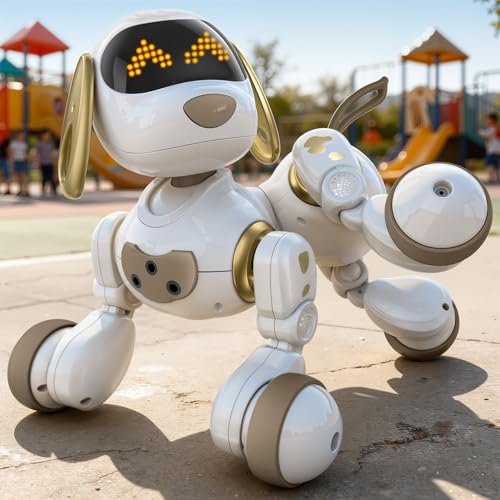
What We Like
- 70 LED lights, 30+ facial expressions
- Obstacle-avoidance sensors for safe play
- Programmable up to 50 custom moves
- Durable child-safe ABS plastic
Trade-offs
- 45-minute battery limits long play sessions
- No voice or app control mentioned
- Remote needs 2 AAA batteries (not included)
With over 30 animated LED expressions and a remote that works up to 98 feet away, this robot dog is designed for kids who want instant, playful reactions without a phone or tablet. It’s made from smooth ABS plastic and stands about 9.8 inches tall, so it’s easy for a child to carry and durable enough for everyday bumps. The obstacle-avoidance sensors let it roam rooms without hitting furniture, and kids can guide it with hand gestures or the remote. Some reviewers say it’s a fun, mess-free way to introduce interactive play, though the programming mode lets kids design up to 50 custom moves if they want to try more advanced control.
The trade-off is that 45 minutes of play from a three-hour charge means you’ll be plugging it in more often than you’d like, especially if you have siblings who both want a turn. Compared to the Loona model with its ChatGPT integration and charging dock, the Ruko 18011 lacks voice control and app connectivity, so older kids who expect smartphone-style interaction may find it limiting. But for the preschool set who just want a dog that wags its tail, spins, and lifts its leg to “pee” on command, the simplicity is actually a strength. Fewer buttons and screens mean more giggles and less frustration.
Product photos
SunFounder PiDog AI Robot Dog Kit

What We Like
- 12 servos enable 32 realistic dog actions
- Supports multiple LLMs for smart conversations
- Rich sensor suite: camera, touch, gyroscope
- Comprehensive online tutorials and community support
Trade-offs
- Requires separate Raspberry Pi purchase
- Targeted at ages 15+ and engineering users
- DIY assembly and programming needed
The PiDog runs on a Raspberry Pi you supply yourself, so the real cost and effort start before it ever wags its tail. With 12 servos and 32 programmed actions, it walks, sits, shakes its head, and performs tricks that mimic a real dog, but this is a development platform, not a plug-and-play pet. It suits makers, students, and tech enthusiasts who want to experiment with OpenCV, MediaPipe, and multi-LLM integration, not someone looking for an out-of-box companion.
You get flexibility in AI interactions. ChatGPT, Gemini, Grok, DeepSeek, Qwen, Doubao, and local Ollama models are all on the table, but you trade the simplicity of a pre-assembled bot. The PiDog requires a separate Raspberry Pi and is designed for users comfortable with programming. For the engineer or hobbyist who wants to build their own intelligent robot dog from the ground up, that is exactly the point.
Petoi Bittle X V2 Robot Dog

What We Like
- Fully assembled, charge and start
- Open-source Arduino and Python coding
- Voice controlled with 35+ actions
- Lightweight at 1.3 pounds
Trade-offs
- Not for carpet, grass, mud, or snow
- 1-hour playtime before recharge
- Optional sensors and Raspberry Pi sold separately
Weighing 1.3 pounds and measuring 4.3 by 7.6 by 4.3 inches, this robot dog is compact enough to carry in a small bag and operate on a desk or kitchen counter without taking up much space. It comes fully assembled, so you charge the battery and start coding in block, Arduino C++, or Python right away. That open-source flexibility makes it a natural fit for a student who wants to learn real robotics programming without wrestling with a soldering iron first. It also works well in a classroom where every kid can have their own unit instead of sharing one.
Bittle X V2 is built for smooth, flat surfaces like concrete or hardwood. Try it on carpet or grass and the lite servos lose traction, so this is an indoor-only companion. Compared to the Loona model, which weighs 2.4 pounds and stands taller, Bittle is lighter and more portable, but it gives up the ability to run on soft or uneven surfaces that a larger robot might handle. If your priority is a programmable coding buddy for hard indoor floors, this is the one.
Liifun Robot Emo AI Dog

What We Like
- Adaptive AI learns and remembers your commands
- Waterproof and shock-resistant for outdoor adventures
- Programmable with self-improving action sequences
- Performance mode evolves routines to your play style
Trade-offs
- Basic version lacks advanced sensors or camera found on pricier models
- Basic version lacks camera for visual recognition features.
A waterproof, shock-resistant body means this robot dog is built for the kind of outdoor play that would leave most toy robots in pieces. It can handle poolside splash battles and park runs, and it remembers terrain patterns to refine its balance over time. The adaptive AI learns your commands and responds faster with repeated use, remembering your favorite moves. For someone who wants a companion that actually grows sharper with use rather than repeating the same preset tricks, this is a genuinely different approach to a robot pet.
At under three pounds, it is lighter than some larger robot dogs, which may affect stability on uneven ground. The basic version is focused on durability and programming rather than the advanced sensors or cameras found on pricier models. If your priority is a tough, learning companion that can handle outdoor adventures without flinching, this makes more sense than a more delicate indoor-focused robot.
Ozega Smart Robot Dog

What We Like
- Program up to 50 custom motion sequences
- Touch sensor on back for interaction
- Type-C rechargeable, no battery swaps
Trade-offs
- No AI or camera for advanced autonomy
- No AI or camera features
With a 10-inch height and a 2.4GHz remote, this robot dog is compact enough for small hands and indoor play. It also responds to 13 voice commands and has a touch-sensitive area on its back, so a child can command it to sit or dance using the remote or voice. That combination makes it a suitable choice for families who want an interactive toy that introduces basic STEM concepts without being too complex for young children.
Product photos
Dingdongwu 3-in-1 Robot Dog Kit

What We Like
- 3-in-1 transforming modes (dog, battle bot, rover)
- 30+ bionic actions including crawl and dance
- Four-wheel Mecanum drive for multidirectional movement
Trade-offs
- No AI or smart companion features like some rivals
- 50-minute battery limits longer play sessions
This is a stunt toy, not a smart companion. Unlike the Loona model, which offers voice and gesture control with real-time interaction and home monitoring, the Dingdongwu doesn’t chat, learn, or respond to gestures. Its ABS plastic body and 50-minute battery are suited for indoor play sessions. If your child expects a pet that recognizes them or follows them around the house, the Dingdongwu will feel more like a remote-control car with legs. For kids who love transforming robots and performing tricks, though, it delivers exactly that kind of hands-on, screen-free action.
Product photos
WowWee CHiP Robot Dog

What We Like
- Trainable via app rewards
- Tracks mood and health
- Replays favorite tricks
- Customizable Smartband
Trade-offs
- App-focused design limits standalone play
- No physical treat dispenser included
- Requires smartphone for full interaction
CHiP is a physical robot dog that responds to your smartphone app for training, mood and health tracking, movement control, and trick replay. You reward good behavior with a digital treat through the app, so it offers the structure of pet care without the fur or vet bills. But because it relies on the app for most interactions, it is not a standalone toy that works without a phone.
The catch is that the app is central to nearly every feature. If you want a robot dog that responds to voice or gesture commands without a phone, this is not it, unlike the Ruko 18011, which offers gesture control and realistic barks in a physical package. CHiP delivers a thoughtful, app-driven robot dog experience, but it demands a smartphone and a willingness to engage with a connected pet rather than a purely autonomous one.
Product photos
TUEESN Robot Dog

What We Like
- Soft-blast target practice for hand-eye coordination
- 30+ lifelike actions with sound effects
- USB-C fast charging in 1 hour
- No downloads or Wi-Fi required
Trade-offs
- Remote needs 3 AAA batteries not included
- At 14.1 inches, it's bigger than Ruko's 8.9-inch dog
- 30-minute playtime means frequent recharges
A remote range over 25 meters means this robot dog can patrol the yard while your kid stays on the porch. The police theme isn’t just for show, the soft-blast target practice lets kids knock down lightweight dummies, which builds hand-eye coordination in a way most robot dogs ignore. For a 6-year-old who wants action over AI chit-chat, the 30-plus lifelike actions (handstands, push-ups, patrolling) deliver immediate fun without any app setup. It’s built tough with reinforced ABS plastic and smooth edges, so you don’t have to hover every second.
Battery life is the trade-off: 30 minutes of play from a one-hour charge means you’ll be plugging it in more often than you’d like. That’s fine for a single play session, but if you’re comparing it to other robot dogs that run on disposable batteries, the TUEESN demands a little more planning. Still, for a kid who wants to play cop-and-robber in the backyard without a phone screen involved, this is the one that delivers the mission-ready action they’re after.
How We Evaluated Robot Dogs
Our research focused on three pillars: manufacturer specs for movement and sensors, documentation for programming capabilities and battery life, and expert round-ups that identified common owner complaints. We also looked at the best robot dog landscape to understand what features matter most in real-world use.
The four criteria that mattered most were autonomy, durability, interactivity, and battery life. Autonomy means whether it needs a phone or runs independently. Durability covers handling carpet, grass, or a toddler drop. Interactivity includes voice, touch, or app-based learning. Battery life asks whether playtime matches expectations. A robot dog that needs constant recharging or app babysitting defeats the purpose for most buyers.
This is a research-led evaluation, not a hands-on test. We analyzed what each model promises on paper, what owners report in practice, and where the gaps between the two tend to live. That honest limit means we flag trade-offs clearly rather than pretending every pick is perfect.
What To Look For In Robot Dogs
The right robot dog balances autonomy, durability, and interactivity for the person who will actually use it. A preschooler’s needs are nothing like a programmer’s.
Match the robot’s autonomy level to the user’s patience. A child who wants instant play will hate a model that requires app setup first. A coder who wants full control will hate a fixed-action toy.
Autonomy and Control
Some robot dogs operate entirely on their own with voice and gesture recognition, while others require a smartphone app or remote control for every move. The Loona and Liifun Emo AI Dog learn and adapt without constant phone input, making them feel more like a real pet. The WowWee CHiP and Ozega models put the smartphone at the center of the experience, which works well for older kids but frustrates younger ones who just want to press a button and play.
Durability and Surface Suitability
Not every robot dog can handle carpet, let alone grass or gravel. The Petoi Bittle X V2 is clearly labeled for hard indoor surfaces only, while the Unitree Go2 Pro climbs 40-degree slopes outdoors. The Ruko 18011 uses child-safe ABS plastic that survives drops from small hands. Check the floor of the room where the dog will live before you choose, a robot that can only run on hardwood is useless in a carpeted playroom.
Battery Life and Charging
Playtime ranges from 30 minutes on the TUEESN police-themed dog to 2.5 hours on the Loona. The difference matters less for a child who loses interest after 20 minutes than for a teen who wants an afternoon of programming. Auto-charging docks, like the one on the Loona, help extend usable time without adult intervention. Models with USB-C charging, such as the Ozega and TUEESN, are more convenient than those needing proprietary cables.
- Check whether the robot returns to its dock automatically or needs you to plug it in.
- Confirm whether batteries are included or require separate purchase (AAA batteries for remotes are not always included).
- Look at recharge time relative to playtime, a 1-hour charge for 30-minute play is a different ratio than a 2-hour charge for 2.5-hour play.
A robot dog that charges faster than it plays will feel like it is always waiting for a recharge.
Robot Dogs Compared
The table below compares all ten robot dogs across the specs that matter most for choosing the right model for your home.
| Product | Dimensions | Battery Life | Control Methods |
|---|---|---|---|
| Loona Robot Pet Dog ChatGPT-4o | 19.0 x 18.0 x 18.0 in | N/A | Voice & gesture |
| Unitree Go2 Robot Dog Pro | 32.0 x 20.0 x 13.0 in | 1-2 hours | App & remote |
| Ruko 18011 Smart Robot Dog | 9.8 × 8.3 × 9.8 in | 45 min | 2.4GHz remote & gesture |
| SunFounder PiDog AI Robot Dog Kit | 10.4 x 7.0 x 3.4 in | N/A | App, voice, coding |
| Petoi Bittle X V2 Robot Dog | 4.3 x 7.6 x 4.3 in | 1 hour | App, voice, coding |
| Liifun Robot Emo AI Dog | 12.2 x 5.9 x 6.9 in | N/A | Programming, remote |
| Ozega Smart Robot Dog | 6 x 9 x 10 inches | N/A | 2.4GHz remote & app |
| Dingdongwu 3-in-1 Robot Dog Kit | 13.1 x 6.1 x 10.0 inches | 50 minutes | Voice, remote, coding |
| WowWee CHiP Robot Dog | N/A | N/A | App |
| TUEESN Robot Dog | 14.1 x 6.3 x 9.8 inches | 30+ minutes | Voice & remote |
Frequently Asked Questions
What is the best robot dog for a child under 10?
Best for kids ages 3 and up, the Ruko 18011 Smart Robot Dog uses durable ABS plastic and has obstacle-avoidance sensors for safe play. It offers 70 LED lights and 30 facial expressions that young children find engaging. The remote control eliminates the need for a smartphone.
Do robot dogs need Wi-Fi to work?
Some do and some don’t. The Loona Robot Pet uses ChatGPT-4o for conversations and needs a connection for that feature. The TUEESN Robot Dog and Ruko 18011 require no downloads or Wi-Fi at all, making them better for families who want a simple out-of-box experience without network setup.
Can robot dogs be programmed by a beginner?
Yes, but the difficulty varies widely. The SunFounder PiDog requires a separate Raspberry Pi purchase and targets users aged 15 and older with DIY assembly. The Petoi Bittle X V2 comes fully assembled and supports Arduino and Python coding, making it more accessible for students and educators who are new to programming.
What is the most realistic robot dog?
For lifelike movement and interaction, the most realistic robot dogs use multiple servos and facial expressions to mimic real canine behavior. The Ruko 18011 offers 30 facial expressions and 70 LED lights, while the SunFounder PiDog uses 12 servos for 32 realistic actions. The Loona’s face and gesture recognition adds another layer of believable interaction.
How long do robot dog batteries last?
Battery life ranges from 30 minutes on the TUEESN Robot Dog to 2.5 hours on the Loona Robot Pet. Most models fall between 45 minutes and 1 hour of active play. Auto-charging docks, like the one included with the Loona, help extend usable time by returning the dog to its charger automatically when power runs low.
The Bottom Line
The Loona Robot Pet ChatGPT-4o is the best overall robot dog for families who want a conversational companion that also monitors their home. Its ChatGPT-powered real-time chat, gesture recognition, and auto-charging dock make it the most complete package for everyday indoor use.
If you need something more rugged for outdoor exploration or programming projects, the Unitree Go2 Pro handles payloads up to 17.8 pounds and climbs steep slopes. For a simple, durable toy that keeps young kids entertained without a smartphone, the Ruko 18011 is the right choice. Budget-minded buyers should look at the Ozega Smart Robot Dog, which offers programmable motion sequences at an affordable price point.
The single most important factor is matching autonomy to the user. A robot dog that requires constant app input will frustrate a young child, while a fixed-action toy will bore a teenager who wants to code their own tricks. Know who is using it before you choose the model.
