
How to Choose a Dog Walker: One Phone Question
This post contains affiliate links. As an Amazon Associate, we earn from qualifying purchases.
To choose a dog walker, run four checks in this order: insurance that states a dog limit, a canine first aid kit carried on every walk, a written contract covering emergencies and off-lead permission, and a test walk you watch yourself. The UK’s CFSG recommends a maximum of four dogs at once. Knowing how to choose a dog walker means checking these in order.
The insurance line does the most work, because it’s the only check with money behind it. A policy that names a dog limit is a contract you can point to after an incident.
What follows is the order I’d run these checks in, the questions that separate a careful walker from a cheap one, and the places where the how to choose a dog walker guidance contradicts itself.
Key Takeaways
- Four dogs is the recommended ceiling in the CFSG guide, and only two of those should be off lead at any one time.
- Ask to see the insurance policy, not for a yes. The policy states the dog limit, and that number is the one that binds.
- Nearly 60% of owners have no written agreement with their walker, per Dogs Trust. Get the contract before the first walk, not after.
- A test walk you observe tells you more than any interview answer ever will.
- No shock, prong, spray or choke collars. CFSG bans them outright and the SF SPCA’s expected answer is a flat no.
What the Dog-Count Rules Actually Say
Four dogs. That’s the recommended ceiling for one professional walker, and it comes from the UK’s Canine & Feline Sector Group.
The CFSG Dog Walking Guide 2024 recommends a maximum of four dogs walked at any one time, with no more than two of those off lead. The figure works as a ceiling rather than a target, because the walker’s insurance policy and local authority requirements both override it wherever they set a lower number.
Two more numbers sit alongside it, and owners almost never hear them. Only two dogs should be off lead at once, and only two professional walkers should walk together. Read together, those three figures describe a group of four dogs handled by one person, with half of them loose.
Here’s where it gets messy. The three welfare bodies that publish guidance on this don’t answer the dog-count question the same way.
| Source | Stated limit | What it means in practice |
|---|---|---|
| CFSG (UK) | Four dogs, two off lead | A recommended cap, lowered further by insurance or council rules |
| Dogs Trust (UK) | Whatever the insurance policy states | No fixed number; the policy is the operative figure |
| SF SPCA (US) | No number given | Groups matched on compatible size, age and behaviour instead |
Only one of those three gives you a number you can hold someone to.
When the Numbers Conflict
The CFSG guide is explicit that four is a recommendation, and that the real ceiling is whichever is lower: the insurance policy or the local authority limit. So a walker can be fully insured for six dogs and still be outside the welfare guidance.
That gap matters more than it sounds. Insurance exists to cover a claim, and a policy that permits six dogs is telling you what the insurer will accept, not what the dogs can cope with.
Where this goes sideways: Hiring a walker insured for six dogs who routinely walks six. The policy is legal cover, not a welfare standard, and by the third week you’ve got a handling problem whether or not anything has gone wrong yet.
The One Phone Question That Sorts Walkers Fast
You ring four walkers on a Tuesday and ask each one the same thing: what happens if my dog goes down mid-walk and I don’t pick up the phone?
I did a version of this when I was shopping for a vet. I rang four clinics and asked one question: what’s your protocol if I call at 2 a.m. With a bloated dog? Two said go to the emergency clinic and stopped there. One gave me the address and told me to ring ahead. That one got my business, and I’ve used the same trick on walkers ever since.
The difference is audible on the phone when you compare a how to choose a dog walker. One person recites a plan. The other says “um” and steers the conversation toward rates.
What a good answer contains: a named practice, clear authority to seek veterinary attention, and a settled position on who pays and how, agreed in writing. Dogs Trust advises agreeing the walker’s level of decision-making in writing, naming a specific practice, and sorting out veterinary costs up front.
Common mistake: Accepting “I’d obviously take them to the vet” as a complete answer. Without written authority and a named practice, the walker’s discretion in an emergency is undefined, and the first time you find that out is the worst possible time.
The AKC guide to finding a dog walker makes the same point from a different angle: trust and safety come before anything else, and a handler who can’t read subtle behaviour signs is a danger to the dog and to everyone nearby.
Which Questions Actually Separate a Good Walker From a Cheap One?
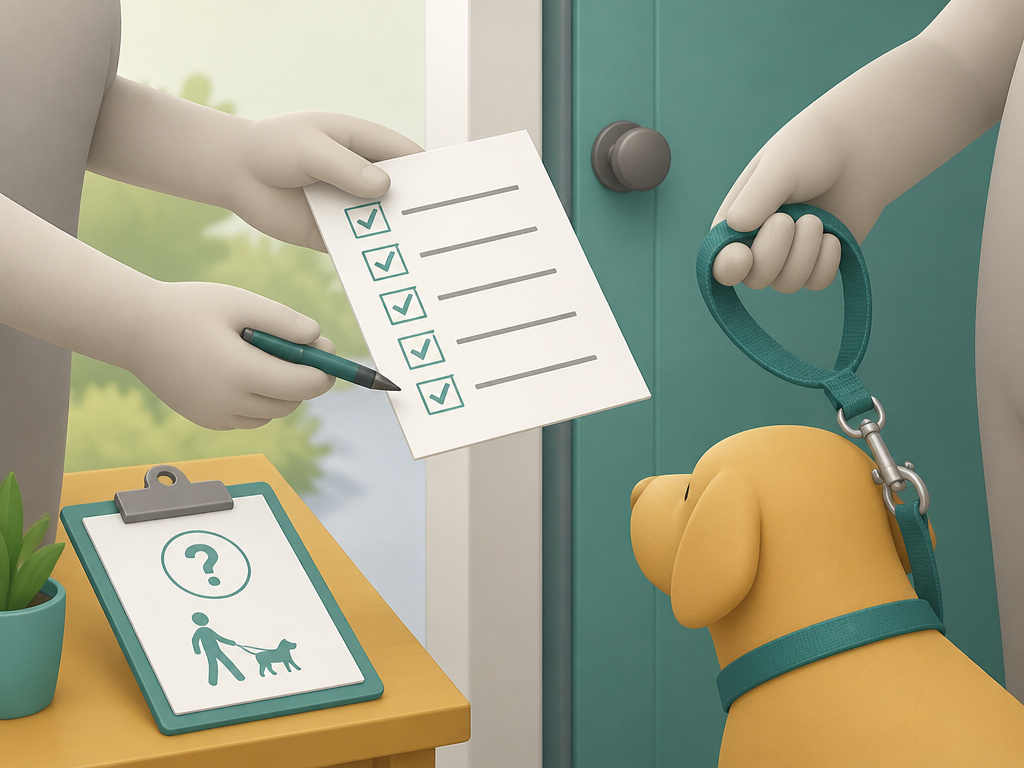
Start with tenure, then work outward. The questions below each have a wrong answer, and the wrong answers are usually obvious once you know what to listen for.
- How long have you been walking dogs, and how long with this company? A walker three weeks into a job may not be the person who ends up holding your lead, and the answer tells you whether to ask the next question.
- Who exactly walks my dog, and is it the same person every time? The SF SPCA is blunt about this one: meet and vet every handler who’ll be in contact with your dog, not just the company owner. For a shy dog, insist on one consistent person.
- What does your insurance policy say about the number of dogs? Ask for the figure, not a nod. If they can’t quote it, they haven’t read the policy.
- Can we do a test walk that I watch? Both the SF SPCA and the AKC recommend it. A walker with nothing to hide says yes.
- What have you noticed about how my dog behaves on a walk? This is the attunement test, and it’s the one that catches people out.
The Attunement Test
Ask this after the second or third walk, once the walker has had a chance to learn your dog. Then compare their answer to what you already know.
If your dog always stops to sniff the same corner, or shies at the same wheelie bin, a switched-on walker will have noticed. A vague answer tells you they’re managing a queue of dogs rather than walking yours.
The dog walker hiring checklist from the SF SPCA covers the rest of the minimum: vaccine records, full veterinary and emergency contacts, and a home visit to learn your pick-up and drop-off routine.
If your dog has issues beyond ordinary walking, that’s a different search entirely. Finding a dog trainer is a separate job from hiring a walker, and one doesn’t substitute for the other.
Where the Welfare Guidance Disagrees With Itself
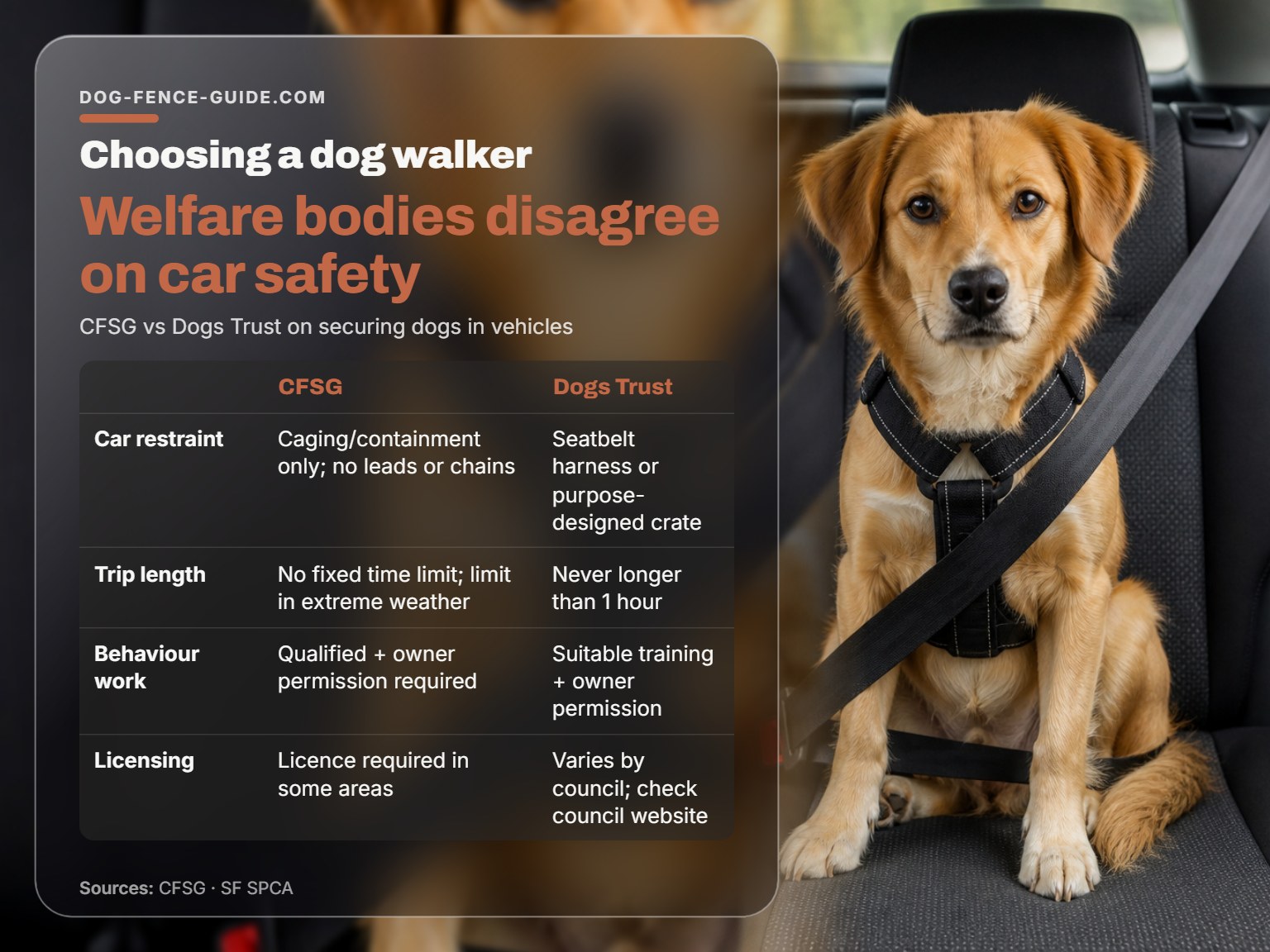
Two of the most-quoted animal welfare bodies in the UK don’t agree on how a dog should be secured in a car.
CFSG says dogs must be restrained by caging or containment, and that restraining with leads or chains must not be used, while Dogs Trust accepts a correctly-sized seatbelt harness or a purpose-designed crate. Dogs Trust accepts a correctly-sized seatbelt harness or a purpose-built crate. Both agree the vehicle needs ventilation, temperature control and regular cleaning.
The trip-length question splits the same way. The SF SPCA states dogs should never be in a vehicle on a trip longer than an hour, while CFSG sets no fixed time limit and instead says to limit distance and time in extreme weather for dogs that struggle with heat. CFSG sets no fixed time limit, and instead says to limit distance and time in extreme weather for dogs that struggle with heat.
Behaviour work is the third fault line. CFSG bars walkers from any behaviour modification or advice unless they’re suitably qualified, experienced and knowledgeable and hold the owner’s express permission. Dogs Trust allows it only with suitable training and the owner’s permission. The AKC frames behaviour knowledge as a safety requirement without barring the work itself.
Licensing is the one where everybody agrees, and the agreement is that there’s no national rule. Requirements vary significantly by council, and CFSG says only that a licence will be required in some areas. Check your local council’s website before you assume anything.
Rule of thumb: if a walker tells you they’re “fully licensed”, ask which council issued it. In most of the UK there’s no such licence to hold, and the answer tells you how carefully they talk about the rest.
What the Leash Study Actually Tested, and Why It Matters
The PMC study put four leash-walking device types through the same pulling test, and it didn’t crown a winner.
That’s the useful part. The research compares efficacy in reducing pulling against welfare impact across those four types, and calls for real-world assessment rather than a blanket recommendation. Lab numbers and a Tuesday afternoon on a busy pavement are different environments.
What this means for you: the equipment question has no universal answer, so the walker’s judgement matters more than the brand.
Ask what they’d put on your dog and why. A walker who says “whatever you’ve got” hasn’t thought about it. A walker who asks about your dog’s neck, pulling habit and escape history has.
Easy to miss: a walker who brings their own aversive kit. CFSG names electric shock, prong, spray and choke collars as equipment that can cause fear, anxiety or distress, and says walkers shouldn’t use them. The SF SPCA’s expected answer to the same question is a flat no. If a slip lead with a thin cord shows up in their bag, ask about it before the first walk, not after.
Harness, Collar, or Head Collar?
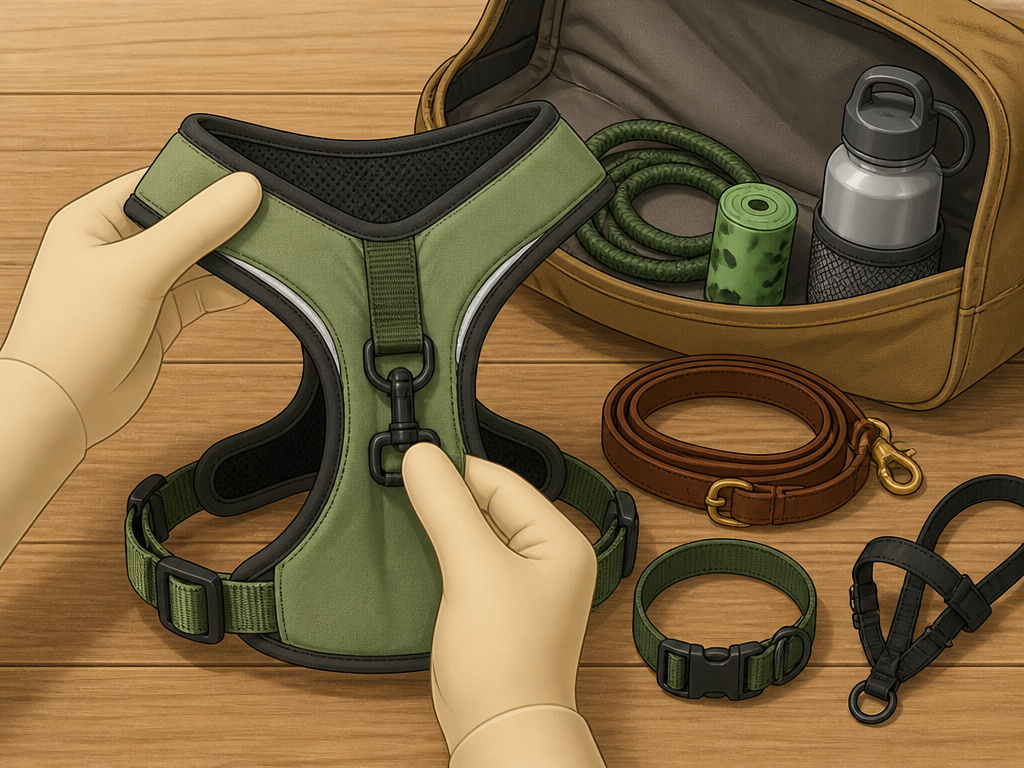
For most dogs on a group walk, a well-fitted dog harness beats a collar because it takes pressure off the throat. A well-fitted harness with a padded chest panel and a front clip that discourages pulling without cranking the neck is the one I’d point most owners toward.
For a dog that already walks politely, a plain flat collar and a leather lead is plenty. The right dog leash matters more than most people think here, because a long, light lead gives a walker more control at distance than a short, heavy one.
For a hard puller, a head collar gives the walker steering rather than strength. Fair warning: introduce it slowly at home first, because a dog that fights a head collar on day one will fight it every day after.
Ask what the walker carries, too, before you spend anything on dog walking accessories. A spare lead, water, poop bags and a canine first aid kit are the baseline, and Dogs Trust expects a first aid certificate alongside the kit.
A Good Walk Is Structured, Not Just Long
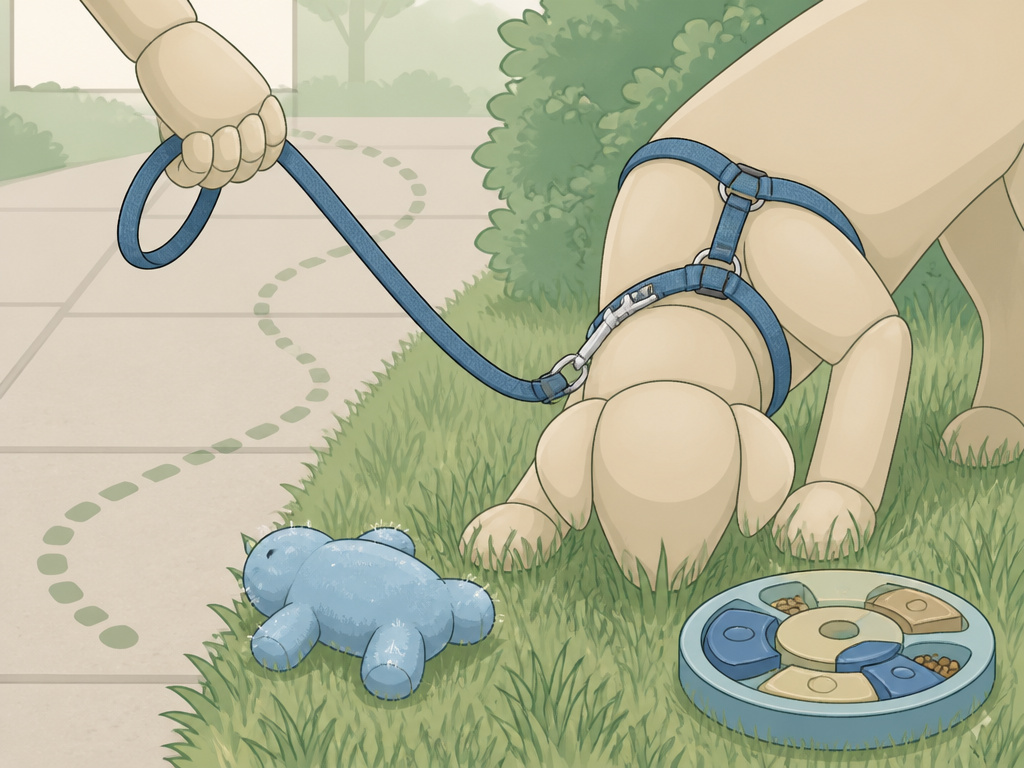
A structured walk looks different from a lap around the block, and the difference shows up in the dog by Thursday.
I’ve come around on this slowly. A long walk on a flexi lead down the same street is exercise for the legs and nothing for the brain. Twenty minutes of sniffing, direction changes and a bit of scent work tires most dogs harder than an hour of pavement.
So ask the walker what actually happens on the walk. Do they vary the route? Do they stop and let the dog sniff, or march? Do they do anything with the dog beyond covering distance?
The gear question follows from that. A stuffed and frozen toy gives a dog something to work at after the walk, and a puzzle feeder does the same job indoors on a wet afternoon. A ball launcher turns a straight-line fetch into something with a bit of problem-solving in it, though I’d keep sessions short and stop before the dog gets frantic.
The part nobody mentions: fast, repetitive fetch builds arousal in a dog that already patrols. If your dog runs the fence line for twenty minutes after every walk, the walker’s routine may be feeding the behaviour rather than burning it off.
Start with your dog, not the product. A high-drive young collie and a nine-year-old who naps till noon need completely different walks from the same person.
If your dog reacts to other dogs on the lead, say so before the first walk and be specific about distance. Reactive dog handling is a separate skill from basic group walking, and plenty of competent walkers don’t have it.
Biscuit would consider a walker with a treat pouch a personal friend by day two.
How Do You Spot a Walker Who’s Cutting Corners?
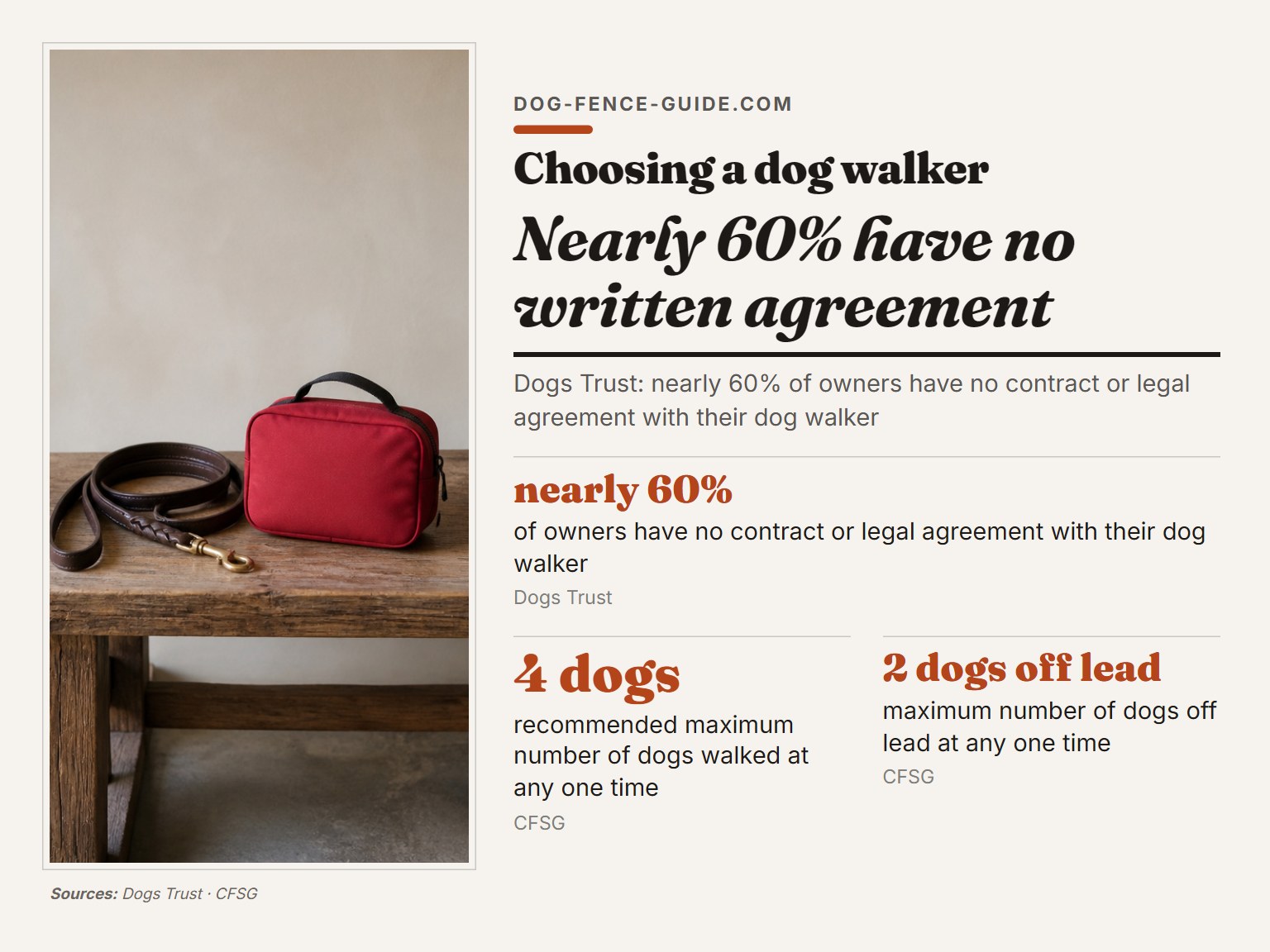
Nearly 60% of owners have no contract or legal agreement in place with their walker, according to Dogs Trust, which means most people are relying on memory and goodwill.
That number is the reason the warning signs matter. Without a written agreement, the only record of what was promised is what you can remember.
| Warning sign | What it usually points to | What to check |
|---|---|---|
| Can’t quote their dog limit | Hasn’t read the policy | Ask for a copy of the insurance schedule |
| No first aid kit in the bag | Untrained in canine first aid | Ask about the certificate and the kit |
| Vague on the emergency plan | No written authority to act | Name a practice and settle costs in writing |
| Same lead for every dog | Equipment not matched to the dog | Ask what they’d use on yours, and why |
| No daily update of any kind | Low attention to individual dogs | Ask for a text or note after each walk |
A brief daily update is a reasonable ask. The AKC suggests a whiteboard, a note, or a text, and the format matters less than whether it happens at all.
The paperwork itself is short. A written agreement should cover:
- The walker’s insurance details and the dog limit on the policy
- Emergency decision authority, the named practice, and how veterinary costs get handled
- Whether your dog goes off lead, agreed in writing rather than verbally
- Walk length, pick-up and drop-off times, and a cancellation notice period
- Treats and food, including type, quantity and frequency
- Your contact details, your vet’s details, and the dog’s medical history and allergies
- A tag carrying the walker’s contact details, plus a schedule and payment terms
If your dog is going to be around other dogs in a bigger setting, the same logic applies to dog daycare and to dog boarding. The questions barely change.
Frequently Asked Questions
How many dogs should a dog walker walk at once?
The CFSG recommends no more than four at any one time, with only two of those off lead. That figure is a recommendation, and the binding limit is whichever is lower: the walker’s insurance policy or the local authority requirement. Dogs Trust doesn’t set a number at all and defers to the insurance policy, so ask for the figure in writing.
Do I need a written contract with a dog walker?
Dogs Trust recommends one, and the near-60% of owners without any agreement are the reason. The contract should cover emergency decision authority, off-lead permission, walk length, cancellation notice and payment terms. A verbal agreement is treated as insufficient by both CFSG and Dogs Trust on the off-lead question specifically.
Should I let my dog walker take my dog off lead?
Only if you’ve agreed it in writing. CFSG requires prior written permission from the owner before any off-lead walking, and Dogs Trust says the same. Even with permission, the CFSG cap of two dogs off lead at once still applies, so a walker with four loose dogs is outside the guidance regardless of what you’ve signed.
What insurance should a dog walker have?
Third-party liability insurance at minimum, and the policy should state the number of dogs they can walk at once. Depending on your agreement, it may also need to cover emergency veterinary fees. Ask to see a copy rather than accepting a verbal confirmation.
How long should a dog walker spend with my dog?
Agree the length and the schedule up front rather than assuming a default. Dogs Trust advises setting walk length, pick-up and drop-off times, and varying the routes for stimulation. A shorter walk with sniffing and direction changes does more for most dogs than a longer march around the same block.
Before You Go
Ring three walkers this week and ask each one the emergency question. Not the rates question, not the availability question. The one about what happens when your dog goes down and you don’t pick up.
If the answer doesn’t include a named practice and a clear line on who authorises treatment, you’ve learned everything you need to know in about ninety seconds.
Here’s the concession. None of this fixes a dog with serious reactivity or separation distress. A group walker isn’t a behaviourist, and no contract clause turns one into the other. If your dog’s problem is anxiety rather than exercise, the paperwork is the wrong tool and you need a qualified trainer first.
And the honest version on the rest: I’d rather have a walker who carries a first aid kit, quotes their insurance limit without checking, and walks four dogs than one with a glossy booking app and eight. The hardware under the deck is what holds it up.
