
How to Choose a Dog Daycare: Step-by-Step Checks
This post contains affiliate links. As an Amazon Associate, we earn from qualifying purchases.
To choose a dog daycare, check four things in order: the maximum dog count on the licence, dogs per staff member, square metres per dog, and whether your dog is assessed before day one. In England, licensed premises allow 6 square metres per dog and no more than 10 dogs per staff member. Knowing how to choose a dog daycare means checking these figures rather than trusting a friendly tour.
Skip that last check in how to choose a dog daycare and you’ll find out about a problem in week three, when your dog starts planting his feet at the door and you’ve already paid for a block of visits. The assessment is where a daycare tells you your dog isn’t a fit. The ones that never say no are telling you something too.
Here is the honest version: most of what separates a daycare from a bad one is paperwork and staffing, and neither shows up on the website. What follows runs from the licence on the wall to the two minutes you should spend standing still and listening.
Key Takeaways
- Ask to see the licence and read the maximum dog number on it. More dogs on the premises than that figure is a breach of licence, not a busy Tuesday.
- Ten dogs per staff member is the English statutory ceiling, and one full-time member of staff per 8 dogs is the higher standard, though the industry’s own guide treats 10 as only amber, with 10–18 yellow and 18 or more red.
- Six square metres per dog is the space floor in England, counted with indoor and outdoor space added together, which is a loophole worth understanding.
- A daycare that never turns a dog away is a warning sign. The RSPCA’s licensing conditions require assessment before admission, not as a courtesy.
- English guidance puts sleeping areas between 10°C and 26°C, while SPCA Certified sets the range for most dogs at 10°C to 25°C.
What Does a Licensed Dog Daycare Have to Prove?
In England, a commercial dog daycare needs a licence from the local council, and that licence has to state the maximum number of dogs allowed on the premises at any one time. That single figure is the most useful thing you can read in the first five minutes of a visit.
The licence sets a maximum dog count for the premises, and exceeding that figure is a breach of the licence, particularly where staffing levels have not risen to match. Pet and retired dogs kept on site count toward the same total, so a facility with three resident dogs has three fewer places to sell.
That last part catches people out. Ask how to choose a dog daycare by finding how many of the dogs in the building belong to the owner, and whether they’re inside the licensed number. If the answer is vague, the number on the wall isn’t the number in the room.
The Eight Training Topics on the Record
The statutory guidance names eight areas staff training must cover: animal welfare including recognising poor welfare, animal handling, animal behaviour, cleanliness and hygiene, feeding and food preparation, preventing and controlling disease, recognising sick or injured animals, and first aid. There must be a written record of that training.
Ask to see it. Not the certificate on the wall, the record. A staff file with eight dated entries is a different building from one with a laminated poster.
| Requirement | What the standard says | Source |
|---|---|---|
| Dogs per staff member | 10 or less; higher standard is 1 full-time per 8 dogs | GOV.UK statutory guidance |
| Space per dog | 6 square metres, indoor and outdoor combined | GOV.UK statutory guidance |
| Sleeping area temperature | Above 10°C, below 26°C | GOV.UK statutory guidance |
| Barriers to the outer boundary | At least 2 secure doors or gates | GOV.UK statutory guidance |
| Noise | Not above 85 dB averaged over 8 hours | SPCA Certified |
Ten Dogs per Staff Member Is the Legal Ceiling in England
The industry’s own practitioner guide treats that same number as yellow rather than green. Wag the Dog & Company’s green light is 10 dogs or fewer per handler, yellow is 10 to 18, and red is 18 or more. So a facility sitting exactly on the English legal limit is, by the industry’s reckoning, already at the caution line.
That gap matters when you’re comparing a daycare with a boarding facility, because overnight coverage is usually thinner than daytime coverage even at the same site.
The other half of the ratio question is group composition. The green standard is separation by size, play style and energy level. Yellow is separation by size only. Red is no clear rules, or every dog in one group.
| Signal | Green light | Red light |
|---|---|---|
| Dogs per handler | 10 or fewer | 18 or more |
| Group separation | Size, play style, energy level | No rules, all dogs together |
| Rest breaks | Several short breaks, individual crates | Non-stop play all day |
| Removal after a puncture | Immediate | Three or more incidents first |
I’d want the ratio in writing before I’d want a tour. A number spoken at the door is a number that changes when someone calls in sick.
How Much Space Does Each Dog Actually Get?
Six square metres per dog, and the guidance allows the facility to count indoor and outdoor space together. That’s the number to hold in your head, because the aggregation is where a cramped building can still pass.
Twenty dogs in a 120 square metre unit is compliant on paper if there’s a yard attached. Stand in the middle of the room and it feels different. A room with twenty dogs in it looks busy from the doorway and cramped from the centre, and the dogs know which one they’re standing in.
SPCA Certified takes a different route entirely. It sets no numeric area figure in the clauses that cover space. Instead it requires behavioural assessment, introductions monitored by at least two staff members, and exclusion of dogs with a known bite history at level 3 or above.
Two certification regimes, two incompatible metrics. One counts floor, the other counts behaviour. Ask which one the facility is actually working to, because a building can pass the first and fail the second.
Easy to miss: A daycare that separates groups by size only is the yellow band, not the green one. Size tells you almost nothing about whether a heavy, bouncy adolescent should be in with a cautious older dog.
Group composition is also why supervising dog introductions properly at home pays off. A dog that has practised calm greeting with one unfamiliar dog handles a daycare intake far better than one that has only ever met dogs through a fence.
Walk the Building Before You Walk the Dog In
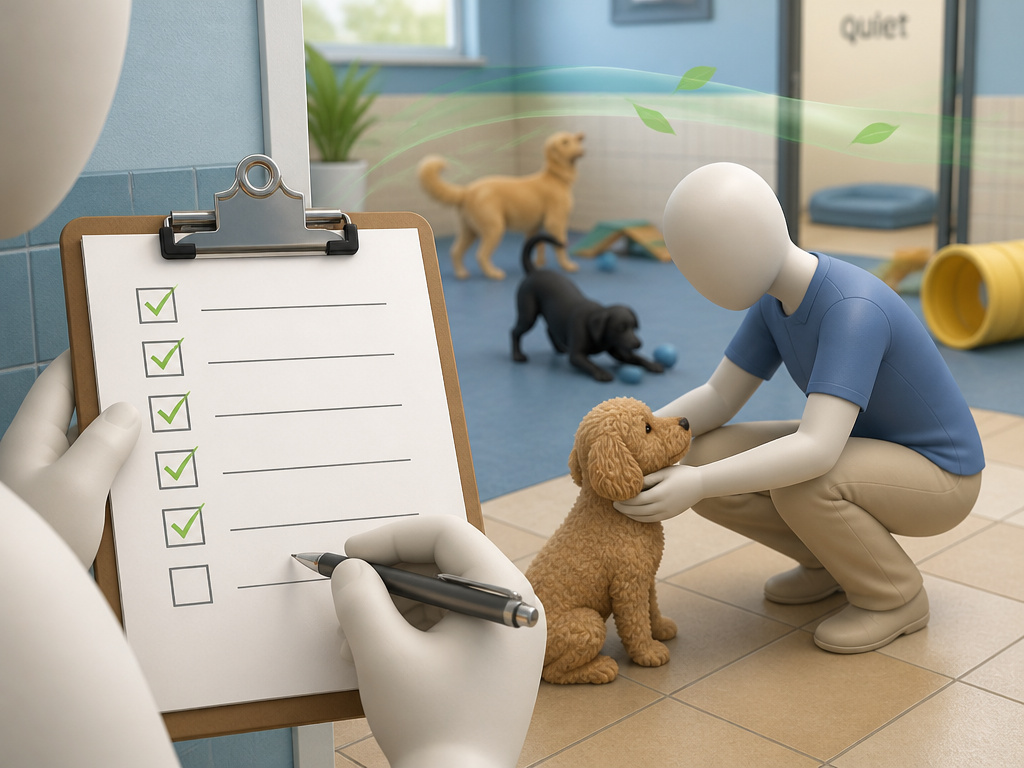
You’re standing in a tiled room at 9:15 on a Tuesday. Six dogs are already in, one is doing laps of the perimeter, and nobody has looked up yet. That’s your two minutes.
The AKC recommends visiting without your dog and simply observing the facility and how staff interact with the dogs. Turn up unannounced if you can. A scheduled tour shows you the building; an unscheduled one shows you the shift.
Smell is the fastest read. A room that hits you with ammonia at the door has been mopped, not cleaned. A room that smells of nothing much, with a faint note of dog, is being cleaned properly and ventilated between groups.
Then stand still and listen. Healthy play is stop-start: a burst of noise, then quiet while the dogs reset. Continuous frantic noise with no pause is arousal that nobody is managing.
Before you start: Ask for the bite policy before you ask for the tour. A facility that admits a dog with a known bite history at level 3 or above is putting your dog in that room. And check the vaccination record covers resident dogs as well as clients, because the guidance requires current vaccinations for both.
It’s the same instinct that should guide choosing a groomer: you’re judging the people and the handling, not the paint on the wall.
Then work through these in order:
- Watch the staff move through the group. Do they step over dogs or around them? A handler who walks through the middle of a play group and gets a calm response has the room.
- Ask where a dog goes when it’s overwhelmed. The guidance requires an area where any dog can avoid seeing other dogs and people if it chooses. If the answer is “he’ll be fine”, that’s a no.
- Ask about crating, and for how long. The AKC raises the question directly. None of the standards in this set give a maximum crate duration, so you’re relying on the answer you get.
- Ask what happens when a dog is sick or injured. SPCA Certified requires a separate isolation area and immediate contact with the owner or emergency contact.
The Assessment Question That Splits the Industry
The RSPCA’s licensing conditions put assessment before admission, which means a dog has to be seen before it can attend at all. The assessment checks whether the dog is scared, anxious or stressed around other dogs and people.
The AKC frames it slightly softer. It says the daycare should assess your dog’s behaviour and personality before accepting them, and notes that some facilities run a full behavioural assessment to customise care.
The practitioner guide goes further than either. Its green-light disqualifying factors include severe crate anxiety, discomfort in a group of dogs even where one-to-one play is fine, and extreme discomfort being handled by staff.
What a Good Assessment Looks Like
SPCA Certified requires new dogs to be introduced gradually, with the process monitored closely by at least two staff members. That’s the detail to listen for. One person doing an intake while also running a play group is not an assessment, it’s a glance.
When I was vet-shopping for my current dog, I called four clinics and asked one question: what’s your protocol if I call at 2 a.m. With a bloated dog? Two said go to the emergency clinic with no further detail. One gave me the address and said call ahead. That one got my business.
The same test works here. Ask what happens when a dog fails the assessment. A daycare that can describe the conversation, the reasons, and what it suggests instead has done this before and will do it again with your dog. It’s the same logic behind choosing a vet: the answer to an awkward question tells you more than the answer to an easy one.
I won’t book a daycare that can’t tell me about a dog it turned away. The ones that can are the ones that will call me at lunchtime if my dog is having a bad day instead of hoping I don’t notice.
10°C to 26°C, 85 Decibels, 50 Lux: The Numbers Nobody Asks About
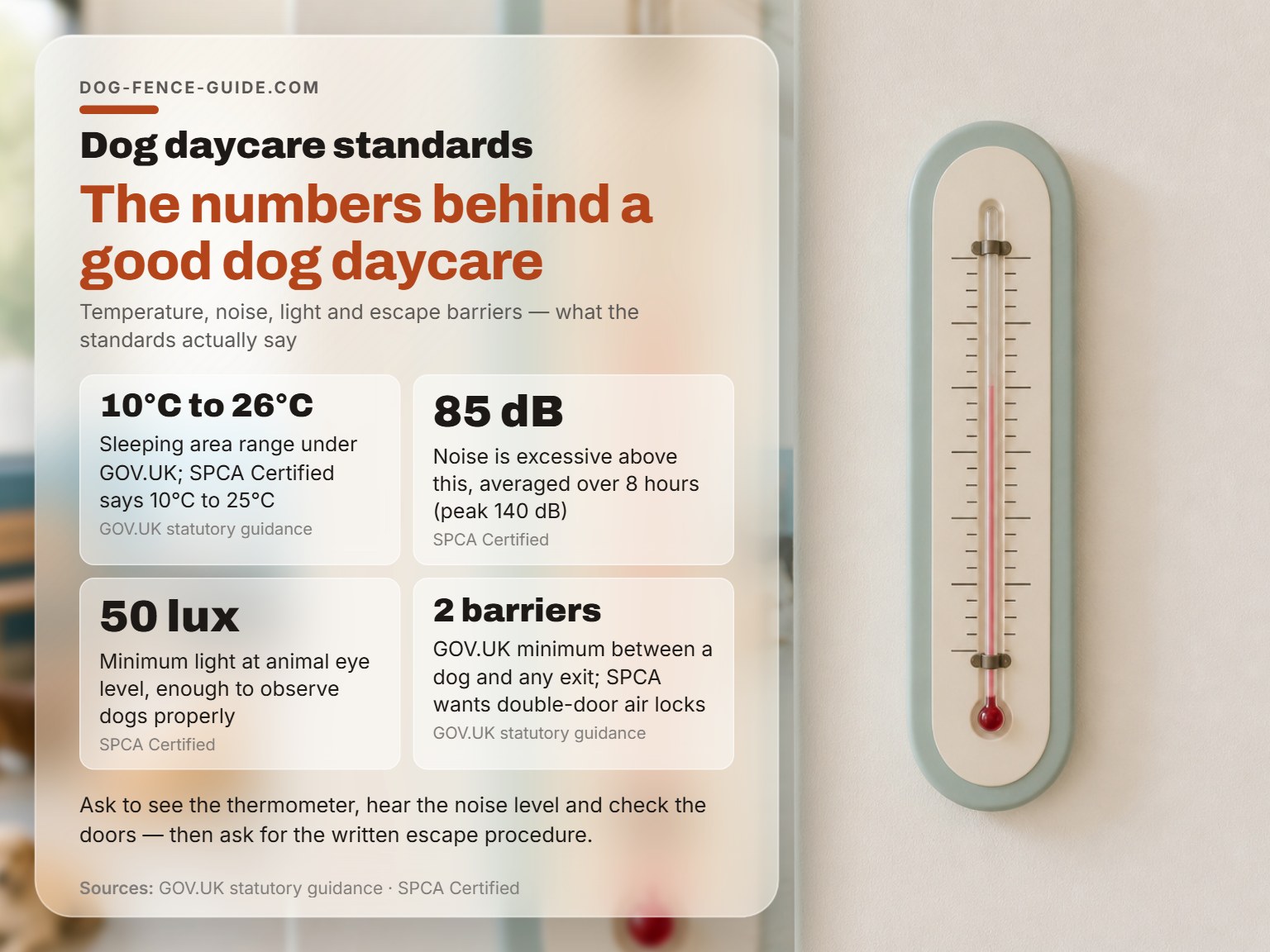
Twenty-six degrees Celsius is the ceiling for the area where dogs sleep under English guidance, and 10°C is the floor. SPCA Certified sets the range for most dogs at 10°C to 25°C, so the two documents disagree by one degree at the top.
Neither is a big deal on its own. Together they tell you the sleeping area should have a thermometer in it that someone actually reads. Ask to see it. A room that’s well above the maximum in July with a fan pointed at the staff desk is a room where dogs are panting through rest time.
Noise has a number too. SPCA Certified treats noise as excessive above 85 decibels averaged over 8 hours, or a peak above 140 decibels. If the room is loud enough that you have to raise your voice to be heard at normal conversation distance, that’s the environment your dog spends the day in.
Lighting is the one nobody thinks about: at least 50 lux at animal eye level, roughly bright enough to read a newspaper at arm’s length. Dim rooms hide problems. A handler can’t spot a limp or a lifted lip in a room where they can’t see colour properly.
Escape prevention splits the same way the temperature does. GOV.UK requires at least 2 secure physical barriers between a dog and any entrance or exit to the outer boundary. SPCA Certified goes further, requiring every external door to be a double-door air lock with enough space between the doors for one to close before the next opens, and every external door to be lockable.
Ask which one your facility has. Then ask whether there’s a written escape procedure and whether every staff member has been trained in it, because SPCA Certified requires both.
What Should You Ask About Breaks, Bites, and Overnight Stays?
Several short breaks through the day in individual crates is the green standard. One long mid-day break is yellow. Non-stop play, or an expectation that dogs will rest in the play area if they get tired, is red.
That last one is the most common answer you’ll get, and it’s the one to push back on. A dog that never gets to switch off spends the whole day in a low-grade stress state and comes home wired rather than tired.
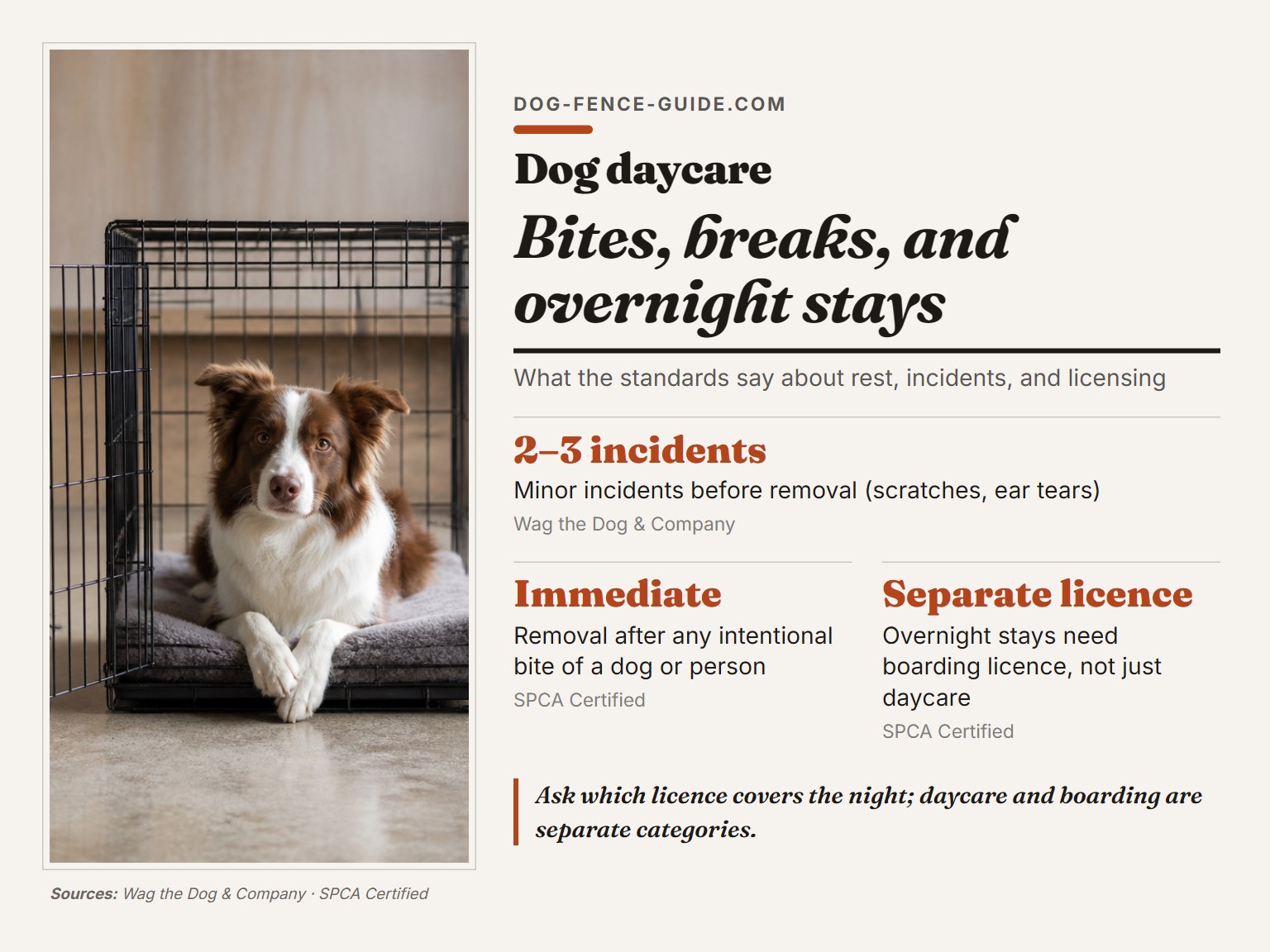
Incident policy has a number attached. The green standard is immediate removal after any incident causing puncture wounds, and removal after 2 to 3 incidents causing minor injuries like scratches or ear tears. SPCA Certified is blunter still: a dog that intentionally bites another dog or person is immediately removed from contact.
Then ask how fights get broken up, and listen for named tools. Break sticks, citronella spray, hoses. A facility that can describe the procedure step by step has thought about it. A facility that says “it doesn’t really happen” hasn’t.
Where this goes sideways: A daycare that also boards overnight without a boarding licence is operating outside its category. SPCA Certified’s daycare standard excludes overnight stays unless the facility is separately licensed as a registered boarding facility, and English day care licences cover day care only.
If you’re planning overnight stays as well, the questions change shape entirely, and boarding your dog for the first time is worth planning separately from daycare.
The Overnight Question
Ask which licence covers the night. Day care and boarding are separate categories in England, and a facility running both needs both. If nobody can tell you which licence applies after 6 p.m., you’ve found your answer.
Your Dog Does the Deciding
A daycare place buys you a safe building and supervised hours. It does not buy you a tired, satisfied dog. Those are different products and only one of them is on the price list.
I’ve watched dogs run fence lines for an hour after a full daycare day. The daycare didn’t fail. The dog got arousal instead of work, and arousal doesn’t drain, it compounds.
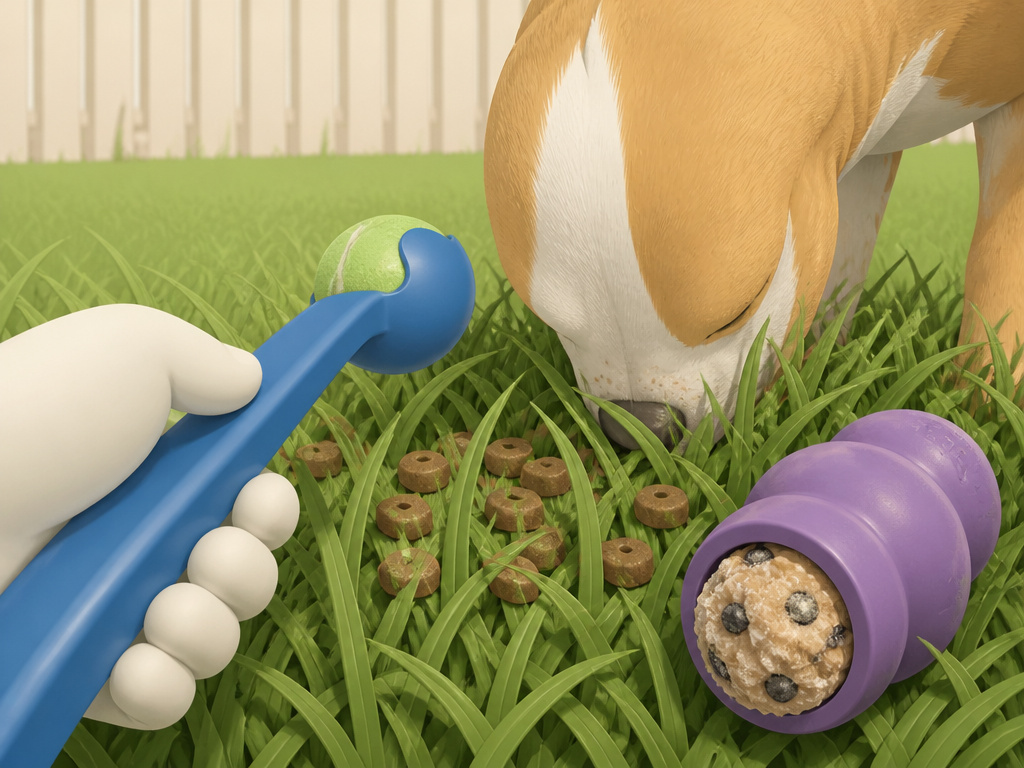
Treat the yard or the daycare room as a venue and plan short structured sessions inside it. Fetch, scent games, a flirt pole. Then watch how your dog uses the space during those sessions. A dog that patrols the boundary between throws is telling you something about what he needs.
For the sessions at home, a ball launcher lets you throw further with less arm, which matters when the point is to stop before the dog gets frantic rather than to exhaust him. A frozen food-stuffed toy is the better tool for rest time, and it’s worth asking whether your daycare uses food-stuffed toys during breaks. A room full of rawhide is a different philosophy from a room full of frozen Kongs.
Scent work is the underrated one. A puzzle feeder or a handful of kibble scattered in long grass tires a high-drive dog harder than another lap of the garden, and it does it without building the arousal that turns into fence-running.
If your dog needs structured work rather than free running, hiring a dog walker for one solo midweek walk often does more than adding a second daycare day. Two days of daycare and one good walk beats three days of daycare for most dogs I’ve met.
Frequently Asked Questions
Is dog daycare bad for dogs?
It’s bad for some dogs. A dog with severe crate anxiety, discomfort in a group, or extreme discomfort being handled by staff is a poor fit, and the industry guide lists all three as disqualifying factors. For a social dog that enjoys other dogs, a well-run daycare is a reasonable use of a working day.
How many dogs should there be per staff member at a daycare?
English statutory guidance says each member of staff should have 10 dogs or less to care for, with at least one full-time member of staff per 8 dogs at the higher standard. The industry’s practitioner guide treats 10 as amber, 10 to 18 as yellow, and 18 or more as red.
Do I need to visit a daycare before booking?
Yes, and visit without your dog. The AKC recommends observing the facility and how staff interact with the dogs before you commit. An unscheduled visit tells you more than a booked tour, because you see the shift as it actually runs.
What temperature should a dog daycare be?
English guidance puts the sleeping area above 10°C and below 26°C. SPCA Certified sets the range for most dogs at 10°C to 25°C. The two standards disagree by one degree at the top, so treat 25°C as the safer target and ask to see a thermometer.
Can a daycare refuse my dog?
Yes, and a refusal is often a sign the assessment is working. Assessment before admission is a licensing condition in England, and the industry’s green standard includes turning away dogs with severe crate anxiety or extreme handling discomfort. A facility that accepts every dog isn’t assessing.
The Bottom Line
Here’s the trigger I’d use. If a facility can’t produce a licence with a maximum dog number on it, or can’t tell you how many staff are on the floor at 10 a.m. On a Wednesday, stop the conversation there. Everything else you’re about to be told is marketing until those two things are in front of you.
The first thing to do this week is small. Ring three daycares and ask one question: how many dogs per staff member, and how many staff are in the building at lunchtime. The answers will sort themselves faster than any tour.
One concession, because it’s real. None of the standards in this set give a maximum crate duration, and that’s a genuine gap rather than something I’m keeping from you. If crating matters for your dog, you’re relying on the answer you get and on watching the rest area with your own eyes.
And a last thing I’d defend to anyone: a daycare that turns your dog away after an assessment has done you a favour. The ones that take everything are running a numbers business, and your dog is one of the numbers.
