
How to Stop a Dog Getting Into the Trash: 5 Steps
This post contains affiliate links. As an Amazon Associate, we earn from qualifying purchases.
To stop a dog getting into the trash, remove access rather than relying on training: put food waste in a small bin out of reach, keep the main bin latched or inside a cupboard, and check the bathroom, recycling, and compost too. VCA notes a drop command does not stop stealing behavior.
That caveat comes from VCA’s veterinary behaviorists, and it reshapes the whole how to stop a dog getting into the trash question. If a trained command can’t stop the raid, the barrier has to be physical, and it has to be one you’ll still maintain on a wet Tuesday when you’re running late for work.
What follows is the setup I’d build in any kitchen with a food-motivated dog: the two-bin system, a five-step rollout, an honest look at which bins survive a determined dog, and the checklist for the morning it goes wrong.
Key Takeaways
- Two bins beat one locked bin. VCA suggests a small food bin out of reach plus a large bin for non-edible trash, which might totally deter food stealing.
- Latches belong on the cupboard. Peninsula Humane notes most dogs can nose a door open or pull a sliding drawer.
- Cut snack bags open before they go in. The FDA says a slit bag can’t seal around a pet’s nose and mouth.
- Check the bathroom bin and the bag by the back door. Access is often easier there than in the kitchen.
- Call the vet before symptoms start if medication, a sharp object, or an unknown item is missing.
The Two-Bin Setup That Removes the Payoff
VCA’s behavior team suggests two containers in the kitchen instead of one. A small bin holds food waste and lives in a cupboard or up on a counter out of reach. A large bin holds non-edible trash and can stay out in the room.
The logic is straightforward. A dog raids the bin for food, so a bin with no food in it stops paying out. VCA notes this may totally deter food stealing, since the garbage is no longer accessible.
A food bin kept inside a closed cupboard removes the reward that drives raiding. Non-edible waste stays in a second, larger container left out in the room. Access to edible scraps is eliminated at the source rather than defended at the lid. Garbage that holds no food holds no reason for a dog to investigate.
A lid that hasn’t seated gives a hollow clack when you let it drop. That sound is your cue to press down until it catches.
Here’s the part that gets skipped: the small bin only works if it is genuinely out of reach. A counter-height bin next to a chair is a bin at dog height.
Why Two Bins Beat One Locked Bin
One locked bin asks a single latch to do all the work. VCA’s two-bin approach removes the reward instead of defending it.
Three things defeat a single bin. An overfull bin holds the lid open, and Dr Duncan Houston notes the container needs enough capacity that waste doesn’t stop the lid closing. A pedal gets discovered. A heavy bin still tips.
A second barrier helps. Houston suggests a pantry, utility room, or cupboard, provided everyone closes it and the dog can’t work the latch. If you’re replacing the container anyway, the garbage cans for dogs shortlist covers latched and weighted options.
Weight in the bottom is the cheap version of the same idea. PetMD suggests bricks, stones, weights, or sand in a bag. A tip-resistant trash can with sand in the base does the same job with less fiddling.
Why Do Dogs Raid the Trash When They’re Well Fed?
Smell is the honest answer. A bin that held chicken bones on Sunday still smells like chicken bones on Tuesday, and your dog reads that from the hallway.
Beyond smell, Anti-Cruelty lists two common drivers: constant hunger and plain boredom. If hunger looks like the cause, they suggest a vet exam to rule out health problems and a diet conversation, plus smaller, more frequent meals through the day.
For boredom, the fix is exercise and something legal to destroy. A well-exercised dog with plenty of chew toys is less likely to raid the bin, and redirecting destructive chewing onto appropriate items does more than any lid.
PetMD’s experts take the same line from a different angle. Caryl Wolff suggests tiring the dog out, leaving toys, and feeding him before you leave him alone.
That’s where the sources split on emphasis. VCA and Peninsula Humane treat management as the primary fix and say training cannot stop the behavior, while PetMD leads with exercise, distraction, and feeding the dog before leaving. PetMD leads with exercise, distraction, and a full stomach. Both are describing layers of the same setup.
A dog that raids the bin usually counter surfs the same kitchen for the same reason. Close one opportunity and the other gets tested.
When I walk a house at dog height, the bin is rarely the first thing I notice. It’s usually the cupboard door that doesn’t quite catch.
How to Stop a Dog Getting Into the Trash: 5 Steps in Order
Access first, habits second, supervision third. Work down the list and don’t skip ahead, because each step covers a gap the one above it leaves open.
Before you start: Three things in a raided bin can hurt a dog fast. Snack bags can seal over the nose and mouth, so cut them open before discarding. Corn cobs and bones can block the gut. Discarded cleaning supplies can poison. Fix access before you fix habits.
- Move the food waste out of the bin. Put scraps in a small container inside a cupboard, or in Tupperware or a bread bin per Anti-Cruelty. Skip this and the main bin keeps paying out every night.
- Fit a child latch to the cupboard. Peninsula Humane recommends a child cabinet latch or lock, because most dogs can bump a door open with a nose or pull a sliding drawer. Without it, the latch on the lid is doing nothing at all.
- Take the trash out after any food goes in. PetMD suggests bagging scraps after dinner and moving them to the garage or dumpster so the smell doesn’t sit there overnight. Skip it and you’ve laid a scent trail for tomorrow.
- Cut bags open and keep the liner inside the rim. The FDA says to cut snack and cereal bags down the side before discarding. Houston adds that bags should sit inside the container rather than hanging over the rim where a dog can pull them.
- Watch the dog around the new barrier. A new barrier is only a hypothesis until you’ve seen your own dog test it.
Fair warning. I learned that last step the slow way with fencing. The install felt like the finish line, and it wasn’t. Watching the dog around a new barrier is where you find out whether the barrier actually holds, and that lesson carried straight over to a kitchen bin.
Which Trash Can Actually Keeps a Dog Out?
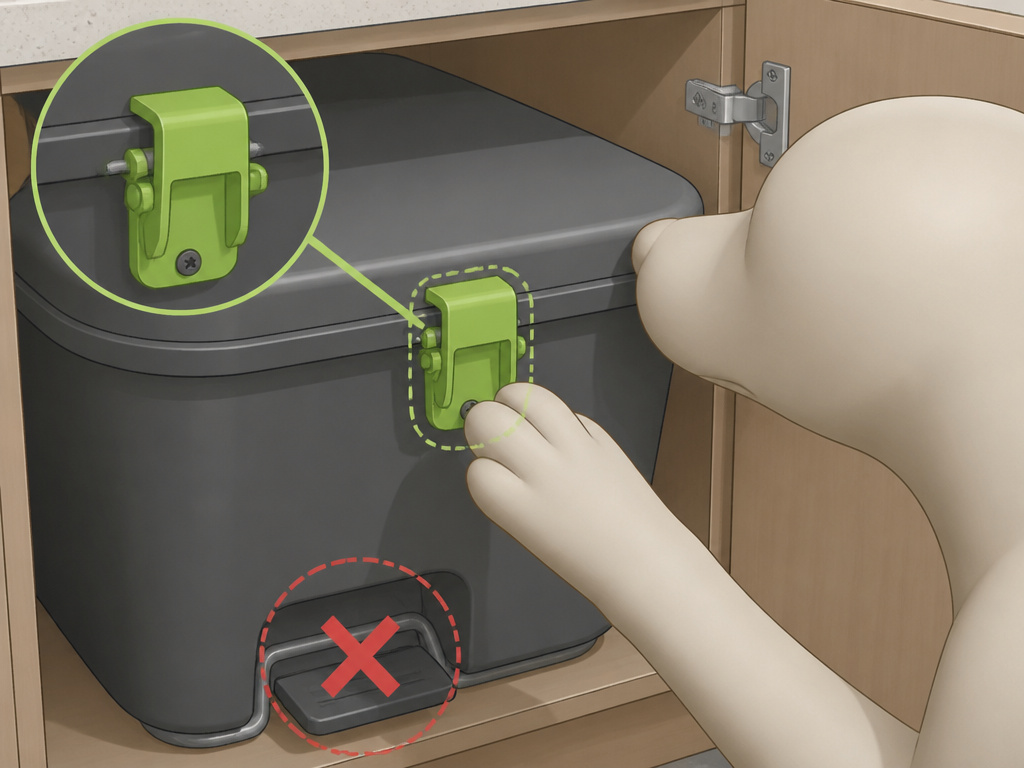
The FDA’s rule is a secure lid your pet can’t open. Dr Duncan Houston’s rule is to treat “pet-proof” as a claim to test in your own layout, not a guarantee. Both are correct, and the gap between them is where most purchases go wrong.
| Bin type | What it stops | Where it fails |
|---|---|---|
| Plain latch, no pedal | A nose or a shove | A determined paw works the latch |
| Pedal bin | Casual nosing | The pedal gets discovered |
| Sensor bin | Hands-free opening | Sensor can’t tell dog from person |
| Heavy weighted bin | A shoulder barge | Still tip-able, and awkward to empty |
| Cupboard bin with child latch | The whole container | Someone leaves the latch open |
A motion sensor cannot reliably tell a person from a dog, so a sensor lid opens for the wrong customer. A heavy bin can still be tipped. A pedal can be discovered.
Pedal, Sensor, or Plain Latch: Pick the Boring One
I’d take a plain positive latch inside a cupboard over any sensor lid, every time. A sensor lid that opens on a passing shadow will also open on a passing dog.
A step can puts the pedal at the height a curious nose investigates, which is exactly the failure Houston describes. The latch is fine. The access point is the problem.
If you want to compare specific models, this dog-proof trash can breakdown covers the ones that survive a determined dog, and the locking trash can options are worth reading before you commit to a design.
The Trash Hazards That Send Dogs to the Vet
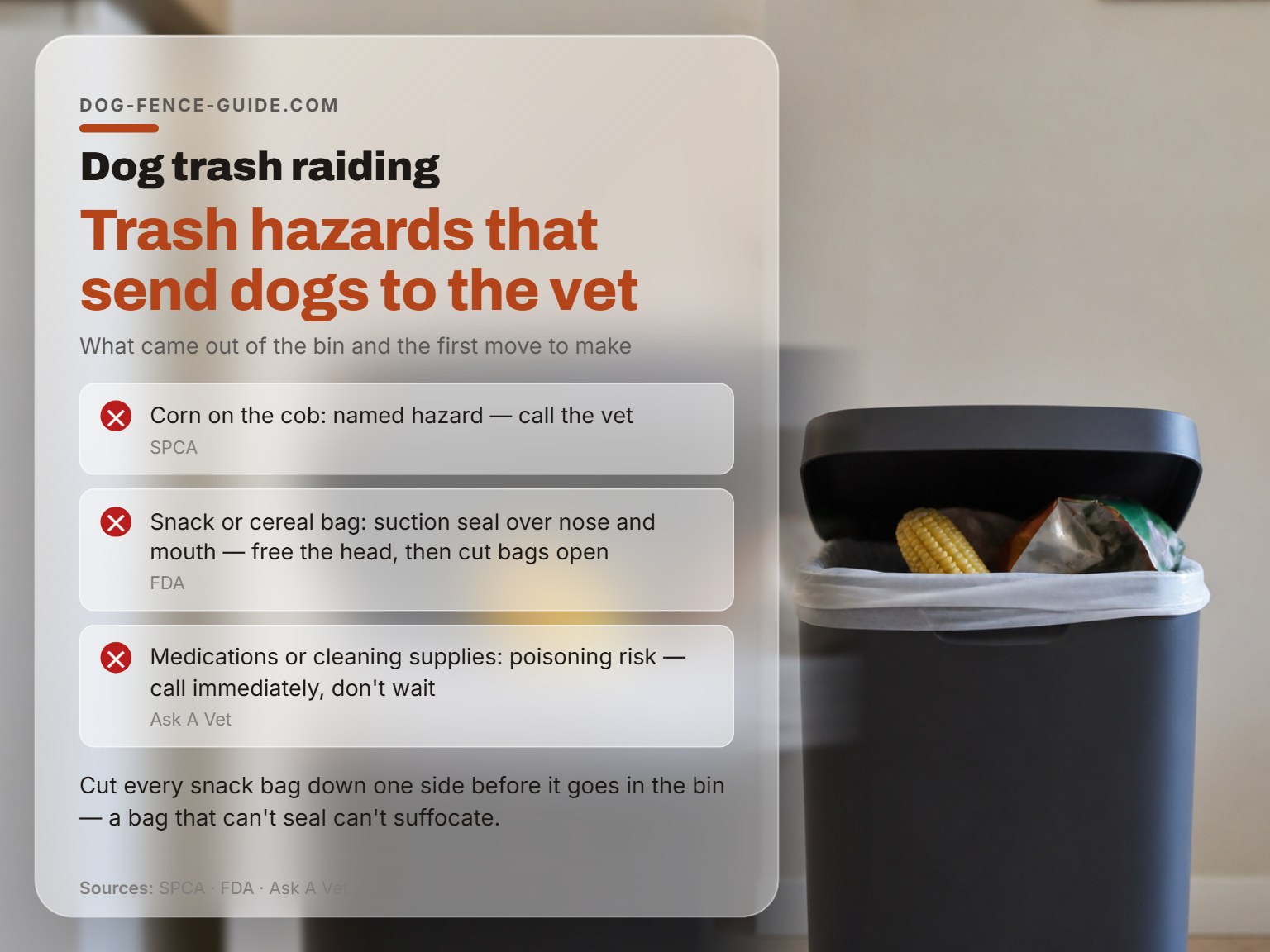
Corn on the cob. Peninsula Humane names it specifically, because some discarded items cause serious problems rather than a messy floor.
That’s the part most bin advice misses. Raiding isn’t only a mess problem, and a lid that closes doesn’t solve a toxicity problem.
| What came out of the bin | Why it matters | First move |
|---|---|---|
| Corn cob, bones | Blockage risk in the gut | Call the vet |
| Xylitol gum or candy | Named toxin in PetMD’s list | Call poison control |
| Snack or cereal bag | Suction seal over nose and mouth | Free the head, then cut bags open |
| Wrappings and packaging | Can block the intestinal tract | Watch closely, then call |
| Medications, cleaning supplies | Poisoning risk | Call immediately, don’t wait |
PetMD’s Caryl Wolff lists poisons, string, xylitol gum and candy, bones, and rotting food as the common finds. Dr Allison Witherow adds that wrappings and packaging can create blockages, and that discarded kitchen cleaning supplies present a poisoning risk if a pet licks them.
The Snack Bag Problem Nobody Warns You About
A snack bag is a different kind of hazard. The FDA explains that snack, cereal, and food-storage bags are made from Mylar (PET), aluminum-laminated polypropylene, HDPE, and LLDPE, and those materials make a bag light and flexible.
That flexibility turns dangerous. A panicking pet breathes faster, the bag collapses and shrink-wraps around the nose and mouth, and the suction effect is strong enough that the pet can’t paw it off.
Cut every snack bag down one side before it goes in the bin. A bag that can’t seal can’t suffocate, and the knife takes two seconds. The FDA pet snack bag safety page suggests cutting it into pieces the way you’d cut up an old credit card.
What to Do If Your Dog Already Ate Something From the Bin
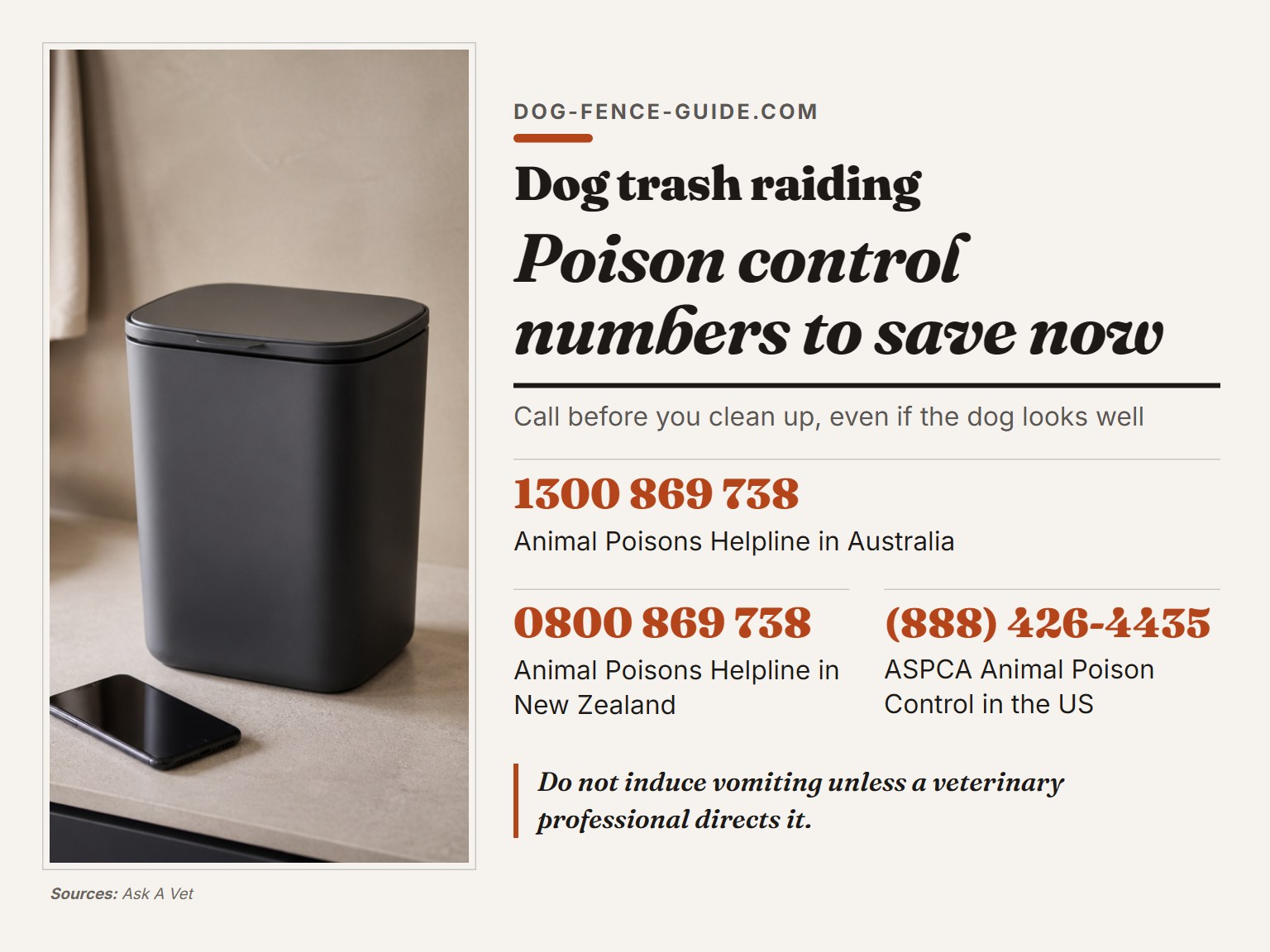
Call before you clean up. Houston is direct about this: don’t wait for symptoms after a suspected hazardous ingestion, even if the dog looks well.
Work through this in order:
- Identify what’s missing. Witherow says to make a list of any known toxins or medications, and estimate the amount and strength.
- Save the evidence. Keep packaging or take a photograph, estimate how much is gone, and note the time.
- Don’t induce vomiting. Both PetMD and Ask A Vet say the same thing: never induce vomiting or give a home remedy unless a veterinary professional directs it, because some substances become more dangerous that way.
- Move the dog away from the rest of the waste. Houston suggests this in the same breath as calling.
- Call if the dog looks ill, even when nothing obviously toxic was in the bin, per Witherow.
Keep these numbers where you can find them in a hurry. Animal Poisons Helpline in Australia is 1300 869 738. New Zealand is 0800 869 738. ASPCA Animal Poison Control in the US is (888) 426-4435.
Save the poison control number in your phone before you need it. In the moment you’ll be scrolling with one hand and holding a dog with the other.
Where Else Dogs Get In: Bathroom Bins, Recycling, and the Bag by the Door
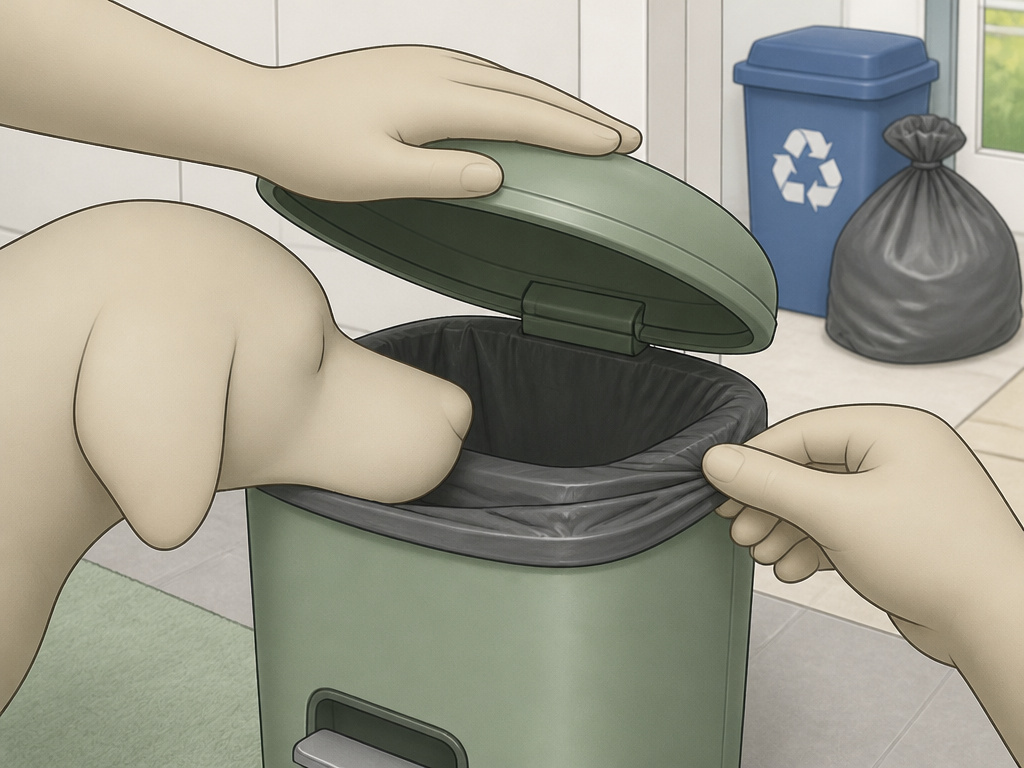
The kitchen bin is latched, the cupboard is shut, and the dog is still finding something. Houston lists the rest of the circuit: bathroom bins, recycling, compost containers, and rubbish bags waiting beside the back door.
The bathroom bin deserves its own mention. PetMD points out that it sits lower to the ground and may not have a lid at all, so access is likely easier there than in the kitchen.
Run this check once and fix whatever fails:
- Bathroom bin: does it have a lid, and is it behind a closed door?
- Recycling and compost: same question, and does the dog reach them when you’re out?
- The bag by the back door: is it inside a container, or sitting loose?
- The liner: is it tucked inside the rim or hanging over it?
- The fill line: is the bin overfull enough to hold the lid open?
An odor control trash can helps in the rooms where you can’t take the trash out daily, because the smell is what brings the dog back.
Then there’s the crate question, and the sources genuinely disagree on sequencing. VCA treats confinement as a first-line control: keep the dog in an area it cannot get out of. Peninsula Humane treats the crate as a fallback, suggesting you dust off an old crate and start using it again if health and well-being are at stake.
In my own house the gate lives at the kitchen doorway, not around the bin. Door and gate management does more work than any single product, and it takes no equipment.
Frequently Asked Questions
Will a locking lid alone stop my dog?
Probably not. The FDA’s standard is a secure lid your pet can’t open, but Houston warns that a lid which looks secure to a person may open with a nose, a paw, or a shove. A lid is one layer. The cupboard, the latch, and the routine are the others.
Is it cruel to crate my dog to keep him out of the trash?
Vets don’t frame it that way. VCA lists confinement as a legitimate first-line control, while Peninsula Humane treats the crate as a fallback, suggesting returning to it if the dog was previously crate trained and its health is at risk. The crate is a management tool, not a punishment, and it works best alongside the other steps.
My dog only raids the bin when I’m alone in the house. Why?
Because that’s when the opportunity exists. Peninsula Humane points out that since you’re away when it happens, there isn’t much training that can be done around the behavior, so management is the practical answer. Fix access rather than trying to catch the dog in the act.
Should I punish my dog for getting into the trash?
Anti-Cruelty is clear that punishing after the fact does no good, because the dog can’t connect the correction to something that happened earlier. React in the moment instead: clap your hands, say “Off!” in a firm tone, and lead the dog out of the area. VCA’s version is to skip the chasing game entirely and use a “leave it” command with a bitter spray on the object.
Do motion-triggered sprays work on bins?
Anti-Cruelty suggests environmental punishers such as a motion-triggered spray like Ssscat, and notes the same caveat that matters most: don’t use them if your dog appears nervous or skittish. Houston’s warning applies too, since a motion sensor can’t reliably tell a person from a dog.
What if I have no idea what my dog ate?
Call anyway. Houston says not to wait for a full symptom checklist before phoning, and to report any vomiting, diarrhea, abdominal discomfort, weakness, or changes in breathing. Witherow’s advice is the same: even when the items aren’t obvious toxins, a dog that’s acting ill needs a vet.
The Bottom Line
If you do one thing this week, fit a child latch to the cupboard where the food bin lives. That single change closes the gap most households leave open, and it takes about as long as hanging a picture frame.
Everything after that is maintenance. Take the scraps out after dinner, cut the bags, keep the liner inside the rim, and glance at the bathroom bin on your way past.
One honest limit: a determined dog will test every latch you own. VCA puts confinement first, Peninsula Humane treats the crate as a fallback, and both are describing the same wall from different sides.
The honest answer to how to stop a dog getting into the trash is a closed cupboard and a boring routine. Peace of mind is the real goal, and it usually arrives through a door that clicks shut rather than a clever bin.
