
How to Stop a Dog Chewing: Step-by-Step
This post contains affiliate links. As an Amazon Associate, we earn from qualifying purchases.
To stop a dog chewing, find the driver before you correct anything. Teething starts at about 12 weeks of age, adolescent exploration runs from seven to 12 months, and boredom or anxiety can restart the habit later. Then remove access, swap in a correctly sized chew, and reward the swap every time.
Those two age windows explain most of the confusion around how to stop a dog chewing. A puppy chewing a chair leg at twelve weeks is running a teething program it can’t switch off. A nine-month-old doing the same thing has usually been rehearsing a habit for months, and the fix looks nothing alike.
What follows is the order I work in: identify the driver, take the rehearsal out of the room, then match the chew to the dog’s size and jaw. The tables below show where the welfare charities and the veterinary bodies contradict each other, because they do, and it changes what you do on day one.
Key Takeaways
- Work out the driver first. The RSPCA is blunt about it: stopping a dog without understanding why it chews can create more problems than it solves.
- Management beats correction for the first two weeks. Remove access to the things you don’t want chewed before you teach anything at all.
- Size the chew to the dog, not the packet. AAHA’s rule is bigger than the snout and slightly wider than the mouth.
- Skip the hammer-test failures. Bones, antlers, yak milk chews and rawhides can fracture teeth.
- Reward the swap every single time. Praise when the dog picks up the right object and the right object becomes the default.
Why Your Dog Chews: Five Reasons, Five Different Fixes
Chewing is normal dog behaviour. The RSPCA’s knowledgebase is explicit that dogs should be given opportunities to chew, and that chewing supports both physical and mental health. It only becomes a problem when it’s excessive, when the dog injures itself, or when it wrecks the house.
Between roughly three and six months of age, a puppy’s needle teeth are replaced by permanent adult teeth. The gums swell and ache as each tooth erupts, and chewing applies counter-pressure that relieves some of that discomfort. This is a developmental process with a start, a peak, and an end.
The mistake is treating all five drivers below as one behaviour with one fix.
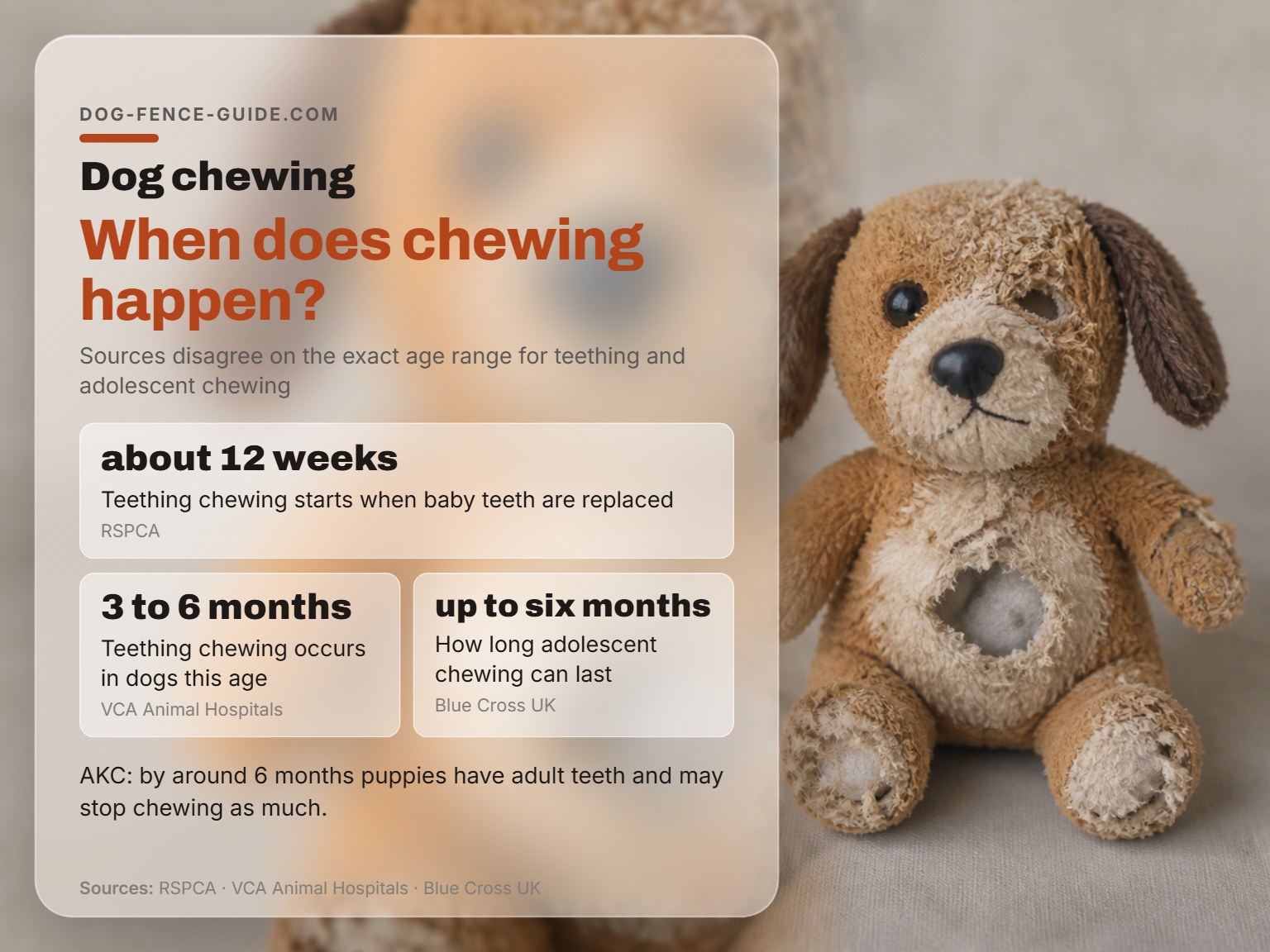
- Teething. The RSPCA puts the start at about 12 weeks, when baby teeth give way to permanent adult teeth. VCA Animal Hospitals describes the same phase as running from three to six months.
- Adolescent exploration. Blue Cross UK places this between seven and 12 months and says it can last up to six months. It happens after the puppy teeth are gone, which makes it a separate event.
- Boredom and under-exercise. The AKC ties adult destructive chewing to too little exercise and mental stimulation, and notes boredom can restart the habit after teething ends.
- Anxiety and stress. The RSPCA lists separation anxiety, frustration and loneliness among the underlying issues that drive excessive chewing.
- Hunger, food-seeking, or pain. VCA describes garbage raiding as self-rewarding, and the AKC flags mouth, teeth or gum pain as a cause worth a vet visit.
Look at how different the fixes are. A teething puppy needs cold, soft textures and time. A bored adolescent needs a job and a longer walk. A dog with gum pain needs a vet, and no amount of redirection will touch that.
That’s why the RSPCA’s first instruction is to work out why the dog is chewing before doing anything about it. Their guidance warns that punishing a dog, or stopping the chewing without understanding it, can lead to more problems than it solves.
When Does Teething Chewing Actually Start?
The sources give four different answers, and all four are describing something real. Puppy teething and adolescent chewing are two separate events with two separate timelines.
| Source | Age window | What it describes |
|---|---|---|
| RSPCA | About 12 weeks | Baby teeth replaced by permanent teeth |
| VCA Animal Hospitals | 3 to 6 months | Teething chewing on household objects |
| AKC | Around 6 months | Adult teeth in; chewing may drop off |
| Blue Cross UK | 7 to 12 months, lasting up to 6 months | Adolescent exploratory chewing |
Read those together and a pattern appears. Puppy teething runs roughly from three to six months, with the RSPCA pinpointing the start at about 12 weeks. Adolescent chewing picks up after that and, per Blue Cross, can run another six months on top.
So don’t assume the problem ends when the adult teeth arrive. The AKC notes many puppies chew less once those teeth are in around six months, but boredom can restart the habit. Blue Cross describes a whole second phase that begins after the puppy teeth have already fallen out.
If you’re in the middle of the first phase right now, the practical work for a teething puppy is mostly about cold, soft textures and close supervision.
How to Stop a Dog Chewing: The Two-Week Management Plan
Before you teach the dog anything, take the rehearsal out of the room. A dog that keeps practising the wrong behaviour is getting better at it every day, and no training plan outruns that.
Before you start: Three hazards matter here. Swallowed pieces of toy or stuffing can cause an intestinal blockage, per AAHA. Hard chews like bones and antlers can fracture teeth. And keep grapes out of reach entirely, because AAHA notes they’re toxic to dogs and can lead to kidney failure.
What to Remove Before Anything Else
- Wallets, remotes, and anything carrying your scent. The AKC points out that items with human smell on them are especially appealing, and Blue Cross names wallets and scissors as things to move out of reach.
- Cords, shoes, and soft toys left on the floor. Blue Cross recommends picking up easily destroyed soft toys at the end of the game rather than leaving them down.
- Anything you can’t supervise access to. The AKC’s line is the one worth memorising: the only 100% effective way to save your possessions is to keep them out of reach.
If you’d rather not move every object in the house, an anti-chew spray can help on specific pieces of furniture. Read the deterrent section below before you buy one, though. Deterrents are a supplement. The management plan is the plan.
The Two-Week Sequence
- Days 1 to 3: confine when you can’t watch. Use a crate or a gated dog-proof room, which the AKC recommends for dogs that destroy upholstered furniture. Skip this and the dog gets a free rehearsal every time you leave the room.
- Days 1 to 3: tether or pen when you’re half-distracted. A leash clipped to your belt keeps the dog where you can actually see it. Without that, “supervision” quietly becomes “occasional glances.”
- Days 4 to 10: one or two unfamiliar chews a day. Blue Cross suggests leaving out one or two chews the dog hasn’t seen for a while, then praising gently when the dog picks one up. Rotate them or the dog stops caring.
- Days 4 to 10: swap, don’t scold. When the dog grabs something forbidden, quietly move its attention to an acceptable chew and make a fuss when it starts chewing. Blue Cross is specific about the order: redirect first, praise second.
- Days 11 to 14: give one room back. Restore access a room at a time and watch what happens. If the old behaviour returns, you moved too fast.
Public bodies publish longer versions of this too, including a puppy chewing behavior fact sheet from the South Australian government.
If furniture is the specific target, this is essentially puppy chewing furniture training with a narrower focus: block access to the couch and reward the chew that’s already on the floor.
What to Give Them to Chew (and What to Take Away)
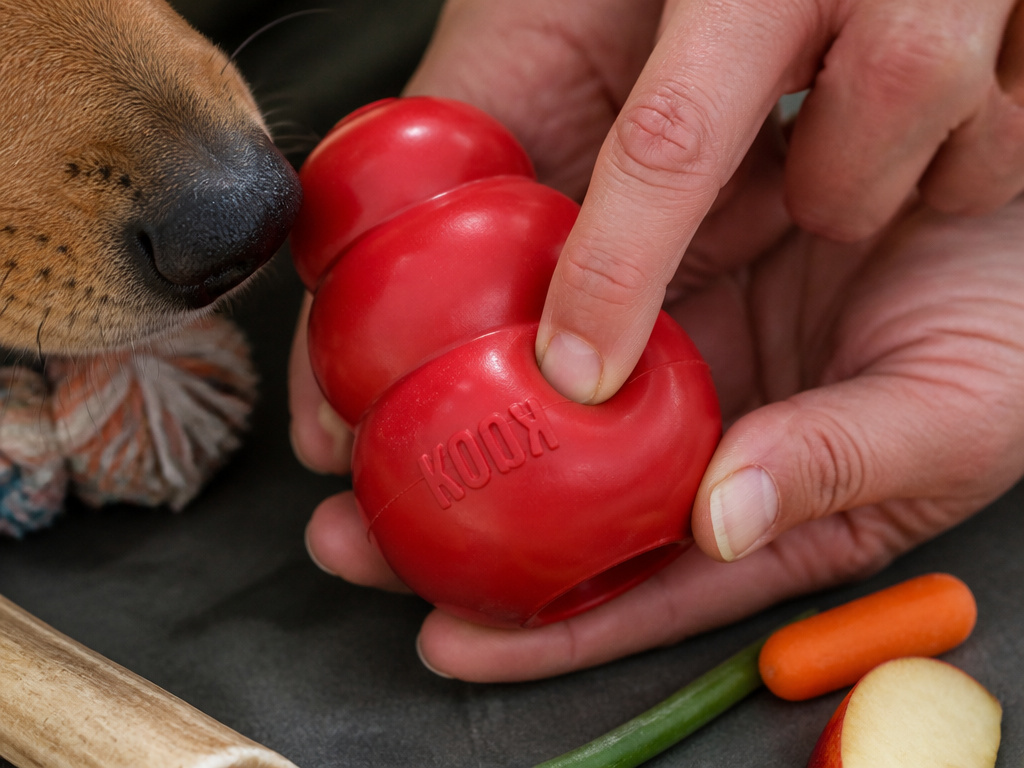
Blue Cross draws a line most owners blur: toys and chews are different objects with different jobs. Toys get thrown, chased, squeaked and tugged. Most aren’t built to be chewed, and the ones that are get called chew toys for a reason.
Blue Cross names Kongs and activity balls as the exceptions. A firm rubber KONG is the one Blue Cross reaches for, because it’s hollow, stuffable, and survives a serious jaw. If your dog has already destroyed a classic red one, get a firmer rubber version built for that.
| Check | AAHA’s rule | Why it matters |
|---|---|---|
| Size | Bigger than the dog’s snout, slightly wider than the mouth | Too small and it can slide back behind the molars |
| Aggressive chewer | One size above the recommended range | Standard sizing assumes a moderate chewer |
| Hardness | If you can’t drive a nail through it, it’s too hard | Enamel fractures on bone, antler and yak milk chews |
| Durability | The dog shouldn’t be able to rip it apart easily | Ingested pieces and stuffing can block the intestine |
The AAHA Don’t Chew On This resource is where those sizing rules come from, and the hardness test is the one people skip. Run a fingernail across the surface of a chew. If it doesn’t give at all, it belongs in the same category as a bone.
A chew should be bigger than your dog’s snout and slightly wider than its mouth. If you can’t drive a nail through it, it’s too hard to be in the dog’s mouth at all.
Here’s where the sources genuinely split. The RSPCA lists hard chewing materials among safe objects to chew, provided there’s adequate supervision. AAHA goes the other way and names bones, sticks, rocks, yak milk chews, antlers and rawhides as things that can damage or fracture a dog’s teeth. Both positions come from credible bodies, and the gap between them is supervision plus how hard your particular dog’s jaw is. For a dog that has already cracked a tooth, I’d take AAHA’s side without hesitating.
Common mistake: Buying the size printed on the packet for a dog that destroys everything. AAHA’s guidance is to go one size above the recommended range for an aggressive chewer, and the packet has never met your dog.
If your dog sits at the top end of that scale, chews for aggressive chewers are a different shopping list entirely. The short version is durable chew toys that pass the nail test, sized up one range, and rotated so they stay interesting.
Low-risk food chews are worth keeping in the rotation as well. AAHA lists baby carrots, green beans, apple slices and blueberries as safe options. Grapes are the one to keep away, since AAHA notes they’re toxic to dogs and can lead to kidney failure.
I’d also skip rope toys for a heavy chewer. They fray into strings, and swallowed string is exactly the kind of thing the blockage warning is about.
Why Punishment Backfires (and Where the Sources Disagree)
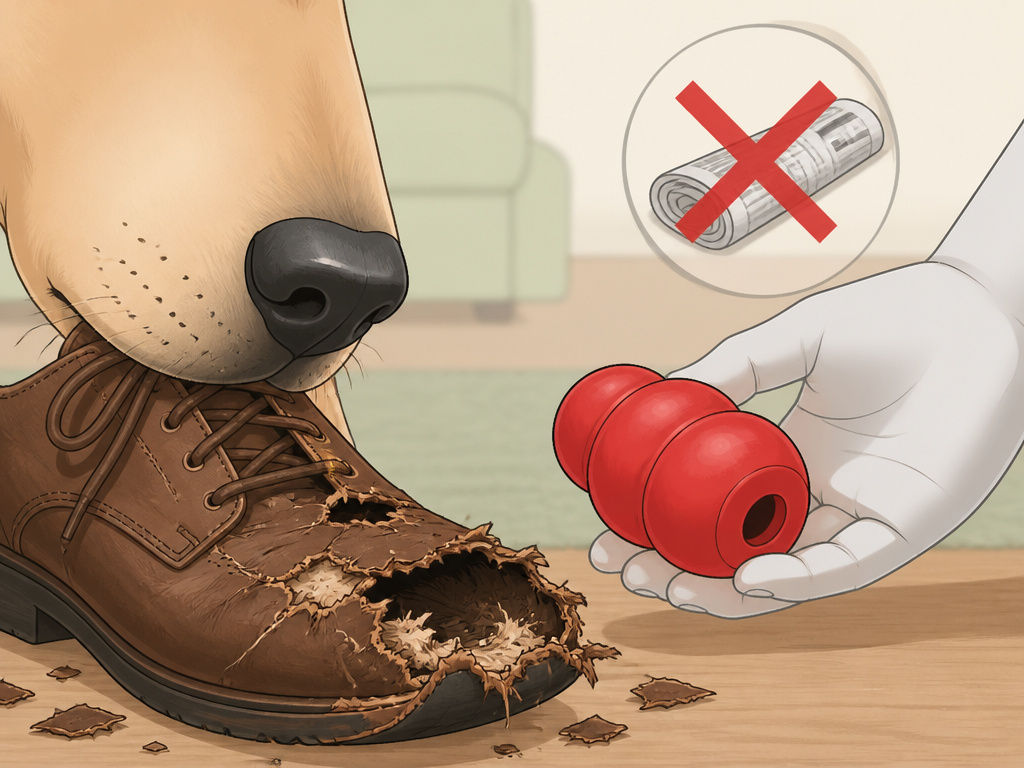
Two credible bodies give opposite advice on interrupting a chew, and pretending they agree doesn’t help you.
| Source | Position on interrupting a chew | What it means in practice |
|---|---|---|
| RSPCA | Punishing, or stopping the dog without understanding why, can lead to more problems | Fix the driver first, then reward the right object |
| VCA Animal Hospitals | Ignoring the dog or using a device to interrupt may help exploratory chewers | Interruption is an option, not a default |
| AKC | Distract with a sharp “Eh!”, then redirect cheerfully | Interrupt and immediately offer the alternative |
| Trainer consensus (anecdotal) | Yelling “No!” can reinforce the behaviour by paying attention to it | Don’t turn the chew into a game |
Owners ask me to skip the management phase and just correct the dog hard every time it picks something up. I won’t do it anymore. I’ve watched that shortcut produce a fearful dog and a result that collapses the moment you stop watching, which is the same failure I’ve seen with containment collars turned up too high. The dog learns one thing: don’t chew while the human is in the room. Take the human out of the room and nothing has changed.
The RSPCA’s position is the strongest version of this argument. Their guidance says punishing a dog for chewing, or stopping it without understanding why, can lead to more problems. The AKC stop dog chewing advice lands in the same place from a training angle: redirecting a dog to an appropriate chew toy is more effective than punishment.
VCA is the outlier, and it deserves a fair read. Their clinical guidance says ignoring the dog, or using a device to interrupt the chewing, may be useful for exploratory chewers. That’s a narrower claim than “punish the dog.” It’s aimed at a specific driver, and it sits alongside their own advice to provide exercise, play and exploration first.
I won’t correct a dog for chewing something it was allowed to reach. That’s my failure, not the dog’s. Fix the room first, then fix the behaviour.
If the chewing is aimed at hands and clothing rather than objects, that’s a separate problem, and it overlaps with how you stop a dog from biting. The principle holds either way: don’t let your reaction become the reward.
Do Chew Deterrent Sprays Actually Work?
Sometimes, on some dogs, for a while. That summary comes from Blue Cross rather than from me.
Blue Cross says spraying an object with a taste deterrent such as Bitter Apple can discourage adolescent chewing, but only in some dogs, and the object needs frequent respraying to keep the taste unpleasant. They also say plainly that spraying doesn’t cure a chewing problem and the rest of their advice still applies.
VCA endorses taste deterrents and adds a caveat the charity guidance leaves out: many pets have to be conditioned in advance to dislike the smell or taste. In other words, the spray does nothing to a dog that hasn’t learned to hate it.
If you want to try one, chew deterrent sprays are worth a look for specific objects rather than as a whole-house strategy. A bitter spray on a chair leg is a reasonable last line of defence. It’s a poor first one.
How Much Chewing Is Too Much?
Excessive chewing usually points at a cause you haven’t found yet.
The RSPCA says excessive chewing can reflect an underlying issue such as separation anxiety, frustration, loneliness, hunger, insufficient exercise, or physical health problems. The AKC adds mouth, teeth and gum pain to that list and suggests asking your vet. When the chewing looks like one of the patterns below, treat it as a symptom.
- Only when you’re out. VCA suggests setting up a videotape to see whether anxiety is the driver. If it is, the anxiety needs treating and the management plan won’t touch it.
- Doorways and crate doors. VCA reads this as an escape attempt rather than exploration, and says the confinement area may need to change rather than be enforced harder.
- The bin and the kitchen counter. VCA calls food raiding self-rewarding, which means redirection alone won’t touch it. Supervision, keeping food out of reach, and booby traps are the levers.
- Suddenly, in an older dog. The AKC flags mouth, teeth or gum pain as a possible cause and recommends a vet check before anything else.
VCA’s diary suggestion is the cheapest diagnostic tool here. Note when the chewing happens, what came immediately before it, and what you did when you caught it. Patterns show up fast.
One thing to be honest about: nobody has a clean number for how long adolescent chewing lasts. Blue Cross says up to six months, and that’s about as precise as the field gets.
The Daily Routine That Actually Holds
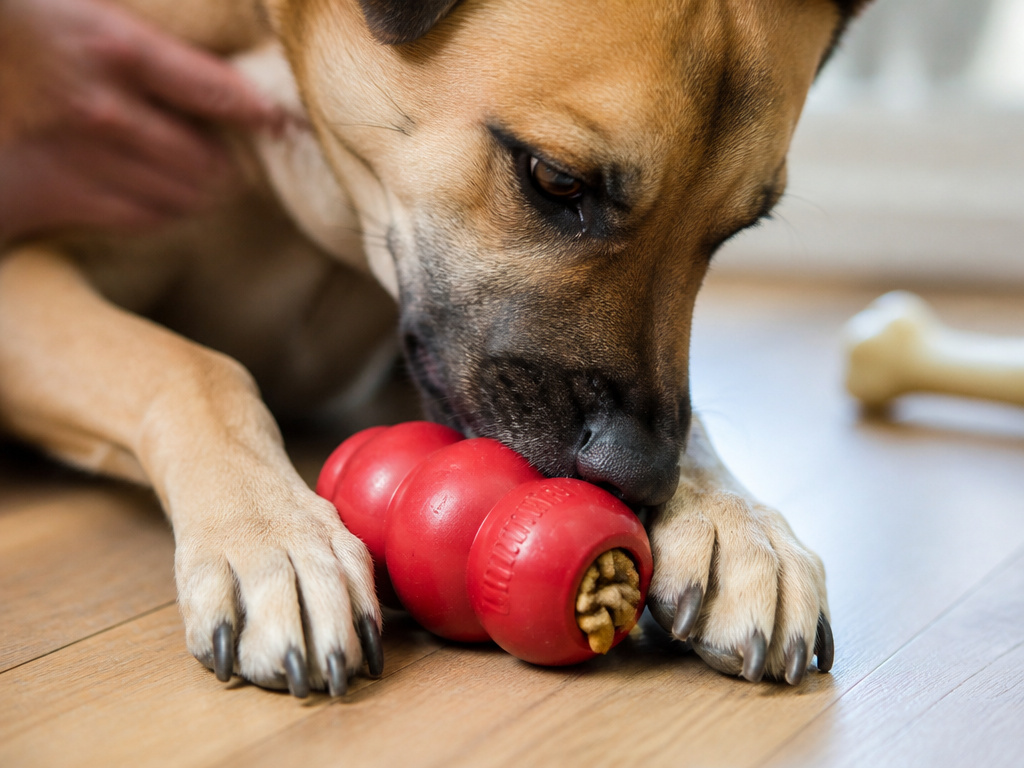
Once the two-week block is done, the routine is what stops it sliding back.
VCA’s list of energy-expending alternatives is worth stealing wholesale: tug-of-war, retrieving, catching a ball or Frisbee, jogging, pulling a cart, flyball, or a long walk. Pick two and do them daily. A tired dog chews less, and that’s the least controversial claim here.
The sources disagree on how many toys should be out. Blue Cross says leave at least one safe toy down at any time so the dog can play alone. The AKC says rotate them and keep only two or three available at a time. Both are chasing the same thing from different ends, which is novelty.
Blue Cross’s daily chew habit is the one I’d keep. One or two chews the dog hasn’t seen for a while, left on the floor, praised gently when the dog picks one up.
You’ll hear it before you see it. A dog working a stuffed KONG makes a soft rubbery squeak against the floor, and a dog working a bone makes a hard click that carries through the house. The second sound is the one to interrupt.
Where this goes sideways: Leaving every chew out all the time. The dog is bored of all of them by week two and starts auditioning your furniture again.
If you want one answer and one purchase: a firm rubber KONG stuffed with moistened kibble, plus a crate or pen for the hours you can’t watch, though VCA notes dogs destructive when trying to escape confinement must first become comfortable in it, and sometimes a new confinement area is needed. That covers the large majority of dogs.
Frequently Asked Questions
Should I punish my dog for chewing?
The RSPCA warns against it, saying punishment or stopping the behaviour without understanding it can lead to more problems. The AKC takes the same line from a training angle and calls redirection more effective than punishment. VCA does endorse interruption devices for exploratory chewers specifically, which is a narrower position than punishment.
How long does puppy chewing last?
It depends which phase you’re in. VCA puts teething chewing at three to six months, and the AKC notes many puppies chew less once adult teeth arrive around six months. Blue Cross describes a separate adolescent phase from seven to 12 months that can last up to six months on its own.
What can I put on furniture to stop chewing?
Blue Cross names Bitter Apple as a taste deterrent, with two caveats: it only discourages some dogs, and it needs frequent respraying. They also state plainly that it doesn’t cure a chewing problem. VCA adds that many pets have to be conditioned in advance to dislike the taste.
Is it safe to give my dog bones or antlers?
The sources disagree. The RSPCA includes hard chewing materials among safe objects, provided there’s adequate supervision. AAHA warns that bones, sticks, rocks, yak milk chews, antlers and rawhides can damage or fracture teeth, and recommends the nail test for hardness.
Why does my dog only chew when I’m not home?
VCA suggests filming the dog while you’re out to find out whether anxiety is the driver, since the treatment changes completely if it is. If the footage shows a dog that settles after a while, you’re likely looking at boredom and under-exercise rather than separation anxiety.
The Bottom Line
Here’s the trigger I’d give you. If your dog is past 12 months, which is the outer edge of the adolescent window Blue Cross describes, stop treating destructive chewing as a chewing problem and start treating it as a diagnostic one. That’s the point where anxiety, pain and under-exercise become far more likely than habit.
The first thing to do this week costs nothing. Walk your main room at knee height and count how many things a dog could reasonably put in its mouth. That number is your real starting point, and it’s usually higher than people expect.
None of this is fast. Two weeks of management before you see a change is normal, and if you can’t commit to that, the honest advice is to block off one room, put a gate on it, and accept a smaller managed space over a whole-house battle you’ll lose.
That’s how to stop a dog chewing, in the order that actually works: cause, environment, chew, reward. Get the first one right and the other three get easy.
