
How to Treat a Greasy Coat on Dogs: Step-by-Step
This post contains affiliate links. As an Amazon Associate, we earn from qualifying purchases.
To treat a greasy coat on dogs, match the shampoo to the grease and give it time to work: the Minnesota handbook and VCA point to a degreasing active such as benzoyl peroxide, sulfur, or salicylic acid for a seborrheic coat, while Blue Cross suggests a baby shampoo for routine bathing; leave medicated shampoo on for 10 minutes, then rinse, and note that Blue Cross advises avoiding hairdryers while the trial protocol air-dried dogs. Seborrheic skin renews about 62% faster than normal skin, so bathing has to repeat on a schedule.
Ten minutes is longer than it sounds with your knees on the bathroom tile and a wet dog leaning into your arm. The how to treat a greasy coat on dogs question hinges on contact time, because the active has to sit on the scale and the grease long enough to break the film, and rinsing early wastes the whole bath.
What follows covers the four ingredient classes you’ll find on a medicated label, the bathing schedule two reputable sources disagree about, the seven-step wash that keeps a greasy dog from getting worse, and how to treat a greasy coat on dogs when the grease is a symptom rather than the problem.
Key Takeaways
- Grease has a clinical name. Seborrhea oleosa produces a generalized, malodorous coat with brownish-yellow material that sticks to hair and skin.
- Look for a roommate before you shop. Bacterial and yeast overgrowth complicate seborrhea often, and secondary causes outnumber inherited ones.
- Leave the shampoo on long enough. The AKC notes many medicated shampoos need five to 10 minutes of contact time, while the published trial protocol used a full 10.
- Benzoyl peroxide caps out at a few weeks. It’s extremely drying, it bleaches fabric and haircoat, and it requires gloves on your hands.
- Sudden grease is a vet question. A coat that changed in the last month is a diagnostic problem, not a shampoo problem.
What a Greasy Coat on a Dog Actually Is
A greasy coat has a clinical name, and knowing it helps before you spend anything. Seborrhea oleosa is the oily form of a keratinization disorder, and it shows up as a generalized, malodorous coat with brownish-yellow greasy material adhering to both hair and skin.
Seborrhea oleosa is the greasy form of a keratinization disorder. Affected dogs carry a generalized, malodorous coat with brownish-yellow greasy material that adheres to hair and skin, a buildup clinicians call casting. The dry form, seborrhea sicca, produces scaling instead, and both forms can appear on the same dog.
Run a fine comb down the back and the teeth come up coated in a yellowish film that smells faintly rancid. That film is the casting. The dry form, seborrhea sicca, produces scale instead, and dogs can carry both at once.
Breeds predisposed to the dry form include Doberman pinschers, Irish setters, German shepherds, and dachshunds, according to the canine primary seborrhea clinical overview from the University of Minnesota. Signs usually start before two years of age. West Highland white terriers carry an autosomal recessive trait for the inherited form, which makes a greasy Westie a different conversation from a greasy lab mix.
Here is the honest version: a greasy coat is a symptom with a short list of causes, and the shampoo is downstream of figuring out which one you’re dealing with.
Why the Coat Turned Greasy: Secondary Causes Come First
Sixty-two percent is how much faster epidermal cells renew in seborrheic cocker spaniels than in healthy ones, 8 days against 21, per the Minnesota handbook. That number explains why the grease reloads so fast after a bath. Skin turning over at that rate keeps pushing scale and oil to the surface, and the coat is slick again before the towel is hung up.
Dr. Charlie Pye, a veterinary dermatologist writing for the AKC seborrhea in dogs guide, puts the priority order plainly. Secondary causes of seborrhea are far more common than primary seborrhea, and a seborrheic dog of a predisposed breed should not be assumed to have the inherited form.
So what does a vet rule out first?
- Allergies, food and environmental, which drive inflammation and disrupt the balance of oils in the skin.
- Endocrine disease, including thyroid and adrenal conditions, both named by the AKC as chronic causes.
- Bacterial overgrowth on the skin, which the Minnesota handbook notes can complicate seborrhea and should be identified and treated.
- Malassezia yeast overgrowth, common in seborrheic dogs and a major contributor to that sharp smell.
- Parasites and fungal infections such as ringworm, some of which spread to other pets and to people.
If a contagious cause turns out to be behind it, the AKC guidance is to treat the other pets in the house and keep the dog out of public places until treatment finishes. Sort out a diet for a healthy coat if you want, and coat supplements have a place, but neither one touches a yeast overgrowth.
How Often Should You Bathe a Dog With a Greasy Coat?
The two most useful sources I found disagree by months, and neither one is wrong. The University of Minnesota handbook puts seborrhea bathing at two to three times per week initially, until scaling is controlled, then often at least weekly. Blue Cross in the UK advises every few months for a normal healthy coat, and warns that frequent bathing may require a conditioner.
| Source | Bathing frequency | Population it’s written for |
|---|---|---|
| University of Minnesota handbook | 2 to 3 times per week until scaling is controlled, then at least weekly | Dogs with diagnosed seborrhea |
| Blue Cross (UK) | Every few months | Normal, healthy coats |
| AKC (Dr. Charlie Pye) | Frequency set by your vet, lukewarm water | Seborrheic dogs under veterinary care |
Read the middle column against the right column and the gap closes. A dog with diagnosed seborrhea is a different patient from a healthy dog that got a little ripe in July.
The double coats go to the eight-week end. My oily terrier mix starts looking greasy around week five, so she gets the short end. Treat the calendar as a starting point and adjust from there.
If there’s a thick undercoat in play alongside the grease, double coat grooming and a shampoo for double coats are separate decisions from the medicated wash. Don’t collapse them into one bottle.
What most people get wrong: Chasing the grease with more baths and no diagnosis. Unless the underlying cause gets treated, the AKC notes the seborrhea is likely to return.
Reading the Label: Which Ingredient Class Matches Your Dog’s Grease
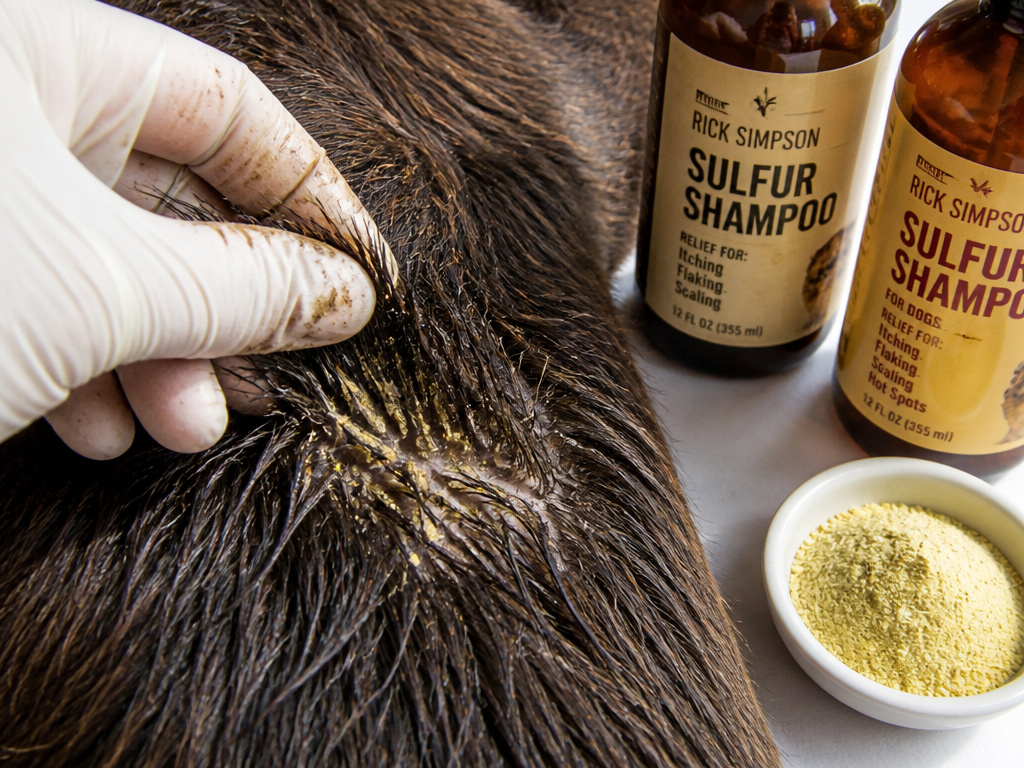
Sulfur plus salicylic acid is the keratolytic pair, and it does a different job from a degreaser. The Minnesota handbook sorts topical ingredients into working classes, and which one your dog needs depends on whether the problem is grease, scale, or a barrier that’s already failing.
| Ingredient class | Examples | What it targets |
|---|---|---|
| Degreasing agents | Benzoyl peroxide, tar, sulfur, selenium sulfide | Greasy scale, crusts, and odor |
| Keratolytic and keratoplastic | Sulfur plus salicylic acid | Loosening and normalizing scale |
| Moisturizers | Propylene glycol, glycerin, colloidal oatmeal, urea, lactic acid | Dry, tight, flaky skin |
| Barrier adjuncts | Ceramides, phytosphingosine, ophytrium, seboliance, EFAs | Supporting the skin barrier |
Degreasing Actives
Benzoyl peroxide, tar, sulfur, and selenium sulfide are the degreasers, and the Minnesota handbook names all four as what’s needed for the greasy scale, crusts, and odor of seborrhea oleosa. Plain oatmeal won’t touch that. It’s the wrong tool for the job.
Keratolytics and Cell-Turnover Actives
Sulfur plus salicylic acid is the keratolytic and keratoplastic pair in the handbook. These loosen scale rather than cut grease, which makes them the better fit for a coat that’s flaky and greasy at the same time. If your dog’s coat feels tacky at the shoulders and dusty at the tail, this is the class to look at.
Moisturizers and Barrier Ingredients
Moisturizer classes in the handbook run propylene glycol, glycerin, colloidal oatmeal, urea, sodium lactate, carboxylic acid, and lactic acid. Barrier adjuncts are a separate list: ceramides, phytosphingosine, ophytrium, seboliance, and EFAs.
Where the sources split is on the starting point. Blue Cross suggests a baby shampoo for routine bathing. The Minnesota handbook and VCA both point at medicated actives for a greasy or seborrheic coat. Those are opposite ends of the shelf, and the difference is whether the dog has a diagnosis.
I’d start with the mildest thing that matches the problem and move up, not the other way around. If you want the short version of the medicated shelf, the anti-seborrheic shampoo options worth comparing are the ones built around those actives.
How to Treat a Greasy Coat on Dogs Without Stripping the Skin
Before you start: Benzoyl peroxide bleaches fabric, jewelry, carpets, and the dog’s own haircoat, so pull the good towels and the rug out of the room first. It also causes photosensitivity in people, so wear gloves during application. Light- and thin-coated dogs need sun exposure limited for the duration of therapy.
You’re on your knees on the tile with a wet dog leaning into your shoulder and one hand holding the shower head. The water hits the back and beads up before it soaks in. That beading is the grease film, and it’s the reason a quick lather does nothing.
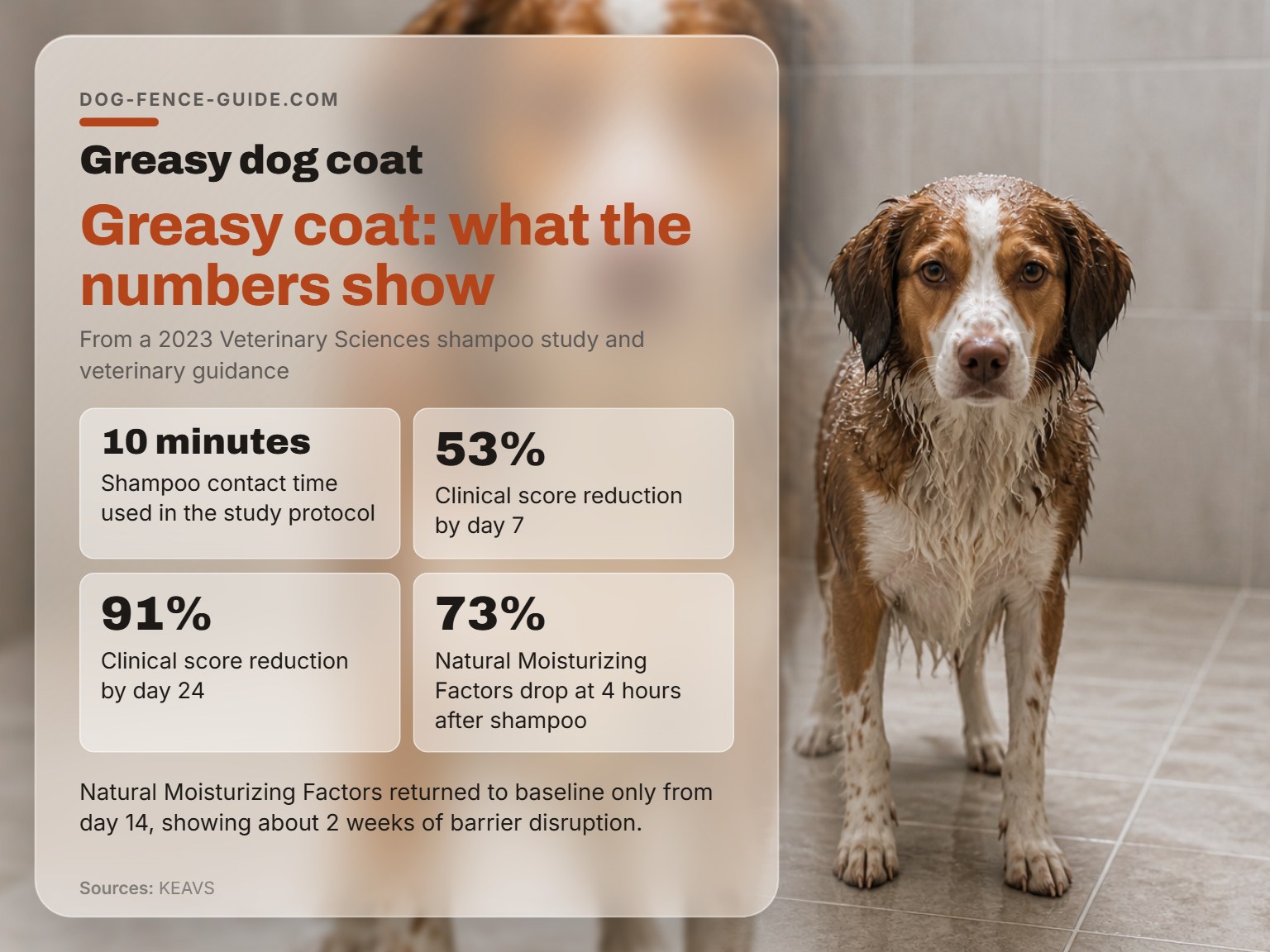
The 2023 Veterinary Sciences idiopathic chronic greasy seborrhea study used a specific sequence, and it’s worth copying step for step.
- Pre-wet the coat thoroughly before any shampoo goes on. The trial applied shampoo to a pre-wet coat, and a dry patch under the suds keeps the active off the skin entirely.
- Work the shampoo down to the skin, not just over the top of the coat. Grease sits against the skin, and surface lather never reaches it.
- Leave it on for 10 minutes. The study protocol used 10 minutes of contact time, and the AKC notes many medicated shampoos need five to 10 for maximum effect. Rinse at minute three and you’ve washed the surface and nothing else.
- Use lukewarm water, per the AKC’s bathing guidance. Hot water strips lipid and buys you a drier, itchier coat next week.
- Rinse until the water runs clear. Residual shampoo keeps working after the dog is dry, and that’s how a greasy coat becomes a tight one.
- Consider skipping the hairdryer. Blue Cross states hairdryers can dry out or irritate an animal’s skin and are probably best avoided, while the trial protocol air-dried every dog.
- Keep the dog off the furniture until the coat is dry, especially after benzoyl peroxide. That’s the bleaching problem, and it’s permanent on upholstery.
Seven steps, and step three is the one that gets skipped.
The rule I’d tape to the tub: Ten minutes of contact time beats a stronger shampoo left on for two. The active needs time on the scale, and no concentration makes up for rinsing early.
Benzoyl Peroxide: Strongest Option, Most Strings Attached
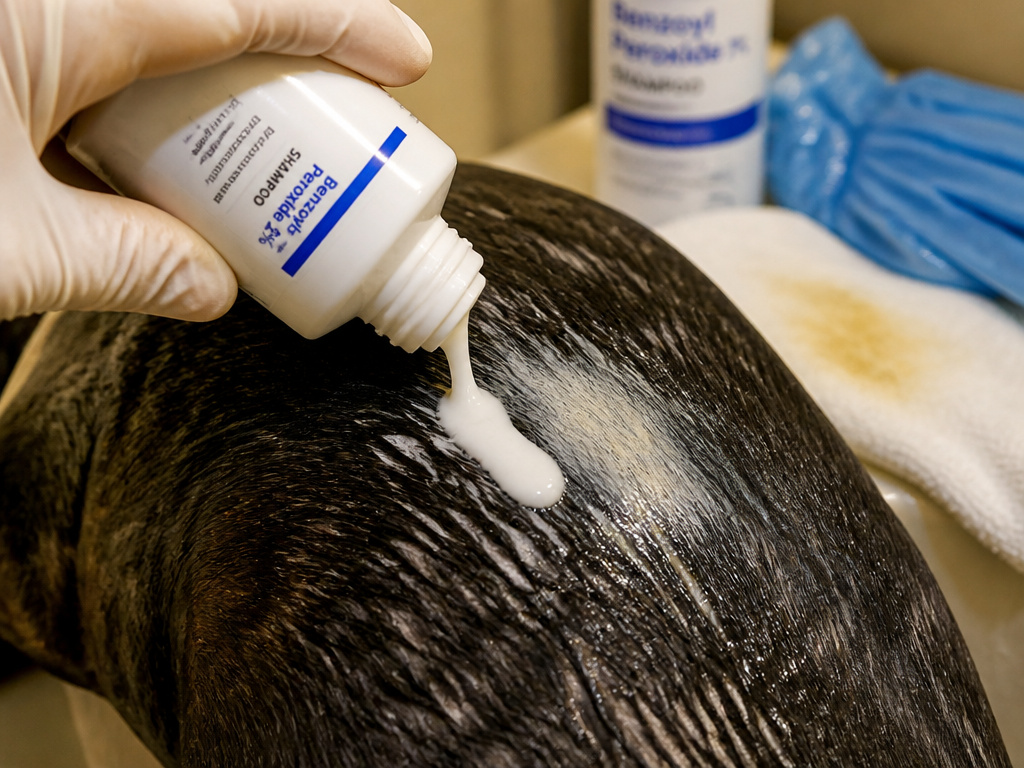
Two percent and five percent are the concentrations you’ll find on a benzoyl peroxide label, and that’s the whole range. VCA’s drug monograph lists the products by name: Micro BP, Micro-Pearls Advantage Benzoyl-Plus, GlycoBenz, Sulfur Benz, BPO-3, Oxibenz-3, and Peroxiderm. If you’re going that route, those are the names to search for, and each one is a degreaser with the same constraints attached.
The first constraint is duration. VCA states plainly that benzoyl peroxide should only be used for a few weeks at a time because it is extremely drying. Clinical improvement in a bacterial skin infection is expected within three to four weeks, so the safe window and the expected result line up neatly.
The second is what it touches. It bleaches fabric, jewelry, carpets, and the pet’s haircoat. A treated dog on a white sofa is a permanent decision.
The third constraint is you. Benzoyl peroxide causes photosensitivity in humans, so gloves are required during application. For light- or thin-coated dogs, sun exposure needs limiting for the duration of therapy.
The part nobody mentions: The bleaching doesn’t stop at the towel. A dog still damp with benzoyl peroxide will leave pale marks on a carpet, a car seat, or a dog bed, and the mark doesn’t wash out.
For a mild greasy coat with no redness and no crusting, I’d reach for sulfur and salicylic acid before benzoyl peroxide. The drying is the part that bites back, and a few weeks of it can leave you with a flaky dog on top of a greasy one.
When Does a Greasy Coat Need a Vet Instead of a Better Shampoo?
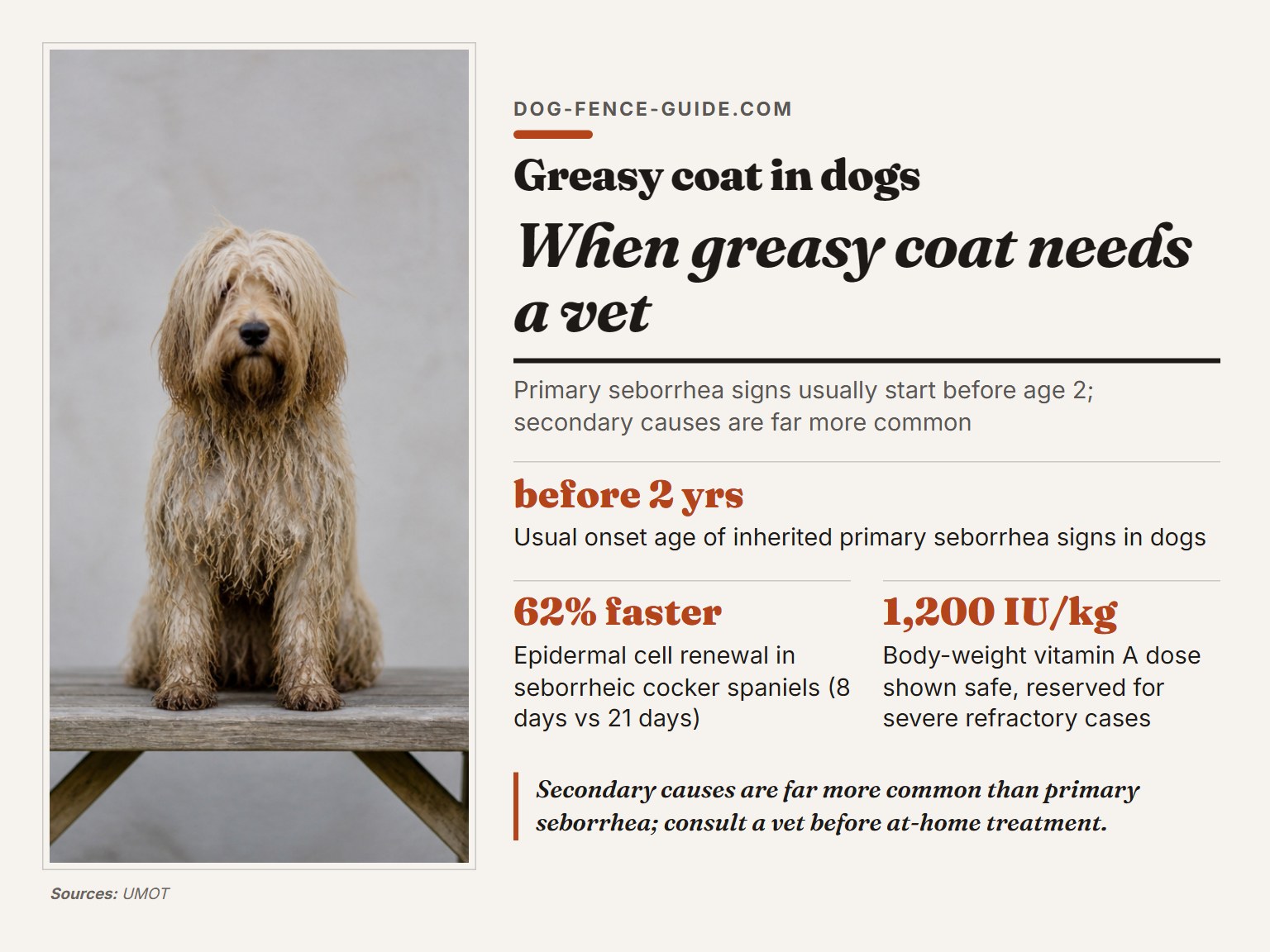
A better shampoo is the wrong first move when the grease showed up last month. Primary seborrhea is inherited and shows up early, usually before two years of age. A coat that changed at six is a different problem, and the odds favor a secondary cause.
Do you actually know whether the grease is new? Most owners don’t, and that’s the single most useful thing to establish before you buy anything.
The red flags that push this toward a vet visit:
- A change in the last few weeks, especially in a dog that’s been fine for years.
- Smell that outpaces the grease. Seborrhea oleosa is malodorous on its own, and a secondary yeast or bacterial infection makes it sharper.
- Redness, crusts, or licking at one spot. That’s inflammation, and inflammation needs a diagnosis.
- Hair loss or thinning beyond what you’d call normal shedding.
- Sudden itching. A comfortable seborrheic dog can become a miserable one fast when something else moves in.
The AKC’s guidance is blunt: always consult your veterinarian before starting any at-home treatments for seborrhea. That advice is practical. The list of things that cause a greasy coat includes conditions you can’t see from the outside.
A body-weight dose of 1,200 IU/kg has been shown to be safe, but the treatment is reserved for severe refractory cases.
For the inherited form, the goal is control rather than cure. The AKC is direct about that, and the trial authors make the same point from the other direction when they caution that results in mild cases shouldn’t be generalized to severe seborrhea.
The Two Weeks After the Bath Matter as Much as the Bath
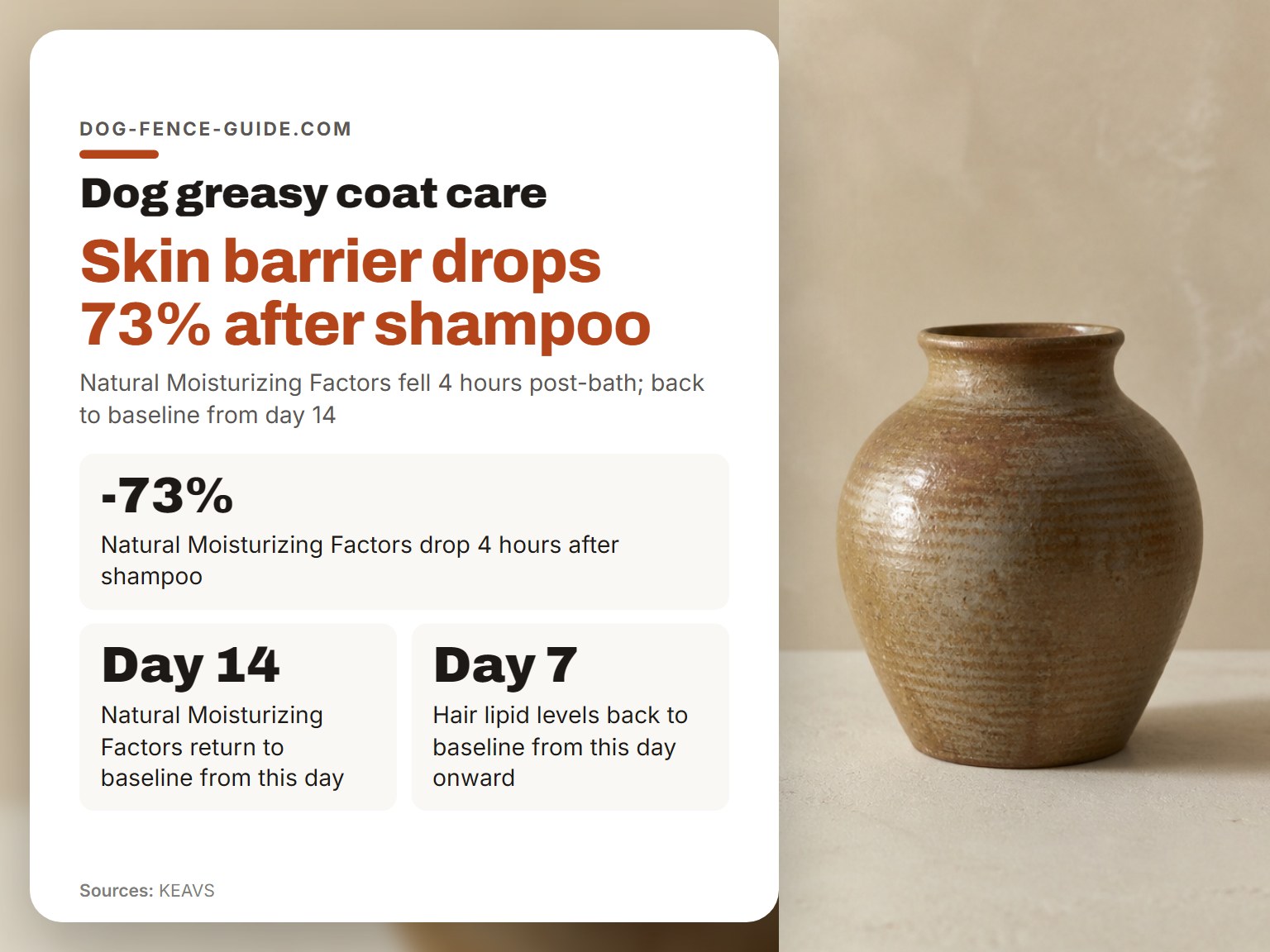
The bath strips the barrier, and the measured numbers are not subtle. In the 2023 trial, Natural Moisturizing Factors dropped 73% four hours after the shampoo and only returned to baseline from day 14. Hair lipid levels recovered sooner, back to baseline from day 7 onward. Read those two together and you get a two-week window where the skin is drier than it was before you started.
That’s the window where a greasy coat turns into a flaky one, and it’s why the handbook’s moisturizer and barrier lists exist at all. Barrier adjuncts named there are ceramides, phytosphingosine, ophytrium, seboliance, and EFAs. A dog conditioner built around any of those does more for the two-week window than another shampoo will.
Fourteen days is a long time in a house with a furnace running.
If the flaking is already established, dry skin treatment is a different playbook from grease control, and the two shouldn’t share a bottle.
Fish oil is the one I’d slow down on. EFAs appear on the handbook’s barrier adjunct list, so there’s a rationale for a fish oil product in the mix, but a capsule is not a fix for a greasy coat. I’ve watched people spend months on it while the actual problem was a yeast overgrowth.
Frequently Asked Questions
How often should I bathe a dog with a greasy coat?
It depends on whether there’s a diagnosis. The Minnesota handbook puts seborrhea bathing at two to three times per week until scaling is controlled, then at least weekly.
Will a regular dog shampoo fix a greasy coat?
Only if the grease is mild and the skin is healthy. Blue Cross suggests a baby shampoo for routine bathing, but the Minnesota handbook and VCA both point at medicated actives for a genuinely seborrheic coat. A plain shampoo removes surface oil without addressing the scale underneath.
Is a greasy coat always seborrhea?
No. The AKC notes that secondary causes are far more common than primary seborrhea, and the list includes allergies, endocrine disease, bacterial overgrowth, Malassezia yeast, and parasites. A coat that turned greasy recently is more likely to have an underlying trigger than an inherited one.
Can I use benzoyl peroxide shampoo on my dog at home?
Yes, with three limits. VCA states it should only be used for a few weeks at a time because it’s extremely drying, it bleaches fabric and haircoat, and it requires gloves because it causes photosensitivity in people. Light-coated dogs also need sun exposure limited during treatment.
Does fish oil help a greasy coat?
Not as a cure. EFAs are listed among barrier adjunct ingredients in the Minnesota handbook, so there’s a supporting role. But fish oil doesn’t address grease, yeast, or scale, and it won’t replace a medicated wash when one is actually needed.
Why does my dog’s coat get greasier in winter?
The Bottom Line
One rule worth keeping: if the grease arrived within the last month, book the vet visit before you buy the shampoo. A coat that’s been oily since puppyhood is a management problem. A coat that changed at six is a diagnostic one, and no bottle on the shelf fixes that.
Everything above assumes either a diagnosis or a mild, long-standing greasy coat. If your dog is already on medication for a thyroid or adrenal condition, the bathing schedule is a side conversation, not the main one.
The frequency argument gets all the attention. The ingredient match is what actually moves the coat.
