
Great Dane vs Mastiff: Which Giant Breed Fits Your Home?
This post contains affiliate links. As an Amazon Associate, we earn from qualifying purchases.
In the Great Dane vs Mastiff comparison, the Great Dane is the taller breed and the Mastiff is the heavier one, and both FCI and AKC standards agree on that split. FCI sets the Dane’s male minimum at 80 cm at the withers; the Mastiff’s male minimum is 76 cm. The weight gap runs the other way.
That weight gap is the reason these two breeds get confused in the first place. A Dane carries its mass upward on long legs. A Mastiff packs more of it into a broader, shorter frame, so which one takes up more of your kitchen depends entirely on whether you’re measuring height or floor space.
What follows walks the standards number by number, then the health data, then the parts of giant-breed ownership that never make it into a comparison table.
Key Takeaways
- The Dane is taller and the Mastiff is heavier, and that is the one claim in this whole comparison that both FCI and AKC standards support.
- Median lifespan is 10.6 years for the Dane and 9 years for the Mastiff in the VetCompass data, above the 6–10 range most sites still print for the Mastiff.
- Bloat is the Dane’s headline risk, and breed clubs recommend discussing prophylactic gastropexy rather than waiting to see.
- The Mastiff’s mass buys a calmer dog and costs heat tolerance; breed clubs flag the breed as heat sensitive.
- Pick containment hardware on failure points, not range ratings, because a 175 lb dog tests the wire, not the brochure.
Great Dane vs Mastiff Size: How Much Taller Is the Dane?
Eighty centimetres is the floor for a male Great Dane under FCI Standard No. 235. That is the minimum height the breed is measured against across Europe.
Height at the withers is measured at the highest point of the shoulder blades, not at the top of the head. FCI Standard No. 235 sets a minimum of 80 cm for male Great Danes and 72 cm for females. The same standard calls the breed the tallest of all breeds.
The Mastiff’s male minimum under FCI Standard No. 264 is 76 cm, with 70 cm for females. The AKC measures the same dogs in inches: 30 to 32 inches at the shoulder for male Danes, 28 to 30 for females, and a 30-inch minimum for male Mastiffs with 27.5 for females.
So the honest gap at the bottom of the scale is 4 cm, or roughly an inch and a half. At the top it widens, because the FCI gives the Dane a male range of 80 to 90 cm and the Mastiff a range of 70 to 77 cm.
Where the Height Numbers Disagree
The standards don’t agree with each other, and the aggregators don’t agree with either.
FCI puts the male Dane minimum at 80 cm. The AKC’s 30 to 32 inch range sits below the FCI floor at its lower bound. Then the commercial sites go further: Hepper prints 26 to 34 inches. Both of those drop below the FCI and AKC minimum at the bottom and stretch past the top.
When a blog range and a breed standard conflict, the standard wins. Every time.
My own testing has been dominated by medium and large dogs, so a Dane’s dimensions sit at the far end of what I know firsthand rather than the middle of it.
The Weight Gap Runs the Other Way
Mass is where the Mastiff takes the lead back.
The AKC gives Mastiff males at 160 to 230 lb and females at 120 to 170 lb. Great Dane males come in at 140 to 175 lb and females at 110 to 140 lb. The FCI figures line up on the Mastiff side, listing males at 160 to 230 lb (73 to 104 kg) and females at 120 to 170 lb (54 to 77 kg), with a minimum weight of about 120 lb (54 kg) for male Danes.
The disagreement here is on the low end. Hepper prints a Mastiff average of 130 to 220 lb and describes the breed as weighing in excess of 160 to 200 lb; A-Z Animals gives 120 to 230 lb. Those lower bounds sit below the AKC’s 160 lb male minimum, which suggests the aggregators are averaging across pets rather than reading the standard.
Growth timing matters more than the final number. A 2004 study in the Journal of Nutrition tracked both breeds and found Danes reach full adult weight at roughly 12 months, while Mastiffs take about 15 months.
That three-month gap is why puppy feeding schedules for the two breeds don’t line up, and why a Mastiff still looks unfinished at an age when a Dane is done growing.
What that timeline changes in practice:
- Feeding charts split by breed, not by size class. A Mastiff is still on growth-formula nutrition when a Dane of the same weight has finished.
- Joint stress accumulates during the growing months, which is why the Mastiff puppy guidance leans toward short, low-impact play.
- Weight-based dosing for everything from flea treatment to anesthesia follows the adult number, so know which number you’re working from.
If you’re sorting out portions, this guide to giant breed dog food covers the growth-versus-adult split properly.
Which Breed Is Better With Young Children?
The most repeated line in this comparison is that the Mastiff is the nanny dog and the Dane is the one you watch. The ratings behind that line are thinner than they look.
The AKC trait ratings, compiled in February 2022, score the Mastiff 5 out of 5 for good with young children and the Great Dane 3 out of 5. That is a real gap, and it’s the source most people are quoting whether they know it or not.
Then the sources split. The BreedFinder Great Dane vs Mastiff comparison says the Great Dane tends to score higher for kid-friendliness. Great Dane Unleashed scores both breeds 5 out of 5. Dogster recommends Danes for households with children aged 6 and older.
Three sources, three different answers, all describing the same two breeds.
There’s a reason for that, and it’s the most useful thing in this section. Research suggests that breed explains only a modest share of individual behavioural variation in dogs. The other 91 percent is the individual dog in front of you. You can read the breed-to-behaviour research yourself.
I’ve watched a shiba test a boundary at the exact same corner for six weeks. Breed generalizations would have told me nothing about that dog. The individual persistence was the whole story.
| Household | Better fit | Why |
|---|---|---|
| Children under 6 | Mastiff | AKC rates it 5/5 with young children against 3/5 for the Dane |
| Runners and long daily walks | Great Dane | AKC energy 4/5 against 3/5; the standard calls for substantial daily activity |
| Quiet, low-traffic home | Mastiff | AKC barking 1/5 against 3/5 for the Dane |
| Hot climate with little shade | Great Dane | Breed clubs flag the Mastiff as heat sensitive |
| Tidy house and a low tolerance for drool | Great Dane | AKC drooling 1/5 against 4/5 for the Mastiff |
If you want the deeper single-breed pictures, the Great Dane pros and cons and the English Mastiff pros and cons both go further than a comparison table can.
What These Two Breeds Actually Die Of
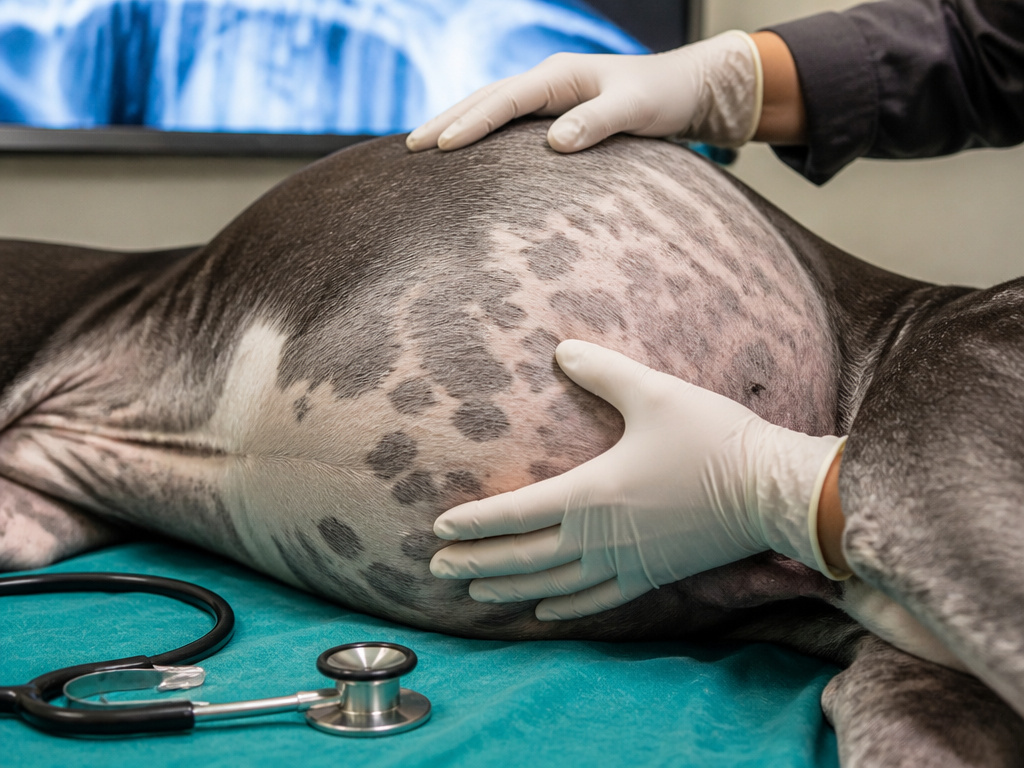
Bloat is the one that should shape the decision.
The Great Dane carries the highest documented breed predisposition to gastric dilatation-volvulus, the twisting stomach emergency usually called bloat, according to OFA and breed-club health pages. Prophylactic gastropexy, a preventive surgical tack of the stomach wall, is recommended by breed clubs for bloat-prone deep-chested breeds.
Worth knowing before you start: A dog with bloat does not wait for a convenient moment. The window between “uncomfortable” and “critical” is short enough that the drive to the clinic should start before you have finished deciding whether to go.
The Bloat Risk Is Not Symmetrical
The Dane’s deep, narrow chest gives the stomach room to swing and rotate once it fills with gas, which is the mechanical reason the breed tops the risk list. The Mastiff is also a deep-chested breed, but the OFA data singles out the Dane.
That asymmetry is why gastropexy comes up in almost every Dane conversation and less often in Mastiff ones.
Other documented conditions, breed by breed:
| Condition | Great Dane | Mastiff |
|---|---|---|
| Bloat (GDV) | Highest documented breed predisposition | Deep-chested, but not the breed OFA singles out |
| Heart | Dilated cardiomyopathy documented; OFA cardiac registry | OFA cardiac registry available |
| Eyes | Entropion flagged in recent UK data | Entropion and ectropion documented |
| Joints | OFA hip and elbow registries | OFA registries plus BVA/KC hip and elbow schemes |
| Cancer | Osteosarcoma flagged as far more likely than baseline | Osteosarcoma and blood-vessel skin cancer flagged |
Both breeds are flagged as far more likely than baseline to develop osteosarcoma, per a 2023 study in Canine Genetics and Epidemiology.
On screening: OFA maintains registries for hip dysplasia, elbow dysplasia, cardiac, and thyroid for both breeds. The BVA/KC Hip and Elbow Dysplasia Schemes list the Mastiff; the Great Dane is not a listed breed on those scheme pages. PRA and degenerative myelopathy are DNA-testable in the Mastiff.
Joint support is worth reading up on early rather than after the first limp. This piece on Great Dane joint support covers what’s actually in the supplements.
The Lifespan Numbers Are Better Than the Blogs Say
Here’s the part nobody tells you. The peer-reviewed numbers are higher than the popular ones.
A 2024 VetCompass study in Scientific Reports, drawing on UK veterinary records, puts the median lifespan at 10.6 years for the Great Dane and 9 years for the Mastiff. Hepper says Danes rarely make it past 8 years old. The ranges repeated across most comparison sites are 7 to 10 and 6 to 10.
The VetCompass medians sit above the popular ranges, though Hepper and other sources still print lower figures. That doesn’t make the blogs liars; it makes them out of date. You can check the VetCompass median lifespan data directly.
Questions to Ask Before You Put a Deposit Down
- Which registries have the parents been screened through? Ask for OFA hip, elbow, cardiac, and thyroid results by name, not a verbal “both parents are healthy” — the paperwork is the point.
- For a Dane, has gastropexy been discussed? If the breeder deflects, that tells you something about how seriously they take the breed’s number one risk.
- For a Mastiff, are the PRA and DM DNA tests done? Both are testable, so “we don’t test for that” is a choice rather than a limitation.
- Can you meet the dam? Temperament is mostly individual, and the mother is the closest thing to a preview you’ll get.
- What does the breeder feed during the growth phase? A Mastiff is still growing at 15 months; the answer should reflect that.
Does a Mastiff Really Need Less Exercise Than a Dane?
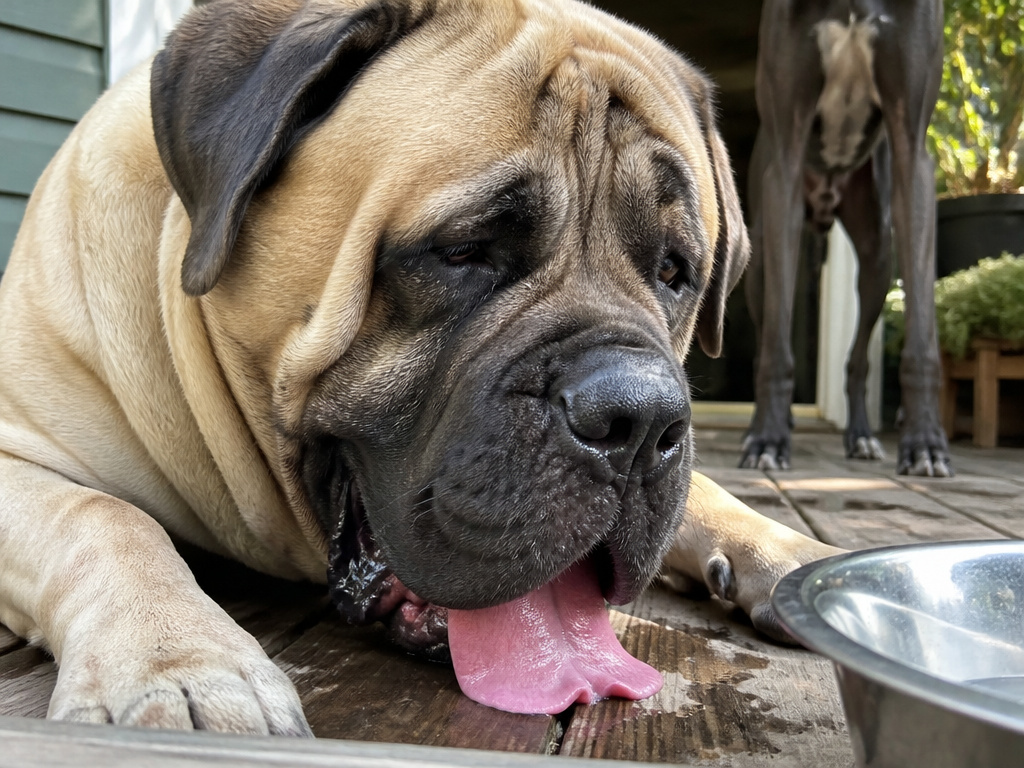
Picture a July afternoon, a shaded porch, and a 200-pound dog flat out with his tongue on the boards. That dog is not being lazy. He’s built to overheat.
Dogster gives the Dane 60 to 120 minutes per day and the Mastiff roughly 60 minutes. Hepper gives the Dane 2 hours a day and the Mastiff 1 hour. PetFindy goes lower on the Dane, at 1 to 1.5 hours.
The breed standards are quieter. FCI Standard No. 235 notes the Dane requires substantial daily activity without fixing a figure. Mastiff breed clubs describe low exercise tolerance and heat sensitivity, again without a number.
On the heat point, the mechanism is straightforward. A big barrel-chested dog has less skin surface relative to its body mass, so it sheds heat more slowly than a lean dog of the same weight. That’s why the Mastiff sounds like a bellows running in the next room while the Dane is still moving.
If the dog is still panting twenty minutes after you’re back inside, the walk was too long regardless of what a blog told you the daily target was.
What I’d actually adjust:
- Split the session rather than extending it. Two shorter walks beat one long one in warm weather, and the dog gets the same sniffing time.
- Move the walk to the cool end of the day and let the dog set the pace on the way home.
- Watch the pavement, not the clock. Heat comes up through the pads long before the air temperature feels dangerous to you.
A well-fitted harness matters more with this much mass on the end of the line. These harnesses for Great Danes are sized for the chest depth rather than just the weight.
What a Giant Breed Actually Needs From Your Yard
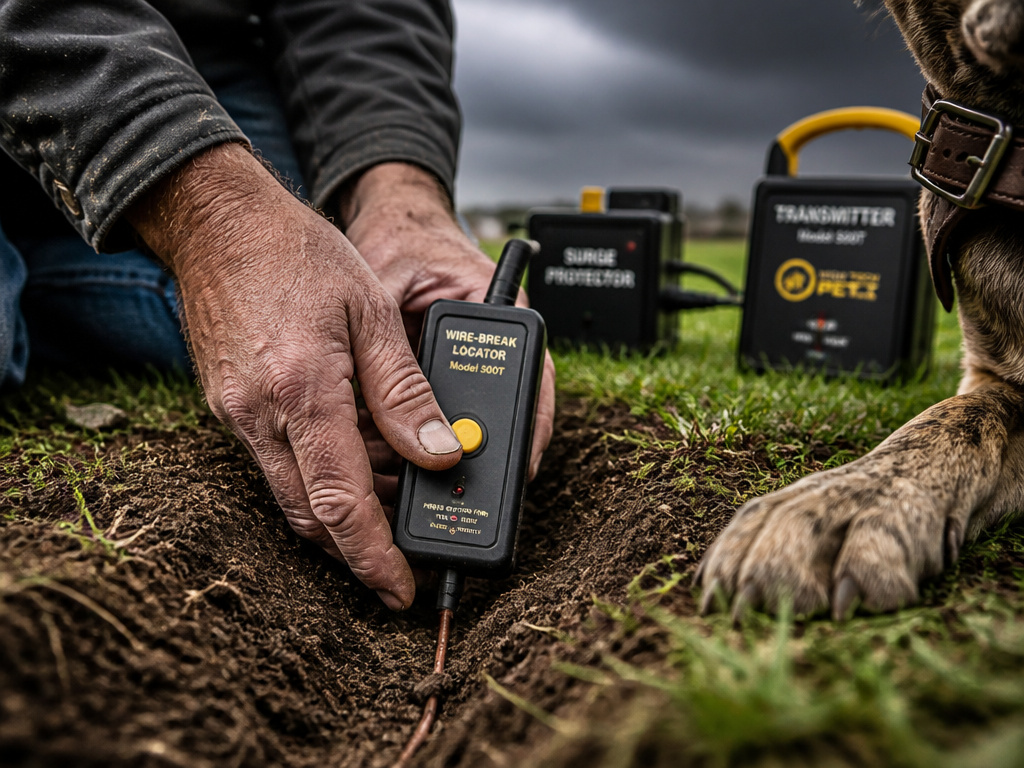
A 175-pound dog hits a fence line with more momentum than a 40-pound dog, and the hardware has to survive that.
I learned the hard part of this the expensive way. Comparing containment systems by price per acre is a fake metric. I tracked it once: the cheaper-per-acre kit cost me far more training time over a month. At my hourly rate that bargain was the most expensive fence I’ve installed.
The real difference between systems is how many things can break and what happens when they do. A wired in-ground loop has one failure point: the wire. A wireless unit has a signal, a transmitter, and a collar battery, and any one of them can end the boundary without telling you.
That’s why the systems I keep coming back to are the wired in-ground ones from Invisible Fence Brand, SportDOG, and Pet Stop. No pushy sales talk here, just a preference built on years of watching what fails.
What actually goes wrong, in order of how often I see it:
- A broken wire nobody noticed for a week. The dog learns the boundary is optional, and unlearning that takes longer than the original training did.
- A collar battery that died on a Tuesday. No warning, no beep, no boundary.
- A boundary the dog maps better than you do. Dogs find the exact spot where the correction stops, and they live in that gap.
- A surge with no protector on the transmitter. One storm, one dead unit.
A surge protector and a wire-break locator prevent most of the “my fence stopped working” calls I get. Neither is exciting. Both are the difference between a boundary that holds and a boundary you’re rebuilding every spring.
And if you can’t commit to daily boundary training for the first couple of weeks, don’t buy a containment system at all. Buy a sturdy leash and a pair of walking shoes instead. Peace of mind is the whole point, and a fence you never trained is not that.
What Surprises New Owners in the First Year
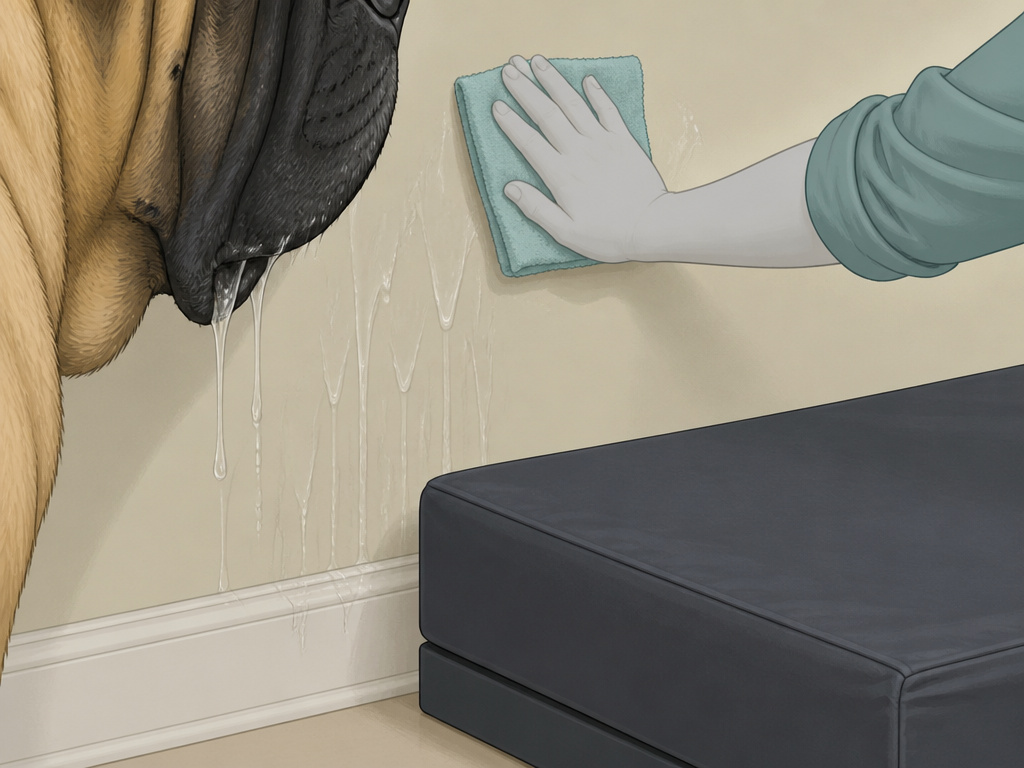
Three things surprise new giant-breed owners: the drool, the tail, and the vet bills.
Start with the drool, because the ratings are not close. The AKC scores the Great Dane 1 out of 5 on drooling and the Mastiff 4 out of 5. A Dane’s jowls sit tighter; a Mastiff’s hang. If drool is a dealbreaker in your house, that single number should decide it.
The other ratings flip in the Dane’s favor on coat. Shedding is 3 out of 5 for the Dane and 1 out of 5 for the Mastiff, and coat grooming is 3 out of 5 against 1 out of 5. The Mastiff has a dense double coat that hides its undercoat until you part the hair with your fingers, but it sheds less visibly than a Dane does.
Barking runs 3 out of 5 for the Dane and 1 out of 5 for the Mastiff. A Dane will announce the mail carrier. A Mastiff mostly won’t bother.
The physical reality is harder to rate. A Mastiff’s drool doesn’t stay on the dog. It lands on the wall at nose height and dries to a clear film you find with your forearm before you ever see it.
Beds are the other first-year shock, because a Dane doesn’t curl. These beds for Great Danes are sized for a dog that wants the whole rectangle.
Frequently Asked Questions
Is a Great Dane bigger than a Mastiff?
Taller, yes. Heavier, no. FCI Standard No. 235 sets the male Dane minimum at 80 cm at the withers against 76 cm for the Mastiff, and the AKC gives the Dane 30 to 32 inches against a 30-inch Mastiff minimum. On weight the order flips: the AKC puts Mastiff males at 160 to 230 lb and Dane males at 140 to 175 lb.
Which breed is easier to train?
The sources disagree, and it’s worth knowing which one you’re reading. AKC trait ratings score the Mastiff 4 out of 5 for trainability and the Great Dane 3 out of 5. BreedFinder reverses it, saying the Dane picks up commands more readily and is the better choice for a first-time owner. Both are describing breed tendencies, and breed explains only a small share of how any individual dog behaves.
Do Mastiffs drool more than Great Danes?
Considerably. The AKC rates Mastiff drooling 4 out of 5 and Great Dane drooling 1 out of 5. The difference is jowl structure rather than behaviour, so no amount of training changes it. If you’re weighing the two breeds and drool is a real issue in your home, that gap matters more than the height difference does.
How long do Great Danes and Mastiffs live?
The best available data comes from a 2024 VetCompass study of UK veterinary records, which puts the median at 10.6 years for the Great Dane and 9 years for the Mastiff. Popular ranges of 7 to 10 and 6 to 10 years are still widely repeated, but they sit below the peer-reviewed medians. Hepper’s claim that Danes rarely pass 8 years is lower still.
Do either of these breeds need a fence?
Neither breed standard says anything about fencing, so this is a judgment call rather than a rule. What I can tell you is that a dog this size tests hardware rather than respecting it. A wired in-ground loop with a surge protector and a wire-break locator holds up better than a wireless unit, because there’s no collar battery to die and no signal to drop at the exact moment the dog decides to push.
The Bottom Line
If you have young children and a quiet routine, get the Mastiff. If you run, walk daily, and want a dog that will go the distance with you, get the Dane. That’s the short version, and I’d rather give you a straight answer than a list of considerations.
Here’s the threshold that should change your mind. If you can’t commit to daily boundary training for the first two weeks after the fence goes in, skip containment entirely and put the money into a leash and a trainer. A giant breed that hasn’t learned the boundary will treat the wire as a suggestion, and a 175-pound dog testing a suggestion is how fences get rebuilt.
One more thing worth saying plainly. The lifespan numbers in this comparison are better than the ones most sites print, and the health risks are more specific than “both breeds have problems.” The Dane’s bloat predisposition is documented and the breed clubs have a recommendation for it. The Mastiff’s heat sensitivity is documented and it changes when you walk. Those are the two facts I’d want in my head before choosing between them.
Peace of mind is the whole point, and you get there by picking the dog whose failure modes you can actually live with.
