
English Mastiff Pros and Cons: Before You Commit
This post contains affiliate links. As an Amazon Associate, we earn from qualifying purchases.
The English Mastiff pros and cons come down to a giant, calm guardian that needs serious space and a shorter lifespan than most breeds. Expect 120-230 lb, around an hour of daily exercise, and a median age at death of 8 years. The breed also carries real health risks, including GDV, joint disorders, and cancer.
That median of 8 years is a measured number, not an estimate. Bell & Hesketh recorded a median age at death of 8 years, and the mean splits by region: 7.72 years in Europe, 8.17 in North America. The figure reframes every decision ahead of it, from neutering timing to how much room you actually need.
The english mastiff pros and cons are real. What follows walks the size, the health risks, the neutering decision, and the daily care that separates a workable Mastiff home from a miserable one.
Key Takeaways
- Budget for 120-230 lb of dog. Females run 120-170 lb; males commonly exceed 200 lb.
- Median age at death is 8 years. PetMD’s 6-10 year range is an estimate, not a measurement.
- UC Davis guidance says neuter males no earlier than 24 months and females no earlier than 12 months, though PDSA gives no neuter age at all. The joint-disorder risk gap is real.
- GDV is an emergency, not a wait-and-see. Unproductive retching needs a vet immediately.
- The breed is Kennel Club Category Three – flagged for conformational exaggerations that cause pain or health issues.
What the Mastiff Gets Right
A calm, 120-230 lb guardian that mostly wants to lie on the couch is a genuinely rare combination. Mastiffs are classed as Working group dogs by the Kennel Club, bred for guarding and search-and-rescue work, and the modern breed still shows that steady temperament.
The breed standard calls for a dog that is calm and affectionate with owners but capable of guarding, indifferent to strangers, and never timid. Adult males stand a minimum of 30 inches at the shoulder; bitches, 27.5 inches. Any dog below those minimums is faulted in the show ring.
That temperament is the breed’s biggest selling point in the english mastiff pros and cons. PDSA calls them gentle giants and notes they tend to get on well with everyone. A Mastiff that’s been socialized early is patient with family, watchful with strangers, and content to nap through most of the day. The English Mastiff breed overview traces the breed back to Roman Britain in 55-54 BCE, and the modern standard still rewards the same massive head and steady disposition.
The pros, in plain terms:
- Calm temperament. A socialized Mastiff is patient with family and indifferent to strangers.
- Low exercise needs. Around an hour a day.
- Predictable grooming, except the wrinkles. Weekly brushing, daily wrinkle wipe, and a bath every few months.
- A real guardian instinct without the hair-trigger aggression some protection breeds carry.
The Size Problem Nobody Prices In
Space is the first thing buyers underestimate. PetMD cites a 500-square-foot apartment as too small for a Mastiff, and that’s a fair starting point. A dog that weighs 120-230 lb needs room to turn around, lie flat, and not knock over every table in the house.
Exercise needs are lower than the size suggests. PDSA puts adult Mastiffs at around an hour of daily exercise, and warns against over-exercising puppies while bones and joints are still developing. That’s lower than the size suggests, and it’s the opposite of what a giant-breed buyer expects.
| Factor | Mastiff reality | What it means for you |
|---|---|---|
| Adult weight | 120-230 lb | Bigger crate, bed, and food bill |
| Exercise | Around 1 hour daily | Less than the size suggests |
| Space | 500 sq ft too small | Yard or large home preferred |
| Lifespan | 6-10 year range (PetMD) | Shorter than most breeds |
Containment is where the size really bites. A Mastiff leaning on a decorative fence will flatten it. For large breeds, spec the fence for force, not height: heavier gauge wire, deeper posts, and gate hardware that can take a 200-pound dog hitting it at speed. Welded-wire panels rated for working dogs and sturdier gate kits hold up better than the box-store hardware most people bolt on. A leash for large dogs needs to be rated for the weight, not just sized for the neck.
Where this goes sideways: Hanging a heavy gate on a thin post. It sags within a season, and the gap at the latch is where a Mastiff gets out.
Buy the better latch.
How Long Do English Mastiffs Actually Live?
The honest answer is shorter than most breed pages admit. PetMD lists the average Mastiff lifespan as 6-10 years. The measured number is worse: Bell & Hesketh found a median age at death of 8 years, with a mean of 7.72 years in Europe and 8.17 in North America.
Those two figures aren’t the same metric, and it’s worth saying so. PetMD’s 6-10 year range is an estimate. The 8-year median is a measured outcome from a peer-reviewed owner survey. They point in the same direction, but the median is the harder number.
That gap matters when you’re comparing breeds. A dog breed lifespan comparison puts the Mastiff near the bottom of the giant-breed list, and it’s the number to plan around, not the optimistic end of a range.
Cancer is the leading cause, at 47% of deaths in the Bell & Hesketh cohort. Old age accounts for 16%, cardiac problems 8%, and gastric issues including GDV and bloat 7%. Osteosarcoma is the most common cancer recorded, specifically in neutered animals.
Plan for 8 years, not 10. The median is the number that matters when you’re deciding whether a giant breed fits your next decade, and the optimistic end of a range is a bad planning tool.
The Mastiff breed mortality study is worth reading in full if you want the breed-by-breed breakdown. Age and cause of death varied across the 19 Mastiff-group breeds, so the English Mastiff numbers aren’t a clean lift from the group average.
The Health Risks That Change the Math

GDV is the one that kills fastest. Gastric dilation volvulus, where the stomach fills with gas and twists on itself, is a documented risk in large, deep-chested breeds. PDSA is blunt about the timeline: signs of bloating or unproductive retching need urgent veterinary attention. Unproductive retching sounds like a dry heave that produces nothing, and it’s the sign to call the vet immediately.
The rest of the list is long. PDSA flags eyelid problems, dilated cardiomyopathy, hypothyroidism, degenerative disc disease, epilepsy that’s harder to control with medication in this breed, and several cancers including osteosarcoma. PetMD adds hip dysplasia as a hereditary risk, worsened by exercise habits, weight, and nutrition.
- GDV (bloat): emergency, unproductive retching, urgent vet.
- Eyelid problems: entropion and ectropion from excessive facial skin, which rubs and irritates the eye.
- Dilated cardiomyopathy: sudden onset, so respiratory distress or exercise intolerance means a vet call.
- Hypothyroidism: manageable with medication.
- Back problems: degenerative disc disease, which can cause pain and paralysis.
- Epilepsy: harder to control with medication in this breed.
- Cancer: osteosarcoma, bone tumours.
- Hip dysplasia: hereditary, worsened by weight and exercise.
The Kennel Club classes Mastiffs as Category Three, a designation for breeds with visible conditions or conformational issues that can cause pain, discomfort, or health problems due to exaggerations. That’s a welfare flag, not a marketing label. The same wrinkles and massive head the AKC standard rewards are the traits the welfare body flags.
What most people get wrong: Waiting to see if the bloating resolves. GDV needs urgent veterinary attention, and unproductive retching is the sign to call the vet immediately, not the next morning.
The AKC official Mastiff breed standard rewards marked wrinkles, great depth and breadth, and a massive head. The Kennel Club standard takes a different tone: any departure from the standard is a fault, with seriousness proportional to its effect on health and welfare.
One more risk worth knowing: cystine urinary calculi, which the fact sheet does not cover. The cystine-containing urinary calculi in dogs paper is the reference if you want the full breed list.
When Should You Neuter a Male Mastiff?
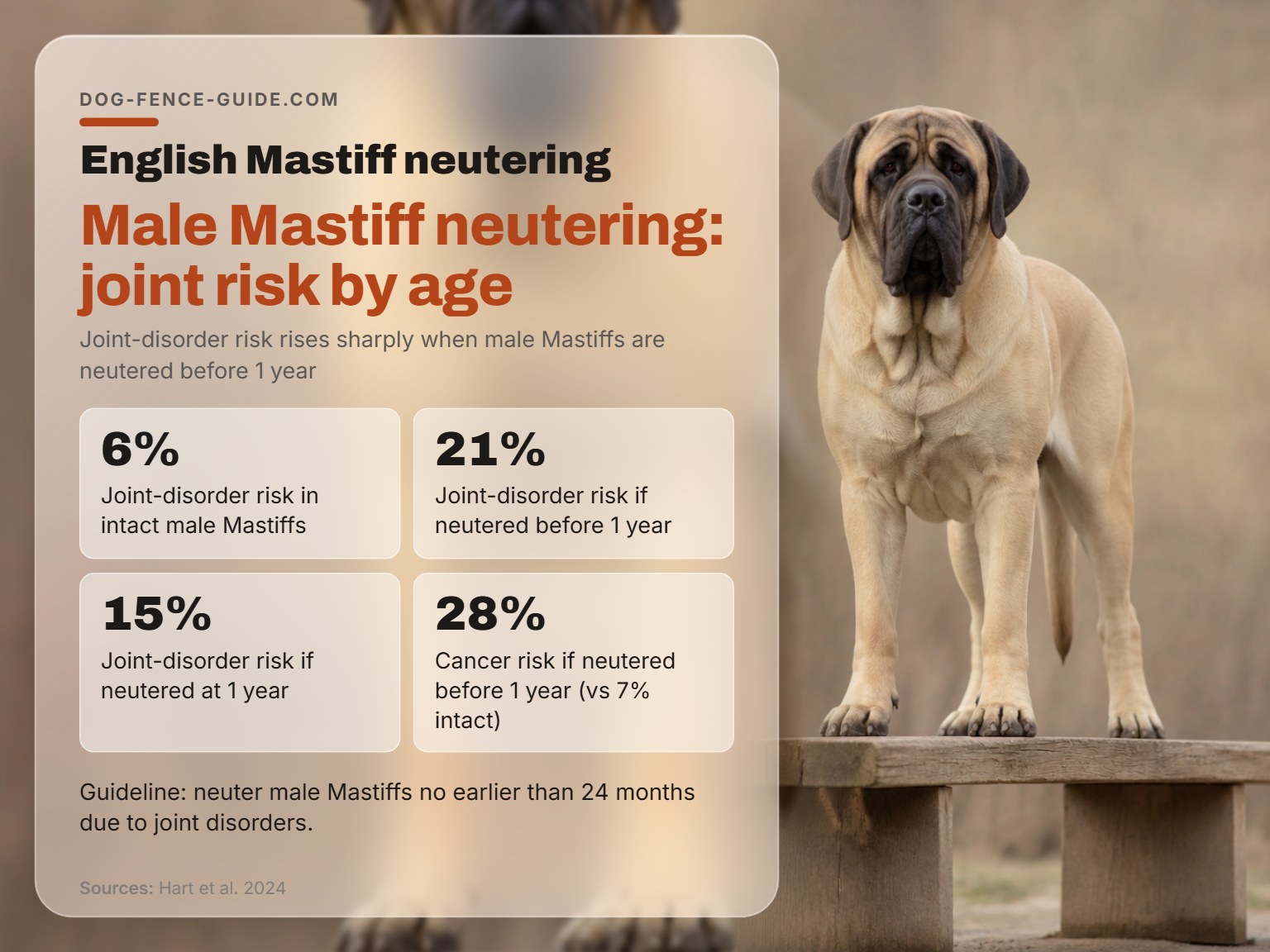
The UC Davis guidance is 24 months for males and 12 months for females, though PDSA gives no neuter age at all, and the reasoning is joint health. Hart et al. Found that neutering male Mastiffs before 1 year pushed joint-disorder risk to 21%, versus 15% at 1 year and 6% in intact males. That’s a real gap, not a rounding error.
The cancer numbers complicate the picture. Male Mastiffs neutered before 1 year had a 28% cancer risk, versus 7% in intact males. Females showed no elevated cancer risk from neutering, but intact females had a 12% pyometra rate, which pushes the other way.
| Sex | Neuter timing | Joint-disorder risk | Cancer risk |
|---|---|---|---|
| Male | Intact | 6% | 7% |
| Male | Neutered before 1 year | 21% | 28% |
| Male | Neutered at 1 year | 15% | – |
| Female | Intact | 9% | 2% |
| Female | Neutered before 1 year | 20% (not significant) | No elevated risk |
Where the sources disagree: PDSA doesn’t give a neuter age at all, and frames early socialisation and exercise caution instead. That leaves the common 6-month practice unaddressed, which is a gap worth naming. The Mastiff neutering age study is the source for the 24/12 split.
I won’t tell you the 24-month figure is universally followed. Plenty of vets still recommend 6 months for convenience or shelter policy. But the joint-disorder gap between 6% and 21% is the number I’d want in front of me before signing off on early neutering.
Do the math.
The Daily Care Reality
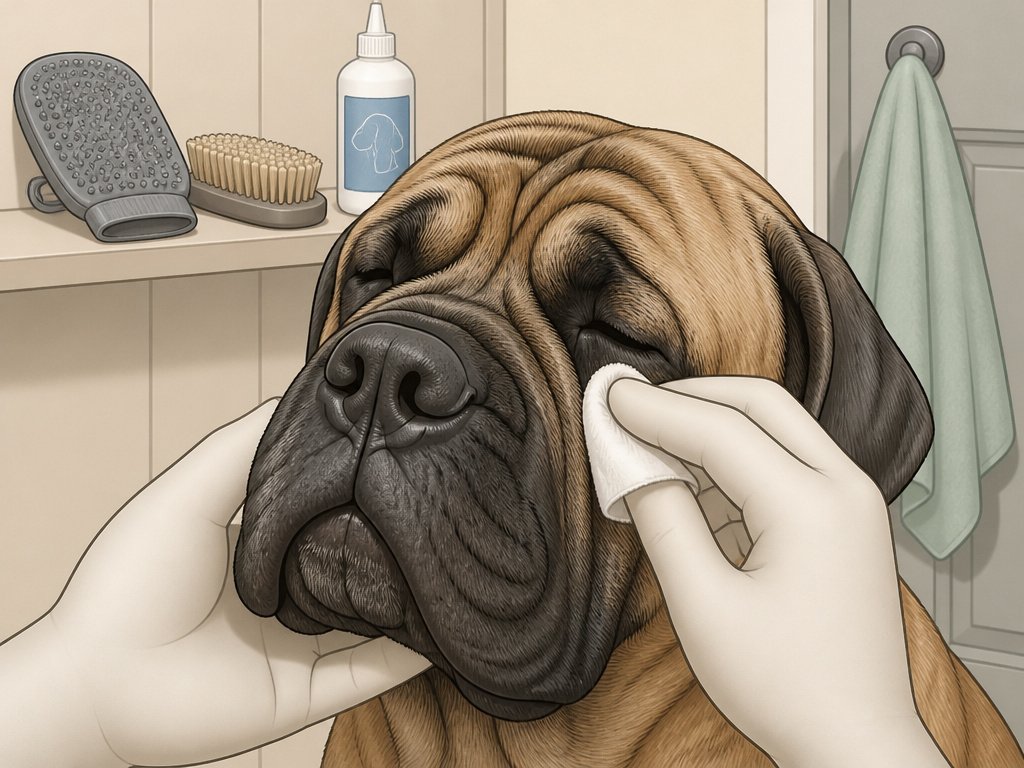
A towel by the front door, a wrinkle wipe on the counter, and a brush that lives on the shelf. That’s the daily routine for most Mastiff owners, and it’s less work than the size suggests.
Grooming is weekly, not daily. PDSA puts Mastiff grooming at once a week, with daily cleaning for the facial wrinkles. PetMD adds weekly brushing with a grooming mitt or bristle brush, more frequent brushing during the once- or twice-yearly heavy shedding periods, and bathing only every few months.
Ear cleaning is the one that surprises people. Routine cleaning with a veterinary-approved ear cleanser is important, and the ears must be cleaned after any water exposure, whether that’s a bath, a swim, or a hose-down in the yard.
Drool is the other daily reality. PetMD calls Mastiffs excessive droolers and recommends keeping a small towel handy. It’s a genuine daily cleanup that most breed pages skip. A heavy-duty dog crate is worth the upgrade for a Mastiff, since standard wire crates are not built for a dog this heavy. A collar for strong dogs needs to be rated for the weight, not just sized for the neck.
Easy to miss: Cleaning the facial wrinkles only when they look dirty. The folds trap moisture and warmth, and a daily wipe is what prevents the yeast and bacterial overgrowth that turns into a vet visit.
Is a Mastiff the Right Dog for Your Home?
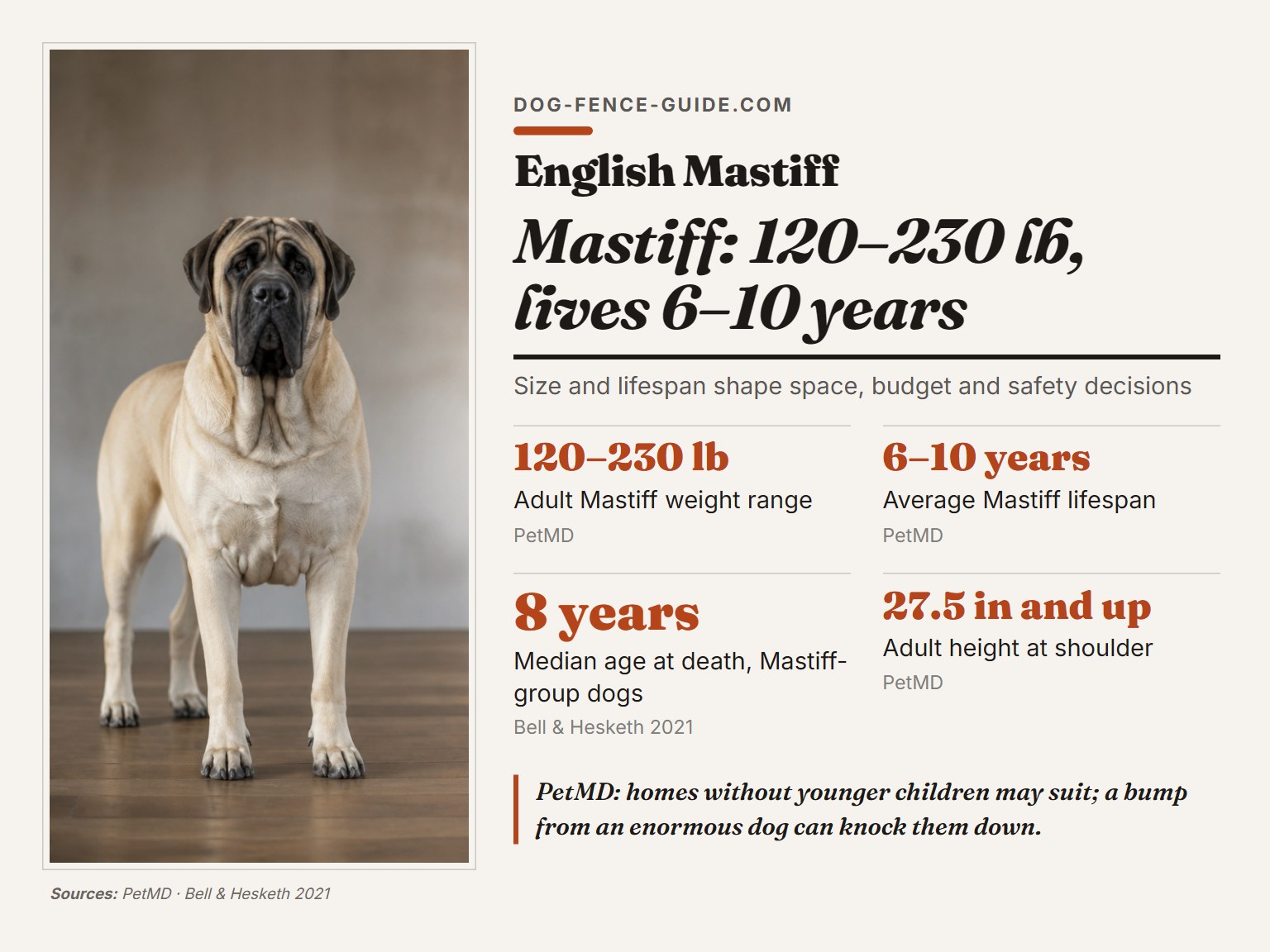
The honest answer depends on three things: space, budget, and whether you can handle a dog that may not see 10. PetMD recommends homes without younger children, who may be easily knocked down by an accidental bump from these enormous dogs.
The risk is the accidental bump from a 120-230 lb dog turning around in a hallway. A socialized Mastiff is patient with kids who understand how to interact with dogs. The sheer mass is the hazard.
Guardian breeds as a group share this profile. If you’re comparing options, the guardian dog breeds overview covers the temperament and space trade-offs across the group, and the Mastiff vs Great Dane comparison is the closest head-to-head for a giant-breed buyer.
The Great Dane pros and cons and Bernese Mountain Dog pros and cons pages cover the other two giant breeds most buyers weigh against a Mastiff.
Before you commit, work through this list in order:
- Measure your space. A 500-square-foot apartment is too small; a yard with a secure gate is the realistic baseline.
- Price out the food and vet bills. A 200-pound dog eats more, and the breed’s health risks mean more vet visits, not fewer.
- Check your fence and gate hardware. The gate latch is where most escapes happen, and a Mastiff leaning on a weak latch will find it.
- Plan the neuter timing. UC Davis guidance is 24 months for males and 12 for females, though PDSA gives no neuter age at all, so discuss timing with your vet.
- Decide who handles the dog when it’s fully grown. A 120-230 lb Mastiff on a leash needs an adult who can hold it.
The Bottom Line
One rule I’d put above everything else: if you can’t commit to a 24-month neuter window for a male Mastiff, don’t buy a male. The joint-disorder gap between 6% and 21% is the single most consequential decision in the breed’s care plan, and it’s the one most buyers make on autopilot at 6 months.
The first step this week is to measure your gate. Not the fence panels, the gate. Walk out with a tape measure and check the gap under the latch, the post depth, and whether the hinges have any sag. That’s where a Mastiff escapes, and it’s a 10-minute check that saves a 2 a.m. Search.
This all changes if you’re looking at a Mastiff as a working guardian on acreage. The containment math is different, the exercise needs go up, and my own experience there is thinner than I’d like. For a suburban or semi-rural home, the advice above holds.
Frequently Asked Questions
How long do English Mastiffs live?
PetMD lists the average Mastiff lifespan as 6-10 years, but that’s a range estimate. The measured figure from a peer-reviewed owner survey is a median age at death of 8 years, with a mean of 7.72 years in Europe and 8.17 in North America. Plan for the median, not the top of the range.
Are Mastiffs good with children?
They can be, with the right kids. PetMD recommends homes without younger children, who may be easily knocked down by an accidental bump from these enormous dogs. A socialized Mastiff is patient with children who understand how to interact with dogs; the risk is the sheer mass, not aggression.
Do Mastiffs need a lot of exercise?
Less than the size suggests. PDSA puts adult Mastiffs at around an hour of daily exercise, and warns against over-exercising puppies while bones and joints are still developing. Steady, low-impact activity is better for the joints than high-impact play.
Should I neuter my male Mastiff at 6 months?
The UC Davis guidance says no earlier than 24 months for males, though PDSA gives no neuter age at all. Neutering before 1 year pushed joint-disorder risk to 21% versus 6% in intact males, and cancer risk to 28% versus 7%. Females have a separate guideline of no earlier than 12 months.
What is the biggest health risk for a Mastiff?
GDV (bloat) is the fastest killer. The stomach fills with gas and can twist on itself, and PDSA says any sign of bloating or unproductive retching needs urgent veterinary attention. Cancer is the leading cause of death overall at 47% of the Bell & Hesketh cohort.
How much space does a Mastiff need?
More than most people expect. PetMD cites a 500-square-foot apartment as too small for a Mastiff. A yard with a secure gate is the realistic baseline, and the gate hardware matters more than the fence panels because that’s where most escapes happen.
