
Labrador vs Golden Retriever: Which Is Right for You?
This post contains affiliate links. As an Amazon Associate, we earn from qualifying purchases.
Labrador vs Golden Retriever is decided by coat, heat tolerance, and health risk rather than size. Both breeds land within an inch and a few pounds of each other. Goldens carry 2.65 times the odds of heat-related illness, and their cancer burden is the breed’s defining health problem.
That 2.65 figure comes from a UK study of 905,543 dogs under primary veterinary care, and it’s an odds ratio measured against the Labrador baseline, not a body count. The study doesn’t explain why the gap exists. Coat is the obvious suspect, and I’ll show you exactly what the data does and doesn’t support further down.
What follows compares the two on the things that actually differ: measured size, coat and grooming load, heat risk, cancer numbers, indoor energy, feeding, and what each breed needs from a containment setup.
Key Takeaways
- Goldens run hotter: 2.65 times the odds of heat-related illness against the Labrador baseline, from a 905,543-dog UK study.
- Grooming frequency is genuinely disputed: Royal Canin says brush a Golden twice a week, while PetPlace and Community Animal Hospitals both say three to four times.
- A 14-base-pair POMC deletion shows up in roughly 12% of Labradors and is associated with higher body weight, adiposity, and food motivation, so measure the kibble instead of eyeballing it.
- Neither breed is a set-and-forget containment dog. Boundary training comes first, and the collar comes second or not at all.
How Big Do Labrador and Golden Retrievers Actually Get?
The AKC standard puts adult male Labradors at 22.5 to 24.5 inches at the withers and 65 to 80 pounds. Females drop to 21.5 to 23.5 inches and 55 to 70 pounds.
Adult male Labrador Retrievers stand 22.5 to 24.5 inches at the withers and weigh 65 to 80 pounds under the AKC standard. Male Golden Retrievers stand 23 to 24 inches and weigh 65 to 75 pounds. Females of both breeds run shorter and lighter, with Labradors at 21.5 to 23.5 inches and 55 to 70 pounds.
So the two breeds overlap almost completely. A big male Golden and an average male Lab are the same dog on a scale.
Third-party tables drift slightly from the registry figures. Everything Labradors lists male Labs at 64 to 79 pounds, and Royal Canin gives 30 to 36 kg, which converts to about 66 to 79 pounds. None of those numbers contradict the AKC badly. None of them match it exactly either.
The Numbers Side by Side
| Measure | Labrador (AKC) | Golden (AKC) |
|---|---|---|
| Male height | 22.5-24.5 in | 23-24 in |
| Male weight | 65-80 lb | 65-75 lb |
| Female weight | 55-70 lb | 55-65 lb |
| Life expectancy | 11-13 yr | 10-12 yr |
Height matters less than people expect. An inch at the withers changes nothing about crate size, car space, or how easily a dog clears a garden boundary.
Lifespan is where the sources genuinely split. The AKC gives Labradors 11 to 13 years and Goldens 10 to 12. PetPlace lists 10 to 12 for both breeds. Mental Floss follows the AKC split. If you’re choosing between them on longevity alone, you’re choosing on a one-year margin that any individual dog can erase.
The Coat Difference Decides Grooming, Shedding, and Summer Walks
Run your fingers behind a Golden Retriever’s ear and you’ll find the first mat as a hard little knot before you ever see it. That’s the whole grooming story in one gesture.
The Labrador coat is short, dense, and slightly oily, a double coat built for cold water and inherited from Newfoundland working dogs. Water beads off the outer layer. The Golden’s coat is medium-length and feathered, with a thick undercoat that protects against brambles and brush.
Both shed year-round. The difference is what the shed hair does on the way out.
Brushing frequency is one of the few places where the sources openly disagree, and it’s worth knowing who says what. Royal Canin recommends brushing a Golden twice a week, a bit more during shedding. PetPlace and Community Animal Hospitals both recommend three to four times a week to prevent mats. Community Animal Hospitals adds professional grooming every six to eight weeks.
Where this goes sideways: Following the twice-weekly schedule through a humid summer and calling it done. The undercoat felts against the skin, and by the time you find it, the mat has to be clipped out rather than brushed out.
For Labradors, the guidance is more consistent: Royal Canin says weekly with more during shedding, PetPlace says about once a week, and Community Animal Hospitals says once a week with occasional bathing. PetPlace puts bathing for both breeds at monthly or as needed.
Here’s the part that surprises new Golden owners. You should never shave the coat in summer. The undercoat insulates against heat as well as cold, so stripping it removes the dog’s own shade and leaves skin exposed. Community Animal Hospitals is explicit about this and recommends early morning or evening walks instead.
Doodle crosses complicate the math further, which is why the Poodle vs Labradoodle coat question keeps landing in my inbox. If you’re weighing a cross instead of a purebred, the Golden Retriever vs Goldendoodle breakdown covers where that feathered coat actually comes from.
Why Golden Retrievers Carry 2.65 Times the Heat-Illness Risk
2.65 is the number worth memorizing. That’s the odds ratio for heat-related illness in Golden Retrievers against the Labrador baseline, with a 95% confidence interval of 1.40 to 5.01, from Hall and colleagues in Scientific Reports (2020).
The same study covered 905,543 dogs under primary veterinary care. It’s a real signal, not a rounding error.
The AKC adds a quiet detail that supports it. The Golden Retriever breed page recommends consulting a vet before starting strenuous or high-impact activity. The Labrador page carries no equivalent caution.
There’s honest uncertainty here. The epidemiology shows the gap without explaining the mechanism, and coat density is inference rather than a measured cause. What the data does support is a practical rule: walk either breed early or late in summer, and never assume a heavy double coat makes a dog heat-proof.
I test containment hardware for a living, not veterinary epidemiology, so read this as a layman’s observation rather than a clinician’s. The dogs that struggle in July are the ones walked at midday by owners who equate a thick coat with heat tolerance. The coat insulates in both directions.
Both breeds need about an hour of daily exercise, per Royal Canin and PetPlace. Royal Canin adds that the exercise should be adapted to the dog’s age and condition, and that a vet is the right person to ask.
Cancer in Golden Retrievers: What the Numbers Do and Don’t Say
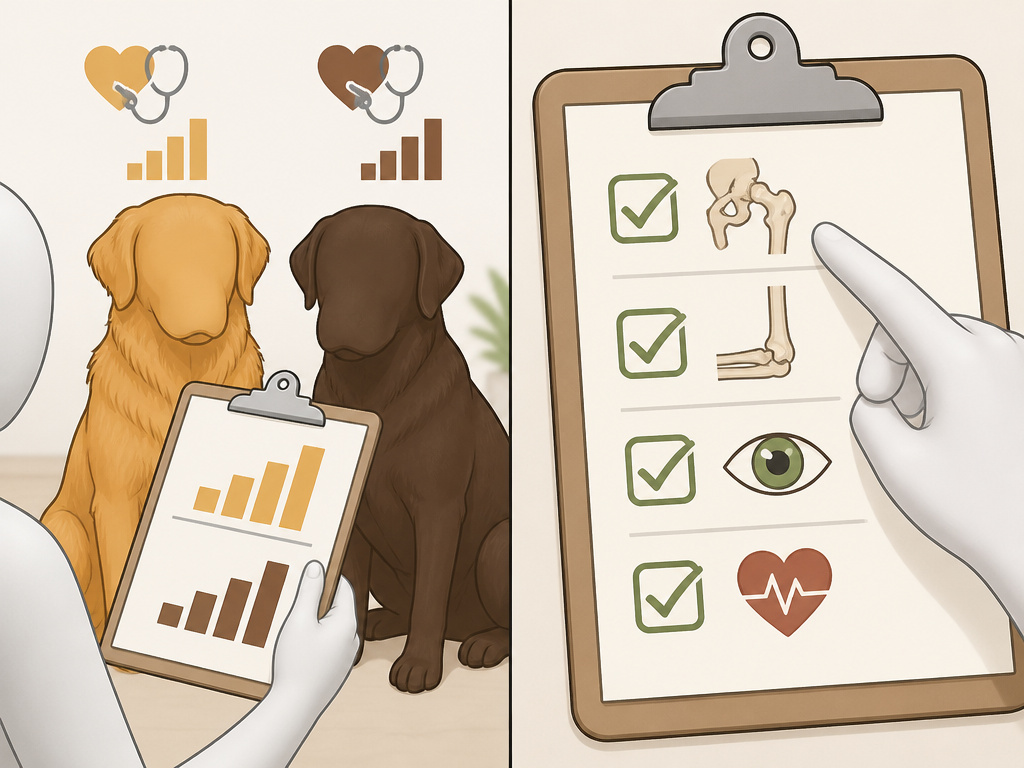
Three cancer statistics get quoted at every Golden owner, and they measure three different things. Conflating them is the most common error in this comparison.
The Golden Retriever Club of America’s 1998-99 national health survey found cancer caused 61.4% of 420 reported deaths, split 66% in males and 57% in females. That’s a share of deaths in a survey population, not a lifetime risk.
The Morris Animal Foundation Golden Retriever Lifetime Study enrolled 3,044 dogs from 2012. As of August 2022, about 75% of recorded deaths in that cohort were cancer-related, and by 2026 the study had logged more than 1,700 confirmed cancer diagnoses, with hemangiosarcoma the largest single contributor. At the 2022 reporting point the mean age was 9.4 years and 64.3% of the dogs were still living, which is why that 75% isn’t a population mortality rate.
Community Animal Hospitals states that approximately 60% of Goldens will develop some form of cancer in their lifetime. That’s a different claim from either of the others.
| Figure | What it measures | What it doesn’t |
|---|---|---|
| 61.4% (GRCA 1998-99) | Cancer’s share of 420 reported deaths | Lifetime risk for a living Golden |
| ~75% (Morris, Aug 2022) | Share of recorded deaths in a cohort still 64.3% alive | Population-wide mortality |
| ~60% (Community Animal Hospitals) | Estimated lifetime cancer development | A measured cohort |
The screening lists differ too, and this is where a puppy buyer should pay attention. Labradors are screened for hip and elbow dysplasia, bloat, progressive retinal atrophy, and exercise-induced collapse, which has a DNA test. Goldens are screened for hip and elbow dysplasia, eye conditions, and subvalvular aortic stenosis, a narrowing below the aortic valve.
PetPlace recommends asking any breeder about hip, elbow, eye, and heart clearances regardless of breed. Ask for the paperwork. A breeder who can’t produce it is telling you something.
Labrador vs Golden Retriever: Which Is Calmer in the House?
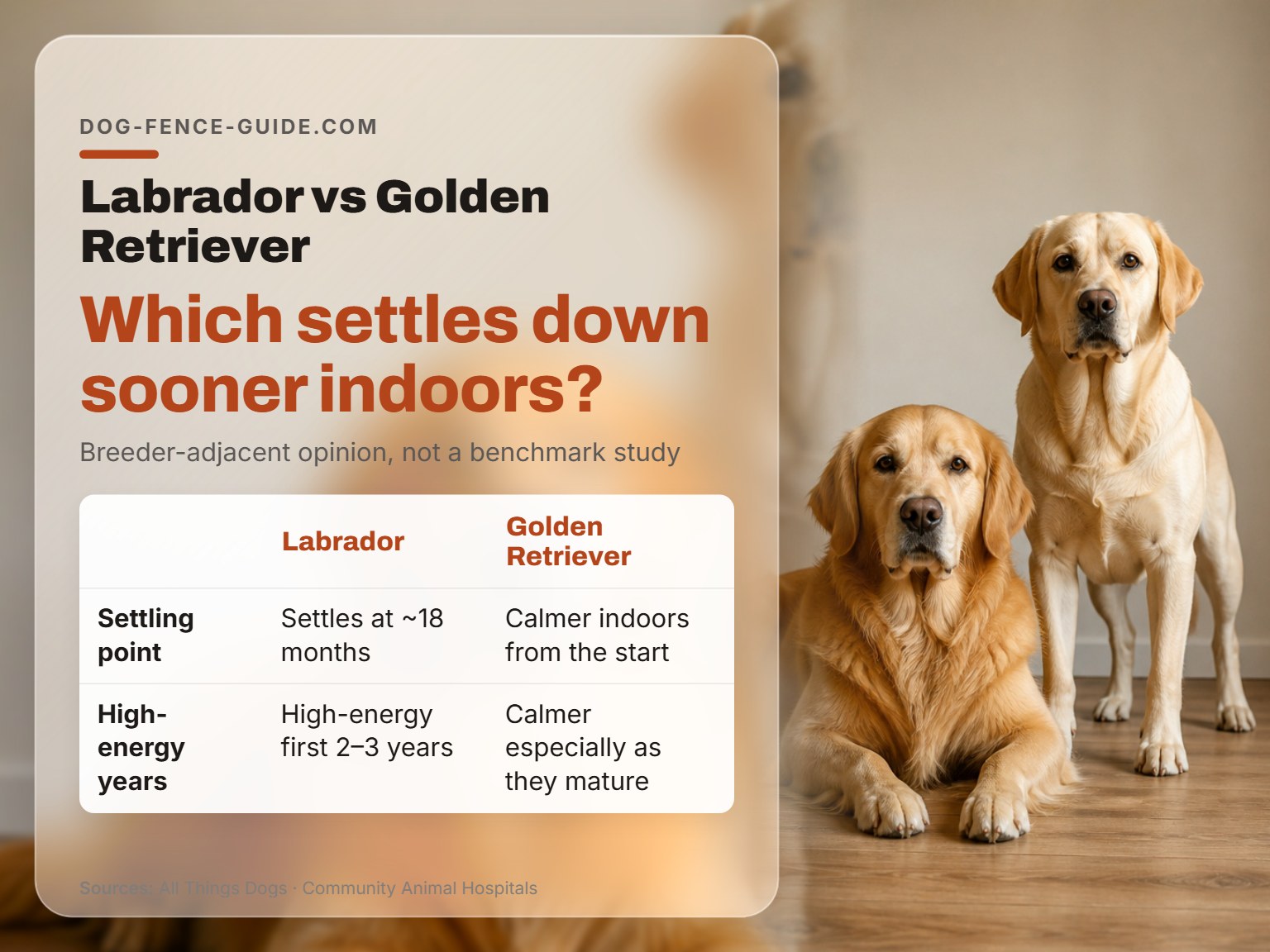
The honest answer is that nobody has measured it. Every claim in this section comes from breeder-adjacent opinion and hospital write-ups, not from a benchmark study.
PetPlace describes Goldens as a little calmer indoors, especially as they mature, and says Labs may stay high-energy well into adulthood. Royal Canin frames the Golden as calm at home and energetic outside, and the Labrador as dynamic and curious. All Things Dogs says Goldens adapt more readily to a sedentary lifestyle while Labs keep high energy reserves.
The timelines are more useful than the labels. All Things Dogs puts the Labrador settling point at roughly 18 months. Community Animal Hospitals says Labs are high-energy through their first two or three years and describes them as puppies in a large dog’s body well into adulthood.
So the practical split looks like this. A Golden tends to be easier to live with in a quiet house from the start. A Labrador tends to be harder for two years and then levels off into something similar.
If you’re already thinking about a cross, the same temperament question follows the coat into the Golden Retriever vs Goldendoodle comparison, where the poodle side usually dials the energy down a notch.
Feeding a Food-Motivated Labrador vs a Golden
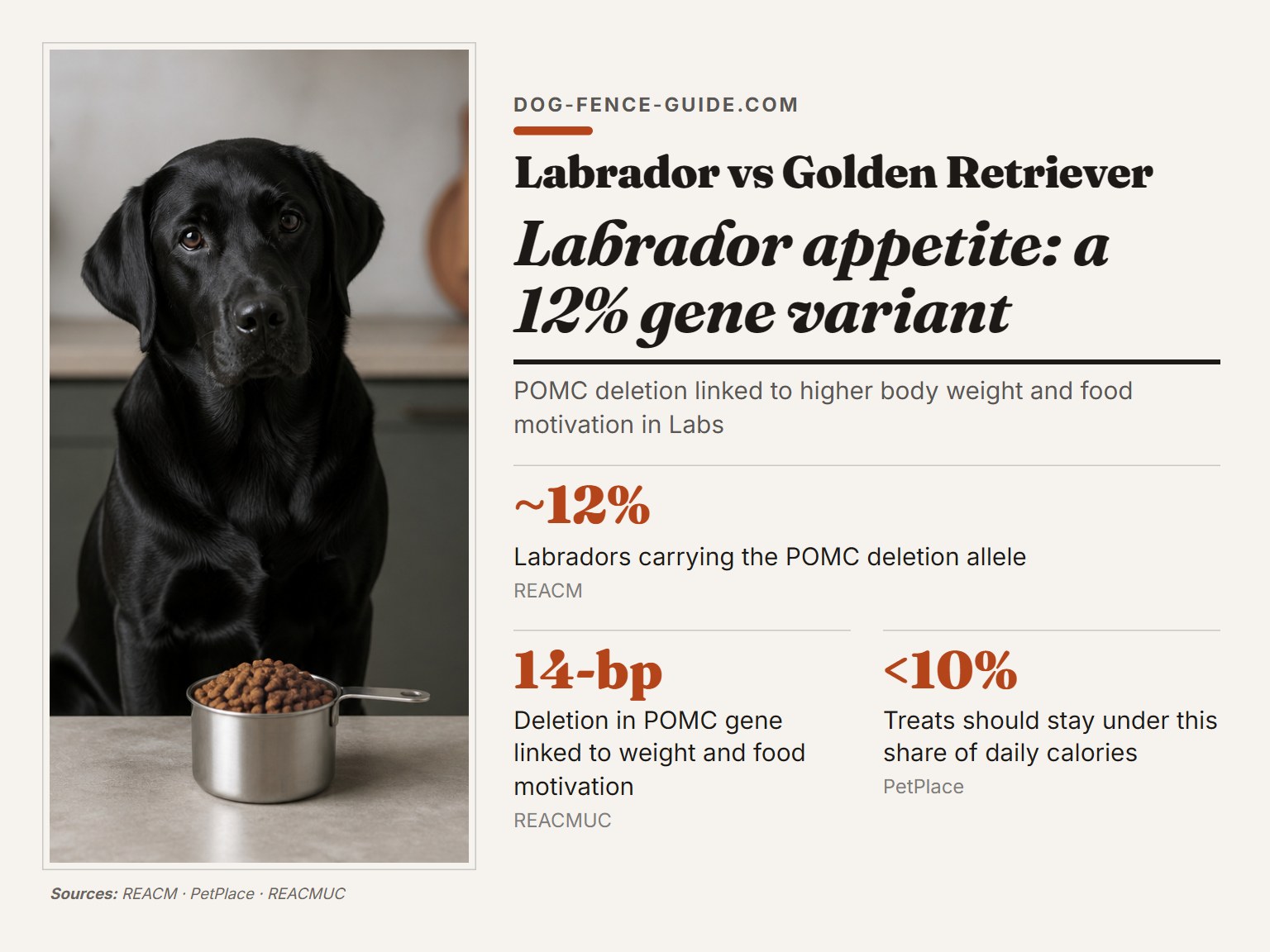
The POMC gene sits at the center of the Labrador appetite question. Raffan and colleagues, publishing in Cell Metabolism in 2016 from the University of Cambridge, identified a 14-base-pair deletion in the gene associated with higher body weight, greater adiposity, and greater food motivation.
That deletion turns up in about 12% of Labradors. There’s no equivalent finding for Goldens in the literature, which is part of why the Labrador obesity reputation has a genetic paper behind it and the Golden one mostly has anecdotes.
The practical fallout is portion control. PetPlace recommends measuring cups, skipping table scraps, and keeping treats under 10% of daily calories, and flags Labs specifically as the breed that needs the most monitoring. Both breeds benefit from glucosamine for joints and Omega-3s.
How Much to Feed and How Often
- Weigh the kibble with a measuring cup, not a scoop. A heaped scoop runs over a level one, and that surplus lands on the ribs within a season.
- Cap treats at under 10% of daily calories. Skip this and the treats quietly become a second meal that nobody counts.
- Skip table scraps entirely for a Labrador. The POMC variant means the dog asks harder and persists longer, so a single successful beg gets repeated for years.
- Recheck body condition monthly with your hands, not your eyes. Run your palms along the ribs. If you can’t feel them under a soft layer, cut the portion before the vet does it for you.
If you want brand-level detail rather than portion math, the best food for Labradors and the best kibble for Golden Retrievers both go deeper than a breed profile can.
Containment and Training: Where These Two Breeds Split
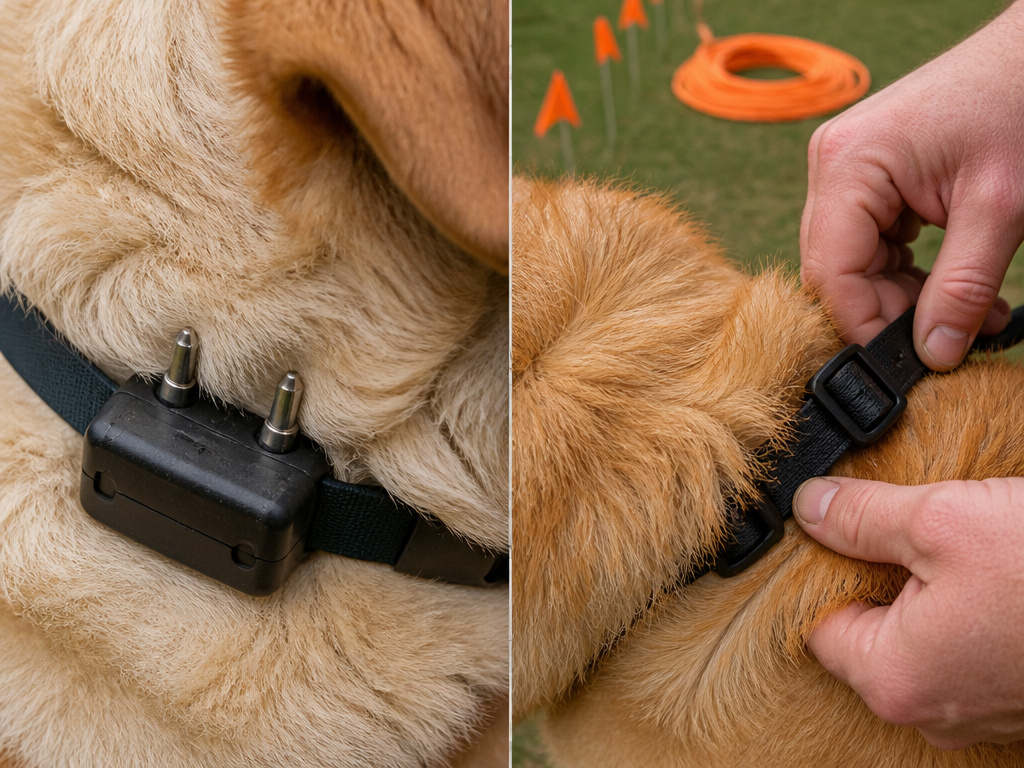
Both breeds are food-motivated, scent-driven, and strong enough to test a boundary the moment they think you’re not watching. That makes containment a training problem before it’s a hardware problem.
I keep a spreadsheet of published correction levels across the in-ground systems I test. Some manufacturers print a voltage range. Others print a level count and nothing else. If a company won’t publish the voltage, I assume the number is embarrassing.
A long level list also flatters a collar that doesn’t have much range. A long level list sounds generous until the lower levels do nothing on a thick-coated dog, which is exactly what you get with a Labrador in full winter coat or a Golden with a dense undercoat. What matters is the effective ceiling, not the count.
Contact points are the other half of that. On a heavy-coated dog, standard points can disappear into the fur and the dog feels nothing until the level gets cranked, which is a bad first lesson. A snug fit and longer points solve it.
The part nobody mentions: A wired in-ground loop with a surge protector and a wire-break locator prevents most of the “my fence stopped working” calls I hear about. The accessories cost less than a service visit and they remove the two most common failure points.
What to Train Before the Collar Goes On
- Leash and long-line recall first, in the yard, on the actual boundary line.
- The boundary marker itself: flags or paint the line and walk it daily so the dog learns the geography before it ever feels a correction.
- A release cue and a return cue that work when the dog is distracted by a scent, which is the only test that counts for a retriever.
- Daily practice before you trust anything.
If you can’t commit to that schedule, skip the system entirely. A Labrador or Golden that doesn’t understand the boundary will simply learn where the signal drops and live in the gap, and that’s a worse outcome than a long line and a pair of walking shoes.
For a fuller picture of what you’re signing up for with the Lab side of this comparison, the Labrador pros and cons covers the daily reality rather than the breed standard.
Frequently Asked Questions
Do Labradors or Golden Retrievers shed more?
Both shed year-round and neither is a low-shedding breed. The difference is handling, not volume. A Labrador’s short coat releases hair that lands on floors and furniture, while a Golden’s longer feathered coat holds shed hair in the undercoat until it mats or gets brushed out.
Is a Golden Retriever or Labrador better with young children?
Both breeds are consistently described as good with children across PetPlace, Royal Canin, and Community Animal Hospitals. The temperament sources lean toward Goldens for quieter households with younger children and toward Labradors for busier, more active homes. Neither claim comes from a measured study.
How much exercise does each breed need?
Royal Canin recommends one hour of daily exercise for both breeds, and PetPlace says at least an hour. Royal Canin adds that the exercise should be adapted to the dog’s age and condition, and that a vet should be consulted. Labrador exercise tends to need to be more intense to tire the dog out.
Are Golden Retrievers really more prone to cancer?
The breed has a documented and unusually heavy cancer burden. The GRCA survey found cancer caused 61.4% of 420 reported deaths, and the Morris Animal Foundation cohort recorded roughly 75% of deaths as cancer-related as of 2022. Those are death-share figures within specific populations, not a lifetime risk estimate for any individual dog.
Which breed handles hot weather better?
The Labrador, on the available evidence. Hall et al. (Scientific Reports, 2020) found Golden Retrievers had 2.65 times the odds of heat-related illness compared with Labradors, with a 95% confidence interval of 1.40 to 5.01. The AKC’s Golden page also recommends a vet consultation before strenuous activity, which the Labrador page does not.
The Bottom Line
Here’s the threshold that actually decides this for most households. If you can’t commit to brushing a Golden three times a week through shedding season, the coat has already made the choice for you, and no amount of temperament comparison will fix a matted dog.
If you can commit to that, and your summers run hot and humid, the Labrador has the better evidence behind it. Lower heat-illness odds, a slightly longer AKC lifespan, and a coat that towels dry.
I’d start this week with one thing: call two breeders and ask for hip, elbow, eye, and heart clearances in writing. Whichever breed you land on, that phone call tells you more about your future dog than any comparison table, mine included.
And if you take nothing else from the Labrador vs Golden Retriever question, take this. Both are the same size, roughly the same lifespan, and roughly the same amount of work. The coat and the health data are where they actually part company.
