
Can Dogs Smell Fear: What the Studies Actually Show
This post contains affiliate links. As an Amazon Associate, we earn from qualifying purchases.
Dogs can smell fear in the narrow sense: they can tell stressed human sweat from calm human sweat. In a 2022 PLOS ONE study, four dogs did exactly that with 93.75% combined accuracy across 720 trials. What they do with the information is still open.
That chemistry is measurable, and it is the basis of the can dogs smell fear question. Under acute stress, the compounds in human sweat shift, and the 2022 team used a Biopac MP150 system to confirm its donors were physiologically stressed before any dog sniffed a sample. Take that step out and the result collapses into “dogs smelled something.”
What follows: what the accuracy figure actually measures, why four published studies point four different ways, and how to read your own dog’s reaction without inventing a story to go with it.
Key Takeaways
- 93.75% is discrimination accuracy, not a fear detector. The dogs chose between two odour samples in a forced-choice task, not free-sniffed your hallway.
- The 2022 trial ran 720 trials across 36 sessions with four dogs, and individual accuracy ranged from 90.00% to 96.88%.
- Published results conflict on direction. A 2025 Frontiers in Veterinary Science study found dogs stayed longer with the experimenter and showed lower tail posture, while D’Aniello et al. (2017) found more stress behaviours and higher heart rates.
- Puppies under six months show fear-odour patterns but not happiness-odour ones. That second response needs socialization to develop.
- The scent and the human have not been fully separated. Dr. Katherine Albro Houpt of Cornell argued in 2017 that there is ‘no proof that dogs can smell fear’ and the isolating experiment ‘has not been done’, while peer-reviewed studies such as Wilson et al. (2022) report measurable, statistically significant responses to stress chemosignals.
What the 93.75% Accuracy Figure Actually Measures
93.75% is the number that gets passed around, and it deserves a closer look before you repeat it.
Four dogs completed 36 sessions totalling 720 trials, each session built from 10 training trials and 20 discrimination trials. Combined accuracy reached 93.75%, with individual dogs ranging from 90.00% to 96.88% against a 0.33 chance probability. Binomial testing returned p<0.001. The design was three-alternative forced choice, so guessing carried a measurable cost.
The setup involved 36 human participants and four dogs, and it is the study most cited in the can dogs smell fear debate. Those dogs weren’t asked whether a person was afraid. They were asked to pick the stress sample out of a lineup, over and over, with a wrong answer always available.
I’ve quoted that figure myself and been sloppy about what it means. It measures discrimination. A dog that can tell sample A from sample B has proven its nose works on stress chemistry. It has proven nothing about how it feels when you come home upset.
That gap is where most popular versions of this claim fall apart. The dog’s sense of smell is doing genuine work here, just on compounds rather than on an emotion.
Can Dogs Smell Fear, or Only Stress?
The popular version says pheromones. The published work mostly says sweat.
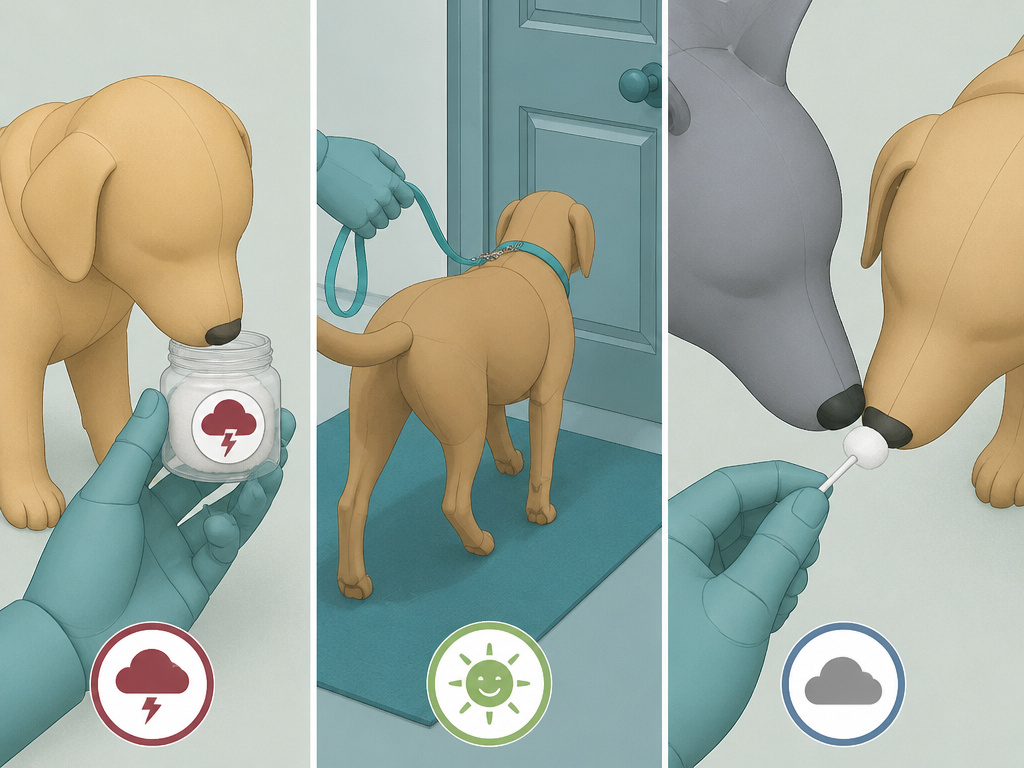
D’Aniello and colleagues collected axilla sweat from male donors and ran dogs through three conditions: fear, happiness, and a no-sweat control. In that Springer chemosignal transmission study, dogs in the fear condition showed more stress behaviours and a higher heart rate. In the happiness condition they showed more stranger-directed behaviour and less owner-directed behaviour. Labrador and Golden retrievers made up the sample.
That’s a real effect. It’s also a long way from the slogan.
Here’s the precision problem. The 2022 PLOS ONE work used what its authors called psychological stress condition odours, not fear odours. Stress and fear overlap in the body, and they aren’t the same state. The papers don’t treat the terms as interchangeable, so neither should you.
Easy to miss: Almost every popular write-up swaps “stress” for “fear” in the headline. The measured stimulus was sweat from stressed donors, and the measured response was a forced choice. Both halves are narrower than the claim.
Whether dogs understand human emotions in any richer sense is a separate question, and a harder one.
Why Four Good Studies Point Four Different Ways
The literature does not agree, and pretending otherwise is the fastest way to get this wrong.
| Study | What the dogs did | Direction |
|---|---|---|
| Frontiers in Veterinary Science (2025) | Stayed longer with the experimenter; lower tail posture | Approach |
| D’Aniello et al. (2017) | More stress behaviours; higher heart rate | Arousal |
| D’Aniello et al. (2021) | Females spent longer at the door | Exit interest |
| PMC13654890 | Less time near targets; more handler-looking | Reorientation |
Those four results don’t fit one story. Approach, arousal, exit, and reorientation are different responses to the same stimulus, and nobody has reconciled them.
The 2025 paper breaks the old assumption most cleanly. It states outright that its finding challenges previous assumptions of an innate interspecific fear avoidance. The Frontiers dog fear chemosignal study ran 41 dogs in the experimental group and 20 in the control.
Lower tail posture is the detail worth holding onto. A tail that drops below the line of the back and stays there reads as a different animal from one that tucks hard and freezes.
The results get narrower still. A separate PMC dog cognitive bias study put 18 dogs and 3 unfamiliar volunteers through a judgement bias test with three bowl locations. The stress-odour effect showed up only at the near-negative location, and only in session three. One condition, one session, out of an entire protocol.
Worth knowing before you start: Dr. Katherine Albro Houpt, professor emeritus at Cornell, said in a 2017 interview that there was “no proof that dogs can smell fear” and that the isolating experiment “has not been done.” That was a credentialed objection to a real gap, and the gap has narrowed without closing.
Her point was methodological. Earlier designs couldn’t separate a dog’s reaction to the scent from its reaction to the present human’s own unconscious response. The 2025 work names that confound directly. It hasn’t fully solved it.
Puppies, Females, and Wolves: Where the Pattern Breaks
Three findings complicate the tidy version: age, sex, and species.
Puppies Under Six Months Read Fear but Miss Happiness
A 2023 study in Animal Cognition found puppies aged 3 to 6 months show consistent fear-odour patterns but no behavioural difference between control and happiness odours. Adult dogs show distinctive patterns for all three. The happiness response appears to require learning during socialization.
So a young puppy picking up on your stress chemistry is plausible. A young puppy reading your good mood through your sweat is not.
Female Dogs Head for the Door
The 2021 sex-differences work found female dogs showed significantly longer door-directed behaviour in the fear condition versus control. That sounds dramatic until you read the rest: overall effects were not sex-dependent for apparatus, owner, or stress behaviours.
One behaviour moved. The rest of the profile didn’t.
Wolves React Like Dogs, and That’s the Problem
Human-socialized wolves responded to human fear odour much the way dogs did in the PMC wolf chemosignal comparison. Neither species preferred fear or neutral smell. Both spent less time near targets and looked more at the handler. Dogs, but not wolves, ended sessions prematurely.
That last detail undercuts the domestication-only explanation. If wolves react similarly, the sensitivity isn’t something domestication built from scratch.
What these three findings mean in practice:
- Age changes the read. A four-month puppy isn’t giving you the same signal an adult is, and treating it that way leads to bad conclusions.
- Sex changes one behaviour, not the whole profile. Don’t build a theory on a single measure.
- Species background matters less than expected, which is the uncomfortable part for anyone arguing this is a dog-specific gift.
What Is Your Dog Actually Reading When You Come Home Stressed?
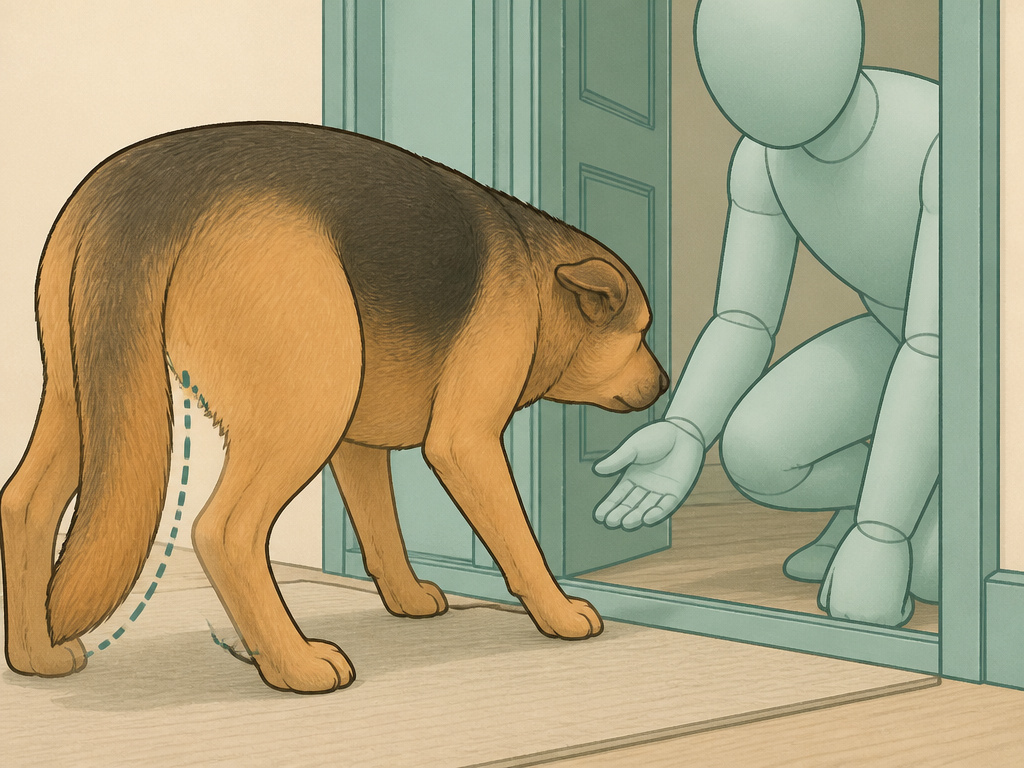
Your dog meets you at the door after a bad phone call. Ears flat, tail low, following you from room to room.
That’s not proof of anything on its own. It’s a set of behaviours, and you’re the one assigning the meaning.
I’ll give you the example that changed how I look at this. My old shepherd tilted left almost every time I said his name, and I thought it was charming for about a year. Then it turned out his right ear had gone dull. My old shepherd tilted left almost every time I said his name, and I thought it was charming for about a year, until it turned out his right ear had gone dull. Check hearing before you call a head tilt cute.
Here’s where I’d start with any dog, in this order:
- Watch the tail before the face. A tail held below the line of the back is a different signal from one tucked hard against the belly, and the difference matters more than most people think.
- Note where the dog looks. Handler-looking is a documented response in the fear condition, and it looks like checking in rather than panic.
- Time how long it lasts. A dog that settles within a few minutes is having a moment. A dog still avoiding you twenty minutes after you’ve calmed down is telling you something else is going on.
- Check the ears for flatness against the skull, because that cue shows up before the whining does and it’s easy to miss when you’re the one who’s upset.
If you want a reference table for the signals themselves:
| What you see | What it usually means | What to check first |
|---|---|---|
| Tail below back line, held there | Lower arousal or appeasement | Whether it started before or after you arrived |
| Ears flat against the skull | Fear or stress response | The trigger in the room, not the dog |
| Following you room to room | Reorientation to the handler | Whether the dog settles within a few minutes |
| Dog leaves and ends the interaction | Avoidance, not stubbornness | Whether you missed an earlier signal |
If you want a comfort measure while you work this out, a plug-in dog appeasing pheromones diffuser or a pressure wrap may help. I haven’t seen controlled trial data for either that matches what the odour studies did, so treat both as comfort rather than treatment.
Where this goes sideways: Assuming your dog is reacting to your mood when it’s reacting to something in the room. A dog that flattens when you’re calm is reading a sound, a smell, or a person at the door, and no amount of deep breathing will fix that.
The same over-reading happens with whether dogs actually feel guilt. The look people call guilty is a response to a scolding tone, not a confession.
If you want to tell if a dog is scared rather than guess at it, start with the body and work backward. Reading dog body language is a skill you build by watching the same dog in the same room over weeks. The signs a dog is stressed overlap heavily with the signs of fear, which is exactly why the researchers keep arguing.
Start with your own yard and your own dog. Watch what your dog does when you’re calm, so you have a baseline to compare against when you’re not.
Frequently Asked Questions
Can dogs really smell fear?
They can discriminate stressed human sweat from baseline sweat at rates well above chance, and that’s the strongest version of the claim the evidence supports. Whether that counts as “smelling fear” depends on how loose you want the definition. The 2022 trial measured discrimination accuracy, not emotional understanding.
Do dogs smell fear or stress?
The studies measured stress chemistry. D’Aniello’s 2017 work used fear-condition sweat, but the 2022 PLOS ONE trial used what its authors called psychological stress condition odours. Fear and stress overlap physically without being identical, and the research doesn’t treat them as the same thing.
Why do studies on this disagree so much?
Different stimuli, different tasks, different measures. One study counts time spent near a stranger, another counts heart rate, another counts door-directed behaviour. The 2025 paper also notes that earlier designs couldn’t separate a dog’s reaction to the scent from its reaction to the human’s own unconscious response.
Can puppies smell fear?
Puppies aged 3 to 6 months show consistent fear-odour patterns, according to a 2023 study. They don’t show a behavioural difference between control and happiness odours, though, which adult dogs do. The happiness response appears to depend on socialization.
Does my dog react to my anxiety?
Possibly, and the honest answer is that the studies can’t tell you which part of your behaviour the dog is responding to. Sweat chemistry is one channel. Posture, breathing, and tone are others, and no design has cleanly isolated them yet.
Before You Go
One number to carry out of here: 93.75% is discrimination, not detection of an emotion. Everything else below hangs off that distinction.
If you want to test it at home this week, do one thing. Spend two minutes watching your dog while you’re calm, and write down the tail position, the ear position, and how close the dog stands. That’s your baseline. Then compare it the next time you’re genuinely wound up. You’ll learn more from one comparison than from a hundred articles, including this one.
Fair warning: if your dog is still avoiding you twenty minutes after you’ve settled, stop looking at your own sweat and start looking at the room. Something else is going on.
And a short checklist before you draw any conclusion about your own dog:
- Check hearing and vision first. A dog that’s tilting, squinting, or misjudging distance may be reacting to a physical change rather than to you.
- Watch one behaviour at a time. Tail first, then ears, then distance. Trying to read all of it at once is how people talk themselves into a story.
- Give it a week of baseline before you believe anything. A single reaction is an anecdote. A pattern across seven days is data.
