
How Do Dogs Communicate With Each Other? Scent and Sound
This post contains affiliate links. As an Amazon Associate, we earn from qualifying purchases.
Dogs communicate with each other through posture, tail position, ear set, scent, and sound, and an off-leash greeting between strangers averages just over six seconds. In a 58-pair park study, 48.1% of greetings shifted at least one dog’s posture, play rarely followed, and no aggression occurred.
That posture shift is the part worth watching when you consider how do dogs communicate with each other. A greeting is mostly two dogs settling who holds the higher stance, and the answer usually resolves in the first few seconds. When it doesn’t resolve, owners describe the result as “they just stood there staring at each other.”
What follows covers what a greeting actually looks like second by second, why the tail wag gets misread more than any other signal, where sound fits in, and how to watch a whole exchange without hovering over your dog.
Key Takeaways
- Greetings are short. The mean was 6.042 seconds across 58 pairs, so most of the negotiation is finished within the first few seconds.
- A wagging tail is not a verdict. Loose and side-to-side reads friendly, low and fast reads anxious, stiff reads threat.
- Sound is a contested channel. Rover’s consumer blog calls vocalization minor, while Siniscalchi et al. (2018) and the Merck Veterinary Manual treat acoustic signaling as a full, co-equal channel.
- Play signals get placed with care. Across 203 observed sessions, 82% of play bites did not follow a relaxed open-mouth display.
- Some breeds can’t show what they feel. Dense coat and flat face physically block the signals everyone else reads.
What Happens in the First Six Seconds of a Dog Greeting?
6.042 seconds. That’s the mean greeting time recorded across 58 dog pairs in one park, with a standard deviation of 0.801 seconds.
Off-leash greeting between unfamiliar dogs averages 6.042 seconds, measured across 58 dyads in a single park. In 48.1% of those encounters, one or both dogs shifted posture, most often from a high or low stance to neutral. Greetings produced no aggression, and play rarely followed. The standard deviation was 0.801 seconds.
The numbers come from a greeting behavior study from the University of Córdoba, run in a single park with 58 pairs. Single-dog greetings outnumbered dual-dog greetings. The dog that started the exchange was significantly larger than the one receiving it, and held a posture equal to or higher than the other dog’s.
Size and height are the two things a dog can read from across a park. Both get settled before contact, which is why the greeting is so brief. Most of what happens in that window is about dog posture rather than anything vocal.
I’ve stopped calling a greeting successful until I see the posture settle. Two dogs can sniff politely for longer than the measured average and still be locked in a standoff.
One caution sits on the whole study. The authors sampled a single park and said so plainly, which means the numbers may not hold across different parks, dog sizes, or the mix of dogs at your local field. If you’re planning puppy introductions, expect the adult dog to set the pace inside that window.
Why the Tail Wag Is the Most Misread Signal in the Park
Watch the tail’s height and speed, not the fact that it’s moving.
A loose, side-to-side wag at mid-height reads as friendly or excitable. A fast wag with the tail held high reads as confidence. A low, fast wag reads as anxiety or internal conflict. A stiff tail reads as threat or anxiety. That breakdown comes from a 2018 review by Siniscalchi and colleagues in Animals.
There’s a finer layer on top of it. The Merck Veterinary Manual notes that dogs pick up on which side a wag predominates, right or left, and read emotional state from that.
Popular pet writing flattens all of this into “a wagging tail means a happy dog,” while Siniscalchi et al. (2018) and the Merck Veterinary Manual describe wagging as context-dependent and lateralized; that difference matters at a park gate.
| Signal | Popular reading | What the research describes |
|---|---|---|
| Loose side-to-side wag | Happy | Friendly or excitable |
| Fast wag, tail held high | Happy | Confidence |
| Low, fast wag | Happy | Anxiety or internal conflict |
| Stiff tail | Happy | Threat or anxiety |
The practical version: look at the base of the tail, not the tip. A stiff tail has no give at the base. A loose wag has give at the base, and the whole rear end moves with it.
Common mistake: Reading the wag at the tip only. A dog can hold a stiff tail and still move the last few inches, and owners call that friendly until the other dog backs off.
How Do Dogs Communicate With Each Other Using Sound?
Sound is where the popular advice and the peer-reviewed literature part company.
The Consumer Version and the Research Version
Rover’s guide to dog communication says dogs communicate “to a lesser extent, vocalizations” compared with other channels. The PMC review of dog communication treats acoustic signaling as a full, co-equal channel, listing barks, growls, howls, whines, pants, and sighs. The Merck Veterinary Manual takes the same position.
That’s a real disagreement: Rover’s consumer blog treats sound as a side channel, while Siniscalchi et al. (2018) and the Merck Veterinary Manual treat it as co-equal, which changes how you watch a park.
The physical reason Siniscalchi et al. (2018) and the Merck Veterinary Manual weight it heavily is simple, though Rover’s consumer blog does not: a bark travels through brush and around a corner, while posture doesn’t.
A growl carries information. Treat it as a sentence and give the dog room to finish it, rather than as a warning shot that needs correcting.
Two signals do most of the work at a park: dog growling when a dog wants space, and why dogs howl when sound has to carry further than the dog can see.
Play Signals: The Bow, the Open Mouth, and the 82% Number

The play bow does one job and the relaxed open mouth does another, a distinction that matters for how do dogs communicate with each other. Mixing them up is how owners misread a dog that’s actually fine.
Cordoni, Nicotra and Palagi watched 203 play sessions at an off-leash park in Palermo. Play bows showed up regardless of what kind of play was happening. The relaxed open-mouth display clustered in contact and face-to-face play.
The play signals in dogs study also found that in 82% of cases, a play bite did not follow a relaxed open-mouth display. That number is the interesting one. It means the open mouth gets placed where it’s needed, not fired off at random.
Fair warning: that 82% is a description of what dogs do, not a guarantee about the next dog you meet.
Play Bow vs. Open Mouth: Different Jobs
The bow works at distance. It’s an invitation that can be sent from across a field and declined without contact. The open mouth works at contact range, where the bite risk is real and the signal has to be immediate.
Asymmetry matters too. Higher play asymmetry shortened sessions, and a greater number of players lengthened them. Play asymmetry also didn’t differ between stranger dogs and familiar dogs, which contradicts the old assumption that play sorts out dominance.
A session that’s going well sounds like loose, breathy panting with an occasional sneeze. Here’s what to look for:
- Loose, open-mouthed panting with a sneeze thrown in
- Both dogs swapping roles, so the chaser becomes the chased
- Brief pauses where one dog shakes off and resets
- Handicapping, where the bigger dog drops its shoulder or slows down
I film greetings and play, then watch them back in slow motion. The thing I catch on replay, every time, is a dog asking for space with a head turn I missed live. It’s the cheapest coaching you’ll get.
The play bow is the one signal most owners already recognize, which makes it the easiest place to start learning the rest.
Some Breeds Can’t Say What They Mean

A flat face and a heavy coat can hide almost everything a dog is trying to say.
Siniscalchi and colleagues note that artificial selection has reduced social-signaling capacity in several breeds. Long or dense fur covers piloerection, eyes, mouth, and legs. The breed standard that wins in the ring is the same anatomy that blocks functional visual communication.
What Fur and Flat Faces Hide
Standard body-language reading fails for brachycephalic and heavily coated breeds, because fur and anatomy physically block the signals. That’s not a training problem on your end. The message just isn’t reaching you.
Where this goes sideways: Assuming a heavily coated dog is calm because the coat hides the raised hackles. The dog is signaling the whole time and the other dog reads it fine. By the time the snap comes, you’ll swear it was unprovoked.
Short version: ear set is often the last signal still visible on a coated dog, which is why dog ear positions are worth learning early.
I’ve stood at a fence line with an owner who called a coated dog relaxed while the ears said something else entirely.
The Channel You Can’t See: Scent and the Limits of Watching
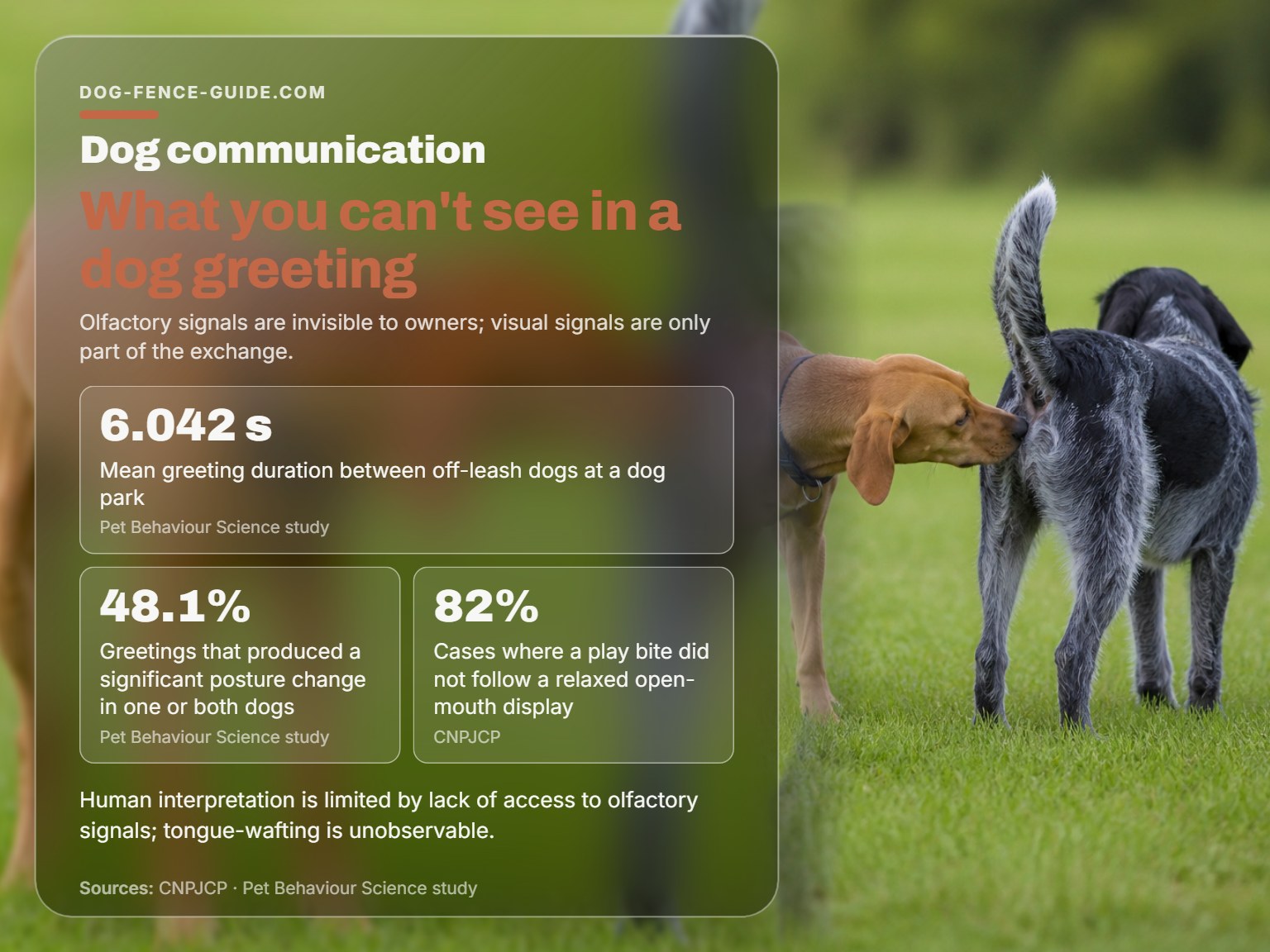
Two dogs meet, one lifts a lip, the tongue flicks out and back, and the exchange has already moved on.
That flick is scent work. The Merck Veterinary Manual’s social behavior of dogs states that human interpretation is limited by a lack of access to olfactory signals, and that vomeronasal uptake through tongue-wafting is unobservable to owners.
| Channel | What dogs use it for | What you can actually see |
|---|---|---|
| Visual | Posture, tail, ears, mouth | Most of it, unless coat blocks it |
| Acoustic | Barks, growls, whines, pants | The sound, not the intent |
| Olfactory | Identity, state, territory | Almost none of it |
| Tactile | Contact during greeting and play | The contact itself |
The olfactory row is the one that should keep you humble. A dog knows things about the other dog that you will never have access to, no matter how long you stand there.
That’s the argument for reading dog body language as a skill with a ceiling. You’re working a partial channel and doing well with it.
How to Watch a Greeting Without Getting It Wrong
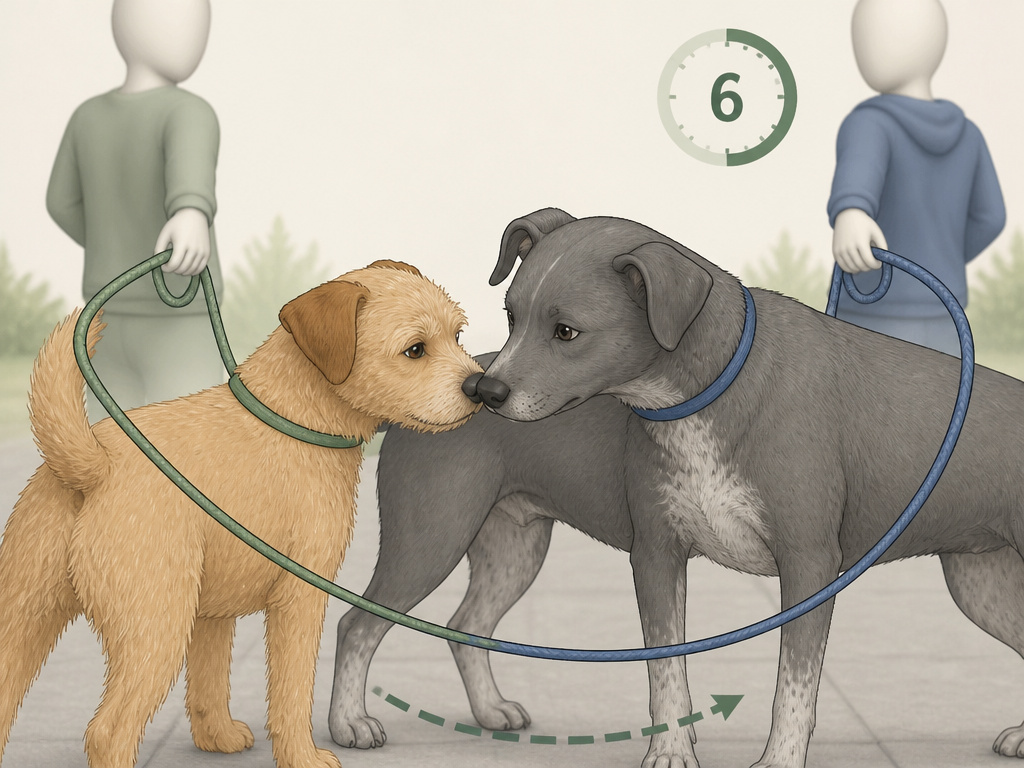
Three things decide whether a greeting goes well: distance, duration, and who breaks it off.
Before you start: Two unfamiliar dogs on leash can wrap a lead quickly, so keep both leads short and loose. A dog that feels tension on the collar pulls into it, and a pull reads as a challenge to the other dog. Keep the meeting near the six-second average and walk away while both are still relaxed.
When to Break It Off Early
If either dog freezes, stops blinking, or the tail goes stiff and high, end it. A few seconds of a bad greeting is enough to set a pattern that is hard to undo.
- Approach at an angle, not head-on. Two dogs on a straight line have nowhere to yield, and a head-on approach is what turns a greeting into a stare-down.
- Keep the leads slack. A tight lead pushes the dog forward into the other dog’s space, which is the fastest way to wreck a six-second greeting.
- Watch the first seconds, then the posture. If both dogs shift to neutral, the rest is admin. If one stays high and stiff, call it.
- Break it off before it drags. Long greetings stop being greetings. Walk both dogs away while they’re still relaxed.
I break greetings off earlier than most owners do, and I’ve never once regretted it.
If you’re bringing a new dog home, the introduce two dogs sequence matters more than the first meeting itself. A GoPro clipped to a fence post gives you a replay you can actually study, which beats trying to remember what happened in real time.
Frequently Asked Questions
Do dogs communicate with each other the same way they communicate with us?
Partly. Posture, ear set, and tail position carry over, but dogs also use signals with each other that they rarely aim at people, like scent-marking and rear-sniffing. The bigger difference is that humans miss the olfactory half entirely.
Is a wagging tail always a sign of friendliness?
No. Height, speed, and stiffness change the meaning. A loose mid-height wag reads friendly or excitable, a fast wag with the tail held high reads confidence, and a low fast wag reads anxiety. A stiff tail is the one to take seriously.
How long should a greeting between two dogs last?
Longer than a few seconds is usually the owner’s idea, not the dogs’. The measured mean in one park study was 6.042 seconds, and play rarely followed there, though popular consumer content implies greeting commonly leads to play; if a greeting drags past that, walk both dogs away while they’re still relaxed.
Why do dogs sniff each other’s rear ends instead of faces?
The rear carries scent glands that give away identity and recent state, and it’s a safer angle than a face-to-face approach. A face approach is the one that can turn into a stare.
Can vocalization really be as important as body language?
Siniscalchi et al. (2018) and the Merck Veterinary Manual treat it that way, listing barks, growls, howls, whines, pants, and sighs as a full channel, while Rover’s consumer blog calls vocalization minor; the disagreement is real, and it’s worth knowing which kind of source you’re reading.
Are some breeds harder to read than others?
Yes. Dense coats and flat faces physically block the visual signals other dogs rely on, and the research notes that artificial selection has reduced signaling capacity in some breeds. Ear set is often the last clear signal left.
The Bottom Line
This all assumes two dogs of roughly similar size and mobility. Put a stiff senior and a bouncing adolescent together and the six-second average stops being useful, because one of them can’t do the dance.
Here’s the step worth taking this week: watch one greeting from start to finish and count the seconds. That’s the whole exercise. You’ll learn more from one timed greeting than from a month of reading about them.
And keep one thing in mind. Most of us read the dog we wish we had, not the one standing in front of us. A dog that walks away from a greeting is doing something harder than a dog that finishes it politely.
