
7 Best Robotic Dogs For Adults in 2026
This post contains affiliate links. As an Amazon Associate, we earn from qualifying purchases.
The Unitree Go2 Pro Robot Dog is the best overall robotic dog for adults. It features 3D LiDAR with 360°x96° perception, can climb 40° slopes, and offers GPT-powered voice interaction. For a home companion with excellent voice and gesture control, the Loona Robot Pet Dog earned the award “Best Voice & Gesture Control,” while the SunFounder PiDog AI Robot Dog Kit is the best choice for DIY programmers and makers.
Finding the right robotic dog as an adult means balancing your desire for genuine interaction against your need for technical capability. You want a robot that feels like a pet but also respects your intelligence, whether that means advanced programming options, realistic movement, or a conversational AI that doesn’t talk down to you.
This guide ranks seven of the best robotic dogs for adults based on specifications, manufacturer documentation, expert round-ups, and patterns in owner feedback. We focus on what actually matters for adult buyers: autonomy, programmability, build quality, and interactive features.
Top 7 Robotic Dogs For Adults in the Market
Certain content that appears on this site comes from Amazon. This content is provided "as is" and is subject to change or removal at any time.
The Best Robotic Dogs For Adults, Reviewed
Unitree Go2 Pro Robot Dog

What We Like
- 3D LiDAR with 360°x96° perception
- Climbs 40° slopes, 6.3" obstacles
- GPT-powered voice interaction (Pro)
Trade-offs
- Not waterproof, avoid rain or water
- Obstacle avoidance must be manually enabled
- Voice/GPT features limited to Pro/X models
A 33-pound quadruped that can carry nearly 18 pounds and hit 3.5 m/s means this isn’t a toy, it’s a serious piece of robotics for adults who want real capability. The 3D LiDAR gives it a 360-degree view of its surroundings, so it can navigate around furniture or uneven ground, though you have to flip the obstacle avoidance on yourself. If you’re after a robot dog that can actually keep up with you on a walk or handle a sloped backyard, this is the one that delivers.
The catch is that none of this works in the rain, the Go2 Pro is not waterproof, so puddles and sprinklers are off-limits. Compared to something like the Loona, which is lighter and more of a desk pet, the Unitree is a full-on outdoor machine that demands you respect its limits. The battery lasts 1-2 hours, which is fine for a training session or a romp around the yard, but you’ll want to plan your outings. For an adult who wants the most capable robot dog available without stepping into full custom programming, the Go2 Pro hits the sweet spot.
Loona Robot Pet Dog

What We Like
- Voice & gesture recognition with ChatGPT
- Auto-charging with multiple route memory
- Home monitoring via camera and speaker
- Interactive play with laser and ball
Trade-offs
- Needs well-lit environment for camera accuracy
- Clear pronunciation required for voice commands
- Charging dock needs open, unobstructed space
The high-definition RGB camera lets Loona recognize faces, understand gestures, and follow you around the house like a real puppy. Voice commands work through Amazon Lex and ChatGPT, so you can tell it to come without fumbling with an app, though clear pronunciation in quiet spaces ensures smoother responses. The speaker and camera also let you keep an eye on your home when you’re away, making it a versatile companion for anyone who wants an interactive pet-like robot.
Weighing 2.4 pounds and standing 18 inches tall, Loona is light enough to carry from room to room and compact enough for a tabletop or floor spot. Unlike the larger Unitree Go2 Pro, which targets adult robotics enthusiasts, Loona is designed for interactive play and home monitoring. It responds to voice commands and gestures, so you can treat it like a pet without needing any coding experience.
Product photos
SunFounder PiDog AI Robot Dog Kit

What We Like
- 12 servos for 32 dog-like actions
- Multi-LLM support for smart conversations
- Rich sensor suite: vision, hearing, touch
- Comprehensive online tutorials and forum support
Trade-offs
- Requires separate Raspberry Pi (not included)
- Designed for ages 15+, not for younger kids
- At 10.4 in, smaller than full-size robot dogs
Twelve servos and a full sensor array, camera, gyroscope, touch, ultrasonic, microphone, let PiDog walk, sit, wag its tail, and respond to voice and gestures. That makes it feel less like a toy and more like a project you can actually teach. It runs on a Raspberry Pi you supply, and with support for ChatGPT, Gemini, Grok, and other LLMs, you can build a dog that holds conversations, recognizes hand signals, or solves math problems out loud. That makes it a natural fit for students, makers, and anyone who wants to learn Python robotics without being locked into a closed system.
The trade-off is that it’s not a ready-to-run companion. You need to source a Raspberry Pi and do the assembly and coding yourself, which rules out anyone looking for an out-of-box pet. Compared to the Petoi Bittle X V2, PiDog has a larger footprint and a different set of features, but its DIY nature means it’s best for those who enjoy tinkering more than playing. If you want a programmable robot dog that grows with your skills, this is the one to build.
Petoi Bittle X V2 Robot Dog

What We Like
- Fully assembled and ready to code
- Voice controlled with 35+ actions
- Open source Arduino and Python support
- Lite feedback servos for realistic movement
Trade-offs
- 1-hour playtime limits extended sessions
- Not suitable for carpet, grass, or uneven surfaces
At just 1.3 pounds and with 35+ lifelike actions, this little robot dog is built for learning, not for lugging around. It’s fully assembled out of the box, so you can jump straight into programming it with block coding, Arduino C++, or Python, no soldering or guesswork. That open-source flexibility makes it a natural fit for classrooms, STEM camps, or anyone who wants to understand how a quadruped actually thinks and moves, rather than just watching it go through preset tricks.
The trade-off is that 1-hour battery life means you’ll want a charging routine if you’re running a full lesson or a long coding session. But for its size and price, it’s a remarkably capable teaching tool that lets you program a dog to see, hear, and respond like the real thing.
LewanSoul MechDog Robot Kit
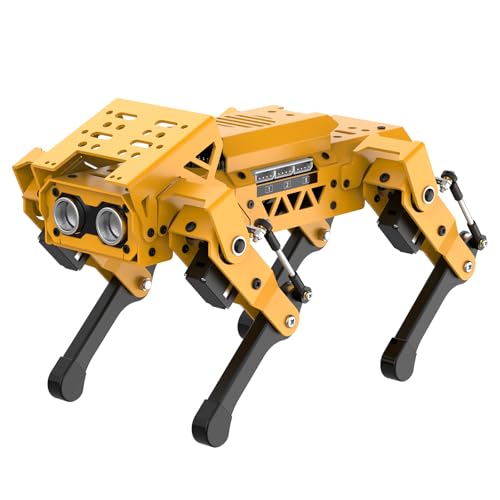
What We Like
- No assembly required, ready to use
- Supports Python, Scratch, and Arduino programming
- Built-in inverse kinematics for lifelike movement
- Compatible with LEGO and extra sensors
Trade-offs
- Coreless servos prioritize speed over heavy lifting
- Lightweight frame limits use to smooth indoor floors only
At just 1.2 pounds and pre-assembled, this robot dog skips the hours of fiddling most kits demand. You can start programming it in Python, Scratch, or Arduino right out of the box, which makes it a practical entry point for adults who want to learn robotics without wrestling with tiny screws. The inverse kinematics give it surprisingly fluid walking, so it doesn’t look like a stiff toy stumbling around your living room. For someone on a budget who wants to understand how quadruped robots actually work, this is the most straightforward path in the guide.
The MechDog’s 5.1-inch length and lightweight 1.2-pound frame keep it stable on smooth indoor floors, so it won’t tip over during tabletop demos. The eight coreless servos deliver fast, precise leg movements for light walking and balancing. If you need a robot dog for rough outdoor terrain, this compact design isn’t built for that. But for learning programming and AI on a desk or living room floor, it works as advertised.
Product photos
HIWONDER PuppyPi Robot Dog

What We Like
- Full ROS1/ROS2 environment support
- Integrates ChatGPT large AI model
- Lidar and robotic arm expandable
- AI vision with face detection and tracking
Trade-offs
- Small size limits outdoor terrain capability
- No built-in battery life specified
- Requires assembly and programming knowledge
The PuppyPi ships with a Raspberry Pi 5 and supports both ROS1 and ROS2 environments, so you can start building autonomous navigation and SLAM mapping projects right away. It also integrates a ChatGPT large AI model for voice and scene understanding, plus a lidar expansion port for 360-degree scanning and obstacle avoidance. This kit is designed for users who want to explore embodied intelligence through hands-on programming.
Weighing just 3.5 pounds, the PuppyPi is compact and light enough to fit on a desk or carry in a backpack, but its size means it’s best suited for indoor or smooth-surface use. Its legs use a link structure with inverse kinematics for precise, coordinated motion. It runs on a Raspberry Pi 5 with full ROS1/ROS2 support, making it a capable platform for learning AI and robotics programming. Owners should be ready to work with Python and Linux, as the robot is designed for education and experimentation rather than out-of-box play.
Product photos
CU-MATE AI Companion Maltese Robot Dog

What We Like
- Natural AI chat for real conversations
- Ultra-soft plush fur for cuddling
- WiFi & app control for personalized interaction
- Non-toxic materials, safety tested for ages 3+
Trade-offs
- Designed for children ages 3+, not for adult play
- Requires WiFi connection for full functionality
A 12-inch plush Maltese with AI chat means this is more a cuddly conversational companion than a tech toy. It walks, barks, and wags its tail to mimic a real pet, and the ultra-soft fur makes it comforting to hold. This suits a child who wants the emotional warmth of a dog without the mess or responsibility, especially for younger kids who just want a soft buddy that talks back. The WiFi app control adds a layer of personalization, letting you adjust interactions from your phone.
At just over a pound, this plush robot dog is light enough for a child to carry around easily. Its soft body and AI chat are meant for indoor cuddling and conversation, not rugged outdoor use. It’s a thoughtful pick for a young child who wants a gentle, interactive companion that can hold a real conversation, but don’t expect it to fetch your slippers.
Product photos
How We Evaluated Robotic Dogs For Adults
This evaluation is based on manufacturer specifications, technical documentation, expert round-ups from the robotics community, and patterns in owner feedback across forums and retailer listings. The focus is on what the data and community consensus indicate about each model’s real-world performance.
The four criteria that mattered most for this category are autonomy and navigation, programmability and expandability, interactive intelligence, and build quality for the intended environment. A robotic dog that cannot navigate a room without bumping furniture is a toy, not a companion. One that cannot be customized or programmed limits its long-term value for adult users.
A research-led evaluation has honest limits. Owner feedback can be subjective, and early-adopter reviews may not reflect long-term reliability. We prioritize models with consistent community documentation and transparent specifications, and we flag trade-offs like the Unitree Go2 Pro’s need for manually enabled obstacle avoidance or the Loona’s requirement for a well-lit room.
What To Look For In Robotic Dogs For Adults
Choosing a robotic dog for adult use means looking past the cute exterior and understanding the technology underneath. The key is matching the robot’s capabilities to your actual needs, whether that is outdoor exploration, indoor companionship, or a programmable learning platform.
Autonomy And Navigation
A robotic dog’s ability to move through its environment without constant intervention defines how much it feels like a real pet. Look for LiDAR or depth-sensing cameras that create a 360-degree perception field. The Unitree Go2 Pro’s 3D LiDAR with 360°x96° perception is a standout, but remember that obstacle avoidance must be manually enabled on that model. For indoor robots like the Loona, camera-based navigation works well but requires good lighting.
Programmability And Expandability
Adult buyers often want more than a pre-programmed pet. Check whether the robot supports open-source platforms like Arduino or Python, and whether you can add sensors, arms, or Lidar modules. The SunFounder PiDog and Petoi Bittle X2 are strong choices for coding, while the HIWONDER PuppyPi supports full ROS1/ROS2 environments for advanced robotics learners.
Interactive Intelligence And Voice Control
The quality of voice interaction separates a gimmick from a genuine companion. Models with GPT or ChatGPT integration offer more natural conversations, but voice recognition quality varies. The Loona Robot Pet Dog uses voice and gesture recognition with ChatGPT and can auto-charge, while the Unitree Go2 Pro’s GPT-powered voice is limited to the Pro and X models. Check whether the robot needs WiFi for full functionality, as some models lose intelligence offline.
- Confirm whether obstacle avoidance is automatic or must be manually enabled.
- Check the robot’s terrain limits, some models cannot handle carpet, grass, or uneven surfaces.
- Verify battery life and whether the robot returns to its charging dock automatically.
- Look for expandability options like sensor ports, arm mounts, or Lidar support.
- Ensure the robot’s size matches your available floor space and storage area.
A robotic dog that matches your environment and your technical comfort level will bring far more satisfaction than one with flashy specs you never use.
Robotic Dogs For Adults Compared
The table below compares the seven best robotic dogs for adults across key specifications, including autonomy, programmability, and interactive features.
| Product | Weight | Dimensions | Battery Life |
|---|---|---|---|
| Unitree Go2 Pro Robot Dog | 33 lbs | L 32.0 inches, W 20.0 inches, H 13.0 inches | 1-2 hours |
| Loona Robot Pet Dog | 2.4 pounds | 19.0 x 18.0 x 18.0 inches | 2.5 hours |
| SunFounder PiDog AI Robot Dog Kit | N/A | 10.4 x 7.0 x 3.4 in | N/A |
| Petoi Bittle X V2 Robot Dog | 1.3 pounds | L 4.3 inches, W 7.6 inches, H 4.3 inches | 1 hour |
| LewanSoul MechDog Robot Kit | 1.2 pounds | 5.1 x 8.3 x 5.5 inches | N/A |
| HIWONDER PuppyPi Robot Dog | 3.5 pounds | 12.6 x 12.6 x 6.7 inches | N/A |
| CU-MATE AI Companion Maltese Robot Dog | 1.2 pounds | 12.0 x 8.0 x 5.0 inches | N/A |
Frequently Asked Questions
What is the best robotic dog for adults who want outdoor exploration?
The Unitree Go2 Pro Robot Dog is the best choice for outdoor use, with 3D LiDAR perception, the ability to climb 40° slopes, and navigate 6.3-inch obstacles. Keep in mind it is not waterproof and should avoid rain or water.
Can robotic dogs for adults be programmed with custom code?
Yes, several models support custom programming. The SunFounder PiDog and Petoi Bittle X2 V2 support Arduino and Python, while the HIWONDER PuppyPi offers full ROS1/ROS2 environments. The LewanSoul MechDog also supports Python, Scratch, and Arduino.
Do robotic dogs for adults require WiFi to function?
Some models need WiFi for full functionality. The CU-MATE AI Companion Maltese requires WiFi for its AI chat and app control. Others like the Unitree Go2 Pro and Loona use onboard processing but may offer enhanced features via connectivity.
What is the best robotic dog for learning robotics and AI?
The HIWONDER PuppyPi Robot Dog is designed for ROS learning and includes ChatGPT integration, Lidar expandability, and AI vision with face detection. The SunFounder PiDog is another strong option for makers with its multi-LLM support and comprehensive tutorials.
Are there robotic dogs for adults that feel like real pets?
The Loona Robot Pet Dog offers the most pet-like interaction with voice and gesture recognition, auto-charging, and playful features like laser and ball games. The CU-MATE AI Companion provides a plush, cuddly experience but is designed for children ages 3+, not adult play.
The Bottom Line
The Unitree Go2 Pro Robot Dog is the best overall pick for adults who want a powerful, feature-packed robotic dog for outdoor exploration and interactive play. Its 3D LiDAR and slope-climbing ability make it the most capable model for adventurous users, provided you are comfortable manually enabling obstacle avoidance and keeping it out of rain.
For those who want a home companion with natural voice interaction and auto-charging, the Loona Robot Pet Dog is the best voice and gesture control pick. Budget-minded buyers new to robotics should start with the LewanSoul MechDog Robot Kit, while makers and students should look at the SunFounder PiDog or Petoi Bittle X2 V2 for programmability.
The single most important factor when choosing a robotic dog for adults is matching the robot’s environment and technical requirements to your own. A model that cannot handle your floors, needs constant WiFi, or requires programming skills you do not have will sit in a box. Pick the one that fits your life, not just your wish list.
