
Rescue vs Breeder Pros and Cons for Dogs: Which Fits?
This post contains affiliate links. As an Amazon Associate, we earn from qualifying purchases.
Rescue vs breeder pros and cons for dogs comes down to what you can verify before you commit. A responsible breeder can show health screening documents for both parents. A rescue usually can’t tell you what happened in the dog’s first year. Breeders sell predictability and a wait list; rescues sell a dog that already exists.
Those documents carry specific names: OFA and CHIC numbers, which only mean the parents cleared the tests their breed club requires. A rescue can’t produce them because nobody kept the records. That gap is the whole argument, and it’s narrower than either side admits.
What follows is what each path can actually prove, where the veterinary sources contradict one another, and the containment audit I’d run in the first month with any new dog, breeder-bred or rescue.
Key Takeaways
- Ask for the OFA or CHIC number, not a verbal claim. A breeder who can’t produce one within a day is telling you something.
- Rescue dogs arrive with an incomplete medical history, which makes the first vet visit more important, not less.
- Neither path fixes the first month. A newly adopted dog needs a leash and a fence check before it needs a bed.
- Puppies shouldn’t leave the litter before 8 weeks, and the ASPCA puts ideal placement at 10 to 12 weeks.
Where the Rescue vs Breeder Pros and Cons for Dogs Actually Split
Two things decide this, and neither one is a moral position. The first is documentation: what can be proven about the parents’ health before money changes hands. The second is predictability: how much you know about the dog at age three.
A responsible breeder’s paperwork consists of OFA or PennHIP hip scores, elbow clearance, thyroid and eye screening results, and a brucellosis test on every breeding dog. These are physical examinations rather than genetic tests, because no genetic screen exists for most complex conditions such as hip and elbow dysplasia. The files document the parents, not the puppy.
Everything else in this argument, including cost, ethics and shelter numbers, hangs off those two axes. Get them straight and the rest sorts itself out.
In my own yard, breed never decided anything. Whether the dog would test the fence line in week one decided everything, and that’s a behaviour question you can only answer by watching.
Documentation is the easy half. Either the breeder has the paperwork or they don’t, and you can check it yourself on the OFA database in an afternoon.
What a Responsible Breeder Can Actually Put on Paper
OFA and CHIC numbers are the closest thing this subject has to a spec sheet.
Cornell’s veterinary write-up uses a Welsh Springer Spaniel as its worked example, and the breed club requires four tests on every breeding dog. Not four optional extras. Four required screens.
The Four Tests a Breed Club Actually Requires
- Hip dysplasia, scored through OFA or PennHIP, which are two different radiographic methods of grading the same joint.
- Elbow dysplasia, graded from x-rays.
- Autoimmune thyroiditis, checked by blood panel.
- Heritable eye conditions, examined by a veterinary ophthalmologist.
Cornell is blunt about the limits of that list. There are currently no genetic tests for most complex conditions like hip and elbow dysplasia, so physical screening is the only tool available. A breeder who tells you a DNA swab cleared their line for hips is either confused or selling.
One test on that list matters to you personally. Cornell says all breeding dogs should be tested for brucellosis, a bacterial infection passed through breeding that also infects people.
The AKC’s Dr. Jerry Klein frames the same idea as a request rather than a claim: ask the breeder for documentation that the sire and dam passed every check their parent club recommends. The AKC breeder selection advice is worth reading before you make that call, because it tells you which questions a breeder expects.
Then there’s the part that trips people up. Preventive Vet notes that some puppy mills register dogs with the AKC or CKC, so papers alone prove nothing. Cornell says the same thing more directly: the AKC is a registry, and registration does not necessarily ensure health quality.
Common mistake: Taking “both parents are health tested” as a complete answer. Ask for the registered name or AKC number, then look the results up on the OFA database yourself. A verbal claim takes ten seconds to make and years to disprove, usually at your own vet’s expense.
If you’re still deciding which breed belongs on your shortlist at all, matching a breed to your life comes before vetting any breeder. Getting that order backwards is how people end up with a dog whose exercise needs they can’t meet.
The Cornell purebred puppy selection guide also lists the questions worth asking about the litter itself: how the puppies were raised, whether they were born indoors, and whether the breeder offers lifelong support.
What a Rescue Knows About a Dog, and What It Doesn’t
Feeding time at a county shelter is a wall of noise. Forty dogs in metal runs, one barker setting off the rest, and pine disinfectant sitting on top of wet concrete. Somewhere in that noise is a dog that will sleep at the foot of your bed for the next decade.
The file in the office is thinner than the noise suggests.
Waggle Vet puts it plainly: rescue and shelter pets often come with limited or unknown health history, particularly strays or surrenders with minimal information. That makes a thorough initial vet visit matter more here than it does for a dog with a documented background.
What’s Usually in the File
- Spay or neuter status. Dogster notes every dog leaving a shelter has been spayed or neutered unless there’s a valid reason it can’t be done.
- At least one vaccination, plus the date the next one is due.
- A behaviour note written from kennel observation, which is a snapshot rather than a forecast.
- Nothing at all about the first two years.
That last gap isn’t a moral failing on the rescue’s part. It’s just what happens when a dog changes hands without paperwork.
CVS Vets makes a point that gets lost in the argument: many rescue dogs arrive through no fault of their own. Divorce, ill health or a change in employment leave people unable to keep a dog they wanted. Those dogs come with a history of living in a house.
I’ve stopped treating a shelter’s behaviour note as a prediction. It’s a snapshot taken in the loudest room the dog has ever been in.
The same source is honest about the limit of that snapshot. Not all dogs behave the same in a kennel as in a home, so a problem noted before adoption can improve or get worse afterwards. That cuts both ways, and anyone who tells you otherwise is guessing.
Foster-based rescues give you a better read. The AKC reports that 93.4 percent of AKC breed club rescues foster their dogs in volunteer homes, and around one third of those dogs come from shelters, animal control and pounds. A foster home gives you something a kennel can’t: a read on rescue dog temperament from someone who has watched the dog in a kitchen.
Shelters are also doing more screening than they used to. Waggle notes that many now run basic health checks, vaccinations and spay/neuter before adoption, which gives you a baseline even without a full history.
Can You Really Find a Specific Breed Through Rescue?
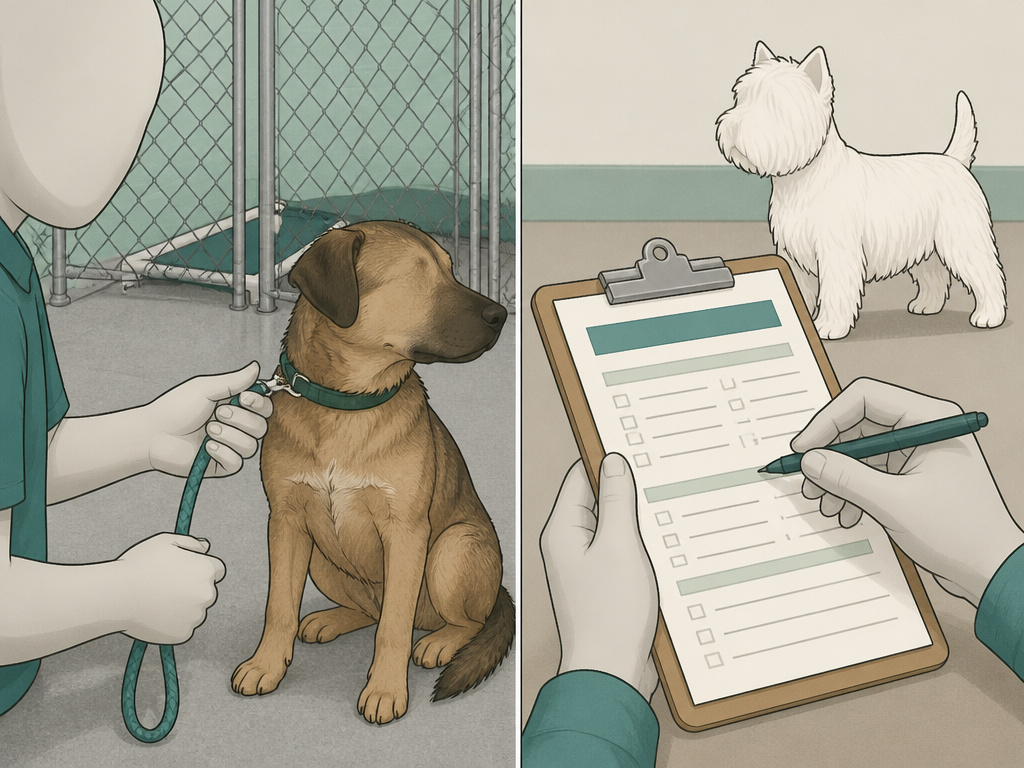
About 5 percent of dogs in U.S. Shelters are purebred, according to the NAIA study the AKC cites. That figure sounds like a closed door. The rescue network behind it is bigger than the number suggests.
Cornell points out that many national breed clubs run breed-specific rescue programs, partly to keep their breed out of shelter kennels. The AKC runs a Rescue Network for exactly this purpose, and individual clubs handle placements directly.
This is one of the places where the sources genuinely disagree, and you should hear both versions.
Kerry Neaf, a foster coordinator quoted by Rover, says every breed has a dedicated rescue group or network, and that purebreds in shelters get adopted quickly rather than sitting there. Her view is that patience gets you there.
CVS Vets takes the opposite line on practicality: finding a specific breed through rescue is considerably harder than going to a breeder, and finding a young puppy is harder still, with long waiting lists attached.
If you need a specific breed and a specific age in the same dog, you aren’t really shopping for a rescue. You’re waiting for one to appear, and the wait is the price.
The exception is age. If you’ll take an adult, senior dog adoption opens up a category breeders can’t supply at all, and you get a dog whose adult size and temperament are already settled.
Does Breed Actually Predict Temperament?
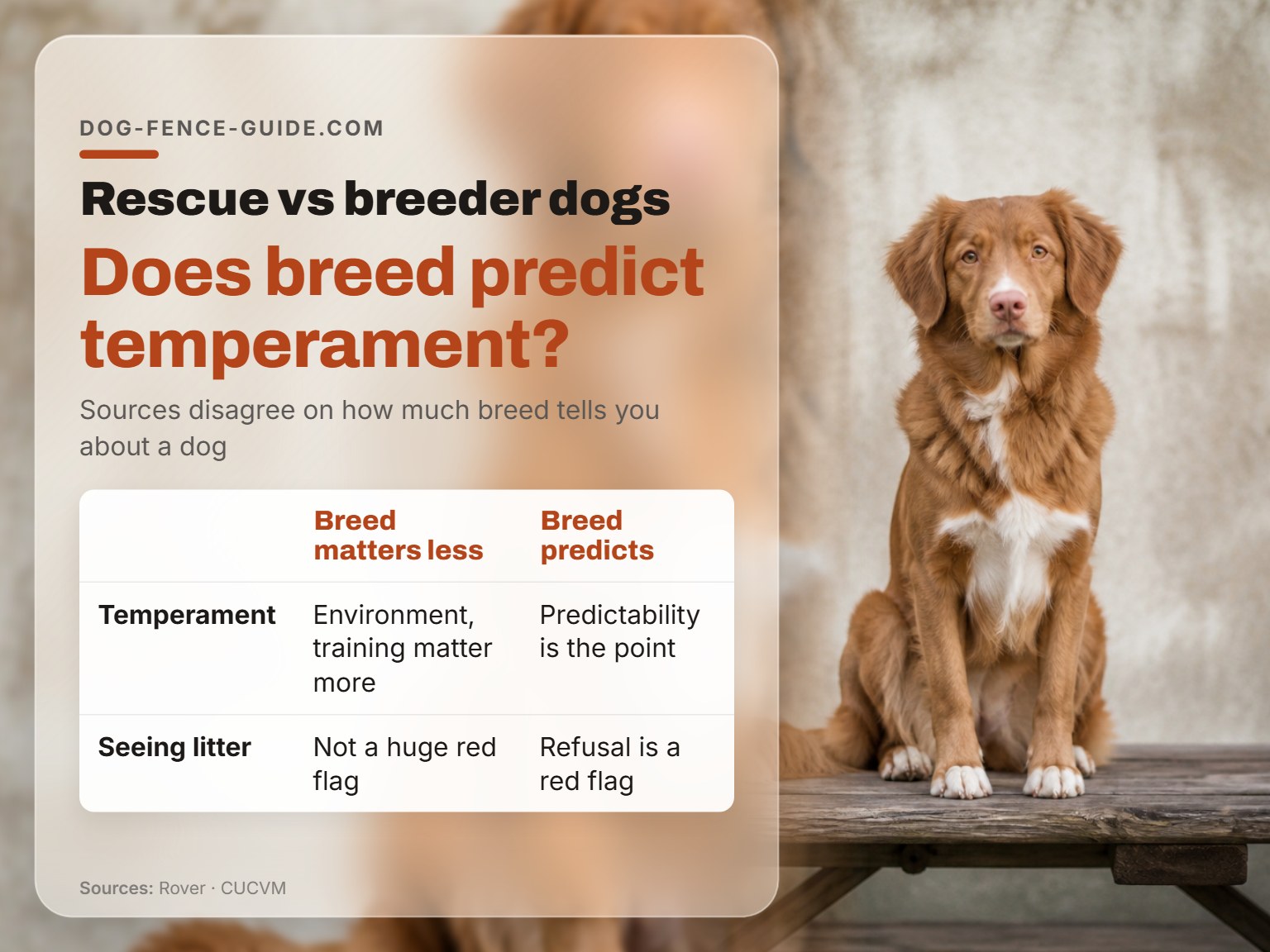
A recent study found that a dog’s breed explains less of its adult temperament than most buyers assume. Rover cites that research directly: environment, upbringing and training play a bigger role in how a dog turns out.
That finding sits awkwardly next to the way purebred dogs are sold.
The AKC’s position, voiced by Dr. Klein, is that predictability is the whole point of buying a purebred from a responsible breeder, while conceding there are no guarantees. Cornell makes a similar case from a different angle: the main benefit of a purebred is consistency in size, coat type, temperament and exercise requirements.
Breeder Kate Dalman, also quoted by Rover, lands somewhere in the middle. Breeders can tell you about lineage, expected size and known health issues, which makes adult outcomes easier to predict. She also says surprises still happen.
| Question | One position | The other position |
|---|---|---|
| Temperament predictability | Rover cites a study finding breed matters less than environment and training | AKC and Cornell both name predictability as the main reason to buy a purebred |
| Disease risk | Rover cites a study finding purebreds no more disease-prone than mixed breeds | Cornell says breed-associated ailments are real, though many common conditions also hit mixed breeds |
| Seeing the litter | Cornell says not seeing the litter isn’t a huge red flag | NZVA says visit the facility and meet the parents; AKC treats refusal as a red flag |
None of those rows resolves cleanly, and that’s the honest answer. The purebred vs mixed breed question gets argued hardest by people who already own one or the other.
What the disagreement actually tells you is this: buy predictability if predictability is what you need, and don’t expect it to be a warranty.
The Wait, the Application, and What Each Path Asks of You
The wait is the part that breaks people.
Cornell’s own veterinary author waited almost two years for a Welsh Springer female. Rover notes that most breeders only breed their dogs once or twice a year, so litters aren’t sitting around. Dr. Klein adds that a breeder not having a puppy available right now is a good sign rather than a bad one, and that a responsible breeder will wait-list you or point you to someone else.
The rescue side has its own queue, just shaped differently. Rover describes the typical process: detailed application forms, interviews, and home inspections in some cases. Dogster notes that some facilities use home visits to verify claims, like a fenced yard for a known runner.
What the Rescue Application Is Really Screening For
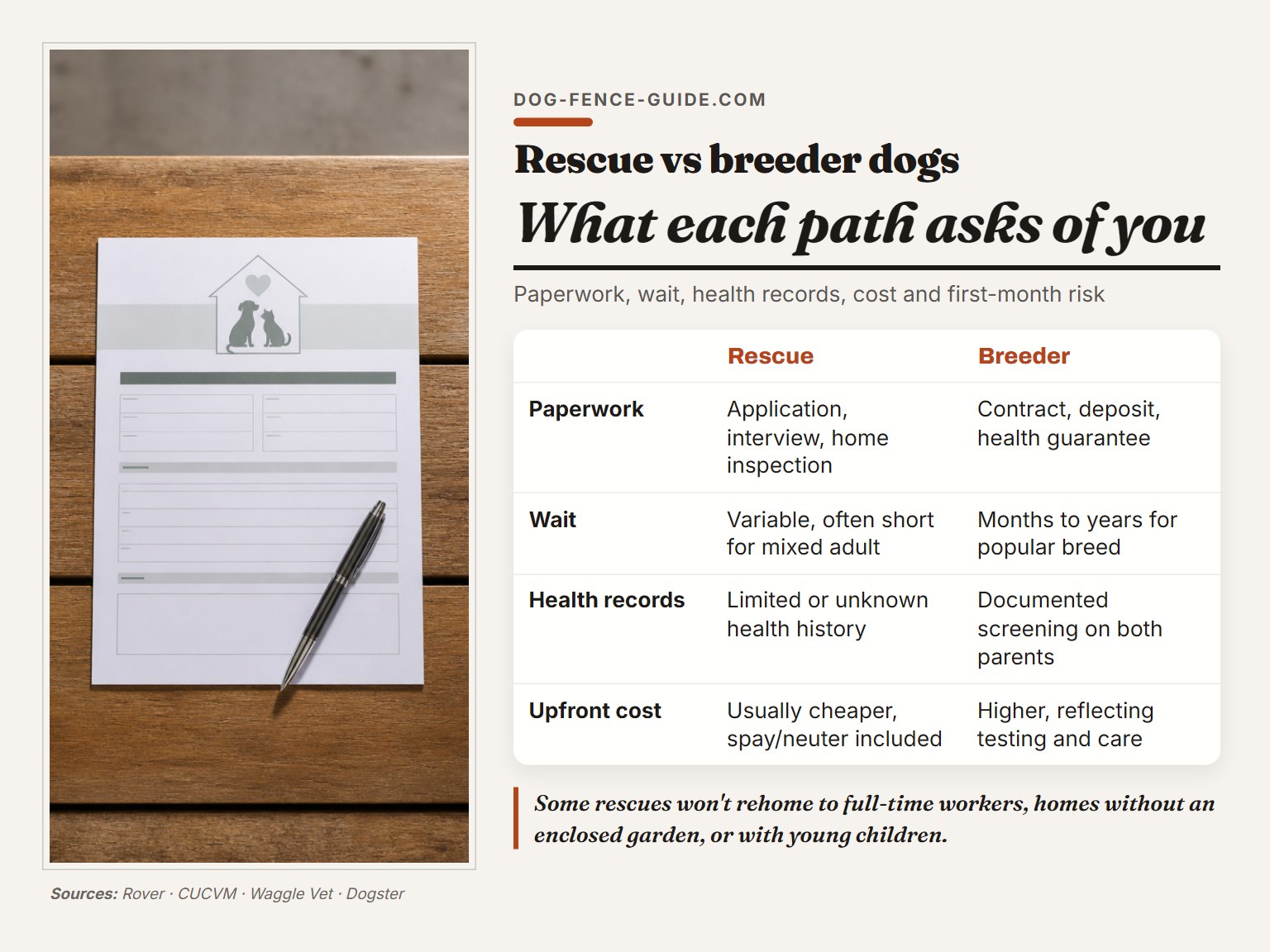
CVS Vets flags the part applicants find hardest: some rescues won’t rehome to people who work full time, don’t have an enclosed garden, or have young children in the house. If you already have a dog, compatibility adds another filter.
Rover frames the identical practice as a benefit, since screening is what keeps dogs from bouncing back into the system. Same facts, opposite feeling about them. Which one you experience depends on your household.
| What it asks of you | Rescue | Breeder |
|---|---|---|
| Paperwork | Application, interview, sometimes a home visit | Contract, deposit, health guarantee |
| Wait | Variable, often short for a mixed-breed adult | Months to years for a popular breed |
| Health records | Partial, sometimes none | Documented screening on both parents |
| Upfront cost | Usually lower, spay/neuter often included | Higher, reflecting testing and care |
| First-month risk | Unknown history, behaviour still settling | Known history, behaviour still settling |
Dogster points out that adoption is usually cheaper than buying, partly because most shelter dogs are mixed breed and partly because the spay/neuter is already done. That’s a real difference, and it isn’t the deciding one.
The adoption application steps are worth reading before you fill one in, so you know what a rescue is actually asking and what a refusal means.
On the breeder side, the AKC case for responsible breeders is the clearest statement of what that money buys: health testing, early socialisation, and a breeder who’ll take the dog back if your circumstances change. Cornell’s guidance is that a responsibly bred dog costs real money because testing and care cost real money, and that a price far outside the normal band in either direction is a warning sign rather than a bargain.
Where Both Sides Get the First Eight Weeks Wrong
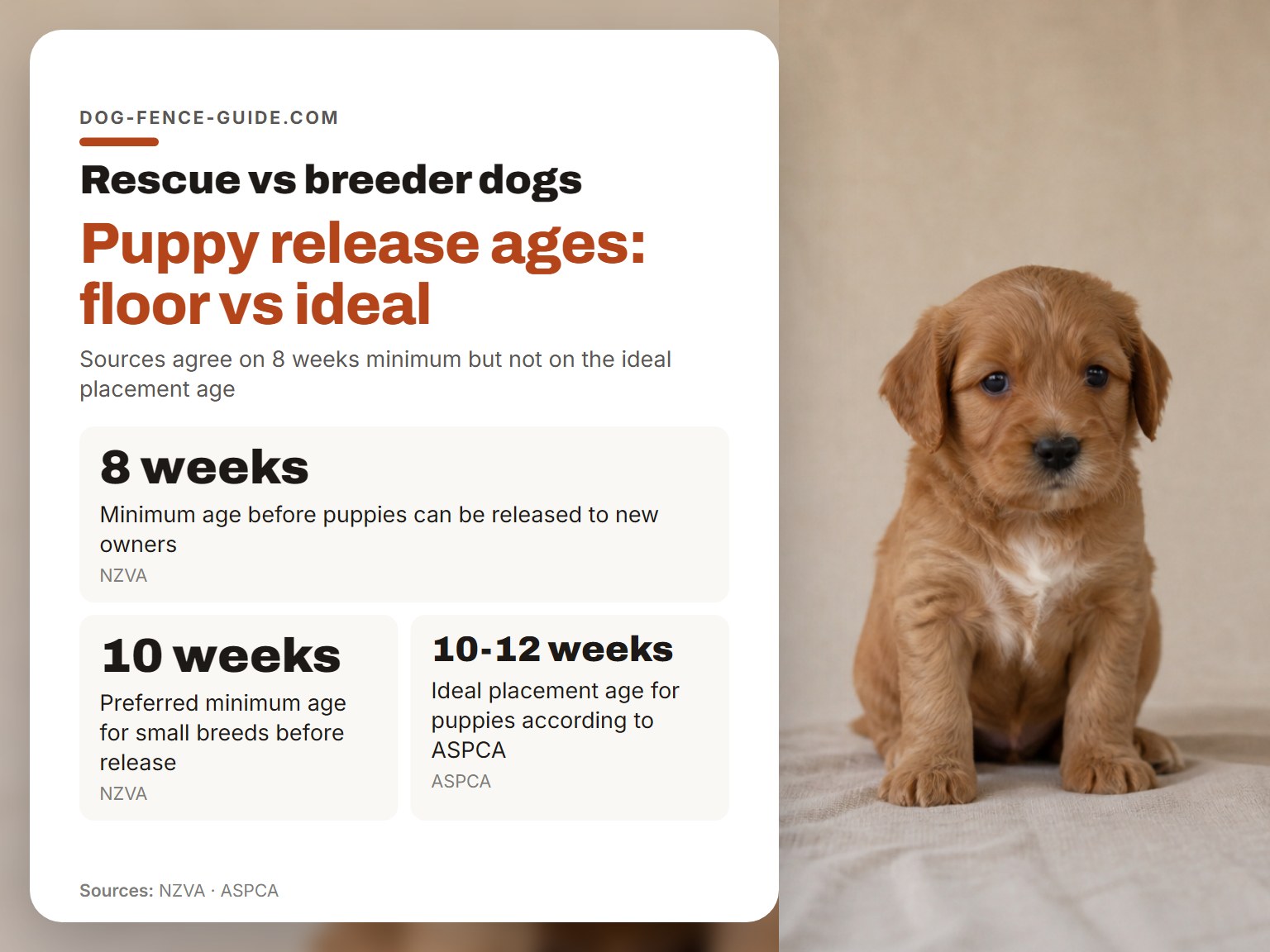
Eight weeks is the floor in most of the guidance, and it’s the wrong number for a small breed.
The NZVA says puppies must be weaned, fully self-sufficient and at least eight weeks old before release, with ten weeks preferred for small breeds. The ASPCA’s position statement says puppies shouldn’t be fully weaned before eight weeks, and puts ideal placement at 10 to 12 weeks.
So the floor agrees and the ideal doesn’t. That gap is where a lot of quiet harm happens.
The socialisation window is messier still, because three reputable organisations draw the lines in different places.
- CVS Vets puts the critical period at around 4 to 16 weeks of age.
- The RSPCA puts it at roughly 2.5 to 14 weeks.
- The NZVA says socialisation with people and other animals should start at three weeks.
Those windows overlap but don’t match, and the practical takeaway is the overlap itself. The windows overlap but don’t match, and the practical takeaway is the overlap itself.
The ASPCA responsible breeding position statement is the document to quote if a breeder argues that eight weeks is fine for every litter. It isn’t, for small breeds.
Holding a litter to ten weeks costs the breeder money and costs you nothing. Take the older puppy.
The First 30 Days Are a Containment Audit, Not a Honeymoon
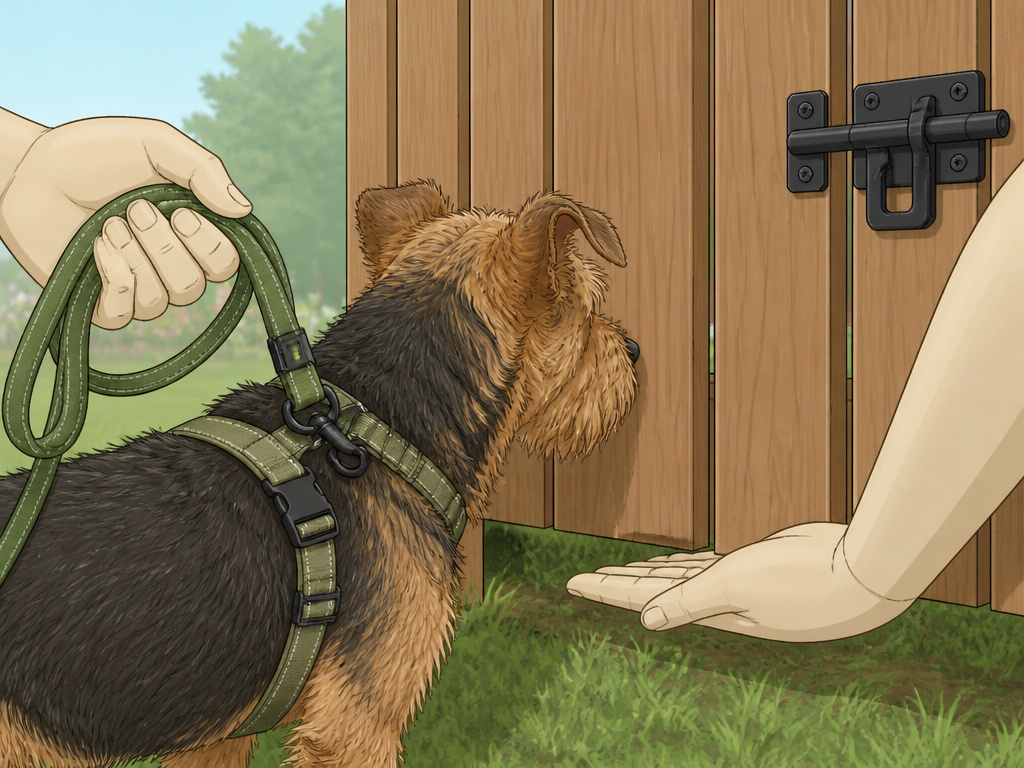
A dog that slept through a kennel tour can clear a fence before you’ve set the water bowl down.
CVS Vets explains why: kennel behaviour and home behaviour aren’t the same thing, and a dog that seemed placid in a run is meeting your garden for the first time with no idea it’s a boundary. Treat the first month as a containment audit, not a settling-in period.
The honeymoon period is the most overrated idea in adoption advice. It tells people the dog will be calm at first, which is precisely when supervision gets relaxed.
I’ve had a reader describe the opposite problem. Her rescue was so nervous it wouldn’t go near the edge of the yard at first. Short, calm sessions got it walking the perimeter on its own eventually, and the lesson stuck with me: patience did more than any equipment did.
The Order I’d Do It In
- Walk the fence line before the dog arrives. Check every gate latch and every gap under a panel. A gap you can slide a hand under is a gap a terrier will test early.
- Fit a harness rather than a collar for the first fortnight. A collar slips over a startled dog’s head; a harness doesn’t. A front-clip harness turns a bolting dog sideways instead of letting it pull straight.
- Use a long line for yard time until the perimeter holds. An adjustable long line gives the dog room to explore while you keep a hand on it.
- Skip the off-leash test in week one. A harness with a solid handle gives you a way to grab a dog that’s already committed to a direction.
- Re-check the gate hardware on day three.
I won’t fit a static-correction collar on a dog in its first month, whatever the boundary system’s manual says.
Two things make the first month easier and neither is equipment. Preparing your home for a rescue dog before pickup day removes half the chaos, and understanding the decompression period stops you mistaking normal shutdown for a problem.
The Red Flags That Mean Walk Away
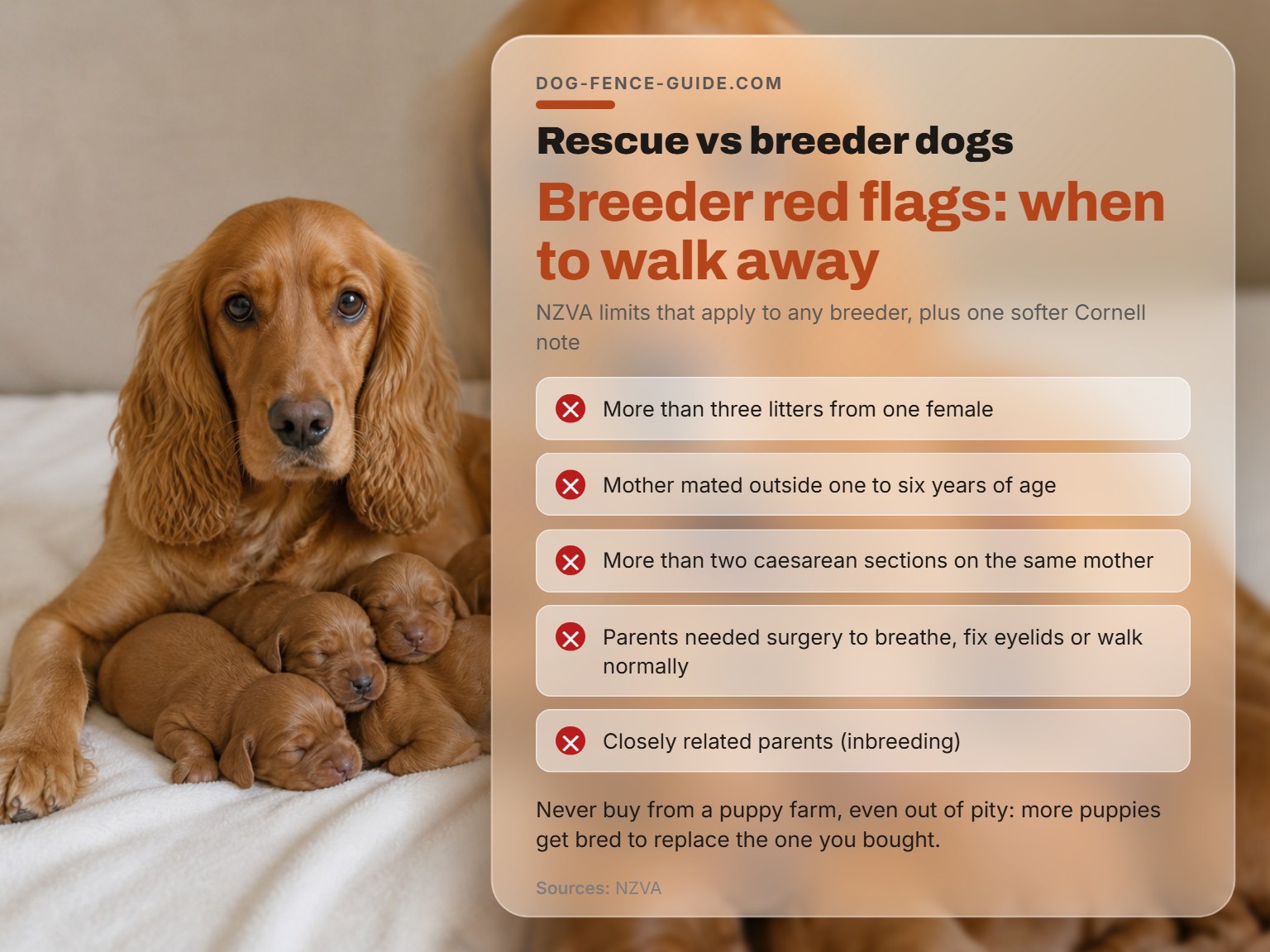
A short list ends the conversation, and it applies to both sides of this debate.
The NZVA is the bluntest on breeding. Never buy from a puppy farm, even out of pity, because more puppies get bred to replace the one you bought. CVS Vets says the same thing from the buyer’s side: buying a puppy to “rescue” it funds the operation that produced it.
- More than three litters from one female. The NZVA treats that as a concern, not a preference.
- A mother mated outside one to six years of age, which is the range the NZVA gives for lower pregnancy risk.
- More than two caesarean sections on the same mother.
- Parents that needed surgery to breathe comfortably, correct eyelid issues or walk normally. The NZVA lists all three as warning signs.
- Closely related parents. Inbreeding is a walk-away on its own.
- A puppy you can’t see with its mother, though Cornell is softer here than the AKC or NZVA and calls it not a huge red flag on its own.
That’s not cleanliness. That’s staging.
The regulatory layer is worth knowing too. In the UK, the licensing threshold for dog breeding is three or more litters in a 12-month period, or breeding as a business. In the US, USDA APHIS Animal Welfare Act regulations under 9 CFR Parts 2 and 3 cover commercial dealers, which means hobby breeders and rescues sit largely outside that inspection regime.
Where this goes sideways: A rescue that imports dogs without a foster period hands you an animal nobody has assessed in a home. CVS Vets flags exactly this pattern, and the first sign of trouble tends to surface after the paperwork is signed.
Imports carry a second problem. CVS Vets notes that for every foreign dog imported for rehoming, a dog already in UK kennels faces euthanasia for lack of adopters. The AKC choosing a rescue group guide takes the same line from the US side: responsible rescues won’t import dogs without individual vet examinations, and the AKC’s official position is that buying dogs at auction isn’t in the breed’s interest.
If a dog does come from outside the country, CDC import rules apply, including rabies vaccination, a microchip and a minimum age, with tightened requirements in effect since 2024.
Frequently Asked Questions
Is it cheaper to adopt or buy a dog?
Adoption is usually cheaper. Dogster notes that most shelter dogs are mixed breed, which affects the fee, and that spay/neuter is normally included before the dog leaves. A responsibly bred puppy costs more because health testing, food and veterinary care cost the breeder real money, and you’ll still pay for spay or neuter later.
Do rescue dogs have more behavioural problems?
Not as a rule. CVS Vets points out that many dogs arrive in rescue through divorce, ill health or job loss rather than through anything the dog did. The honest caveat is that kennel behaviour doesn’t reliably predict home behaviour, so problems can improve or worsen after adoption.
Is AKC registration a sign of a good breeder?
No. Cornell states plainly that the AKC is a registry and doesn’t necessarily ensure health quality, and Preventive Vet notes that some puppy mills register their dogs. What actually documents quality is an OFA or CHIC number you can look up yourself.
How long will I wait for a puppy from a breeder?
Longer than you’d like. Cornell’s own author waited almost two years for a Welsh Springer female, and Rover notes that most breeders produce only one or two litters a year. A breeder with nothing available today is normal, and often a good sign.
Should I buy a puppy to rescue it from a bad situation?
No. Both CVS Vets and the NZVA say the same thing: buying out of pity funds the operation and guarantees another litter takes that puppy’s place. Reporting the seller does more for the dogs than purchasing one.
Before You Go
Here’s the threshold I’d hold you to. If you can’t name the specific health tests the parents passed, and you can’t look those results up yourself, you aren’t ready to put down a deposit. That applies whether the dog costs a fortune or arrives through a rescue with a file full of gaps.
The rescue vs breeder pros and cons for dogs don’t resolve into a winner. They resolve into a fit. If you need a known breed, a known age and a documented health line, a responsible breeder is the only path that supplies all three. If you can flex on breed and take an adult, a rescue gives you a dog whose temperament is already visible, which is worth more than a pedigree to a lot of people.
One concession, because it’s true: none of this matters much if your yard can’t hold a dog. I’ve watched people agonise over a breeder’s paperwork and then let the dog out into a garden with a gate that lifts off its hinges. The fence is the part you control.
So do this week’s job first. Walk the perimeter, put a hand on every latch, and find the gap you’d squeeze through if you were forty pounds and bored. Then go choose your dog.
