
How to Teach Kids to Behave Around Dogs: Step-by-Step
This post contains affiliate links. As an Amazon Associate, we earn from qualifying purchases.
To teach kids to behave around dogs, start earlier than feels natural and keep the rules short. VCA Animal Hospitals puts the starting age at 18 months, and the same guidance says children should be rewarded for good interaction and stopped immediately when they get it wrong. Supervision is the floor everything else sits on.
That 18-month figure is the only hard number in the guidance I checked. Ireland’s HSE and the UK’s PDSA both land on “when your child is able to understand,” which is accurate and not much help on a Tuesday afternoon. So the working answer sits between them: begin with the one-step rules as soon as a toddler can follow one, and save the longer explanations for later. Parents often ask how to teach kids to behave around dogs, and the answer follows the same pattern.
What follows is the bite data, the greeting advice two national bodies contradict each other on, the body-language signals worth teaching, and the household rules that prevent the everyday bites.
Key Takeaways
- Start at 18 months, the only numeric age floor in the guidance from the sources checked.
- Never leave a young child alone with any dog, family pet included, because family pets inflict two thirds of bites to children.
- The outstretched hand is genuinely contested: HSE teaches a safely outstretched hand with fingers curled in, while PDSA calls reaching out threatening and recommends arms by the sides.
- Reward good interaction and stop bad interaction immediately. VCA warns that punishment raises a dog’s fear and makes aggression more likely.
- Video and live dogs beat lectures in the research, though the overall evidence quality was rated poor.
What the Bite Numbers Actually Say About Kids and Dogs
800,000 people seek medical attention for dog bites each year, and half of them are children, according to CDC figures cited by VCA Animal Hospitals.
Bites cluster in a narrow age band. VCA reports that dog bites are most prevalent among children ages 5 to 9, and more prevalent among boys. Children under 4 are most often bitten in the head or neck, which is a matter of height. A small child’s face sits level with a dog’s mouth. Older children get bitten on the hands and arms instead.
A retrospective study by Dr. Ilana Reisner found that 66 percent of dogs that bit a child had never bitten a child before, and 19 percent had never bitten a human at all. The clinical conclusion drawn from that data is that any dog may bite, and biting is a normal canine response to a perceived threat.
The dog is usually not a stranger. VCA notes children are most likely bitten by dogs they know, and that family pets inflict two thirds of all dog bites to children.
What triggers the bite shifts with age. Under 6, the circumstances usually involve food or possessions. Older children get bitten approaching or invading a dog’s territory.
VCA also reports that most aggression toward children is fear based, though many dogs show aspects of food, possessive and territorial aggression as well.
Put those facts together and preventing dog bites stops looking like a park problem. It’s a living-room problem.
When Can You Start Teaching a Child to Behave Around Dogs?
Eighteen months, according to VCA Animal Hospitals, which is the only numeric age floor in the guidance I read.
Ireland’s HSE and the UK’s PDSA both say to start “when your child is able to understand,” which leaves the judgement entirely with you. My reading is that 18 months is roughly the point where a toddler can follow a single instruction and accept a redirect. That’s all the lesson needs to be at that age.
VCA’s framing is worth copying exactly. Reward good interaction with the dog, and stop inappropriate interaction immediately. Not later. Not with a lecture on the way home.
The dog’s half of the job starts much earlier. VCA puts the puppy socialization period at 6 to 14 weeks, and notes that after 14 weeks puppies become considerably more apprehensive of their surroundings and react more fearfully to threatening stimuli. If a baby is on the way, the introducing a dog to a baby work belongs before the birth, not after it.
When you compare a how to teach kids to behave around dogs approach, I would rather see a two-year-old drilled on one rule than a seven-year-old lectured on six.
The Greeting Rule Two National Health Bodies Disagree On
Two national health bodies give opposite instructions for the same three seconds of a greeting, and both are worth reading.
HSE teaches the classic move. The child walks slowly toward the dog and the owner, asks permission, and lets the dog sniff a safely outstretched hand with the fingers curled in. PDSA says the opposite. Reaching a hand toward a dog can be threatening, PDSA warns, and it enters the dog’s personal space. Children should keep their arms by their sides.
| Question | HSE (Ireland) | PDSA (UK) |
|---|---|---|
| Hand out or arms down? | Sniff a safely outstretched hand, fingers curled | Reaching out is threatening; keep arms at sides |
| Who starts the greeting? | Child walks over slowly and asks the owner | Let the dog come to the child |
| Treats at the greeting? | Warns a dog may bite taking food from a hand | Child throws the treat on the ground |
| Tail wagging? | Children may mistake it for friendly while the dog growls | Not listed; watch head turns, lip licks, ears back |
| Standing still near a dog | Stand like a statue, then back away slowly | Stay still, arms close, no eye contact, then move off |
That’s a real split. One body teaches a child to extend a hand into a strange dog’s space; the other teaches the child to stand still and let the dog decide.
When two credible sources disagree on how to teach kids to behave around dogs, I teach the version that’s harder to get wrong. HSE teaches an outstretched hand with fingers curled in, while PDSA recommends arms down and letting the dog close the gap. A child who did nothing has less to undo than a child who reached first.
How to Teach a Child to Greet a Dog: A 5-Step Sequence
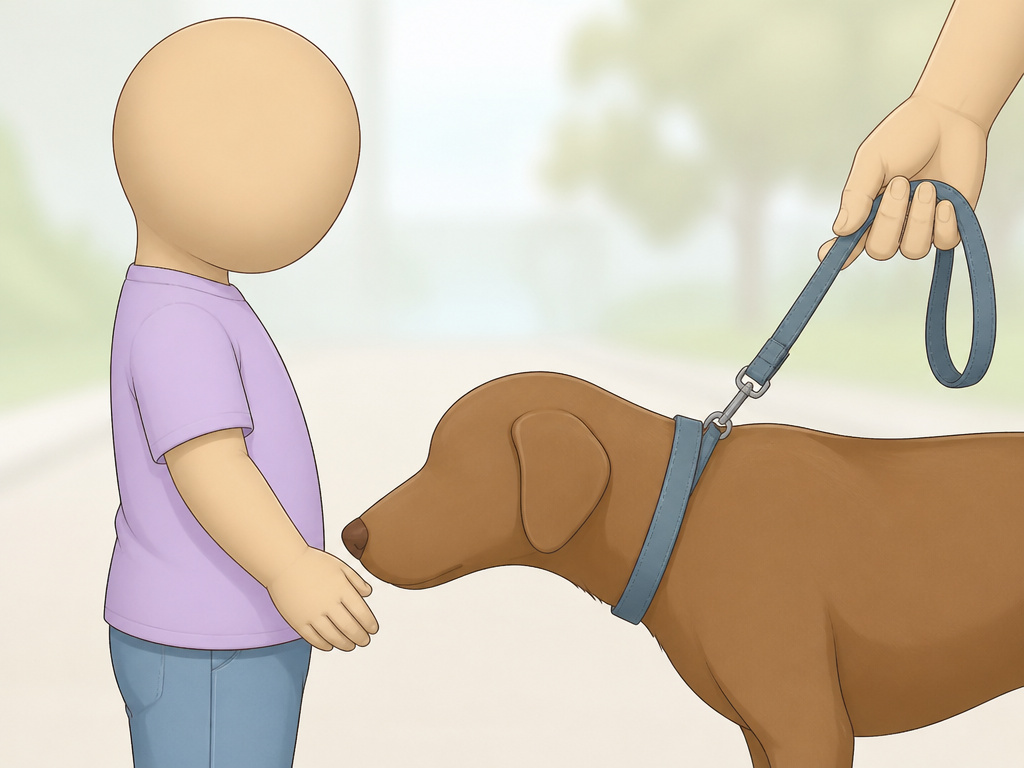
Five steps, in this order, and the first one happens before the child is anywhere near the dog.
Before you start: A dog that is eating, sleeping, guarding a toy, or in pain can bite with no warning, and a child’s face sits at the same height as a dog’s mouth. Keep an adult within arm’s reach for every greeting, and skip the greeting entirely if the dog is on a tight lead and pulling.
- Ask the owner from a safe distance. HSE is firm on this one: children approach a dog only when the owner is there, and always ask permission first. Skip it and the child is already inside the dog’s space before anyone has agreed to it.
- Keep arms down and let the dog close the gap. PDSA’s reasoning is that a hand pushed forward removes the dog’s choice. A dog with no choice has fewer options than simply walking away.
- Turn side-on, never face-to-face. HSE notes face-to-face contact is a common cause of bites. A child leaning in puts their face at the exact height of the dog’s mouth.
- Two seconds on the back or chest, then stop. PDSA suggests a couple of seconds of calm, gentle petting while an adult watches the dog’s behaviour. Keep going longer and you’re trusting the dog to end it politely.
- Walk away slowly. Do not run. PDSA warns that running away likely excites the dog and may read as a game. A chased child gets knocked over.
What to do if the dog approaches the child first
PDSA’s version is to stay still, keep arms close to the body, avoid eye contact, then move slowly away, while HSE’s version is to stand like a statue and back away slowly without an eye-contact element. HSE’s version is a statue pose with a slow backward walk, and it leaves the eye-contact piece out.
Neither is wrong. PDSA includes a no-eye-contact element, while HSE’s statue-and-back-away version leaves it out.
When the dog will not settle
Remove the dog. VCA is direct about this: if the dog finds the situation stressful or shows unwanted responses, it should be calmly and immediately taken out of the situation.
For an adult handling a dog that gets over-excited around children, VCA suggests a head halter and lead for physical control. A head-halter and leash can help maintain control of the dog and prevent unruly, exuberant or aggressive behavior. Neither one replaces supervision, and neither one is a fix for a dog that has already bitten.
Reading Dog Body Language Before a Bite Happens
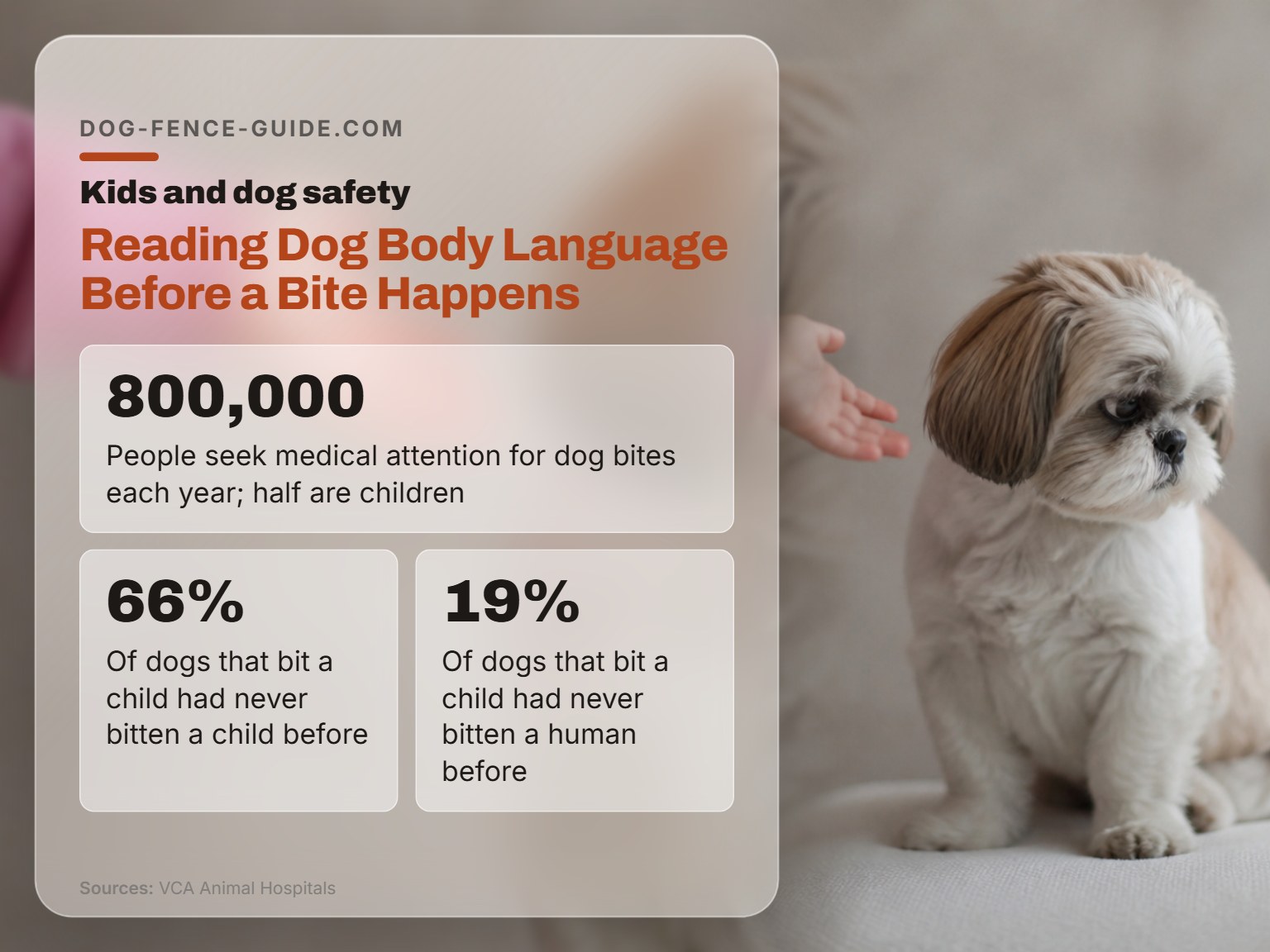
A dog turns its head away from a toddler’s hand and licks its nose. Nothing happens. Ten seconds later the same dog is growling, and the adults are surprised.
PDSA lists the quiet signals worth teaching a child: head turn, whale eye, lip licking, yawning, panting, pacing, ears back, cowering. None of them look dramatic. That’s the whole problem.
| Signal | What it looks like | What to do |
|---|---|---|
| Head turn | Dog looks away as a hand comes near | Stop. Give the dog space |
| Whale eye | Whites of the eye showing, head turned away | Call the child back immediately |
| Lip lick or yawn | Quick tongue flick, yawn with no tiredness | End the interaction now |
| Ears back, cowering | Flattened ears, lowered body, tucked tail | Separate child and dog |
| Panting or pacing | Heavy panting in a cool room, restless walking | Remove the dog from the room |
The tail-wagging trap
HSE warns that children may mistake a wagging tail for a friendly dog, even when that dog is growling. PDSA’s discomfort list does not include tail wagging at all.
Both are usable. Teach a child that a wagging tail means the dog is excited, and excited covers a lot of ground. Then teach the signals that actually predict a bite: the head turn, the lip lick, the yawn.
A study on teaching children to read dog signaling found that recognition of distress signals improved after training and the effect endured over time. Learning rose with age and varied by which signal was being taught, which fits what I see: the head turn is easy, the lip lick takes longer.
What to Teach Children Never to Do Around Dogs
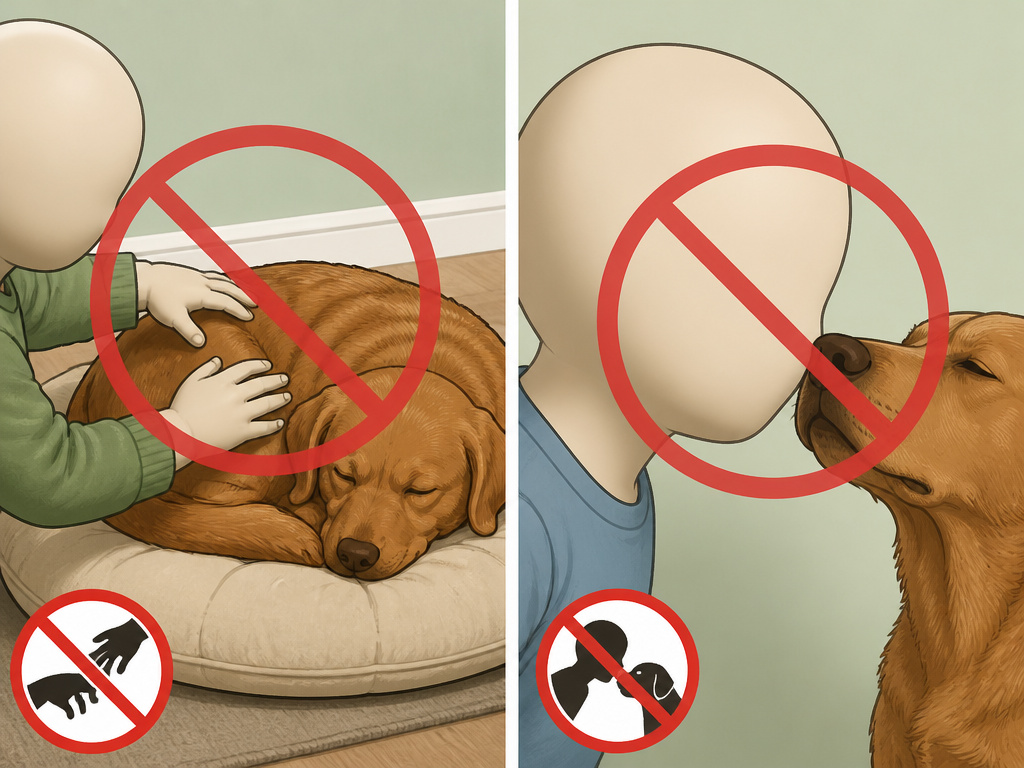
The behaviours that cause the most bites are the affectionate ones.
HSE’s list is the one to teach almost word for word:
- No hugging and no kissing. Face-to-face contact is a common cause of bites, and this is the rule children break most often.
- Do not disturb a sleeping dog. A startled dog may bite before it knows who is there.
- No sneaking up, cornering, teasing or annoying. HSE’s line is that any dog can bite if it is scared, confused or in pain.
- No running and shouting around dogs. Movement and noise raise the dog’s arousal before a child has even reached it.
- Stay away from a dog guarding something. Puppies, territory, toys, food. All of it.
- Never put a face near a dog’s mouth and nose.
- No wandering around the house with food, no feeding a dog from the table, and no letting a dog beg at mealtimes.
Where this goes sideways: Correcting the child after the dog has already walked away. The dog learns nothing from it, and the child learns that the rule only exists while an adult is watching. Run that pattern three or four times and the rule quietly stops applying when you leave the room.
Puppy mouthing is a different problem from an adult dog’s bite, and puppy biting needs its own plan before the puppy is heavy enough to knock a child down.
Food, Toys, and the Family Dog: Rules That Hold
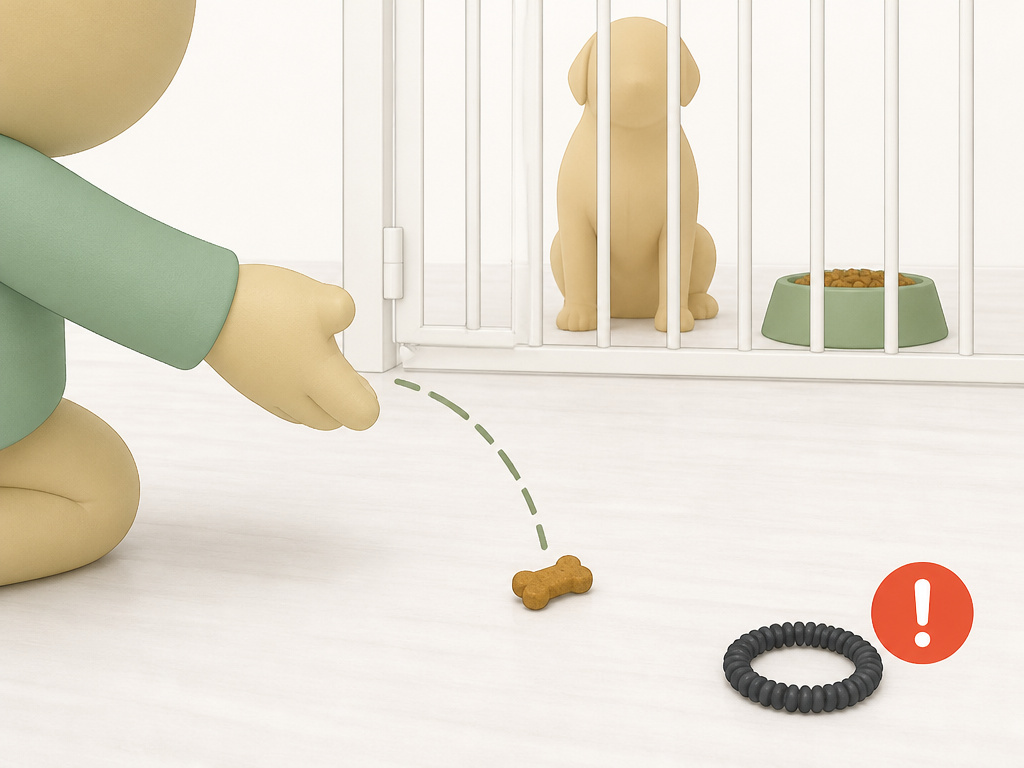
Food is where the calmest family dog stops being calm.
VCA reports that children under 6 are often bitten in circumstances involving food or possessions. That single line explains most of the bites I hear about from readers, and almost none of them involve a strange dog.
HSE’s answer is structural. Feed the dog on the ground, in its own space, and always away from where children play, because dogs are protective of food. PDSA adds that children should keep a safe distance from toys, bowls and food, and should never take food or a toy from a dog even if they know that dog well.
Feeding rules that remove the flashpoint
- Feed the dog in a separate room or behind a gate, not in the kitchen where children are moving through.
- Put the bowl down and walk away. A dog watched over its food is a dog being taught to guard it.
- Nobody pets the dog while it eats. Not the adults, not the children, not once.
- If a child wants to give a treat, PDSA’s method is to throw it on the ground rather than hand it over.
The last one matters more than it sounds. HSE warns that a dog may accidentally bite while trying to take food from a hand, which is the mechanism behind a lot of “he’s never done that before” stories.
If your dog already stiffens over a bowl, that’s resource guarding and it needs a plan before a child is in the same room as the bowl.
The hair bobble problem
PDSA flags elastic bands and hair bobbles specifically, because children try to put them on a dog’s legs, ears, or around its neck, and the injuries can be serious.
I have seen this one. A hair band around a dog’s ear is not a small thing by the time anyone notices it.
Does Dog-Safety Education Actually Work?
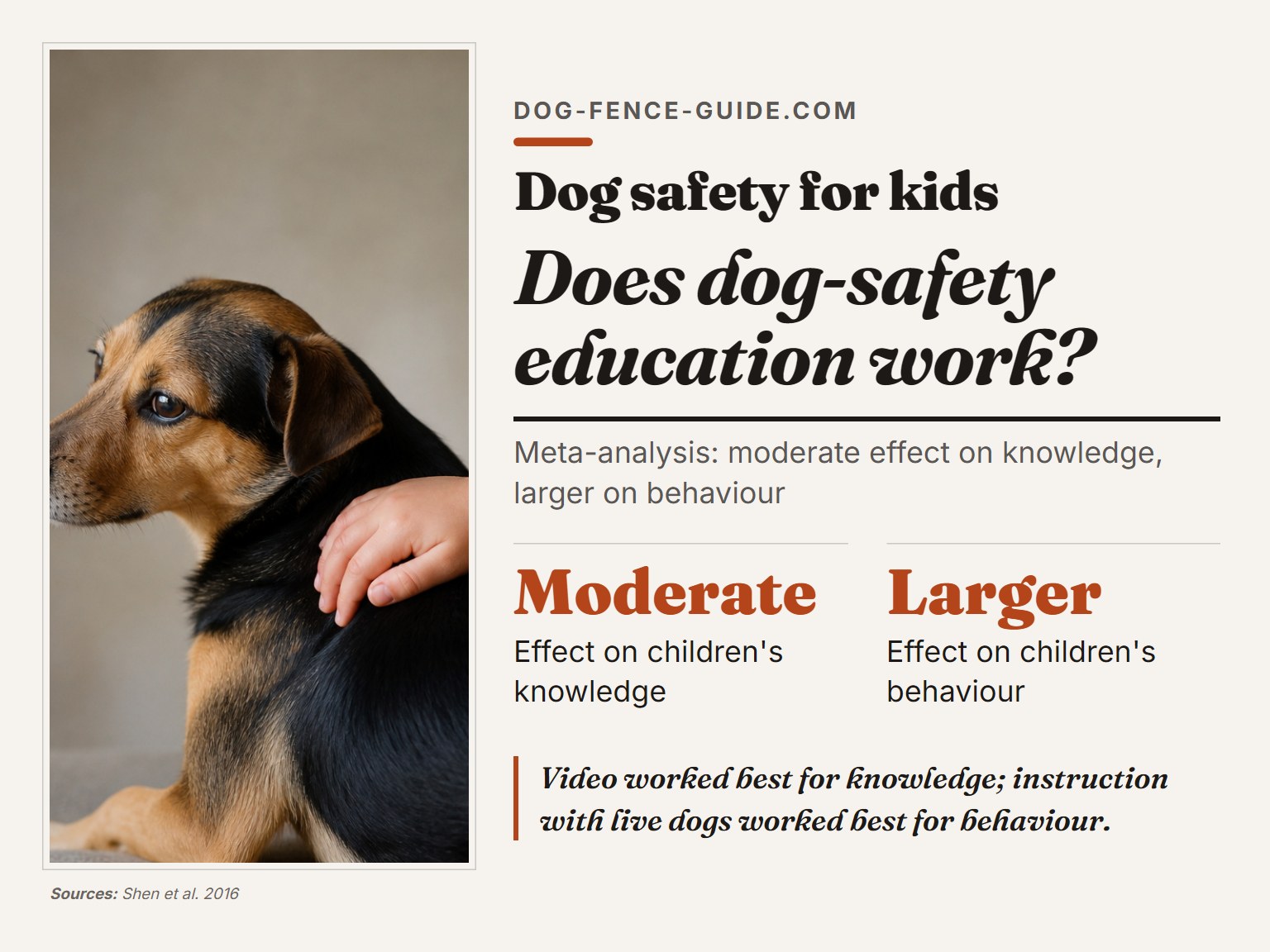
Partly. The evidence is thinner than the confidence of the people selling the programs.
The meta-analytic review of dog-bite prevention by Shen and colleagues found a moderate effect on knowledge and a larger effect on behaviour. It found a moderate effect on children’s knowledge and a larger effect on their behaviour. It also rated the quality of the evidence as poor.
The two findings that matter for a parent:
- Video worked best for knowledge. Video worked best for knowledge.
- Instruction with live dogs worked best for behaviour. Children who practised with a real dog in the room changed what they actually did.
The studies that got results were short and repeatable. Chapman’s 30-minute lesson with a dog handler and a dog. Lakestani’s two video sessions covering six clips of fearful, defensive and friendly dogs, with follow-up at a median of 14 days. The Blue Dog CD, used two to three times a week and then at home for two weeks.
Repetition is the pattern. One assembly in year three does not hold.
The part nobody mentions: The meta-analysis rated the evidence quality poor. That doesn’t mean the programs fail, it means nobody has run a clean enough trial to prove they work. Treat any single session as a start, not a solution.
The Dog’s Half of the Job
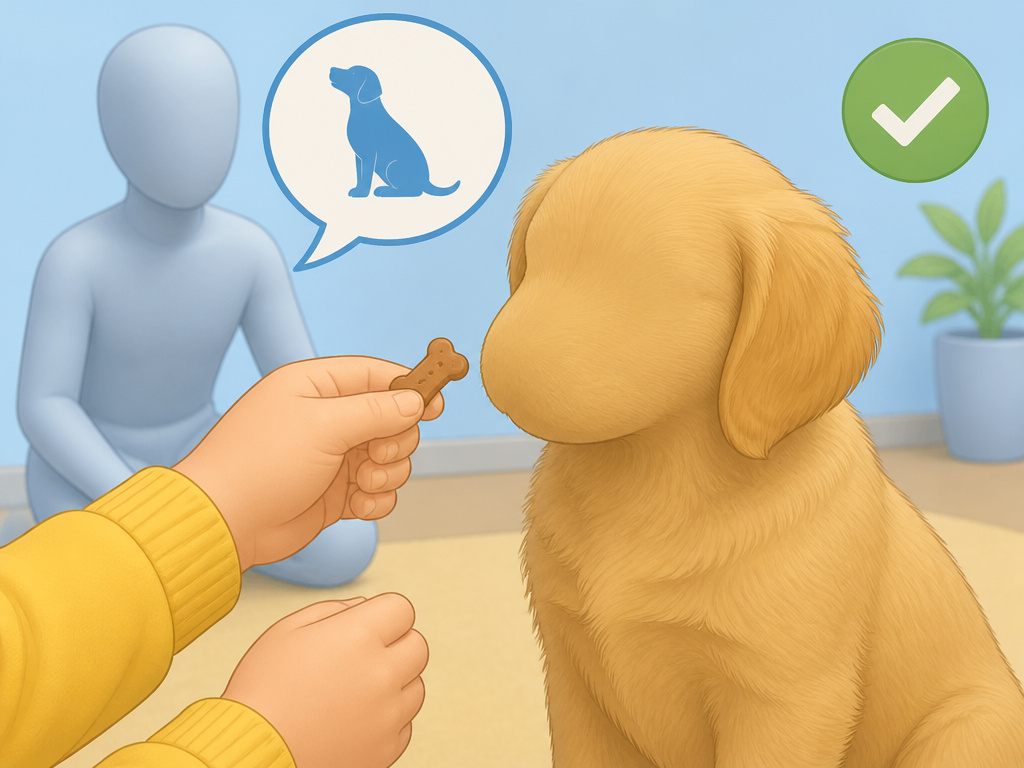
VCA Animal Hospitals puts the socialization window at 6 to 14 weeks, and after 14 weeks the same source says puppies become considerably more apprehensive.
That window is the reason puppy socialization matters more than any piece of equipment you’ll buy. A puppy that met calm children of different ages during those weeks tends to be relaxed around them as an adult. A puppy that didn’t can carry fear into every encounter for the rest of its life.
The rest of VCA’s list is unglamorous and effective:
- Good verbal control. Sit, down, come, drop it. A dog that responds to those from an adult is a dog that can be moved out of a situation.
- Children give known commands when an encounter is going well, ideally commands taught with positive reinforcement so the dog will comply for a child as readily as for an adult.
- No punishment. VCA warns that punishment for bad behaviour or disobedience greatly increases a dog’s fear and makes aggression more likely. Striking a dog can specifically create a fear of being touched.
- Muzzle a dog with a bite history around children. Muzzle a dog with a bite history around children.
- Keep aggressive dogs safely separated from children rather than relying on training to hold.
Two commands do most of the work in a house with children. The leave it cue handles dropped food and dropped toys, and the place command gives the dog somewhere to be that isn’t under a toddler’s feet.
Choosing a family dog breeds on temperament is reasonable. Assuming the choice removes the need for supervision is not.
Frequently Asked Questions
At what age should you start teaching a child about dog safety?
VCA Animal Hospitals gives 18 months as the starting point, which is the only numeric age floor in the guidance from the sources I checked. HSE and PDSA both use “when your child is able to understand” instead. Practically, start with one-step rules as soon as a toddler can follow and accept a redirect.
Should a child offer a hand for a dog to sniff?
The two main sources disagree. HSE teaches a safely outstretched hand with the fingers curled in. PDSA says reaching toward a dog can be threatening and enters the dog’s personal space, and recommends children keep their arms by their sides instead. Arms down is the harder version to get wrong.
Can a toddler learn to read dog body language?
Yes, at the level of the obvious signals. PDSA lists head turning, whale eye, lip licking, yawning, panting, pacing, ears back and cowering as the signs to teach. A study on teaching children to read dog signalling found recognition improved and held over time, with older children learning more than younger ones.
Is it safe to leave a child alone with the family dog?
No. VCA says never leave young children and infants alone with any dog, and PDSA says children should never interact without close supervision even with your own family dog. VCA notes family pets inflict two thirds of dog bites to children, which settles the question.
Do school dog-safety programs actually reduce bites?
The evidence is mixed. The Shen meta-analysis found a moderate effect on knowledge and a larger effect on behaviour, but rated the quality of the evidence as poor. Programs built around video for knowledge and live dogs for practice performed best, and short repeated sessions outperformed one-off assemblies.
What should a child do if a dog runs at them?
PDSA’s sequence is to stay still, keep arms close to the body, avoid eye contact, then move slowly away, while HSE’s version is to stand like a statue and back away slowly. HSE’s version is to stand like a statue and back away slowly if movement is needed. Both agree on the critical part: do not run, because running excites the dog and may read as a game.
Before You Go
One threshold is worth more than everything above it. A growl is the cheapest warning you will ever get from a dog, and it is the point where supervision stops being enough.
If your dog has growled at a child, treat that as the trigger to separate them and bring in a professional, not as a behaviour to correct out of the dog. VCA is explicit that punishment increases fear and makes aggression more likely, so correcting the growl removes the warning and keeps the bite.
Here is the honest version of what to do this week. Pick one rule, not five. Practise it once a day for a week, in the same room, with an adult within arm’s reach. Then ask yourself three questions before you trust the setup:
- Does my child know what to do when the dog walks away, not just when it stays?
- Can I recall my dog off a dropped piece of food, every time, without repeating myself?
- Has anyone in this house been left alone with the dog this week, even for a minute?
If the answer to the last one is yes, the rules aren’t the problem yet. The supervision is.
