
How to Tell If a Dog Is Overweight: Ribs, Waist, Tuck
This post contains affiliate links. As an Amazon Associate, we earn from qualifying purchases.
To tell if a dog is overweight, run three checks: feel the ribs under a light layer of fat, look for a waist from above, and check for a tuck from the side. A body condition score of 4 or 5 on the 9-point scale is ideal, and each step above 5 equals 10% of body weight over ideal.
That 10% figure is the part worth sitting with when you consider how to tell if a dog is overweight. The gap between a 6 and a 7 is the difference between a dog carrying 10% extra weight and one carrying 20%, and the health costs stack up across that range. By 8 or 9, every major veterinary body calls the dog obese, even while they argue about exactly where the line sits.
What follows is the hands-on version: three checks you can run in under a minute, the body-fat numbers behind the 9-point scale, and the places where the veterinary bodies genuinely disagree about where overweight ends and obese begins.
Key Takeaways
- A BCS of 4 or 5 out of 9 is the target. AAHA maps that range to 15-24% body fat, and BSAVA calls 4/9 or 5/9 optimal for longevity.
- Every step above 5 adds 5% body fat and 10% over ideal weight. A 7 sits at 30-34% body fat, which is where joint and metabolic problems start showing up.
- The scale alone says little. BSAVA states that bodyweight tells you very little about fat mass, though it’s precise for tracking change in one dog over time.
- A 7 or above goes to a vet. PetMD is blunt on this: 7, 8 and 9 need a professional, while a 6 in an otherwise healthy dog can often be handled at home.
- Check a dog at 4 or 5 once a month. PetMD recommends a monthly check for dogs already in the ideal range, which catches drift early.
How to Tell If a Dog Is Overweight With Your Hands and Eyes
Your hands and eyes will get you most of the way to a body condition score, which is the core of how to tell if a dog is overweight. PetMD puts it plainly: the only tools required are your hands and your eyes.
Body condition scoring assesses fat mass by palpation and visual inspection. Three sites carry most of the signal: the rib cage, where a thin fat layer should let ribs be felt under light pressure; the waist behind the rib cage seen from above; and the abdominal tuck seen from the side.
The rib check
Run your fingertips along both sides of the chest, just behind the front legs. You should find the ribs under a thin pad, the way the bones on the back of your own hand sit under skin. If you have to press hard enough to feel your fingertips throb, the FDA’s guidance is that the dog may be carrying excess fat around the ribs.
The other direction counts too. Ribs that stand out sharply with no padding at all point toward underweight, which is its own problem and worth a vet visit.
The waist check
Stand over the dog and look straight down. A dog at a healthy weight has a visible pinch behind the rib cage. The FDA describes the failure clearly: a back that is broad and flat like a footstool, with no definite waist, usually means an overweight dog.
Light matters here.
The tuck check
Look at the dog from the side, standing naturally. There should be a slight upward slope from the end of the rib cage toward the hind legs. A stomach that hangs low, bulges or sags is a flag.
The FDA adds a test that needs no interpretation at all: if you can grab a handful of fat, the dog is overweight.
Three checks, one minute, no equipment.
What the 9-Point Body Condition Score Actually Measures
Each step up the scale adds 5% body fat, and every step above 5/9 equals another 10% of body weight over ideal. Those figures come from the 2021 AAHA nutrition guidelines, which map each 9-point body condition score to a body fat percentage.
| BCS (9-point) | Body fat | Over ideal weight |
|---|---|---|
| 4 | 15-19% | None |
| 5 | 20-24% | None |
| 6 | 25-29% | 10% |
| 7 | 30-34% | 20% |
| 8 | 35-39% | 30% |
| 9 | 40-45%+ | 40% |
The table is the reason a single number is worth arguing about. A 6 and a 7 look close on paper. In body fat terms they’re five points apart, and in excess weight terms they’re 10% apart.
AAHA’s authors suggest universal use of the 9-point scale with whole integers, so a score recorded in one clinic means the same thing in another. BSAVA names the target explicitly: a BCS of 4/9 or 5/9 is optimal for maximal longevity and minimal obesity-associated disease risk in dogs.
Which Scale Should You Use, the 5-Point or the 9-Point?
AAHA wants the 9-point scale used universally, with whole integers, for record standardization. The FDA notes that many vets use either a 1-5 or a 1-9 scale, with 1 being very skinny and 5 or 9 being obese.
Pick one scale and stay on it for the dog’s whole life. A score only means something against that dog’s own history, and a record that mixes 5-point and 9-point numbers destroys the comparison.
The 9-point version is the more heavily validated of the two, and BSAVA recommends it for that reason. The 5-point version has a documented accuracy problem: a 2012 study in Veterinary Medicine: Research and Reports found clinicians in Japan widely used a 5-point BCS and rounded off, skipping half-points, which reduced accuracy. The same study concluded that a 5-point score on its own under-detects overweight, and that supplementing body condition scoring with a body fat percentage closes most of the gap.
WALTHAM acknowledges both the 5- and 9-point systems plus its own S.H.A.P.E. Guide, and flags inter-user scoring variance as a limitation of all of them.
If your vet uses a 5-point scale, ask what the number means in body fat terms before you act on it.
Where the Numbers Disagree: 15%, 21%, or 30%?
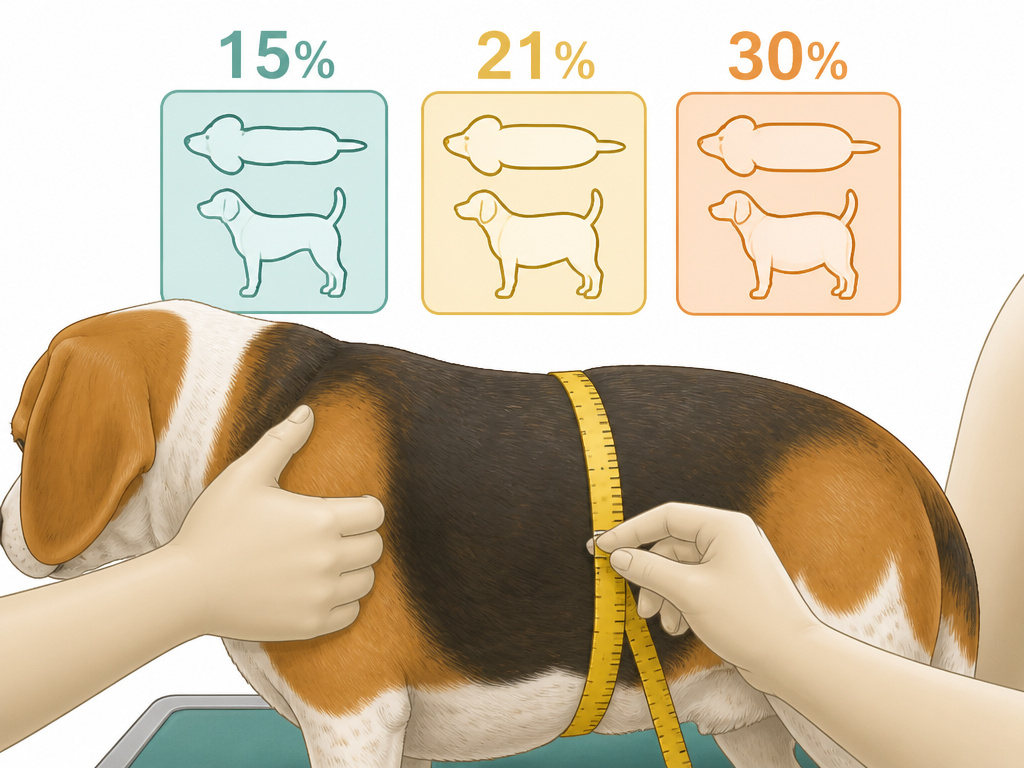
Ask four organizations where overweight ends and obese begins, and you get three different answers. They’re measuring different things, which is why the numbers don’t line up.
| Source | Overweight | Obese |
|---|---|---|
| FDA / APOP | 10-20% over ideal | 21%+ over ideal |
| WALTHAM | 15% above ideal | More than 30% above ideal |
| BSAVA | BCS 6-7 | BCS 8-9, at least 30% excess |
| AAHA | BCS 6 = 10% over | BCS 8 = 30%, BCS 9 = 40% |
The FDA’s consumer guidance, drawing on the Association for Pet Obesity Prevention, works purely in percentages over ideal body weight. WALTHAM sets its overweight line at 15% above ideal and its obese line above 30%. BSAVA defines the obese phenotype by BCS band and puts it at a minimum of 30% excess weight. AAHA’s conversion table splits the difference by giving each BCS its own percentage.
None of these is an error. A percentage over ideal weight, a BCS band and a body fat range are three different rulers, and a number from one doesn’t convert cleanly into another.
That’s the practical takeaway: pick one framework and stay inside it. Switching between them mid-diet is how owners end up chasing a target that keeps moving.
Why the Scale Alone Won’t Tell You Much
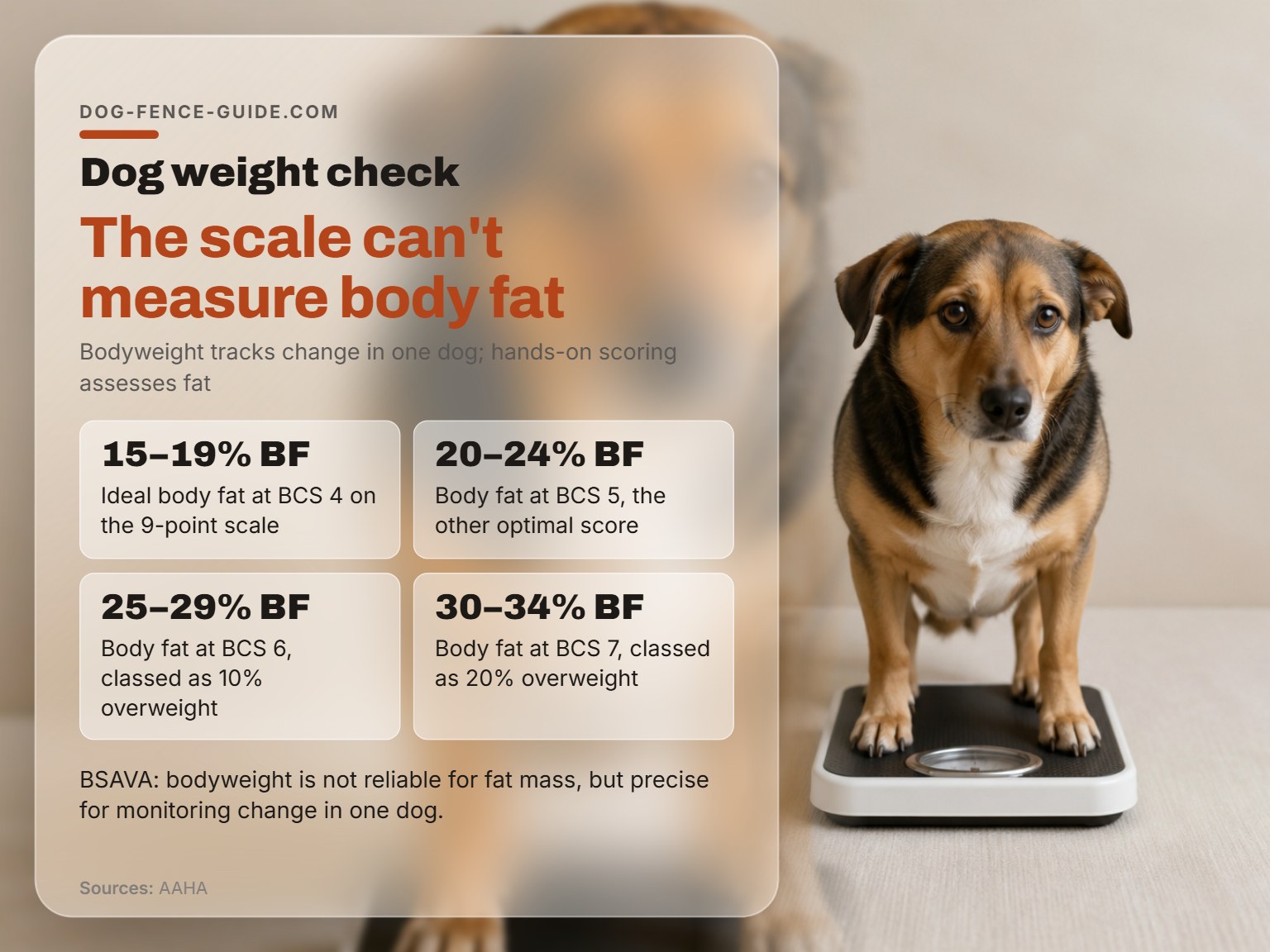
A number on a bathroom scale says very little about body fat. BSAVA states it directly: bodyweight tells you little about fat mass specifically, and it’s precise and accurate for monitoring change within an individual animal.
That second half is the useful part. PetMD points out that body condition scoring assesses fat mass by palpation and visual inspection, which the scale alone cannot do.
AAHA makes a related point about muscle. Body condition score and muscle condition score aren’t causally related and should be assessed separately, which means a dog can be overweight and losing muscle at the same time.
Here is the honest version: for most owners, the scale is a trend tool and the hands-on check is the diagnostic.
If you want to track weight at home, BSAVA lists two workable methods, bathroom scales or a pet carrier weighed with digital luggage scales. The second one is how most people weigh a large dog at home without wrecking their back.
Your vet sees the trend across visits, which is the piece you can’t reproduce in your kitchen. The FDA suggests bringing four questions to the next appointment:
- What are the specific signs that my dog is gaining weight?
- What is a good, normal weight for this dog, given its breed and age?
- What food do you recommend, how much is a serving, and how often should I feed?
- Does my dog have a health condition, such as osteoarthritis, that makes it wiser to keep weight on the low side?
Why Do Two People Score the Same Dog Differently?
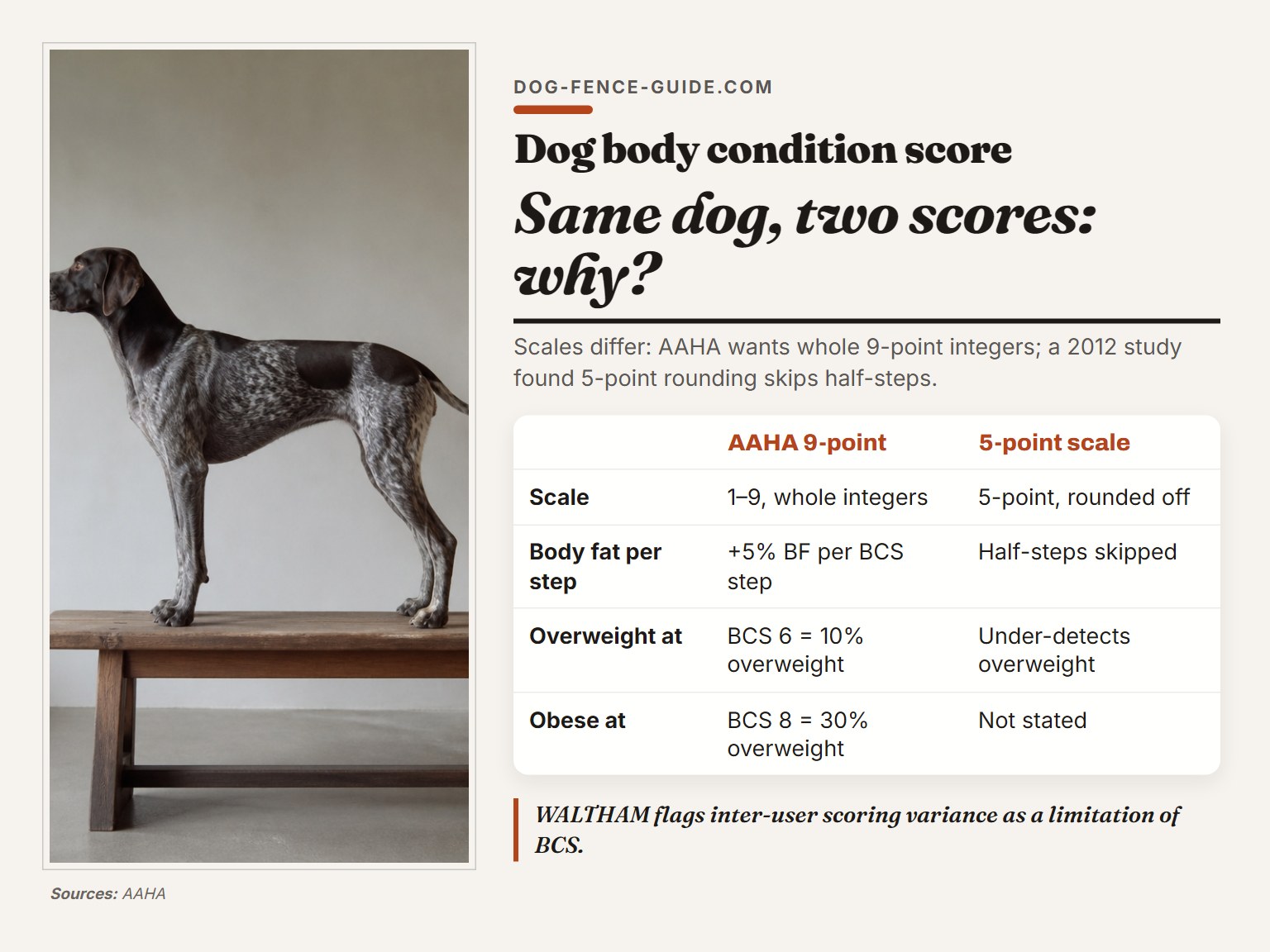
Two people, one dog, one afternoon, two different numbers. It happens more often than the precision of the scale suggests.
WALTHAM flags inter-user scoring variance as a limitation in its own guidance. The 2012 study found the 5-point scale made it worse, because rounding off skips the half-steps where a lot of real dogs sit. AAHA’s answer is whole integers on a 9-point scale, which at least forces a decision.
Some of what a score misses:
- Muscle loss, which AAHA scores separately and which can sit alongside extra fat on the same dog.
- Fluid from a heart or kidney problem, which adds scale weight without adding fat.
- Coat, which hides a waist on a heavy-coated breed.
I’d rather see an owner check ribs every month and get the number slightly wrong than check once a year and get it exactly right. The trend is what protects the dog.
The Dogs the Standard Check Reads Wrong
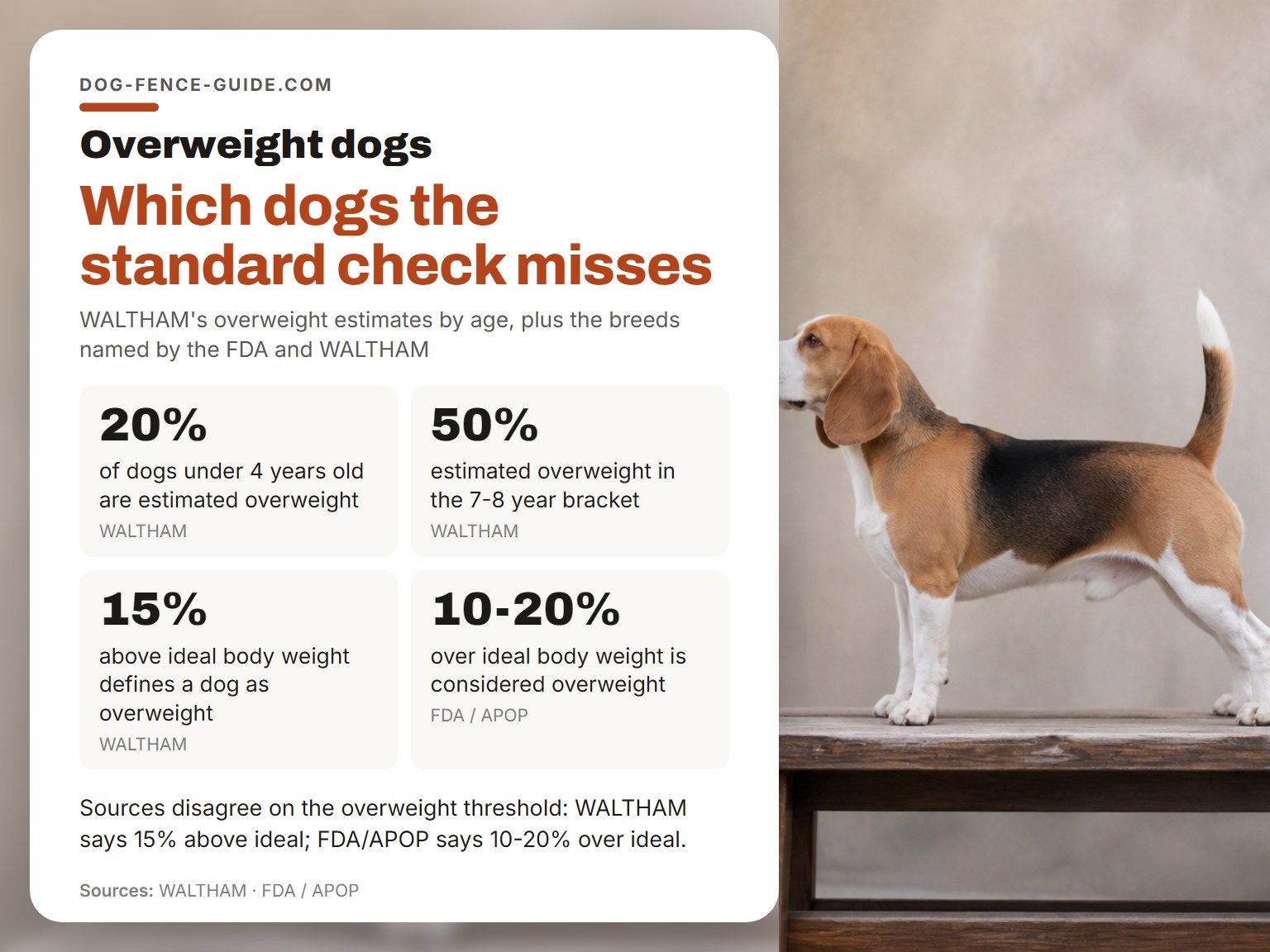
Labradors, beagles, dachshunds and basset hounds all appear on the FDA’s list of breeds more inclined toward obesity. WALTHAM names beagles, Bernese mountain dogs, collies, Labradors, cairn terriers and King Charles spaniels.
Age moves the odds more than most owners expect. WALTHAM’s estimates put 20% of dogs under 4 years old as overweight, rising to 50% in the 7-8 year bracket.
Sex and neuter status matter as well. WALTHAM notes that female dogs appear more predisposed to obesity than males, and that neutering increases the frequency in both sexes. The FDA adds that spaying and neutering can slow a dog’s metabolism, and so can aging.
For some breeds the FDA advises keeping weight on the low side on purpose: large and giant breeds, plus breeds predisposed to orthopedic problems such as dachshunds, German shepherds and Newfoundlands.
The groups worth weighing more often:
- Neutered dogs of either sex, which BSAVA flags as higher risk.
- Females, which WALTHAM lists as more predisposed than males.
- Dogs aged 7 to 8, where WALTHAM’s overweight estimate reaches 50%.
- Breeds on the FDA or WALTHAM lists, including Labradors, beagles, dachshunds, basset hounds, collies, cairn terriers and King Charles spaniels.
- Any dog that has been overweight before, which BSAVA singles out for more frequent weighing.
BSAVA’s baseline for a healthy adult dog is a weight and BCS check at least once a year, with more frequent checks for anything on that list. During growth it advises monthly checks, and every two weeks around the time of neutering.
If the number climbs without an obvious reason, that’s worth a separate conversation about weight gain. And a dog that’s slowing down, sleeping more and filling out may simply be getting older, which is worth checking against the signs of aging before you cut calories.
What to Do With the Number
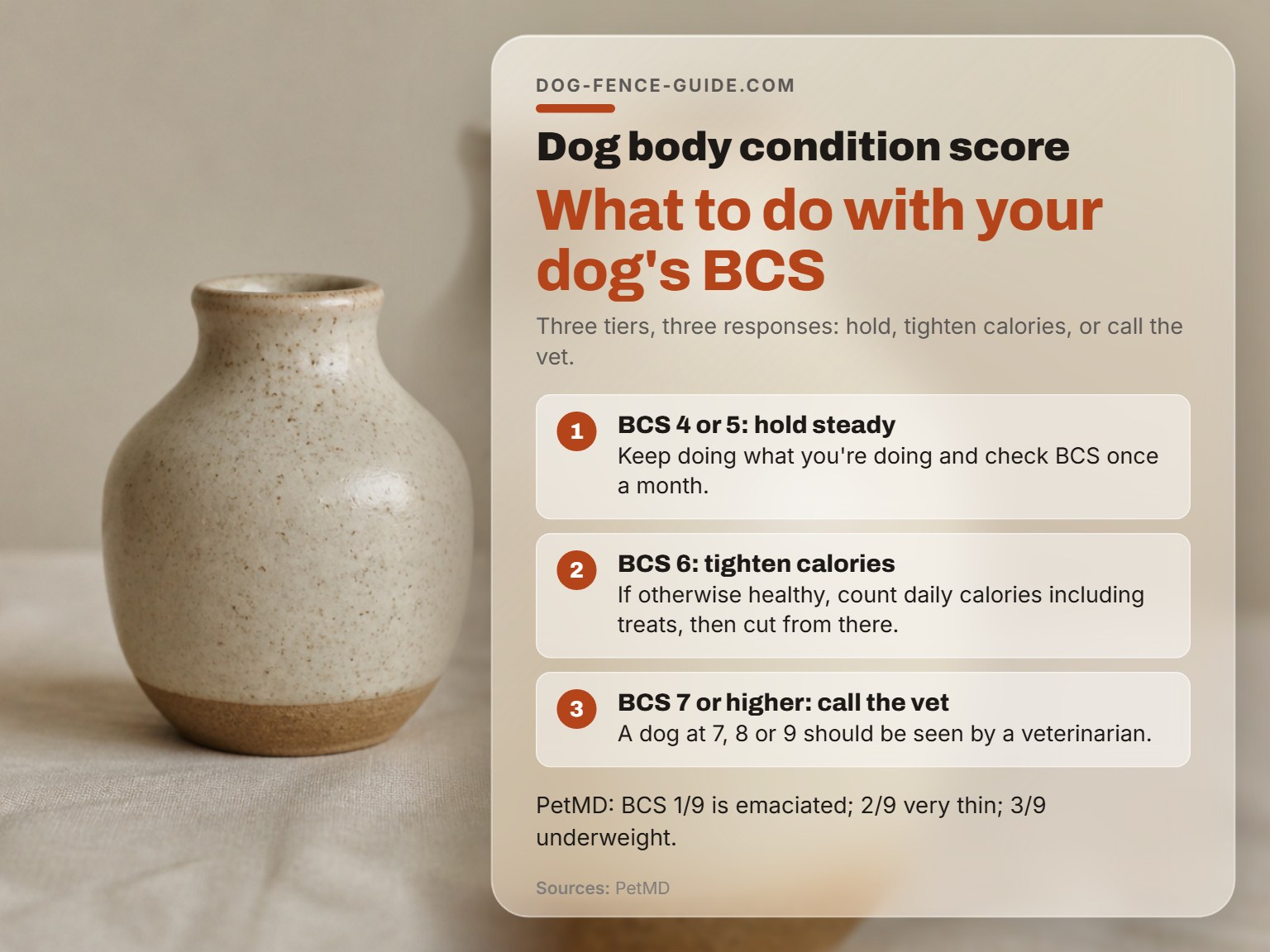
Three tiers, three different responses: hold steady at 4 or 5, tighten the calories at 6, and call the vet at 7 or above.
If the score is 4 or 5
Keep doing what you’re doing and check again in a month. PetMD recommends a monthly BCS check for dogs in the ideal range, which is frequent enough to catch drift and infrequent enough that you’ll actually do it.
If the score is 6
A 6 in an otherwise healthy dog can often be managed at home. PetMD’s approach is to start by working out how many calories the dog takes in every day, including treats and extras, then cut from there.
The FDA warns that the amount recommended on the side of the food bag, can, or pouch may not be right for your dog, depending on age, activity level and other factors.
If the score is 7 or higher
PetMD is direct here: a dog at 7, 8 or 9 should be seen by a veterinarian, who can rule out health problems and recommend a diet. The same goes for a dog at 1 or 2, which PetMD describes as emaciated and very thin respectively.
The lose weight conversation belongs with your vet, because the underlying causes change the plan.
Common mistake: Cutting the ration hard and skipping the vet visit. Book the appointment first, then start the diet.
Fair warning on one more thing.
Frequently Asked Questions
Can I tell if my dog is overweight without a scale?
Yes. PetMD notes the only tools needed for a body condition score are your hands and your eyes. The rib, waist and tuck checks cover most of it, and BSAVA points out that bodyweight tells you little about fat mass on its own anyway.
What body condition score counts as too fat?
Anything above 5/9. AAHA maps a 6 to 25-29% body fat and 10% over ideal weight, and PetMD recommends a vet visit at 7 or above. BSAVA calls 4/9 or 5/9 optimal for dogs.
Is a 6 out of 9 a crisis?
It’s the low end of overweight. AAHA puts a 6 at 25-29% body fat, and PetMD suggests an otherwise healthy dog at 6 can often be managed at home by counting daily calories, including treats.
How often should I check?
PetMD recommends monthly checks for dogs at 4 or 5. BSAVA’s baseline for healthy adults is a weight and BCS check at least once a year, with more frequent checks for neutered dogs, predisposed breeds and dogs that have been overweight before.
Does a fenced yard keep an overweight dog fit?
No.
Can I just cut the food in half?
Not without a plan. The FDA warns that the amount on the bag may not suit your dog’s age or activity level, and PetMD’s home approach starts with counting total daily calories including treats. A dog at 7 or above should see a vet first.
The Bottom Line
Put your hands on your dog’s ribs tonight and write the date and the score on the calendar. That’s the whole first step, and it costs nothing.
Everything above assumes a dog with no other symptoms. If your dog is losing weight while eating normally, or gaining without any change in food or routine, the score is the wrong tool and a vet is the right one.
