
Can Dogs Eat Chocolate? No Safe Amount Explained
This post contains affiliate links. As an Amazon Associate, we earn from qualifying purchases.
Dogs can eat chocolate only by accident, and the dose decides how sick they get. Three thresholds matter: 20 mg/kg of methylxanthines brings mild signs, 40 to 50 mg/kg hits the heart, and 60 mg/kg and up causes seizures.
Methylxanthines is the umbrella term, and it covers two compounds that behave differently once they’re inside a dog. Theobromine does most of the damage and clears slowly. Caffeine rides along for the trip and clears fast, but it stacks on top of whatever theobromine is already doing.
That split explains the strange arithmetic of chocolate poisoning. A dog can look completely normal at bedtime and be in real trouble by breakfast. What follows is the dose math, the timeline, and the two-hour window that decides whether you’re watching or driving.
Key Takeaways
- 20 mg/kg of methylxanthines is where mild signs start, according to Merck, the AKC, and the UK’s Veterinary Poisons Information Service.
- Signs usually show up 6 to 12 hours later, so a dog that seems fine at dinner can be sick by morning.
- Ask about emesis within 2 hours of ingestion, per Merck, though one clinical review puts the useful window at up to 8 hours for large amounts.
- The AKC says there is no safe amount for any dog, while Merck, the FDA, and VPIS publish dose thresholds.
- Cocoa mulch is the yard version of this hazard, and Merck notes some hulls have had methylxanthines removed.
What Dose of Methylxanthines Actually Makes a Dog Sick?
Three numbers do all the work, and the same three show up in every veterinary source that publishes thresholds.
Methylxanthines are absorbed from the gut, distributed through the body, and recycled through the liver and bile before excretion in urine. Theobromine clears with a half-life of 17.5 hours in dogs; caffeine clears in 4.5 hours. Signs usually appear 6 to 12 hours after ingestion and can persist up to 72 hours in severe cases.
| Methylxanthine dose | What it means | Who publishes it |
|---|---|---|
| 20 mg/kg | Mild signs: vomiting, diarrhea, thirst | Merck, AKC, VPIS |
| 40 to 50 mg/kg | Heart effects, racing pulse | Merck, AKC, VPIS |
| 60 mg/kg and up | Seizures | Merck, AKC, VPIS |
| 9 mg/lb mild, 18 mg/lb severe | The same line, in pounds | FDA |
| 100 to 200 mg/kg | Oral LD50 for caffeine and theobromine | Merck |
Merck puts the oral LD50 for both caffeine and theobromine at 100 to 200 mg/kg, then adds a caveat that matters more than the number. Severe signs and death can occur at much lower doses, and individual susceptibility varies.
The FDA uses pounds instead of kilograms, which trips people up. The FDA veterinary chocolate toxicity guidance sets mild signs at 9 mg per pound and severe signs at around 18 mg per pound. Note where the second one lands: on Merck’s heart-effects band, not Merck’s seizure line.
That gap matters. The two agencies agree on the mild threshold.
How Much Chocolate Is That? The Label Math by Product Type
The cocoa percentage on the wrapper is one way to estimate methylxanthine content.
Merck publishes methylxanthine concentrations by product type, and the spread is enormous. Cocoa powder sits at 28.5 mg/g. Milk chocolate sits at 2.3 mg/g. That’s a large difference inside the same pantry.
| Chocolate type | Merck (mg/g) | AKC (mg/g) |
|---|---|---|
| Cocoa powder | 28.5 | 28.5 |
| Unsweetened baker’s | 15.5 | 16 |
| Semisweet or sweet dark | 5.3 to 5.6 | 5.4 to 5.7 |
| Milk | 2.3 | 2.3 |
| White | 0.04 | Not listed |
The FDA publishes the same idea in milligrams of theobromine per ounce. Milk chocolate: 57 mg. Semisweet chips: 136 mg. Dark chocolate at 70 to 85% cacao: 227 mg. Unsweetened baking chocolate: 364 mg.
Six ounces of semisweet chips works out to 816 mg of theobromine, which is the figure the FDA uses to show how differently a big dog and a small dog handle the same bowl.
The 65% Cocoa Bar Shortcut
Merck gives a shortcut for bars that print a cocoa percentage. Multiply the unsweetened chocolate figure by that percentage. A 65% cocoa bar carries roughly 10.1 mg of methylxanthines per gram, or 286 mg per ounce.
That’s why “dark chocolate” isn’t a useful answer on its own. A higher-percentage bar and a lower-percentage bar are different problems.
Merck and the AKC Round Differently
Look at unsweetened baker’s chocolate in that table. Merck says 15.5 mg/g. The AKC says 16 mg/g. The gap comes from rounding and from natural variation in cocoa beans.
VPIS makes that variation explicit. Theobromine content varies because cocoa beans vary and formulations vary. Two bars with identical labels can differ.
Why Theobromine Stays in a Dog’s Body So Long
17.5 hours. That’s the theobromine half-life in dogs, and it explains more about this hazard than any other single number.
Merck’s mechanism section lays out the chain. Theobromine and caffeine block adenosine receptors, which produces central nervous system stimulation, diuresis, and a fast heart rate. They also increase calcium entry into cells and block its storage inside muscle, so skeletal and cardiac muscle contract harder.
There’s a second layer. Methylxanthines compete for benzodiazepine receptors in the brain and inhibit phosphodiesterase, which raises cyclic AMP levels. They also raise circulating epinephrine and norepinephrine.
Short version: the dog’s heart is being told to speed up by three separate signals at once.
The half-life gap explains the duration. Dogs clear theobromine with a half-life of 17.5 hours versus 4.5 hours for caffeine, and both compounds get recycled through the liver and bile, which stretches exposure further. I’ve stopped trying to hold all the receptor names in my head. The half-life is the number I keep, because it tells me how long the problem lasts.
If you want the other half of the picture, the same mechanism drives caffeine toxicity in dogs, and that math runs on a much shorter clock.
What Chocolate Toxicity Looks Like, Hour by Hour
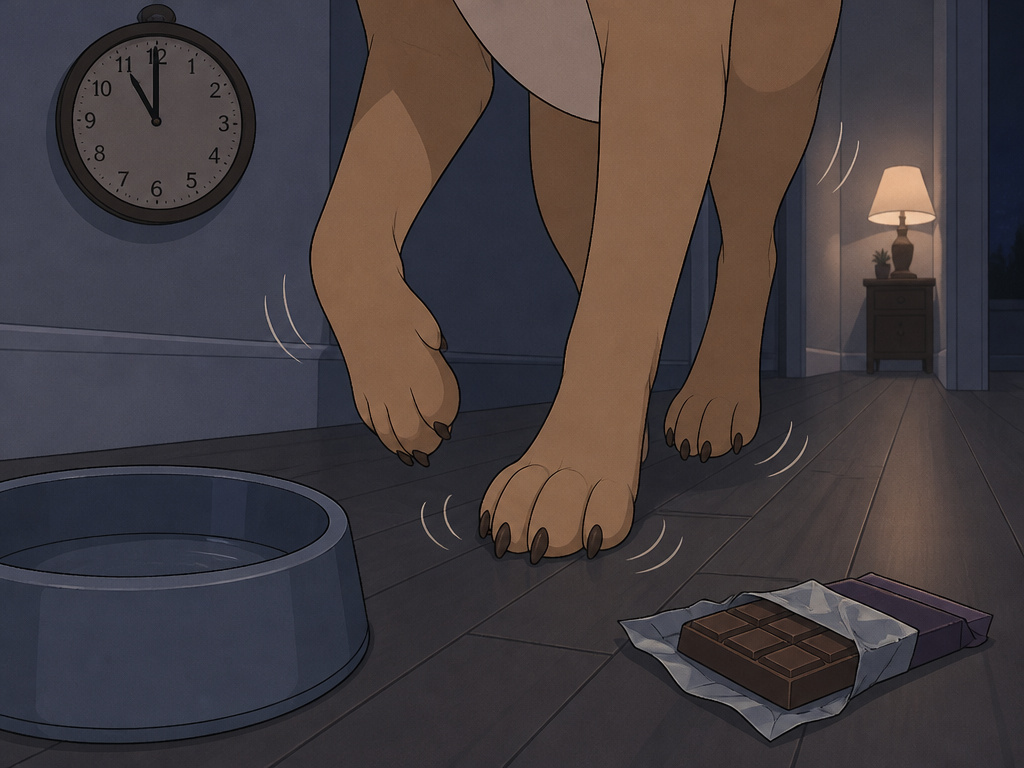
It’s 11 p.m. And the dog won’t settle. He paces the hallway, empties the water bowl, and comes back to pace again.
Merck lists the early signs as polydipsia (excessive thirst), vomiting, and diarrhea. From there it can progress to hyperactivity, increased urination, ataxia, rigidity, tremors, and seizures.
The cardiac signs are the ones that scare me most:
- Racing heart rate, sometimes with premature ventricular contractions
- Rapid breathing, and gums that look grey or blue instead of pink
- High blood pressure
- Rising body temperature
- Low potassium late in the course, which makes the rhythm worse
Restlessness has a sound. It’s nails ticking across the floor long after everyone else has gone to bed.
Common mistake: Waiting for symptoms before calling. Signs usually appear 6 to 12 hours after ingestion, and the first few hours are when decontamination is still on the table.
Merck adds one more thing that surprises owners: severe signs can persist for up to 72 hours.
Timing catches people out. A dog who ate chocolate at 6 p.m. Can be perfectly normal at 10 p.m. And vomiting at 2 a.m.
Can Dogs Eat Chocolate Safely, or Is There No Safe Amount?
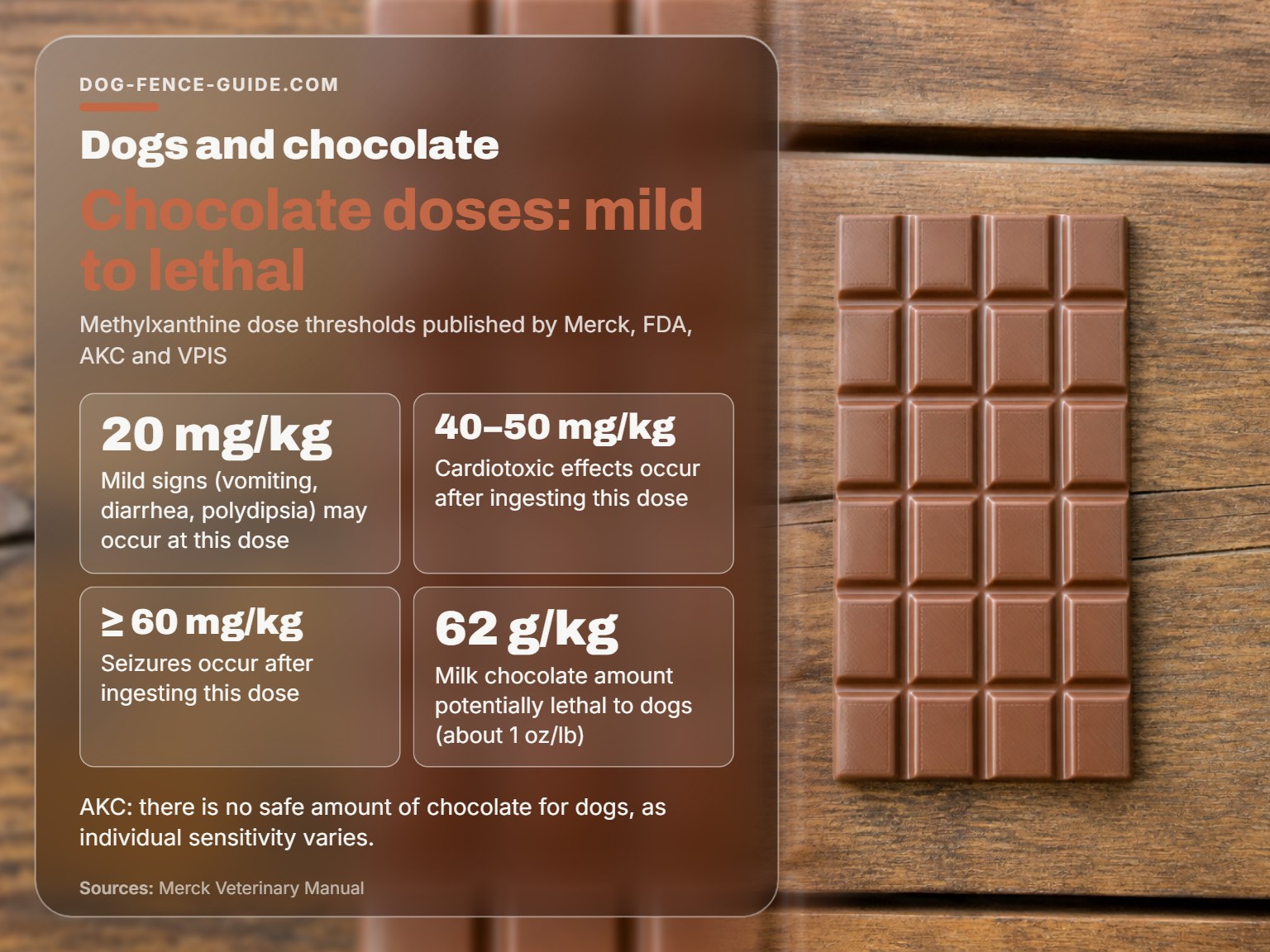
The AKC says flatly that there is no safe amount of chocolate for dogs, because individual sensitivity to methylxanthines varies from dog to dog.
The can dogs eat chocolate question has two answers sitting side by side, and both are defensible. Merck, the FDA, and VPIS all publish dose thresholds anyway.
Here’s the honest version. A threshold tells you what happened to the average dog. It says nothing about yours.
Rule of thumb: If you’re doing arithmetic at midnight to decide whether to call, call. The math is the vet’s job, and you’ll sleep better either way.
What the AKC Says
The AKC’s position is the conservative one, and it’s easy to defend. Sensitivity varies, so a dose that’s mild for one dog can be worse for another. The AKC also notes that a potentially lethal dose is roughly one ounce of milk chocolate per pound of body weight, and an average Hershey’s Milk Chocolate bar weighs 1.55 ounces. The AKC’s position is that there is no safe amount of chocolate for dogs.
What Merck, FDA, and VPIS Say
All three publish thresholds, and they broadly agree on the mild line at around 20 mg/kg. They diverge on treatment triggers.
VPIS works in grams of chocolate per kilogram of body weight rather than milligrams of methylxanthine. Its treatment line is above 3.5 g/kg for dark chocolate and above 14 g/kg for milk chocolate. Merck frames clinical decisions around the methylxanthine dose instead.
VPIS also adds two facts that cut against panic. Around half of the cases reported to it stay asymptomatic, and out of 1,000 canine cases with follow-up on its database, it recorded only 5 fatal cases.
Chocolate is still a hazard, and the odds are better than the internet suggests. I’d rather you call and be told it’s nothing than wait and find out it wasn’t.
What to Do in the First Two Hours After Your Dog Eats Chocolate
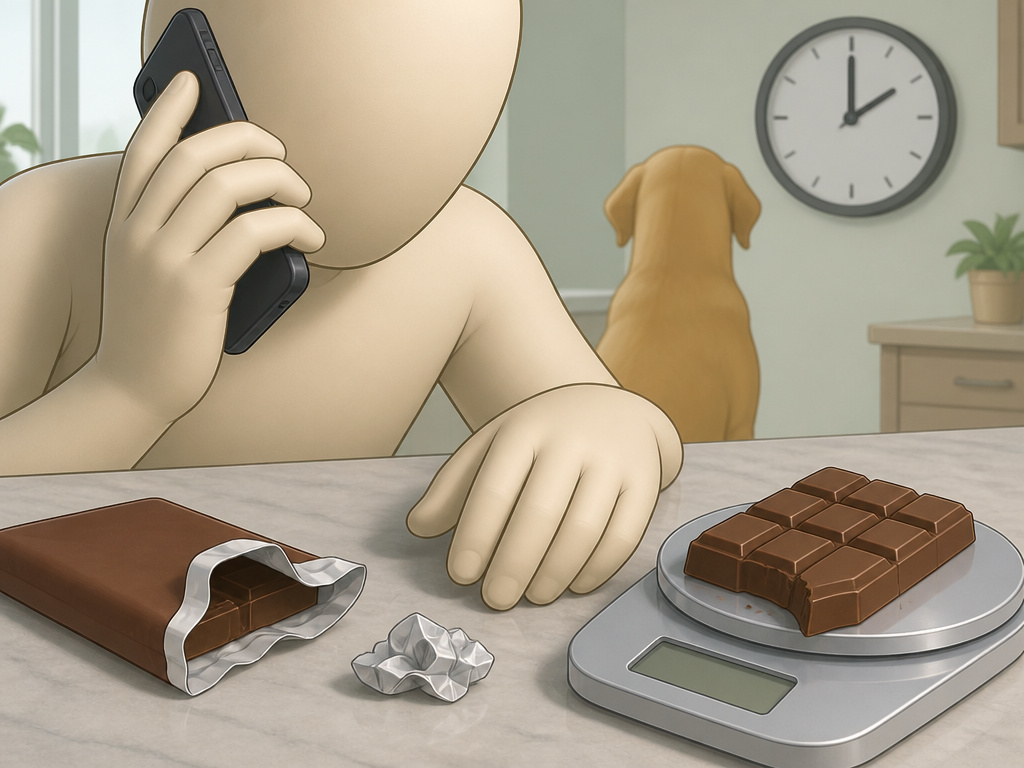
Four steps, in this order, and the first one is a phone call.
Before you start: Do not induce vomiting on your own. Emesis is a vet-directed decision, and the wrong method at home can cause aspiration. Emesis is a vet-directed decision, and the wrong method at home can cause aspiration.
- Collect the packaging and weigh what’s left. The ASPCA’s first instruction is to gather the wrapper so your vet or a poison service can identify the chocolate type and estimate the amount. Skip it and you’re guessing at the dose, which is the one number that decides everything.
- Call a poison service or your vet. Call a poison service or your vet.
- Follow their direction on decontamination. Merck suggests considering emesis within 2 hours of ingestion. One review in Today’s Veterinary Practice puts the useful window at up to 8 hours after a large ingestion, and notes that emesis recovers roughly 40% to 60% of stomach contents.
- Keep him calm and hydrated. Chocolate’s diuretic effect is why fluids matter. Signs usually show up 6 to 12 hours in.
The ASPCA Animal Poison Control guidance flags two things people forget to check. Fillings can include raisins or macadamia nuts, which are separate toxins. Sugar-free chocolate can contain xylitol.
If You Don’t Know How Much He Ate
This is the common case, and it’s fine. Tell the vet what you know: the type of chocolate, the size of the bar, roughly how much is missing, and your dog’s weight.
Your vet can run the same math from your dog’s weight plus the amount and type of chocolate. Your vet runs the same math.
The evidence is usually on the floor. A torn wrapper, a smear of chocolate on the carpet, foil chewed into a small silver ball. I’d bag all of it and take it with me.
Cocoa Mulch Is the Yard Version of This Hazard
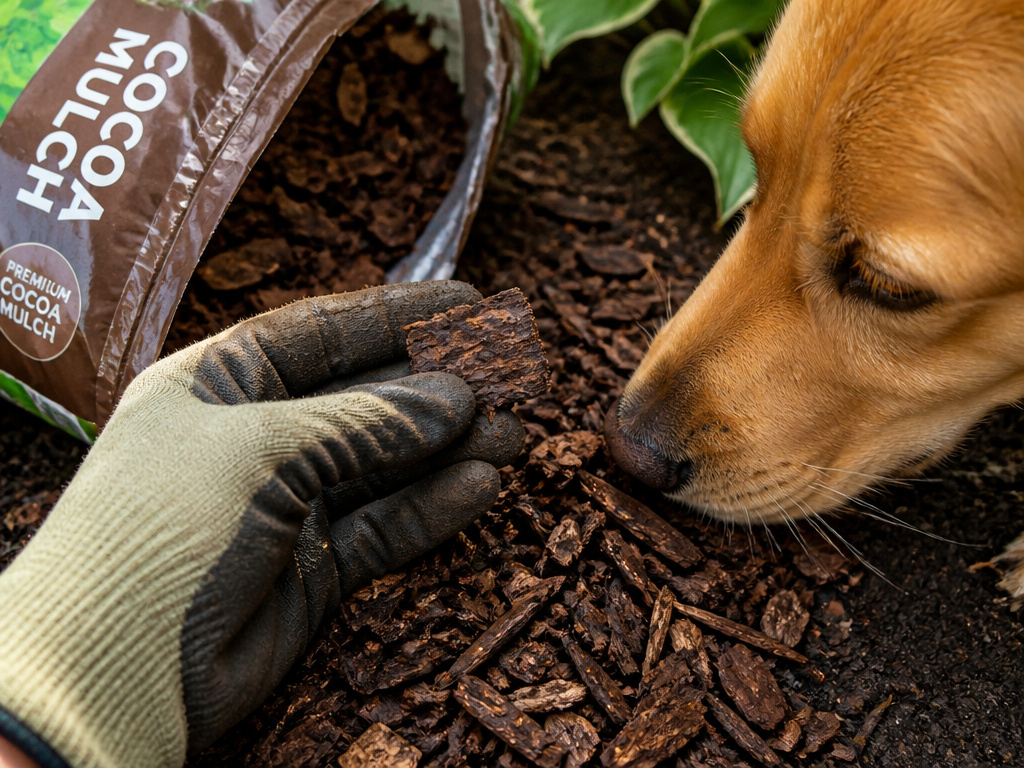
Cocoa mulch is the one yard product I would pull out on sight.
Merck lists cocoa bean hulls at 9 mg/g of methylxanthines, or 255 mg/oz. That’s higher than milk chocolate.
Merck also notes that some cocoa bean hulls have had methylxanthines removed before being marketed as mulch. So the same bag could mean a mild stomach upset or a real toxicosis, and there’s no way to tell by looking.
In the bag it looks like any other dark bark chip.
I check every bag of mulch before it goes on the yard, and I’ve turned down free mulch more than once because the label didn’t say what it was made from. A dog who grazes the garden finds it before you do.
Most owners have a short list of toxic foods memorized, and it usually stops at chocolate and grapes.
A PMC review of foods toxic to dogs and cats groups chocolate with Allium plants, macadamia nuts, grapes and raisins, xylitol-sweetened products, and alcoholic drinks. The same yard-and-kitchen sweep that catches chocolate will catch onions and garlic too.
White Chocolate, Sugar-Free Chocolate, and Fillings
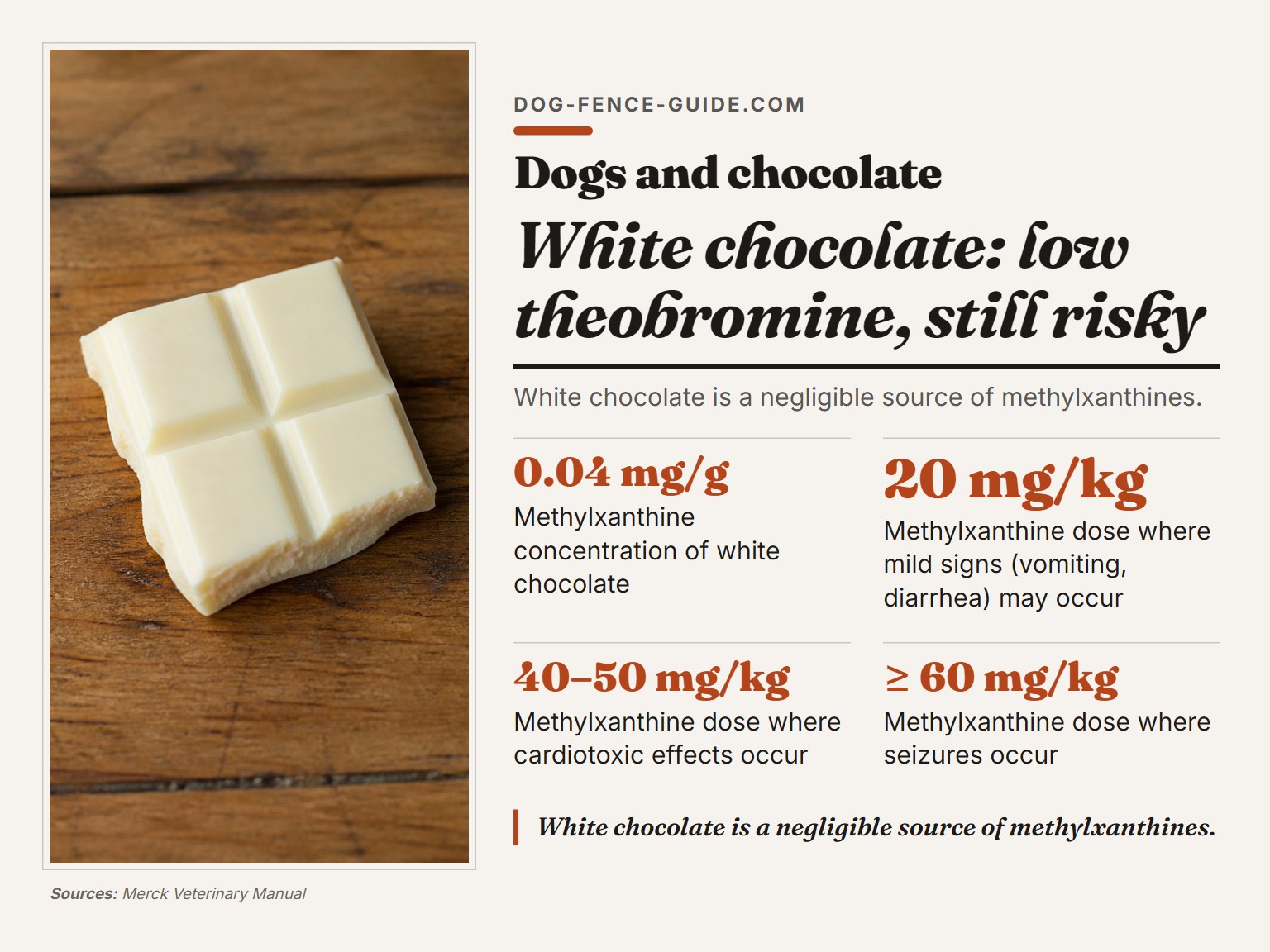
White chocolate is a different problem from dark chocolate, and so is the sugar-free stuff.
Merck puts white chocolate at 0.04 mg/g of methylxanthines, and white chocolate is a negligible source of methylxanthines. VPIS agrees, saying white chocolate is very low in theobromine and unlikely to cause theobromine toxicity.
The fat and sugar load is the real risk there. Merck notes that chocolate’s high fat content can trigger pancreatitis in susceptible dogs, and Merck notes that chocolate’s high fat content can trigger pancreatitis in susceptible dogs. The FDA keeps a separate page on the wider problem of sweets in a dog’s diet: FDA warning on sweets for pets.
Easy to miss: Sugar-free chocolate may contain xylitol, which the ASPCA notes can cause low blood sugar and liver damage in dogs. That’s a separate emergency on its own timeline, and it never shows up in a theobromine calculation.
- Fillings can include raisins or macadamia nuts, which the ASPCA flags as separate toxins.
- Sugar-free pieces may contain xylitol.
- Liqueur-filled chocolates add alcohol to the list, which the PMC review also names as a household food toxin.
- Mixed gift boxes are a problem, because the label on the lid describes nothing inside it.
Lower dose, same caution. A dog who eats a tray of white chocolate truffles still needs a phone call, and the reasons just change.
Frequently Asked Questions
How much chocolate is dangerous for a dog?
Merck puts mild signs at 20 mg/kg of methylxanthines, heart effects at 40 to 50 mg/kg, and seizures at 60 mg/kg and above. The FDA expresses the same idea as 9 mg per pound for mild signs and around 18 mg per pound for severe signs. Because concentration varies so much by chocolate type, the safest answer is to call with the wrapper in hand.
How long after eating chocolate will a dog show signs?
Merck says clinical signs usually appear within 6 to 12 hours of ingestion, and that they can persist for up to 72 hours in severe cases. That delay is the dangerous part, because a dog can look normal through the entire early window.
Should I make my dog vomit if he ate chocolate?
Not on your own. Merck lists emetics including ropinirole and apomorphine and notes that drugs licensed for dogs should be prioritized. Merck suggests considering emesis within 2 hours of ingestion, while a review in Today’s Veterinary Practice puts the useful window at up to 8 hours after a large ingestion. Both are vet decisions.
Is white chocolate safe for dogs?
No, it’s just lower risk on the theobromine side. Merck puts white chocolate at 0.04 mg/g and calls it negligible, and VPIS says it’s unlikely to cause theobromine toxicity. Sugar-free white chocolate may contain xylitol.
What if my dog ate chocolate and seems fine?
Watch him and call anyway. Signs usually appear 6 to 12 hours later, so “fine right now” tells you very little. The ASPCA notes that if the situation isn’t serious, a vet may simply have you monitor at home.
Does milk chocolate count, or only dark?
Both count, but they’re far apart. Merck lists milk chocolate at 2.3 mg/g of methylxanthines and semisweet dark at 5.3 to 5.6 mg/g, so a bar of dark carries more than twice the load. Cocoa powder is higher again at 28.5 mg/g.
The Bottom Line
The answer to can dogs eat chocolate is no, and the number that decides how bad it gets is the methylxanthine dose. Merck’s three lines are the ones to remember: 20 mg/kg for mild signs, 40 to 50 mg/kg for heart effects, and 60 mg/kg and up for seizures.
Here’s the trigger that should send you to the phone. If your dog ate dark chocolate, baking chocolate, or cocoa powder, call. Those three carry the highest loads, and the differences between them matter less than the fact that you called.
One concession: all of this assumes you know roughly what he ate. If you don’t, the advice doesn’t change. Call, describe what you found, and let someone with the calculator do the math.
And one thing I’d say to any owner standing in the kitchen at midnight. I’d rather you call and be told it’s nothing than wait and find out it wasn’t.
