
Golden Retriever vs Goldendoodle: Which Is Right for You?
This post contains affiliate links. As an Amazon Associate, we earn from qualifying purchases.
In the golden retriever vs goldendoodle decision, the golden retriever wins on predictability: a written breed standard, a 3,000-dog lifetime health study and a documented adult size. The goldendoodle has no kennel-club standard, so size, shedding and health risk vary by litter.
That absence of a standard has practical consequences. Every goldendoodle number you see quoted, from 25 to 100 pounds in the same table, comes from a different source rather than a single measured specification. In the golden retriever vs goldendoodle comparison, the golden retriever’s figures come from a document that gets revised on a schedule.
What follows is the comparison I’d want before driving out to see a litter: the actual standard, the places where the published sources contradict each other, what the coat does to your house and your containment setup, and the health data that exists on one side and not the other.
Key Takeaways
- The golden retriever has a breed standard; the goldendoodle has none. No AKC, FCI or UK Kennel Club recognition means no fixed height, weight or coat type exists for the cross.
- Shedding on a goldendoodle is a coin flip, not a promise. F1 and F2 litters produce straight, high-shedding coats, and owner reports contradict the low-shedding marketing.
- The “hypoallergenic” label has no peer-reviewed backing. Allergen load tracks the individual dog, not the breed or the cross.
- Health surveillance exists for one side only. Goldens sit inside a 3,000-dog lifetime study and OFA hip schemes; the goldendoodle is excluded from breed health surveys entirely.
- Budget time for grooming, not just money for the puppy. Curly doodle coats mat, and matting is a welfare problem rather than a cosmetic one.
Golden Retriever vs Goldendoodle: What the Standards Actually Say
The FCI Standard No. 111 puts a golden retriever dog at 56 to 61 cm at the withers. That’s the whole documented comparison, because there’s nothing on the goldendoodle side to set against it.
The AKC breed standard places male golden retrievers at 23 to 24 inches at the withers and females at 21.5 to 22.5 inches, while Rover gives males about 65 to 75 pounds and females about 55 to 65 pounds. FCI Standard No. 111 gives a dog height of 56 to 61 cm and specifies no weight at all.
The AKC golden retriever breed page and FCI Standard No. 111 are the two documents that settle height. Neither is a suggestion. Breeders breed to them, judges score against them, and a puppy outside the band is out of standard.
The goldendoodle has no equivalent. The AKC, the FCI and the UK Kennel Club do not recognize the cross, which means no height band, no weight range and no fixed coat type exist to check a breeder against.
| Trait | Golden Retriever | Goldendoodle |
|---|---|---|
| Breed standard | AKC and FCI Standard No. 111 | None from any kennel club |
| Height at withers | 23-24 in male, 21.5-22.5 in female (AKC) | No fixed range; breeder estimates only |
| Weight | About 65-75 lb male, 55-65 lb female (AKC) | 50-90 lb standard, 15-40 lb mini and toy (Rover) |
| Coat | Dense water-repellent outer coat, soft undercoat | Curly, wavy or straight, unpredictable |
| Health surveillance | Lifetime study plus OFA and BVA/KC schemes | Excluded from breed health surveys |
The Goldendoodle Association of North America publishes a private-registry standard, and it’s worth knowing what that document actually says. GANA sorts dogs into Petite, Mini, Medium and Standard by the size of the parent Poodle. That’s a breeding protocol, not a dimensional guarantee.
Why the Poodle Side Doesn’t Fix the Size Problem
You’d expect pairing a golden with a Standard Poodle to tighten the range, since the Poodle half is supposed to be the smaller parent. It doesn’t work that way. The AKC Standard Poodle standard requires a dog over 15 inches at the shoulder and sets no upper height limit at all. A big Standard Poodle sire throws big puppies.
So a breeder quoting 50 to 90 pounds for a standard goldendoodle is quoting a survey of their own litters. Ask what both parents weigh and what the last three litters weighed at twelve months. The same variability runs through the Poodle vs Labradoodle pairing, and it traces back to the identical cause.
Which One Sheds Less? Depends Which Litter You Get
Owner communities report that a goldendoodle can shed more than a golden retriever, though DoggyQ says the opposite. That happens in F1 and F2 litters that inherit the golden’s straight outer coat instead of the Poodle’s curls, and owner communities report it often enough that it can’t be waved off as bad luck.
The published sources split three ways. DoggyQ calls the goldendoodle hypoallergenic with very little hair drop, though no peer-reviewed evidence supports that label. Dog-Learn rates doodle shedding as “None to Medium” against “Medium to High” for the golden. Dog-Learn rates doodle shedding as “None to Medium” against “Medium to High” for the golden, and marks allergy-friendly as “Maybe” for the doodle versus “No” for the golden, while DoggyQ calls the doodle hypoallergenic.
Then the veterinary literature lands on top of all three. Work on the Can f 1 allergen in dog coats finds allergen load varies by individual dog, not by breed or cross, and no peer-reviewed evidence supports the goldendoodle as hypoallergenic. If allergies are the reason you’re considering a doodle, the question of whether doodle mixes are hypoallergenic deserves a harder look than a breeder’s website.
Run your fingers into a doodle’s coat at the shoulder and you’ll find the loose hair trapped in the curls rather than on your floor. It still has to come out. A slicker brush pulls it in a matted clump instead of a loose cloud.
A breeder who guarantees a low-shedding goldendoodle is describing a probability, not a specification. Ask to see both parents’ coats in person, and ask what the breeder does if the puppy turns out to shed.
What most people get wrong: Treating “low-shedding” as a property of the cross rather than of the individual dog. Coat inheritance isn’t fixed without a standard, so a straight-coated puppy from two curly parents is a real outcome and shows up in F1 and F2 litters.
Size and Weight: Where the Published Sources Genuinely Disagree
Six sources, and no two agree on the goldendoodle’s weight range. That disagreement isn’t sloppiness on their part. It’s what happens when there’s no standard to cite.
| Claim | Who publishes it | The figure |
|---|---|---|
| Golden retriever weight | AKC breed standard | About 65-75 lb male, 55-65 lb female |
| Golden retriever weight | Dog-Learn | 55-80 lb |
| Goldendoodle weight | Rover | 50-90 lb standard, 15-40 lb mini and toy |
| Goldendoodle weight | Dog-Learn | 25-100 lb |
| Goldendoodle weight | Golden Hearts | 50-70 lb standard, from 30 lb mini |
Notice the golden retriever column drifts too, just less. The AKC standard says about 65 to 75 pounds for a male. Dog-Learn says 55 to 80 pounds. PuppyInTraining averages the whole breed at 55 to 75 pounds. The same drift shows up in the Labrador vs Golden Retriever figures, where the standard and the aggregator sites part company on weight.
The goldendoodle spread is wider because there’s nothing underneath it. Twenty-five pounds at one end and a hundred at the other is a huge swing inside one “breed.”
Four things to pin down before you commit to a litter:
- Both parents’ adult weights, measured, not remembered.
- The last three litters’ weights at twelve months, if the breeder tracks them. Good ones do.
- Which generation the puppy is, F1, F1b or F2, because that changes the coat odds.
- Coat type at eight weeks, knowing it can still change.
How Much Exercise Does a Goldendoodle Actually Need?
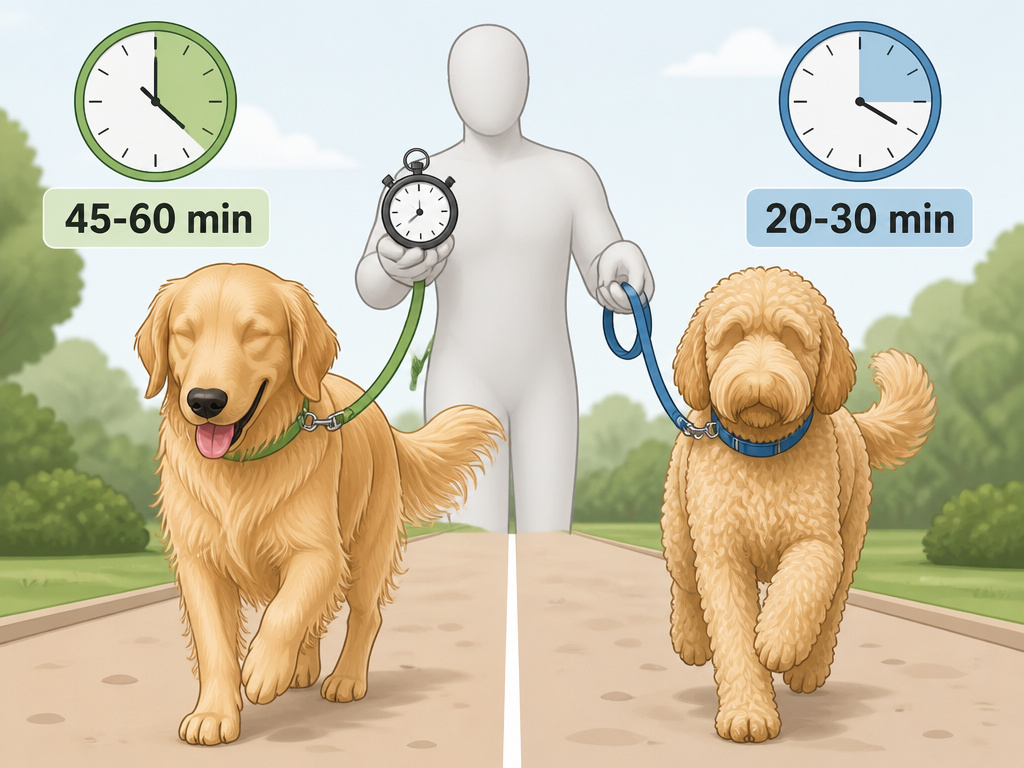
Rover publishes at least 20 to 30 minutes a day for goldendoodles, while Outlinist says an hour and PuppyInTraining lands at 45 minutes. Outlinist says an hour, and PuppyInTraining lands at 45 minutes, so the sources disagree on the goldendoodle’s daily exercise requirement.
Three sources, three answers, and the gap between them is the difference between a sedate lap dog and a working retriever. Rover puts golden retrievers at 45 to 60 minutes of hard exercise every day, and Outlinist says goldendoodles are no different from goldens on that front, while Rover and PuppyInTraining give lower goldendoodle figures.
The lower figures don’t hold up well against the parent breeds. A Standard Poodle is a water retriever bred to work all day, and a golden is a sporting breed. Neither parent is a low-drive animal, which is why the same caution applies across the popular poodle mixes that get marketed as calmer than their parents.
If you want to judge a specific puppy rather than a category, do this:
- Watch the parents move, not the puppies. Puppies are tired after ten minutes regardless of breed.
- Ask what the breeder does with their adult dogs. A dog that gets a real job is a dog that needs one.
- Plan for the golden retriever figure, 45 to 60 minutes, and treat anything less as a bonus rather than a promise.
Health and Lifespan: One Side Has a 3,000-Dog Study, the Other Has Nothing
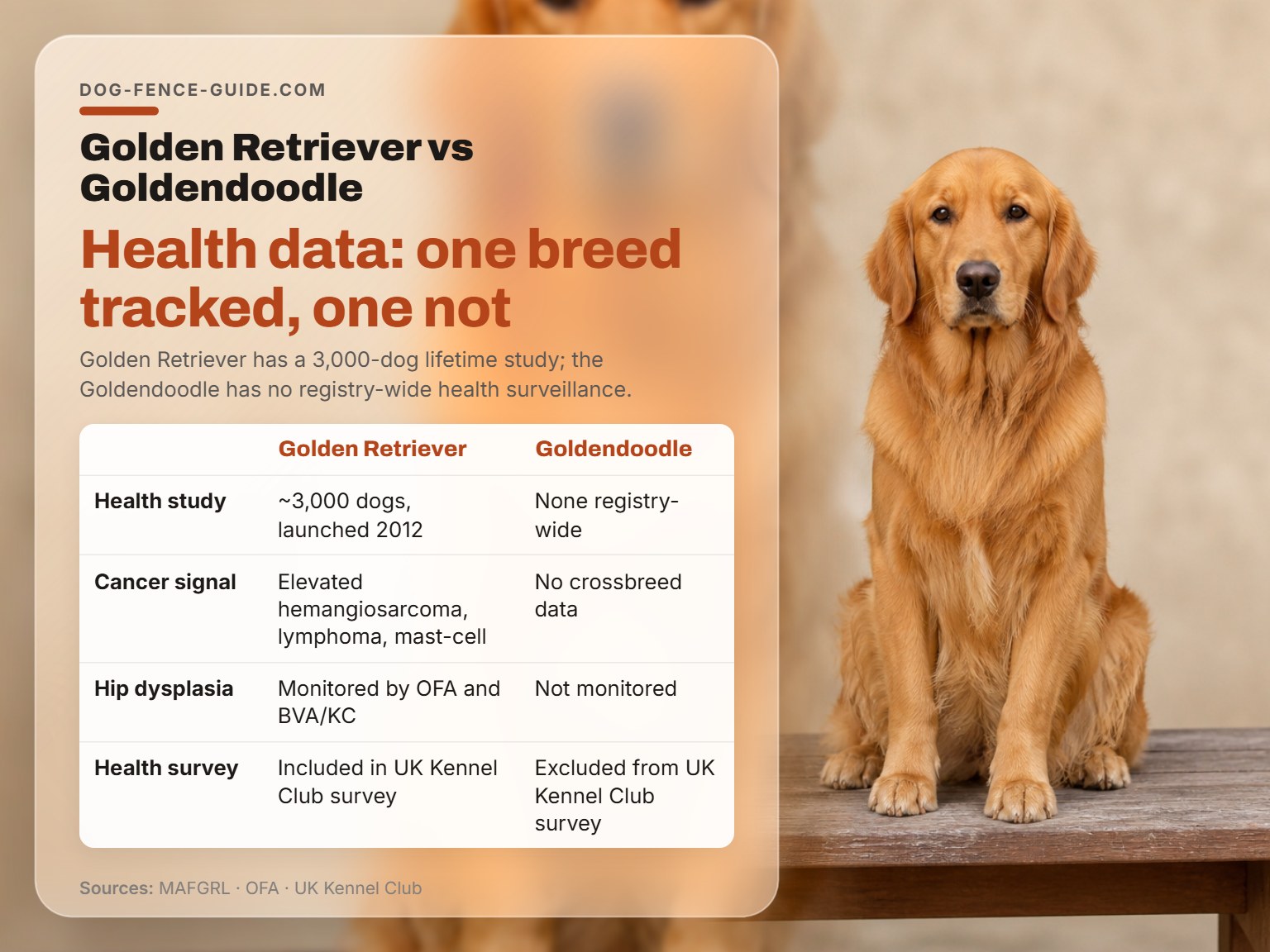
The Morris Animal Foundation launched its Golden Retriever Lifetime Study in 2012 and enrolled about 3,000 dogs in a prospective lifetime cohort. Peer-reviewed work from that cohort documents elevated hemangiosarcoma, lymphoma and mast-cell tumour incidence in the breed.
That’s grim news for the golden, and it’s also the most useful thing on this page. A breed with a known cancer signal and a working surveillance system is a breed you can screen for and insure against with real information.
Goldens are also a monitored breed under the Orthopedic Foundation for Animals and the BVA/Kennel Club Hip Dysplasia Scheme, both of which publish breed-specific scored distributions. You can look up a pedigree and see the numbers.
The goldendoodle has none of that. The UK Kennel Club Purebred Dog Health Survey excludes the cross, so no registry-wide health surveillance exists for it at all. Health claims rest on parent-breed data plus whatever testing an individual breeder paid for.
What Hybrid Vigor Actually Means for a Goldendoodle
Outlinist says goldendoodles are prone to the same diseases as goldens but at lower risk, and PuppyInTraining says hybrids are generally more resistant to genetic issues, though the veterinary consensus does not establish either as fact. The veterinary consensus in the research brief doesn’t support either as established fact, and the absence of crossbreed health registries is the reason nobody can prove it either way.
That’s an honest gap, and I’d rather name it than paper over it. Anyone who tells you the doodle is definitively healthier is selling something.
Lifespan is the same story. Outlinist, Dog-Learn, Golden Retriever Goods and Golden Hearts put the golden at 10 to 12 years, and PuppyInTraining’s 15 to 18 years is a clear outlier against the rest. For the doodle you’ll see 10 to 15 years from Dog-Learn and Golden Retriever Goods, 12 to 15 from Outlinist, and 10 to 12 from PuppyInTraining, so the doodle figure is unverifiable. The golden figure is broadly agreed. The doodle figure is unverifiable.
I won’t quote a doodle lifespan to anyone as a number. There’s no cohort behind it, so what you’re actually getting is an average of guesses. Plan for the golden figure and be pleasantly surprised.
Feeding either dog well is the one lever you fully control, and it’s worth reading up on best dog food for Golden Retrievers or best dog food for a Goldendoodle depending on which way you go.
Grooming: What the Coat Actually Costs You in Time
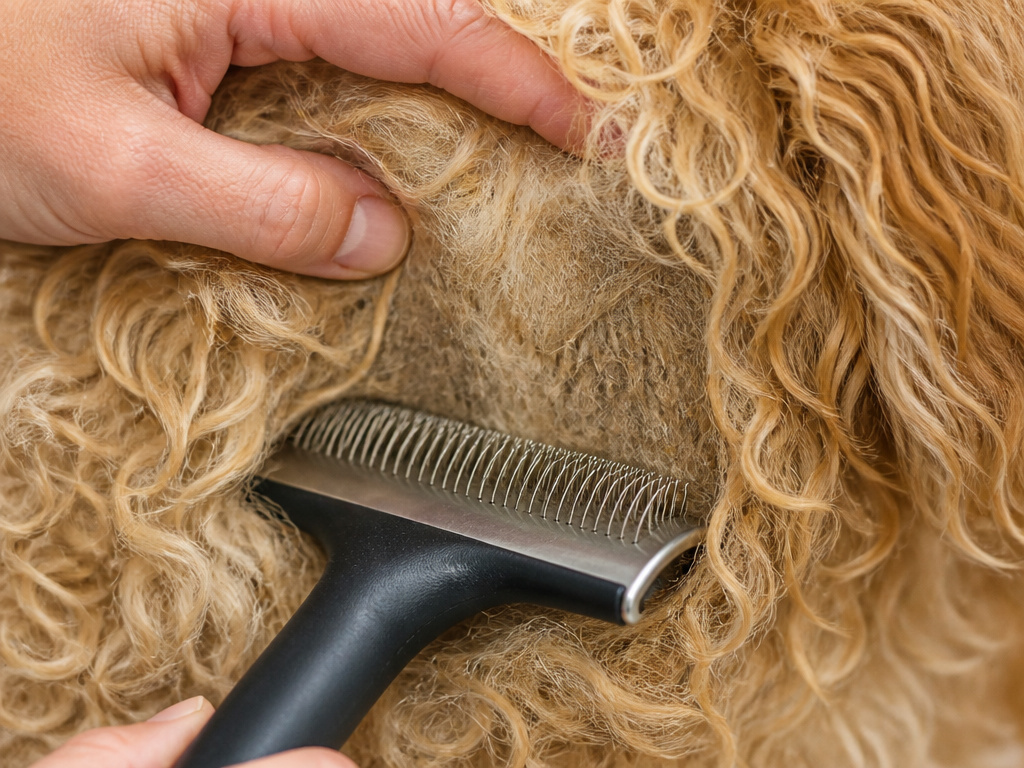
Short version: the golden is more brushing, the doodle is more consequences.
The Golden Retriever Coat: Brush Often, Never Shave
The sources disagree on frequency and agree on the important part. Outlinist says daily brushing and occasional bathing, and states plainly that a golden must never be shaved because of the double coat, while PuppyInTraining says twice a week year-round and DoggyQ says daily coat care plus professional grooming, while PuppyInTraining says twice a week year-round. PuppyInTraining says twice a week year-round and every day while the dog is blowing coat, while Outlinist says daily brushing. DoggyQ says daily coat care plus professional grooming.
Twice a week versus daily is a real gap, and the honest answer depends on the season. In spring and autumn, when the undercoat comes out, twice a week won’t hold. You’ll find tufts on the skirting board either way.
The Goldendoodle Coat: Mat Risk and the Six-Week Rule
Here the sources split harder. Outlinist says brushing a few times a week may suffice and the coat can be shaved very short, while PuppyInTraining says every second day and Golden Hearts says doodles need more grooming than goldens. PuppyInTraining says every second day to prevent tangling and matting, while Outlinist says a few times a week may suffice. Golden Hearts says doodles need more grooming than goldens because curly coats mat more easily, while Outlinist says brushing a few times a week may suffice. Golden Retriever Goods recommends a full groom every 6 to 8 weeks including bath, nail trim and ear cleaning, while Outlinist says brushing a few times a week may suffice.
A matted doodle coat feels felted, like a wool sweater washed hot. The slicker brush stops dead halfway down the flank, and pulling through it hurts the dog. That’s the part the “brush a few times a week” advice leaves out. Full Goldendoodle grooming is a schedule, not a habit.
Where this goes sideways: Skipping the six-week groom because the coat still looks fine on top. Mats form underneath at the friction points, behind the ears and under the collar, and by the time you can see them the only humane option is a shave-down.
Which Dog Is Easier to Contain in a Real Yard?
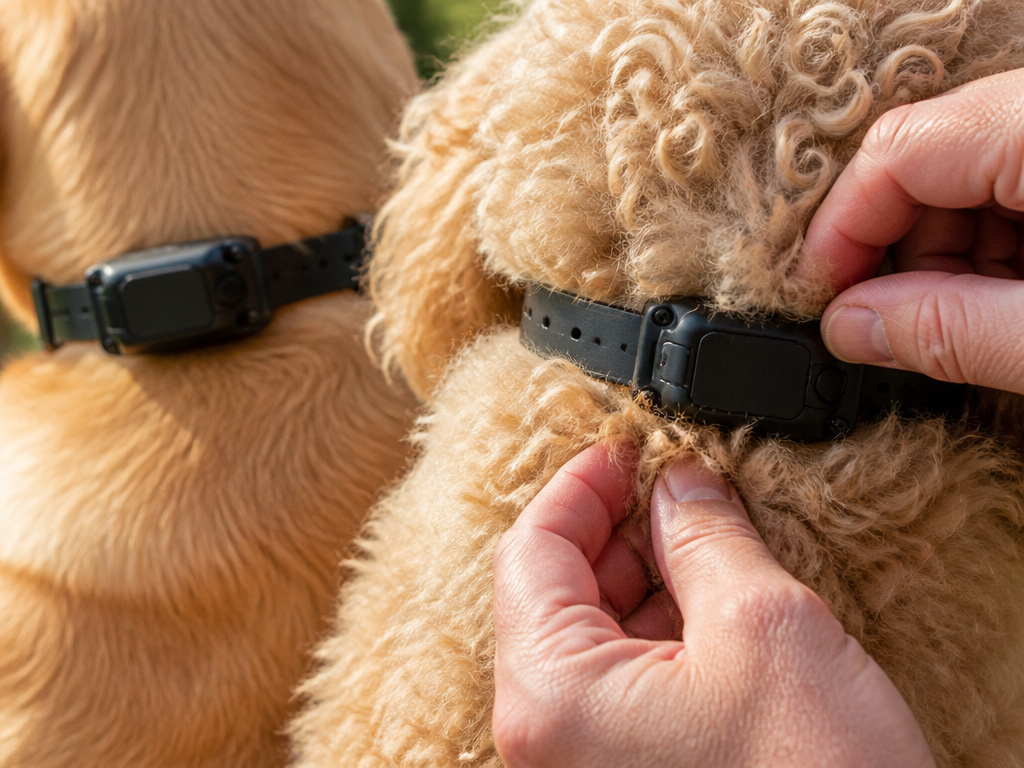
A golden retriever is the easier dog to hold with an electronic system, and the reason is the coat.
On a doodle, standard contact points disappear into the curls. The dog doesn’t register anything until the collar is near its top setting, which is a miserable way to train any dog. Longer points plus a snug fit is the only combination that works consistently on a curly coat.
This is why I compare effective ceiling instead of number of levels. A collar with many levels sounds generous until the lower settings do nothing on a heavily coated dog, and the useful range collapses to the top few settings. Thick coats swallow correction.
A collar that only works near its top setting has no range left. When the dog blows through the top setting once, you’ve got nothing to escalate to.
Physical fencing sidesteps the coat question entirely, which is why I’d rather see a doodle behind a fence and a collar as backup than the other way round. Check these before you buy anything:
- Walk the perimeter slowly and look at the joints, not the long runs. Gates, corners and the gap where the fence meets a gate post are where escapes actually happen.
- Measure the lowest point, not the average height. A washed-out gap under a panel is an invitation.
- Test the gate latch with a shoulder, not a hand. A latch that pops under pressure will pop under a dog.
- Check what comes in, not just what goes out. A fence that keeps your dog in and the neighbour’s dog out is doing two jobs.
Frequently Asked Questions
Does a goldendoodle’s size depend on which parent it takes after?
Yes, and that is why predicting adult size is difficult. A goldendoodle inherits from both a golden retriever and a poodle, and the poodle parent may be toy, miniature or standard, so the range of possible outcomes is wide. Ask the breeder for the actual heights and weights of both parents and, if available, earlier litters from the same pairing. Even then, treat any estimate as a rough guide rather than a guarantee.
Which of the two is easier to insure?
Insurers price on expected claims, and the golden retriever has decades of claims history behind it, so quotes tend to be consistent and easy to compare. The goldendoodle sits in a murkier category because companies differ on whether to treat it as a crossbreed or price it against the poodle. Get written quotes for both before you commit, and check specifically whether hereditary joint conditions are excluded.
Do goldendoodles need more exercise than golden retrievers?
Not necessarily, but the range is broader because the cross can inherit either parent’s energy level. Golden retrievers have a fairly consistent working-dog drive and do well with roughly an hour of daily activity. A goldendoodle from two high-energy parents may need more, while one leaning toward a smaller poodle type may need less. Meet the parents if you can, since their temperament is the best available predictor.
At what age can I tell whether a goldendoodle puppy will shed?
You often cannot tell reliably from a young puppy, which is the core problem. Coat type becomes clearer as the adult coat comes in, usually somewhere between six and twelve months, and even then it can surprise you. If a low-shedding coat is essential, look at an older puppy or adult whose coat has already developed rather than relying on a breeder’s prediction at eight weeks.
The Bottom Line
Here’s the question that actually decides it. Do you need to know what you’re getting before it arrives? If the answer is yes, buy the golden retriever. You get a standard, a height band, a cancer study and a hip registry, and you can check a pedigree before you put a deposit down.
If you’re renting, or you’ve already met an adult goldendoodle from a breeder you trust and you like that specific dog, the calculus flips. You’re buying that dog, not the cross. That’s a perfectly sane way to choose, as long as you know you’re choosing an individual rather than a breed.
Before you buy, verify three things in your own situation. Ask the breeder for both parents’ measured adult weights and the last three litters’ twelve-month weights. Ask which generation the puppy is and what coat the parents actually carry. And walk your fence line once, slowly, before the dog ever sees the yard.
Peace of mind comes from the checks you do first, not the paperwork you get after.
