
How to Treat a Bee Sting on a Dog: Step-by-Step
This post contains affiliate links. As an Amazon Associate, we earn from qualifying purchases.
To treat a bee sting on a dog, scrape the stinger out with the edge of a credit card, ice the site for about 10 minutes wrapped in cloth, and watch closely through the first hour. Facial swelling, vomiting, or weakness means a vet visit right away.
The onset window is the part owners underestimate when learning how to treat a bee sting on a dog. A reaction can start as a small, firm lump on the muzzle and turn into noisy, labored breathing before the ice pack has warmed up, and the swelling doesn’t always stay where the stinger went in.
What follows walks through the first ten minutes, the stinger-removal argument that splits veterinary sources down the middle, the signs that mean drive now, and the antihistamine question you should settle with your vet before you ever need the answer.
Key Takeaways
- Scrape the stinger, don’t pinch it. VCA Animal Hospitals and Small Door Vet both warn that tweezers can squeeze more venom into the dog, while PetMD advises using tweezers if you can isolate the exact sting site, so the sources disagree.
- Ice for about 10 minutes, wrapped in a cloth. PetMD gives 5 to 10 minutes and warns that bare ice on skin can damage tissue.
- Watch closely, then keep watching all day. VCA notes reactions can be delayed for hours after the sting.
- Facial swelling, vomiting, diarrhea, or weakness is an emergency, not a wait-and-see.
- Settle the Benadryl dose with your vet in advance. The 1 mg per pound figure is a rule of thumb, and Benadryl-D is a different drug that can be toxic to some dogs.
How to Treat a Bee Sting on a Dog in the First Ten Minutes
The yelp comes first, then the spinning, then the pawing at the muzzle. By the time you get hands on the dog, she has usually made it worse with her own front feet, so knowing how to treat a bee sting on a dog matters.
The sting that taught me the routine was on a paw. The stinger was still in, and I scraped it out flat with the edge of a credit card instead of pinching it. Then a cold pack for about ten minutes, and a long look at the muzzle, because the muzzle is the one that sends you to the vet.
A bee leaves the stinger behind, and the venom sac keeps pumping after the insect is gone. Wasps and hornets leave nothing behind, so removal applies to bee stings only. Scraping a rigid edge across the dog’s coat flicks the stinger free without squeezing more venom into the tissue.
Before you start: A dog in pain will bite, and the mouth is the worst place to be reaching into. Have a second person hold the collar from behind rather than leaning over the dog’s face. Wrap any cold pack in a cloth, because bare ice on skin causes tissue damage.
Here’s the sequence, in the order that actually matters:
- Get the dog away from the nest. Call her to you instead of chasing her, because PetMD points out you can easily be stung yourself. A dog stung once will often go back for a second look.
- Look for a stinger, but don’t turn it into a search party. Bees are the only insects that leave a stinger behind. If the coat is thick enough that you can’t see skin, stop looking and move on.
- Scrape it out flat. A credit card edge or a fingernail, dragged across the coat. Pinching squeezes the venom sac and pushes more toxin into the site.
- Ice for about 10 minutes, wrapped. Skip it and the swelling has a head start you can’t claw back later.
- Switch to an oatmeal bath for multiple stings. VCA recommends a soothing oatmeal bath when there are several stings, and a thick baking soda and water paste for a single site. A dog with multiple stings will be miserable without it.
Once the stinger is out, the site is a small puncture. You don’t need to scrub it, but the basics of dog wound care apply if the skin is broken. A sting is a puncture rather than a tear, so the dog bite wound ointment in your kit can stay in the kit for now.
How Long Does a Bee Sting Reaction Take to Show Up?
Ask three veterinary sources and you get three windows, which tells you something useful: nobody can hand you a precise clock.
- VCA Animal Hospitals puts allergic reactions within 20 minutes, with delays of hours possible.
- PetMD says symptoms usually show within an hour, occasionally later.
- Small Door Vet gives 30 to 60 minutes, with rare cases hours afterwards.
Plan around the longest window you’ve been handed. VCA is explicit that a reaction may be delayed for hours, and Small Door Vet advises keeping a close eye on the dog all day. A dog who looks fine early on can still go downhill later.
Some swelling and discomfort is normal and doesn’t mean the dog is allergic. Small Door Vet notes the skin at the site may feel firm, and that firmness on its own is not a reason to panic.
Which Stings Need a Vet and Which Can Wait
A single sting on the shoulder of a healthy dog is a home-care problem. A sting on the muzzle is a different animal.
Small Door Vet’s rule is the clearest one going: for a single sting somewhere other than the mouth or muzzle, with no concerning signs, home monitoring is generally safe. Everything else moves up the ladder.
| What you’re seeing | What it usually means | What to do |
|---|---|---|
| Firm swelling right at the sting site | Normal reaction | Ice, monitor |
| Hives on the face or body | Allergic reaction | Call the vet now |
| Swelling spreading away from the site | Allergic reaction | Vet now |
| Vomiting, diarrhea, weakness | Possible anaphylaxis | Emergency clinic |
| Pale gums, cold legs, seizures | Shock | Emergency clinic |
Signs of an Allergic Reaction
Small Door Vet lists general weakness, difficulty breathing, a large amount of swelling extending away from the sting site, and hives around the face or anywhere on the body. Any one of those is enough. PetMD’s version adds facial swelling, vomiting, diarrhea, and weakness, and says to get the dog to a clinic or emergency facility immediately.
Anaphylaxis is rare in dogs, but PetMD notes it becomes more likely with multiple stings over time as the immune system turns abnormally sensitive. A single incident with many bees can also hit harder, because more histamine gets released.
Signs of Anaphylactic Shock
The shock picture is uglier and faster: diarrhea, vomiting, drooling, pale gums, cold extremities, seizures, and coma, per Small Door Vet. Any of those means an immediate emergency visit. If you want the fuller picture of what shock in dogs looks like before it gets that far, it’s worth reading once while your dog is healthy.
For dogs stung repeatedly, the ASPCA Animal Poison Control Center advises in-clinic monitoring for a minimum of 6 hours, ideally 24, and its ASPCA Pro venom reaction treatment guide covers the systemic-poisoning cases that need hospitalization for multiple days. VCA adds that after a severe reaction, expect the dog to stay at the hospital for one or two days depending on how fast she responds to therapy.
Should You Use Tweezers to Remove a Bee Stinger?
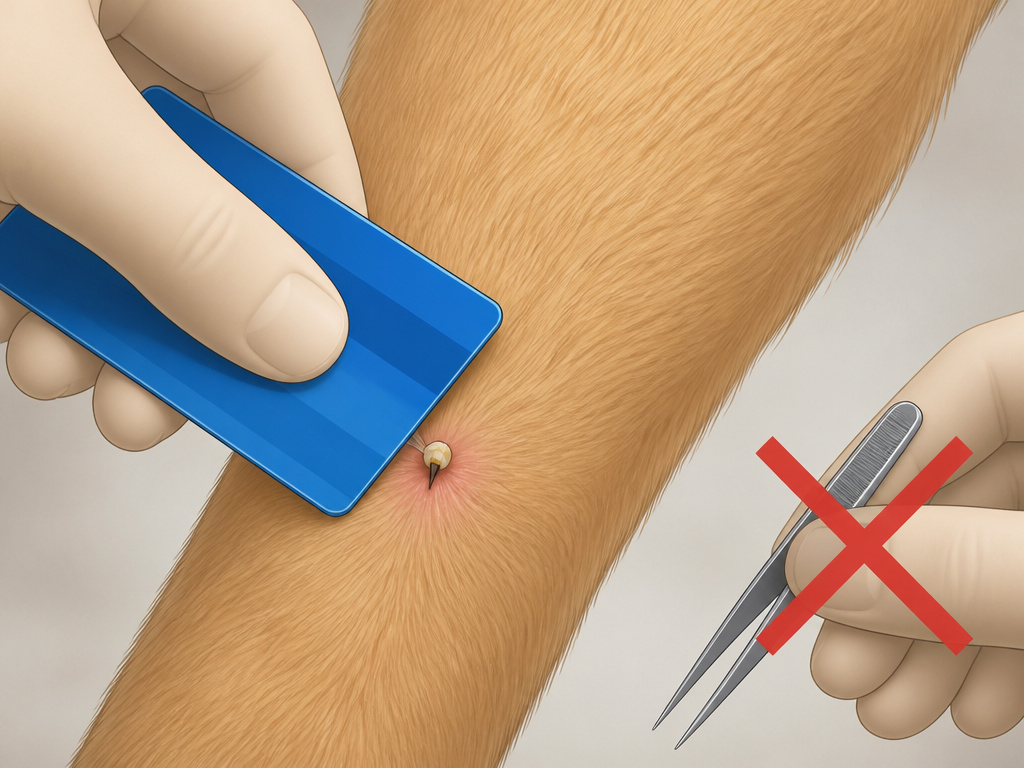
This is the one spot where two credentialed veterinary sources flatly contradict each other, and you should know that before you pick a tool out of the drawer.
| Source | Position on tweezers |
|---|---|
| VCA Animal Hospitals | Do not use them; they may squeeze more venom from the sac |
| Small Door Vet | Don’t use them; scrape with a fingernail or credit card instead |
| PetMD (Jamie Lovejoy, DVM) | Use tweezers if you can isolate the exact sting site |
VCA’s wording is blunt: “Do not use tweezers, which may squeeze more venom out of the stinger sac.” PetMD’s is equally clear in the other direction, telling owners to use tweezers on any stinger that’s remaining. Both are veterinarian-authored. Both are widely cited.
When sources split like this, VCA Animal Hospitals and Small Door Vet advise scraping with a credit card or fingernail, while PetMD advises using tweezers if you can isolate the exact sting site.
Where this goes sideways: Grabbing a stinger between two metal tips compresses the sac before it releases. Do that on a stinger that’s still loaded and you push the remaining venom into the site, which is exactly the outcome you were trying to avoid.
My own kit has fine-tipped tweezers in it, but those live with the tick tool, where a steady pull at the skin line is the right move. For stingers, a dead credit card sits in the same pouch.
Stings to the Mouth, Nose, and Muzzle
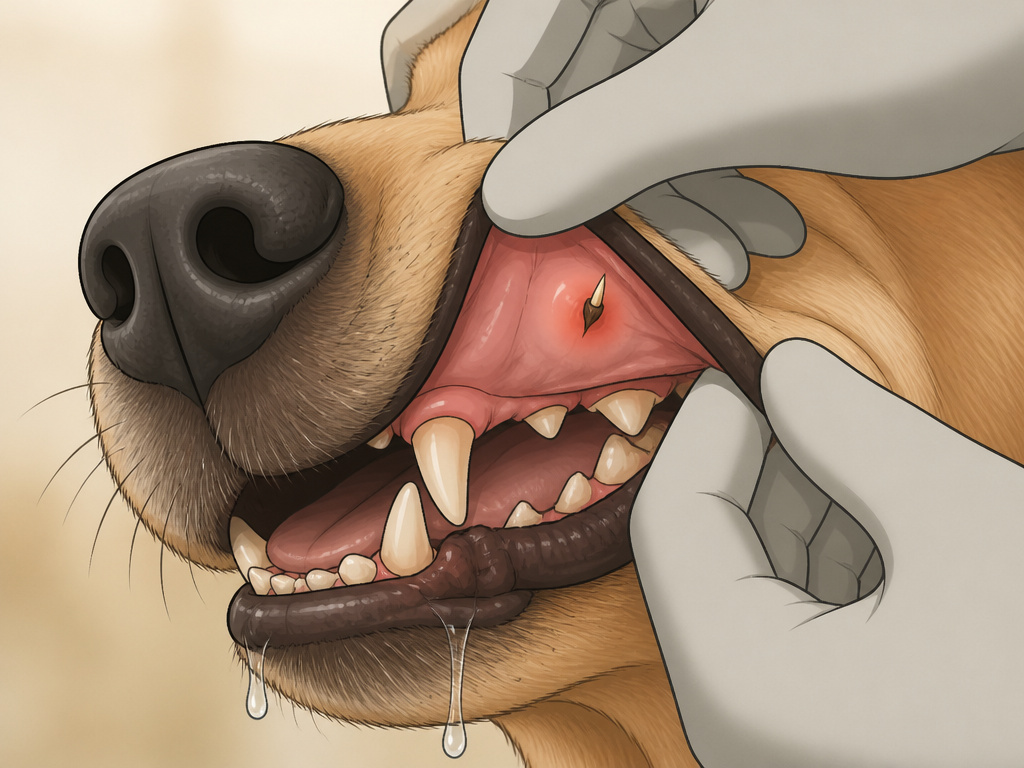
Swelling inside a mouth has nowhere to go but inward, and that is the whole problem with a sting on the tongue, lip, or throat.
Small Door Vet is reassuring on frequency and serious on consequence: airway trouble from a mouth sting happens relatively infrequently, but when it does, the swelling can interfere with airflow. Watch for frequent coughing, gagging, wheezing, or excessive drooling, and go in if any of those show up.
The nose gets hit more often than people expect, simply because dogs investigate with it. VCA notes that many insect bites land on the nose, and that insects sting the closest body part, which makes eyes, ears, and feet easy targets too. PetMD puts the face and muzzle at the top of the list, with paws close behind.
Easy to miss: A dog stung inside the mouth may only drool and swallow hard at first. Drooling that doesn’t stop, or a dog who starts pawing at her face and breathing audibly, is the point to stop watching and start driving.
Removing a stinger from the mouth carries its own risk. Small Door Vet’s warning is worth taking literally: even the most docile dog may bite when she’s in pain and scared. If you can’t see the stinger clearly, take extra care, because even the most docile dog may bite when in pain and scared.
The Antihistamine Question: Dose, Drug, and Evidence
Here is the honest version. Benadryl is what everyone reaches for, and the evidence under it is thinner than the internet suggests.
The 1 mg Per Pound Rule
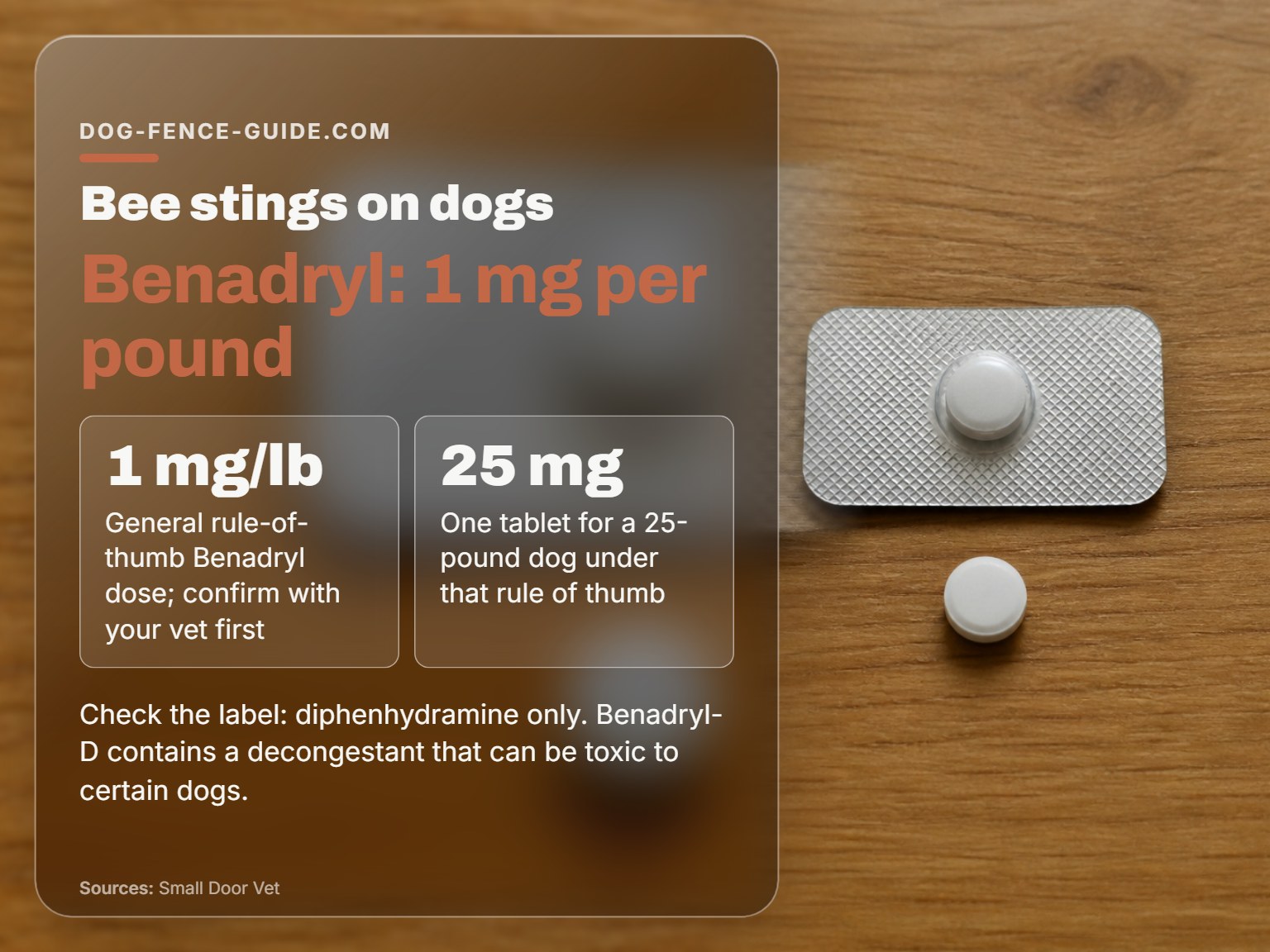
Small Door Vet gives a general rule-of-thumb dose of 1 milligram per pound of body weight, which works out to one 25 milligram tablet for a 25-pound dog. That same source says, in the same breath, to check with your vet about the correct dose first. Do that. A number on a website is not a prescription, and it doesn’t account for your dog’s other medication or size.
PetMD’s framing is similar: discuss antihistamine safety with your vet and know your dog’s dose for common over-the-counter antihistamines ahead of time, so you can act promptly on a minor sting instead of hunting for a phone number.
Why Benadryl-D Is a Different Drug
Benadryl-D contains a decongestant on top of the diphenhydramine, and Small Door Vet warns that the decongestant can be toxic to certain dogs. Check the box for diphenhydramine as the only active ingredient. If the label says “D,” “Cold,” or “Sinus,” put it back.
The evidence grading is where this gets interesting. The RECOVER Initiative’s 2026 clinical guidelines, published in the Journal of Veterinary Emergency and Critical Care, rate an oral H1 antihistamine for an uncomplicated allergic reaction as a Strong recommendation backed by Low quality of evidence. They also explicitly advise against it when the risk to the person giving it is high.
On epinephrine, RECOVER is even more cautious. Prehospital injectable epinephrine for anaphylaxis is a Weak recommendation with Very low quality of evidence, and it should not delay getting the dog to a vet. Home epinephrine syringes are a Weak recommendation based on expert opinion.
I keep antihistamines in the house as a bridge, not a treatment. If I’m an hour from a clinic and the dog is stable, it buys time. If the dog is vomiting or her gums look pale, the tablet goes back in the cupboard and the car keys come out.
A few things worth writing on the inside of the kit lid:
- Diphenhydramine only — no decongestant, no combination products.
- Your vet’s number and the nearest emergency clinic, both written down, because phone batteries die at the worst moment.
- Your dog’s weight in pounds, since every dose conversation starts there.
- Whether she’s had a bad reaction before, because that changes the whole plan.
If your dog has had a severe reaction in the past, VCA notes the vet may prescribe an Epi-Pen for future stings, and Small Door Vet describes the same option as a single-dose epinephrine syringe for trips and hikes. PetMD’s view is that this is typically not needed. Worth asking about, not worth assuming.
For dogs with a history of reacting badly, allergy relief for dogs is a conversation to have with your vet before the next sting, not after.
Dense Coats and the Stinger You’ll Never Find
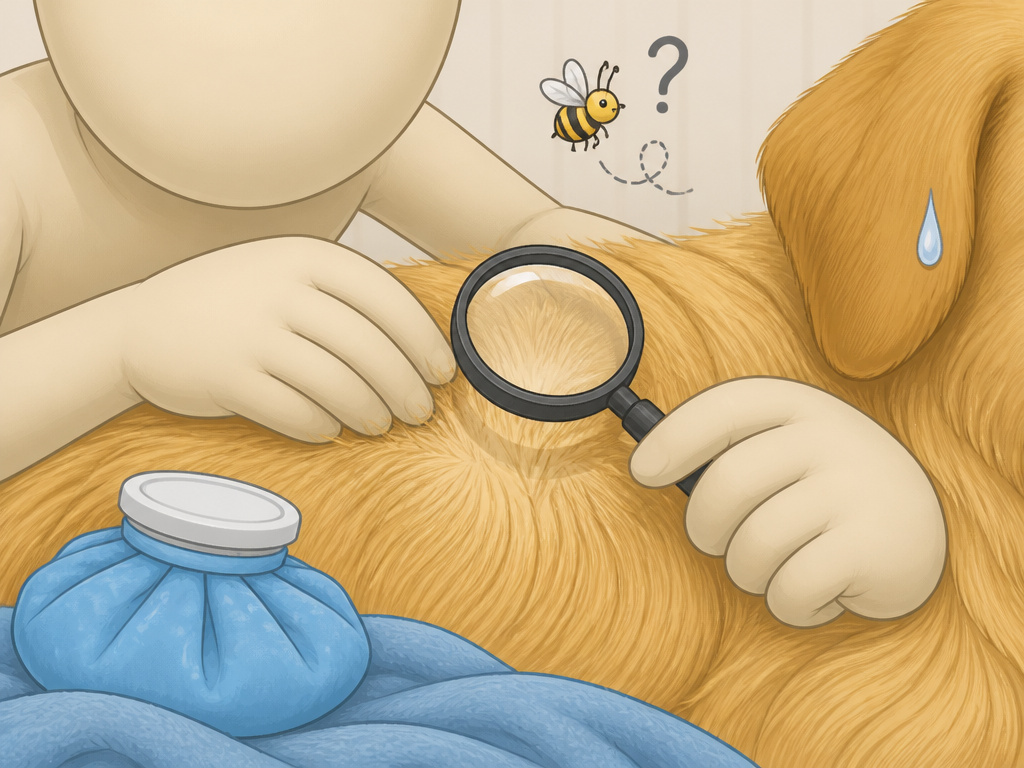
Fitzgerald and Flood, writing in Clinical Techniques in Small Animal Practice in 2006, make an argument you won’t find on most pet-care pages: on account of dense coats, time-consuming and meticulous searches for embedded stingers should not be attempted.
That runs straight against the consumer-facing advice to locate and remove the stinger. Both positions have a logic to them. The stinger does keep pumping venom, which is why removal helps. But on a thick-coated dog, parting fur while the dog writhes is its own problem, and you may never find the thing anyway.
If you can’t see the stinger, stop looking. Ice the area, watch the dog, and remove the stinger if you can find it. A stinger you can’t find is not a stinger you can remove.
This is where I’d push back gently on the standard script. A short-coated dog with a visible stinger is a quick job. A double-coated dog with a sting somewhere under the ruff is a different situation, and the peer-reviewed advice is to leave it alone.
How to Keep It From Happening Again
Prevention comes down to where the dog’s nose goes, and most stings happen because a nose went somewhere interesting.
Bees and wasps are a normal part of a yard, so the goal is fewer encounters rather than none. If your dog spends time outdoors where insects are common, the insect repellents for dogs question is worth researching, with the caveat that not every human repellent is safe for a dog.
A few practical habits:
- Walk the fence line and look for ground nests before the dog finds them.
- Check under sheds and deck edges for nests before the dog finds them.
- Keep water bowls fresh so the dog always has clean water.
- Check the neck for swelling while you’re looking the dog over. Sting swelling is easy to miss under fur.
Scratching afterwards is the part nobody warns you about. A sting site can bother a dog, and a dog who scratches it open turns a small puncture into a skin problem. An e-collar is the unglamorous fix, and Small Door Vet suggests one for exactly this reason. If scratching is already a battle, the same tricks that soothe itchy skin apply here.
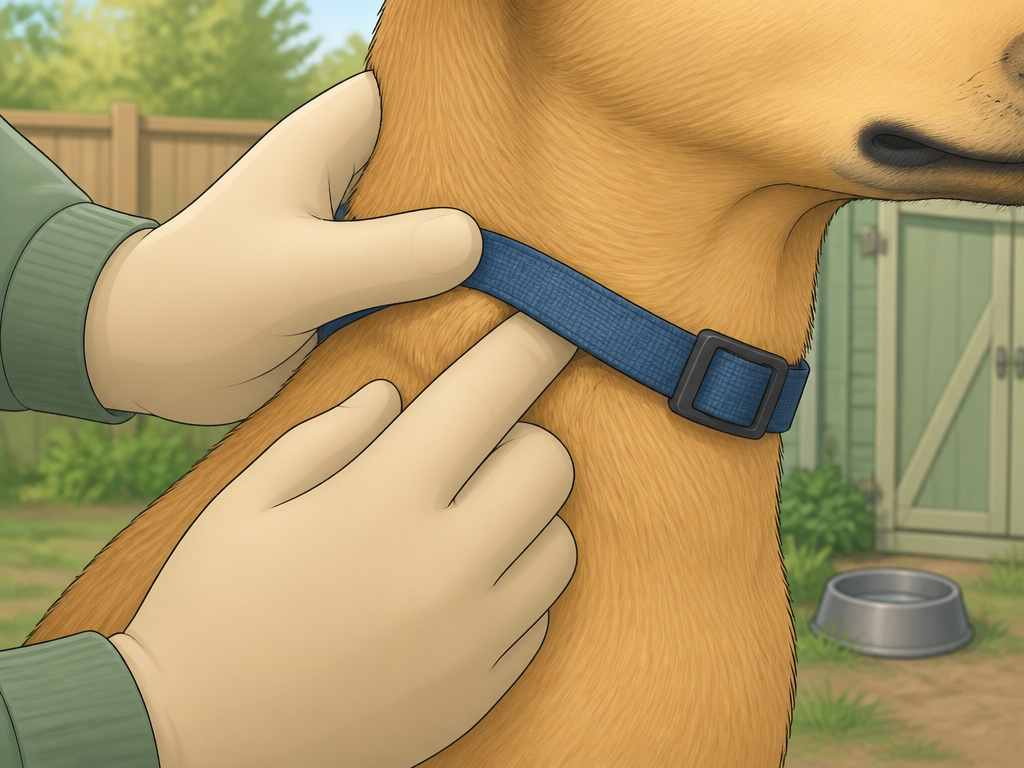
A sting under a snug collar is easy to miss entirely. If your dog wears one all day, a finger-under-the-strap check earns its keep.
Frequently Asked Questions
Should I give my dog Benadryl right after a bee sting?
Ask your vet first, ideally before you ever need to. Small Door Vet gives a rule-of-thumb dose of 1 milligram per pound of body weight, and says plainly to confirm it with your vet. Make sure the product is plain diphenhydramine and not Benadryl-D, which contains a decongestant that can be toxic to some dogs.
How do I know if my dog is having an allergic reaction to a sting?
Small Door Vet lists general weakness, difficulty breathing, swelling that spreads well beyond the sting site, and hives around the face or body. PetMD adds facial swelling, vomiting, diarrhea, and severe lethargy. Any of those means a vet visit, not a wait-and-see.
Can I use tweezers on a bee stinger?
Veterinary sources disagree. VCA Animal Hospitals and Small Door Vet both say no, because tweezers can squeeze more venom out of the sac. PetMD says to use tweezers if you can isolate the exact spot. Scraping with a credit card edge works either way, which makes it the safer default.
What if my dog swallowed the bee?
Watch for vomiting, per Small Door Vet. The gastrointestinal tract tends to handle bee toxins reasonably well because of stomach acids, and vomiting will likely resolve on its own. Anti-nausea medication and antihistamines may be needed, so a call to the vet is still the sensible move.
How long should I watch my dog after a sting?
VCA says allergic reactions usually occur within 20 minutes but may be delayed for hours. Small Door Vet advises keeping a close eye on the dog all day. The period right after the sting is the most concentrated, and the rest of the day is the tail.
Do wasps and hornets leave a stinger behind?
No. VCA is clear that wasps and hornets don’t leave a stinger, so removal only applies to bee stings. If your dog was stung by a wasp, skip the stinger hunt entirely and go straight to icing the site.
Before You Go
The one number to remember is 20 minutes. That’s VCA’s typical onset window for an allergic reaction, and it’s the reason a dog who seems fine right after a sting still needs eyes on her.
Everything else here is technique. Scrape instead of pinch. Ice for about ten minutes, wrapped. Know your dog’s weight in pounds and your vet’s number by heart. If the swelling moves off the sting site, if she vomits, or if her gums go pale, the home-care part of the day is over.
This weekend, put a dead credit card in the dog kit and write the emergency clinic’s address on the lid. Peace of mind is the real goal.
