
Labradoodle Pros and Cons: What Owners Actually Report
This post contains affiliate links. As an Amazon Associate, we earn from qualifying purchases.
Labradoodle pros and cons start with the coat: a friendly, low-shedding dog whose grooming takes more time than owners expect. Health-wise it lands close to its parent breeds. A UK study of 9,402 dogs found 86.6% of 342 disorder comparisons showed no significant difference from Labradors and Poodles.
That coat is where the hours go. A doodle’s hair keeps growing instead of cycling out on its own, so it gets longer and thicker until someone cuts it. Skip the brush for a week and the undercoat packs into felt behind the ears and under the collar.
What follows is the honest split: the parts of the Labradoodle pitch that hold up, the parts that cost you time and money, and the places where the published numbers flatly disagree with each other.
Key Takeaways
- Grooming beats shedding as the real cost. Owners in a US survey expected low-maintenance coats and got more work than they bargained for.
- “Hypoallergenic” has no research backing. A 2012 study found more Can f 1 allergen in the hair of “hypoallergenic” breeds than in Labradors, though Dogster calls Labradoodles ‘pretty close’ and PetMD notes no breed is 100% free of allergens.
- Health odds land near the parent breeds. 86.6% of 342 disorder comparisons showed no significant difference.
- Size depends on which Poodle was used. Published adult weights run from about 30 pounds for a Mini Labradoodle to 75 pounds for a Standard cross.
- Budget for a groomer, not just a brush. PetMD describes the coat as needing an extensive routine to stop mats.
Are Labradoodles Really Hypoallergenic?
Start with the allergen itself, because the breed label hides it. Can f 1 is the protein that sets off most dog allergies, and it rides on hair, skin flakes, and dust.
Can f 1 is the main dog allergen carried on hair, coat, and household dust. In a 2012 study of 196 “hypoallergenic” dogs and 160 non-hypoallergenic dogs, hair and coat samples from the hypoallergenic group had a geometric mean of 2.26 micrograms per gram, against 0.77 in Labrador and control breeds.
That result runs against the sales pitch. The authors concluded there is no evidence for classifying any breed as hypoallergenic, though Dogster calls Labradoodles ‘pretty close’ and PetMD notes no breed is 100% free of allergens. Dogster takes a softer line, calling Labradoodles not truly hypoallergenic but “pretty close.” PetMD sits in the middle: no breed is 100% free of allergens, and a Labradoodle gives no guarantee against sneezing, watery eyes, or respiratory symptoms.
The same study found three different answers depending on where the sample came from. That’s the part most summaries skip.
| Where the sample came from | What the 2012 study found |
|---|---|
| Hair and coat | Higher Can f 1 in “hypoallergenic” breeds than in Labradors |
| Settled floor dust | Lower Can f 1 in homes with Labradoodles |
| Airborne allergen | No difference between breeds |
So a Labradoodle may leave less allergen on the floor while putting no less into the air. If you’re allergic and hoping a doodle solves it, spend an hour in a house with one before you commit.
The hypoallergenic claims made for doodles get messier once coat genetics enter, because an F1 cross and a multigenerational doodle don’t inherit the same coat.
The Grooming Load Nobody Warns You About
Run a metal comb through the coat just behind the ear and it stops halfway with a soft ripping sound. That’s a mat starting, and it forms in days.
In a US survey of doodle owners, the gap between expectation and reality showed up in grooming. Owners bought in expecting low-maintenance, non-shedding coats. The data showed grooming and upkeep took more investment than they expected. They still reported high satisfaction, which tells you something about how much people will forgive a dog.
Published advice splits hard on this. Dogster describes Labradoodles as needing minimal grooming, with regular brushing to prevent mats and a coat that can be clipped short, while PetMD describes long, curly coats that need an extensive routine and Hladky-Krage & Hoffman found grooming took more investment than owners expected. PetMD describes long, curly coats that need an extensive routine to avoid mats and knots. Both are describing the same dog.
Here’s what the work actually is:
- Comb, don’t just brush.
- Brush regularly. Curly coats trap dead hair instead of dropping it, so a weekly pass leaves felt behind the ears.
- Book a groomer every few months if you want the coat kept short, which is Dogster’s guidance, though PetMD describes the coat as needing an extensive routine.
- Start young. PetMD notes puppies must be trained early to sit through long grooming sessions, and a dog that fights the table makes every appointment harder.
A doodle coat mats the way bread dough over-proofs. Nothing looks wrong for the first hour, then the structure is gone and you can’t get it back.
I’d rather see an owner brush briefly each day than book a long session once a month. Short and boring beats long and rare, every time.
Two tools do most of the work. A slicker brush gets through dense curl without dragging, and a steel comb is what actually finds the mat. For bath day, ask your veterinarian which shampoo they recommend for a doodle’s skin.
Which brush suits which coat is its own rabbit hole, and a guide to the best brushes for Labradoodles sorts slicker from pin from undercoat rake. Bath choices matter just as much when the skin is already itchy, which is where a guide to the best dog shampoo for a Labradoodle earns its keep.
Where this goes sideways: Clipping a matted coat short at home with a cheap clipper. The blade catches the felt, the dog yelps, and you finish the job at a groomer within the week with a shaved dog and a bigger bill.
The Labradoodle Pros and Cons in the Health Data
86.6% is the number that should anchor this conversation. That’s the share of 342 disorder comparisons where designer crossbreeds showed no significant difference from their purebred parent breeds, in a UK study of 9,402 dogs.
Bryson and colleagues set out to test the hybrid vigour claim directly. They found no overall health advantage for the crossbreeds. They also found no overall disadvantage, which cuts against the opposite claim that doodles are walking vet bills. The split ran 7.0% of comparisons with higher odds in the crossbreeds and 6.4% with lower odds.
The eye data is where a real difference shows up. In a UK survey of 175 Labradoodles, multifocal retinal dysplasia turned up in 20 dogs, or 4.6%. Cataracts turned up in 16, or 3.7%. The MRD rate was significantly higher than in Labrador Retrievers (P<0.0001). The cataract difference was not significant (P=0.4866).
PetMD lists progressive retinal atrophy, cataracts, and glaucoma as conditions Labradoodles are prone to. That’s a predisposition list, not a population odds figure, and the two don’t reconcile cleanly. A breed can be listed as prone to something and still show no measurable excess across a population.
The doodle physical health study is the population view. The survey of ophthalmic abnormalities in Labradoodles is the eye-specific one, and it’s the source of the 4.6% figure.
What Breeders Should Be Screening For
Ask what testing the parents had before you look at a puppy. Jamie Whittenburg, DVM, lists genetic testing, eye exams, OFA or PennHIP scoring, and echocardiograms as the screen a breeder should be running.
If a breeder can’t tell you the eye status of both parents, walk away. MRD showed up in 4.6% of the Labradoodles examined in one UK survey, and it isn’t something you spot in a puppy photo.
How Big Do Labradoodles Actually Get?
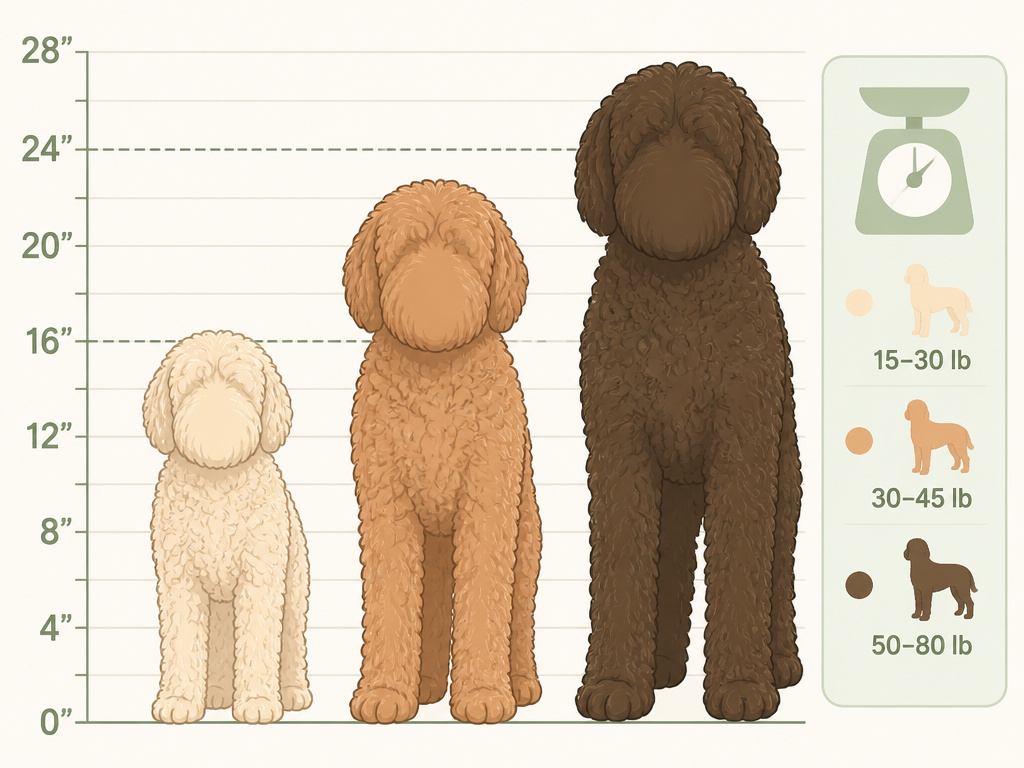
The published numbers don’t agree, and the gap is too wide to call a rounding error. PetMD puts a full-grown Labradoodle at 50 to 75 pounds and about 25 inches tall, while Dogster calls the medium size the most common, at 30 to 50 pounds and 16 to 24 inches.
| Measure | PetMD | Dogster |
|---|---|---|
| Typical adult weight | 50-75 lb | 30-50 lb (medium, most common) |
| Typical adult height | About 25 in | 16-24 in |
| Sizes listed | Standard and Mini | Mini, medium, and standard |
Both sources are describing real dogs. The difference is the cross. PetMD’s figure assumes a Standard Poodle parent, while Dogster’s medium-size figure reflects a smaller cross. A Mini Labradoodle, bred from a Miniature Poodle, lands at 16 to 20 inches and around 30 pounds.
So the honest answer to “how big” is: ask which Poodle. A Labradoodle from two Standard-sized parents and one from a Miniature Poodle are different animals with the same name.
If you’re guessing at a rescue pup, Embark and Wisdom Panel both report breed composition. Treat the result as a hint about adult size, not a promise.
The Poodle vs Labradoodle comparison matters here, because the Poodle parent is doing most of the work on both size and coat.
Behaviour: Where the Doodle Label Gets Sloppy
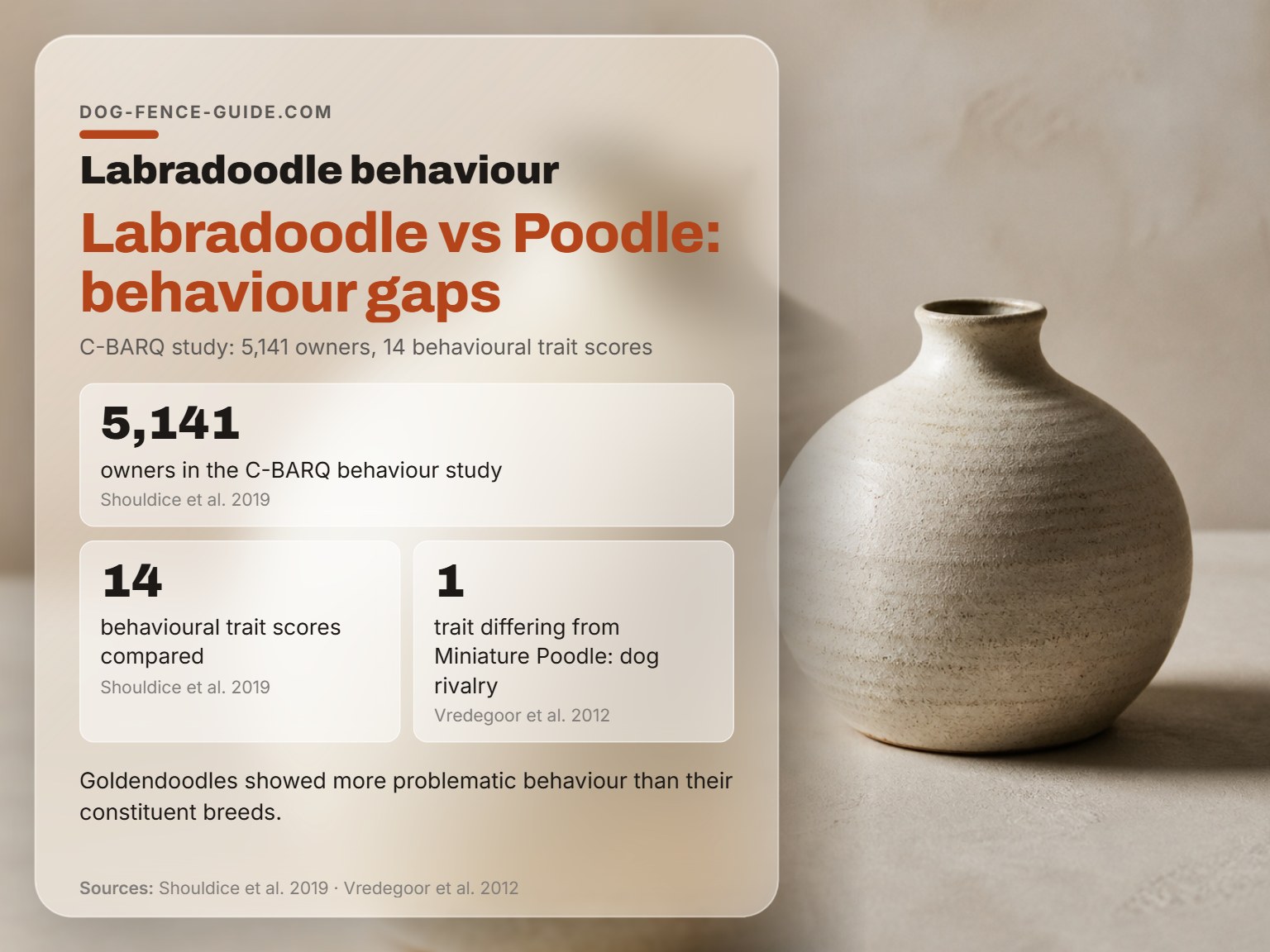
Two doodles, two different answers. That’s the finding from the largest behaviour dataset on this cross.
The C-BARQ study covered 5,141 owners and 14 behavioural trait scores. Goldendoodles displayed more problematic behaviour than their constituent breeds. Labradoodles differed significantly from the Miniature Poodle only in dog rivalry, and showed no significant behavioural differences versus the Standard Poodle.
A doodle’s alert bark is a sharp, repeating yap that carries through a closed door and across two yards. Dogster flags it directly: Labradoodles may bark at noises or visitors more than you’d like, which makes them a poor fit for apartments and small homes.
Labradoodle vs Poodle on Behaviour
If you want the calmer odds, the Standard Poodle side is the safer bet on paper, though the C-BARQ data found no significant behavioural difference between Labradoodles and Standard Poodles. The C-BARQ data found no significant behavioural difference between Labradoodles and Standard Poodles, so the Labrador half isn’t adding much either way.
Against a Miniature Poodle, the Labradoodle differs on dog rivalry. That’s the trait to watch if you already have a second dog in the house.
The Cockapoo sits in the same UK dataset, and a guide to Cockapoo pros and cons is the parallel read if you’re weighing one mix against another. The study of Labradoodle behavioural traits has the full trait breakdown.
The part nobody mentions: A bored doodle doesn’t sulk quietly. Dogster ties the chewing and barking directly to separation anxiety, so a dog left alone all day will redecorate the door frame.
Exercise, Yards, and Whether This Dog Stays Put
I learned the containment lesson the hard way, with a beagle and a wireless fence. The fence worked exactly as designed. The dog treated the boundary as a suggestion whenever a squirrel was worth the correction, and I spent a month learning that a collar beep is a training aid, not a wall.
Labradoodles need a lot of daily activity. Dogster is blunt about the failure mode: without enough exercise they get restless, bored, and destructive, and the breed isn’t a good fit for apartments or small homes.
Fair warning. The Labrador half is the reason this dog needs a job, and a guide to Labrador Retriever pros and cons covers the exercise appetite that comes with it.
If you’re setting up a yard for one, work in this order:
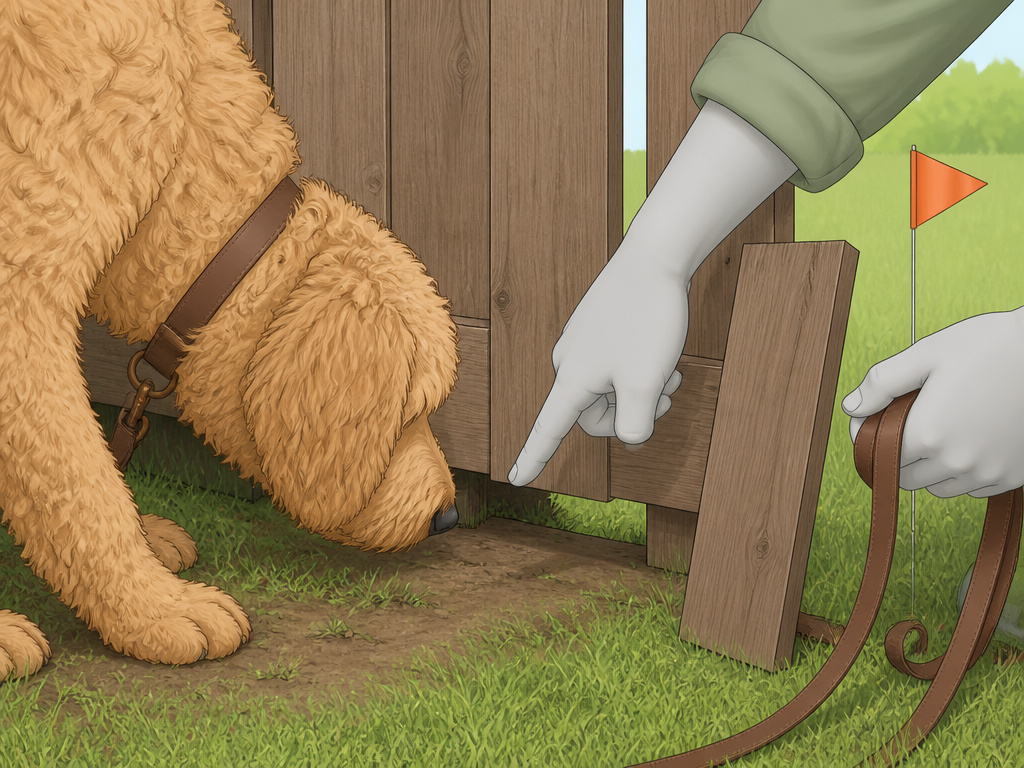
- Walk the fence line before you buy anything. Gaps under gates and loose pickets fail more often than height does, so fix those first.
- Decide what the fence is for. A physical fence contains a dog with prey drive. An electronic boundary trains a dog that already respects the line.
- Give the training weeks their due. Boundary work with flags and a leash is what makes either system hold. Skip it and you’ve bought hardware.
- Watch the dog at the fence line for a week. You’ll learn more about its real drive than any product page will tell you.
If you go electronic anyway, I’d still treat the collar as a training aid rather than a fence.
Feeding and Daily Care Without the Guesswork
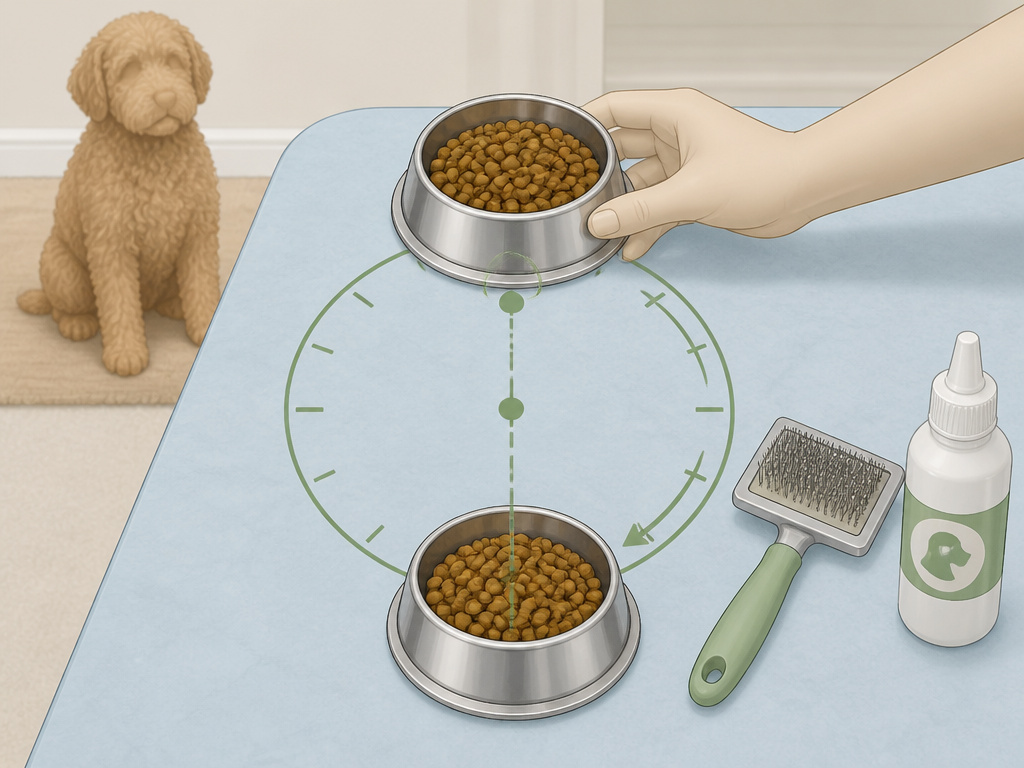
Two meals a day, twelve hours apart, is the baseline PetMD sets for an adult Labradoodle. Puppies under 6 months need to eat more often than that.
Whittenburg explains why the split matters. A dog fed once a day tends to fixate on the meal and can get anxious around it. Feeding every 12 hours suits metabolism and mental health better, and it may help guard against gastric dilatation-volvulus, because the dog eats a smaller amount and eats it more slowly.
The Daily Routine That Works
- Feed at 12-hour intervals. Same times daily, so the dog stops watching the clock.
- Check ears weekly and ask your vet which ear-cleaning product they recommend, which is PetMD’s advice rather than a brand pick.
- Brush before the bath, not after. Wet curl tightens, and a mat you didn’t find dry becomes a mat you can’t get out.
- Book the groomer on a schedule rather than when you first notice mats. By then the coat is already behind.
Food is the first lever most owners pull when the itching starts, and a shortlist of the best dog food for Labradoodles with allergies is a reasonable place to compare formulas. For a puppy or an adult with no skin trouble, a guide to the best dog food for doodles covers the everyday case.
Frequently Asked Questions
Do Labradoodles shed?
They shed very little compared with a Labrador, but the amount varies dog by dog. PetMD notes shedding depends on coat type and some Labradoodles shed more than others. The hair that doesn’t drop ends up in the coat instead, which is why brushing matters more than vacuuming.
Are Labradoodles good with kids?
Dogster rates them well for families with children, and PetMD describes them as friendly and loyal. The caveat is exercise. A doodle that hasn’t been walked is a doodle that chews, and that applies to the kids’ toys as much as the door frame.
How long do Labradoodles live?
Both PetMD and Dogster put the typical lifespan at 12 to 15 years. PetMD ties that range to regular vet care, a balanced diet, and daily exercise rather than to the cross itself.
Are Labradoodles good for first-time owners?
Dogster says yes, and PetMD calls them easy to train. The honest caveat is grooming. A first-time owner can absolutely handle the training. The coat is the part that catches people out.
What health problems do Labradoodles have?
PetMD lists progressive retinal atrophy, cataracts, and glaucoma as conditions to watch. A UK survey of 175 Labradoodles found multifocal retinal dysplasia in 4.6% and cataracts in 3.7%. Population-level data from 9,402 dogs found no overall health disadvantage versus the parent breeds.
Do Labradoodles need a lot of exercise?
Yes. Dogster is direct about it: without daily physical activity they get restless, bored, and destructive. That rules out apartments and small homes for most of this breed.
The Bottom Line
Here’s the trigger that should decide it for you. If you won’t book a groomer every few months and brush three times a week, don’t get a Labradoodle. The coat doesn’t care how much you love the dog.
This weekend, before you put a deposit down, do one thing: ask the breeder for the eye status of both parents. If the answer is vague, that’s your answer.
The rest of it is genuinely good. A Labradoodle is friendly, trainable, and lands close to its parent breeds on health in the largest dataset we have. Just go in knowing that the “hypoallergenic, low-maintenance” pitch is marketing, and the grooming is the real contract.
Start with your own yard and your own dog. Everything else follows from that.
