
What to Do If a Dog Breaks a Bone: Step-by-Step
This post contains affiliate links. As an Amazon Associate, we earn from qualifying purchases.
If a dog breaks a bone, muzzle him before you move him, keep him still, cover any wound with a clean cloth, and call your vet or an emergency clinic. PetMD advises not to straighten or splint the limb yourself, while ACVS notes bone fragments must be immobilized and lists splinting as a veterinary treatment option. Closed fractures are ideally treated within 2-4 days; open fractures need the wound and bone cleaned within 8 hours.
The 8-hour clock is what changes your morning. An open fracture means the bone has come through the skin, or something went through the skin and broke the bone, and that open doorway is why the American College of Veterinary Surgeons treats it as more urgent than a closed break. That one distinction decides the what to do if a dog breaks a bone answer: whether you drive to your regular vet or straight to an emergency hospital.
What follows is the order of operations: the first ten minutes, how to tell a break from a sprain, what to leave alone, and how the recovery actually runs week by week.
Key Takeaways
- Muzzle first, move second. A dog in fracture pain will bite the hand trying to help, even a dog that has never bitten anyone.
- Open fractures run on an 8-hour clock for the first wound and bone clean-out; closed fractures are ideally treated within 2-4 days.
- PetMD advises against splinting or straightening the limb yourself, while ACVS notes immobilization matters and lists splinting as a veterinary option. Keep the dog still and let the vet decide.
- Healing needs a minimum of 4 weeks in puppies and 8 weeks in adults before normal activity starts, and restrictions run 2-3 months.
- Confine to a carpeted room or a kennel, gate off the stairs, and use a short leash for bathroom breaks only.
What to Do If a Dog Breaks a Bone: The First Ten Minutes
The dog comes back from the back corner of the yard carrying a hind leg at an angle no leg should make, and every instinct tells you to scoop him up and drive. Slow down for sixty seconds. The order you do things in matters more than the speed.
Immobilization means the joints above and below the break are held so the fragments cannot shift. The American College of Veterinary Surgeons notes that a fracture held still hurts less, and that the sharp ends of broken bone damage muscle, nerve, and blood vessel tissue when they move. Bones with disrupted tissue heal slower.
That last line is the reason to be careful rather than fast. A leg that gets jostled on the way to the car is a leg that takes longer to heal afterward.
Before you start: A dog in fracture pain will bite, even a dog that has never bitten anyone, so muzzle him before you touch the leg. Don’t try to straighten the limb or push anything back under the skin. If the skin is broken, cover it with a clean cloth and leave it covered.
Here is the sequence, in order.
- Muzzle him first. The PDSA is blunt about this: a dog in that much pain may bite the person trying to help. A soft nylon muzzle goes on in seconds and comes off just as fast. Skip it and a bitten hand slows down the whole trip.
- Leave him where he is and keep him still. PetMD’s guidance is to keep the dog as still as possible. Every time the leg shifts, the sharp ends grind against muscle and nerve tissue, and ACVS notes that disrupted tissue heals slower than clean tissue.
- Cover any wound with a clean cloth or bandage. The PDSA warns that a wound near a break is an open door for serious infection. A clean tea towel from the hall closet does the job.
- If it’s bleeding, press. VCA’s wound guidance is dry gauze first with direct pressure, then a bandage layer or clean dry cloth on top. Those layers protect the wound during the drive.
- Call ahead. Ring the clinic before you load the dog. Tell them which leg, and whether the skin is broken. That one detail changes how they prepare for you.
- Move him on something flat. If there’s any chance of a spinal injury as well, the PDSA says carry the dog on a flat board and don’t let him walk.
How Do You Tell a Broken Bone From a Sprain?
Most breaks in dogs land in the hindlimb, according to PetMD, and a dog that won’t put weight on a back leg is showing you the classic picture. The trouble is that a bad sprain looks similar from three feet away.
The signs PetMD lists for a fracture are limping, an inability to bear weight, swelling, severe pain, and a limb sitting in an abnormal position. Dogs hide signs of pain better than most owners expect, so watch the leg rather than the face.
| What you see | What it can mean | What to do |
|---|---|---|
| Won’t bear weight on the leg | Fracture or severe sprain | Keep still, call the vet |
| Swelling over one spot on the bone | Fracture with tissue damage | Don’t press on it |
| Limb sitting at an odd angle | Displaced fracture | Don’t straighten it |
| Pale or white gums | Shock from blood loss or pain | Keep warm, go now |
| Blood at a break in the skin | Open fracture | Cover it, 8-hour clock |
A dog that’s limping but still eating and putting some weight down is a different picture from one that won’t stand at all. And a dog still lame a week or two later may have a torn ACL rather than an unhealed fracture, which is a whole different conversation.
Why X-Rays Decide It
PetMD is direct about this: X-rays are the best way to tell a bruise or a sprain from a break. You cannot palpate your way to an answer at home, and guessing wrong in either direction costs you time.
Shock is the thing that gets missed while everyone stares at the leg. The American Kennel Club puts normal dog temperature at 100.4 to 103.1 degrees Fahrenheit, and that number falls during shock. The AKC pet first aid ebook lists the three signs together: a rapid, weak pulse, pale or white gums, and a falling body temperature. If you see those, keep the dog warm with a blanket and get moving.
Closed vs Open: One Buys You Days, the Other Buys You Hours
The American College of Veterinary Surgeons draws one line through every fracture, and it’s the line between skin intact and skin broken. Everything about your timeline hangs off it.
The ACVS fractured limbs guide sets the windows plainly. Closed fractures are ideally treated within 2-4 days. Open fractures are best treated with an initial procedure to clean the wound and bone within 8 hours of the injury, though the final surgery can be delayed 24-48 hours after that.
| Fracture type | Treatment window | Why it matters |
|---|---|---|
| Closed fracture | Ideally within 2-4 days | Skin intact, infection risk lower |
| Open fracture, first clean-out | Within 8 hours of injury | Infection risk makes it more emergent |
| Open fracture, final repair | Can wait 24-48 hours | The initial clean is the urgent part |
| Joint or growth plate fracture | Varies, often surgical | Affects future joint function |
So a closed break is not a “wait until Monday” situation, but it also isn’t a lights-and-sirens situation. An open break is. The Merck Veterinary Manual notes that joint and growth plate fractures are common in young, growing dogs and cats, which matters because those injuries can affect how the limb develops.
Falls, car accidents, and rough play are the usual causes, per Merck. For the clinical side of open fracture care, there’s a peer-reviewed review on emergency management of open fractures if you want to read past the owner-level version.
What Not to Do While You Wait
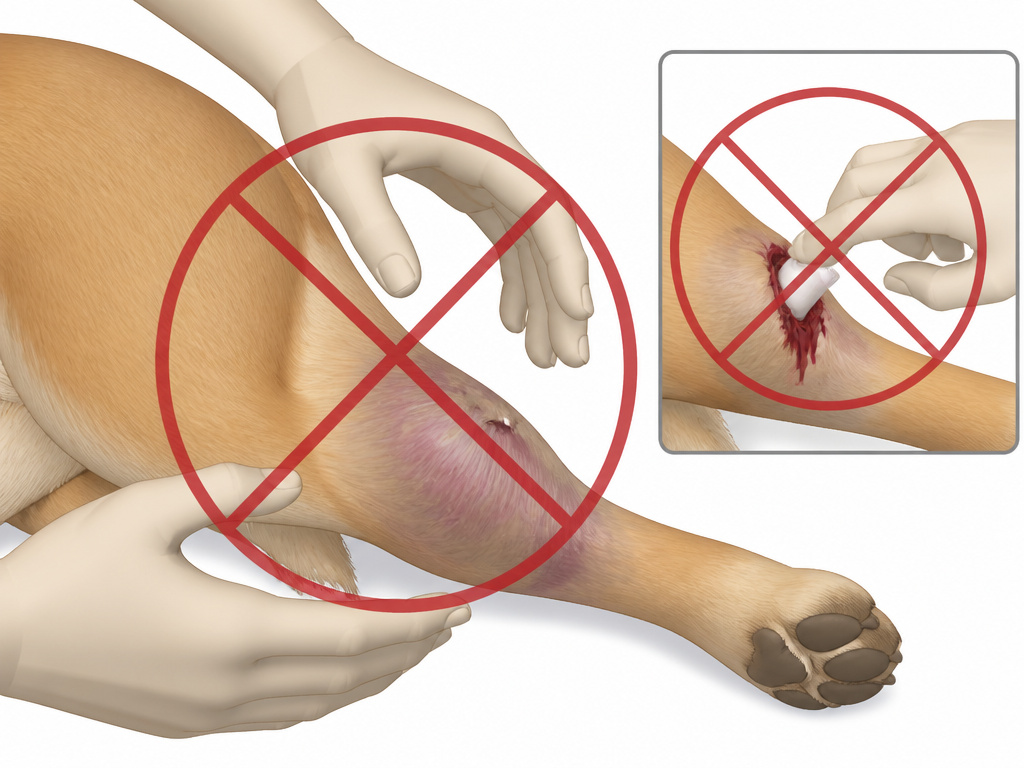
Don’t straighten the leg. PetMD advises against splinting it yourself, though ACVS notes immobilization matters and lists splinting as a veterinary option. Don’t push a bone end back under the skin. Three instructions, and owners break all three within the first five minutes.
Here’s what to leave alone, and what happens when you don’t.
- Don’t try to straighten the limb. PetMD says this outright, while ACVS stresses that bone fragments must be immobilized and lists splinting as a veterinary option. Pulling a displaced leg straight moves fragments through tissue that was still intact.
- Don’t splint it yourself. More on the reasoning in the next section, because the sources genuinely split on this one.
- Don’t push a protruding bone back in. That drags surface contamination down into the fracture and can damage the nerves and vessels running past it.
- Don’t wait to see if he walks it off. PDSA’s line is simple: call your vet for advice immediately if you suspect a broken bone.
- Don’t let him walk to the car. A dog that hops on three legs is loading the broken limb every time he lands.
I keep a muzzle and a slip lead hanging by my own back door, and I’ve never once regretted the five seconds it takes to grab them. What I have regretted is the assumption that my dog would never bite. He’s a soft one. He’s also never had a bone in three pieces.
If you need to stop bleeding from a wound on the way out, direct pressure with dry gauze beats everything else in your kitchen.
Where this goes sideways: Wrapping a leg tightly “to keep it stable” without training. A bandage that’s too tight cuts circulation below the wrap, and you won’t notice until the toes swell.
Vets Don’t All Agree on Splinting, and You Should Know Why

Two respected sources give opposite guidance on splinting, and both of them are right about their own part of the problem. This is one of the few places in fracture care where you’ll get a straight contradiction.
What the Surgeons Say
ACVS is clear that immobilization is a core principle: the bone fragments must be prevented from moving so the sharp ends don’t damage muscle, nerves, and blood vessels. Splinting is listed as a veterinary treatment option, and it’s feasible below the elbow and below the knee. Above those joints, at the upper arm and the thigh, splinting gets difficult because the shoulder and hip don’t hold a splint well.
What the Emergency Guidance Says
PetMD tells owners the opposite thing, and for good reason: keep the dog still and avoid trying to straighten or splint the limb yourself. That advice is aimed at your toolkit, not at the vet’s.
Read the two together and the line is obvious. Immobilization matters. Doing it badly with a rolled-up magazine and an ace bandage is worse than not doing it, because a loose splint slides and a tight one strangles the blood supply. For the clinical version of this argument, a traumatic orthopedic emergencies chapter covers how it’s handled in practice.
How Long Does a Broken Bone Take to Heal?
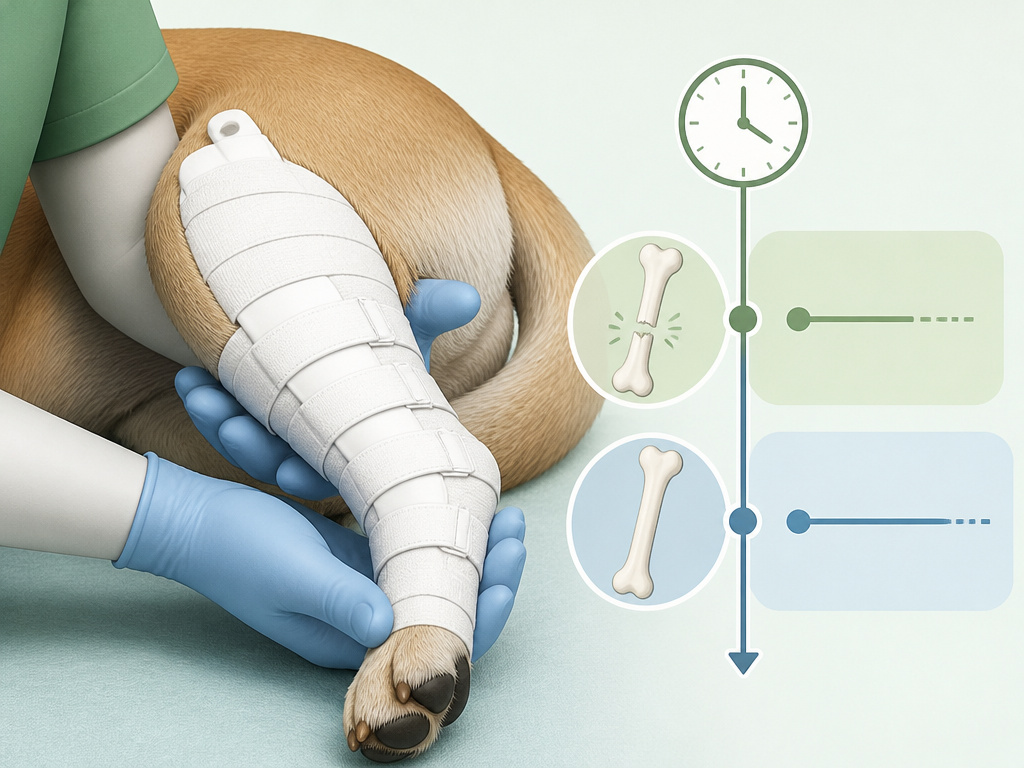
Healing time depends on the dog’s age and on how much soft tissue the injury wrecked. ACVS notes that young bones heal faster than old bones, and that a bone surrounded by damaged muscle and blood vessel tissue heals slower than one surrounded by healthy tissue.
Here’s where the two main sources part company, and it’s worth seeing both numbers.
- ACVS: a minimum of 4 weeks in young puppies and 8 weeks in adult or older animals before progressing to normal activity, with restrictions running a long 2-3 months.
- PetMD: 6-8 weeks for puppies and 3-4 months for adult pets.
Read them as two points on the same line rather than a flat contradiction. ACVS is describing the earliest point where the bone is healed enough to start increasing activity. PetMD is describing the full return to normal. The gap between those two moments is where most re-injuries happen.
ACVS is also honest about the stakes: catastrophe can happen if the fracture repair is stressed too soon. PetMD adds that while a dog’s bone can heal on its own, an unrepaired fracture can take years instead of months, and the bone can heal in the wrong position.
Pain control is a vet decision, and the dog pain medication your vet picks depends on the repair and the dog. Whether joint supplements change the long-term outcome is genuinely unsettled, so treat confident claims about them with suspicion.
When a repair needs hardware, the options run to plates, pins, and interlocking nails, and there’s a published interlocking nail dog fracture study if you want the technical end of it.
How Do You Keep a Dog Quiet for Two Months?

You don’t, not perfectly. You build a room that makes quiet the easiest option, and then you defend it for the full restriction period.
ACVS lays out the confinement rules without much room for interpretation. Confine the dog to one section of the house with carpeted floors, or to a kennel. Use baby gates to block slippery floors and stairs. No jumping on or off furniture, no playing, no running, no jumping. For dogs, a short leash for bathroom breaks. For cats, a large dog crate with food, water, a bed, and a litter pan.
Setting Up the Confinement Room
A baby gate across the hallway and a crate with the door bungeed open gives a dog a den he’ll actually use. Carpet matters more than people think, because a hardwood floor turns a three-legged dog into a sliding dog.
You’ll hear the recovery before you see it. Three toenail clicks and one soft drag on the hallway floor tells you exactly how much weight is going on that leg today.
- Carpet or a rubber-backed runner over any hard floor in the confined area.
- A gate at every stairwell, not just the one you use.
- A short leash by the door for bathroom trips, so nobody free-lances a lap of the yard.
- Something to chew that doesn’t require standing up.
Some owners ask about dog leg braces as a gentler alternative to a splint. That’s a conversation for your vet, not a decision to make from a product page.
Two months of boredom beats one more surgery. The dog will forgive you for the crate. He won’t forgive a repair that has to be redone.
I’ve never seen a credible published figure on how often a repair fails because the dog got loose, so I won’t invent one. Ask your own vet what they see.
The Emergency Plan You Should Build Before the Break Happens
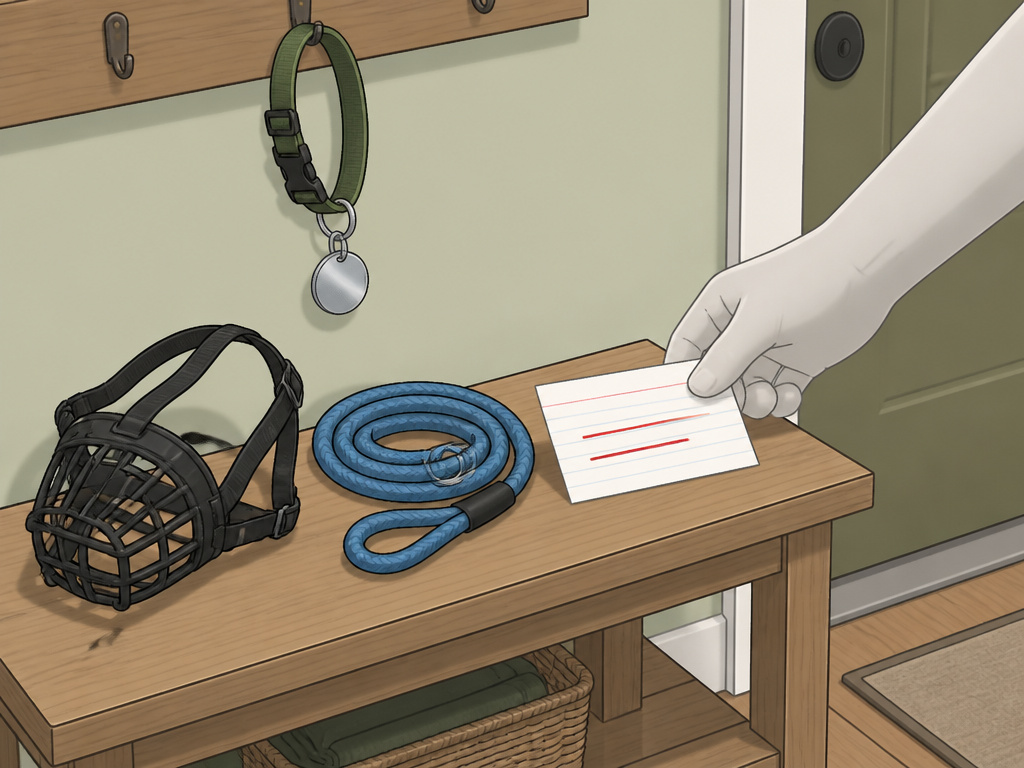
Three things live by my front door: a muzzle, a slip lead, and a card with the emergency clinic’s address on it. None of them cost much. All of them save minutes on the worst morning of your year.
Start with identification that works when you’re not there. A current tag on the collar is the fastest thing a stranger can read. A microchip is the backup, and it only works if the registration is current. Your microchip registry lets you log in and check the phone number and address on file. Do that check once a year. A chip registered to a disconnected number is a chip that does nothing.
Then think about the fence you’re relying on. If your dog got out through a dead battery or a broken wire, fix the fence before you trust it again, and walk the line yourself rather than assuming. A GPS collar is a useful second layer, and I’d still never treat it as the only one. Batteries die and coverage drops, and a tracker tells you where the dog went, not how to get him back.
Frequently Asked Questions
Should I give my dog painkillers before the vet sees him?
No. Pain control after a fracture is a prescription decision, and the right drug depends on the repair, the dog’s age, and what else is going on. Your vet needs a clear picture of the dog’s condition, and medication you give at home muddies it. Call ahead and ask what they want you to do.
Can a dog’s broken bone heal on its own?
It can, but PetMD is clear that this isn’t recommended. An unrepaired fracture can take years instead of a few months, and the bone can heal in the wrong position, which leads to chronic pain and a malformed limb. Prompt treatment is the shorter and kinder road.
Is a closed fracture still an emergency?
It’s less urgent than an open fracture, but it isn’t a wait-and-see situation. ACVS puts ideal treatment for closed fractures at 2-4 days, and the PDSA describes broken bones as extremely painful and requiring immediate veterinary attention. Call the same day and let your vet set the schedule.
What if the bone is sticking out through the skin?
Cover it with a clean cloth or bandage and leave it alone. Don’t push the bone back in, because that pulls contamination down into the fracture. Then call ahead and go, because an open fracture is on an 8-hour clock for the first clean-out.
How do I know if it’s broken or just bruised?
You don’t, and neither does anyone else without an X-ray. PetMD names X-rays as the best way to tell a bruise or sprain from a break. Swelling and a reluctance to bear weight can come from either one, which is exactly why the imaging matters.
The Bottom Line
Here’s the one thing to do this weekend, before any of it matters: pull up your dog’s microchip registration and confirm the phone number on file is one you still answer. That’s a ten-minute job that decides whether a stranger can get your dog back to you.
Then hang the muzzle and the slip lead by the door, in the same spot, and leave them there.
One honest limit on all of this. If your dog is a giant breed or a working dog with a high pain tolerance, the signs get quieter and the transport becomes a two-person job. Everything above still applies, but the margin for error shrinks. That’s the version of what to do if a dog breaks a bone I’d want a friend to hear before the driveway, not after.
