
What to Do After a Dog Car Accident: Step-by-Step
This post contains affiliate links. As an Amazon Associate, we earn from qualifying purchases.
After a dog car accident, get the dog out of moving traffic only if it’s safe to do so, cover open wounds with clean cloth, keep it warm and still, and call the nearest emergency vet on the way. Hold direct pressure for at least 3 minutes before you check a bleed, and never muzzle a dog that is struggling to breathe.
That last clause is where the published guidance splits three ways. The Red Cross says muzzle every dog. The AVMA says muzzle only if the dog threatens to bite. The PDSA says never muzzle a dog that’s fighting for breath or has face injuries.
What follows is the what to do after a dog car accident order I’d want a neighbor to work through: your own safety, the phone call, moving the dog, the muzzle decision, and the two things your hands can actually do at the roadside before a vet takes over.
Key Takeaways
- Call the clinic you’re driving to and have a passenger make the call so the team is ready when you arrive, though Texas A&M advises calling your local Animal Control Officer first.
- Hold direct pressure for at least 3 minutes before you lift the cloth to look. Peeking early restarts the bleed.
- Never muzzle a dog with laboured breathing or face injuries, no matter which organization told you to muzzle every dog.
- A dog that walks away can still be bleeding internally. Internal injuries and organ damage aren’t always obvious at first.
- Confirm your microchip registration this week. A chip returns a number, not a location, and a stale phone number is the same as no chip.
What to Do After a Dog Car Accident in the First 60 Seconds
Traffic is the second emergency in the what to do after a dog car accident sequence, and it’s the one that puts rescuers in hospital. VCA’s emergency guidance opens with the same instruction every time: stay calm and scan the scene for anything else that can hurt you or the dog. A live lane counts. So does a dog that’s about to bolt straight back into it.
Hill’s Pet, quoting ACS Distance Education, is blunt about the order. Move the dog out of the road only if you can do it without risking your own safety. Otherwise, wait for help. That’s harder advice to follow than it reads, especially when the dog on the asphalt is yours.
Before you start: A dog in shock can bite even its owner, so keep your face back and your fingers out of its mouth. The roadside is where a rescue turns into a second casualty, so put your hazard lights on and get someone else to wave traffic down before you kneel in the road. If you’re alone on a fast road, call for help from behind the barrier instead of stepping into the lane.
An injured dog is assessed in a fixed order: airway, bleeding, then movement. Scene safety comes before all three. A dog in shock can bite without warning, even the person holding the leash, so restraint protects the handler as much as the animal.
Ask someone else to help you lift, whatever the dog’s size. The AVMA lists that as a safety step rather than a courtesy, because a struggling dog is harder to carry than a still one and a dropped dog is a second injury on top of the first.
Who to Call First? The Sources Genuinely Disagree
Call the clinic you are actually driving to, and have a passenger dial it, though Texas A&M advises calling your local Animal Control Officer first.
Texas A&M’s veterinary teaching hospital takes the outlier position. Its guidance says to call your local Animal Control Officer on duty immediately if you see an animal hit by a car, and it cites the bite risk to good samaritans as the reason. Their small animal ER sees at least three to five animals hit by a car each week on average, per Texas A&M canine collision guidance, and most of those victims are medium to large dogs that were loose or had escaped a backyard.
Every other body in the set routes you to a vet instead. The AVMA says to transport the injured pet to the closest veterinary hospital immediately and to call ahead so the team can be ready. VCA says to contact your veterinary hospital, describe the situation, and get first aid advice. The PDSA says any pet involved in a road traffic accident should be checked by a vet straight away. The NSW Roads and Maritime Services guidance quoted by Hill’s Pet says to contact the owner, Police or the RSPCA, and that a driver must remain at the scene.
Put a passenger on the phone and keep both hands on the wheel. A clinic that knows a hit-by-car is on the way can have fluids and a gurney waiting. A clinic that finds out when you walk through the door starts cold.
The practical resolution is simple. Most sources route you to a vet, though Texas A&M says to call Animal Control first, so make the call that gets help moving and drive. If you’re the driver who hit someone’s dog rather than the owner, stay put and report it, because leaving the scene is a separate problem from the injury.
Moving an Injured Dog Without Making It Worse
Do not push an injured dog through the door of a carrier. VCA is specific about this, and it’s the detail most people get wrong in a hurry: take the top off the carrier or box and lower the dog in from above.
For a small dog, a carrier or a strong cardboard box works. For a larger dog, VCA recommends a makeshift stretcher from rigid material, such as a sturdy, appropriately sized piece of wood. The AVMA is looser about the material and allows a board, a sled, a blanket, or something similar. The PDSA doesn’t address immobilisation at all and only advises keeping the pet warm.
That gap matters if you’re deciding under pressure. If you suspect a broken bone or a spinal injury, VCA’s instruction is to lay the dog on a board and immobilise it with straps, cords, or duct tape over a blanket, never with tape on skin, paying particular attention to the head and neck. If you have no board and no help, a blanket held stiff by two people is a technique rather than a device, and it beats dragging.
A blanket is a stretcher if two people hold it taut. One person at the shoulders, one at the hips, and the dog stays level. That’s the whole trick.
Wrap the dog snugly in a blanket to limit movement during transport, and be careful doing it if bones or the spine might be involved. Once the dog is in the car, the AVMA’s rule is to keep it confined in a small area with enough air, which usually means a carrier or a box rather than a loose dog on the back seat.
Where this goes sideways: Lifting a dog under the chest with both arms. If the spine is damaged, that scoop is the moment a treatable injury becomes paralysis, and the PDSA lists spinal damage as a common outcome of road traffic accidents. Support the whole body on something flat instead.
The Muzzle Question: Three Credible Answers, One Dangerous Default
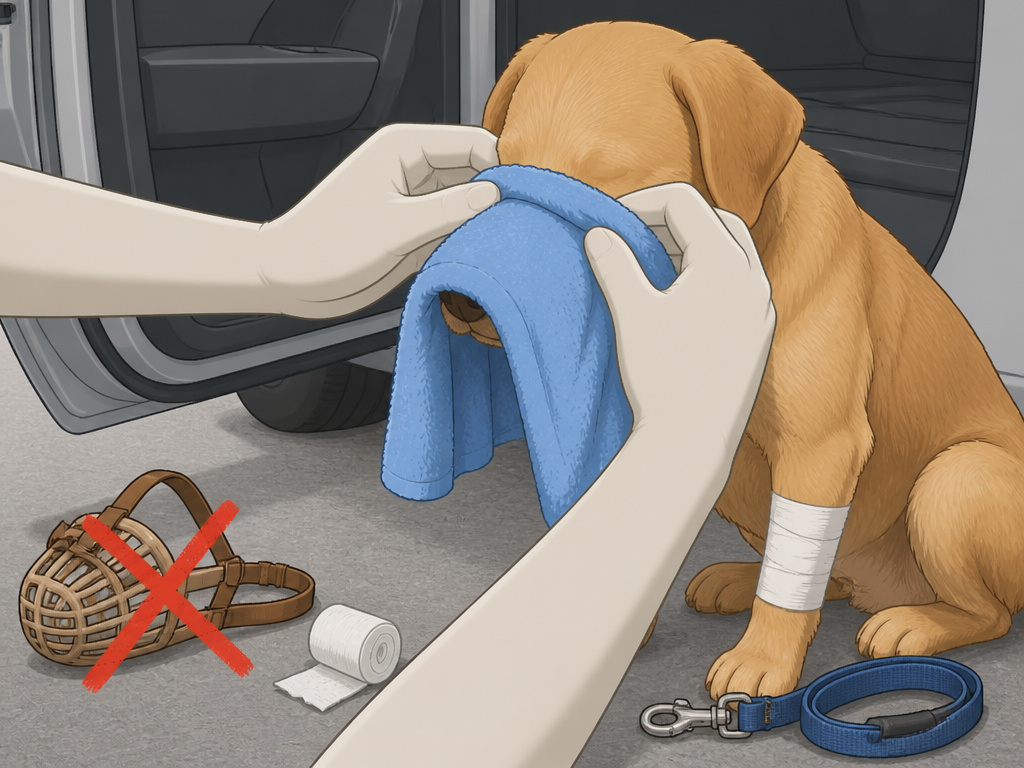
Three credible organizations publish three different muzzle rules, and the strictest one is the one that can kill a dog. The Red Cross position is to always put a muzzle on the dog. The AVMA says apply a muzzle only if the pet threatens to bite, and adds a hard exception for vomiting. The PDSA says use a muzzle or a towel if necessary, but never on a pet struggling to breathe or one with face injuries.
| Source | Muzzle rule | Where it fails |
|---|---|---|
| Red Cross | Always muzzle | Face injuries and laboured breathing |
| AVMA | Only if the dog threatens to bite | A shocked dog bites without warning |
| PDSA | Never with breathing trouble or face injury | A calm dog that is biting |
| Hill’s Pet | Only if the dog is not vomiting | A vomiting dog still bites |
| Liikenneturva | Tie the mouth or muzzle | A tight tie compromises breathing |
The mechanism behind the PDSA exception is worth understanding. A dog with a smashed jaw or a chest injury has one working airway, and it’s the mouth and nose. Closing the mouth removes the only route left, and a dog that can’t breathe panics harder than a dog that’s simply in pain.
There’s a middle path that satisfies most of the disagreement. Use a towel or a roll of gauze over the muzzle rather than a fitted muzzle, which is what Hill’s Pet suggests, and only if the dog is breathing quietly and isn’t vomiting, though Liikenneturva advises tying the mouth or muzzling a shocked dog and the AVMA says muzzle only if the pet threatens to bite. A towel draped over the head, which is Texas A&M’s recommendation, protects you without closing anything.
Whatever you use, the AVMA’s handling rules apply throughout. Don’t hug an injured pet. Keep your face away from its mouth. And put a muzzle, a spare leash, and a gauze roll in the dog first aid kit you keep in the car, because the moment you need them is the moment you won’t be shopping for them.
Bleeding, Breathing and Broken Bones: What You Can Actually Fix at the Roadside
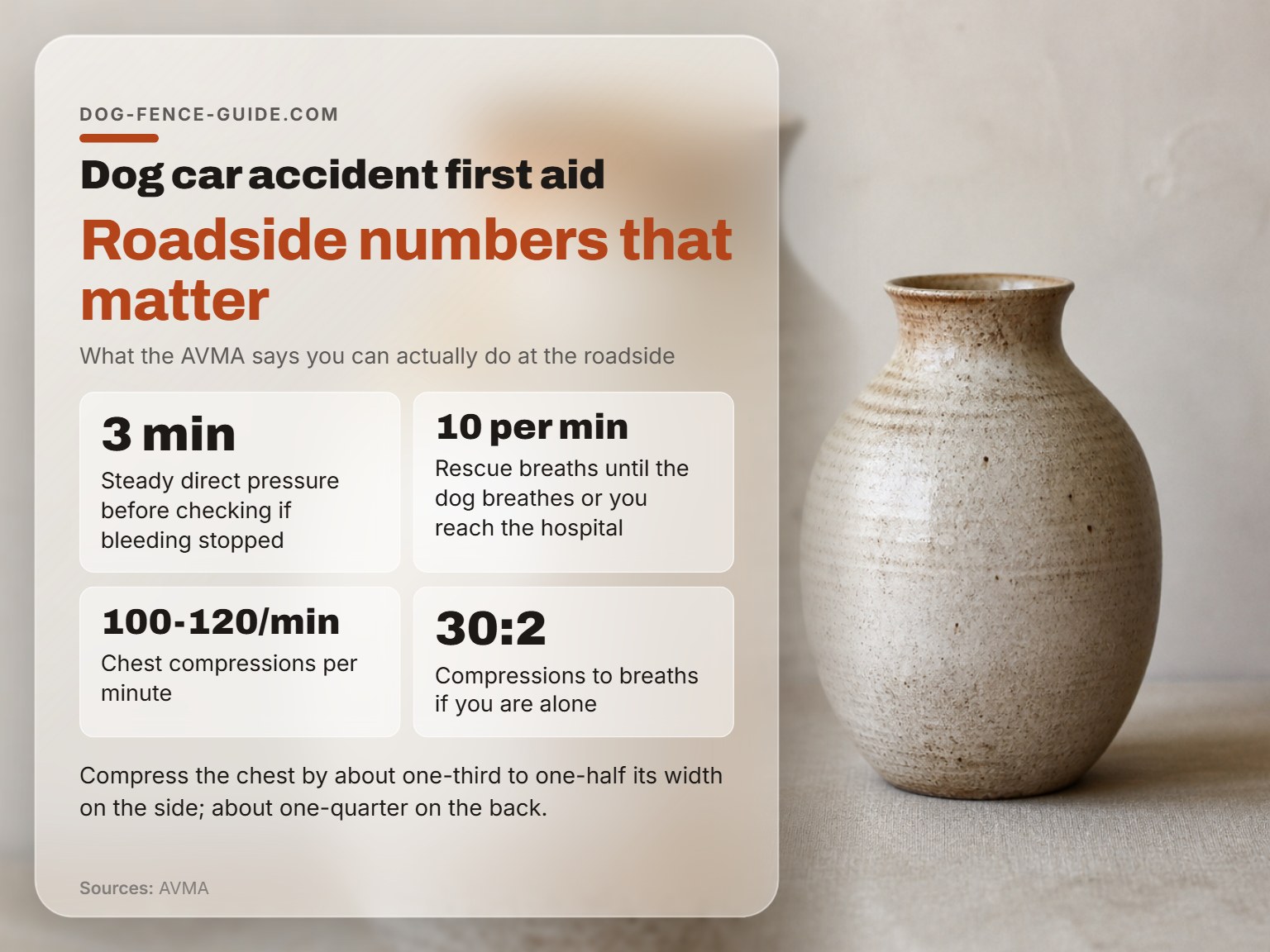
Three minutes of direct pressure feels considerably longer than three minutes. Count it out loud if you have to, because the AVMA’s threshold is at least 3 minutes of steady pressure before you check whether the bleeding has stopped.
If the Dog Is Bleeding
Press on the wound with a clean cloth, a nonstick bandage, or whatever clean material VCA’s guidance describes as available. Blood soaks a gauze pad fast, and the pad goes from white to dark quickly. Add another layer on top. Lifting the first one off takes the forming clot with it, which is exactly what the AVMA warns against.
If there’s a foreign object in the wound, leave it alone. The AVMA says not to remove it, and if you must trim it to move the dog, leave 3 to 6 inches sticking out so the object keeps plugging the hole it made.
Skip the hydrogen peroxide. The AVMA states plainly that it should not be used on wounds.
If the Dog Is Not Breathing
This is the part where the numbers matter and the order matters more. Tilt the head so the neck lines up with the spine, hold the mouth closed, and breathe into the nose until the chest rises. The AVMA’s rate is 10 rescue breaths per minute until the dog breathes on its own or you reach the hospital.
If there’s no heartbeat, add compressions at 100 to 120 per minute. Alone, that’s 30 compressions then 2 breaths. With help, one person compresses while the other gives rescue breaths. If your dog collapses and stops breathing on the way to the car, start there and keep going, because the same rule applies whether the cause was a bumper or something else.
Depth is where people underdo it. On the dog’s side, compress the chest by about one-third to one-half of its width. On its back, compress by about one-quarter. Cats and most dogs go on one side, and barrel-chested dogs like English Bulldogs go on their back.
What Not to Do at the Roadside
- No fingers in the mouth of a conscious dog. VCA is explicit about this, and a dog with a clear airway doesn’t need your hand in there.
- No hydrogen peroxide on wounds, per the AVMA checklist.
- No removing an object that’s plugging a wound, and no trimming it flush either.
- No painkillers from the human medicine cabinet. Nothing in the source material supports giving them.
| What you see | What it can point to | How fast to move |
|---|---|---|
| Bleeding that stops, then restarts | Disturbed clot or deeper injury | Immediate vet |
| A dog that seems fine but won’t settle | Internal bleeding or organ damage | Same day, not next morning |
| A cat hit by a car that can’t pass urine | Burst bladder, common in cats | Immediate vet |
| Back legs not working | Spinal injury | Immobilise, then move |
| Laboured or noisy breathing | Chest injury or diaphragm damage | Immediate vet, no muzzle |
What the Injuries Look Like Two Days Later
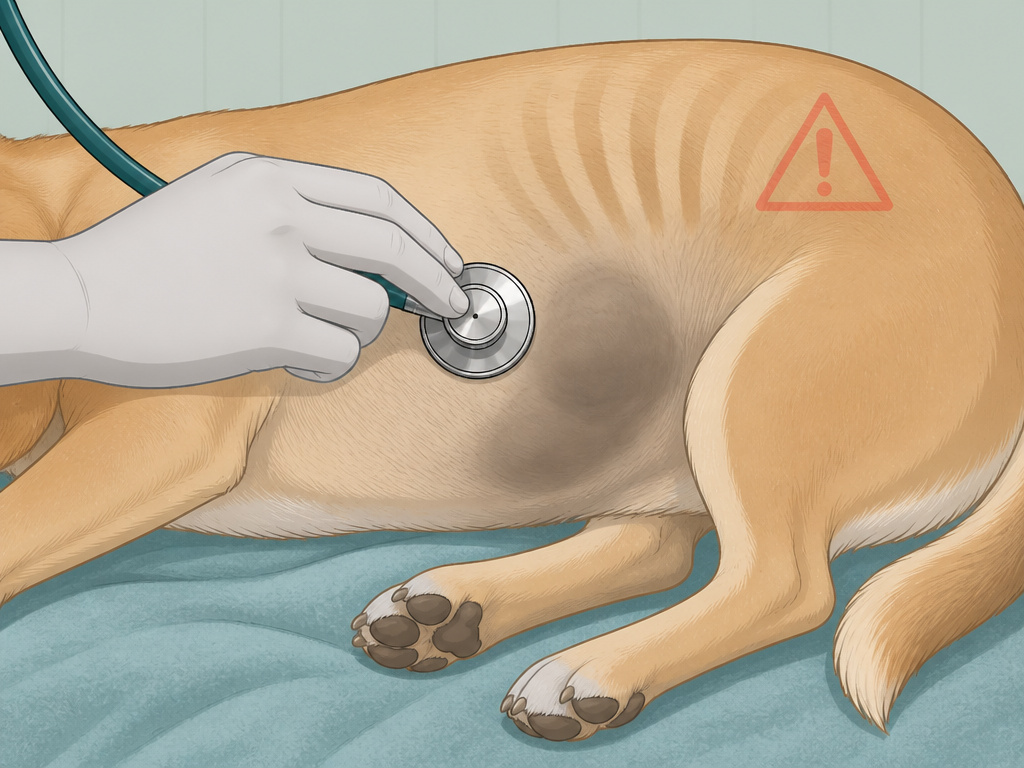
VCA’s advice is to have the dog examined as soon as possible even if it appears to have fully recovered, and that sentence is the most important one on this page. The dog that trots to the car is the dog whose owner skips the vet.
Internal bleeding and organ damage aren’t always obvious to begin with, which is the PDSA’s phrasing and a polite way of saying the dog can look normal while something is leaking. The PDSA also flags two injury patterns that owners don’t expect. A burst bladder is common in cats hit by a car, and damage to the neck and back is common in both species, with paralysis as a possible result. Head, spine and chest injuries often cause fatal damage that can’t be treated at all.
Recovery timelines vary with severity. Minor wounds are likely to heal within a week, more serious wounds take weeks or longer, and broken bones often take a few weeks with strict rest or physiotherapy. The overall range runs from a few days to many weeks. Texas A&M’s team lists the most common injuries from vehicle accidents as bone fractures, skin lacerations and abrasions, and life-threatening internal bleeding.
Easy to miss: A dog that’s eating and wagging on day two. Internal injuries don’t follow a schedule you can see from the outside, so the exam happens today even when the dog is acting like nothing happened.
For a longer read on the same material, the UC Davis pet first aid guide covers the fundamentals at more length.
Keeping the Dog Out of Traffic in the First Place
I once ran a boundary wire past a downspout without thinking about where the water went. After the first heavy rain the connection failed, and it took me an afternoon of walking the line to find the break. A containment system that fails quietly is how a dog ends up loose near a road, and loose dogs are the population Texas A&M’s ER sees most.
The AVMA’s AVMA pet first aid brochure is the document I’d print and keep in the glovebox, because it covers the roadside decisions. Prevention is the cheaper half of the same conversation.
Restraint in the Car Is Not Optional
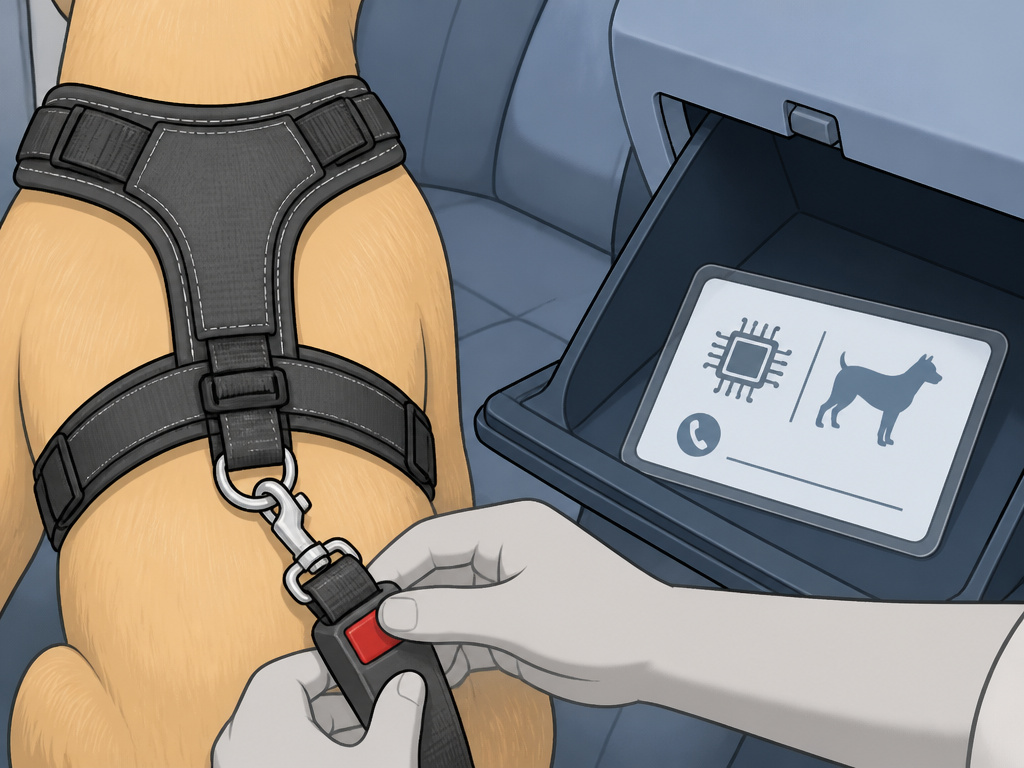
Liikenneturva, Finland’s road safety council, treats this as crash protection rather than comfort. A pet seat belt or a safety harness attached to the car’s seat belt is one approved option, and a robust kennel or travel crate is the other. The crate has to be attached to the car, and it needs to be roomy enough for the dog to stand up, turn around, and lie down.
The harness details matter more than the marketing. Look for wide, durable straps made from seat-belt-like material and metal buckles, because the wide strap spreads the impact over a larger area. Liikenneturva also notes that the law doesn’t require testing for pet car products, so a crash-tested harness claim is only worth what the manufacturer can show you.
Two rules are absolute in their guidance. Never transport a pet in the closed luggage compartment of a passenger car, and the driver can’t have the pet on their lap. An unrestrained pet can be ejected through the windshield or catapulted over the seat in a sudden stop.
The PDSA takes a different view and says dogs travelling in a car should be securely held by a passenger, while Liikenneturva advises a seat-belt harness or robust crate attached to the car, which is why the dog car restraints question has more than one answer.
What to Put in the Car Before You Need It
Liikenneturva suggests a laminated, double-sided note kept somewhere accessible, with the contact side facing down. Here’s what goes on it:
- The dog’s official name and microchip identifier.
- Date of birth, breed, and any identifying marks.
- Illnesses and medication.
- Temperament, including whether the dog is aggressive to strangers.
- In-case-of-emergency contacts for you and a backup.
That card does the job a collar tag can’t, because a panicked dog loses collars. Pair it with a crash-tested crate or a harness for the journey itself, and you’ve covered the two failure points that show up most.
The Microchip Check Nobody Does
Texas A&M’s team is direct about a misconception that costs dogs their lives. A microchip can’t be tracked. Scanning it returns a chip number, the hospital calls the registry, and the registry calls whatever phone number you gave them years ago.
If that number is dead, the chip is a piece of glass in the dog’s back. Call the registry, confirm the details, and do it before you need it. A collar with a current phone number written on it is the low-tech backup, and Texas A&M notes that a rabies tag is not always useful after hours.
For the everyday version of this, keep the dog on a leash in public and fix the gap in the barrier rather than adding height to the fence. On roads outside town, Liikenneturva’s rule is to walk on the left, on the shoulder, with the dog on the shoulder side. If you’re planning a longer trip, the same preparation applies to travel with a dog at any distance.
Frequently Asked Questions
Should I move a dog that’s been hit by a car?
Only if you can do it without stepping into danger yourself. Hill’s Pet, quoting ACS Distance Education, says to move the dog out of the road only if it can be done without risking your own safety, and otherwise to wait for help. Once you do move it, support the whole body on something flat rather than lifting under the chest.
Can a dog be fine after being hit by a car without seeing a vet?
No. VCA’s guidance is to take the dog for a veterinary examination as soon as possible even if it appears to have fully recovered. Internal bleeding and organ damage aren’t always obvious at first, and the PDSA notes that head, spine and chest injuries often cause damage that can’t be treated once it’s advanced.
How long does recovery take after a dog is hit by a car?
The PDSA puts the range at a few days to many weeks, depending on severity. Minor wounds are likely to heal within a week, more serious wounds take weeks or longer, and broken bones often take a few weeks with strict rest or physiotherapy.
Should I muzzle my dog after a car accident?
Only if the dog is breathing normally, isn’t vomiting, and has no face injuries, though Liikenneturva advises tying the mouth or muzzling a shocked dog. The AVMA says muzzle only if the pet threatens to bite, and the PDSA says never muzzle a pet struggling to breathe or one with face injuries. A towel over the head, which is Texas A&M’s suggestion, protects you without closing the airway.
What if I hit a dog with my car and can’t find the owner?
Stay at the scene and report it. The NSW Roads and Maritime Services guidance quoted by Hill’s Pet says to contact the owner, Police or the RSPCA, and that the driver must remain at the scene. Liikenneturva adds that an injured dog must be treated by a vet as soon as possible even if the owner can’t be reached.
What should be in a dog first aid kit for the car?
The AVMA’s checklist covers a muzzle, a digital thermometer, a gauze roll, nonstick bandages, blunt-ended scissors, disposable gloves, and saline solution. Keep the peroxide for veterinary-directed use only, and never on a wound.
The Bottom Line
After a dog car accident, the threshold that decides everything is breathing. If the dog is breathing normally, has no visible wound, and is walking, you still go to the vet today, because internal injuries don’t announce themselves at the roadside. If the dog is struggling for breath, bleeding heavily, or can’t move its back legs, skip the assessment and drive.
The muzzle decision is the one place where following the loudest advice can hurt the dog in front of you. Breathing trouble and face injuries rule a muzzle out, though Liikenneturva advises tying the mouth or muzzling a shocked dog.
The one thing I’d do this weekend: dig out the microchip paperwork, call the registry, and confirm the phone number on file is the one in your pocket right now.
