
Havanese Pros and Cons: What the Standards Actually Say
This post contains affiliate links. As an Amazon Associate, we earn from qualifying purchases.
Havanese pros and cons start with a sturdy little body, 23-27 cm at the withers under FCI rules, wrapped in 12-18 cm of soft coat. The pros: compact size, a lively gait, and a distinctive long coat. The cons: strict grooming rules, a fence-gap problem, and two registries that disagree on weight, height tolerance, and trimming.
Those two registries are the FCI (Federation Cynologique Internationale, the international breed registry) and the UKC (United Kennel Club, a US registry). They don’t just word things differently. On height tolerance, weight limits, undercoat, and trimming, they take positions that can’t both be true for the same dog. That matters whether you’re buying a puppy, entering a show, or trying to understand what “breed standard” means for a pet.
What follows walks through the real pros and cons of Havanese ownership, grounded in what those two standards actually say: size, coat, grooming rules, containment, and the registry paperwork that catches new owners off guard.
Key Takeaways
- Height runs 23-27 cm under FCI (8.5-10.5 in under UKC), and the two bodies disagree on how much leeway to allow.
- The coat is 12-18 cm long and FCI forbids trimming it for show except minor tidy-ups on feet, forehead, and muzzle.
- UKC disqualifies dogs under 7 lb or over 14 lb; FCI sets no weight at all, so a dog can pass one registry and fail the other.
- Undercoat is where the standards openly contradict: FCI calls a sparse or absent undercoat normal, UKC disqualifies complete absence in adults.
- Small size means fence gaps matter more than fence height; a gap under a gate is a Havanese-sized hole.
What Size Is a Havanese, Really?
The FCI standard sets the Havanese ideal height at 23-27 cm at the withers, with a tolerance band of 21-29 cm. The UKC standard sets height at 8.5-10.5 in, roughly 21.6-26.7 cm. The ranges overlap but the tolerance rules do not: FCI allows a dog outside the ideal, UKC does not.
That tolerance gap is the first thing to understand about Havanese pros and cons. A dog that measures 21 cm is within FCI tolerance and outside UKC’s range entirely. Same dog, two different answers.
| Spec | FCI (2016) | UKC (2014) |
|---|---|---|
| Height at withers | 23-27 cm ideal; 21-29 cm tolerance | 8.5-10.5 in (~21.6-26.7 cm) |
| Weight | Not specified | 7-14 lb; outside = disqualification |
| Body ratio | 4/3 length to height | Much longer than tall; square = serious fault |
| Coat length | 12-18 cm topcoat | Not specified |
The weight column is where the practical difference hits. UKC sets a hard 7-14 lb band and disqualifies anything outside it. FCI sets no weight at all. An owner following FCI rules could field a dog UKC would pull from the ring.
Why the 4/3 Body Ratio Matters
FCI describes the Havanese body as 4/3, measured from point of shoulder to point of buttock against height at the withers. That ratio is why the breed looks longer than it is tall. UKC says the same thing in different words: the dog should be much longer front to rear than tall, and a square appearance is a serious fault.
That proportion affects how the dog moves. FCI describes a light-footed, elastic gait with forelegs free-striding and pointing straight forward. A square dog doesn’t move that way. The body ratio and the gait description are two halves of the same standard.
The 12-18 cm Coat and the Rules That Come With It
FCI sets adult topcoat length at 12-18 cm. That’s a long topcoat on a dog that stands 23-27 cm tall. The coat is soft, preferably wavy, and the breed standard calls it long and abundant.
Here’s where the coat stops being a cosmetic detail and starts driving ownership decisions:
- Regular brushing is not optional at that length. A soft, wavy coat needs attention where it rubs.
- The undercoat is sparse by design, per FCI. That’s why the coat hangs rather than fluffs.
- Bathing frequency matters more than shampoo choice when the coat is this long.
- A wet Havanese needs combing, not just toweling.
If you want the specific tools that work on this coat type, the best brushes for Havanese guide covers tools that handle a 12-18 cm topcoat.
What the Standards Say About Undercoat
This is the cleanest contradiction in the two standards, and it matters for anyone buying a puppy.
FCI describes the Havanese undercoat as woolly, not very developed, and often totally absent. In FCI terms, a dog with almost no undercoat is normal.
UKC disqualifies complete absence of guard hairs (the longer, stiffer outer coat) or undercoat in adults. In UKC terms, that same dog is faulty.
Same breed. Opposite answers. If you’re buying a puppy and the breeder tells you the undercoat is sparse, ask which registry the dog is being shown under before you decide whether that’s a problem.
FCI vs UKC: Where the Two Standards Split
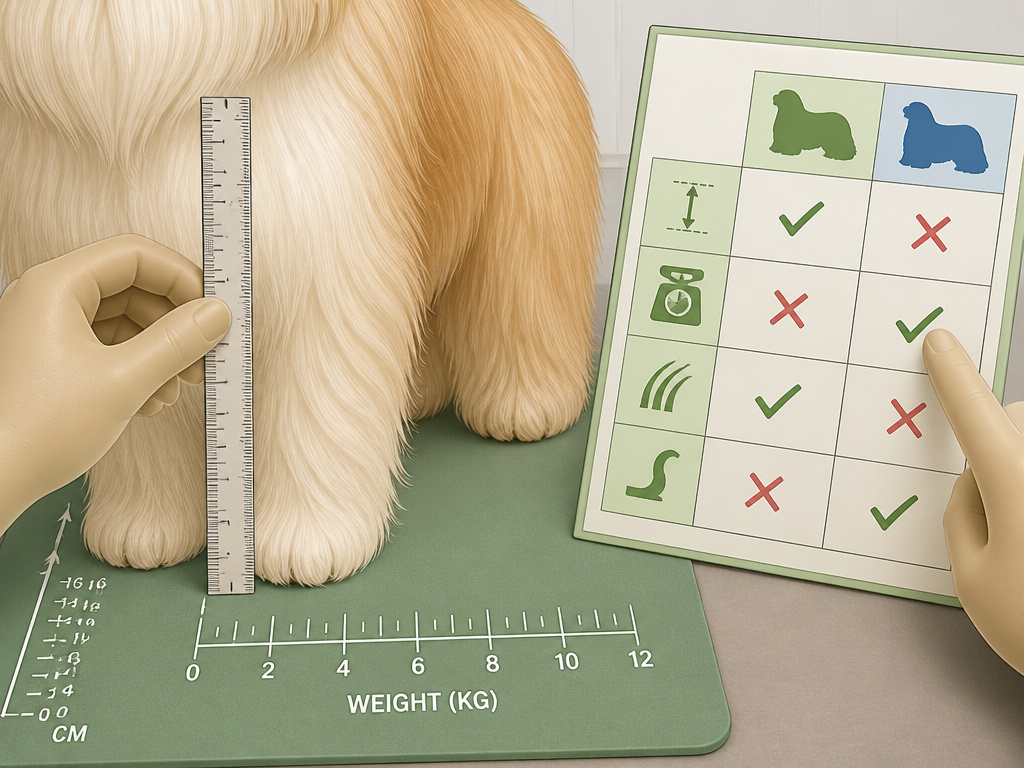
The two standards agree on the broad shape of the breed and disagree on the details that affect real ownership. Here’s the full list of splits that matter:
| Trait | FCI position | UKC position |
|---|---|---|
| Height tolerance | 21-29 cm allowed | Outside 8.5-10.5 in = eliminating fault |
| Weight | Not specified | 7-14 lb; outside = disqualification |
| Undercoat absent in adult | Normal, often total | Disqualification |
| Coat trimming | Forbidden except minor tidy-ups | Silent on trimming |
| Cryptorchid | Only via “two testicles descended” note | Disqualification |
| Pigment fault age | No age carve-out | Puppies under 12 weeks exempt |
The height and weight rows are the ones that catch importers when you compare a havanese pros and cons. A dog that is FCI-conformant at 21 cm with no weight limit can still be UKC-disqualified for being under 8.5 in or under 7 lb. If you’re buying across registries, check both standards against the dog’s actual measurements.
The trimming row is the one that catches pet owners who later decide to show. FCI forbids all grooming, scissoring to even coat length, and all trimming. UKC doesn’t say that.
The Grooming Rule That Trips Up New Owners
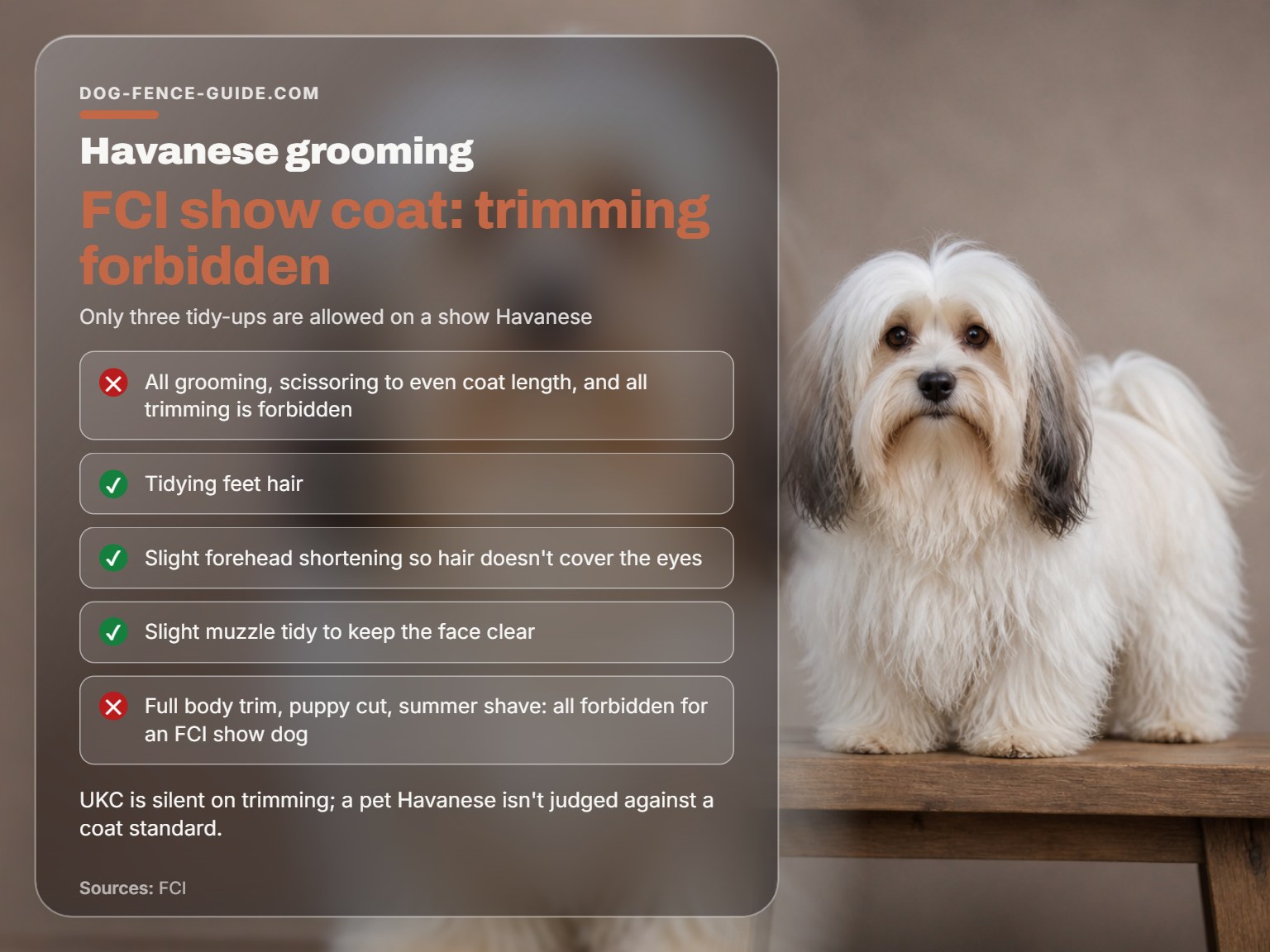
FCI is explicit: “All grooming, the usage of scissors to even out the length of the coat and all trimming is forbidden.” That’s a hard rule in the standard, and it applies to show dogs.
The permitted exceptions are narrow:
- Tidying feet hair so the paw stays clean and the dog doesn’t slip.
- Slight forehead shortening so hair doesn’t cover the eyes.
- Slight muzzle tidy to keep the face clear.
That’s the whole list. A full body trim, a puppy cut, a summer shave: all forbidden under FCI for a show dog.
For a pet, the calculus is different. UKC is silent on trimming, and a pet Havanese isn’t being judged against a coat standard. But if you bought the dog with any intention of showing under FCI, the trimming rule changes your entire grooming routine.
Common mistake: Trimming a Havanese coat for summer heat and then entering an FCI show. The dog is disqualified on coat, and the coat doesn’t grow back to 12-18 cm in time for the next show season.
Matting: The Real Grooming Cost
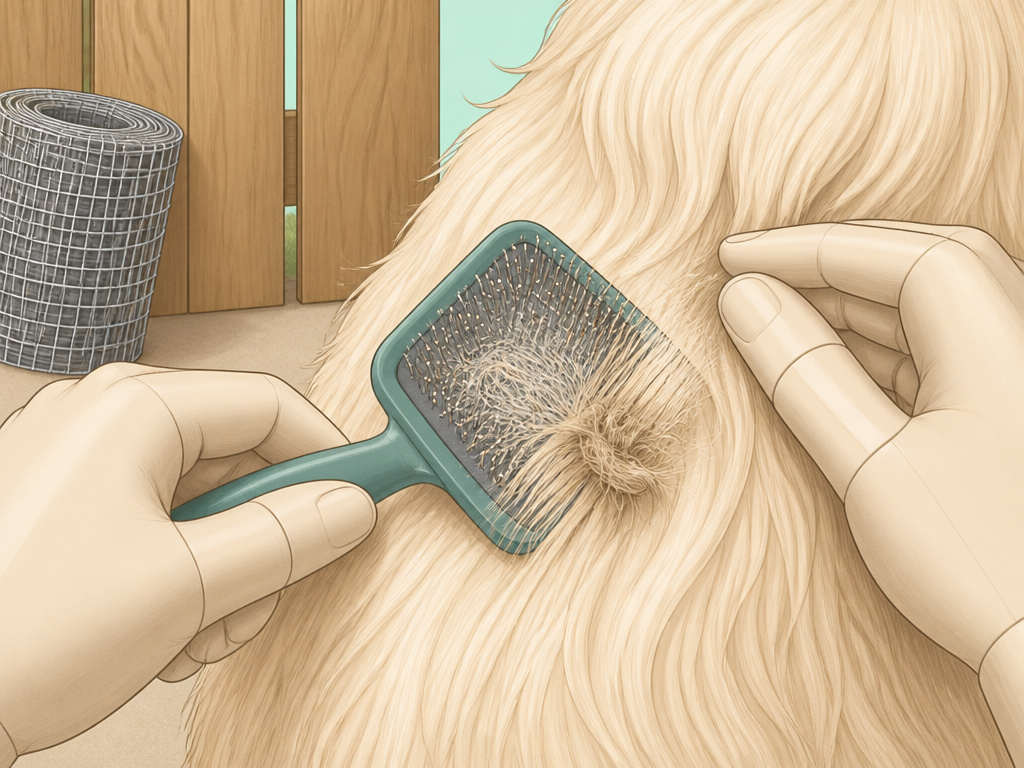
A 12-18 cm soft coat needs regular attention.
Brush the friction points, comb after every bath, and keep the coat dry between outings. A coat that dries without combing is a route to a mat that has to be cut out.
Why a Standard Fence Is a Sieve for a Havanese
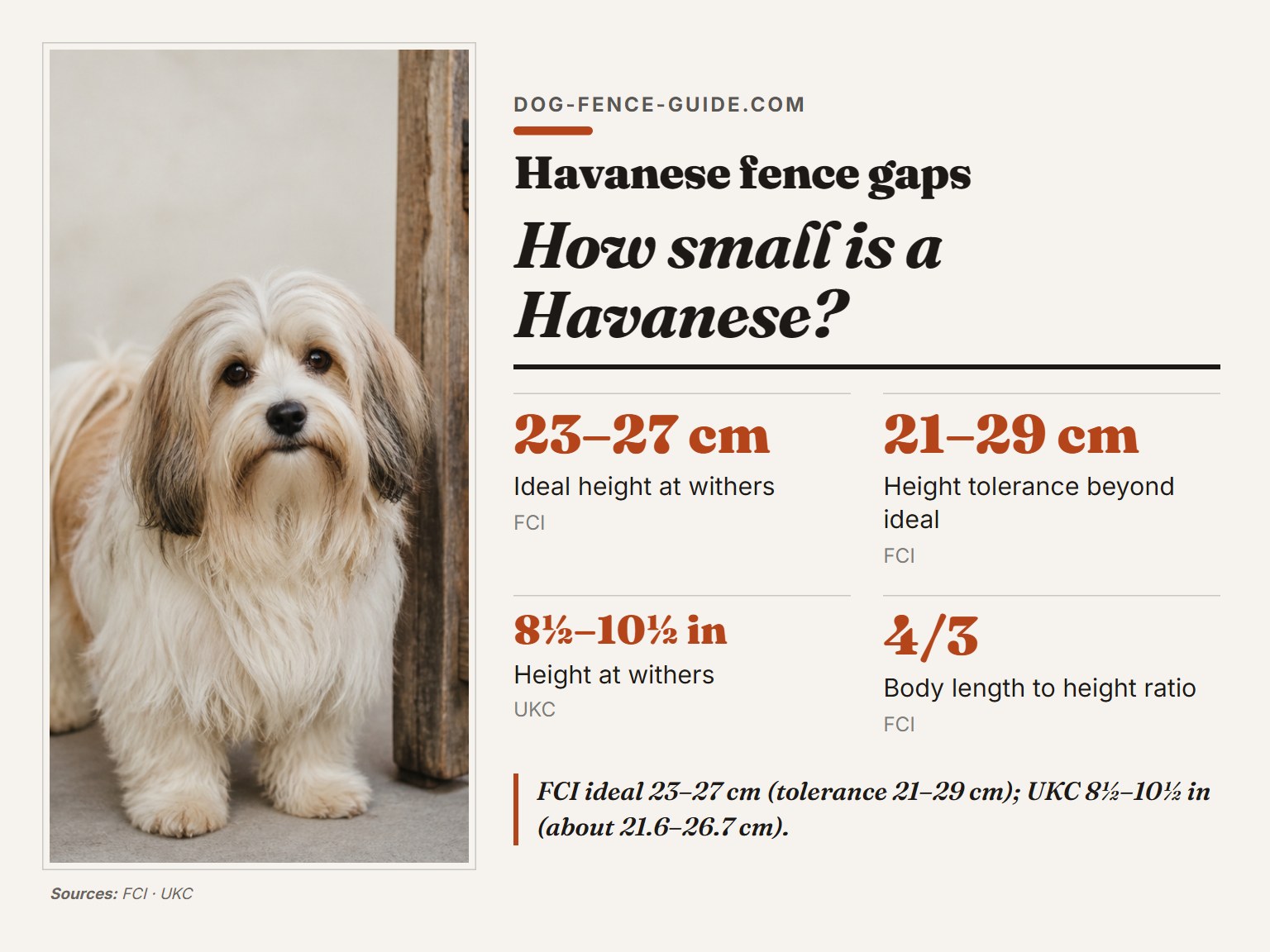
A Havanese stands 23-27 cm tall and is built low to the ground. That body shape finds every gap a larger dog walks past. The gap under a standard gate, the space between wide pickets, the loose corner where the fence meets the house: all of them are Havanese-sized holes.
The number to remember is the gap under every gate. Any gap wider than that is wide enough for a small dog to squeeze through. Measure the bottom of every gate, the space between pickets, and the gap where the fence meets a wall or post.
Here’s the fence check I’d run before bringing a Havanese home:
- Slide a ruler under every gate. If the gap is wide enough for a small dog to squeeze through, add a bottom rail or a strip of hardware cloth.
- Walk the picket line with the ruler. Wide-picket fences are the worst offenders for small breeds.
- Check the corners where fence meets house or post. That’s where the gap is widest and least visible.
- Look at the latch, not the panel. A gate that latches loosely shifts in wind and opens a bottom gap.
The Havanese body is the shape that finds the one loose gate corner you forgot about. Low to the ground means the bottom gap is the first place to check.
For the bottom gap specifically, a roll of hardware cloth stapled along the lower edge of the fence closes the gap without rebuilding the fence. A similar welded-wire product holds up in weather. For a dog that needs a contained outdoor area rather than a full fence line, an exercise pen with a top panel handles the small-dog escape routes better than a standard pen without one.
Skip this if: your fence is already a privacy fence with a concrete footing and a self-latching gate. The bottom gap is closed by the footing, and the latch is the only thing left to check.
Disqualifications: What Gets a Havanese Pulled From the Ring
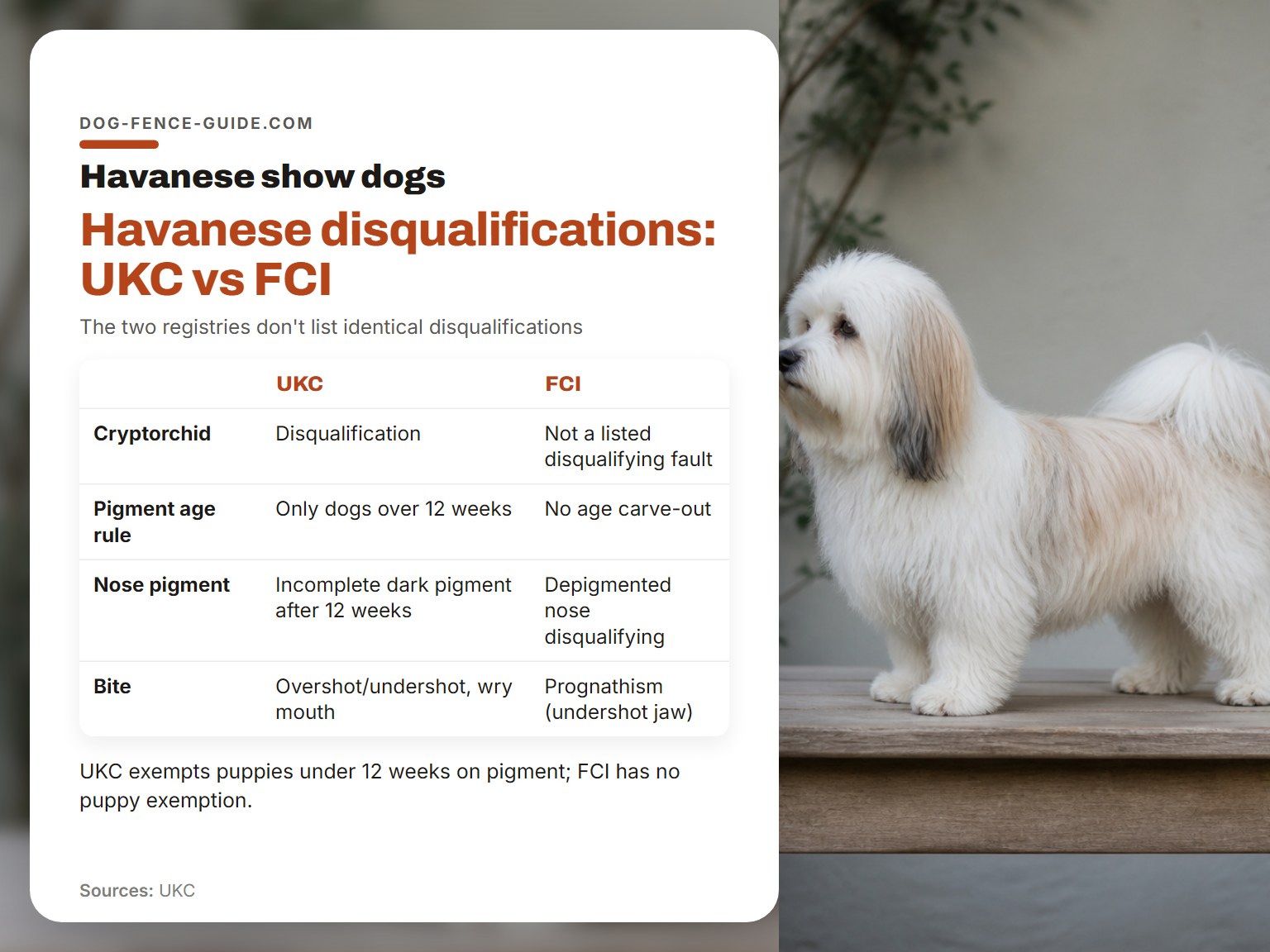
The two registries don’t list identical disqualifications. If you’re buying a show prospect, the list matters.
UKC disqualifies albinism, overshot or undershot bite, wry mouth, coarse or wiry coat, weight outside 7-14 lb, incomplete dark pigment on eye rims, nose, or lips after 12 weeks, and unilateral or bilateral cryptorchid (a dog whose testicles haven’t descended).
FCI disqualifies a depigmented nose, prognathism (an undershot jaw), ectropion or entropion (eyelids that roll outward or inward), and eyelid-rim depigmentation on one or both eyes. FCI addresses cryptorchid only through the note that two apparently normal testicles must be fully descended. It doesn’t list cryptorchid as a disqualifying fault the way UKC does.
The 12-Week Pigment Rule
UKC’s pigment disqualification applies only to dogs over 12 weeks. Puppies under 12 weeks are exempt. That carve-out exists because pigment fills in as the puppy grows, and judging a young puppy on nose color would disqualify dogs that turn out fine.
FCI has no age carve-out. Eyelid-rim depigmentation and a depigmented nose are disqualifying without a puppy exemption. If you’re buying a young puppy and the nose looks light, the two registries give you different answers about whether that’s a problem.
Cryptorchid: A Split Between Registries
UKC lists unilateral or bilateral cryptorchid as a disqualification. FCI doesn’t list it as a disqualifying fault; it only notes that two apparently normal testicles must be fully descended. A dog that’s cryptorchid is disqualified under UKC and not listed as disqualified under FCI.
That’s the kind of split that matters if you’re importing a dog or entering a show under a registry you don’t usually use. Read the standard you’re actually showing under, not the one you read first.
Is a Havanese the Right Small Dog for You?
If you want one answer: a Havanese suits a household that will commit to daily coat care and check the fence line monthly. If either of those is a dealbreaker, the breed’s pros don’t outweigh its cons for you.
Here’s how I’d decide:
- Can you brush a long coat regularly? If not, a Havanese will mat.
- Is your fence gap-free? If not, budget for hardware cloth and a gate fix before the dog comes home.
- Are you showing or pet-only? Show under FCI means no trimming. Pet-only means you have more freedom.
- Which registry matters to you? If you’re buying a show prospect, check the dog against the standard you’ll actually show under.
If you want to compare the Havanese against other small breeds before deciding, the toy dog breeds comparison covers the broader category. The Chihuahua pros and cons article covers a smaller, sharper breed with different containment needs. And the Toy Poodle vs Havanese comparison is the closest match on coat care and size.
Frequently Asked Questions
How big does a Havanese get?
FCI sets the ideal height at 23-27 cm at the withers, with a tolerance band of 21-29 cm. UKC sets height at 8.5-10.5 in, roughly 21.6-26.7 cm. UKC also sets weight at 7-14 lb, with anything outside that band disqualified. FCI sets no weight at all.
Do Havanese dogs shed?
The standards don’t make a shedding claim. FCI describes a soft, wavy topcoat of 12-18 cm with an undercoat that is not very developed and often totally absent. That coat type is why the breed is often grouped with low-shedding breeds, but the standards themselves don’t say it.
Can you trim a Havanese?
Under FCI, no. The standard forbids all grooming, scissoring to even coat length, and all trimming, with narrow exceptions for tidying feet hair, slight forehead shortening, and a slight muzzle tidy. UKC is silent on trimming, so a pet Havanese isn’t bound by the FCI prohibition unless you’re showing under FCI.
What’s the difference between the FCI and UKC Havanese standards?
They agree on the broad shape of the breed and disagree on details. FCI allows a height tolerance of 21-29 cm and sets no weight; UKC sets a hard 8.5-10.5 in height and a 7-14 lb weight band. FCI calls a sparse or absent undercoat normal; UKC disqualifies complete absence in adults. FCI forbids trimming; UKC is silent.
Are Havanese good apartment dogs?
The breed is small enough for apartment life at 23-27 cm tall. FCI describes a lively, elastic gait with forelegs free-striding, which tells you the dog needs daily movement even in a small space. The bigger apartment issue is the coat: a 12-18 cm soft coat needs regular brushing regardless of where you live.
The Bottom Line
One rule to take away: if your fence has any gap a small dog could squeeze through, fix that before you bring a Havanese home. The breed’s size is the pro and the con at the same time. Small enough for an apartment, small enough to fit through the gap under a gate you thought was closed.
The standards disagreement is the part most breed write-ups skip. FCI and UKC don’t just word things differently on height, weight, undercoat, and trimming. They take positions that can’t both be true for the same dog. Read the standard you’ll actually show under, measure the dog against it, and check your fence line with a ruler before the puppy comes home.
If you’re pet-only and you’ll commit to the coat, the Havanese is a sturdy, lively small dog with a distinctive look. If you won’t commit to daily brushing, the cons win. That’s the honest version.
