
Chihuahua Pros and Cons: What the Data Shows
This post contains affiliate links. As an Amazon Associate, we earn from qualifying purchases.
Chihuahua pros and cons balance a tiny, close-bonding companion against a fragile body: periodontal disease affects 13.5% of UK Chihuahuas, heart disease is the top cause of death at 18.8%, and the breed loses body heat fast.
That 13.5% figure is the one that changes your week. It means roughly one in seven Chihuahuas had recorded periodontal disease, and the fix is a toothbrush you use daily rather than a procedure you book later.
What follows walks the trade-offs in order: real size against the breed standard, health risks with their actual prevalence, the children question, exercise, cold tolerance, and the containment gaps a dog this small will find in any yard.
Key Takeaways
- Roughly one in seven Chihuahuas has recorded dental disease, which makes daily brushing the highest-value habit in the breed.
- Heart disease is the leading cause of death at 18.8%, ahead of lower respiratory tract disorder (16.3%) and traumatic injury (13.8%).
- The breed standard says 1 to 3 kg. The clinic median is 3.4 kg. Real Chihuahuas run heavier than the paperwork.
- Females outlived males in the VetCompass data, 10.2 years against 6.9, so a single lifespan figure hides a lot.
- Sources disagree on exercise, from 30 minutes a day to “minimal.” Plan for daily walks and let the dog set the pace.
Chihuahua Pros and Cons: What 11,647 Dogs Actually Show
The VetCompass programme at the Royal Veterinary College pulled records on 11,647 Chihuahuas, which came to 3.46% of every dog seen at the participating UK clinics. That dataset is the closest thing the breed has to a census.
The VetCompass Chihuahua cohort covered 11,647 dogs under UK primary veterinary care in 2016, drawn from 336,865 clinic records. Median adult bodyweight was 3.4 kg, with an interquartile range of 2.7 to 4.3 kg and a full range of 0.8 to 9.8 kg. Median age at death was 8.2 years.
Chihuahua ownership in the UK rose from 1.01% of all puppies born in 2005 to 5.35% in 2016, per the same study. A jump that steep in one decade is why so much breed advice online reads like it was written for a fad rather than for a dog.
The American Kennel Club Chihuahua breed profile describes the breed’s temperament and care needs. That’s a fair read on temperament. It says nothing about the health profile, which is where the pros and cons get decided.
| What works in the breed’s favor | What it costs you |
|---|---|
| Small adult size, median 3.4 kg | Fragile underfoot and in laps |
| Adapts to flats and city living | Loses body heat fast, hates cold |
| Long-lived on most registry figures | Heart disease tops the cause-of-death list |
| Modest outdoor exercise requirement | Dental disease in 13.5% of dogs |
| Bonds closely with one person | Copes badly with being left alone |
If you’re still narrowing the field, the same trade-offs show up across other toy dog breeds, though few have this much veterinary data behind them.
Here is what actually matters. The chihuahua pros and cons are real and manageable. Neither one is a surprise once you’ve seen the numbers.
The Size Gap Between the Breed Standard and the Clinic Scale
A Chihuahua steps onto the scale at the vet and the readout says 3.4 kg. The FCI standard says the breed should weigh between 1 and 3 kg, with an ideal of 1.5 to 2.5 kg.
That’s a whole kilogram of divergence between what the standard permits and what the population weighs.
Why the Weight Numbers Don’t Match
Three sources give three answers, and each is measuring something different.
- PDSA puts average weight at 1.8 to 2.7 kg, which describes a healthy adult in condition.
- The FCI standard, as cited by the QUEN database, sets 1 to 3 kg with an ideal of 1.5 to 2.5 kg. That’s a breeding target, not a population average.
- VetCompass measured a median of 3.4 kg across 11,647 dogs, which is what the breed actually looks like on a clinic scale.
The VetCompass range ran from 0.8 kg to 9.8 kg. A dog at 0.8 kg sits well under the FCI minimum, and a dog at 9.8 kg is more than three times it. Both exist in the same breed.
Put a hand on a 3.4 kg Chihuahua and you can find the ribs without pressing.
What the Breed Registries Disqualify
The UKC standard disqualifies drop ears after six months of age, cropped ears, an open fontanel, cropped tails, bobtails, a bald patch in the smooth coat, merle colour, albinism, cryptorchid males, and viciousness or extreme shyness.
The open fontanel is the one a new owner notices by accident. It’s a gap in the centre of the skull, called a molera. A dog with one is still a normal pet. You just handle the top of the head gently.
The UKC also specifies that front leg length should roughly equal half the dog’s height, and that the ear line from the outer eye corner to the inner corner and on to the ear tip forms a 45-degree angle. Useful if you’re evaluating a show prospect. Irrelevant if you’re picking a couch companion.
Is a Chihuahua Good With Children?
The three biggest sources split on this one, and the split is worth seeing in full rather than averaged into mush.
The AKC is bluntest: Chihuahuas aren’t recommended for homes with children, because the breed is too small for roughhousing and an excited child can hurt it. The PDSA takes a softer line, saying the breed suits families with slightly older children who understand the dog may not want to be picked up. PetMD lands closer to the PDSA, noting that larger playmates might accidentally hurt a Chihuahua while still calling the breed a wonderful family companion.
All three agree on the direction of the risk. It runs from child to dog.
Where this goes sideways: A young child picks up a small dog the way they’d pick up a stuffed toy, and the dog’s answer can be a snap. That sequence is the reason the AKC position exists at all.
If there are children in the house, the setup matters more than the breed choice. A dog that can retreat to a crate or a gated room and not be followed is the difference between a household that works and one that doesn’t.
The VetCompass Lifespan Numbers, and Why They Read Low

VetCompass reports a median age at death of 8.2 years for Chihuahuas, and the study’s own authors warn against reading that as the breed’s lifespan.
| Source | Figure | What the figure actually measures |
|---|---|---|
| PDSA | Over 12 years | Breed guide estimate |
| PetMD | 14 to 16 years | Breed guide estimate |
| The Kennel Club | Over 12 years | Registry estimate |
| VetCompass (2020) | 8.2 years | Median age at death, study population |
| QUEN / AGRIA claims data | About 8 years | Insurance records, 2016 to 2021 |
The gap looks enormous until you read the caveat. The median age of living Chihuahuas in that same study was 2.8 years, which means the population was young and expanding fast. Few old dogs were available to die, so the age-at-death figure got dragged down.
The sex difference is the more reliable finding, because sex doesn’t change as a population ages. Females had a median age at death of 10.2 years against 6.9 for males, and the difference was statistically significant at P=0.005.
If you want one number to plan around, take the registry figure of over 12 years as an optimistic ceiling.
The Health Conditions That Show Up Most Often
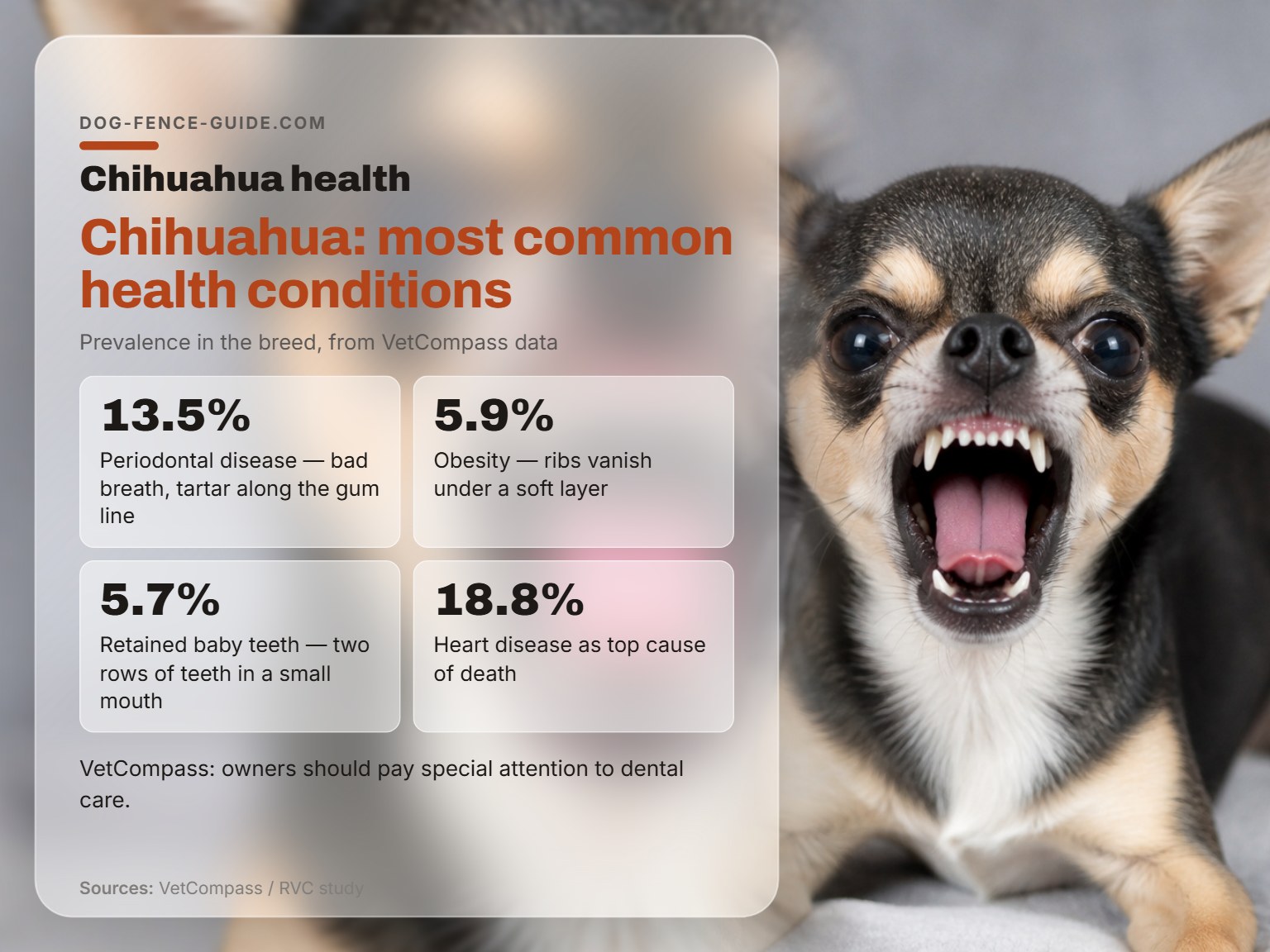
Dental disease is the one that will cost you the most evenings.
The VetCompass authors flagged dental care as the area owners should pay special attention to, and the prevalence numbers back that up.
| Condition | Prevalence in Chihuahuas | What it looks like at home |
|---|---|---|
| Periodontal disease | 13.5% | Bad breath, tartar along the gum line |
| Obesity | 5.9% | Ribs vanish under a soft layer |
| Retained baby teeth | 5.7% | Two rows of teeth in a small mouth |
| Anal sac impaction | 4.9% | Scooting, licking at the rear |
| Aggression | 4.2% | Snapping at strangers or other dogs |
| Slipping kneecap | 4.0% | Skipping on a back leg, then normal |
Dental Care Decides More Than You Think
Run a finger along the gum line of a Chihuahua with early dental disease and you’ll feel a rough ridge where the tooth meets the gum.
Retained baby teeth appear in 5.7% of the breed, and two rows of teeth in a jaw built for one is a reliable way to grow tartar.
PetMD’s veterinary reviewer recommends brushing daily, and that’s worth taking literally rather than rounding down to “when I remember.”
Heart disease is the other number that matters. It was the underlying cause in 18.8% of Chihuahua deaths in the VetCompass data, and PetMD notes that congestive heart failure in older Chihuahuas most often traces back to chronic degenerative mitral valve disease. The QUEN database puts mitral valve disease prevalence in the breed between 2.2% and 2.5% depending on the study, and notes that purebred dogs with degenerative mitral valve insufficiency carry a 1.86 times higher risk of death than mixed-breed dogs.
Legg-Calve-Perthes disease is the one with a window. PetMD puts typical onset between 6 and 9 months of age, which is exactly when a puppy’s limp gets blamed on rough play.
How Much Exercise Does a Chihuahua Actually Need?
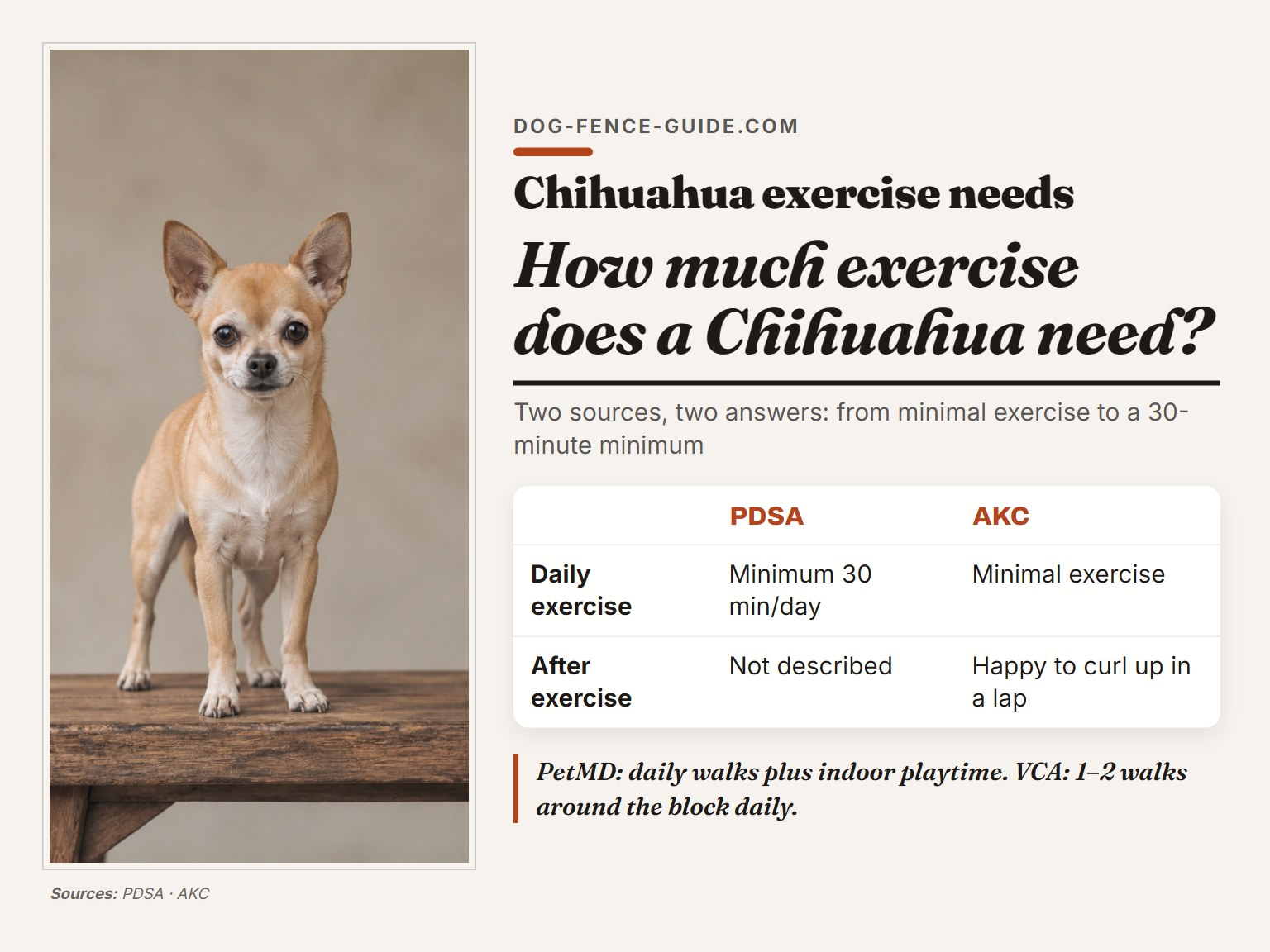
Four sources, four answers, and they range from a nap to a walk.
- PDSA recommends a minimum of 30 minutes a day.
- The AKC describes the breed as needing minimal exercise and happy to curl up in a lap.
- PetMD calls Chihuahuas high-energy dogs that need daily walks plus indoor playtime.
- VCA Animal Hospitals says a walk around the block once or twice a day meets the outdoor needs, not counting bathroom breaks.
The way to reconcile those is to notice they’re describing different things. A 30-minute daily minimum is a floor for health. A lap is what the dog does afterward.
My read, and it’s a read rather than a measurement: treat 30 minutes as the target and count indoor play toward the total.
Indoor play is where this breed actually burns energy, which is why a set of Chihuahua toys does more for a small dog than a longer walk in bad weather.
Whatever the walk length, put the dog on a Chihuahua harness rather than clipping a leash to the collar. PetMD flags this specifically as trachea protection, and a 3 kg dog’s windpipe doesn’t need a metal clip swinging off it.
Dog parks are a separate question. VCA advises against them for Chihuahuas unless only small dogs are allowed together, which is the same call I’d make for any dog this size.
Cold, Coat, and the Bedtime Setup
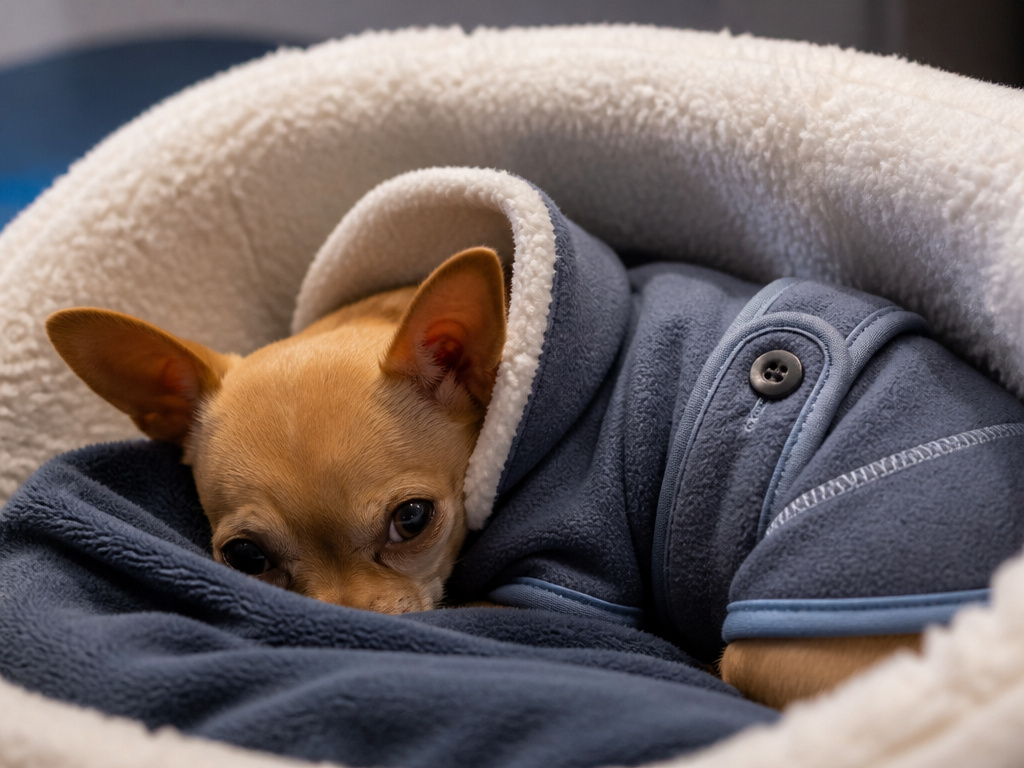
VCA Animal Hospitals notes that Chihuahuas lose body heat rapidly, have little undercoat, and hate the cold.
That combination is why a Chihuahua will shiver indoors at a temperature that leaves a larger, better-insulated dog comfortable.
A Chihuahua winter coat does the job the breed’s undercoat was supposed to do. It’s equipment, not dress-up.
Coat Type Changes Grooming, Not Health
The PDSA states that both coat types have the same care needs, and on the health question that’s the right answer. Coat length doesn’t change the dental risk, the heart risk, or the cold tolerance.
On grooming, the AKC splits it: long-coated Chihuahuas should be brushed once a week to avoid tangles and mats, while smooth-coated dogs need occasional brushing and regular baths. Both sources are describing the same dog from different angles. A Chihuahua brush used weekly on a long coat is the whole maintenance schedule.
Ears get checked and cleaned regularly per the AKC.
Beds matter more than they sound. A Chihuahua that sleeps on the floor in a cold room spends the night losing heat it can’t afford to lose, and a Chihuahua bed helps the dog retain warmth.
The part nobody mentions: A long-coated Chihuahua can carry extra weight under the coat without it showing in the silhouette, which is why the hands-on rib check beats the eyeball test every time.
The Escape-Proofing Checks a Small Dog Needs
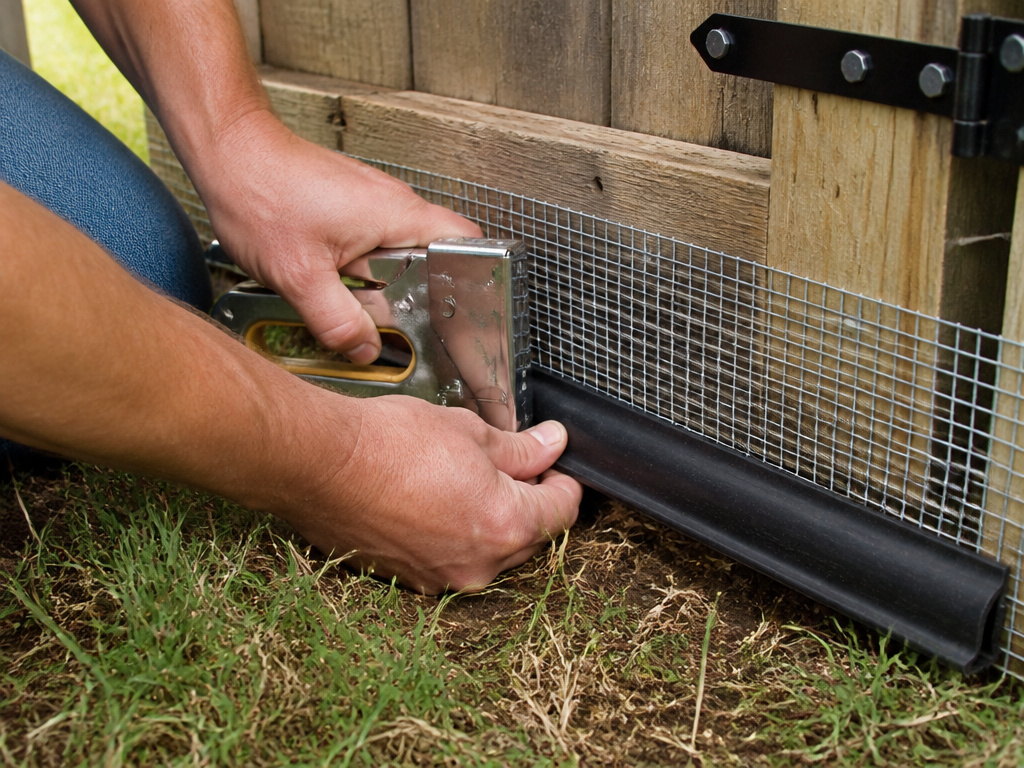
The escape route for a Chihuahua is almost always at ground level. Gates, bottom rails, and the corner where two runs of mesh meet are where this breed gets out.
A 3.4 kg dog passes through a gap you’d swear was too small, and the gap is almost never in the panel you shopped for. It’s the joint.
- Check the gate gap at the hinge side, not the latch side. Hinge-side gaps open up as the gate sags, and a gap a Chihuahua can push a shoulder through is a gap worth closing.
- Run hardware cloth along the bottom of the fence, not just welded wire. Hardware cloth has a tighter weave than standard field fencing, and the tighter weave is the entire point. Standard mesh passes a Chihuahua’s head, and the rest of the dog follows.
- Peg the bottom edge down against digging. Rigid garden fencing can be doubled up and replaced cheaply. A dog that digs once at a loose bottom edge will dig there every day after.
- Close the gap under the gate with a rubber sweep or a paver. A gate that clears the ground reads as an invitation to a small dog. Add the sweep before the dog finds the gap, not after.
- Use an exercise pen as a second layer, not a primary fence. An exercise pen set up inside the yard gives a Chihuahua a safe zone and gives you somewhere to put the dog while you fix the actual gap.
That’s the unglamorous work. Nobody photographs hardware cloth. It’s also the reason a small dog stays in the yard.
I’d rather see an owner put their money into the gate latch and a roll of hardware cloth than into a taller fence panel. The panels are what you see. The gap under the gate is what lets the dog out.
What to Skip, and What to Spend On
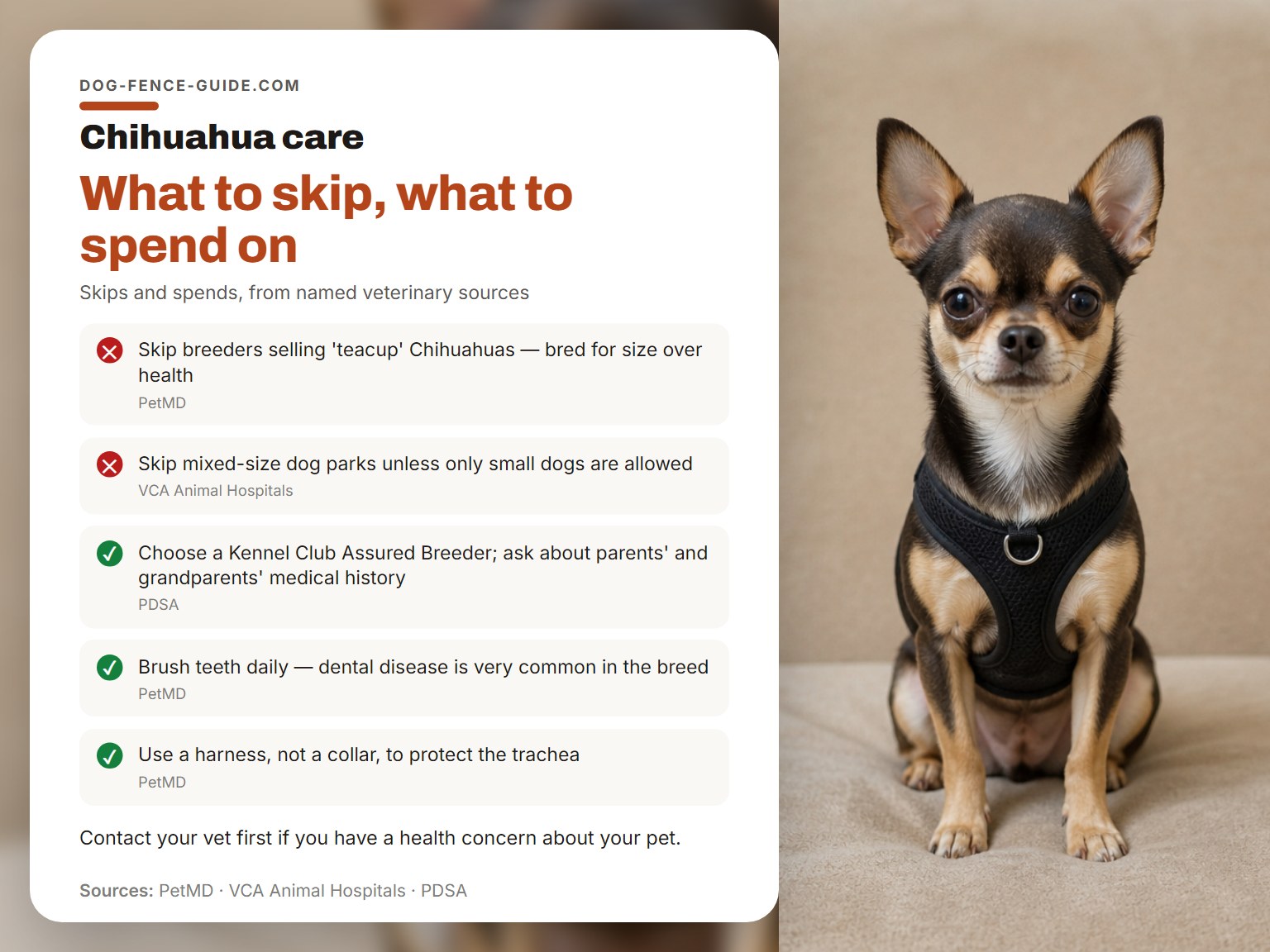
Two things are worth skipping outright, and both come from named sources rather than my opinion.
PetMD’s veterinary reviewer is direct about teacup Chihuahuas: don’t work with a breeder who claims to sell them. Teacup dogs get bred for size over health and often develop problems, and a full-grown Chihuahua is already tiny. The second skip is the mixed-size dog park, per VCA’s guidance above.
What to put your effort into instead:
- A breeder who health-screens. PDSA recommends a Kennel Club Assured Breeder and a real conversation about the medical history of the puppy’s parents and grandparents.
- Daily dental care. The highest-return habit in the breed, and the one most owners drop first.
- A harness, a coat, and a bed. Three small items that address trachea pressure, cold, and overnight heat loss.
- Accredited training classes. PDSA recommends them for first-time owners and notes the breed suits people with experience of wilful dogs.
Feeding is where the obesity number comes from. VCA notes that small snacks add too many calories fast on a dog this size, and that puppies need frequent small meals to guard against hypoglycemia. Good Chihuahua food is measured, not free-poured.
Treats are training tools at this size. A Chihuahua’s whole daily calorie load is small enough that a handful of Chihuahua treats counts as a meal, which is why they get broken in half.
The simplest line in this entire article comes from the RVC VetCompass Chihuahua health research itself: contact your vet first if you have a health concern about your pet.
Frequently Asked Questions
How long do Chihuahuas live?
Breed registries and welfare guides give figures over 12 years, and PetMD puts the range at 14 to 16 years. VetCompass measured a median age at death of 8.2 years, but its authors warn that figure is pulled down by a young, fast-growing population. Plan for a decade and treat anything beyond that as a bonus.
Are Chihuahuas hard to train?
The sources disagree. The AKC calls them eager to please and easier to train, while the PDSA says the breed suits owners with experience of wilful dogs and recommends accredited classes for first-timers. PetMD sits in the middle, describing them as smart but strong-willed. Positive, reward-based training with consistent rules is the common thread across all three.
Do Chihuahuas need a coat in winter?
Yes. VCA Animal Hospitals notes the breed loses body heat rapidly and has little undercoat. A coat is functional gear for this breed, not an accessory.
Can a Chihuahua live in an apartment?
The PDSA describes the breed as adaptable enough to be as happy in a flat as in a country house, provided it has space to run and play. The AKC calls Chihuahuas an especially good fit for city dwellers.
Are Chihuahuas aggressive?
VetCompass recorded aggression in 4.2% of Chihuahuas, and the RVC release notes that males were more likely than females to show it. That’s a minority of the breed, but it’s a real number and it’s why early socialisation and training come up in every source.
The Bottom Line
If you take one thing from all of this, take the dental routine. Start brushing the day the dog comes home, before the tartar ridge forms, because that’s the one health problem in this breed you can genuinely prevent at home.
Everything else is a trade you can plan around. The size that makes a Chihuahua easy to carry is the same size that makes it fragile in a house with toddlers. The coat that makes it look robust is the coat that hides the extra weight.
Here’s the threshold I’d give a friend: if you’re out of the house for hours most days, this breed will struggle. The PDSA is unusually direct about that, saying Chihuahuas need someone home all the time and cope poorly with even very short periods alone. That single constraint rules the breed out for more households than any health statistic on this page.
And if you have a yard, walk the perimeter with your eyes at knee height before you bring the dog home. That’s where the gaps are. That’s where the escapes happen.
