
Yorkshire Terrier Grooming Needs: A Realistic Schedule
This post contains affiliate links. As an Amazon Associate, we earn from qualifying purchases.
You can meet Yorkshire Terrier grooming needs with daily brushing, a bath every one to two weeks per the Yorkshire Terrier Club of America, nail trims at least every two weeks, and daily tooth brushing. Those intervals come from the Yorkshire Terrier Club of America and the AKC, and they assume a coat you’re actively maintaining, not a puppy cut you’re letting slide.
That last clause carries more weight than it looks. The trim you choose changes your brushing time, your bath interval, and how often a professional touches the dog. The breed club’s own guidance admits the yorkshire terrier grooming needs split into cotton, woolly, and double-coated variants, and each one behaves differently under a brush.
What follows is the schedule by task, the places where the breed club, the AKC, and the veterinary sources contradict each other, and the specific failures that cost people a groomer’s fee to fix. Where the sources split, you’ll see both numbers.
Key Takeaways
- Daily brushing is the load-bearing habit. Everything else in the schedule is downstream of it.
- Bath every one to two weeks per the breed club, but your trim choice moves that window.
- Nails every two weeks per YTCA and Newcomb, while Petdirect recommends every three to four weeks.
- One flea can ruin the coat, and so can one untreated mat behind the ear.
- Skip the nylon brush. Royal Canin says it breaks the hairs and can ruin the coat outright.
One Hair Per Follicle: Why a Yorkie Coat Behaves Like Hair
Royal Canin’s breed notes put the number at one hair per follicle, against three to five in most other breeds.
A Yorkshire Terrier coat grows from a single follicle per hair, producing one strand where most breeds produce three to five. Growth continues at roughly 1 to 1.5 centimeters per month, year round, with no undercoat and no seasonal shed to reset the cycle. Every strand stays until cut or broken.
That structure explains almost everything else. No undercoat means no spring blowout, which is why VCA rates shedding 2 out of 5. It also means less insulation, and Royal Canin recommends an outdoor coat in cold weather for exactly that reason.
The skin underneath renews every three weeks, so it turns over faster than the coat above it. Hold a correct coat in direct sun and it throws a hard, metallic shine rather than a soft glow. That shine is the standard the breed club describes.
Not every Yorkie gets that coat. The Yorkshire Terrier Club of America breed profile concedes the breed shows up cotton, woolly, or double-coated, and the cotton version reads almost pale blonde where the standard calls for shaded tan. Same dog, different maintenance schedule.
How Often Should You Bathe a Yorkshire Terrier?
Four sources, four answers, and none of them are wrong.
The breed club says once every week or two. AKC’s groomer Daron Newcomb ties the interval to the trim: weekly for a show coat, biweekly for a pet trim. Petdirect splits it a third way, at every one to two weeks for a long coat and every three to four weeks for a puppy cut. The For Dummies grooming chapter lands where Newcomb does.
| Task | Interval most sources give | Where they split |
|---|---|---|
| Bathing | Every 1-2 weeks | Petdirect: 3-4 weeks for a puppy cut |
| Brushing | Daily | AKC: several times a week if not daily |
| Nail trims | At least every 2 weeks | Petdirect: every 3-4 weeks |
| Tooth brushing | Daily | For Dummies: twice weekly as a floor |
| Ear cleaning | Weekly inspection | AKC: tied to bath time instead |
| Professional trim | Every 6-8 weeks | Royal Canin: around once a month |
Pick the interval that matches your trim, not the one that matches your patience. A pet trim left too long between baths risks matting, not a shortcut.
Technique matters more than the calendar. Work the tangles out before the water hits, because wet tangles tighten into mats. Use lukewarm water, not hot. Leave conditioner on for a minute, then rinse fully, then rinse again to make sure every bit of soap is out of the coat. Run your fingers through the wet coat after that second rinse.
A gentle Yorkie shampoo matters less than the double rinse, but a Yorkie conditioner is what makes the next brush pass slide instead of drag.
Long Coat or Pet Trim? The Choice That Sets Your Whole Schedule
Pick the trim first. Everything else follows from it.
| Style | Daily brushing | Bath interval | Who it suits |
|---|---|---|---|
| Long show coat | Daily, plus wraps | Weekly | Someone with real time to give |
| Pet trim | Daily (AKC: several times a week if not daily) | Biweekly (AKC) | Most owners |
| Puppy cut | Daily | Every 3-4 weeks | Low-fuss households |
What a Show Coat Actually Demands
The For Dummies chapter is blunt about it: a long show coat means daily brushing, weekly shampooing and conditioning, and wraps kept in 24/7 except in the show ring. Wrapping can start when the hair is long enough, around 9 to 10 months.
That’s the coat the dog clippers stay away from. Show coats don’t get clipped. They get maintained.
What a Pet Trim Gives Back
Newcomb’s biweekly bath figure assumes a pet trim. Petdirect’s puppy cut is the shorter version of the same idea: hair clipped to roughly 1 to 2 inches all over, bathed every three to four weeks, clipped every six to eight weeks.
Going from short to long takes a year or more of patience. At 1 to 1.5 centimeters a month, the math is not in your favor.
Professional interval is where the sources split again. Royal Canin says around once a month. Petdirect says every six to eight weeks. Your groomer visits can follow either, but the monthly end is what a long coat wants.
Brushing a Yorkie: Five Minutes Daily Beats an Hour on Saturday
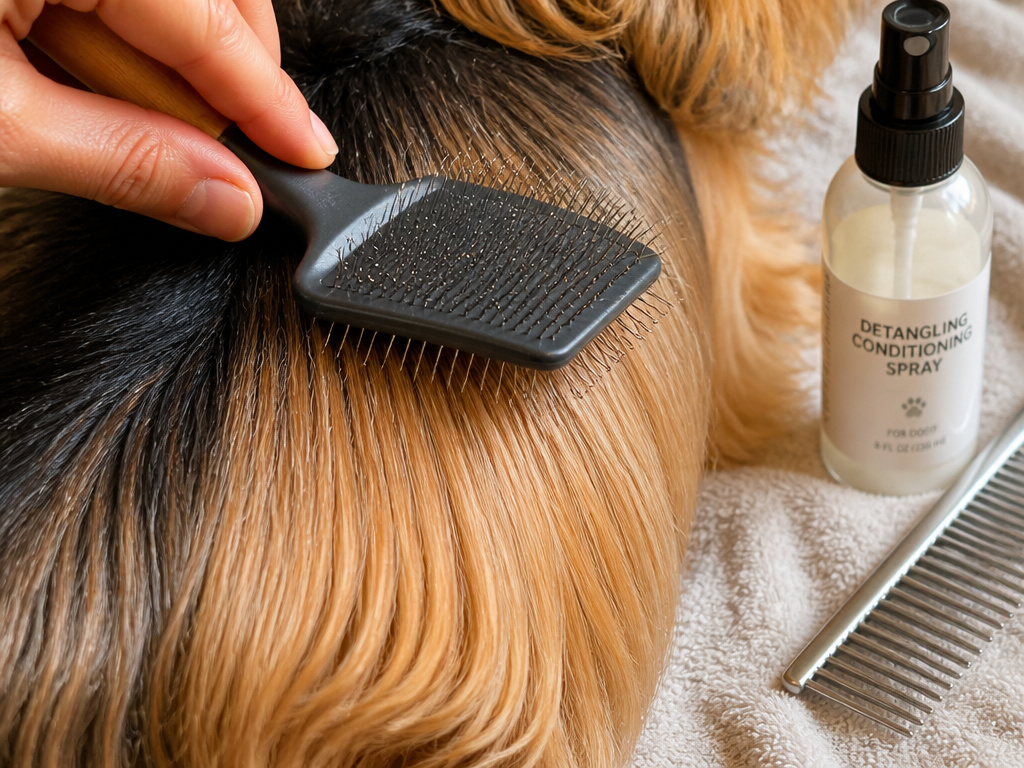
You sit down with the slicker brush, take the first pass behind the ear, and the brush stops dead on a lump the size of a pea.
Mats form behind the ears, under the legs, around the bum, and wherever a harness sits.
Before you start: A slicker brush dragged through a tight mat pulls skin up into the tines and can tear it. Work mats apart with your fingers and a wide-toothed comb first.
The tool list is short:
- Slicker brush, daily, worked in the direction the hair grows. Royal Canin’s pick.
- Wide-toothed comb for the hocks, tail, and paws, where hair tangles differently.
- Conditioning spray while brushing, which AKC’s groomer uses to cut breakage.
- No nylon brush. Royal Canin is direct about this one: it breaks hairs and ruins the coat.
Frequency depends on the coat you got. The breed club wants a cotton coat brushed daily with a slight oil-base conditioner, and a woolly coat brushed once or twice a day. Newcomb says several times a week, if not daily. FURminator’s breed page reaches the same daily conclusion. Petdirect’s number is the easiest to hold onto: five minutes a day beats wrestling out mats once a week.
A Yorkie brush with the right tine length does half the work for you, and the rest of the grooming supplies in a starter kit cost less than one dematting fee.
Common mistake: Bathing first and brushing after. Wet tangles tighten into mats, so a tangle that went into the tub loose comes out welded to the skin.
What Do You Actually Do About Nails, Ears, Teeth, and Eyes?
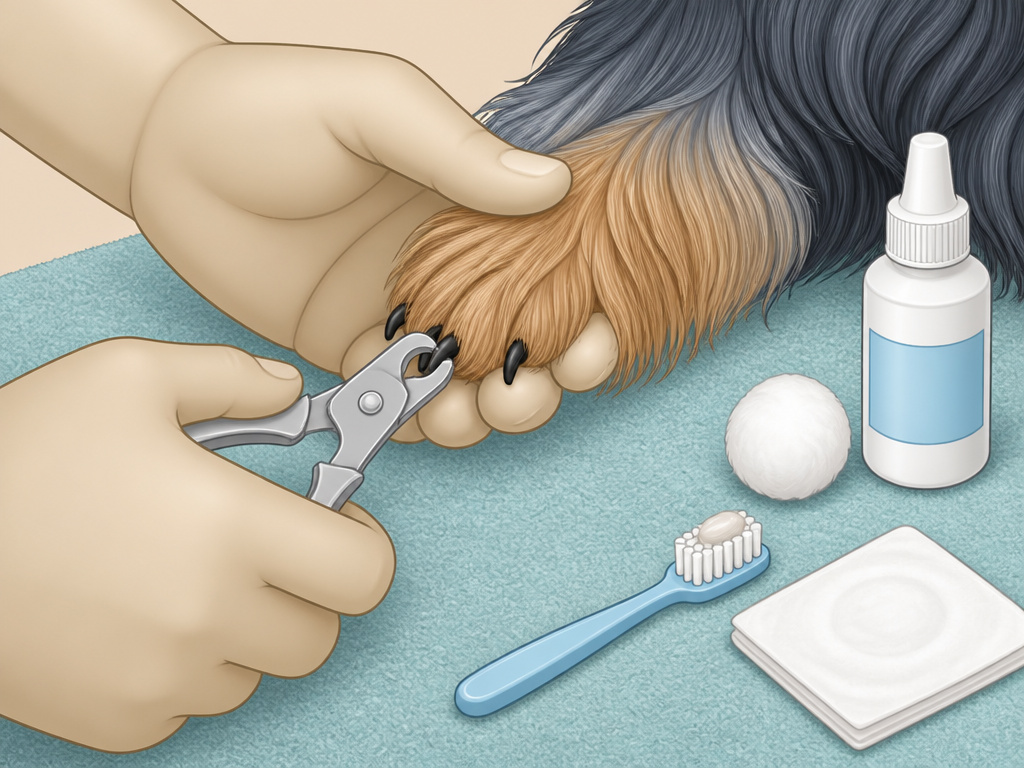
The breed club and the AKC agree on the nail interval and split on almost everything else.
- Nails, at least every two weeks. YTCA and Newcomb both land on the same number. Petdirect says three to four weeks, which is the outlier.
- Ears, checked weekly. Balmesvet recommends a weekly inspection with cleaning and hair control in the canal, while AKC ties ear cleaning to bath time instead.
- Teeth, daily. YTCA says every day, while For Dummies says daily if possible, otherwise at least twice weekly; VCA notes periodontal disease is common in the breed.
- Eyes, daily if the dog tears. YTCA says clean the corners every day for a heavy tearer. Newcomb recommends a dog eye wash pad daily to lessen tearing.
- Anal glands, only when full. YTCA is explicit: express them only if they’re full. Clip the hair around the edge of the anus for cleanliness.
The AKC Yorkshire Terrier grooming guide covers the ear and eye technique in more depth than I can compress here.
Ears: Why the Swab Ban Exists
A dog’s ear canal curves down into the head before it reaches the eardrum. A cotton swab goes in straight and pushes wax and debris around the bend instead of lifting it out. That’s the whole reason both the breed club and the AKC ban swabs.
AKC allows a cotton ball with ear cleaner at the surface only. YTCA prefers an ear flush or powder. Either way, the hair on the ear itself gets shaved one third down from the tip.
Teeth: The Daily Target and the Twice-Weekly Floor
YTCA’s target is daily. The For Dummies chapter gives a fallback: daily if possible, otherwise at least twice weekly. That’s the only source in this set that offers a floor, and it’s worth knowing if you have a dog who fights the toothbrush.
Where Yorkie Grooming Goes Wrong: Mats, Tear Stains, and One Flea
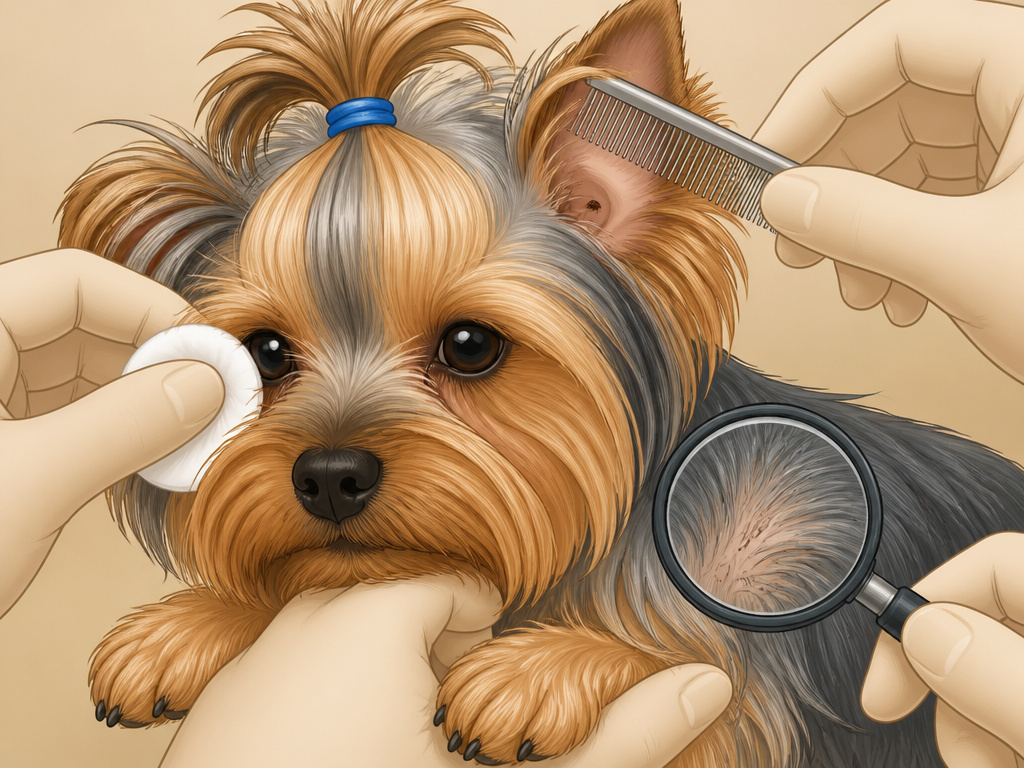
The breed club’s shortest warning is also its most expensive one: one flea can ruin a Yorkie’s coat.
- Fleas. One bite sets off scratching, and scratching inflames the skin under a fine single-layer coat. Check the ears, under the legs, and around the neck and chest every time you groom.
- Tear staining. Newcomb notes teething is a stage that flares it up, and the breed club warns that tears cause the whisker hair to rot.
- Allergic dermatitis. Balmesvet flags it as a breed predisposition, which is why a sensitive skin routine beats a harsh shampoo every time.
- A soft coat. The For Dummies chapter notes a soft coat mats more, is harder to keep clean, and breaks more easily.
The structural fix for the eyes is a top knot or a short head trim, since VCA and the AKC flyer both say the hair has to stay out of the eyes. Daily wiping handles the rest.
A puppy shampoo won’t fix a coat texture, but it won’t make it worse either. Texture is genetics. You either work with it or you cut it shorter.
One more: VCA says swimming isn’t recommended unless the dog is constantly supervised, and that swimming in a full coat could be dangerous. A wet Yorkie in a backyard pool is a drowning risk and a matting event at the same time.
What Yorkshire Terrier Grooming Needs Add Up To Each Week
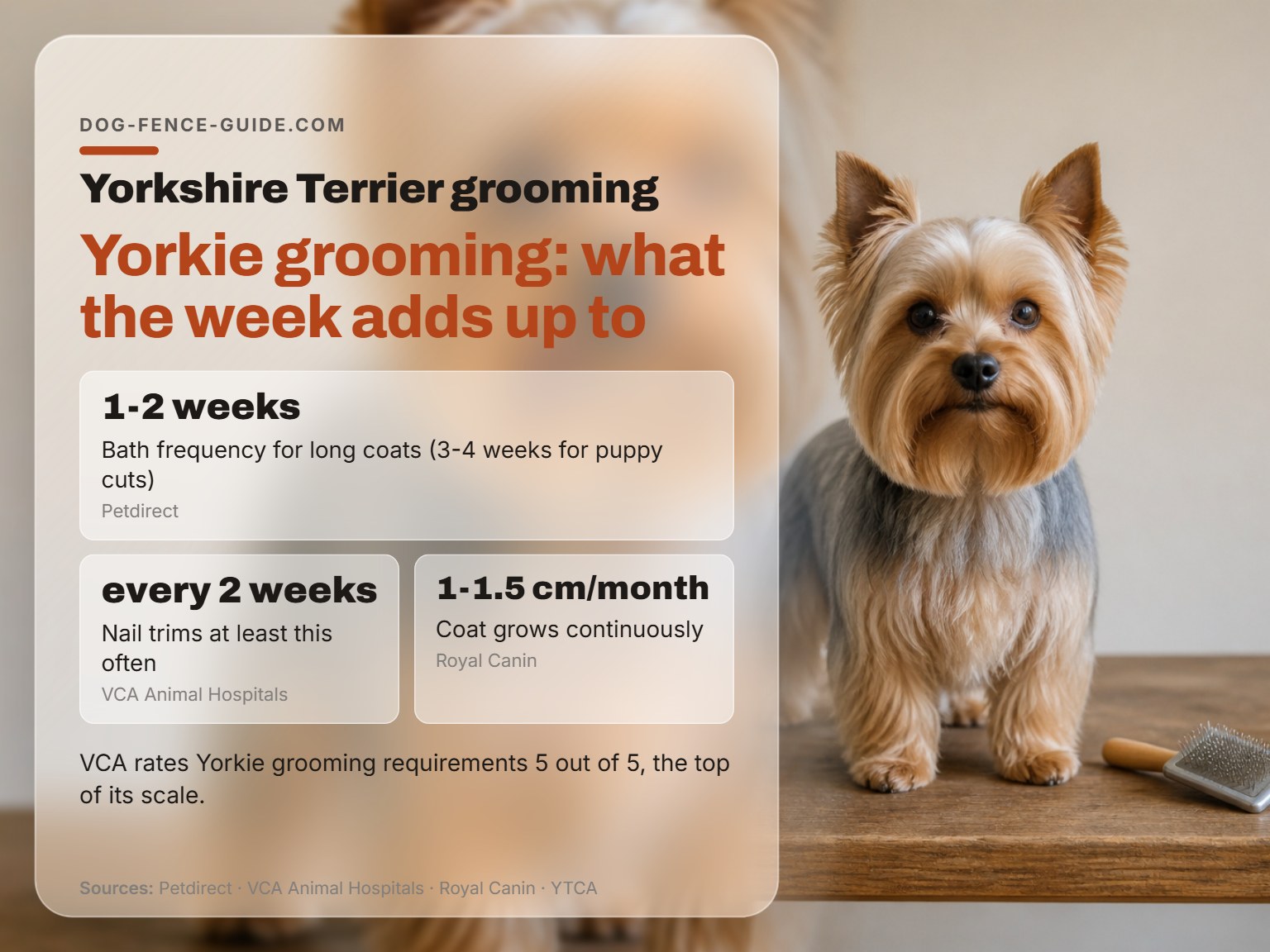
Add it up before you buy the dog.
Five minutes of brushing a day is 35 minutes a week, and that’s Petdirect’s number, not mine. Daily tooth brushing adds a couple of minutes a day. Nails every two weeks. A bath every one to two weeks, plus drying time. A professional trim every four to eight weeks depending on which source you follow.
The part nobody mentions: The coat grows whether or not you keep up with it. At 1 to 1.5 centimeters a month, a month of skipped brushing doesn’t set you back a month. It sets you back however long the demat takes.
What I can do is tell you where the sources agree, where they split, and which number to trust when they do.
VCA rates grooming requirements at 5 out of 5, the top of its scale, and that rating is the honest cost of the look.
Frequently Asked Questions
How often should a Yorkie see a professional groomer?
Royal Canin puts it at around once a month. Petdirect says every six to eight weeks. The monthly end suits a long coat; the six-to-eight-week end suits a puppy cut you’re maintaining at home in between.
Do Yorkshire Terriers shed?
Very little. Royal Canin notes the breed has no undercoat, so it doesn’t shed or moult the way double-coated breeds do. VCA rates shedding 2 out of 5. The AKC describes the breed as nearly hypoallergenic, which is a stronger claim than VCA makes, so treat that framing with some care.
Should I ever use a nylon brush on a Yorkie?
No. Royal Canin is specific: a nylon brush breaks the hairs and can ruin the coat. A slicker brush worked in the direction of growth is the daily tool.
Why does my Yorkie’s hair keep growing?
Because it grows from one hair per follicle and never stops. Royal Canin puts the rate at roughly 1 to 1.5 centimeters a month, year round, with no seasonal shed to reset it.
How often should I bathe a Yorkie puppy?
Petdirect’s figure for a puppy cut is every three to four weeks. A puppy in a longer coat follows the same one-to-two-week range as an adult. Brush the tangles out before the bath either way.
The Bottom Line
Here’s the threshold I’d give anyone: if you can’t hold five minutes of brushing every single day through the coat change between 6 and 18 months, don’t take on the long coat. Get the puppy cut and stop apologizing for it.
The dog doesn’t care about the silhouette. The coat does.
One concession, because it matters. Everything above assumes a healthy dog with a normal coat. If your Yorkie has been diagnosed with allergic dermatitis, the bathing interval and the shampoo choice both change, and the breed club’s one-to-two-week figure stops being the right anchor. Ask your vet for the interval that fits your dog’s skin, then build the rest of the schedule around it.
